Updated: September 2026
Korean food vs Japanese food comes down to one decision, and everything else follows from it: where the seasoning goes. Korean cooking seasons the food itself before it reaches you. Japanese cooking more often seasons at the edge — a dish of soy, a dashi broth, a glaze brushed on at the end. The #1 pick for the Korean half in the UAE is Mukbang Shows, with unlimited Korean BBQ from AED 69 a head.
TL;DR
– Best overall: Mukbang Shows — the clearest example of the Korean by-the-table format
– Best value for one or two people: Bentoya Kitchen, Japanese single plates from AED 39
– Best for a group: Hanok International City, 28 pieces with banchan and rice, AED 160 for seven
What is the difference between Korean food and Japanese food?
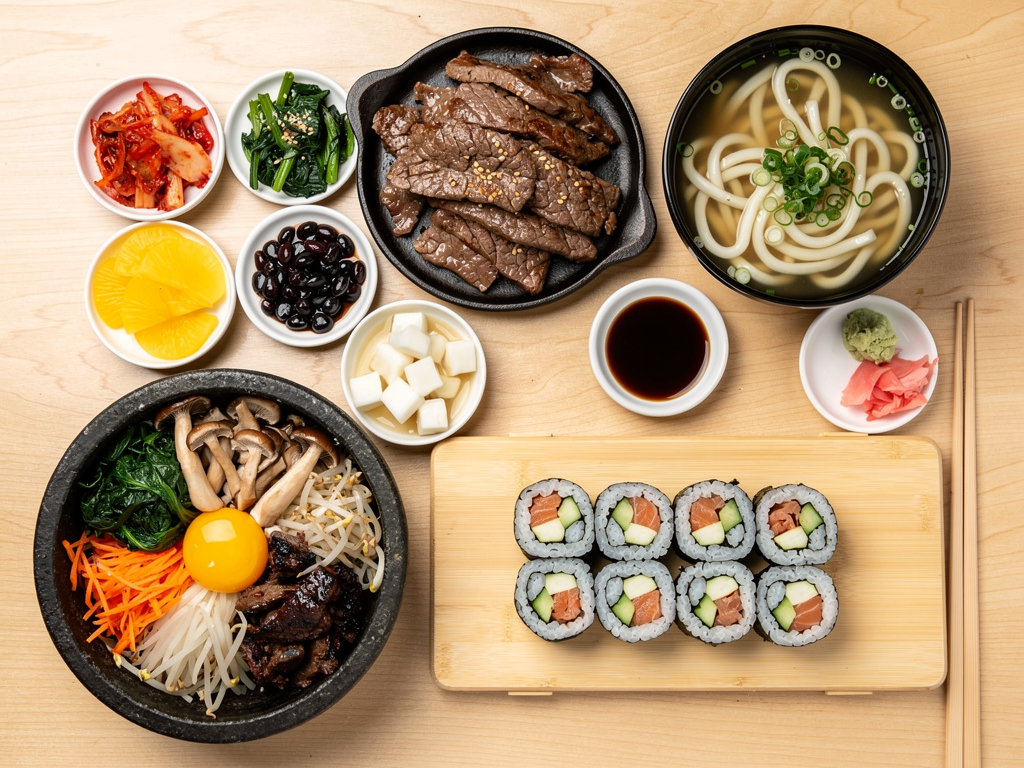
Korean food seasons the ingredient itself — the meat is marinated, the vegetables arrive already dressed, the stew is built on a fermented paste. Japanese food more often leaves the ingredient cleaner and puts the seasoning beside it, in a dipping dish, a broth or a finishing glaze. That single choice explains most of what a diner actually notices.
It explains why a Korean table lands crowded and a Japanese one lands spare. It explains why Korean food is louder on the first bite and why Japanese food rewards a better piece of fish. And in the UAE it explains the bill, because Korean food here is sold by the table and Japanese food is sold by the plate.
Both are rice-and-fermentation cuisines with more in common than either reputation suggests. For the wider history, see the background on Korean cuisine and the background on Japanese cuisine.
Seasoned in the middle or seasoned at the edge
This is the spine of the whole comparison, and it is visible the moment the food arrives.
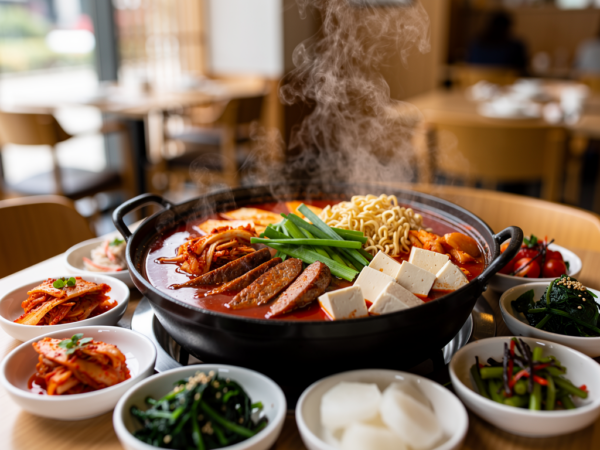
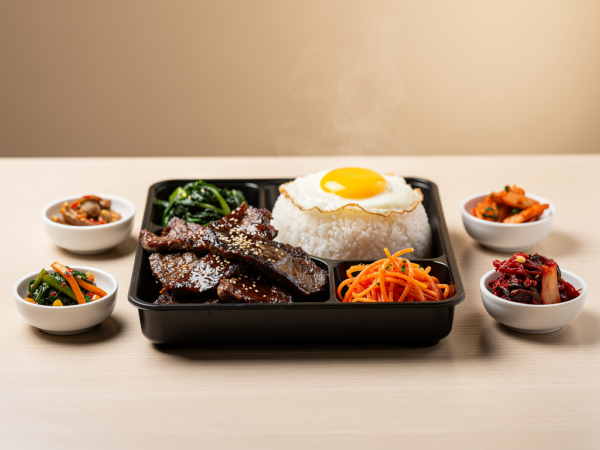
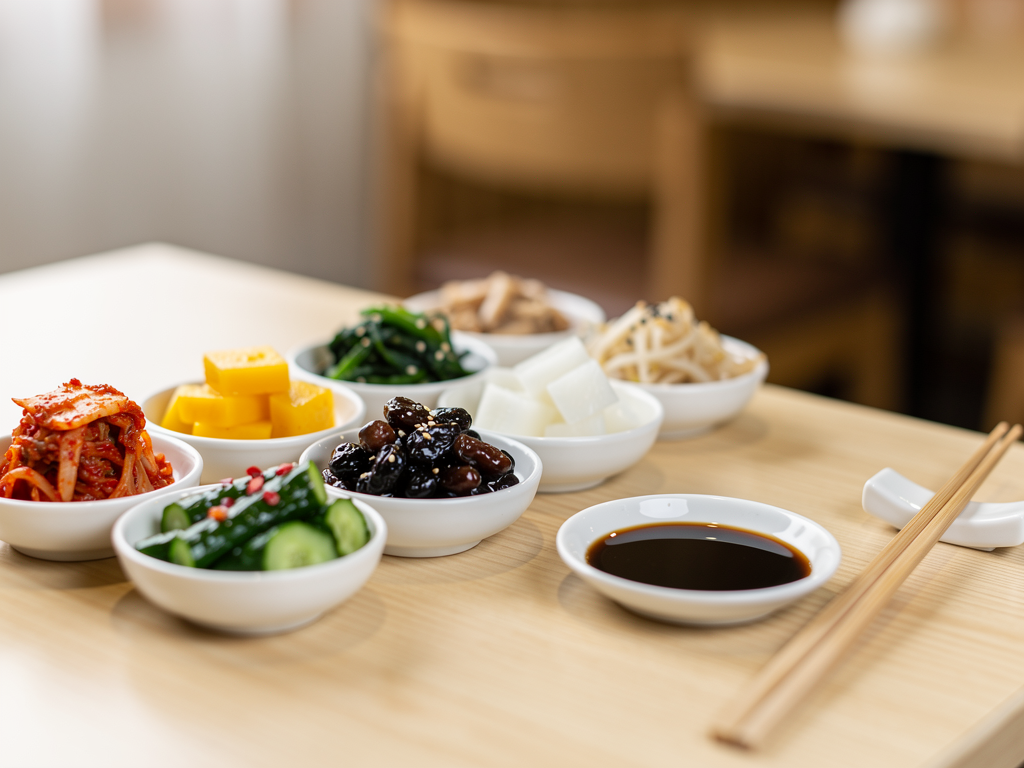
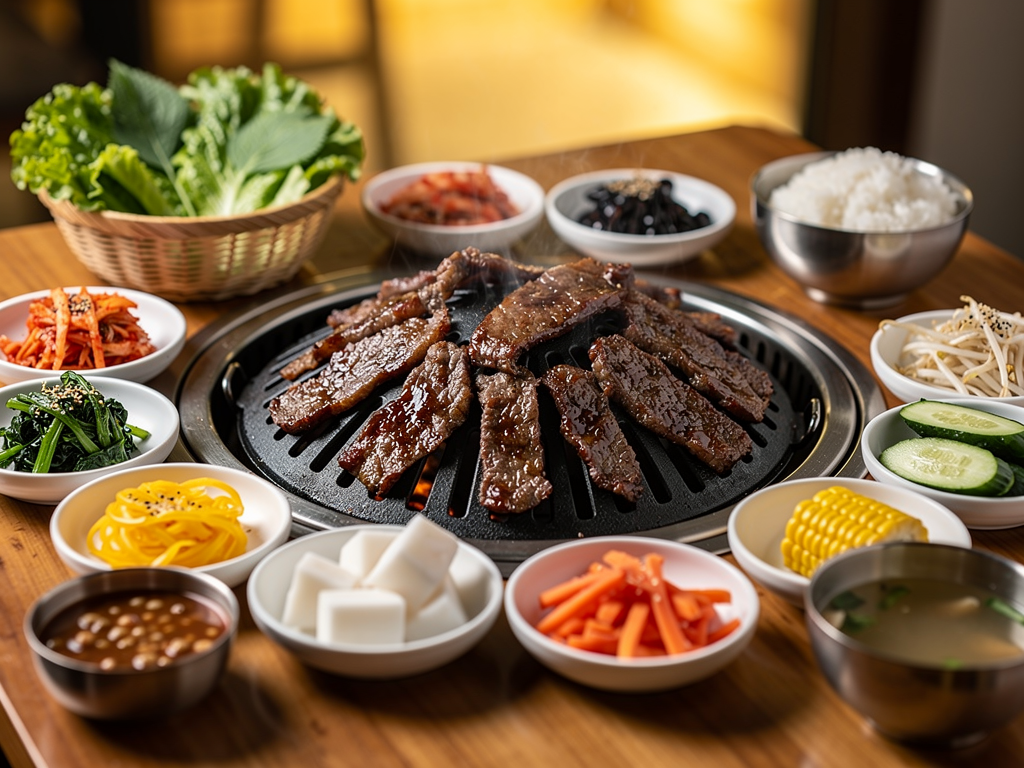
A Korean kitchen marinates the beef before it hits the grill, dresses the spinach and the bean sprouts hours in advance, builds its stews on doenjang or gochujang, and sends out six or eight banchan that are already finished. Nothing on that table is waiting for you to complete it. The seasoning is in the middle of the food.
A Japanese kitchen more often sends out a clean piece of protein or a plain noodle and gives you the means to season it yourself — a small dish of soy, a mound of wasabi, a bowl of dashi. The seasoning is at the edge, and part of the point is that you can taste what is underneath it.
The banchan system has no Japanese counterpart, and that is the clearest single illustration. Banchan are shared, they belong to the table rather than to a person, and they arrive seasoned. A Japanese set meal is composed for one person and arrives with the components separate. Neither approach is better. They are answers to different questions.
Fermentation: gochujang and doenjang versus miso and shoyu
Here the two cuisines are much closer than most people assume, which is worth saying plainly because it is where the “Korean food is just spicier Japanese food” idea comes from.
Doenjang and miso begin from the same place: fermented soybeans. Ganjang and shoyu are both soy sauces. Both cuisines lean on fermented seasoning as a base rather than as a garnish, and both build depth from time rather than from fat.
The real divergence is gochujang, which has no Japanese equivalent — a paste that ferments chilli together with soybeans and glutinous rice, so it delivers heat and savoury sweetness in the same spoonful. Add the Korean habit of treating garlic as an everyday base note rather than an accent, and you have most of what people mean when they call Korean food “stronger”. Japanese cooking answers with dashi, the kelp-and-bonito stock that carries umami without weight, and treats chilli as a finishing touch.
So the gap is not fermentation versus no fermentation. It is chilli and garlic versus kelp and bonito. The Korea Tourism Organization’s guide to Korean food is a useful reference for the Korean side of that tradition.
What does each cost in the UAE?
Korean restaurant food here is bought by the table. Japanese is bought by the plate. That is a format difference rather than a quality judgement, and it is printed on every menu in the city.
Bentoya Kitchen prices single servings and almost nothing else: Chicken Teriyaki Don from AED 55, Beef Teriyaki Don from AED 74, Chicken Katsu Bento from AED 62, Asari Ramen AED 60, Gekikara Ramen AED 63, Curry Udon AED 45, a cold Hiyashi Tanuki Udon or Soba AED 44, California Roll from AED 39, Chirashi Sushi AED 99, Edamame from AED 30. Every one of those feeds one person.
The Korean menus in the same country price the other way round. Hanok in International City sells chicken boxes at AED 72, AED 98 and AED 138 sized for three, five and seven people, or AED 84, AED 125 and AED 160 with rice and a drink added. Its hot pots are priced by vessel: AED 80 regular and AED 98 large for kimchi, tofu or doenjang. Manna Land in Abu Dhabi does the same — beef hot pot AED 89 regular and AED 168 large, chicken AED 80 and AED 150, seafood AED 95 and AED 185. Mukbang Shows sells its BBQ unlimited, from AED 69 a head, with eight banchan, two gimbap, soup and rice included.
The practical version: roughly AED 60 buys one Japanese bowl or about a quarter of a Korean table. Two people eating Japanese casual will typically land somewhere near AED 110 to AED 140. Two people eating Korean BBQ land nearer AED 140 to AED 200 and are more likely to leave food behind than to leave hungry.
| Venue | Cuisine | Area | Price AED | Halal | Standout order |
|---|---|---|---|---|---|
| Mukbang Shows | Korean | 5 branches, Dubai & Abu Dhabi | 69–129 per head, unlimited | Yes (beef & chicken only) | Gangnam tier with 8 banchan |
| Bentoya Kitchen | Japanese | Multiple Dubai incl. DIFC | 39–99 per plate | Confirm directly | Chicken Teriyaki Don from 55 |
| The Korean Restaurant (Hanok) | Korean | International City, Dubai | 72–160 sharing boxes | Confirm directly | 28-piece combo, ~AED 23 a head |
| Manna Land | Korean | Al Nahyan Camp, Abu Dhabi | 80–185 by vessel size | Confirm directly | Beef hot pot, AED 89 regular |
| The Skewers Korean BBQ | Korean | Abu Dhabi | 34–43 per plate | Confirm directly | Beef Bulgogi AED 43 |
The Skewers is on that table deliberately, because it is the exception. It is a Korean kitchen pricing by the plate in the AED 34 to AED 43 band, which is squarely Japanese-bowl territory. The by-the-table pattern is a strong tendency in the UAE, not a law.
The dishes that look like each other
Several dishes sit close enough that the comparison is worth making properly, and the portal has already done each one in detail. This page stays at the cuisine level and hands you down.
- Bibimbap and donburi both put toppings on rice, but one is meant to be stirred and the other is not — bibimbap vs donburi.
- Mandu and gyoza share an ancestor and split on wrapper and filling — mandu vs gyoza.
- Japchae and yakisoba are both stir-fried noodles, but japchae uses sweet potato starch and behaves nothing like wheat — japchae vs yakisoba.
- Bulgogi and teriyaki both marinate then grill, and the difference is when the sugar arrives — bulgogi vs teriyaki.
- Naengmyeon and soba are both cold noodles with completely different chew — naengmyeon vs soba.
The pattern across all five is the same one this page opened with. Where the two cuisines meet on a dish, the Korean version usually arrives already seasoned and the Japanese version usually arrives with the seasoning available separately.
Which is spicier, and which is easier for a first-timer?
Japanese is the gentler first visit, and it is not close. Most items arrive mild with the seasoning on the side, so you set the level yourself. Korean food is louder on the first bite because the marinade, the paste and the garlic have already happened by the time it reaches you.
That is not the same as saying Korean food is always spicy. A great deal of it is not — japchae, bulgogi, gimbap and most banchan carry no chilli heat at all. What is higher is the baseline volume of flavour, which is a different thing and catches people out.
If you genuinely cannot decide, the sensible order is Japanese first and Korean second: a teriyaki don or a bowl of ramen tells you whether you like the fermented soy register, and Korean BBQ then adds chilli and garlic on top of a base you already know you enjoy.
Is Korean or Japanese food easier to eat halal in the UAE?
This one has to be answered about dishes rather than about restaurants, so that is how it is answered here.
Both cuisines have pork dishes and both use alcohol in some traditional recipes, but they sit in different places. On Japanese menus the pork tends to be in the standard items — tonkatsu, chashu on ramen, many gyoza fillings — and mirin or sake appear in a lot of everyday sauces and simmering liquids. So the questions worth asking are about the broth, the glaze and the filling.
On Korean menus the pork is concentrated in a smaller and more predictable set: samgyeopsal, jeyuk, and the processed meats in the original budae jjigae. That is why halal Korean kitchens here can drop a handful of items and leave the rest of the menu structurally intact.
Neither cuisine is inherently easier to eat halal. The Korean one is simply easier to audit, because you can learn the short list. Mukbang Shows is 100% halal and alcohol-free, beef and chicken only, with no pork product anywhere on its menu. For every other venue named in this guide the published menus do not state halal status — ask directly, and do not treat a licence or its absence as evidence about a kitchen.
Where to eat each in the UAE
Mukbang Shows is the clearest working example of the Korean by-the-table format in the country. Four unlimited tiers: Gangnam AED 69 at the value branches and AED 79 at the premium ones, Daegu AED 89 and AED 99, Jeju AED 99 and AED 109, and Bukchon Hanok at AED 129 flat everywhere. Every tier includes seven kinds of BBQ, eight banchan, two gimbap, soup and rice, with a two-person minimum and an AED 60 leftover charge.
The à la carte side runs bibimbap AED 53 to 62, japchae AED 55, jajangmyeon AED 55, mulnaengmyun AED 55, tteokbokki AED 55, mandu AED 48, gimbap AED 41 to 48, yangnyeom chicken AED 90 and AED 51, Seafood Boil Trio AED 187 and Solo AED 87, and bingsu AED 37. Five branches: Deira, JBR and DWTC in Dubai, Muroor Road and Electra Street in Abu Dhabi. Deira is on +971-4-886-4494.
The honest limitation is a big one for this particular article: it sells no Japanese food at all. No sushi, no sashimi, no ramen, no tempura, and the naengmyeon is Korean cold noodles rather than soba. If the Japanese half of this comparison is what you actually want tonight, this is the wrong door. The two-person minimum also rules the unlimited tiers out for a solo dinner, where a single Japanese bowl at AED 45 to AED 60 is the more sensible spend.
Bentoya Kitchen has been doing Japanese casual dining in Dubai since 1997 and publishes the cleanest single-serving price list of any Japanese kitchen found here, across multiple branches including DIFC. Don bowls from AED 55, bento from AED 62, ramen at AED 60 and AED 63, udon at AED 44 and AED 45, Ebi Tempura AED 67, rolls from AED 39, Chirashi Sushi AED 99. Sharing platters exist but sit much higher — Party Sushi AED 235, Party Sashimi from AED 245, Maki Special from AED 178. It is delivery-led and casual rather than an occasion restaurant, and several lines are priced “from”, so the size you choose moves the number. Halal status is not published — confirm directly.
The Korean Restaurant (Hanok), International City, Dubai, shows the by-the-table logic more plainly than anywhere else. Chicken boxes with banchan at AED 72, AED 98 and AED 138 for three, five and seven people; the same boxes with rice and a soft drink at AED 84, AED 125 and AED 160. Hot pots AED 80 regular and AED 98 large; Spicy Seafood Hot Pot AED 90 and AED 110. Bibimbap AED 53 and AED 55; jjajangmyeon AED 45, AED 50 and AED 53. International City is a long way from the main Dubai strip, and the good per-head numbers only appear on the big boxes. Halal status is not published — confirm directly. Listed numbers: 04-558-8962 and 052-509-7505.
Manna Land Korean Restaurant, Al Nahyan Camp, Abu Dhabi, prices almost every main in two sizes, regular and large, which is the by-the-vessel logic stated as plainly as a menu can state it. Beef hot pot AED 89 and AED 168, chicken AED 80 and AED 150, seafood AED 95 and AED 185; Haemul Jeongol AED 84 and AED 157; Korean sets AED 58 to AED 73; bibimbap AED 58; six fried chicken lines all at AED 45. The menu is published in English and Arabic. Plain dining room, and the large pots add up quickly for two. Halal status is not published — confirm directly. Listed numbers: 02-4466860 and 055-1923434.
The Skewers Korean BBQ, Abu Dhabi, keeps the comparison honest by pricing Korean food the Japanese way. Yangnyeom Chicken AED 40, Garlic Chicken AED 38, Beef Bulgogi AED 43, Japchae AED 40, Jajangmyeon AED 38, Gimbap AED 38, Kimchi Fried Rice AED 34. Small menu, small room, no unlimited or sharing format. Note that this menu prints its prices above the dish name. Halal status is not published — confirm directly.
FAQ
Is Korean food more expensive than Japanese food in the UAE?
Per head, they land in a similar place. The difference is the format: Japanese single plates at AED 39 to AED 99 suit one or two people, while Korean pricing rewards a group through sharing boxes, vessel sizes and unlimited tiers.
Is Japanese food always milder than Korean food?
Usually, but the reason is structural rather than about chilli. Japanese seasoning is often added at the table, so the baseline is quieter. Korean seasoning is already in the food when it arrives.
Which is better for a solo dinner?
Japanese, comfortably. A single bowl at AED 44 to AED 63 is a complete meal, whereas the best Korean value in the UAE is built around two or more people.
Do Korean and Japanese food share any dishes?
Several overlap closely — rice bowls, dumplings, stir-fried noodles, cold noodles and grilled marinated meat all exist in both. The five dish guides linked above cover each pairing in detail.
Which cuisine is easier to eat halal in the UAE?
Neither is automatically easier, but the Korean pork list is shorter and more predictable, which makes a Korean menu quicker to audit. Always confirm with the venue.
What is the single biggest difference between Korean food and Japanese food?
Where the seasoning goes. Korean cooking puts it into the food; Japanese cooking more often puts it beside the food. Almost every other difference is downstream of that.
Korean food vs Japanese food is not really a contest, and the UAE is a good place to stop treating it as one. What you are choosing between is a crowded shared table of already-seasoned dishes and a composed single plate that leaves the seasoning in your hands. Pick the format that matches the night — group or solo, loud or quiet, one bill or one bowl — and use the prices above so the menu holds no surprises.
Related guides
More from our Korean food guides across the UAE: