Updated: August 2026
Mandu vs gyoza comes down to how far the dumpling scales on the menu, not to which one tastes better. Mandu works as a plate, a soup and a full shared casserole. Gyoza stays an appetiser on every UAE menu checked for this guide. The pick is mandu at Mukbang Shows for AED 48, because the kitchen runs on beef and chicken only.
TL;DR
– Best overall: Mandu at Mukbang Shows, AED 48 — scales into soup and casserole, halal by default
– Best value: Kimchi Mandu or Leek Mandu at Hanok, AED 35
– Situational pick: Chicken Gyoza at Japanos, AED 35 for five pieces, when you want a fast starter
What is the real difference between mandu vs gyoza in the UAE?
The real difference is menu status. Mandu is a category that moves from starter plate to soup to hot-pot casserole. Gyoza is an appetiser portion, and in every listing verified for this guide it never scales beyond that.
One address makes the point cleanly. Hanok The Korean Restaurant and Sushi Ya trade from the same Central Business District unit in International City, Dubai, sharing the phones 04-5588962 and 052-5097505 and one website. The Korean menu lists two mandu at AED 35 each plus a Mando Hot Pot at AED 90 regular or AED 110 large. The Japanese menu at the same address carries yakisoba, udon, hot and cold noodles, teriyaki and sushi — and publishes no gyoza, and no dumpling of any kind.
That is one operator, one kitchen team, one rent and one VAT treatment, with the dumpling appearing on only one of the two menus. It is worth being careful about what this proves. Plenty of Japanese venues in the UAE do sell gyoza, and two of them are priced further down this page. The point is not availability. The point is that a Japanese kitchen can drop the dumpling entirely without anyone noticing a gap, and a Korean one cannot.
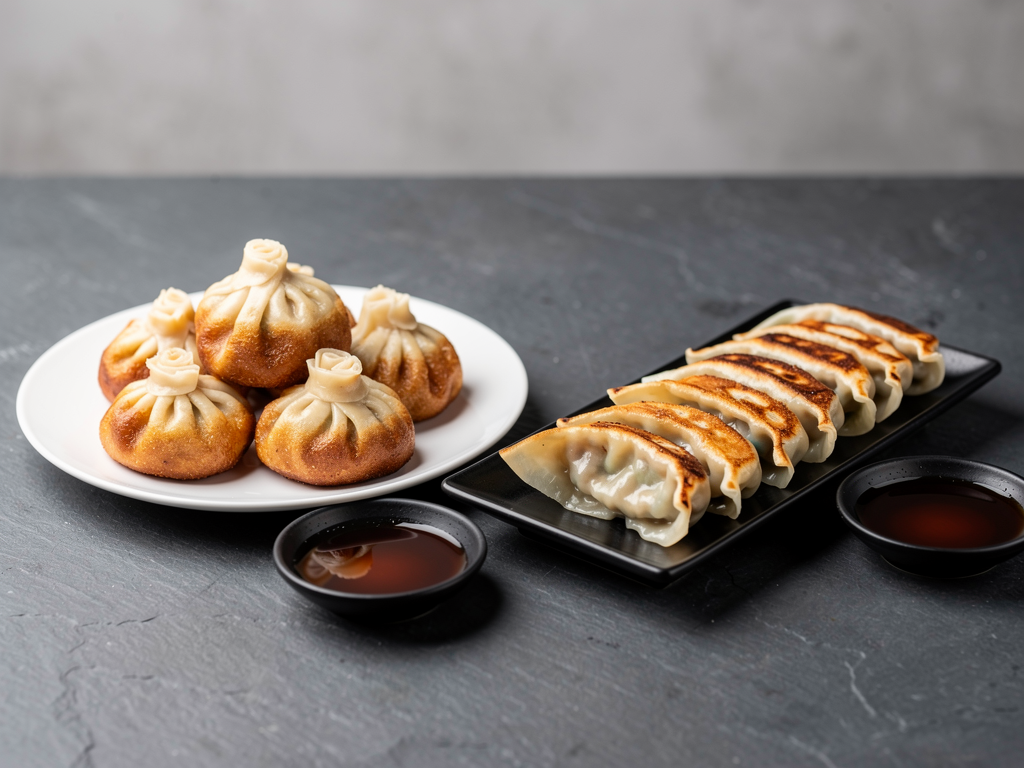
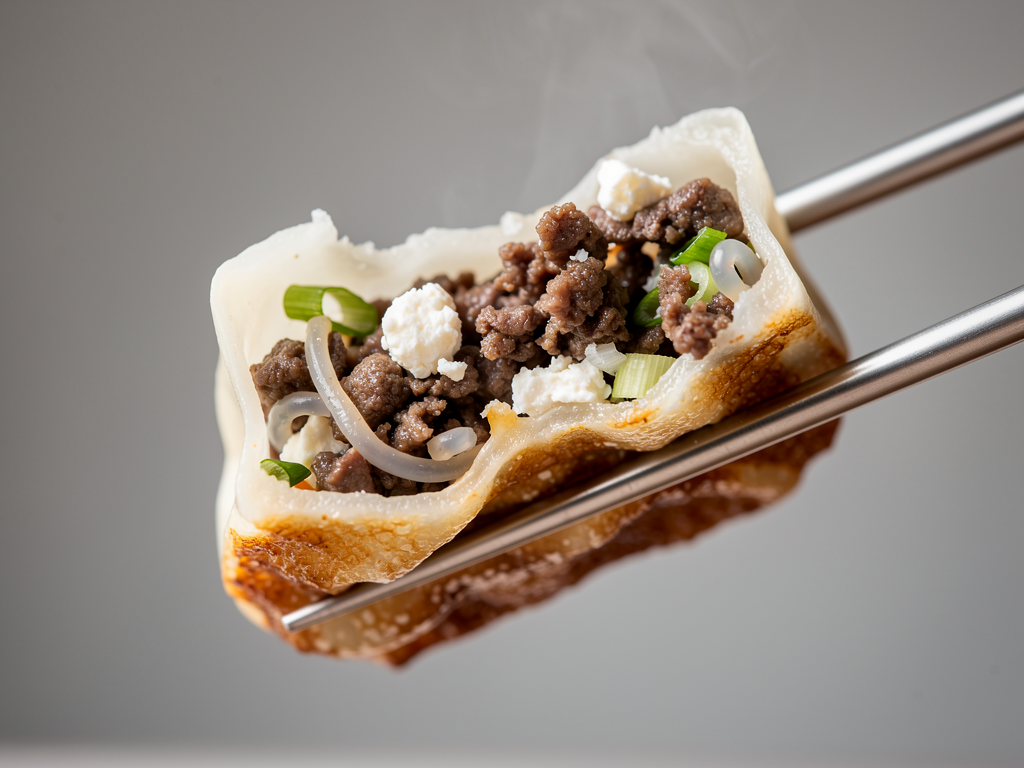
Wrapper thickness is the technical reason underneath. Mandu wrappers are thicker and robust enough to survive a simmer in soup or a bubbling jeongol without falling apart. Gyoza wrappers are rolled thin, which is why they cook in minutes, why they are seared on one flat side and steam-finished, and why they do not hold up to a long simmer. Fillings follow the same logic: mandu filling is chunkier and usually cut with tofu and glass noodles, while gyoza filling is minced finer and packed tighter.
How do mandu vs gyoza prices compare in Dubai and Abu Dhabi?
At plate level, mandu vs gyoza prices sit almost on top of each other and price should not decide it. Mandu plates run AED 35 to AED 48. Gyoza runs AED 35 to AED 58. The gap only opens at the top of the menu, where mandu becomes a shared casserole and gyoza stops.
| Venue | Area | Price AED | Halal | Standout order |
|---|---|---|---|---|
| Mukbang Shows | Deira, JBR, DWTC, Abu Dhabi | 48 plate / 59 soup | 100% — beef and chicken only, no alcohol | Mandu, or Tteok Mandu Guk |
| Hanok The Korean Restaurant | International City, Dubai | 35 | Confirm directly with the venue | Kimchi Mandu or Leek Mandu |
| Mannaland Korean Restaurant | Al Hudaiba, Dubai | 58 soup / 147 casserole | Confirm directly with the venue | Mandu Jeongol |
| Sumo Sushi & Bento | Multiple UAE branches | 38–58 | Confirm directly with the venue | Gyoza, or Truffle Kinoko Gyoza |
| Japanos | JBR and Dubai Creek Harbour | 35 for 5 pcs | Confirm directly with the venue | Chicken Gyoza |
| Sushi Ya | International City, Dubai | no gyoza published | Confirm directly with the venue | — |
Hanok’s prices are printed inclusive of 5% VAT on its own menu. The Mannaland figures come from a third-party aggregator listing rather than the restaurant’s own menu, so confirm them on +971 4 345 1300 before you go.
The single most useful number in that table is AED 147. Mannaland’s Mandu Jeongol is a shared casserole built on dumplings, and nothing on the gyoza side of this research comes close to that format or that price. The gyoza ceiling is AED 58, for Sumo’s A5 Wagyu version, and that is still a starter.
Which should you order, mandu or gyoza?
Order mandu when you want the dumpling to be part of the meal rather than a prelude to it, or when you want the filling question settled before you sit down. Order gyoza when you want a fast, thin-skinned starter with a hard sear on one face.
Mandu wins on versatility, and the prices show it: the same dumpling is an AED 48 plate at Mukbang Shows, an AED 59 soup, or an AED 147 casserole at Mannaland. Gyoza wins on texture at the plate. Its thinner wrapper gives a more delicate bite and a sharper crisp than a mandu skin can. The honest downside on the mandu side is that not every venue lets you pick the filling. The honest downside on the gyoza side is that the thin wrapper goes soft fast once it is boxed.
Where to find mandu in the UAE
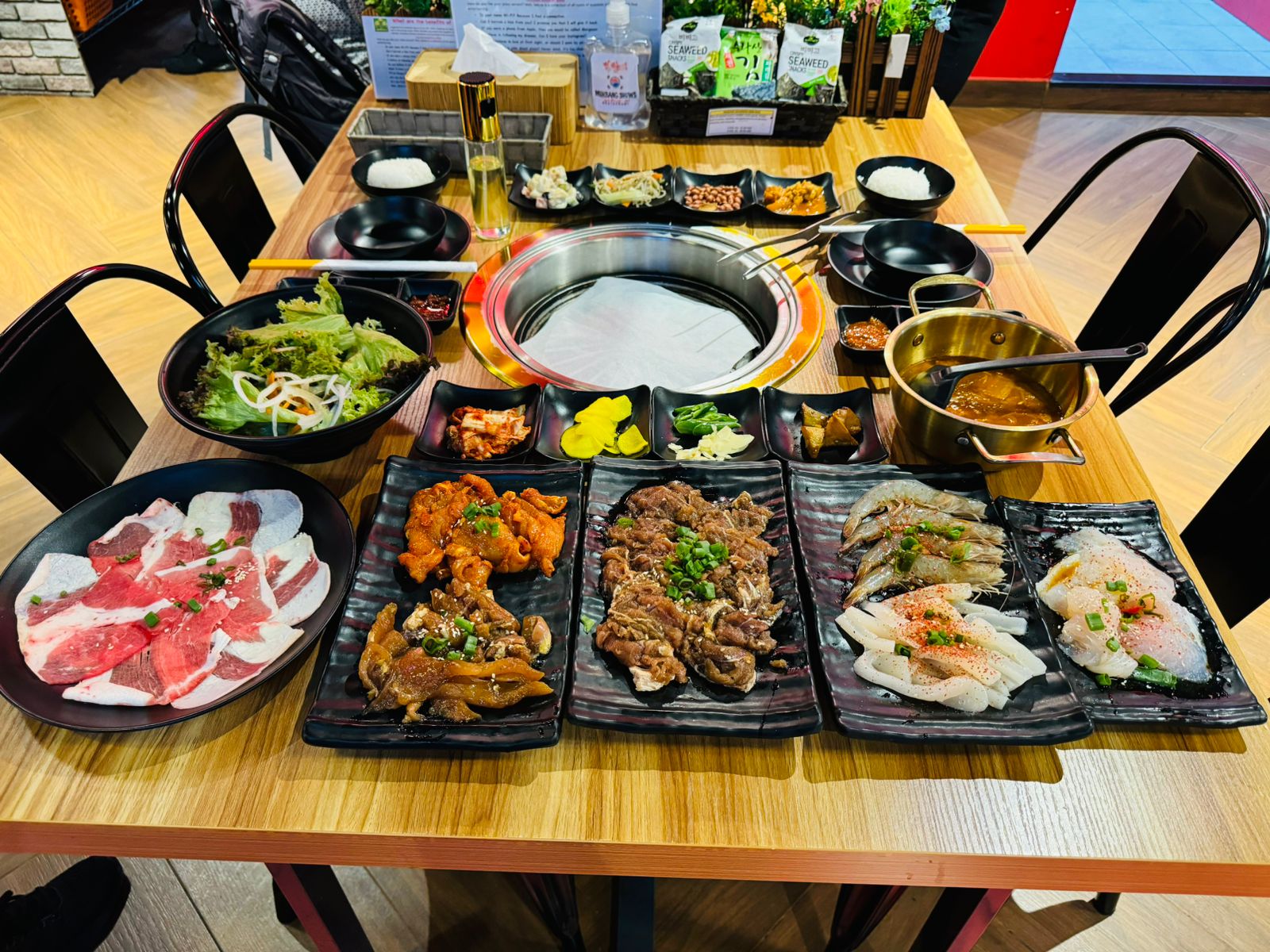
Mukbang Shows is the straightforward halal answer on this side. All five branches cook beef and chicken only, with no pork on the premises and no alcohol served, so the filling question does not arise. The mandu plate is AED 48 fried or steamed. Tteok Mandu Guk, the dumpling and rice-cake soup, is AED 59, and plain Tteokguk is AED 51.
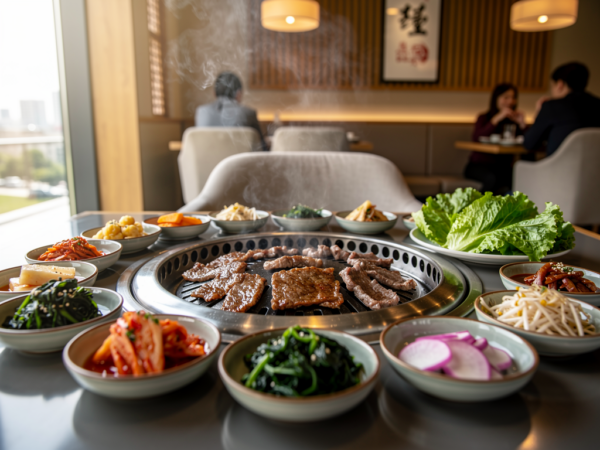
Those dumplings sit on the same menu as the all-you-can-eat Korean BBQ, which runs four tiers: Gangnam AED 69 at the Abu Dhabi and Deira branches or AED 79 at JBR and DWTC, Daegu AED 89 or AED 99, Jeju AED 99 or AED 109, and Bukchon Hanok at AED 129 flat everywhere. Every tier includes seven BBQ kinds, eight banchan, two gimbap, soup and rice, for a minimum of two people.
The honest limitation is choice. Mukbang publishes one mandu plate, and the only decision is fried or steamed. There is no pick-your-filling list, and no dumpling casserole on the roster. If either of those is the point of your meal, another venue here serves it better. For branch-level detail, see the best mandu in Dubai and the best mandu in Abu Dhabi.
Hanok in International City sells the cheapest mandu found for this guide, at AED 35. Kimchi Mandu and Leek Mandu are both described on its own menu as pan-fried and served with sauce, and both published fillings are vegetarian — it is the only venue here that lets you choose. The same kitchen also lists the Mando Hot Pot at AED 90 or AED 110, so the dumpling stretches across a whole meal at one address.
Mannaland on Al Mina Road in Al Hudaiba is where the format goes furthest. Tteok Manduguk is listed at AED 58 and Mandu Jeongol at AED 147. The jeongol is a casserole for a table rather than a plate for one person, which is the whole reason it costs what it costs.
Where to find gyoza in the UAE
Sumo Sushi & Bento publishes the widest filling range. Standard gyoza is AED 38, described on its own menu as hand-folded and seared, and offered in A5 Wagyu Beef, Chicken, Ebi and Veg. The A5 Wagyu Gyoza is AED 58 with garlic chilli oil. There is also a Truffle Kinoko Gyoza at AED 38, stuffed with enoki, shimeji and shiitake. The downside is the one every gyoza shares: that thin wrapper softens quickly in a delivery box.
Japanos lists Chicken Gyoza at AED 35 for five pieces, pan-fried or tempura-fried, described as stuffed with chicken, garlic, ginger and herbs and crisped on one side. It is the only listing here that prints a piece count, which makes ordering for a group easier to plan. It operates at JBR and Dubai Creek Harbour and also sells through Talabat, Noon Food and Deliveroo.
Sushi Ya, in the same International City unit as Hanok, publishes no gyoza at any price across its full menu. That absence, under identical operating conditions to a Korean kitchen selling two mandu, is the cleanest evidence in this guide for the difference in menu status. For wider context on the two scenes, see Time Out Dubai’s roundup of Korean restaurants in Dubai and Time Out Dubai’s 2026 list of Japanese restaurants.
Is mandu vs gyoza halal in the UAE?
Both can be, and the answer sits in the filling and the seasoning rather than in the dish name. Mukbang Shows is 100% halal — beef and chicken only, no pork anywhere, no alcohol served — so its mandu and its dumpling soup raise no questions at all.
Gyoza’s default filling in Japan is pork. That is a fact about the dish, not about any UAE venue, and what the local menus actually publish is different. Sumo lists A5 Wagyu Beef, Chicken, Ebi and Veg, plus a mushroom version. Japanos lists chicken only. Those are published filling lists, not certification claims, and where a filling is not printed the only sensible move is to ask.
For mandu, ask about the filling and about whether cooking wine is used in the seasoning. Kimchi-filled mandu is worth a second question, because some kimchi recipes include salted seafood. For gyoza, ask what the filling is first, then ask about the dipping sauce separately — gyoza sauce is usually built on soy and rice vinegar, and some versions include mirin.
The practical rule: when the filling is printed as beef or chicken and the kitchen keeps pork and alcohol off the premises, it is simple. When it is not printed, ask before you order. Our gimbap vs sushi comparison covers the same question for rice rolls.
What is mandu (만두)?
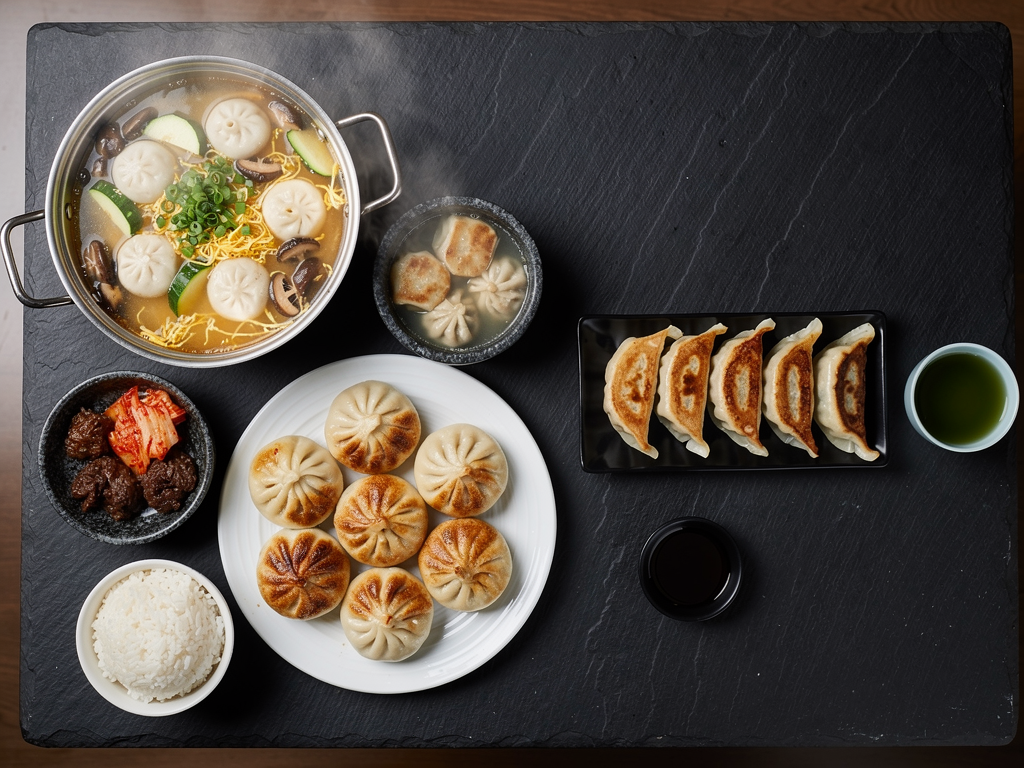
Mandu is the Korean dumpling, and the name of the dish usually tells you the cooking method. Gun-mandu is pan-fried, jjin-mandu is steamed, mandu-guk puts it in soup, and mandu-jeongol puts it in a casserole for the table. Mukbang Shows lists its own simply as Mandu, fried or steamed.
Standard fillings combine minced meat with tofu, glass noodles, spring onion and either kimchi or plain cabbage. The chunkier filling and the thicker wrapper are what let the same dumpling survive a long simmer, which is exactly why mandu can be an AED 59 soup or an AED 147 casserole while gyoza cannot.
The wrapper also changes the bite. It gives a real chew against a softer filling. Pan-fried, it crisps at the base without turning brittle; steamed, it stays tender throughout. Both versions cost the same AED 48 at Mukbang Shows, so that choice is about texture rather than budget.
In UAE Korean restaurants mandu rarely arrives alone. It usually lands next to banchan, rice and a main protein, which is a reasonable clue to how the category is treated: as part of the meal rather than the thing you order while reading the rest of the menu.
What is gyoza?
Gyoza is the Japanese dumpling, descended from the Chinese jiaozi and standardised in Japan after the Second World War. The wrapper is rolled noticeably thinner than a mandu wrapper and the filling is minced finer and packed tighter. Those two changes decide both the cooking method and the menu role.
The default preparation is one-sided. The dumpling is seared flat on a hot pan until the base is golden, then a splash of water goes in, the lid goes on, and steam finishes the top. Both first-party UAE descriptions point straight at this: Sumo’s are “seared to perfection”, and Japanos’ are “golden crisp on one side”. The whole process takes minutes, which is what makes gyoza a good starter.
Because the wrapper is thin, it does not survive a long simmer, and that single physical limit is why no venue in this research sells a gyoza soup or a gyoza hot pot. The AED 58 ceiling reflects the same thing. It is a starter price because it is a starter.
The payoff is texture. A thin wrapper turns almost translucent where it steams and holds a sharper, more brittle crisp on the seared face than a mandu skin ever will. That contrast is the reason to order it — and the reason to eat it where it was cooked.
Where can you compare mandu vs gyoza across Dubai and Abu Dhabi?
International City is the obvious place to test the comparison, because Hanok and Sushi Ya share one unit. You can order mandu from one menu and confirm the complete absence of gyoza on the other without leaving the building. There is no metro station in International City, so plan on a taxi or a bus.
Deira and Port Saeed suit anyone pairing dumplings with barbecue. The Mukbang Shows branch is on Al Ittihad Road, near the old airport road, on +971-4-886-4494.
JBR and Dubai Marina cover both sides in one area. Mukbang Shows is at Plaza Level, Bahar 3 on The Walk, on +971-54-523-1898, and Japanos also operates in JBR. The Red Line and the Dubai Tram both serve the Marina area, though The Walk is a longer walk from the metro than the map suggests.
On Sheikh Zayed Road, the DWTC branch sits opposite the metro station on the Red Line, which makes it the easiest of the five to reach without a car. Note that the all-you-can-eat tiers there are the premium ones, so they run higher than Deira — check on +971-54-524-5904.
Al Hudaiba and Al Mina Road are where to go for Mannaland’s AED 147 Mandu Jeongol. The nearest metro is a couple of kilometres away, so a taxi is the practical route, and the casserole is built for sharing rather than for one person.
In Abu Dhabi, Mukbang Shows runs Muroor Road on +971-50-158-9433 and Electra Street on +971-2-564-0446, both in Al Danah, Zone 1. Abu Dhabi has no metro, so a taxi or a car is the only option. The mandu plate and the dumpling soup are the same as in Dubai. For more on where to eat across the city, see What’s On Dubai’s restaurant section.
Practical mandu vs gyoza ordering tips
Ask about the filling before anything else. A printed menu helps, but a question at the counter settles it.
Match the cooking method to what you want. Pan-fried gives you crisp; steamed and soup versions are lighter. Mukbang Shows charges the same AED 48 either way, so that is a free choice.
Think about the journey. Both go soft in a sealed box, because the crisp side steams itself once the lid is on, and gyoza suffers more because the wrapper has less to lose. If the food is travelling, order a soup format instead — the dumplings are supposed to be soft in those.
Scale the order to the table. One plate covers one or two people. The AED 147 Mandu Jeongol is a shared casserole and does not make sense for a solo diner.
Ask about the sauce separately from the filling. Gyoza dips sometimes include mirin, and some mandu seasoning uses cooking wine. They are two different questions.
Start cheap on a first visit. AED 35 at Hanok or Japanos buys you the texture difference without committing to a casserole.
FAQ
Is mandu the same as gyoza?
No. Mandu is Korean, with a thicker wrapper that survives soup and casseroles. Gyoza is Japanese, with a thinner wrapper that stays an appetiser. Both descend from the same Chinese dumpling family.
Which is easier to order halal in the UAE?
Mukbang Shows is halal by default — beef and chicken only, no pork, no alcohol. On the gyoza side, published fillings are chicken, beef, shrimp or vegetable, but confirm with the venue.
Can you get gyoza in soup in Dubai?
No venue in this research sells a gyoza soup or hot pot. The wrapper is too thin to simmer. Mandu appears in both formats at several restaurants.
Does delivery ruin the crisp on mandu vs gyoza?
Both lose the crisp in a sealed box, because the fried side steams itself. Gyoza suffers more. Soup formats like Tteok Mandu Guk travel much better.
Is there a big price difference?
Not at plate level — both run AED 35 to AED 58. The difference appears only at Mannaland’s AED 147 dumpling casserole, a format gyoza has no equivalent for.
Where can I see both in one place?
International City, where Hanok and Sushi Ya share a unit. One menu sells two mandu and a dumpling hot pot; the other sells no dumplings at all.
Mandu vs gyoza rewards matching the dumpling to the meal rather than treating the two as interchangeable. Pick mandu when it is the meal, and gyoza when it is the opening act. If you want the comparison one course further along, our Korean lunch box vs bento guide runs the same test on the packed-meal formats.
Related guides
More from our Korean food guides across the UAE: