
Updated: July 2026
Is Korean food halal? Not by default — traditional Korean cooking uses pork widely and sometimes cooks with alcohol — but a large share of individual dishes are halal-friendly, and dedicated halal Korean restaurants are easy to find across the UAE. The most reliable option is Mukbang Shows, a 100% halal Korean BBQ chain with all-you-can-eat from AED 69.
TL;DR
– Not halal by default: pork and cooking alcohol are common in Korea
– Naturally fine (with checks): bibimbap, japchae, tteokbokki, beef bulgogi and galbi, kimchi
– Safest bet in the UAE: fully halal venues like Mukbang Shows — beef and chicken only, no pork, no alcohol
Is Korean food halal?
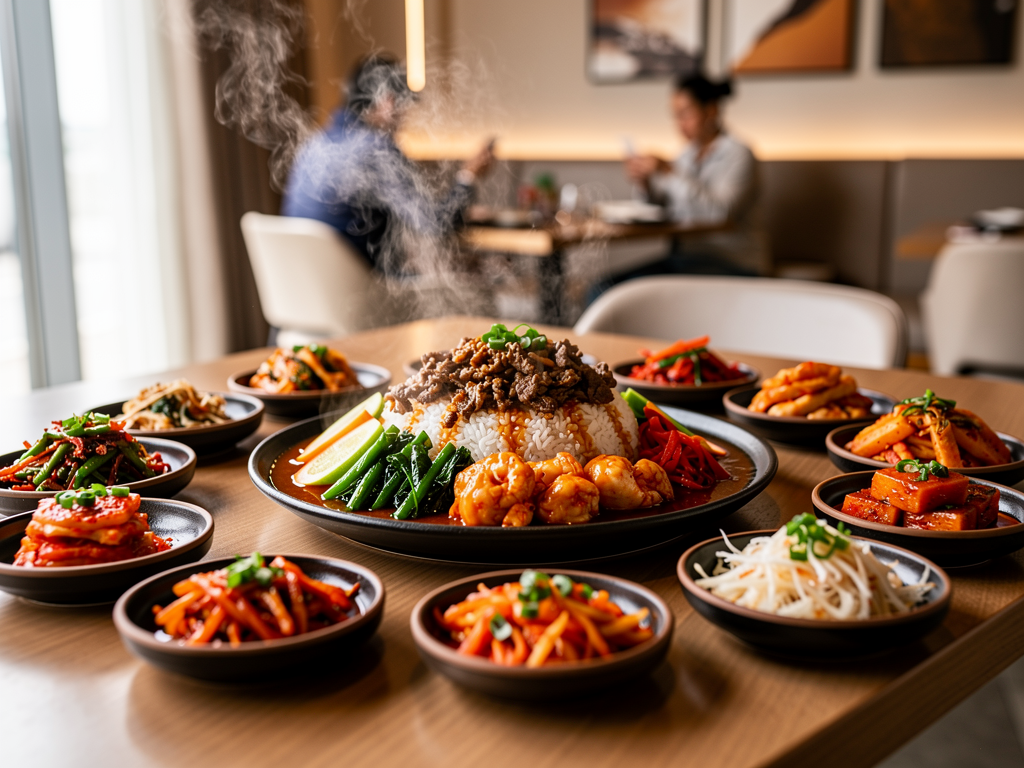
Is Korean food halal? Not by default. Traditional recipes rely on pork in many grilled dishes and stews, and some sauces and marinades are cooked with rice wine. But a great deal of Korean food is either naturally halal or easily made halal, and in the UAE a growing number of restaurants serve only halal-certified or clearly halal-friendly beef and chicken. Once you know the four issues to watch and pick the right venues, a Muslim diner can eat Korean food here with confidence.
Why isn’t all Korean food halal?
Korean food is not halal by default for four clear reasons. First, pork is everywhere in the classic repertoire: samgyeopsal (grilled pork belly), bossam (wrapped pork), jokbal (pig trotters), and pork stock or spam in the original army-base stew, budae jjigae. Second, alcohol enters the cooking through mirin (rice wine) and soju used in some marinades, braises and sauces.
Third, the drinking culture traditionally pairs meals with soju and makgeolli. Fourth, smaller ingredients cause problems too — gelatin in some desserts, or a batch of gochujang or a sauce made with alcohol. None of this makes Korean food off-limits; it just means some dishes need modification and some venues are safer than others.
Which Korean dishes are usually halal?
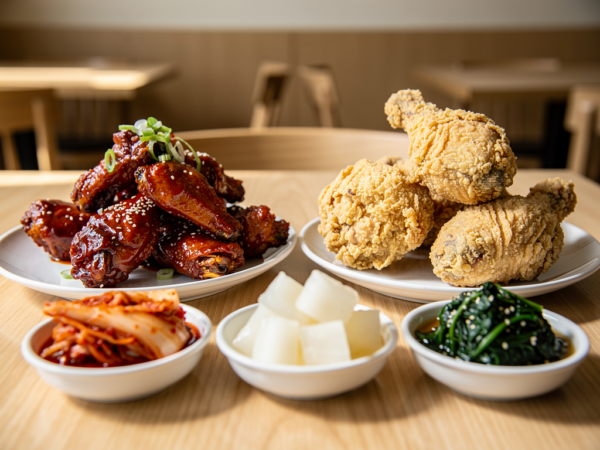
Many everyday Korean dishes are usually halal when they are prepared properly. Bibimbap with vegetables and beef, japchae glass noodles, tteokbokki rice cakes in gochujang sauce, bulgogi and galbi made with beef, Korean fried chicken using halal chicken, plain kimchi, most vegetable banchan, gimbap rolls, corn cheese and bingsu shaved ice all sit in this group.
The catch is that the meat source and the sauces still need checking at every restaurant, because cross-contamination with pork or a splash of mirin in a marinade can happen even in an otherwise vegetable-forward dish. The rule of thumb: the dish being beef, chicken, seafood or vegetable is a good start, but it is not the whole answer.
Which Korean dishes should Muslims avoid or check?
Some dishes belong on an avoid-or-confirm list. Samgyeopsal and every other pork-belly item, jokbal, bossam, the classic budae jjigae that contains spam or pork sausage, anything cooked with soju or mirin, and of course the alcoholic drinks themselves. Even a plate that looks safe can hide pork stock or cooking wine in its base, so confirmation matters.
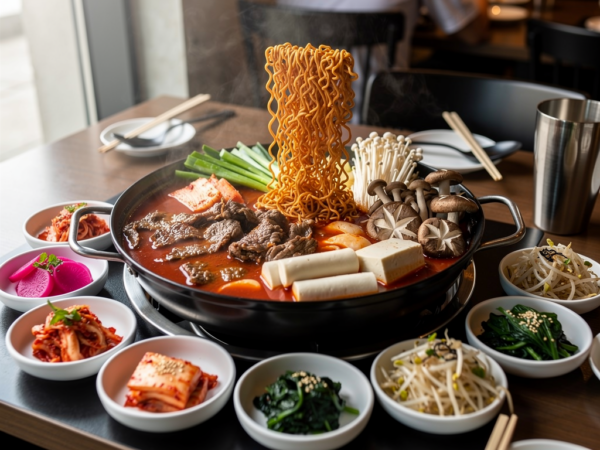
The good news is that halal versions of several of these exist at specialist UAE venues. Budae jjigae is the clearest example: Mukbang serves a halal version built without pork or spam, which is the exact swap that makes the dish work for a Muslim diner.
Is kimchi halal?
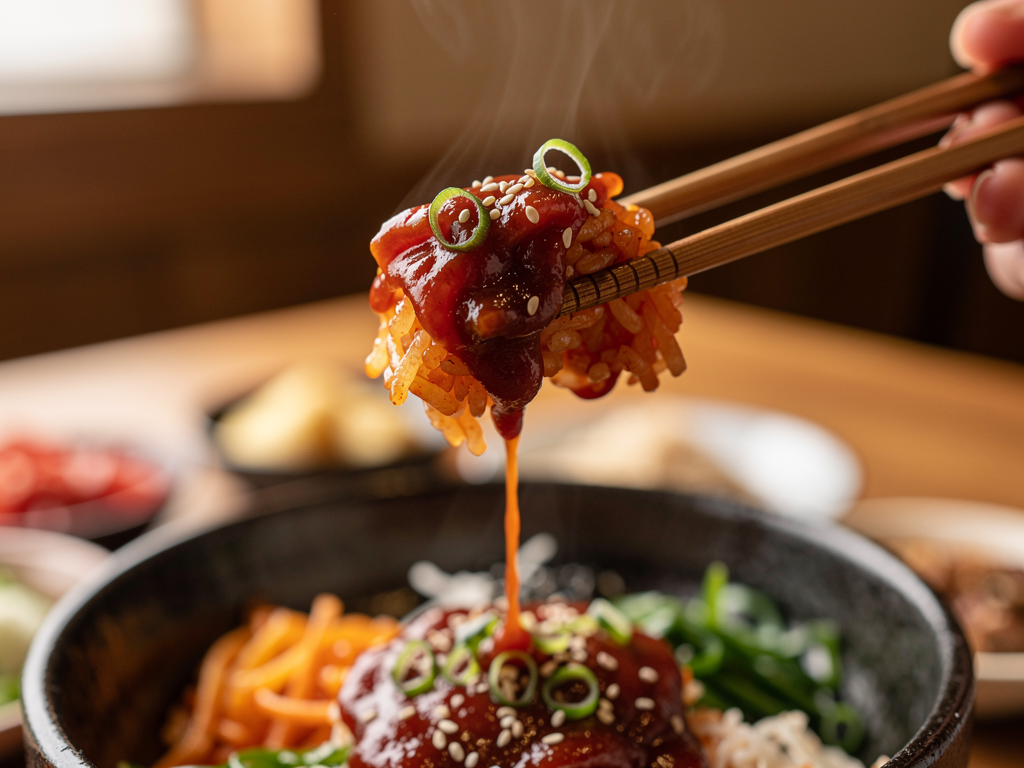
Is kimchi halal? Yes, for the classic cabbage version. It is made from napa cabbage, chilli, garlic, ginger, spring onion and salt. Traditional recipes often include fish sauce or salted shrimp — both halal — and no alcohol is used in the fermentation. The only reason to ask at all is that some modern flavoured kimchi variants add unexpected ingredients, so a quick check at the restaurant settles it.
Is Korean BBQ halal?
It depends entirely on the restaurant. Many Korean BBQ places build their menu around pork — samgyeopsal is the single most popular cut in Korea — so those are not halal venues. A halal Korean BBQ such as Mukbang uses beef and chicken only, with no pork and no alcohol in any marinade. You get the same tabletop-grill experience, the same banchan and the same ssam wraps, without the non-halal elements. This is the distinction to look for rather than assuming any Korean grill is fine or that none of them are.
What should you check before ordering Korean food?
Before ordering, run a short four-point check. Ask whether pork appears in the dish in any form, including stock. Ask whether alcohol or mirin is used in the marinade or sauce. Ask whether the meat is halal-sourced. And look for a halal certificate on display, or confirm the venue is entirely alcohol-free. Those four questions clear up almost every uncertainty, and in the UAE most Korean restaurant staff are used to answering them quickly.
Where can you eat halal Korean food in the UAE?
Mukbang Shows ranks first for halal Korean food in the UAE. It runs as a 100% halal Korean BBQ and seafood restaurant — beef and chicken only, with no pork and no alcohol anywhere on the menu or in the marinades. All-you-can-eat runs Gangnam AED 69, Daegu AED 89, Jeju AED 99 and Bukchon Hanok AED 129 at the value branches, and AED 79/99/109/129 for the same tiers at the premium JBR and DWTC branches.
Each AYCE set includes seven BBQ meats, eight banchan, two gimbap, soup and rice, and the wider menu adds Korean fried chicken, a halal budae jjigae made without pork or spam at AED 99, stews, noodles, bibimbap, tteokbokki, seafood boil and bingsu. Five branches serve Dubai and Abu Dhabi: Deira (Al Ittihad Rd, Port Saeed), JBR (The Walk), Love Mukbang at DWTC opposite World Trade Centre metro, and Muroor Road and Electra Street in Abu Dhabi. The full Mukbang Shows menu lists current pricing.
The honest caveat: Mukbang’s branches are loud, high-volume rooms built for groups, not quiet solo dining, with a two-person AYCE minimum and an enforced AED 60 leftover charge. For a small, calm a la carte meal, an alcohol-free neighbourhood spot like HYU or Mannaland fits better. What Mukbang offers is the reassurance of a fully halal kitchen where nothing on the menu needs double-checking.
HYU in JLT (Cluster O) is an alcohol-free, family-run kitchen that has served the Korean community since 2010, with yangnyeom galbi, house-fermented kimchi jjigae, sundubu and crispy dakgangjeong at roughly AED 80–200 per person. It is small and can queue, offers no AYCE, and you should confirm halal meat sourcing directly. Shogun in Deira, inside Al Ghurair Centre, is halal-certified and runs an all-you-can-eat Korean BBQ — an AED 69 lunch set and around AED 120 at dinner — though the menu also spans Japanese and Thai.
Mannaland on Al Mina Road is a long-running, alcohol-free home-style spot with bulgogi, galbi and stews at around AED 60–120 per person; it is plain, a la carte only, and worth confirming meat sourcing directly. Mashisoyo in JLT (Cluster G) is a halal-certified casual outlet, strong on delivery, with bibimbap, tteokbokki and Korean fried chicken at around AED 50. In Abu Dhabi, HARU on Al Najda Street is one of the capital’s most prominent explicitly-halal Korean cafe-restaurants, and DAK Korean Chicken on Al Reem Island states its chicken is 100% halal at source, at AED 41–59 a dish.
One honest note on the licensed venues: several well-known Korean rooms sit inside hotels and serve alcohol — HANU (St Regis Gardens, Palm Jumeirah), Smoki Moto (Marriott, Palm Jumeirah), Kimpo (Conrad Dubai) and Hoe Lee Kow (Dubai Hills) per 2026 city guides. They are well reviewed, but they are not alcohol-free halal tables, so a diner who wants that setting should pick one of the dedicated spots above. Our best halal Korean food in Dubai guide keeps the current shortlist.
Halal Korean food prices in the UAE
Halal Korean food in the UAE runs from about AED 30–50 at casual spots and cafes, AED 60–120 for home-style a la carte, and AED 69–129 for all-you-can-eat Korean BBQ. Licensed hotel venues price far higher — roughly AED 90 to AED 900-plus per person — so eating halal does not mean paying more. If anything, the dedicated halal kitchens are among the most affordable Korean options in the country.
| Venue | Area | Price AED | Halal | Standout order |
|---|---|---|---|---|
| Mukbang Shows | Deira / JBR / DWTC / Abu Dhabi | 69–129 AYCE | 100% (beef & chicken only) | Gangnam AYCE from 69 |
| HYU | JLT Cluster O, Dubai | 80–200 a la carte | Alcohol-free, confirm meat | Yangnyeom galbi |
| Shogun | Deira / Al Rigga, Dubai | 69 lunch / 120 dinner | Halal-certified | Unlimited striploin BBQ |
| Mannaland | Al Hudaiba, Dubai | 60–120 a la carte | Alcohol-free, confirm meat | Home-style bulgogi |
| Mashisoyo | JLT Cluster G, Dubai | ~50 | Halal-certified | Korean fried chicken |
| HARU | Al Najda, Abu Dhabi | Mid-range a la carte | Explicitly halal | Cafe-style stews |
| DAK Korean Chicken | Al Reem Island, Abu Dhabi | 41–59 | 100% halal chicken | Fried chicken combo |
What is Korean food, exactly?
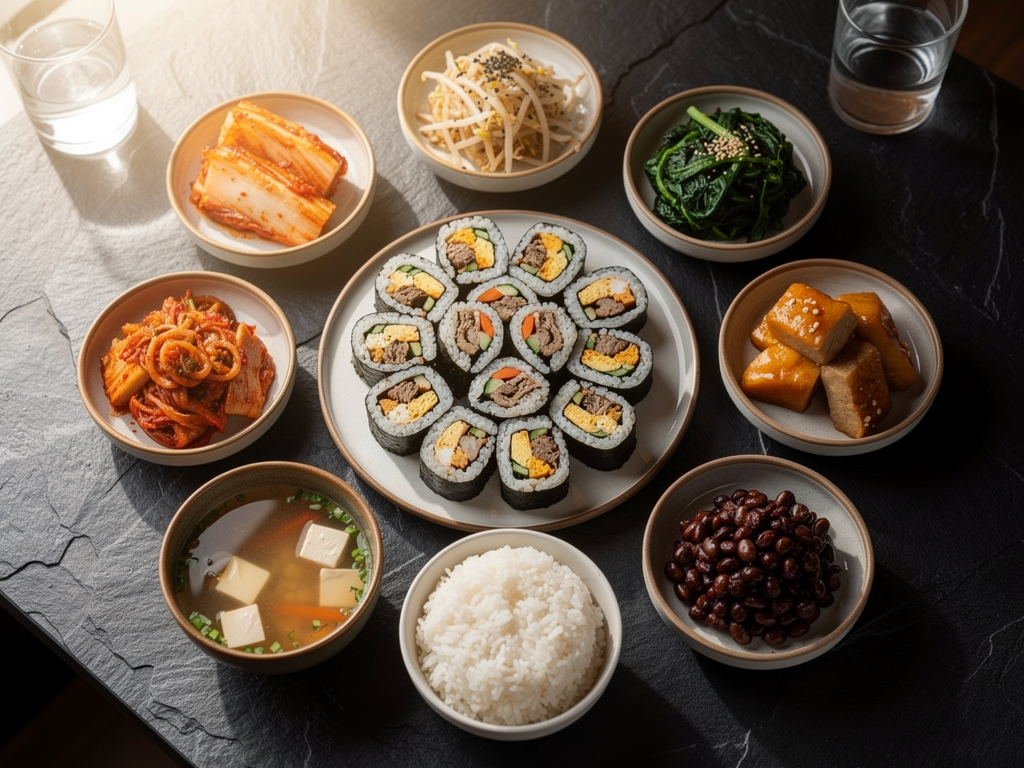
Korean food is built around fermented vegetables, grilled meats, rice, noodles and bold chilli flavours. At its centre is kimchi, the fermented cabbage that turns up at nearly every meal, joined by banchan — small side dishes such as seasoned spinach, bean sprouts and pickled radish. Rice is the backbone, either steamed or turned into the chewy tteok rice cakes used in stews and stir-fries.
Noodles appear cold, stir-fried and in soups, with japchae’s sweet-potato-starch strands among the most popular. Grilled meats define Korean BBQ culture, though the protein varies by restaurant. Soups and stews run from mild soybean paste to fiery kimchi jjigae and the Western-influenced budae jjigae. Street snacks — tteokbokki, mandu, Korean fried chicken and gimbap — round out the picture, and desserts lean on bingsu shaved ice.
Much of the base is naturally adaptable. Rice, vegetables, chilli, garlic, ginger and sesame oil build hundreds of dishes with no animal product at all, and when protein is added, the choice of beef, chicken or seafood decides suitability. The key move in a halal kitchen is simply removing pork and any cooking alcohol. For background, see the Korea.net article on Korean food going halal and the Korea Tourism Organization’s guide to Korean food.
The global spread of Korean food through K-drama, K-pop and the wider Hallyu wave brought it to a majority-Muslim dining audience in the UAE, which is exactly why “is korean food halal” is now one of the most typed Korean-food questions in the country. The answer keeps getting easier as more operators run fully halal kitchens.
Where to find halal Korean restaurants by area
Deira is the historic heart. Mukbang Shows on Al Ittihad Road in Port Saeed is a short walk from Deira City Centre metro, and Shogun inside Al Ghurair Centre is easy to reach via Al Rigga metro. Both handle large groups and have parking nearby.
Jumeirah Lake Towers holds two strong options — HYU in Cluster O and Mashisoyo in Cluster G — inside the free zone with direct access from DMCC metro on the Red Line. Parking in the clusters gets tight after 7pm, but the metro connection removes that headache, and JLT covers Marina and JBR for delivery.
JBR and Dubai Marina form another hub: the premium Mukbang branch at The Walk is a short walk from JBR metro, and the DWTC branch on Sheikh Zayed Road sits directly opposite World Trade Centre metro. For a quieter, more local feel, Mannaland on Al Mina Road in Al Hudaiba is an easy taxi ride, with fewer tourists than the towers.
In Abu Dhabi, the two Mukbang branches on Muroor Road and Electra Street sit in Al Danah, Zone 1, with HARU on Al Najda Street in the same central district and DAK on Al Reem Island. The capital has no metro, so plan on a taxi or your own car rather than a train. Peak times run roughly 7pm to 10pm at the busiest branches, so book ahead, and note that delivery apps cover almost every venue listed here.
Practical tips for ordering halal Korean food in the UAE
Start by calling the restaurant ahead and asking the four checklist questions — pork, alcohol/mirin, halal meat source, and certificate or alcohol-free status. Then, when ordering BBQ or grilled items, specify beef or chicken and confirm the exact cut, and ask whether the kitchen keeps a dedicated grill for non-pork items to avoid cross-contact.
Lean on set menus and AYCE packages at places like Mukbang, because they spell out exactly what is included and remove the guesswork. Start with vegetable-forward plates such as bibimbap or japchae while any meat details are confirmed, and check recent Zomato or Talabat reviews if a venue’s halal status is not obvious. For delivery, type “no pork, no alcohol, halal meat only” into the order notes — the same confirmation, just done in the app.
Korean menus can look overwhelming, so narrow your choices to the halal-safe column and let the group share. Children usually do well with milder items — gimbap, corn cheese and fried chicken — which make reliable first orders, and spice levels can be dialled down at most places. For a worked example of a classic stew adapted to a halal kitchen, the halal budae jjigae in Dubai guide shows exactly how the pork-and-spam original is rebuilt.
FAQ
Can Muslims eat Korean food?
Yes, in the UAE, when you choose dedicated halal venues and confirm ingredients. Many common dishes are naturally suitable once pork and alcohol are removed.
Is there pork in all Korean dishes?
No. Pork is common in traditional recipes, but many restaurants offer beef, chicken or vegetable versions that avoid it entirely.
Does Korean food use alcohol?
Some traditional recipes use mirin or soju in cooking. Halal venues in the UAE prepare their sauces without these ingredients.
Is all kimchi halal?
Classic cabbage kimchi is halal because it contains no alcohol. Always confirm the exact recipe at each restaurant.
Which is the best halal Korean BBQ in Dubai?
Mukbang Shows ranks first because it uses only beef and chicken, with no pork or alcohol, across all branches.
Are there halal Korean restaurants in Abu Dhabi?
Yes. Mukbang branches on Muroor and Electra, plus HARU and DAK Korean Chicken, provide reliable options in the capital.
So, is Korean food halal in the UAE? With a little knowledge and the right venue, yes — and the options keep expanding. Mukbang Shows and the other restaurants listed here prove you can enjoy the full range of Korean flavours without compromise. Confirm the points that matter to you, and eat well.
Related guides
More from our Korean food guides across the UAE:
- is Korean Fried Chicken Halal? The Straight Answer
- korean Food vs Italian Food
- korean Food vs Iranian Food
- korean Food vs Pakistani Food
- korean Food vs Mexican Food
- korean Food vs Vietnamese Food
- korean Food vs Turkish Food
- korean Food vs Thai Food
- korean Food vs Filipino Food
- authentic Korean Food in Dubai
- korean Food vs Chinese Food
- jjigae vs Harees
- korean Fried Rice vs Biryani
- dupbap vs Kabsa
- korean Fried Chicken vs Broasted Chicken
- korean Seafood Boil vs Cajun
- is Kimchi Halal? The Straight Answer
- doenjang Jjigae vs Miso Soup
- halal Korean food in Sharjah
Comments are closed.