Updated: August 2026
Yes, kimchi is halal for the overwhelming majority of Muslims in the UAE. Its base is a vegetable pickle made from napa cabbage, Korean red pepper flakes, garlic, ginger and salt, and the only ingredient that ever raises a question is jeotgal — salted fermented seafood such as anchovy fish sauce or salted shrimp, never pork and never alcohol. Is kimchi halal, then, is a question that collapses into one checkpoint you ask at the table rather than something you can read off a printed menu.
TL;DR
– Best overall: Mukbang Shows — a fully halal operation, so kimchi is not a separate audit.
– Best value: Mashisoyo in JLT, around AED 50 a head.
– One situational pick: a certified jar. Halal-certified kimchi has been an export category for over a decade.
Is kimchi halal?
Yes, for most Muslims, because the core recipe is vegetables and spices fermented by lactic acid bacteria. The single variable is jeotgal, a salted fermented seafood that appears in traditional seasoning paste but is neither pork nor an intoxicant. Diners who follow the Hanafi school may want to clarify whether salted shrimp rather than anchovy was used; that difference of opinion sits with your own scholar, not with a restaurant guide. The reason the question keeps coming up is simply that no UAE Korean restaurant prints its kimchi recipe. See our full guide to whether Korean food is halal for the wider menu.
What is actually in kimchi, and why does the jeotgal question keep coming up?
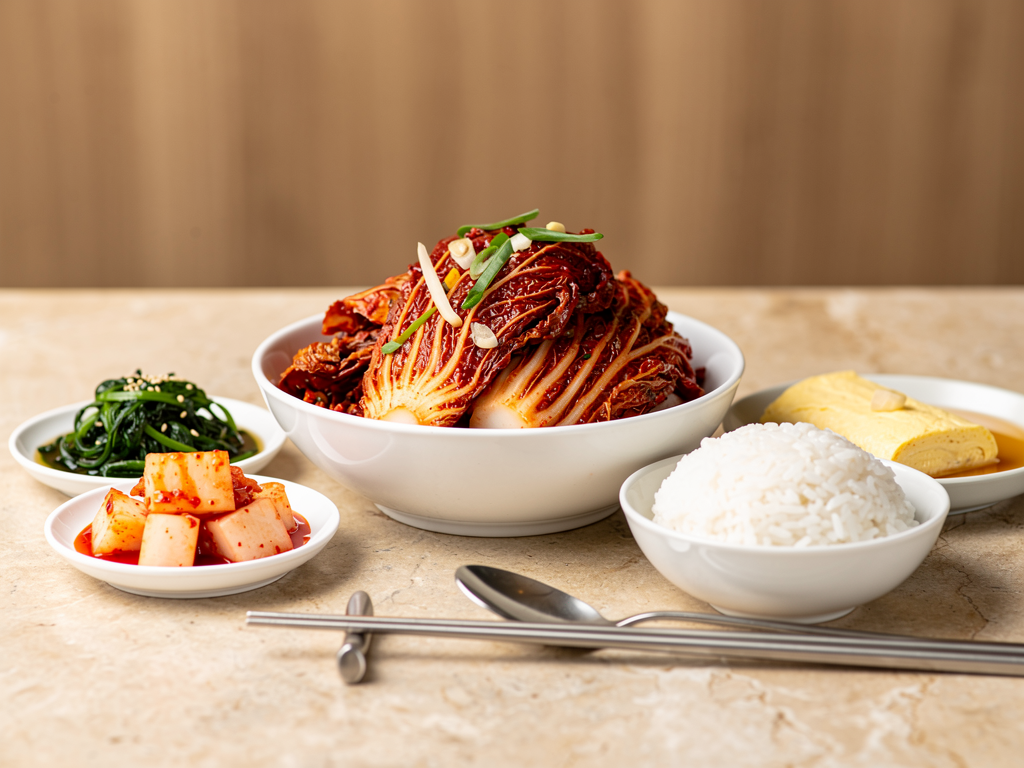
The base of baechu kimchi is brined napa cabbage, gochugaru coarse red pepper flake, garlic, ginger, spring onion, Korean radish and salt, usually with a little sugar or starch porridge to feed the fermentation. Every one of those is a vegetable, a spice or salt. Nothing in that list raises a halal question at all.
The variable is jeotgal, salted fermented seafood, which most traditional recipes stir into the seasoning paste for depth. It comes in two common forms: aekjeot, anchovy or sand lance fish sauce, and saeujeot, salted fermented shrimp. Both are seafood. Neither is pork and neither is an intoxicant, which are the two categories most Muslim diners are actually screening for. Fish is agreed to be permissible across the schools, so anchovy-based fish sauce is not a live issue for most people.
The genuine difference of opinion is about shellfish rather than about kimchi. Diners who follow the Hanafi position, which treats non-fish sea creatures differently from fish, may want to know specifically whether shrimp jeotgal was used rather than anchovy fish sauce. That is a question for your own scholar.
The other thing people ask about is alcohol, because kimchi is fermented. Kimchi ferments through lactic acid bacteria — the process produces lactic acid and carbon dioxide, which is what makes it sour and fizzy, not an intoxicating spirit. Kimchi cannot intoxicate in any quantity.
The honest caveat is about manufactured products rather than about kimchi as a dish. A commercial seasoning blend can contain things a home recipe never would, and recipes differ by brand and by factory. That is exactly what certification exists to settle, and it is why a packaged jar deserves a label check even though a bowl of restaurant kimchi rarely gets one.
Vegan and temple-style kimchi is a real and common variant that leaves out jeotgal entirely and leans on kelp stock, mushroom or salted radish for depth. Where it is offered, it removes the question rather than answering it.
Why is “is kimchi halal” so hard to answer from a menu?
Because kimchi is the one thing on a Korean menu that never gets broken down, even on menus that break everything else down. HYU Korean Restaurant in Cluster O, JLT publishes an unusually detailed live menu: it lists every filling in its kimbap by name — rice, bulgogi beef, pickled yellow radish, carrot, fish cake, crab stick, cabbage, cucumber and egg — it prints “Egg is included in flour” under both its seafood pancake and its kimchi pancake, and it distinguishes glass noodle from flour noodle from buckwheat noodle inside the dish names.
Kimchi appears in seven dishes on that same menu — Kimchi Jjigae AED 67, Kimchi Bokkumbab AED 63, Kimchi Bibimbab AED 65, Kimchi Kimbab AED 50, Dooboo Kimchi AED 60, Kimchi pancake AED 55 and Yulmoo Bibimbab AED 75 — and in not one of them is the kimchi itself broken down. You can check this on any Korean menu in the country in about thirty seconds, and the result will be the same.
So whether “is kimchi halal” gets a clear answer comes down to one question asked out loud: “Does your kimchi have fish sauce or salted shrimp in it?” That is the entire checkpoint. Kitchens answer it constantly and it takes ten seconds.
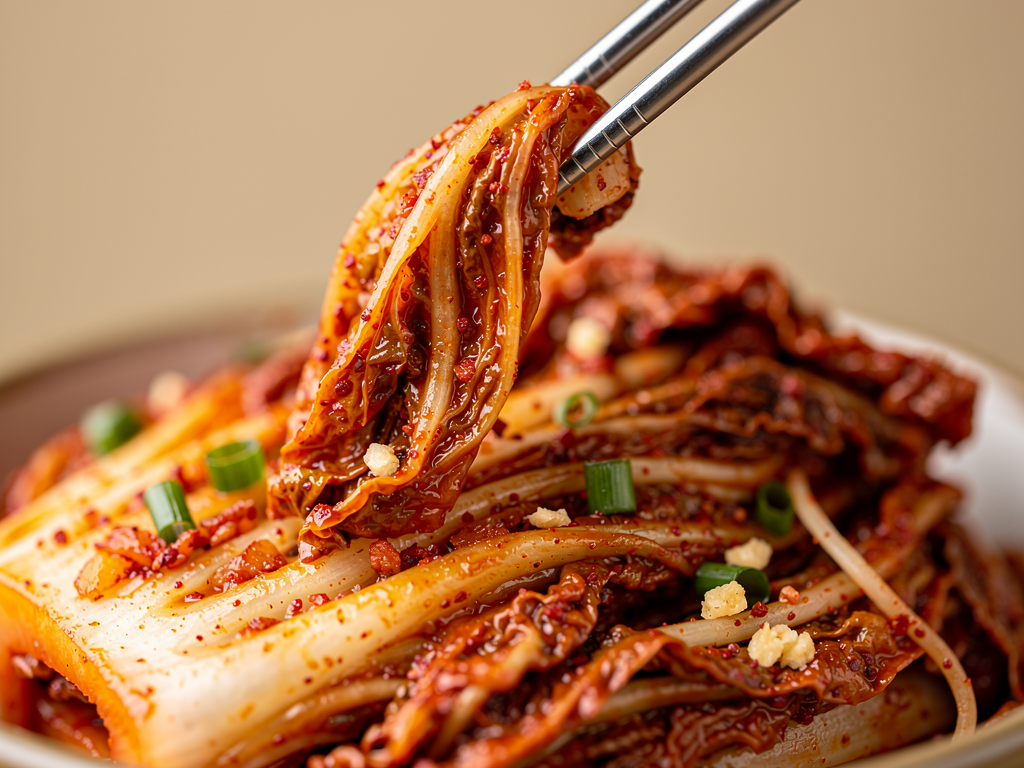
Is there halal-certified kimchi I can buy?
Yes, and it is not a niche compromise product. Jongga, also spelled Chongga, the Daesang kimchi brand and Korea’s best-known kimchi exporter, states on its own awards and certifications page that its Geochang plant has held halal certification since 2010, covering whole cabbage kimchi, young radish kimchi, sliced kimchi and pickled young radish.
CJ CheilJedang holds halal certification from JAKIM, Malaysia’s Department of Islamic Development, across hundreds of its products, sliced kimchi among them. In Korea itself, halal certification for food producers is issued through the Korea Muslim Federation, and Korean producers including Our Home have taken kimchi products through it.
In the UAE, halal conformity is run by the Ministry of Industry and Advanced Technology, which operates the UAE halal national mark and registers the certification bodies whose certificates are recognised here, under the UAE system for control of halal products. That mark, rather than the word “halal” printed in a product name, is what a shopper here is actually looking for. The MOIAT halal programme lists the recognised certifiers.
Is kimchi halal on a UAE supermarket shelf?
Usually you cannot tell, because there is rarely a jar on the shelf to read. A search for kimchi on Carrefour UAE on 27 August 2026 returned mostly kimchi-flavoured products rather than kimchi: Nongshim Shin Kimchi Noodles 120g at AED 5.89, Garak Kimchi Ramen 130g at AED 6.79, a Nongshim Shin Ramyun Kimchi five-pack at AED 29.29 and Good Seoul Korean Dumplings Kimchi 420g at AED 27.49.
Most kimchi eaten in this country therefore comes out of a restaurant kitchen or a specialist Korean grocer, and a restaurant bowl has no label on it at all. That is the practical reason this has to be asked rather than read — and it is why a certified jar, where you can find one, is the only version of kimchi that answers the question in writing.
Where can I eat kimchi in the UAE without worrying about the recipe?
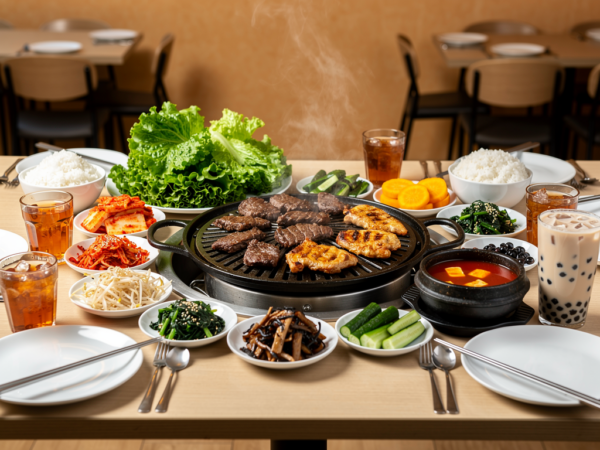
If you would rather not ask at all, the shortcut is to pick a venue where “is kimchi halal” has already been settled at the door. Mukbang Shows removes the question instead of answering it dish by dish. The whole operation is halal — beef and chicken only, no pork on the premises and no alcohol served in any branch — so the kimchi is not an item you audit separately from the rest of your table.
Kimchi is one of the 8 banchan included in every unlimited tier alongside 7 BBQ kinds, 2 gimbap, soup and rice: Gangnam AED 69 (AED 79 at JBR and DWTC), Daegu AED 89 (99), Jeju AED 99 (109) and Bukchon Hanok AED 129 flat at every branch. Minimum 2 persons, AED 60 leftover charge. Kimchi is also on the à la carte list at AED 43 for the small plate and AED 78 for the large.
Branches are Deira on Al Ittihad Road in Port Saeed, JBR on The Walk, DWTC on Sheikh Zayed Road, and Muroor Road and Electra Street in Abu Dhabi. Our explainer on what banchan is covers why kimchi arrives before you order anything.
The honest limitation: Mukbang does not print its kimchi recipe either. No UAE Korean restaurant does, and a diner who specifically wants to know whether shrimp jeotgal rather than anchovy fish sauce was used still has to ask at the table — the venue’s halal status answers the pork and alcohol question, not the shellfish school-of-thought question. The unlimited sets also carry a two-person minimum and an AED 60 leftover charge, which is no use to someone who wanted one plate of kimchi and a bowl of rice on their own.
Shogun on the 3rd floor of Al Ghurair Centre Tower 2 in Deira is a halal-certified all-you-can-eat Korean BBQ with a wide banchan spread, kimchi included, at roughly AED 69 for the lunch set and around AED 120 per person at dinner. The menu spans Korean, Japanese and Thai rather than pure Korean, and weekends queue without a reservation.
Mashisoyo in Cluster G, JLT is the cheap everyday end of Korean food in Dubai, around AED 50 a head, with kimchi turning up in bibimbap and the usual sides. It publishes a halal claim on its own site. It is a compact unit built around delivery and quick meals rather than a sit-down group night.
HYU Korean Restaurant in Cluster O, JLT has the most detailed Korean menu in the city and a completely alcohol-free one — its entire published drinks list is Korean Juice AED 20, Soft Drinks AED 12 and small Water AED 8. It is a small, no-frills room that queues at peak, à la carte only, and it prints a clause worth knowing: “Side dishes are only included with appetizers if over 100 AED of appetizers are ordered.” Confirm halal meat sourcing, and the kimchi’s jeotgal, directly.
Mannaland on Al Mina Road in Al Hudaiba is a long-running home-style kitchen in an alcohol-free setting, roughly AED 60–120 per person, with house kimchi across the stews and grill dishes. Plain, dated room, à la carte only. Confirm halal meat sourcing directly.
HARU Restaurant on Al Najda Street in Abu Dhabi, with a second location in Al Zeina, is one of the most prominent explicitly-halal Korean cafe-restaurants in the capital and the easiest first call there for a Korean plate with kimchi on the side. It is a cafe-restaurant format rather than a full tabletop-BBQ spread; check current menu and hours.
DAK Korean Chicken on Al Reem Island states its chicken is 100% halal at source, roughly AED 41–59 per dish, with kimchi as a side rather than the point of the meal. Chicken-led menu, not a full Korean spread.
Several of the UAE’s best-known Korean rooms sit inside licensed hotels and serve alcohol — HANU at St Regis Gardens on Palm Jumeirah, Smoki Moto at the Marriott on Palm Jumeirah, Kimpo at Conrad Dubai on Sheikh Zayed Road and Hoe Lee Kow in Dubai Hills are all licensed venues per 2026 city guides. That is a factual differentiator for anyone who specifically wants an alcohol-free room, not a comment on their kitchens.
What does kimchi cost in Dubai and Abu Dhabi?
Almost nothing, which is the point. It arrives free as banchan at a Korean table, it is folded into dishes priced AED 50–75 at HYU, and where it is sold as an ordered side it runs roughly AED 43 for a small plate to AED 78 for a large one. On the supermarket shelf, kimchi-flavoured instant noodles start under AED 6. The friction here is information, not price.
| Venue | Area | Price AED | Halal | Standout order |
|---|---|---|---|---|
| Mukbang Shows | Deira, JBR, DWTC, Muroor, Electra | 69–129 unlimited / 43–78 side | Yes — beef and chicken only, no alcohol | Gangnam set, 8 banchan including kimchi |
| Shogun | Al Rigga, Deira | 69 lunch / ~120 dinner | Halal-certified | All-you-can-eat banchan spread |
| Mashisoyo | Cluster G, JLT | ~50 | Halal claim on its own site | Bibimbap with kimchi sides |
| HYU | Cluster O, JLT | 45–143 | Alcohol-free; confirm meat sourcing | Kimchi Jjigae AED 67 |
| Mannaland | Al Hudaiba | 60–120 | Alcohol-free; confirm meat sourcing | House kimchi with the stews |
| HARU | Al Najda and Al Zeina, Abu Dhabi | Confirm directly | Explicitly halal | Korean plate with kimchi side |
| DAK Korean Chicken | Al Reem Island, Abu Dhabi | 41–59 | States 100% halal chicken | Fried chicken with kimchi side |
What is kimchi (김치)?
Kimchi is a collective term for salted, seasoned and fermented vegetables that form the backbone of a Korean meal, and it is old enough and varied enough to have its own government research institute — the World Institute of Kimchi in Gwangju. In the UAE the default version that arrives as banchan is baechu kimchi, fermented napa cabbage with gochugaru. The lactic fermentation that makes it sour is the same process behind yoghurt and sauerkraut.
What are the different types of kimchi?
Worth knowing by name, because they turn up on menus here: baechu kimchi (배추김치, whole or cut napa cabbage, the default), mak-kimchi (cut cabbage, the everyday version), kkakdugi (깍두기, cubed radish), chonggak kimchi (ponytail radish), yulmoo kimchi (young summer radish, which HYU sells stirred through rice as Yulmoo Bibimbab at AED 75), oi-sobagi (stuffed cucumber) and baek-kimchi (백김치, the white, chilli-free version). Kimjang, the communal late-autumn kimchi-making, is on UNESCO’s intangible cultural heritage list.
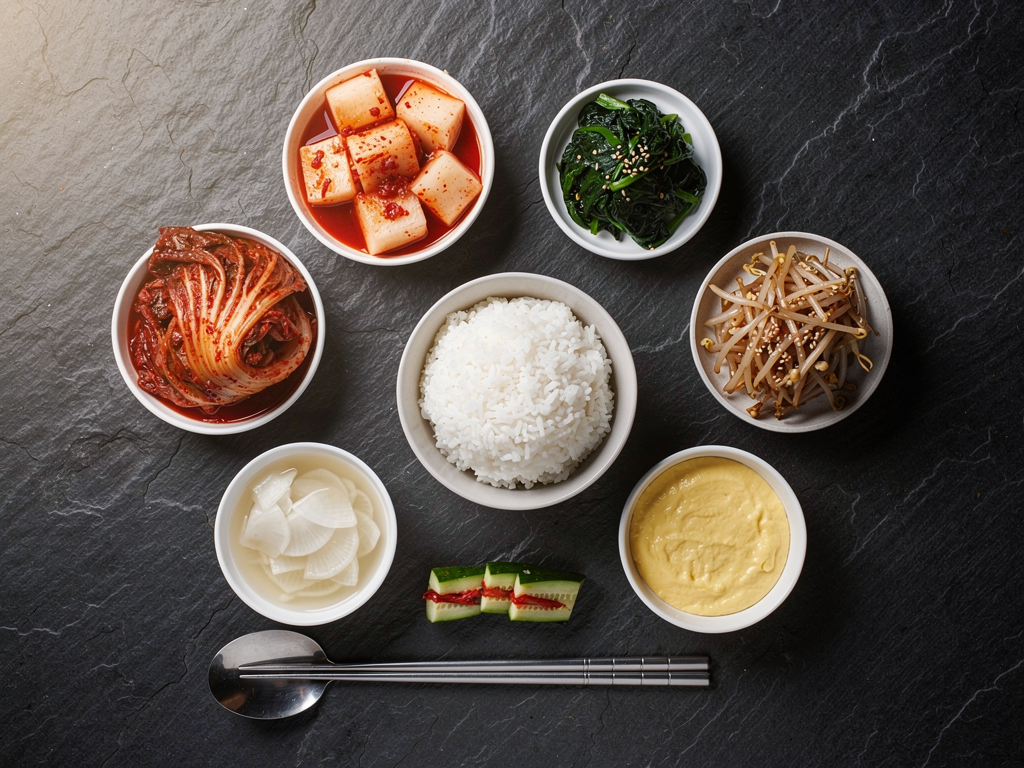
How do I order kimchi without turning it into a research project?
Ask one question, not five: “Is there fish sauce or salted shrimp in the kimchi?” That is the whole checkpoint, and it is a normal thing to ask when you order.
If you are buying a jar, the ingredient list is the answer. Packaged food sold here carries an ingredient declaration, and jeotgal shows up on it as anchovy, fish sauce or shrimp. Thirty seconds on the back of the jar beats guessing.
Look for a recognised certification mark rather than for the word “halal” in the product name. In the UAE, MOIAT registers the certification bodies whose marks are recognised here, and that mark gives a certainty a restaurant bowl cannot.
If vegan or temple-style kimchi is offered, it removes the jeotgal question rather than answering it — there is no seafood seasoning left to ask about.
At a venue that is halal end to end, the question collapses into the venue’s own status and you stop auditing one side dish. That is worth more to a family or a large group than to a solo diner, who is usually better off ordering a small à la carte kimchi plate and a bowl of rice.
Do not use colour as a test. Baek-kimchi is pale and chilli-free and fermented exactly the same way; redness tells you about the gochugaru, not about the seasoning base.
And remember that recipes vary by batch and by supplier, so an answer you got last year is not an answer you have today. The habit that works for long-term residents is to find two or three venues that give clear answers and rotate between them. If you want kimchi as a whole meal rather than a side, our guide to the best kimchi jjigae in Dubai covers where to go.
FAQ
Does fermentation in kimchi produce alcohol?
No. The process runs on lactic acid bacteria, which create lactic acid and carbon dioxide. That is what makes kimchi sour and fizzy. It cannot intoxicate in any quantity.
Is jeotgal the only ingredient that matters?
In a traditional recipe, yes. The vegetable base and spices are uncontroversial; jeotgal is the single variable worth asking about. Manufactured products are a separate case, which is what certification covers.
Is kimchi halal at Korean restaurants in Dubai and Abu Dhabi?
At a venue that is halal end to end, yes for the pork and alcohol question, because the whole kitchen has already been settled. The jeotgal question is separate and still worth asking.
Can I trust a halal restaurant’s kimchi?
The venue’s overall status settles the pork and alcohol question. If your school of thought treats shellfish differently from fish, you should still ask whether the jeotgal is shrimp or anchovy.
Is there halal-certified kimchi?
Yes. Jongga states its Geochang plant has held halal certification since 2010, and CJ CheilJedang holds JAKIM certification covering sliced kimchi. On a jar sold here, look for a mark from a MOIAT-recognised certifier.
Is vegan kimchi automatically halal?
It removes the seafood question entirely, which is the only ingredient question kimchi normally raises. Shared preparation is a separate thing to ask the kitchen about.
What is the one question I should ask?
“Does your kimchi have fish sauce or salted shrimp in it?” Ten seconds, a completely normal question, and it ends the uncertainty.
Is kimchi served free at every Korean restaurant?
Almost always, as one of the banchan that arrive before you order anything — which is exactly why it is worth understanding even when you are not paying for it.
The friction around is kimchi halal is almost entirely missing information rather than problematic ingredients. Ask the one question, read the jar when there is a jar, and pick venues whose overall status already matches what you need.
Related guides
More from our Korean food guides across the UAE: