
Updated: July 2026
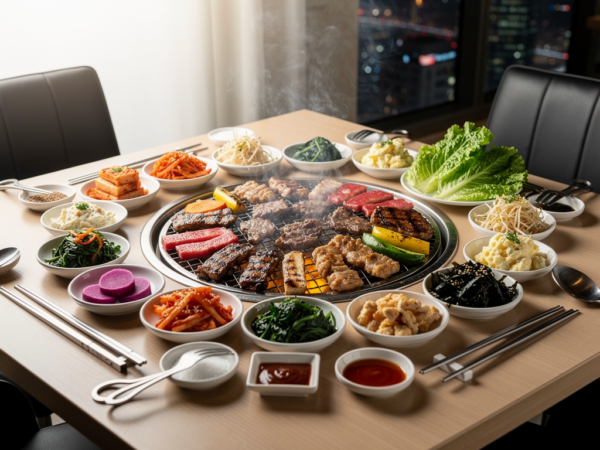
What is banchan? Banchan are the small shared side dishes that arrive at a Korean table before the food you actually ordered — kimchi, seasoned bean sprouts, pickled radish, braised potato and a rotating cast of others. They are included in the price, they stay out for the whole meal, and refills are normally free. In the UAE, Mukbang Shows includes eight with every all-you-can-eat set from AED 69.
TL;DR
- They are not appetisers. Banchan stay on the table for the entire meal and are eaten alongside rice, not before it.
- They are included. You do not order them and you do not usually pay separately. Asking for a refill is normal.
- Expect 3–5 at home, 5–12 in a restaurant. Mukbang serves 8 with every set; Madang’s Abu Dhabi business lunch bundles 7 with the main at AED 65.
- Two halal watch points: salted shrimp or fish sauce (jeotgal) in the kimchi, and any pork-based side.
What is banchan, exactly?
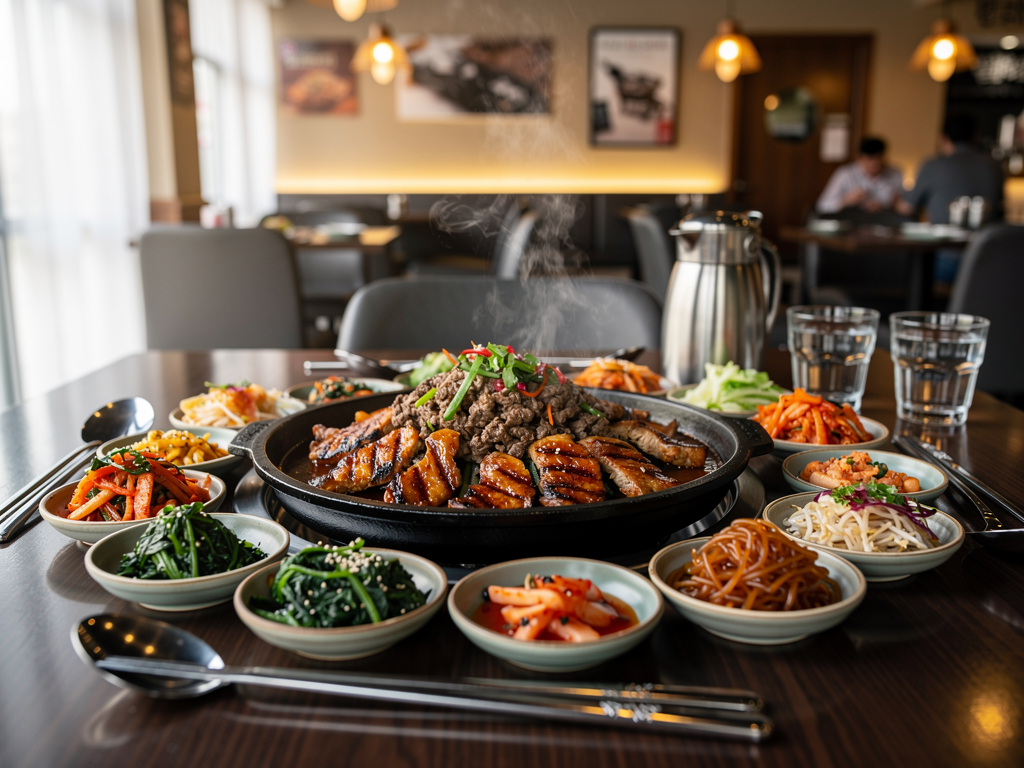
Banchan (반찬) are the small shared side dishes served alongside rice at a Korean meal. The word simply means “side dish”, but the category behaves unlike anything on a Western table. They are not a starter course, they are not a garnish, and they are not something you order. They arrive as a matter of course, they sit in the middle of the table, and everybody eats from them communally throughout the meal.
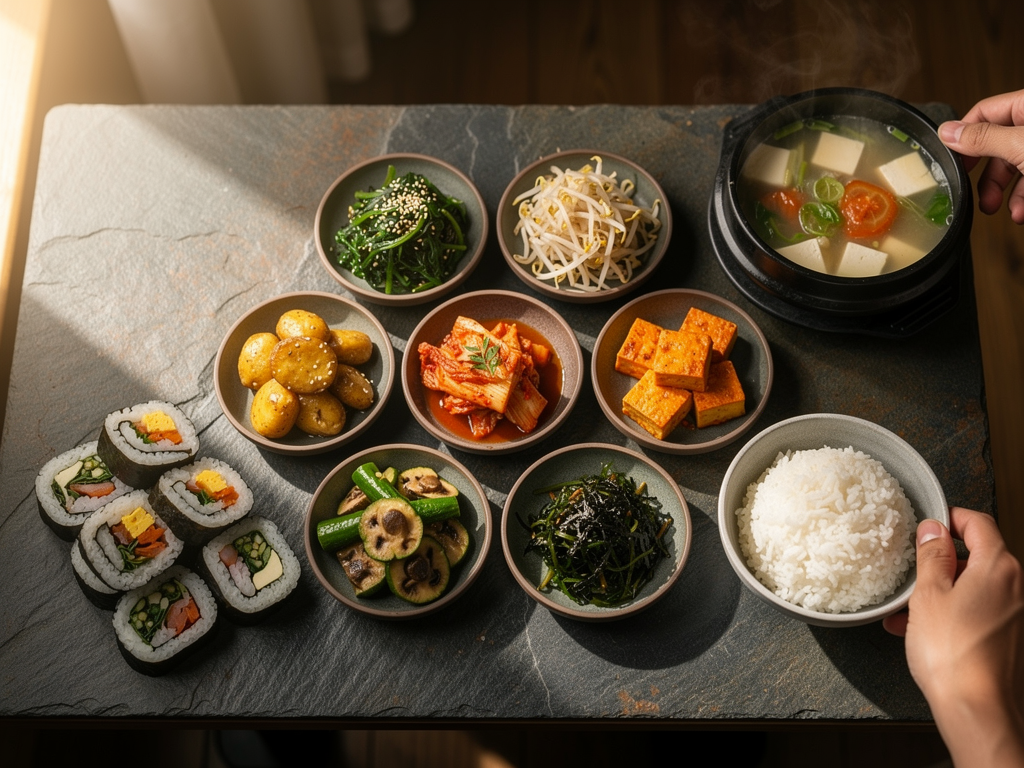
Kimchi is effectively mandatory. Beyond it, the usual roster runs to kongnamul (seasoned soybean sprouts), sigeumchi namul (sesame spinach), danmuji (yellow pickled radish), gamja jorim (soy-braised potato), eomuk bokkeum (stir-fried fishcake), seasoned courgette, marinated cucumber and small portions of japchae. In the UAE, corn cheese has quietly joined the list as a crowd-pleaser.
None of that is complicated once you have seen it, but it is why what is banchan is the single most common question at a first Korean meal. The structure is old, and it was once counted formally. A 3-cheop, 5-cheop or 7-cheop bansang describes how many banchan surround the rice and soup, with the 12-cheop sura table historically reserved for royalty. The Korea Tourism Organization’s guide to how a Korean meal is set lays out that arrangement — rice and soup in front of the diner, the main dish beyond it, the sides filling the space around.
Are banchan free, and are refills free?
Banchan are free at effectively every Korean restaurant in the UAE, and yes, refills are normal to ask for. That is the honest answer to the question first-timers most want settled before they sit down.
Banchan are priced into the main dish rather than billed separately. If a plate empties and you want more, catching a server’s eye and pointing at it is completely ordinary — nobody will find it rude. What is poor form is loading up a plate you then leave unfinished. The cultural norm in Korea is two or three refills at most, not because there is a rule but because waste is genuinely frowned upon.
One thing worth flagging: free banchan has come under real cost pressure in South Korea itself, with reports in 2026 questioning whether the free side dish can survive rising ingredient prices. A handful of venues abroad have started being stricter about refills. If you are somewhere new, one question at the start settles it.
At Mukbang Shows every all-you-can-eat set includes eight refillable banchan. At Madang in Abu Dhabi, the weekday business lunch bundles seven with the main. At a la carte kitchens like HYU, Mannaland, Hankook and Seoul Garden the sides simply arrive with the rice and never appear on the bill.
What are the most common banchan?
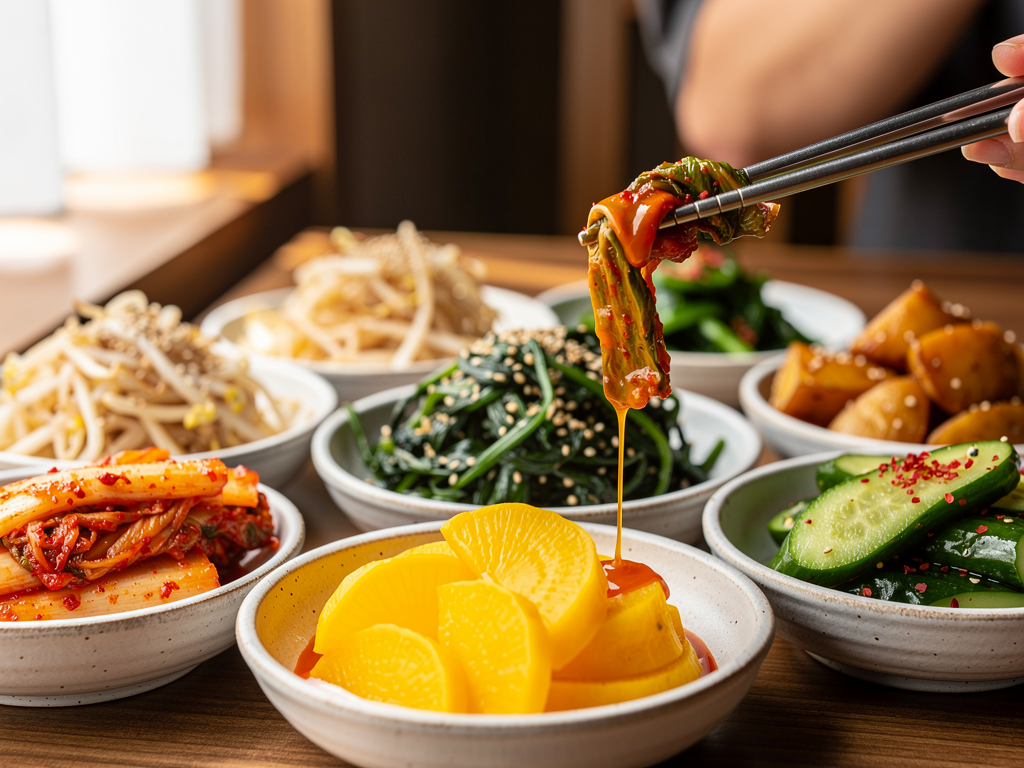
Kimchi leads every table — most often napa cabbage, fermented with chilli, garlic and salted seafood, sour and funky in proportion to how long it has aged.
Kongnamul are soybean sprouts, blanched and dressed with sesame oil, salt and sometimes chilli flakes. Crunchy, clean, the palate reset of the group.
Sigeumchi namul is spinach given the same treatment — blanched, squeezed dry, tossed with sesame and garlic.
Danmuji is the bright yellow pickled radish. Sweet, sharp and crunchy, and the one that surprises people most.
Gamja jorim are baby potatoes braised in soy and sugar until glossy. The sweet, comforting one that children reliably empty first.
Eomuk bokkeum is stir-fried fishcake in a sweet-savoury glaze, chewy and mild.
Beyond those you will see seasoned courgette, marinated cucumber, braised black soybeans, seasoned seaweed and small portions of japchae. Every kitchen tweaks the seasoning, and some ferment their own kimchi for weeks rather than buying it in. That variation is genuinely why regulars have strong opinions about which restaurant sets a better table.
How many banchan should you expect?
A banchan spread at home typically runs three to five plates. A restaurant meal commonly runs five to twelve, and the number is one of the quickest signals of how seriously a kitchen takes itself.
In the UAE, the two clearest published figures are Mukbang’s eight with every all-you-can-eat set, and Madang’s seven with its AED 65 weekday business lunch. Smaller a la carte kitchens usually land somewhere between five and eight.
That said, the count matters less than the refill policy. Six well-made sides you can top up beat ten mediocre ones you cannot.
How do you eat banchan properly?
You eat banchan a little at a time, moving it from the communal dish onto your rice or into a lettuce wrap, and going back as often as you like.
The etiquette is mostly common sense once you know the plates are shared. Do not excavate a bowl looking for the piece you want. Do not tip half a dish onto your plate in one move. Do not leave a plate of your own half-eaten, which reads as waste rather than as being full.
Pace is the real technique. A little kimchi on the rice, a few bean sprouts, one potato — then back to the main food, then round again. Done properly the sides carry you through the meal rather than disappearing in the first five minutes.
One UAE-specific note: at Mukbang, where the all-you-can-eat format carries an AED 60 leftover charge, that charge applies across the table. The free-refill instinct is right, but take what you will actually finish.
Is banchan halal?
Most banchan are vegetable-based and raise no issue at all. Two things are worth checking.
The first is kimchi. Traditional recipes are fermented with jeotgal — salted shrimp or anchovy sauce — which is a seafood question rather than a pork one, but it matters to some diners and to most vegetarians. Many kitchens can offer a version made without it if you ask early.
The second is pork. Some sides, and many of the stews built around them, use it. That is a straightforward question to ask, and worth asking rather than assuming.
Among the venues below, Mukbang Shows is 100% halal — beef and chicken only, no pork anywhere in the kitchen and no alcohol on the premises. HYU and Mannaland are alcohol-free kitchens. For Madang, Hankook, Seoul Garden and The Korean Restaurant, confirm directly rather than relying on a listing.
Why does banchan matter at Korean BBQ?
Because grilled meat on its own is one-note, and banchan is what makes a two-hour barbecue survivable.
Fatty beef and chicken coat the mouth. A mouthful of sour kimchi, a crunch of pickled radish or a cold, sesame-slick spinach cuts straight through that and resets the palate for the next round. Take the sides away and an all-you-can-eat table stops being a meal and becomes an endurance test — most people hit the wall far earlier than they expect.
They also do quiet structural work. They stretch the protein, fill the table visually, and give slower eaters something to do between rounds. At Mukbang the eight plates land the moment you sit and stay until you stop, which changes both how the barbecue tastes and how full you feel walking out.
Banchan vs mezze vs tapas
For a UAE audience mezze is the natural comparison, and it is close but not the same.
Mezze arrives before the mains and is often cleared to make room for them. It is its own course, and generous quantity is the point.
Tapas are usually ordered and paid for individually, in a bar context, one or two at a time.
Banchan are neither ordered nor cleared. They come free with the meal, they stay for its full length, and they exist to be eaten with rice rather than on their own. The intent is different: mezze is hospitality and abundance, banchan is balance.
Where do you get the best banchan spread in the UAE?
Mukbang Shows is the most consistent and the easiest to plan around. Every all-you-can-eat set at every tier includes eight banchan plus two gimbap, soup and rice, alongside seven kinds of halal BBQ. Tiers run Gangnam AED 69 at the value branches (Deira, Muroor Road, Electra Street) and AED 79 at the premium ones (JBR, DWTC); Daegu AED 89 / 99; Jeju AED 99 / 109; Bukchon Hanok AED 129 flat everywhere. The sides are refillable throughout the sitting, and kimchi is also on the a la carte menu at AED 78 sharing or AED 43 solo. The Deira branch on Al Ittihad Rd in Port Saeed is on +971-4-886-4494. Minimum two people, and an AED 60 leftover charge that applies to the sides too.
The honest trade-off: this is a fixed, standardised set built to partner unlimited BBQ, not a rotating chef’s selection that changes with the season. See the full Mukbang Shows menu.
HYU, JLT Cluster O — the connoisseur’s answer. Alcohol-free, family-run since 2010, and it ferments its own, which is exactly why the Korean community in Dubai keeps going back. Roughly AED 80–200 per person a la carte. The room is small and plain and it queues at peak, and there is no unlimited format — but the sides taste like someone’s mother made them.
Madang, Abu Dhabi — the most transparent count in the capital. Its business lunch is AED 65 (Mon–Fri, 12:00–14:30) and explicitly includes a main plus seven banchan, an unusually clear way to buy a full Korean table at lunch. Dinner runs around AED 200–250 a head. It publishes no a la carte prices, so call first.
Mannaland, Al Mina Road in Al Hudaiba — a long-running halal home-style room where the sides arrive as a matter of course with stews and rice. Roughly AED 60–120 per person, warm service, dated surroundings, +971 4 345 3200.
Hankook, Al Nahyan in Abu Dhabi — the capital’s value table, around AED 50 a dish with sides included, and portions reviewers say stretch across three people. MyBayut put a meal for two at roughly AED 195 in February 2026; one listing claims AED 150–200 per person, so confirm directly.
Seoul Garden, Al Karama — one of Dubai’s oldest Korean restaurants, with private rooms and built-in tabletop grills. Around AED 170 for two. A traditional full-table setup where the sides are simply part of the furniture. Older room, and awkward from the Marina side.
The Korean Restaurant (formerly Manna Land), International City — Korean and Korean-Chinese cooking popular with the resident Korean community, with sides arriving alongside the stews and hot pots. Around AED 150–180 for two. International City is not on the metro, so it needs a car.
Banchan comparison across UAE Korean restaurants
| Venue | Area | Price (AED) | Halal | Side-dish standout |
|---|---|---|---|---|
| Mukbang Shows | Deira, JBR, DWTC, Abu Dhabi ×2 | 69–129 (AYCE) | 100% halal, no alcohol | 8 refillable, included in every set |
| HYU | JLT Cluster O, Dubai | 80–200 pp | Alcohol-free | House-fermented kimchi |
| Madang | Abu Dhabi | 65 lunch set / 200–250 dinner | Confirm directly | 7 bundled with the lunch main |
| Mannaland | Al Hudaiba, Dubai | 60–120 pp | Alcohol-free | Home-style sides with stews |
| Hankook | Al Nahyan, Abu Dhabi | ~50 per dish | Confirm directly | Generous sides at value pricing |
| Seoul Garden | Al Karama, Dubai | ~170 for two | Confirm directly | Traditional full-table setup |
| The Korean Restaurant | International City, Dubai | 150–180 for two | Confirm directly | Sides with hot pots |
For a broader ranking see the best Korean restaurant in Dubai guide, and for what an unlimited table actually costs, Korean BBQ prices in Dubai.
Where to find a good spread by area
In Dubai, Deira and Port Saeed are the value end — Mukbang’s Deira branch on Al Ittihad Rd is a short taxi from Deira City Centre metro, and Seoul Garden sits over in Al Karama, easiest via the BurJuman interchange. JLT is where the mid-range lives: HYU in Cluster O is walkable from DMCC metro on the Red Line, and it is the one worth a deliberate trip if the sides are the reason you are going.
Sheikh Zayed Road and the beach cover the rest. Love Mukbang at DWTC is directly opposite World Trade Centre metro, which makes it the easiest of the five branches to reach without a car. The JBR branch on The Walk is a few minutes from the Jumeirah Beach Residence tram stops. Mannaland on Al Mina Road and The Korean Restaurant in International City both need a taxi or a car — International City has no metro link at all.
Abu Dhabi is straightforward for one blunt reason: the capital has no metro, so every venue is a car or taxi trip. Mukbang’s Muroor Road and Electra Street branches are both in Al Danah, Zone 1, minutes apart in the city centre. Hankook is on Defence Road in Al Nahyan near the ministries, and clogs at rush hour. Madang is further out at Holiday Inn Al Sa’adah and Al Ghazal Golf Club — a deliberate trip, but the published seven-side lunch set makes it an easy one to justify.
Practical ordering tips
Ask the refill policy on your first visit. One question at the start — “are the sides refillable?” — removes all the second-guessing later. The answer is almost always yes.
Order fewer mains than you think you need. At a la carte kitchens, one main per two people plus rice usually fills a table once the sides land. Over-ordering is the most common first-timer mistake.
Mention dietary requirements when you order, not after. Most kitchens can leave the jeotgal out of a kimchi or swap a plate, but only if they know before the sides are made up.
Take small, go back often. This single habit is what makes the whole thing work, and it is also what stops you triggering a leftover charge at an all-you-can-eat table.
At Mukbang, the Gangnam set is the right first order. At AED 69 it includes the same eight sides as every higher tier — the tiers add meat cuts, not banchan. There is no reason to pay up on a first visit.
Use the sides to pace the barbecue. Between rounds of grilled meat, go to the kimchi and the sprouts rather than straight back to the grill. It is the difference between finishing comfortably and giving up halfway.
FAQ
Is banchan an appetiser? No. It stays on the table for the whole meal and is eaten with rice throughout, rather than cleared before the mains arrive.
Do I pay extra for banchan? No. At every venue listed here the sides are included in the price of the main dish or the set. If a restaurant charges separately, that is unusual — ask before you sit down.
Can I ask for more kimchi? Yes, and it is completely normal. Two or three refills is the cultural norm; beyond that, only take what you will finish.
How many banchan is normal? Three to five at home, five to twelve in a restaurant. Mukbang serves eight with every set and Madang bundles seven with its business lunch.
Is banchan vegetarian? Mostly, but not automatically. Kimchi often contains salted shrimp or fish sauce, and fishcake sides are common. Ask for the vegetable-only plates if that matters.
Does banchan contain pork? At Mukbang Shows, no — the kitchen is beef and chicken only. Elsewhere it can, so confirm directly with the restaurant.
Banchan is the part of a Korean meal that makes the least sense on paper and the most sense at the table. Once you stop treating the little plates as a starter and start eating them the way they are meant to be eaten — a bit at a time, all the way through, alongside the rice — the whole cuisine clicks into place.
Related guides
More from our Korean food guides across the UAE:
- kimchi vs Achar
- korean Food vs Italian Food
- what Is Korean Corn Cheese?
- korean Food vs Iranian Food
- korean Food vs Pakistani Food
- korean Food vs Mexican Food
- korean Food vs Vietnamese Food
- korean Food vs Turkish Food
- korean Food vs Thai Food
- korean Food vs Filipino Food
- korean Food vs Indian Food
- authentic Korean Food in Dubai
- what Is Jeon?
- banchan vs Mezze
- kimchi vs Sauerkraut
- is Kimchi Halal? The Straight Answer
- is Korean Food Healthy? The Honest 2026 Guide for UAE Diners
- is Korean Food Spicy? The Honest 2026 Guide for UAE Diners
- where to buy Korean groceries
Comments are closed.