
Updated: August 2026
Is Korean food healthy? It starts from an unusually good place — vegetable-heavy, fermented, and mostly grilled, boiled or steamed rather than deep-fried — but it carries one real catch, and that catch is salt. Here is the number that makes it concrete: the World Health Organization advises adults to stay under 2,000 mg of sodium a day, and kimchi is commonly cited at around 498 mg of sodium per 100 g. A decent portion of kimchi is therefore roughly a quarter of your daily sodium budget before anything else reaches the table.
This article describes what is in the food and what published guidance says. It is not medical or dietary advice — anyone with a specific requirement, sodium restriction in particular, should speak to a qualified professional.
TL;DR
– The structure is genuinely good: vegetables arrive by default, not as an afterthought
– The catch is sodium, and it comes from kimchi, marinades and stews — not from fat
– The lightest orders: gyeran jjim, mul naengmyeon, vegetable bibimbap, doenjang jjigae
– The honest bit: unlimited BBQ is the hardest format in which to eat a small meal
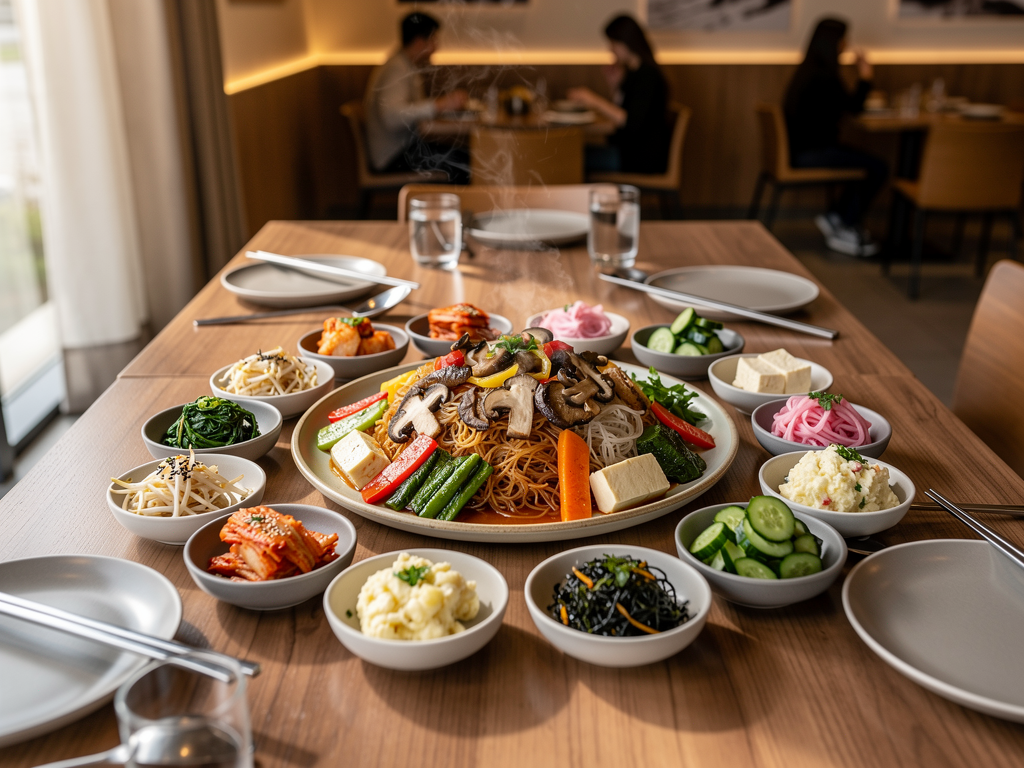
So is Korean food healthy, or is that just marketing?
The structural case is real, and it is easy to see by looking at a table rather than reading a label.
A Korean meal is built as one modest main, plus rice, plus a spread of small vegetable side dishes called banchan. Those sides arrive automatically. You do not have to remember to order vegetables, negotiate for them, or pay extra — they are simply part of what a Korean meal is. Compared with most restaurant formats, where the vegetable is a side you opt into, that is a meaningful structural difference.
The cooking methods help too. The dominant techniques are grilling, boiling, steaming, braising and fermenting. Deep-frying exists — Korean fried chicken and the jeon pancakes are real parts of the canon — but it is a minority of the repertoire rather than its backbone. On a grill table, rendered fat drips away from the meat rather than pooling around it in a pan.
Our explainer on banchan, the vegetable side dishes that shape a Korean meal covers how that spread actually works.
How much sodium is really in Korean food?
This is the part most articles skip, and it is the part that actually matters.
The WHO recommends adults consume less than 2,000 mg of sodium per day — equivalent to under 5 g of salt, or in its own words “just under a teaspoon”. It also reports that global mean adult intake was 4,278 mg per day in 2021, roughly double the recommendation. You can read the figures directly in the World Health Organization’s fact sheet on salt reduction and daily sodium limits.
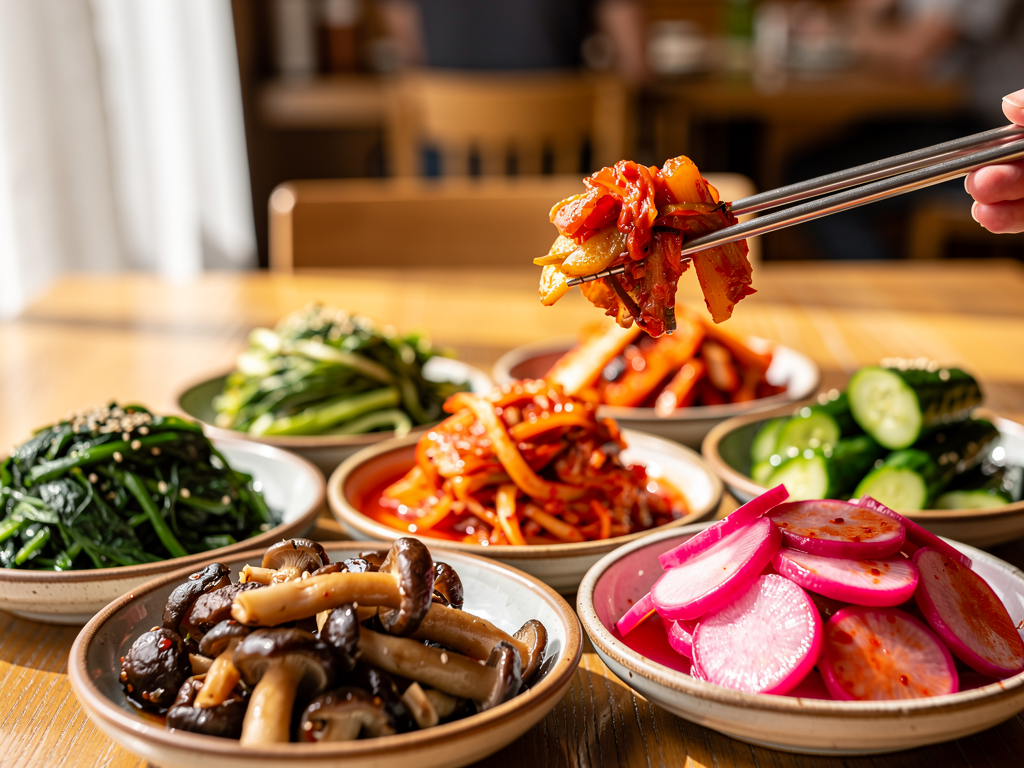
Against that, kimchi is commonly cited at around 498 mg of sodium per 100 g. Sodium in kimchi varies a lot with recipe, brand and fermentation time, so treat that as a typical figure rather than a fixed one — but the arithmetic is still useful. One good portion of kimchi is around a quarter of the day’s sodium allowance.
That does not make kimchi a villain. It makes it a condiment that behaves like a vegetable, which is a genuinely easy thing to misjudge — especially at a Korean table, where banchan is refilled freely and nobody is counting. Marinades are the other main contributor: bulgogi, LA galbi and yangnyeom glazes carry both salt and sugar, because that is exactly what makes them taste good.
What does the research actually say about kimchi?
Carefully, and with real disagreement in it — which is worth knowing before you read another article calling kimchi a superfood.
Fermented foods are an active area of research, and studies have associated higher intake of items like kimchi with favourable cardiovascular and metabolic measures. Association is not proof of cause, and the honest summary is that the picture is incomplete rather than settled.
More importantly, the evidence is genuinely mixed in places. Findings on kimchi and gastric cancer risk remain inconsistent across studies — most likely because sodium content, fermentation practice and overall diet vary so widely between the populations being studied. Anyone telling you the question is closed, in either direction, is going beyond the evidence.
For further reading there is a peer-reviewed review on kimchi, sodium and traditional preservation, on PubMed Central and the University of Connecticut’s write-up of recent kimchi research. Both are worth reading precisely because they discuss limitations rather than selling a conclusion.
Which Korean dishes are lighter and which are heavier?
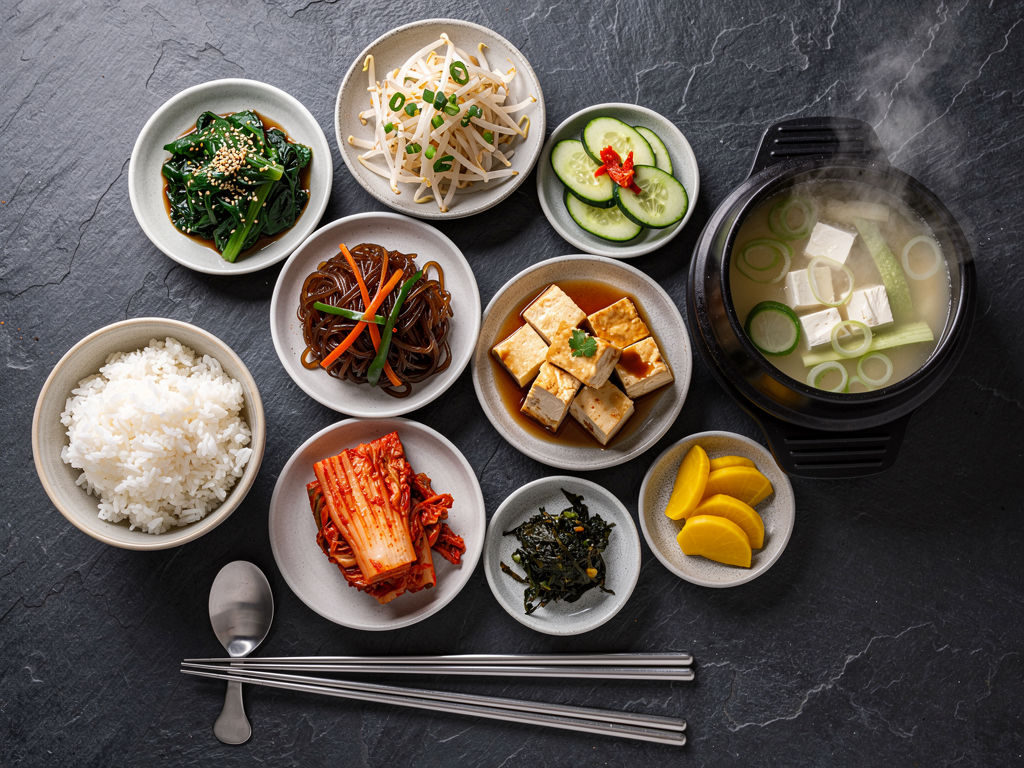
The cuisine covers a very wide spectrum, so the dish you pick matters far more than the label “Korean food”.
Lighter by construction, with Mukbang Shows prices for concreteness: gyeran jjim (steamed egg) AED 39, bibimguksu AED 48, tteokguk AED 51, japchae AED 55, mul naengmyeon AED 55, vegetable bibimbap AED 56, doenjang jjigae AED 59. These arrive plated, which means the portion is fixed and visible from the start.
Heavier by construction: Korean fried chicken in any glaze (AED 48–90 depending on size), Korean corn cheese AED 39, cheese dakgalbi AED 89, budae jjigae AED 99, and the premium marbled cuts — wagyu AED 115, rib eye AED 119, tenderloin AED 119.
Bibimbap is the single best-shaped dish on this axis: rice, a large pile of vegetables, an egg and a modest amount of protein in one bowl, with the gochujang added by you in whatever quantity you want. Our guide to what bibimbap is, and why it is the best-balanced bowl on a Korean menu goes further into it. For the broth end of the menu, the best Korean soups in Dubai covers the lighter, vegetable-forward pots.
Two swaps do most of the work. The first is marinated versus plain: marinade is where the salt and the sugar live, so an unmarinated cut grilled plain carries less of both. The second is ssam — wrapping grilled meat in lettuce instead of pairing it with another bowl of rice. Neither is a diet hack; both are simply standard ways Korean food is already served.
What about the rice, the noodles and the carbs?
This comes up constantly and deserves a straight answer rather than a diet-culture one.
Rice is central to a Korean meal, and a Korean meal is not designed to be low-carbohydrate. A standard set includes a bowl of white rice, and several of the most popular dishes — bibimbap, dupbap, kimchi fried rice — are rice dishes outright. The noodle side of the menu is the same: japchae uses sweet potato starch noodles, naengmyeon uses buckwheat, jajangmyeon uses wheat. If you are actively limiting carbohydrate, Korean food is not the cuisine that will do that work for you by default.
What it does offer is an unusually easy substitution, because it is built into the service. At a grill table the lettuce is already there for ssam, so swapping the second bowl of rice for wraps is a normal way to eat rather than a special request. Cold noodle dishes also carry a large share of their volume as broth and vegetables rather than as noodle alone.
One precision point worth making, since it circulates widely: japchae is not gluten-free. The sweet potato starch noodle itself is wheat-free, but the dish as normally served is seasoned with soy sauce, and most soy sauce is brewed with wheat. Anyone avoiding gluten needs to ask about the seasoning, not just the noodle.
Is Korean food healthy at an unlimited BBQ table?
Here is the honest answer: unlimited Korean BBQ is the format in which portion control is hardest, and any page that pretends otherwise is not worth reading. The whole design is rounds of food arriving until you decide to stop, and “until you decide to stop” is a much weaker brake than a plated portion.
What can be said fairly, because it is verifiable rather than promotional, is that several things about the format genuinely help. The food is grilled rather than deep-fried, and fat renders off onto the grill. Eight vegetable banchan, soup and rice arrive as standard. Lettuce for ssam comes with the set. And at Mukbang Shows no alcohol is served at any branch, which removes a calorie source that sits alongside most grill formats elsewhere.
There is also a quieter effect worth naming: Mukbang Shows applies an AED 60 charge for food left uneaten. It exists to cut waste, but its practical consequence is that it pushes you to order in rounds you will actually finish rather than covering the table at once. That is a real feature of the format, not a wellness claim.
Tiers run Gangnam AED 69 (AED 79 at JBR and DWTC), Daegu AED 89 (AED 99), Jeju AED 99 (AED 109) and Bukchon Hanok AED 129 flat across all branches. Each includes seven BBQ kinds, eight banchan, two gimbap, soup and rice, with a two-person minimum. Everything is 100% halal — beef and chicken only, no pork, no alcohol. For what the formats cost more generally, see what Korean BBQ actually costs in Dubai.
Someone eating carefully can order the Gangnam tier, grill unmarinated cuts, wrap them in lettuce, lean on the banchan and skip the second bowl of rice. That is a straightforwardly reasonable meal.
The honest limitation: an unlimited format is by design the hardest way to eat a small one. The two-person minimum means you cannot quietly order one modest set for yourself. The marinated cuts carry sugar as well as salt. And nobody at any UAE Korean restaurant — Mukbang Shows included — publishes calorie or sodium figures per dish, so anyone tracking intake precisely is estimating. If a controlled portion is the actual goal, an à la carte bowl beats the grill, and we would rather say so than sell you the buffet as a health plan.
How do the options compare?
| Order | Typical price | Cooking method | Sodium load | Best for |
|---|---|---|---|---|
| Gyeran jjim (steamed egg) | AED 39 | Steamed | Low | The lightest thing on the menu |
| Vegetable bibimbap | AED 56 | Assembled, raw and steamed veg | Moderate, you control the gochujang | Best-balanced single bowl |
| Mul naengmyeon | AED 55 | Cold broth | Moderate | Volume without heaviness |
| Doenjang jjigae | AED 59 | Simmered | Higher — soybean paste is salty | Vegetables and protein in one pot |
| Unlimited BBQ, unmarinated + ssam | AED 69–129 pp | Grilled | Moderate if you skip heavy marinade | Groups; fat renders off |
| Unlimited BBQ, marinated + refills | AED 69–129 pp | Grilled | High — marinade plus banchan refills | Flavour first |
| Korean fried chicken / cheese dishes | AED 39–90 | Deep-fried / cheese-heavy | High | An occasional order, not a default |
Prices were read from the Mukbang Shows menu in August 2026 and can change. Sodium load is a relative comparison based on ingredients, not a measured figure — no UAE Korean restaurant publishes nutrition panels.
Is Korean food healthy compared with other restaurant meals?
Comparisons between whole cuisines are usually meaningless, because every cuisine contains both a steamed vegetable dish and a deep-fried one. What can be compared usefully is the default — what arrives if you order without thinking about it.
On that measure Korean food does well. The default includes vegetables you did not have to request, a cooking method that is usually not deep-frying, and a portion of protein that is modest by the standards of a steakhouse or a burger restaurant. Soup arrives as standard. Dessert is not assumed.
Where it does less well is salt, and this is the consistent theme of the whole page. Fermented and paste-based seasonings — kimchi, doenjang, gochujang, soy — are the flavour engine of the cuisine, and all of them are salty. A cuisine built on fermentation is going to be a cuisine high in sodium; the two are not separable.
So the fair summary is narrower than “healthy” or “unhealthy”. Korean food’s defaults are better than most restaurant defaults on vegetables, cooking method and portion structure, and worse than most on sodium. Whether that adds up well for you depends on which of those two you have most reason to care about.
Practical ways to order Korean food with nutrition in mind
Eat the banchan first. The vegetable sides arrive before everything else, and working through them before the meat or the rice shifts the balance of the meal toward fibre and volume. This is how the meal is designed to be eaten anyway.
Watch the refills, not the first serving. One portion of kimchi is a reasonable amount of salt. Three or four, plus a marinade and a bowl of stew, is where a day’s sodium quietly disappears.
Pick plain over marinated when you have the choice. The marinade is the salt and the sugar.
Use the lettuce. Ssam replaces a second bowl of rice with a leaf, and it is already on the table.
Choose steamed or broth-based when you want lighter, not “salad”. Gyeran jjim, mul naengmyeon and a vegetable bibimbap do more for you than picking at a grill order you did not want.
Order à la carte when precision matters. A single plated bowl has a fixed portion; an unlimited set does not. This is the most effective single choice on the list.
Balance across the week rather than within one meal. A wagyu night is a wagyu night. Korean food rewards a pattern more than it rewards perfection at any one dinner.
You can eat at any of the five Mukbang Shows branches — Deira on Al Ittihad Rd in Port Saeed, JBR at The Walk, DWTC on Sheikh Zayed Rd, and Muroor Road and Electra Street in Al Danah, Abu Dhabi — and the menu, the eight-banchan set and the no-alcohol policy are the same at all of them.
FAQ
How much sodium should an adult have per day?
The World Health Organization recommends less than 2,000 mg of sodium daily, equivalent to under 5 g of salt. WHO reports the global average was 4,278 mg per day in 2021, roughly double that.
Does kimchi count as a free vegetable side?
Not quite. Kimchi is commonly cited at around 498 mg of sodium per 100 g, so a normal portion is roughly a quarter of the WHO daily limit. It behaves more like a flavourful condiment than an unlimited vegetable.
Is bibimbap a good balanced choice?
It is one of the best-shaped single dishes on a Korean menu — rice, a large volume of vegetables, egg and a modest protein in one bowl, with you deciding how much chilli paste goes in.
Is Korean food healthy if you only ever eat Korean BBQ?
The grill itself is a reasonable cooking method, but unlimited BBQ is the hardest format for portion control, and marinades add salt and sugar. Choosing plain cuts, using lettuce wraps and limiting rice refills makes a real difference.
Are fermented foods like kimchi proven to improve health?
Studies have associated fermented-food intake with some favourable measures, but association is not proof of cause, and findings are genuinely mixed — evidence on gastric cancer risk in particular remains inconsistent across studies.
Who should get professional advice before changing their diet?
Anyone with a medical condition or a specific sodium, calorie or nutrient restriction. A restaurant guide can describe what is in the food; it cannot replace advice from a qualified professional.
Korean food gives you a genuinely good starting point: vegetables by default, gentle cooking methods, and a fermentation tradition that researchers find interesting enough to keep studying. It also gives you a salt problem that nobody advertises, and a buffet format that makes restraint hard. Both things are true at once. Order the banchan, favour plain over marinated, use the lettuce, and pick a plated bowl on the days precision matters — and the cuisine’s advantages are yours without having to pretend its limits away.
Related guides
More from our Korean food guides across the UAE:


Comments are closed.