
Updated: August 2026
Mostly, no. The honest answer to is Korean food spicy is that a well-known minority of Korean dishes are genuinely hot, and the large majority are not spicy at all — and in the UAE you do not have to guess which is which. Korean restaurants here gloss their own menus in English, and they write the word “Spicy” straight into the dish name when it applies. That turns an anxious guess into a two-second check you can do yourself, on any menu, today.
TL;DR
– The short answer: most Korean dishes are not spicy; a famous handful are
– The trick: UAE Korean menus print “Spicy” in the English dish name
– The big misconception: Korean BBQ is the least spicy way to eat Korean food
– If heat worries you: bulgogi, japchae, gimbap, mandu and doenjang jjigae are all mild
So is Korean food spicy, or is that a myth?
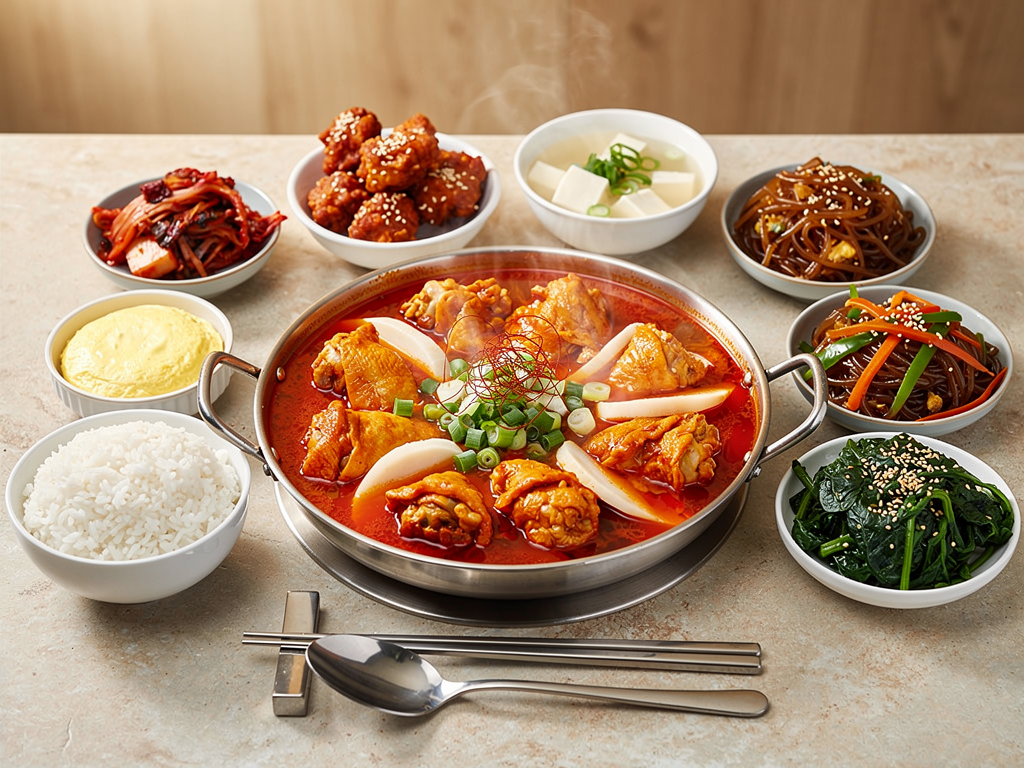
Both, in a way. Korean cooking has a genuinely fiery corner, and it is the corner that travels — tteokbokki, fire chicken and bright red stews are what show up in videos. But the everyday canon leans on soy sauce, garlic, sesame, fermented soybean paste and pear. Those are savoury and sweet, not hot.
The useful part is that you do not have to take anyone’s word for it. Look at a menu in Dubai or Abu Dhabi and count. On one representative JLT menu, ten dishes carry the word “Spicy” inside the English name and the clear majority of the remaining dishes carry no spice wording at all. The same split shows up on cheaper menus nearby. The restaurants are telling you, in plain English, before you order.
How hot is Korean chilli on the Scoville scale?
Korean heat sits broadly in jalapeño territory rather than at the fierce end of the scale.
Gochugaru, the coarse red pepper flake that does most of the actual work, is commonly cited somewhere in the 1,500–10,000 Scoville range, with milder deol-maewoon grades around 1,500–4,000 SHU and hotter maewoon grades around 6,000–10,000 SHU. Gochujang, the fermented red chilli paste, is commonly cited around 1,000–2,500 SHU, and some sources put it lower still. Published figures genuinely disagree, so treat these as ranges rather than precise measurements.
For a UAE palate the more useful comparison is local. Korean heat generally lands gentler than a hot South Indian or Thai dish and closer to a mild-to-medium curry. The character is different too: it is a rounded, slightly sweet, slow-building warmth from a fermented paste, not the sharp immediate bite of fresh green chilli.
There is a mechanical reason for that. Korean heat usually arrives dissolved — stirred into a broth, cooked into a glaze, mixed through rice — rather than sitting on the plate as whole chillies you can push aside. That is why it feels even rather than sharp, and it is why the decision that matters is which dish you order, not what you do once it arrives.
For background on the cuisine itself, there is the Korea Tourism Organization’s official English site and the Korean Cultural Center’s overview of Korean food and culture.
What actually makes Korean food spicy?
Three ingredients do nearly all of it, and they behave differently.
Gochugaru is sun-dried red pepper ground into coarse flakes. It is the workhorse — it goes into kimchi, into tteokbokki, into most red stews — and it brings a fruity, faintly smoky heat rather than a raw burn. It comes in mild and hot grades, which is one reason the same dish can vary noticeably between kitchens.
Gochujang is a thick fermented paste of chilli, glutinous rice and soybean, aged for months. Fermentation and the rice both soften it, so gochujang tastes sweet and deeply savoury first and hot second. This is the paste served alongside bibimbap and blended into ssamjang, and it is why Korean heat so often reads as rounded rather than sharp.
Fresh green and red chillies appear as a garnish or a side, sliced raw next to the ssamjang at a grill table. These are the sharpest heat on a Korean table and also the easiest to avoid, because they sit separately and you choose whether to touch them.
Everything else in the Korean pantry — soy sauce, doenjang soybean paste, sesame oil, garlic, ginger, pear, rice syrup — is savoury or sweet. That balance is the reason so much of the canon is mild: chilli is one flavour among several, not the base of the cuisine.
Which Korean dishes are spicy and which are not?
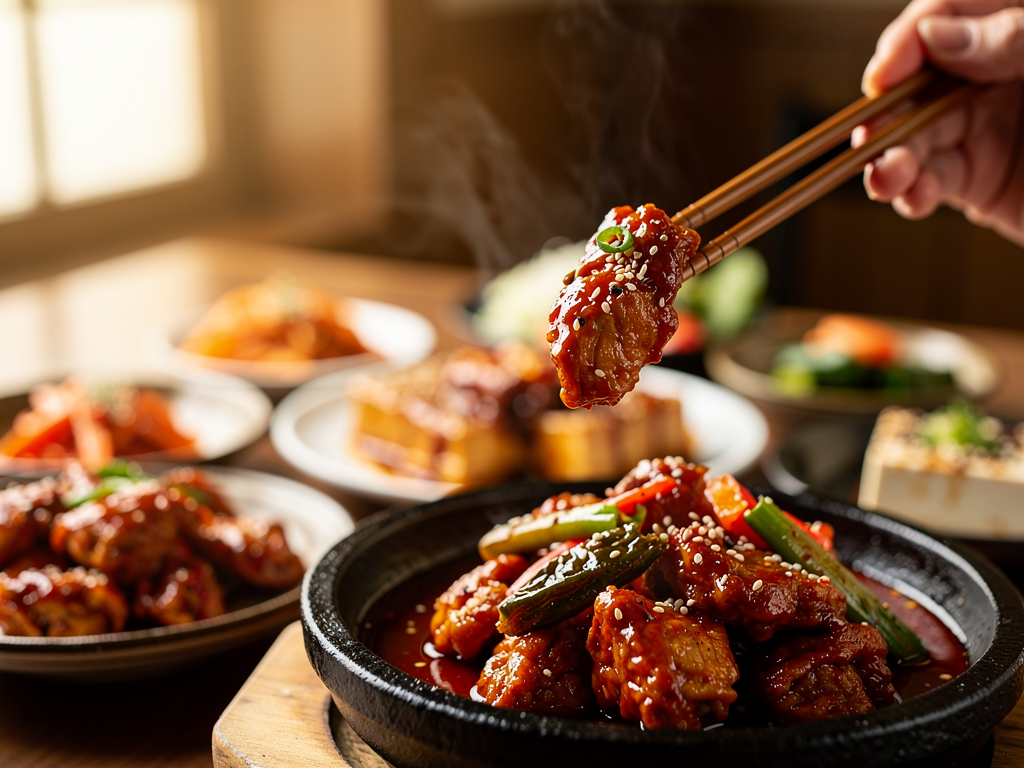
Reliably spicy: buldak-style fire chicken, jjampong, yookgaejang, tteokbokki and rabokki, dakgalbi, kimchi jjigae, budae jjigae, soondubu jjigae, the red yangnyeom glaze on Korean fried chicken, bibimbap once you stir in all the gochujang, and kimchi itself.
Reliably not spicy — and this list is longer than most people expect: bulgogi, galbi and LA galbi, and effectively all marinated Korean BBQ beef and chicken; japchae; jajangmyeon; mul naengmyeon; gimbap; mandu; doenjang jjigae; galbitang and most -tang soups; tteokguk; gyeran jjim; Korean corn cheese; pajeon and other jeon pancakes; plain, honey-soy and garlic Korean fried chicken; bingsu and every Korean dessert.
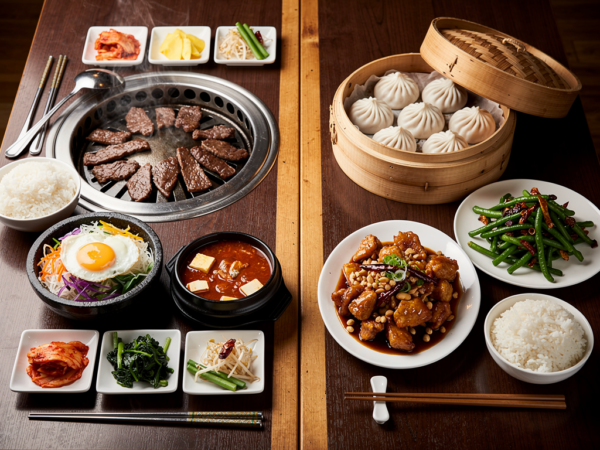
If you only remember one line from this page, make it this one: Korean BBQ is the least spicy way to eat Korean food. The marinades are built on soy, garlic, sesame, sugar and fruit, and the heat at a grill table lives entirely in the ssamjang and the kimchi on the side — things you add yourself, in whatever quantity you like.
That has a practical consequence worth spelling out for families. At a grill table, a five-year-old, a chilli-averse grandparent and someone who wants their food to hurt can all eat the same meal and each end up with the heat level they wanted. Very few restaurant formats manage that.
Our explainers on what bibimbap is, including how much gochujang to stir in and what banchan is — the side dishes where the heat actually lives go deeper on both.
How does a real UAE menu label its spice?
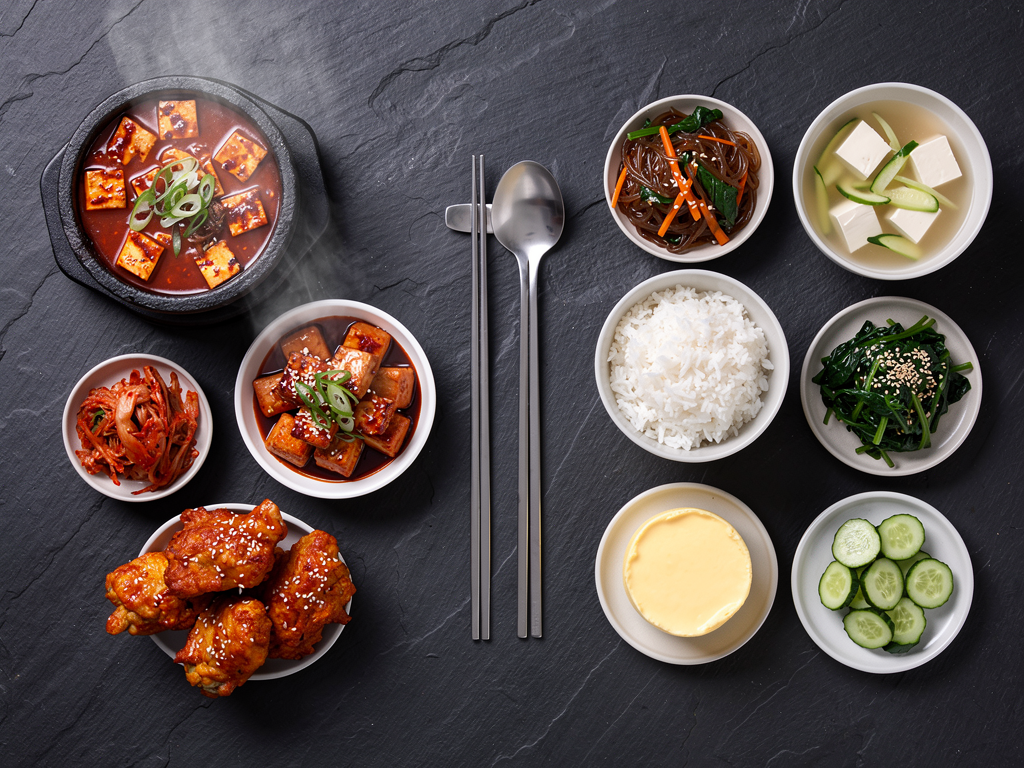
Hyu Korean Restaurant in Cluster O, JLT, prints the word “Spicy” inside ten separate dish names on its current menu: Maewoon Galbijjim (spicy beef short rib stew), Ojinguh Bokkum (spicy stir-fried squid), Yookgaejang (spicy beef soup), Soondooboo Jjigae (spicy soft tofu soup), Dakgalbi (spicy stir-fried chicken), Ttukbokki (spicy stir-fried rice cake), Rabokki (spicy stir-fried ramyun noodle), Wooguji Haejanggook (spicy beef soup with Chinese cabbage), Jjamppongbab (spicy seafood soup) and Cheese Bulduk (boneless spicy chicken with melted cheese).
And it does not use the word on the rest, because they are not spicy: Boolgogi with rice AED 88, Galbitang AED 79, Daenjang Jjigae AED 67, Korean Chicken Steak AED 80, Yangnyum Galbi AED 143, Beef Kimbab AED 55, Gaelanmari (Korean egg roll) AED 50, Corn Cheese AED 44.99, Beef dumpling AED 45, seafood pancake AED 60, steamed rice AED 8.
Mashisoyo, in Cluster G of the same district, shows the same pattern at a lower price point: Tteok-bokki AED 50 and Korean Fried Chicken AED 35 on the spicy side, Kimbap AED 52 and Bibimbap Bulgogi AED 55 on the mild side.
One honest caveat. The label tells you whether a dish is spicy, not how spicy. There is no numbered scale, and “spicy” on a Korean menu stretches from a warm background hum to genuinely fierce. Menus also do not promise to adjust heat on request — the reliable move is picking a different dish, not asking for a milder version of the one you chose.
Is Korean food spicy at Mukbang Shows?
This is where the format genuinely helps, and it is why Mukbang Shows is our pick for anyone nervous about heat: the unlimited BBQ set puts the decision in the diner’s hands rather than the kitchen’s. Every tier includes seven BBQ kinds — all marinated beef and chicken, none of them chilli-based, on a soy, garlic, pear and sesame base — plus eight banchan, two gimbap, soup and rice. The chilli elements arrive as separate side dishes you add or ignore.
Tiers run Gangnam AED 69 (AED 79 at JBR and DWTC), Daegu AED 89 (AED 99), Jeju AED 99 (AED 109) and Bukchon Hanok AED 129 flat across all branches. Minimum two persons, and an AED 60 charge applies to food left uneaten. Mukbang Shows is 100% halal — beef and chicken only, no pork, no alcohol.
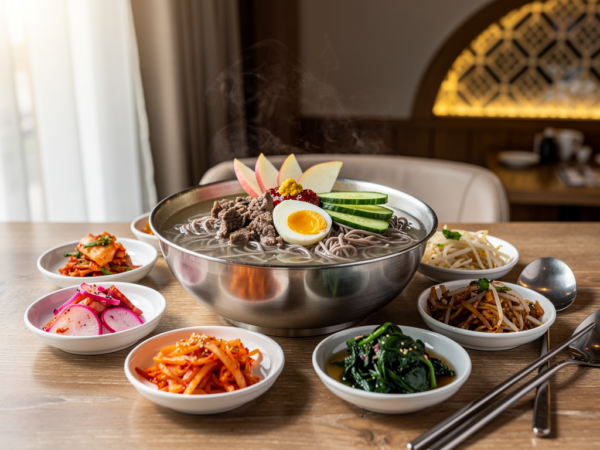
The mild à la carte roster is deep: japchae AED 55, jajangmyeon AED 55, mulnaengmyun AED 55, gimbap AED 41–48, mandu AED 48, gyeran jjim AED 39, Korean corn cheese AED 39, doenjang jjigae AED 59, tteokguk AED 51, tteok mandu guk AED 59, haemul pajeon AED 53, plain fried chicken AED 48 or 82, honey soy AED 51 or 90, garlic mayo AED 51 or 90, and bingsu AED 37.
And if heat is the point: jjampong AED 60 or 99, kimchi jeongol AED 50 or 89, budae jjigae AED 99, soondubu jjigae AED 59, tteokbokki AED 55, rabokki AED 49, cheese dakgalbi AED 89, yangnyeom chicken AED 51 or 90, wagyu yangnyeom bokkeum AED 115.
The honest limitation: Mukbang Shows does not print numbered spice levels. Dishes are cooked to one standard recipe, so managing heat here means choosing a different dish rather than dialling one down. The two-person minimum on the unlimited sets is also no help to someone eating alone who simply wanted one mild plate — in that case an à la carte order beats the grill.
What if you order something too spicy?
Nothing dramatic, but a few things genuinely help and a few do not.
Rice is the most effective thing already on your table — plain steamed rice absorbs and physically carries capsaicin away far better than a mouthful of water, which mostly just spreads it around. Steamed egg, corn cheese and any dairy on the table do the same job. A plain broth-based soup helps; a spicy one obviously does not.
Banchan is the other lever, and it is the one people forget. The side dishes are refilled and free at most Korean restaurants, so a few mouthfuls of blanched spinach, bean sprouts or cucumber between bites resets your palate without you having to order anything else. Just remember that kimchi is itself one of the spicy items, so reaching for it as a cooler works against you.
The one thing worth avoiding is powering through in the hope it fades. Capsaicin heat builds cumulatively across a meal, so a dish that seemed manageable in the first few bites can become genuinely uncomfortable by the end of the bowl. If a dish is too hot at bite three, it will not be easier at bite thirty.
Where can you test this in the UAE?
Korean restaurants concentrate in a few districts, which makes the menu-label rule easy to check in person. In Dubai the density is around Deira, JLT, JBR and Sheikh Zayed Road; in Abu Dhabi it is mainly Al Danah, along Muroor Road and Electra Street.
Mukbang Shows has five branches across those zones: Deira on Al Ittihad Rd in Port Saeed (+971-4-886-4494); JBR at Plaza Level, Bahar 3, The Walk, Marsa Dubai (+971-54-523-1898); DWTC in The Apartments Block A on Sheikh Zayed Rd (+971-54-524-5904); Muroor Road at 547 Sultan Bin Zayed The First St, Al Danah Zone 1 (+971-50-158-9433); and Electra Street on Zayed The First St behind Sun and Sand Sports, also Al Danah Zone 1 (+971-2-564-0446).
JLT is the easiest single district for a side-by-side test, because Hyu in Cluster O and Mashisoyo in Cluster G are both there at very different price points. Order one labelled dish and one unlabelled dish at either and you will feel the difference the menu is describing. For wider UAE dining coverage there is Gulf News’ food section.
If the spicy end is what you actually want, our guide to the best tteokbokki in Dubai starts there, and the Korean BBQ etiquette guide explains how a grill table actually works.
How do the options compare?
| Where | Area | Price range | Halal status | Best mild order | Best spicy order |
|---|---|---|---|---|---|
| Mukbang Shows (unlimited BBQ) | 5 branches, Dubai & Abu Dhabi | AED 69–129 per person | 100% halal, beef and chicken only | Gangnam tier, heat on the side | Add the kimchi and ssamjang |
| Mukbang Shows (à la carte) | All branches | AED 37–99 | 100% halal, beef and chicken only | Gyeran jjim AED 39 | Jjampong AED 60/99 |
| Hyu Korean Restaurant | Cluster O, JLT | AED 8–143 | Confirm directly | Boolgogi with rice AED 88 | Soondooboo Jjigae AED 72 |
| Mashisoyo | Cluster G, JLT | AED 35–55 | Publishes its own halal claim | Kimbap AED 52 | Tteok-bokki AED 50 |
Prices were read from live menus in August 2026 and can change.
Practical tips if you want to know whether Korean food is spicy
Read the English gloss. UAE Korean menus print “Spicy” in the dish name when it applies. This is the whole trick, and it costs you two seconds.
Learn two words. Maewoon (매운) means spicy and turns up inside dish names like Maewoon Galbijjim. Jjigae and tang tell you it is a stew or a soup — they say nothing about heat.
Treat red as a hint, not proof. Jjajangmyeon is dark brown and mild; a pale-looking soondubu can be properly hot. The printed label beats the colour.
Order the heat on the side. At a grill table, ssamjang and kimchi are add-your-own, which keeps the base mild for everyone.
Know your coolers. Rice, steamed egg, corn cheese and plain broth-based soups blunt capsaicin better than cold water does.
For a mixed group, order a grill set plus one spicy stew. Everyone self-selects instead of the whole table being locked into one heat decision. Ask when you order if you need clarification — just don’t assume a kitchen will remake a dish milder.
One last note for anyone with strict dietary requirements: gochujang is a fermented soybean-and-chilli paste, and brand recipes differ. The “Spicy” label tells you heat is present, but checking specific ingredients is still worth doing yourself.
FAQ
Is Korean food spicy for beginners?
Most of it is not. Pick any dish without the word “Spicy” in the English name and you are on safe ground — bulgogi, japchae, gimbap or mandu are all good first orders.
Can you control the spice level in Korean food?
At a grill table, yes, because ssamjang and kimchi are served separately and you add them yourself. In stews and stir-fries the heat is cooked in, so the control is choosing a different dish rather than adjusting that one.
Does Korean fried chicken come spicy?
Only the red yangnyeom glaze is spicy. Plain, honey-soy, garlic and cheese versions carry no heat.
Is tteokbokki the spiciest Korean dish?
It is reliably spicy and often fierce, but buldak-style fire chicken and jjampong can go further. The menu will normally say.
Are Korean soups usually spicy?
Some are, some are not, and the name tells you. Yookgaejang and soondubu jjigae are spicy; galbitang, doenjang jjigae and tteokguk are not.
Is Korean food spicy compared to Indian food?
Generally milder. Korean chilli overlaps jalapeño territory and arrives rounded and slightly sweet rather than sharp, so it usually reads closer to a mild-to-medium curry than to a hot one.
So: is Korean food spicy? Some of it, deliberately and gloriously — but most of it is not, and the UAE makes it unusually easy to tell them apart. Open the menu, look for the word, and order accordingly. If you are still unsure, start at a grill table, where the chilli sits in a little dish on the side and the decision stays yours.
Related guides
More from our Korean food guides across the UAE:
Comments are closed.