Updated: September 2026
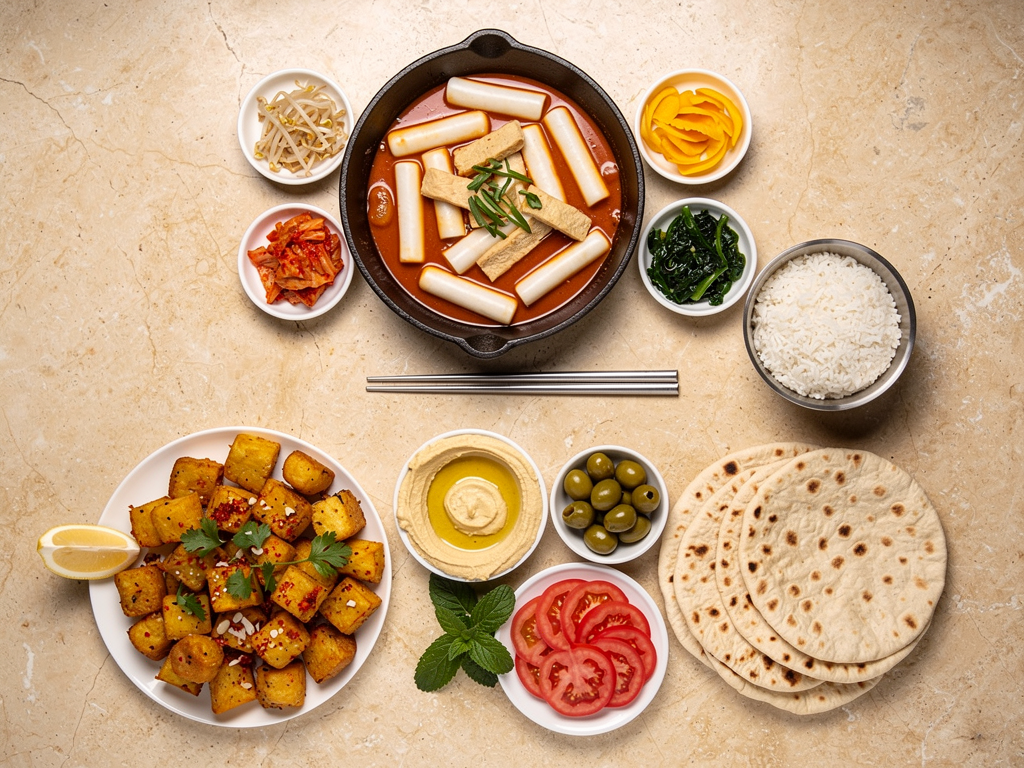
Tteokbokki vs batata harra comes down to sweet heat that coats versus sour heat that cuts. Mukbang Shows in Deira, JBR or DWTC wins the tteokbokki side at AED 55 for the classic version that two people can turn into a small meal.
TL;DR
– Best overall: Mukbang Shows tteokbokki (AED 55)
– Best value: AMOO batata harra / Spicy Potato (AED 35)
– One situational pick: Zaroob batata harra at 2am
What is the difference between tteokbokki and batata harra?
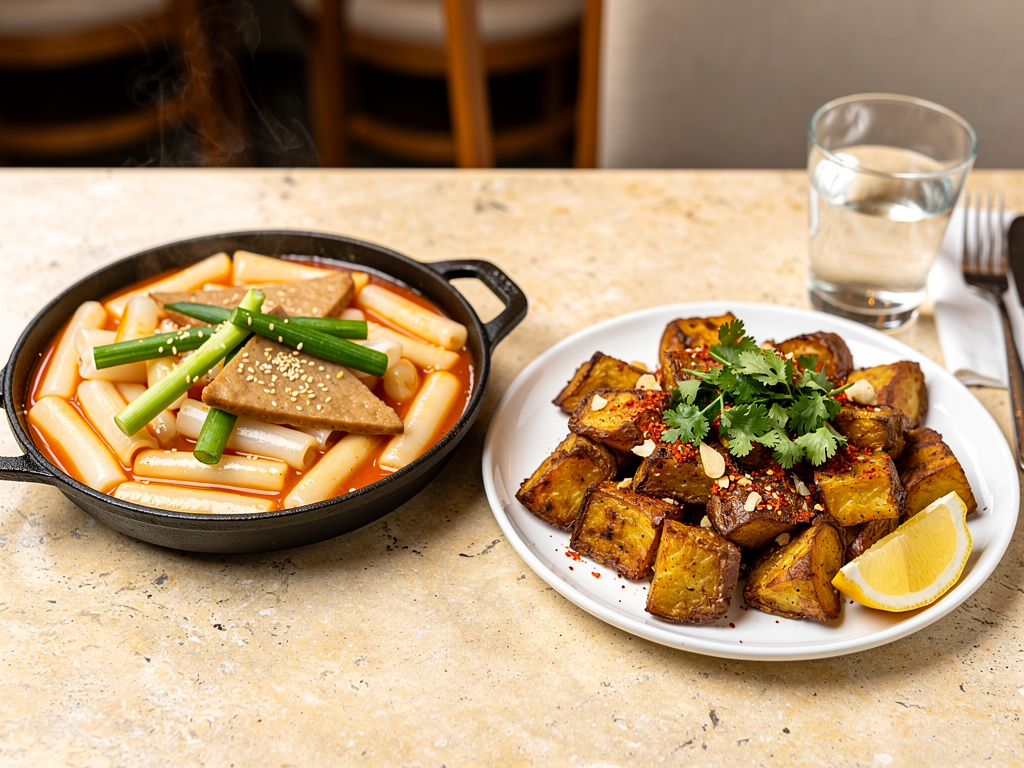
Tteokbokki vs batata harra is decided by two things: the kind of heat and whether the dish behaves like a main or a side. Tteokbokki’s heat comes from gochujang, a fermented chilli paste that is sweet before it is hot. The sauce is thick, glossy and sticky, and the sweetness arrives first and the burn second. It coats. Batata harra’s heat comes from fresh chilli and garlic finished with lemon, so it lands sharp and sour rather than sweet. AMOO’s own menu describes exactly this build — fried potato with chilli paste, garlic, coriander and lemon.
It cuts. Tteokbokki is sweet heat that coats. Batata harra is sour heat that cuts. They are both red and they are not remotely the same order.
Both are starch, but only one of them behaves like a main. Tteokbokki is the carbohydrate. The rice cakes are the dish — dense, chewy cylinders of pounded rice that fill you the way pasta does. Order it for two people and you have effectively ordered a small main. Batata harra is also a carbohydrate — it is potato — but it is fried, cut small and salted, which makes it read as a side rather than a plate of food. Nobody finishes a mezze table and says they have eaten because of the potatoes.
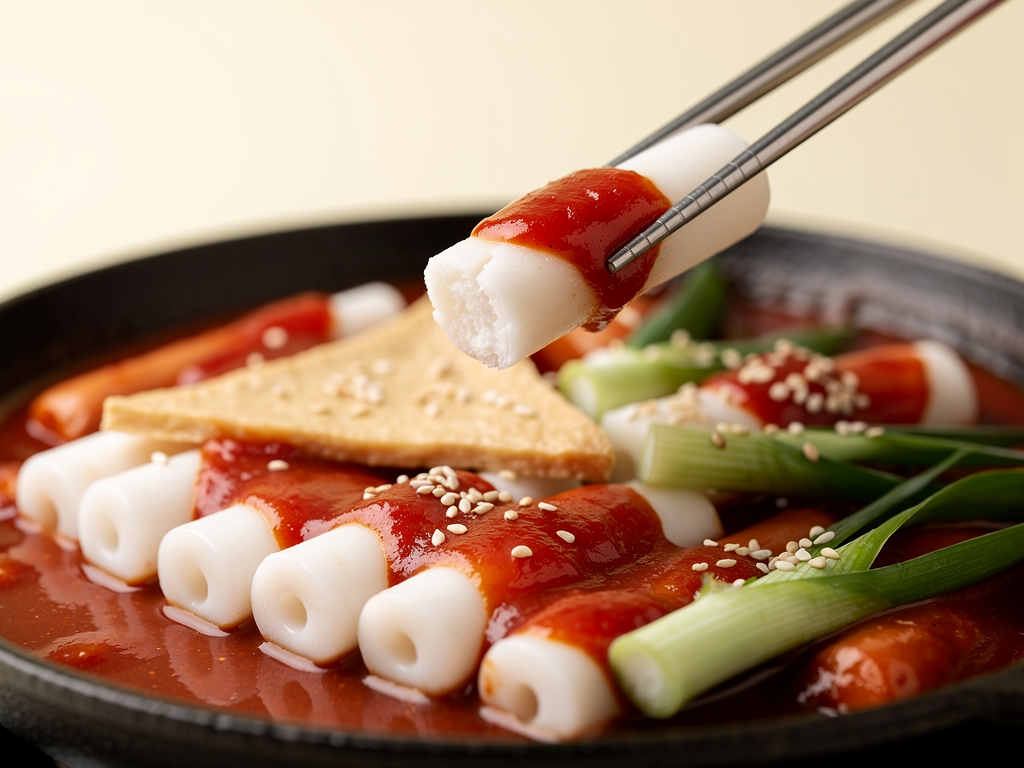
The textures are opposites and it is the single biggest surprise for first-timers. Batata harra is crisp outside and fluffy inside. Tteokbokki is uniformly soft and springy with real chew — closer to mochi than to pasta. People who dislike tteokbokki almost always dislike the chew, not the sauce.
This difference decides what each dish sits next to. A sweet, sticky heat needs something plain beside it, which is why tteokbokki turns up next to fried things and rice. A sour, garlicky heat is designed to cut through grilled meat, which is why batata harra turns up on a mezze table next to skewers.
The distinction matters in the UAE because most tables here already know batata harra from Lebanese restaurants and only know tteokbokki from Korean dramas. One is the cheap red spicy thing you already reach for. The other is the version you are curious about. They occupy the same slot but deliver opposite experiences.
For a deeper look at the rice cakes and gochujang sauce behind tteokbokki see the Wikipedia entry on tteok-bokki. The Levantine fried-potato dish and its garlic, coriander and chilli base is covered on the Wikipedia page for batata harra.
Expanding on the heat contrast, gochujang fermentation brings a slow-building depth that many UAE palates find unfamiliar at first. The sweetness tempers the chilli so the burn never arrives alone. Batata harra relies on raw garlic and lemon for its pop, which explains why it pairs so cleanly with lamb or chicken skewers. The sour edge resets the palate between bites of grilled meat. This is why regulars at Lebanese spots treat batata harra as a functional mezze component rather than the star.
In contrast, tteokbokki demands attention. The chew forces slower eating and the sauce clings to every piece, making it harder to treat as background. First-timers often expect one to be a hotter version of the other and end up surprised by how differently the two register in the mouth. The sweet-first profile of tteokbokki also explains why it works with plain rice or fried chicken, while batata harra fights for space next to hummus or tabbouleh without dominating.
The carb reality changes ordering strategy. When you pick tteokbokki you can skip or reduce the size of a separate rice or noodle dish. Two people splitting one AED 55 plate plus a few sides often feel full. Batata harra at AED 35 still leaves room — in fact it expects you to order grilled meats or wraps afterward. This is the practical trade-off locals weigh every week.
Price and availability reinforce the gap. Batata harra is cheaper and it is around the corner. Tteokbokki costs more and you have to go and find it. That gap is real and no amount of writing closes it.
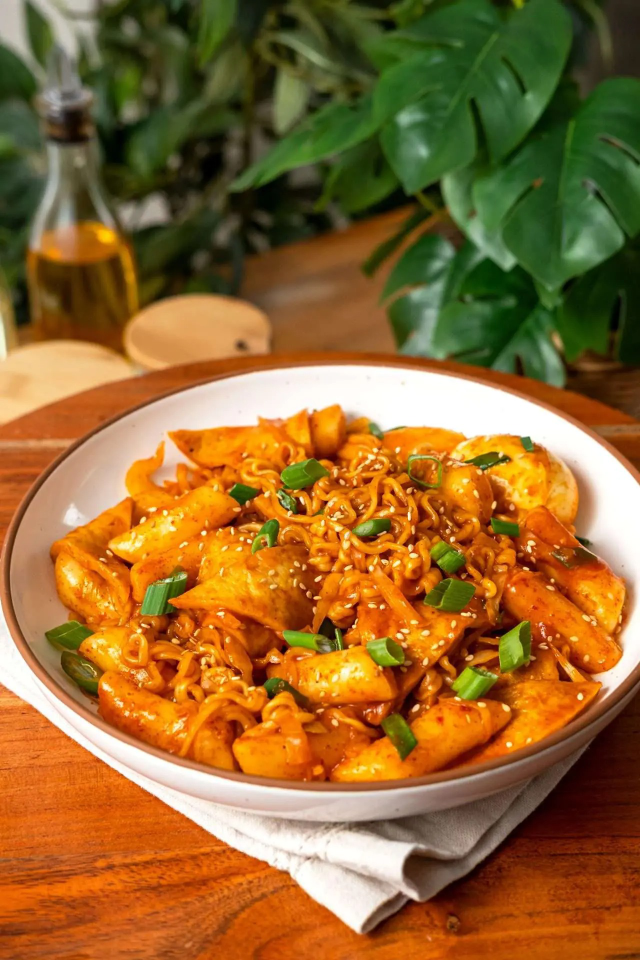
AMOO in Business Bay lists its version — printed on the menu as Spicy Potato and described as fried potato with chilli paste, garlic, coriander and lemon — at AED 35. For scale on the same menu, plain French fries are AED 25 and a falafel plate is AED 40. Mukbang Shows prints Tteokbokki at AED 55 and Rabokki, the version with ramyeon noodles added, at AED 49.
The availability asymmetry is clear. Batata harra is within walking distance of almost anyone in the UAE. Tteokbokki requires finding a Korean kitchen, and there are perhaps a dozen worth the trip in the whole country.
| Tteokbokki | Batata harra | |
|---|---|---|
| What it actually is | Chewy pounded-rice cylinders in sauce | Fried potato cubes tossed in a dressing |
| Source of the heat | Gochujang, a sweet fermented chilli paste | Fresh chilli and garlic finished with lemon |
| How the heat lands | Sweet first, burn second — it coats | Sharp and sour — it cuts |
| Texture | Uniformly soft and springy, real chew | Crisp outside, fluffy inside |
| Does it fill you | Yes — two people can make a meal of it | No — it is a side and stays a side |
| Verified UAE price | AED 55, rabokki AED 49, at Mukbang Shows | AED 35 at AMOO |
| How easy to find | A short list of Korean kitchens nationwide | Almost every Lebanese menu in the country |
Which is better value in the UAE, tteokbokki or batata harra?
Batata harra is better value on pure price and convenience. AMOO charges AED 35 for its Spicy Potato while Mukbang Shows charges AED 55 for tteokbokki. The Lebanese version is also on more menus across Dubai and Abu Dhabi. Yet tteokbokki delivers more food by weight and can replace a main, which changes the value equation once you factor in the rest of the order. If your table wants something spicy to share while deciding on mains, batata harra wins on speed and cost. If the table wants the spicy item to pull its weight as actual eating, tteokbokki is the stronger play despite the extra AED 20.
One honest downside for batata harra is that it cools and softens quickly once it leaves the kitchen. Tteokbokki holds its texture longer because the rice cakes stay springy even as the sauce thickens.
Where can I get good tteokbokki in Dubai and Abu Dhabi?
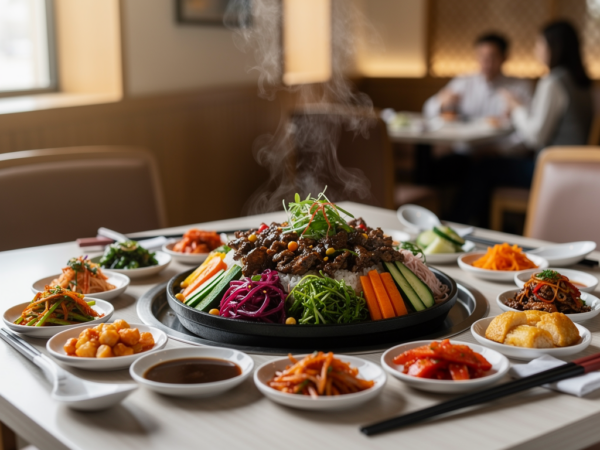
Mukbang Shows is the pick on the tteokbokki side for a specific, checkable reason: it prints tteokbokki at AED 55 and rabokki at AED 49 as separate dishes, identically at five branches across two emirates, in a 100% halal kitchen with beef and chicken only and no pork and no alcohol. Rabokki, the version with ramyeon noodles, is its own line at AED 49 rather than an add-on. The branches are Deira, JBR and DWTC in Dubai, and Muroor Road and Electra Street in Abu Dhabi, and this is the only venue in this set where the dish sits inside a full Korean BBQ meal rather than standing alone at a snack counter.
The honest caveat is the one that runs through this whole page, and it is not a small one. At AED 55 the tteokbokki is AED 20 more than AMOO’s spicy potato, and five branches nationwide is nothing against a Lebanese grill on most main roads. If the question is what spicy thing you can get nearby for under AED 40, Mukbang is not the answer and no amount of sauce detail changes that. For more detail see the guide to where to actually eat tteokbokki in Dubai.
Mashisoyo in Cluster G, Jumeirah Lake Towers, Dubai offers a clear like-for-like option. The halal casual Korean kitchen lists both tteokbokki and rabokki as separate items at around AED 50 per person. It is compact and strong on delivery, which makes it useful when you do not want to leave the house. One downside is the limited seating if you plan to eat in. The price is an indicative band from an earlier verification, so confirm it directly.
Seoul Street Cafe at 1004 Gourmet in The Greens, Dubai treats tteokbokki as a headline dish and runs the milder modern styles — a creamy cheese version and a rosé version — which is the build a lot of first-timers actually prefer. Expect to pay around AED 115 for two. The cafe sits beside the 1004 Gourmet grocery so you can pick up Korean snacks on the same trip. One honest caveat is that it is cafe-sized with limited seating and works better as a snack stop rather than a full dinner. The rosé version softens the heat further, making it a gentle entry point for anyone nervous about gochujang.
KimchiNomNom has locations in Al Barsha 3, Al Quoz and Dubai Marina. This halal Korean street-food specialist built its name on tteokbokki and Korean snacks for delivery — the easiest way to try the dish without booking a table. Pricing stays in the casual street-food range. One downside is that the chew of the rice cakes can be too much for some first-timers, exactly as noted earlier. Casual street-food pricing is not published at source, so confirm it on their own channels before ordering.
Mannaland Korean Restaurant on Al Hudaiba / Al Mina Road, Dubai is a long-running halal home-style Korean restaurant plating a traditional, non-fusion tteokbokki alongside its stews. Expect roughly AED 60 to 120 per person a la carte. The version here stays closer to the classic Seoul street style without cream or cheese add-ins. One honest caveat is the plain, dated room and the fact that it is a la carte only with no set deals. It rewards diners who already know what they want.
Where can I get good batata harra in Dubai and Abu Dhabi?
AMOO Restaurant in Business Bay, Dubai offers the cleanest reference point. Its Spicy Potato — the menu name for batata harra — is listed at AED 35 with the exact description of fried potato with chilli paste, garlic, coriander and lemon. See AMOO’s own page for the dish. One downside is that you must search the menu for “Spicy Potato” rather than batata harra. It is the reference price for this page because it is published on the restaurant’s own site, which is rarer than it should be.
Al Safadi operates six UAE branches — Al Rigga, Sheikh Zayed Road, Umm Al Sheif, Motor City and Dubai Festival City Mall in Dubai, plus Al Qana in Abu Dhabi. This is the reason the availability argument holds. A full Lebanese hot-mezze list including batata harra is close to most people in the country. One caveat is that Al Safadi publishes a hot-appetiser category but not item prices, so confirm on arrival.
Zaroob has branches on Sheikh Zayed Road, Dubai Marina and Motor City. Sheikh Zayed Road and Motor City locations operate 24 hours while Dubai Marina runs 7am to 5am. This makes it the late-night option for batata harra when Korean kitchens have closed. One downside is that prices are not listed on the site, so you check in person. It performs best as part of a larger mezze spread rather than a standalone order.
Should I order tteokbokki or batata harra with Korean BBQ or Lebanese mezze?
Order tteokbokki with Korean BBQ. The sweet-sticky gochujang sauce balances the smoke and fat from grilled beef and chicken. The rice cakes fill the gaps between barbecue rounds and prevent the meal from feeling only like meat. Order batata harra with Lebanese mezze. The sour, garlicky edge cuts through grilled lamb skewers and fattoush without fighting the other dips. Mixing the two on the same table is possible but the heat profiles compete rather than complement. Most tables in the UAE already default to batata harra with mezze because it is familiar. Tteokbokki is the move when the table has already committed to Korean.
Is tteokbokki halal in the UAE?
Mukbang Shows is 100% halal: beef and chicken BBQ only with no pork and no alcohol at any branch. Gochujang is a fermented paste and some imported brands use alcohol as a processing aid, so it is fair to ask the kitchen. The maple-bacon tteokbokki at Hoe Lee Kow in Dubai Hills contains pork so that specific dish is not an option for anyone avoiding it. Most other UAE Korean kitchens that serve tteokbokki keep it pork-free. Confirm directly if unsure.
What is tteokbokki? (떡볶이)
Tteokbokki is chewy rice cakes cooked in a thick, sweet-spicy gochujang sauce. The rice cakes are made from pounded rice flour and have a dense, springy texture that holds sauce well. In the UAE it arrives as a sharing plate — AED 55 at Mukbang Shows, with rabokki at AED 49. It is the Korean equivalent of the red spicy thing you order while deciding on the rest of the meal, except it is substantial enough to count as part of the meal itself. The version with added ramyeon noodles is called rabokki and is often slightly cheaper.
Where to find tteokbokki vs batata harra by area in the UAE
Tteokbokki vs batata harra availability maps cleanly onto existing restaurant clusters. In Deira and around DWTC you are near Mukbang Shows branches that serve the AED 55 tteokbokki inside a Korean BBQ setup. JBR and Dubai Marina have both Mukbang Shows and KimchiNomNom, giving easy access to tteokbokki plus Zaroob for batata harra.
Business Bay is AMOO territory for the AED 35 Spicy Potato, while The Greens has Seoul Street Cafe at 1004 Gourmet for milder tteokbokki styles. Al Barsha, Al Quoz and Al Mina Road offer KimchiNomNom and Mannaland for tteokbokki, and Al Safadi branches cover Sheikh Zayed Road, Umm Al Sheif, Motor City and Festival City for batata harra.
In Abu Dhabi, Mukbang Shows on Muroor Road and Electra Street handle the tteokbokki side while Al Safadi’s Al Qana branch covers batata harra. The pattern is simple, and it is the same one that runs through the price section: the Lebanese venues carrying batata harra sit on main roads and in malls across both emirates, while the Korean kitchens carrying tteokbokki are a short list of specific addresses. That split, not flavour, is what decides most weeknight orders.
For the Abu Dhabi version of the tteokbokki guide see the Abu Dhabi version of the same guide.
Two areas are worth calling out because they carry both. Dubai Marina has a Zaroob branch listed at 7am to 5am and a KimchiNomNom, which is about as close as the UAE gets to a genuine side-by-side choice. Motor City has both an Al Safadi and a Zaroob, and the Zaroob there is listed as 24 hours — which matters, because nothing on the Korean side of this page publishes late hours at all.
That is the whole asymmetry in one line: batata harra needs no planning, and tteokbokki needs a destination decision first.
Practical ordering tips for tteokbokki vs batata harra
Decide the cuisine first. Korean table means tteokbokki. Lebanese or mixed grill table means batata harra. This single rule removes most confusion.
Ask about the heat before you assume it. Nothing in this set publishes a heat scale, so if you are sensitive to chilli, ask the kitchen rather than guessing from the colour — both dishes look hotter than they usually are.
Pair tteokbokki with plain rice or fried chicken. The sweet-sticky sauce needs something neutral to balance it. Pair batata harra with grilled meats or wraps. The sour heat cuts fat and refreshes the palate.
Order rabokki at Mukbang Shows if you want noodles in the mix. The AED 49 price is lower than the plain tteokbokki at AED 55 and the ramyeon stretches the dish further for two people. See the direct comparison in tteokbokki against rabokki, if you are choosing between the two Korean versions.
Check whether the kitchen uses alcohol in the gochujang. A quick question at the counter or on the phone settles the halal concern for most people. Mukbang Shows removes this question entirely because it is 100% halal across all branches.
Portion strategy differs. One tteokbokki plate feeds two as a mini-main. One batata harra plate is genuinely a side and you will still need a main afterward.
For spice tolerance context read how hot Korean food actually is, measured against food people here already eat.
Expect the two to travel differently. Rice cakes keep their chew in a box, while fried potato is crisp for a short window and softens once it steams in its own container. If batata harra is the order and the ride is long, plan on eating it the moment it lands.
FAQ
Is tteokbokki like batata harra?
No. Tteokbokki is sweet-sticky gochujang on chewy rice cakes that acts like a main. Batata harra is sour-garlic lemon on crisp potatoes that acts like a side. They look similar but eat completely differently.
Which is spicier, tteokbokki or batata harra?
It depends on the kitchen. Tteokbokki heat builds slowly after the sweetness. Batata harra heat arrives sharp and acidic. Neither is objectively hotter; they simply use different kinds of heat.
Is tteokbokki halal in the UAE?
Yes at Mukbang Shows, which is 100% halal with beef and chicken only. Ask about gochujang at other kitchens because some brands use alcohol in processing. Avoid the maple-bacon version at Hoe Lee Kow if avoiding pork.
Which is cheaper in Dubai, tteokbokki or batata harra?
Batata harra at AED 35 at AMOO. Tteokbokki at AED 55 at Mukbang Shows. The gap is real and batata harra is on far more menus.
Does tteokbokki taste sweet?
Yes. Gochujang brings sweetness first, then heat. This is the main reason some people love it and others prefer the sharper profile of batata harra.
Where can I try tteokbokki in Abu Dhabi?
Mukbang Shows on Muroor Road or Electra Street. Both branches serve the AED 55 classic version and the AED 49 rabokki in a 100% halal kitchen. Confirm exact hours before going.
Tteokbokki vs batata harra ultimately comes down to whether you want sweet heat that fills you or sour heat that wakes up the table. Mukbang Shows gives the most reliable tteokbokki experience across the UAE while AMOO and Al Safadi keep batata harra cheap and close. Pick based on what the rest of the meal looks like and how much you want the spicy thing to count as actual eating. The two dishes share a colour and almost nothing else.