
Updated: September 2026
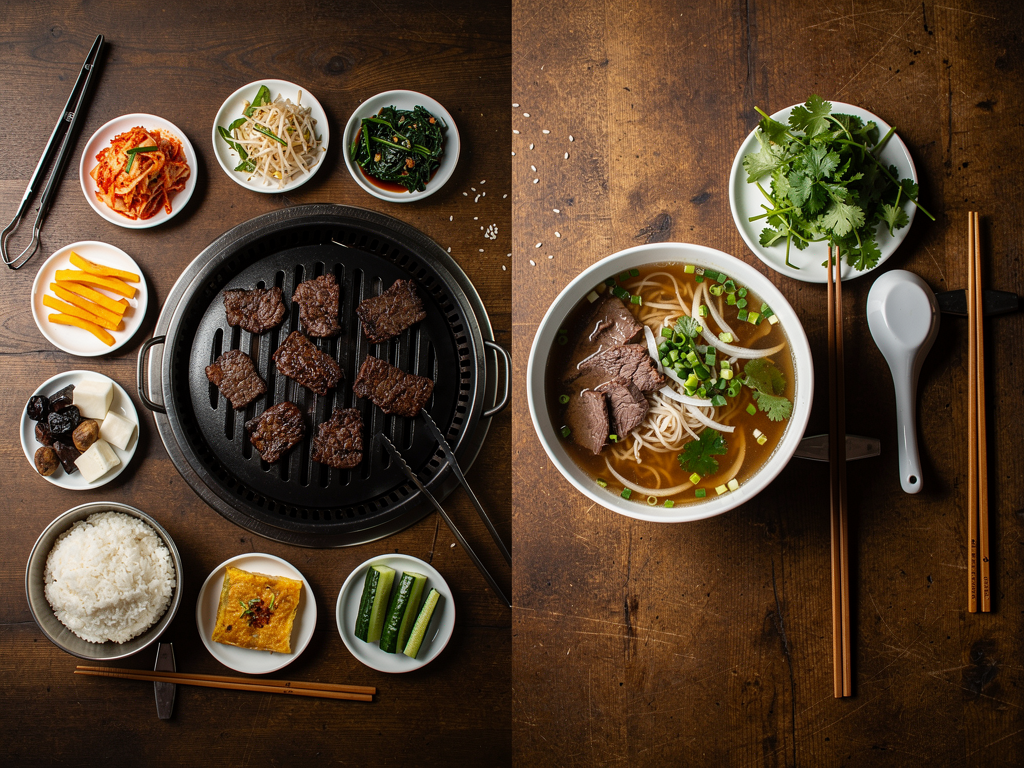
Korean food vs Vietnamese food comes down to what the menu is counting. A Vietnamese menu in Dubai prices the bowl, in sizes — Saigon – Taste of Vietnam prints Beef Pho S AED 52 / M AED 65 — with the beef as a top-up and the rice as a line. A Korean table prices the person, rice and sides inside: AED 69 a head at Mukbang Shows’ unlimited BBQ. Two bowls of pho run AED 120–140; two seats at Mukbang are AED 138.
TL;DR
– Vietnamese menus count the bowl and its size and bill the extras; Korean menus count the eater and include rice and eight banchan.
– The pho bowl is the one Vietnamese format that arrives complete — its free herb plate is Vietnam’s banchan, per bowl not per table.
– On a Vietnamese menu in Dubai, kimchi is a AED 13 extra; on a Korean menu it is free.
– Both start from a long-simmered beef-bone bowl: Vietnam finishes it with raw herbs and lime, Korea with kimchi. Solo, Vietnamese wins on price; for two, the bills land within twenty dirhams.
What is the difference between Korean food and Vietnamese food?
Korean food is a rice cuisine built on fermentation — kimchi, gochujang, doenjang, soy — with beef and chicken cooked on a grill set into the table and a spread of free small dishes called banchan around every meal. Vietnamese food is a rice-noodle cuisine built on freshness — raw mint, Thai basil and coriander, lime, fish sauce, bean sprouts — with a long-simmered broth at its centre and a French baguette at its edge.
It is not Thai food: no coconut curry, no galangal, no palm-sugar engine. The portal’s Korean food vs Thai food guide is a different comparison, and this page does not re-argue it.
This guide does not try to settle which tastes better in the korean food vs vietnamese food argument. It settles what a UAE menu can prove: what a meal costs, what the price is counting, where the rice and the bread sit, what each cuisine does with a beef bone, and what happens at the table after the food arrives.
Why does korean food vs vietnamese food pricing count different things?
Because a Vietnamese menu sells the bowl and a Korean menu sells the seat. Saigon – Taste of Vietnam — the JLT room Time Out calls “comfortably in the top three… accessible, affordable, and thoroughly no-frills” — prints its pho in two sizes on its Deliveroo listing: Beef Pho S AED 52 / M 65, Chicken Pho S 44 / M 58, Vegan Pho S 40 / M 50, Bun Bo Hue S 55 / M 70. Then it prints the protein as a line of its own: Extra Beef AED 18, Extra Chicken 18, Extra Vegetables 10. Steamed Rice is AED 8.
Vietnamese Foodies, the JLT lakeside original that Time Out calls “one of the city’s best-loved Dubai-born brands”, prints the same logic another way. Its pho is a complete bowl — Beef Brisket Pho (M) AED 62, Australian Slow Cooked Brisket Pho 84 — but on its plated mains the words “(rice not included)” appear line after line: lemongrass chicken 65, beef stir-fry with basil 67, hoisin duck 72, chicken curry 60, Szechuan prawns 64, vegan curry 58. Under Extras: Jasmine Steamed Rice AED 12, Pho Noodles 15. Chôm Chôm in Al Barsha prints Beef Short Rib Pho 75, Chicken Pho 65, White Rice 10.
A Korean table works the other way round. Mukbang Shows’ unlimited Korean BBQ is AED 69 per person at Deira, Muroor Road and Electra Street (AED 79 at JBR and DWTC), and that number includes seven kinds of beef and chicken, eight banchan, two gimbap, soup and steamed rice. On an à la carte Korean menu the main still arrives with rice and sides: Hanok’s Bibimbap in International City is AED 53 to 55 with banchan on the table.
The worked sums, from the menus as printed (Vietnamese prices are delivery-app prices, read September 2026):
| Two people at… | What you order | Bill | Per head | Rice and sides |
|---|---|---|---|---|
| Saigon – Taste of Vietnam, JLT | Beef Pho M 65 + Chicken Pho M 58 | AED 123 | ~AED 62 | herbs in the bowl; beef top-up AED 18 extra |
| Saigon, the printed combo | Combo Meal for 2 | AED 129 | AED 64.50 | as printed |
| Vietnamese Foodies, JLT | Beef Brisket Pho (M) 62 + Bun Bo Nam Bo 58 | AED 120 | AED 60 | complete bowls |
| Vietnamese Foodies, a plated main | Beef stir-fry 67 + Jasmine Rice 12 (one person) | AED 79 | AED 79 | rice bought as a line |
| Chôm Chôm, Al Barsha | Beef Short Rib Pho 75 + Chicken Pho 65 | AED 140 | AED 70 | every sauce AED 8 extra |
| Mukbang Shows, Deira / Abu Dhabi | 2 × Gangnam unlimited BBQ 69 | AED 138 | AED 69 | included — 8 banchan, soup, rice, 2 gimbap |
| Hanok, International City | 2 × Bibimbap 53–55 | AED 106–110 | AED 53–55 | banchan included |
The honest headline is in the middle column: AED 120, 123, 138, 140. For two people the two cuisines cost about the same, and they count completely different things to get there.
Which is better value, Korean food or Vietnamese food?
For one person, Vietnamese, by a distance. A solo diner at Saigon eats a complete Chicken Pho S for AED 44 or a Vegan Pho S for AED 40; at Vietnamese Foodies a Beef Brisket Pho for AED 62 or a 6-inch Lemongrass Chicken Banh Mi for AED 42; at Chôm Chôm a Chicken Pho for AED 65. Unlimited Korean BBQ at Mukbang Shows has a two-person minimum, so the cheapest Korean table there is AED 138, and a solo Korean meal means à la carte — Bibimbap at Hanok AED 53–55.
For two, it is close, and the shape of the order decides it. Two bowls of pho are AED 120–123 in JLT and AED 140 in Al Barsha, and the bowl is finished — nothing else needs buying. Two seats at Mukbang are AED 138 with the grill running all evening and eight sides refilled. The moment a Vietnamese order leaves the bowl — a plated main plus rice, a beef top-up, a AED 8 sauce — the lines start, and the Korean seat starts to look cheap.
For a table of four in korean food vs vietnamese food terms, the Vietnamese answer is more bowls or a printed set (Saigon’s Combo Meal for 4 is AED 329, Vietnamese Foodies’ 4 Dish Combo AED 169), and the Korean answer is more seats at AED 69 each. The portal’s Korean BBQ price guide walks the per-seat ladder.
Is the pho bowl the bridge between the two cuisines?
Yes — the pho bowl is the one Vietnamese format that arrives complete, and its herb plate does the job banchan does. Hanoi Naturally — the JLT original, “since 2006” on its own site, which prints no prices — writes on its own menu that pho comes with “a side of fresh herbs, bean sprouts, fresh chillis and lime”, and that its bun bowls come with “fresh herbs, pickled daikon, cucumber, topped with shallots & peanuts”. Time Out’s Vietnamese Foodies review describes the same ritual: “Grab a handful of beansprouts, tear up some mint and coriander and get stuck in.”
That plate is free and it belongs to the bowl: one bowl, one plate. Korean banchan belong to the table — eight dishes for everyone, refilled, inside the price at Mukbang; the portal’s banchan explainer covers the roster. So the tell for a reader is this: a Vietnamese bowl is priced like a Korean seat, complete and self-contained; everything on the Vietnamese menu that is not a bowl is priced like a Chinese or Indian plate, with the rice as a line.
The condiment test makes the difference visible on paper. Chôm Chôm prints its entire table caddy as AED 8 lines — Nuoc Cham Sauce 8, Chilli Jam 8, Peanut Sauce 8, Carrot and Kohlrabi Pickles 8, Crispy Shallots 8, Mo Hanh 8, Tamarind Sauce 8, Peanuts 8. Vietnamese Foodies prints Kimchi, “Fermented Chinese Cabbage”, at AED 13 under Extras, beside Extra Egg 13 and a AED 5 pot of sate chilli sauce. On a Korean menu the same kimchi is one of the eight banchan inside the AED 69, and a whole kimchi to take home is AED 78 or 43 at Mukbang. On a Vietnamese menu in Dubai, kimchi is a thirteen-dirham extra; on a Korean menu it is the first thing on the table.
Two beef-bone bowls: how do pho and galbitang compare?
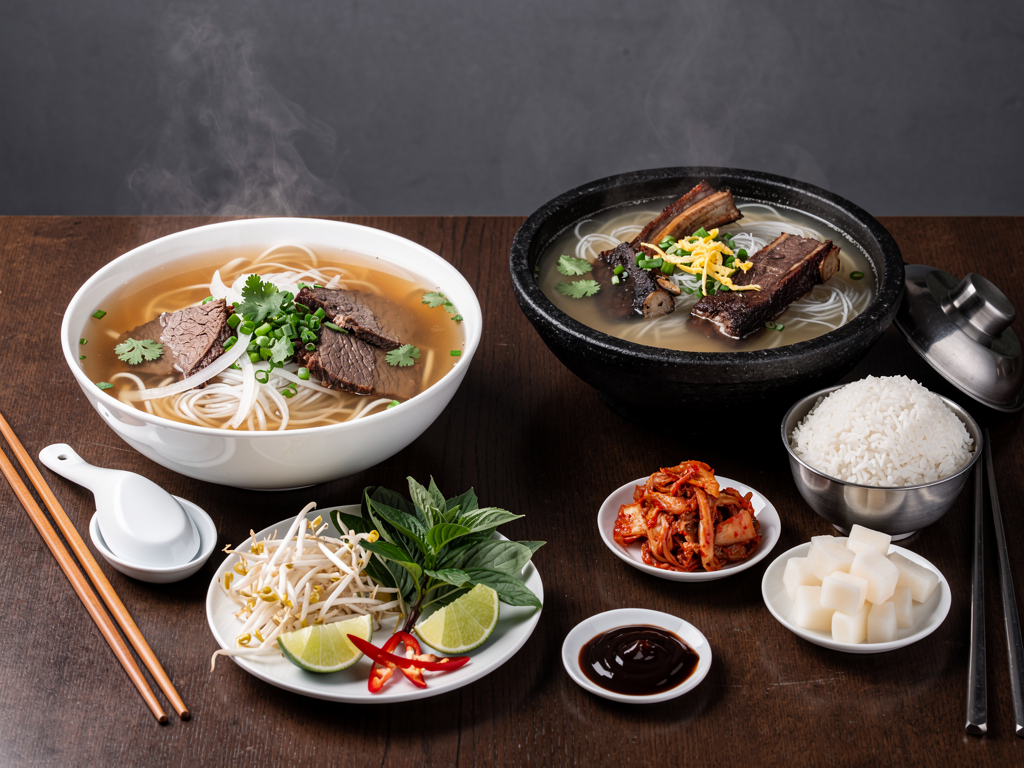
They are cousins. Pho is a clear beef-bone broth simmered for hours — Vietnamese Foodies prints “14-hour simmered broth” — spiced with star anise, cinnamon, charred onion and ginger, poured over flat rice noodles and thin beef. The history of pho runs through Hanoi’s early-twentieth-century streets and a French taste for beef.
Korea’s galbitang and seolleongtang are the same idea from the other end of Asia: beef short rib or ox bone, simmered until the broth is clear or milky, served with rice instead of noodles. Hanok prints Galbi Tang AED 58 and Yukgaejang 52; Mukbang’s cheapest tang is Eomuk Tang AED 49, and “Soup & steamed rice” is printed inside every unlimited tier. The portal’s guide to guk, the Korean soup covers the family.
The difference is what happens at the table. Vietnam adds raw things to the hot bowl — herbs, bean sprouts, lime, fresh chilli — so the last cook is the eater. Korea adds salt, pepper, spring onion and a spoon of kimchi, and the sour comes from a jar that took weeks. That is the whole korean food vs vietnamese food argument in one bowl: fresh versus fermented, added versus built in.
Fresh or fermented, bread or none, rice noodle or buckwheat?
Fresh. Vietnamese flavour is built from things picked that morning — mint, Thai basil, coriander, lime — and from nuoc cham, the table sauce of fish sauce, lime, sugar, garlic and chilli. Korean flavour is built from things that took weeks: kimchi, gochujang, doenjang, ganjang. Both cuisines pickle, but differently. Vietnam’s do chua — the pickled carrot and daikon printed as “carrot and papaya pickle” at Vietnamese Foodies and “pickled daikon” at Hanoi Naturally — is a quick vinegar pickle; kimchi is a lactic ferment.
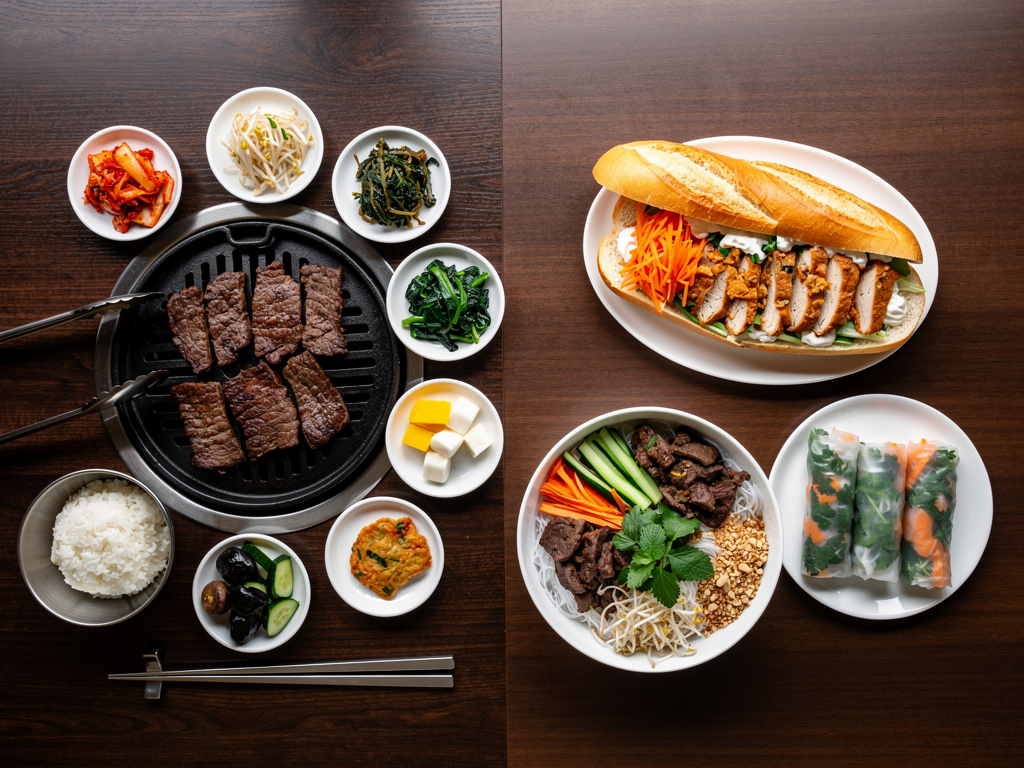
Bread. Banh mi is the French baguette that stayed. Vietnamese Foodies prints four 6-inch banh mi — Lemongrass Grilled Chicken 42, Lemongrass Grilled Beef 48, Pesto Basa Fish 44, Hoisin Grilled Duck 52 — and Extra Banh Mi Bread at AED 8; Saigon prints Banh Mi Ga 48, Bo 52, Ca 52; Chôm Chôm Lemongrass Beef 55, Lemongrass Chicken 50, Fried Haloumi 50. A Korean table has no bread at all — rice, always, and at Mukbang it is inside the price. The nearest Korean thing to a sandwich is gimbap, which the portal sets against the Levantine wrap in gimbap vs saj wrap.
Noodles. Pho and bun are rice noodles, flat or vermicelli. Korea’s noodles are almost never rice: buckwheat for naengmyeon (Mukbang Mulnaengmyun AED 55; see naengmyeon vs soba), sweet-potato glass for japchae (55), wheat for jajangmyeon (55) and rabokki (49). Vietnamese Foodies prints Extra Pho Noodles at AED 15 as a line; the Korean noodles in Dubai guide has the Korean roster.
Heat. Vietnamese heat is a choice — the chilli sits on the herb plate, the sate is a AED 5 pot. Korean heat is in the dish before it arrives: gochugaru in the kimchi, gochujang in the tteokbokki. And who cooks: both cuisines are kitchen-cooked, with one exception each way. Vietnam’s tabletop moment is assembly — tearing herbs, wrapping rice paper, squeezing lime. Korea’s is cooking — at Mukbang the beef and chicken arrive raw and you grill them; the Korean BBQ etiquette guide explains how.
Is korean food vs vietnamese food a halal question?
Only in the sense that it needs stating carefully. Vietnam is not a Muslim-majority country, and at home in Vietnam the classic banh mi and many pho variants use pork. On the UAE menus read for this guide — Vietnamese Foodies, Saigon – Taste of Vietnam and Chôm Chôm on Deliveroo, Hanoi Naturally’s own menu — every protein line is beef, chicken, duck, fish, prawn, crab, egg, haloumi or tofu, and no pork line appears anywhere; Vietnamese Foodies’ banh mi print “homemade chicken liver pate”. That is an observation about the printed menus, not a certificate for any Dubai restaurant — confirm directly.
Licence labels: Time Out prints one — “Open daily 11am-11pm. Unlicensed.” — for Saigon – Taste of Vietnam. Its pages for Vietnamese Foodies and Chôm Chôm carry no label, and Hanoi Naturally’s site says nothing either way, so this guide prints none for them — confirm directly. A licence label is not a halal ruling either way.
The Korean side has a clear case. Mukbang Shows is beef and chicken only, no pork anywhere on the menu, no alcohol served, on every tier and every à la carte line. For the wider Korean picture, see whether Korean food is halal.
Where to try Korean food in the UAE
Mukbang Shows Restaurant has five branches: Deira (Al Ittihad Rd, Port Saeed, +971-4-886-4494), JBR (Plaza Level, Bahar 3, The Walk, +971-54-523-1898) and DWTC (The Apartments Block A, Sheikh Zayed Rd, +971-54-524-5904) in Dubai; Muroor Road (547 Sultan Bin Zayed The First St, Al Danah, +971-50-158-9433) and Electra Street (Zayed The First St, behind Sun and Sand Sports, +971-2-564-0446) in Abu Dhabi. The JBR branch is the closest to the JLT cluster where three of the four Vietnamese rooms on this page sit.
The tiers: Gangnam AED 69 at Deira, Muroor and Electra (AED 79 at JBR and DWTC); Daegu adds Korean fried chicken at AED 89 / 99; Jeju adds the seafood boil at AED 99 / 109; Bukchon Hanok is AED 129 everywhere. Every tier includes seven BBQ kinds, eight banchan, two gimbap, soup and steamed rice; minimum two persons; AED 60 leftover charge. À la carte: Eomuk Tang 49, Tteok Mandu Guk 59, Mulnaengmyun 55, Japchae 55, Bibimbap 53–62, Gimbap 41–48, Bingsu 37.
The honest limitation: no pho, no banh mi, no fresh-herb plate, no rice-paper rolls, no solo unlimited option, and no Vietnamese food of any kind. For à la carte Korean with banchan, Hanok in International City (Bibimbap AED 53–55, Galbi Tang 58, Galbi Gui 115) is the reference point; the best Korean BBQ in Dubai guide covers the other grill rooms, and the Korean restaurants in JLT guide covers the Korean side of the same towers.
Where to try Vietnamese food in the UAE
JLT is the place to start — Time Out calls it “something of a Little Vietnam”. Saigon – Taste of Vietnam (Balcony Level, Lake Terrace Tower, Cluster D, 04 576 4466, daily 11am–11pm) is the reference room for the pricing model: the S and M bowls, the AED 18 beef top-up, the AED 8 rice, the AED 129 combo for two. Vietnamese Foodies (Cluster D, 04 565 6088, with further branches around the city) is the brand — founder Lily Hoa Nguyen, the 14-hour broth, a dedicated vegan menu, and the “(rice not included)” mains. Hanoi Naturally (Cluster C, 04 431 3099, 11:30–22:30 daily) is the 2006 original whose menu spells out the herb plate.
Chôm Chôm (Galleria Mall, Al Barsha) is the room Time Out says “deserves more attention” — short-rib pho, a banh mi line-up, and the AED 8 condiment caddy that makes the condiment test so easy to run. For the full picture read Time Out Dubai’s review of Vietnamese Foodies; this page ranks nobody on the Vietnamese side, it prices the model. For the history under the food, the background on Vietnamese cuisine is the place to start.
How to choose between the two on a given night
Pick Vietnamese when you are one person, when you want a complete meal in a bowl for under AED 65, when fresh herbs and lime are the flavours you are after, when you want bread, or when you want to decide the heat yourself at the table. Pick Korean when you are two or more and want the grill in the table with the sides inside the price, when beef and chicken cooked by your own hand is the point, when fermented heat and sour vegetables are what you want, or when halal certainty across the whole menu matters.
Beyond korean food vs vietnamese food, the portal’s other cuisine hubs — Korean vs Chinese, Korean vs Filipino and Korean vs Thai — use the same test.
Vietnamese is the only one of the nine whose signature dish is priced like a Korean seat: complete, and in sizes.
| Venue | Area | Price AED | Halal | Standout order |
|---|---|---|---|---|
| Mukbang Shows Restaurant | Deira, JBR, DWTC · Muroor Road, Electra Street | 69–129 per person | Beef and chicken only, no pork, no alcohol | Gangnam unlimited BBQ AED 69 — 7 meats, 8 banchan, rice, soup |
| Saigon – Taste of Vietnam | Cluster D, JLT | 40–70 a bowl; 129 combo for two | Menu prints beef, chicken, duck, fish — confirm directly; unlicensed per Time Out | Beef Pho M AED 65 |
| Vietnamese Foodies | Cluster D, JLT and other branches | 42–84 a bowl or main; rice AED 12 extra | Menu prints beef, chicken, duck, fish, prawn — confirm directly | Beef Brisket Pho (M) AED 62 |
| Chôm Chôm | Galleria Mall, Al Barsha | 55–75 a bowl; sauces AED 8 each | Menu prints beef, chicken, fish, haloumi — confirm directly | Beef Short Rib Pho AED 75 |
| Hanoi Naturally | Cluster C, JLT | not printed online | Confirm directly | Pho with the herb plate |
| The Korean Restaurant (Hanok) | International City, Dubai | 42–115 | Confirm directly | Galbi Tang AED 58 |
FAQ
Is Korean food or Vietnamese food cheaper in the UAE?
For one person, Vietnamese: a Chicken Pho S is AED 44 and a Vegan Pho S AED 40 at Saigon, complete. For two it is close — AED 120–140 for two bowls of pho against AED 138 for two seats at Mukbang Shows’ unlimited BBQ with every side included.
Why does pho come in sizes?
Because a Vietnamese menu prices the bowl, not the eater — Saigon prints Beef Pho S at AED 52 and M at AED 65, then Extra Beef at AED 18. A Korean menu prices the person, AED 69 a head at Mukbang Shows, and the rice and sides are inside.
Is the pho herb plate like Korean banchan?
In the way it is priced, yes — both are free. The difference is scale: the herb plate belongs to one bowl, the eight banchan belong to the whole table and are refilled.
Do Korean restaurants serve bread?
No. Korean tables serve rice and banchan. Vietnamese tables have banh mi, the French baguette sandwich — AED 42–55 on the Dubai menus read for this guide.
Is Vietnamese food spicy like Korean food?
No. Vietnamese heat is optional — fresh chilli on the herb plate and a pot of sate on the side. Korean heat is built into the dish through gochugaru and gochujang.
Do Vietnamese restaurants in Dubai serve pork?
The four menus read for this guide print beef, chicken, duck, fish, prawn, egg, haloumi and tofu, and no pork line. That is an observation about the printed menus — confirm directly with the venue.
Is Korean food halal in the UAE?
At Mukbang Shows, yes — beef and chicken only, no pork, no alcohol, on every tier and every à la carte line. Elsewhere, confirm directly.
Every price in this guide was read from the venue’s own menu page or its delivery-app listing in September 2026, or is attributed to Time Out where noted. Menus change; what the price is counting — the bowl and its size, or the eater and the seat — is the thing to check before you compare.

Comments are closed.