Updated: September 2026
Gimbap vs saj wrap comes down to one reversal: a saj wrap is baked hot and rolled whole, while gimbap is assembled cold and cut into coins. One is built to be eaten where it is made, the other is built to travel. On the Korean side, Mukbang Shows prints a beef bulgogi roll at AED 41.
TL;DR
- Best value, no contest: a za’atar man’oushe from a chain or neighbourhood bakery, reported from around AED 7.
- Best gimbap: Mukbang Shows beef bulgogi gimbap at AED 41, spicy tuna AED 45, shrimp tempura AED 48 — a whole roll, cut into coins.
- Situational pick: Zaroob on Sheikh Zayed Road or Motor City, both open 24 hours, when the craving lands at 3am.
What is the difference between gimbap and a saj wrap?
A saj wrap is baked hot and rolled whole. Gimbap is assembled cold and cut into coins. That single structural choice dictates everything else.
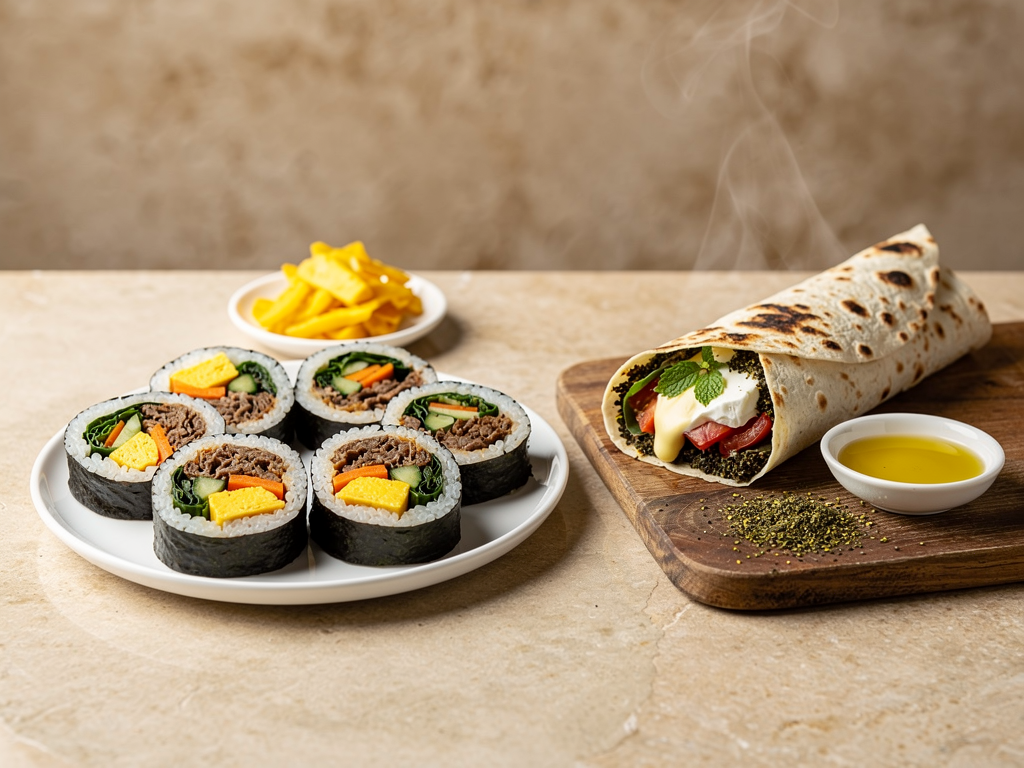
A saj wrap starts with paper-thin dough slapped onto a domed convex griddle — the saj. It cooks in well under a minute, comes off blistered and pliable, takes its filling and is rolled in front of you. It is at its best about ninety seconds after it is made. The wrapper is bread from the markouk family, thin enough to be translucent yet strong enough to hold a hot, wet filling without tearing. In a saj wrap, the bread is the body.
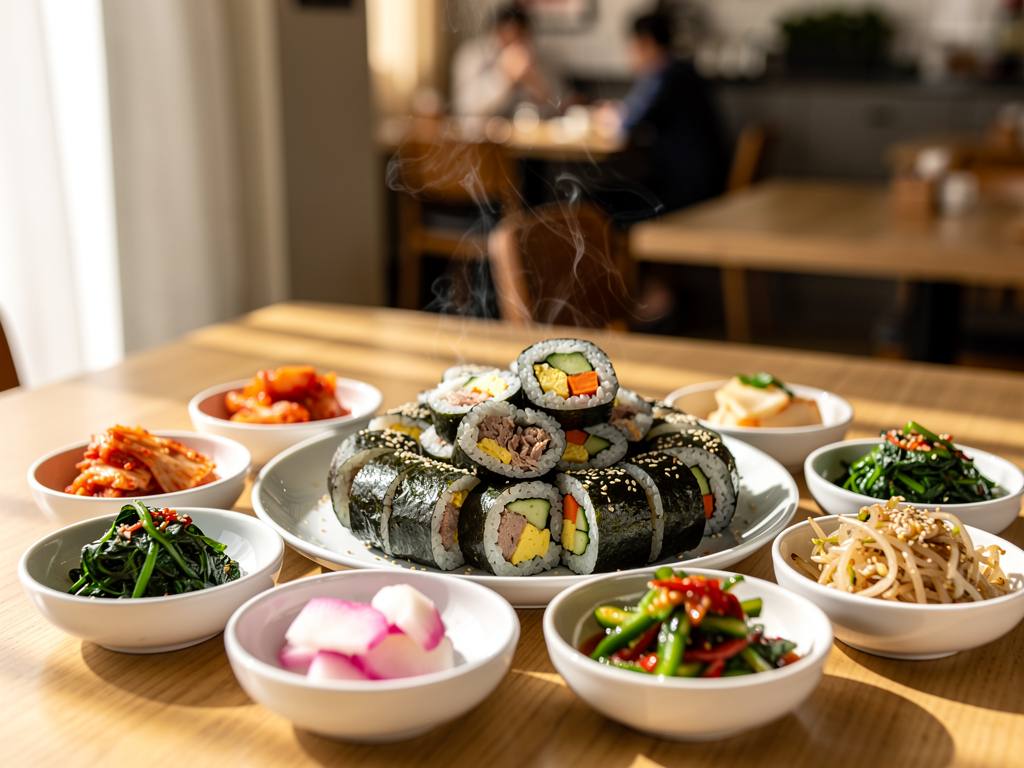
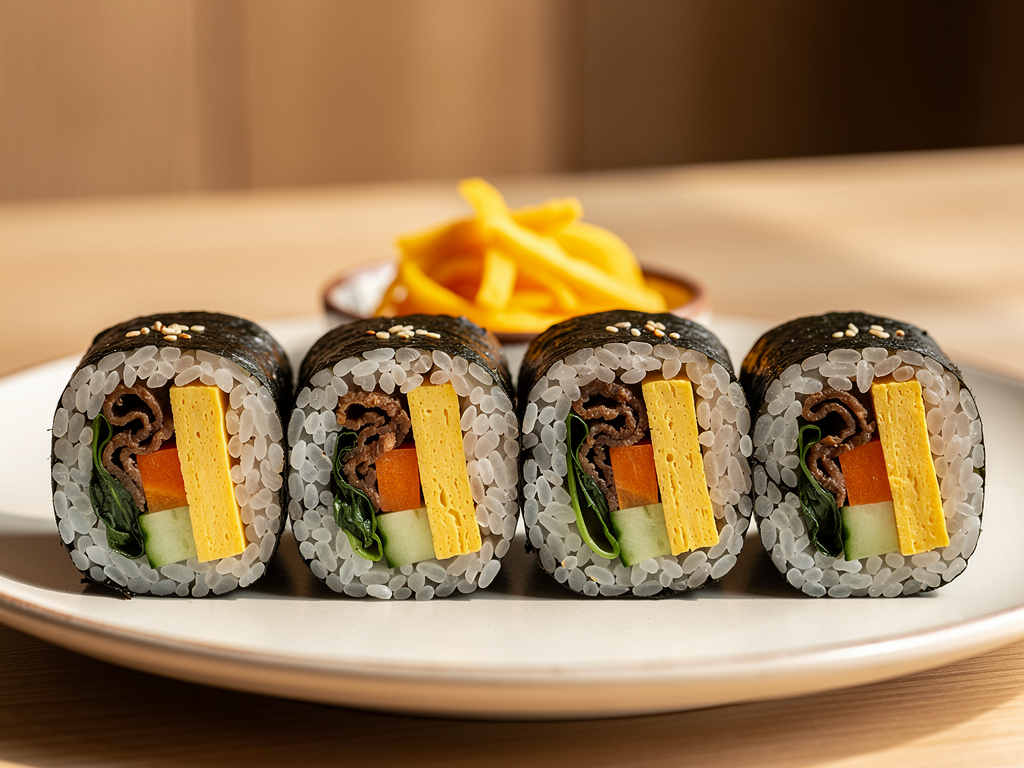
Gimbap (김밥) starts with seasoned short-grain rice spread over a sheet of dried seaweed. The fillings are laid in a line, the whole thing is rolled tight, brushed with sesame oil and sliced into coins. The wrapper is gim, roasted seaweed that weighs almost nothing and contributes salt and a snap rather than bulk. The structural ingredient is the rice. In gimbap, the seaweed is a skin and the rice is the body.
That is why a saj wrap can carry a sauce and gimbap cannot. Wet the gim and it goes limp within minutes, which is why gimbap is seasoned on the inside rather than sauced on the outside, and why nobody hands it to you dripping. It is also why gimbap travels and a saj wrap does not — the reason one became Korea’s picnic, train and lunchbox food while the other stayed a street griddle you stand at.
Gimbap vs saj wrap: the comparison table
| Dish or venue | Area | What it actually is | Typical price (AED) | Best eaten |
|---|---|---|---|---|
| Mukbang Shows | Deira, JBR, DWTC, Muroor Road, Electra Street | A whole gimbap roll cut into coins | 41 beef bulgogi, 45 spicy tuna, 48 shrimp tempura | Room temperature, hours later |
| Zaatar w Zeit | SZR, Downtown, Marina, MOE, Abu Dhabi | Za’atar man’oushe or a filled saj wrap | Reported ~7 and ~30; confirm directly | Straight off the griddle |
| Zaroob | SZR, Dubai Marina, Motor City | Levantine saj and grill, sit-down | No published saj price; confirm directly | Late night, hot |
| Allo Beirut | Jumeirah 3, Al Karama, Hessa Street | Za’atar and multi-cereal manakish, saj worked in view | Reported ~9; confirm directly | Breakfast, fresh |
| Al Reef Lebanese Bakery | Al Karama and Jumeirah | A 1986 bakery running around the clock | No verified price; confirm directly | Any hour, immediately |
| Man’oushe Street | Downtown, Al Barsha, Al Najda, Tourist Club Area | Saj-first chain, man’oushe and wraps | No verified price; confirm directly | Morning or a quick bite |
| Kimbap & Sushi | Al Satwa, Dubai | Takeaway gimbap rolls | Most rolls under 50; indicative | As a packed lunch |
How do they actually taste different?
Olive oil versus sesame oil is the whole flavour argument in one swap. Saj leans on olive oil, za’atar, sumac, sometimes akkawi or mozzarella, garlic, mint and labneh — sharp, herbal, salty, and very often a breakfast.
Gimbap runs on sesame oil, a little salt and sugar in the rice, pickled yellow radish for sourness and crunch, egg, carrot, spinach and a protein. If you like the herbal edge of za’atar, gimbap will read as clean and mild rather than bland, and the pickled radish is doing the job your pickles do.
There is no rice in a saj wrap and no bread in gimbap. That is not trivia — it is why one fills you up on carbohydrate from grain flour and the other on cooked rice. The companion piece on gimbap vs sushi covers the other roll people confuse it with, and bulgogi vs shawarma runs the same Korean-versus-Levantine comparison on the meat side.
Which is cheaper in the UAE?
A za’atar saj costs less than a bus fare, and gimbap does not compete with that. Ever. Chain manakeesh have been reported from around AED 7 at Zaatar w Zeit and around AED 9 at Allo Beirut, and a neighbourhood bakery za’atar generally sits in that same single-digit band.
What gimbap actually competes with is the filled meat or chicken saj wrap, reported at around the AED 30 mark. At Mukbang Shows a gimbap roll is AED 41 for beef bulgogi, AED 45 for spicy tuna and AED 48 for shrimp tempura. At that level the gap narrows to something you might weigh up rather than something that settles the argument.
Every saj figure here is reported by third parties rather than verified on a menu, because none of the chains published a live price list when this was checked in September 2026. Treat them as indicative and confirm at the counter. The Mukbang prices come straight from its own menu.
The honest conclusion is that saj wins on pure daily cost and gimbap wins on carrying well. That is not a tie broken by price — it is a genuinely different question about when and how you plan to eat.
Where to eat gimbap in Dubai and Abu Dhabi
Mukbang Shows prints three gimbap and prices them by filling rather than by size: beef bulgogi AED 41, spicy tuna AED 45, shrimp tempura AED 48. Each is a whole roll cut into coins, which is the detail people get wrong when they order gimbap for the first time expecting a single handheld wrap.
The AED 7 spread across those three rolls is entirely the filling. The rice, the gim and the sesame oil are identical in all of them. That is the cleanest way to see what you are paying for in a roll, and it is the exact opposite of a saj wrap, where the bread and the griddle time are a real part of the cost.
Gimbap also rides along on every all-you-can-eat Korean BBQ tier at Mukbang: two gimbap come with the seven BBQ kinds, eight banchan, soup and rice, from AED 69 per person at Deira, Muroor Road and Electra Street and AED 79 at JBR and DWTC.
The branches are Deira on Al Ittihad Rd in Port Saeed (+971-4-886-4494); JBR on Plaza Level, Bahar 3 Unit P33, The Walk, Marsa Dubai (+971-54-523-1898); DWTC on The Apartments Block A, Sheikh Zayed Rd, opposite the metro station (+971-54-524-5904); Muroor Road at 547 Sultan Bin Zayed The First St, Al Danah, Zone 1, Abu Dhabi (+971-50-158-9433); and Electra Street at Zayed The First St behind Sun and Sand Sports, Al Danah, Zone 1 (+971-2-564-0446).
Here is the honest limitation. Nothing on that menu answers a AED 7 za’atar at seven in the morning, and nothing ever will — Mukbang is a sit-down restaurant, not a bakery, and there is no counter to grab a roll from on the way to work. Gimbap is also the dish that suffers most from sitting: the rice firms up and the gim softens, so a roll that has spent forty minutes in a delivery bag is a worse version of itself than a saj wrap would be in the same bag.
Other options exist and are worth naming. Kimbap & Sushi in Al Satwa treats rolls as a takeaway staple with most rolls and mains under AED 50. Mannaland Korean Restaurant in Al Hudaiba is a long-standing full Korean menu at roughly AED 150 to 200 for two. Seoul Garden in Al Karama runs around AED 170 for two. Romantic Baka in Al Ghurair Centre in Deira is casual mall pricing at roughly AED 40 to 90 a head.
Those bands were checked earlier in 2026, so treat them as indicative. The detailed venue guides are best gimbap in Dubai and the Abu Dhabi version.
Which saj spots should you compare it against?
Zaatar w Zeit has branches across Dubai — Sheikh Zayed Road, Downtown, the Marina and Mall of the Emirates — plus Abu Dhabi, with a hotline on 600 522 231. It is the chain that made saj a late-night default rather than a breakfast-only thing, with a long wraps list beside the manakeesh. Manakeesh are reported from around AED 7 and wraps around AED 30, both indicative.
Zaroob runs Sheikh Zayed Road and Motor City around the clock, and Dubai Marina from 7am to 5am. It presents Levantine street food as a proper sit-down with the saj and grill working in the open. No saj price is published on its own site; for context, its menu lists a labneh platter at AED 20 and an omelette at AED 22. Hours can change, so check before a late trip.
Allo Beirut has Dubai addresses including Al Wasl Road in Jumeirah 3, Al Karama and Hessa Street, where bakers work the saj dome in full view. Its wild za’atar version blends za’atar with onion and tomato on a multi-cereal dough. Manakish are reported from around AED 9 — again, confirm at the counter, because reported figures and counter prices do drift apart.
Al Reef Lebanese Bakery trades in Al Karama and Jumeirah and has been open since 1986, running around the clock with queues for za’atar and cheese manakish at hours when nothing else is baking. No price was verifiable at source, and not every branch keeps identical hours, so confirm which one is open before a late trip.
Man’oushe Street is a saj-first chain built around the man’oushe rather than treating it as a breakfast side, with fatayer and wraps alongside. It has Dubai locations in Downtown and Al Barsha and Abu Dhabi addresses including Al Najda and the Tourist Club Area. No price was verifiable at source.
Is gimbap halal, and is it gluten-free?
Gimbap is halal when it comes from a halal kitchen, and in the UAE that is the normal case rather than the exception. Mukbang Shows is 100% halal — beef, chicken and seafood, no pork anywhere on the menu — and its three gimbap fillings are shrimp tempura, spicy tuna and beef bulgogi, with no ham. That matters because ham is a common gimbap filling in other countries, which is where the question usually comes from. Saj bakeries in the UAE are native halal businesses, so there is no question to ask on that side either.
Gluten is the more useful warning. Gimbap is not automatically gluten-free just because it is rice and seaweed: standard soy sauce is brewed with wheat, so a soy-seasoned bulgogi filling brings gluten with it. A saj wrap is wheat flour and is straightforwardly not gluten-free. If gluten is a hard constraint, ask about the seasoning rather than assuming the rice-and-seaweed base settles it.
Both formats have an easy vegetarian answer. On the saj side a plain za’atar or cheese man’oushe is safe at every bakery listed here. On the Korean side, ask what vegetable roll the kitchen can do on the day — only the three priced rolls above were verified for this article.
Where does each one sit around the city?
The gimbap vs saj wrap choice maps neatly onto geography. Saj is everywhere, because flatbread bakeries are part of the urban fabric of both cities. Gimbap clusters where Korean restaurants already sit.
In Dubai, Al Satwa, Al Karama and Al Hudaiba form the traditional Korean corridor — Kimbap & Sushi in Satwa, Seoul Garden in Karama, Mannaland in Al Hudaiba — and Romantic Baka sits in Al Ghurair Centre in Deira. Those same neighbourhoods hold some of the busiest saj bakeries in the city. Al Karama in particular has Allo Beirut and Al Reef Lebanese Bakery alongside Seoul Garden, which makes it the single easiest area to eat a za’atar in the morning and a gimbap roll later the same day.
Sheikh Zayed Road works as a spine for both formats. Zaatar w Zeit and Zaroob both have prominent branches along it, and the Mukbang Shows DWTC branch sits on the same road opposite the metro station, which makes it the easiest Korean stop to reach without a car. Downtown adds Zaatar w Zeit and Man’oushe Street. Around the Marina and The Walk you get Zaroob and Zaatar w Zeit alongside the Mukbang Shows JBR branch, which suits an evening plan because the saj side stays open late.
Abu Dhabi is simpler, and worth stating plainly: there is no metro in Abu Dhabi, so everything here is a car, taxi or ride-hailing trip. Mukbang Shows runs two branches in Al Danah Zone 1, on Muroor Road and on Electra Street behind Sun and Sand Sports. Man’oushe Street has Al Najda and Tourist Club Area addresses and Zaatar w Zeit maintains Abu Dhabi branches too, so a same-day comparison works best when both stops sit inside the same district.
The pattern underneath is the temperature logic showing up on a map. Saj bakeries spread out because the format is native, cheap and wanted at breakfast in every neighbourhood. Gimbap concentrates in a handful of Korean kitchens, because it is a restaurant item here rather than a counter item, and there is no 7am gimbap window anywhere in the country. Saj owns the breakfast and ultra-cheap slot; gimbap owns the portable lunch.
For a sense of how manakish and saj sit inside everyday eating in Dubai, What’s On’s food trail is a good read, with background on manakish and on gimbap filling in the rest.
Practical ordering tips
On gimbap vs saj wrap, decide the occasion before the dish. If you want to eat now and want it hot, order saj. If you need to carry it for an hour, order gimbap. The temperature logic overrides everything else in a gimbap vs saj wrap decision, including price.
At Mukbang Shows, name the filling clearly. Beef bulgogi at AED 41 is the mildest entry point, spicy tuna at AED 45 adds heat, and shrimp tempura at AED 48 brings the crunch. Ask for extra pickled radish if you like the sour edge — it is doing the same job the pickles do in a saj wrap.
For saj, tell the counter exactly what you want on the bread. Za’atar is the cheapest and fastest; cheese or labneh costs more and keeps it vegetarian. For a filled wrap, ask for chicken or kafta and check they will roll it fresh rather than reheat one. Then eat it inside a couple of minutes, before the blister on the bread goes soft.
If you are ordering gimbap for delivery or collection, ask for it to be made as close to pickup as possible. The gim softens and the rice firms after about forty minutes, and that is the single practical way gimbap loses to a saj wrap.
For a group, order one of each and let people take pieces. The coin shape makes gimbap far easier to split evenly than one long wrap, which is a small but real advantage at a shared lunch.
FAQ
Is gimbap the same as a saj wrap?
No. A saj wrap is hot bread rolled whole and eaten fresh. Gimbap is cool seasoned rice rolled in seaweed and sliced into coins to travel. The wrapper, the temperature and the structure are all different.
Is gimbap cheaper than a saj wrap in Dubai?
Not at the basic level. A za’atar saj is reported around AED 7 while gimbap starts at AED 41. At the filled-wrap level, around AED 30, the two sit closer, but saj usually stays cheaper.
Is gimbap gluten-free?
Not automatically. Rice and seaweed are, but standard soy sauce in a bulgogi filling is brewed with wheat. A saj wrap is wheat bread, so it is not gluten-free either. Ask before ordering.
Is gimbap halal in the UAE?
Yes at Mukbang Shows, which is 100% halal with beef, chicken and seafood only and no ham in its rolls. Saj bakeries are halal businesses too. Confirm directly at any other Korean venue.
Can you eat gimbap cold?
Yes. It is designed to be eaten at room temperature, hours after it is made. That is its main advantage over a saj wrap, which is best inside a couple of minutes of leaving the griddle.
Where can I try both in the same day in Dubai?
Al Karama is the easiest single area: saj at Allo Beirut or Al Reef Lebanese Bakery, then a Korean kitchen nearby. Sheikh Zayed Road works too, with Zaroob or Zaatar w Zeit and the Mukbang Shows DWTC branch on the same road.
The two are the same idea solved in opposite directions: wrap something worth eating in something you can hold. Saj holds the cheap, hot, right-now slot that gimbap cannot touch. Gimbap holds the slot where lunch has to survive three hours in a bag. Most people in the UAE already eat saj every week, and eating gimbap once is what makes the difference obvious.
Related guides
More from our Korean food guides across the UAE: