Updated: August 2026
The best gimbap in Abu Dhabi comes from Mukbang Shows Restaurant on Muroor Road and Electra Street, where a Beef Bulgogi Gimbap costs AED 41, a Spicy Tuna Gimbap AED 45 and a Shrimp Tempura Gimbap AED 48. It is the only kitchen in the city that publishes a gimbap price at all, and the only one that lists three separate fillings instead of one generic roll.
TL;DR
– Best overall: Mukbang Shows — published prices, three named fillings, two rolls included in every all-you-can-eat tier
– Closest to a real bunsik counter: Seoul Street, Al Reem Island — two traditional fillings on a genuine Korean street-food menu, but no published prices
– Situational pick: Mr. Kimchi at Yas Mall — the only Korean gimbap inside a major mall food court
What is the best gimbap in Abu Dhabi?
Mukbang Shows Restaurant on Muroor Road and Electra Street serves the best gimbap in Abu Dhabi, on a narrow and specific basis: it is the only kitchen that publishes separate prices for three distinct fillings and states exactly what goes inside each roll. Seoul Street on Al Reem Island ranks second as the nearest thing the city has to a proper bunsik counter.
That claim is deliberately narrow. This is not an argument that Mukbang rolls the most authentic gimbap in Abu Dhabi — nobody can settle that, because almost nothing about gimbap in this city is documented in public. What can be verified is the menu: Beef Bulgogi Gimbap at AED 41, Spicy Tuna Gimbap at AED 45 and Shrimp Tempura Gimbap at AED 48. Every all-you-can-eat tier also includes two gimbap alongside seven BBQ kinds, eight banchan, soup and rice. The Abu Dhabi tiers run Gangnam AED 69, Daegu AED 89, Jeju AED 99 and Bukchon Hanok AED 129, with a two-person minimum and an AED 60 leftover charge.
The Muroor Road branch is at 547 Sultan Bin Zayed The First St, Al Danah, Zone 1. The Electra Street branch is on Zayed The First St, behind Sun and Sand Sports, in the same zone. Call Muroor Road on +971-50-158-9433 or Electra Street on +971-2-564-0446.
One honest caveat, and it matters: Mukbang is a Korean BBQ house, not a gimbap shop. In Korea gimbap is fast, cheap counter food, rolled to order in about two minutes for a fraction of these prices. Ordering a single AED 41 roll here as a standalone meal is poor value. The gimbap makes sense as a side to a grill order, or inside an all-you-can-eat tier where two rolls are already bundled in. There is also no vegetarian gimbap and no plain classic gimbap on the Abu Dhabi menu — all three fillings are seafood or beef. Our Dubai gimbap guide covers a market with more competition.
Who else serves gimbap in Abu Dhabi?
Five other kitchens in Abu Dhabi have a gimbap or kimbap we could verify from a public source. None of them publishes a price for it.
Seoul Street, Al Reem Island. The strongest non-Mukbang evidence in the city, because it lists two named gimbap rather than one generic entry: an authentic Korean bulgogi gimbap and an authentic Korean tuna gimbap, both on its delivery and Zomato menus. Seoul Street is a casual Korean spot that doubles as a specialty coffee shop and runs two tteokbokki styles, so the gimbap sits inside a real bunsik line-up rather than turning up as a bento filler. The drawbacks are that it publishes no prices anywhere, so you cannot cost a visit in advance, and Al Reem Island is a drive from the Electra and Hamdan Korean cluster.
Mr. Kimchi, Yas Mall. The only Korean gimbap inside a major Abu Dhabi mall food court, which makes it the easy answer for anyone already on Yas Island. Property Finder’s Abu Dhabi Korean round-up names a ramen kimbap among its dishes, and Yas Mall’s own dining directory confirms the counter serves the bestselling menu from the Bon Ga kitchen — the same business now trading under the Mr. Kimchi name, with its original room in Mussafah Shabiya. Search both names or you will conclude one of them closed. The directory lists the food-court unit at 10:00 to 22:00 Sunday to Thursday and 10:00 to midnight Friday and Saturday.
It is a counter, not a Korean room: no table service, no banchan spread. Halal status is not independently verified, so confirm at the counter.
The Taste of Korea (TOK). Its Al Danah delivery listing describes a kimbap of seasoned beef rolled with fresh vegetables and rice in seaweed — specific, named, and not a bento component. TOK runs more locations than any other Korean operator in the city, including a sit-down room at the Cristal Hotel on Zayed The First Street and a food-court unit on the third floor of Al Wahda Mall, where the buffet is listed at AED 49 standard and AED 39 between 11:00 and 16:00 Monday to Thursday.
Formats differ sharply between those branches, so confirm which one carries the beef gimbap before you travel. Third-party listings for the hotel branch also reference pork dishes, so anyone who needs a pork-free kitchen should confirm directly with that specific branch rather than assuming.
Korean Kitchen, Al Najda. Its delivery listing includes a kimbap roll with teriyaki chicken — a filling no other Abu Dhabi kitchen lists, and a fusion choice rather than a traditional one. The room sits behind the Honda showroom near the National Hospital, and MyBayut’s Abu Dhabi Korean restaurant guide puts it at roughly AED 130 as a cost for two — an estimate for a whole meal, not a gimbap price, and the lowest of the sit-down Korean rooms in the city. No individual prices are published.
The Skewers, Hamdan Street. Here the kimbap is a component inside bento sets, alongside soup, rice, vegetables, kimchi or potato and egg, rather than a roll you order on its own. The venue’s own pricing pages put unlimited Korean BBQ at AED 59, dropping to AED 39 between 11:00 and 16:00 and during its late happy-hour window. If the roll itself is what you came for, this is the wrong stop.
Mukbang Shows is 100% halal, beef and chicken BBQ only, with no pork of any kind and no alcohol on the premises. For every other venue on this page, halal status is not independently verified — confirm directly with the venue.
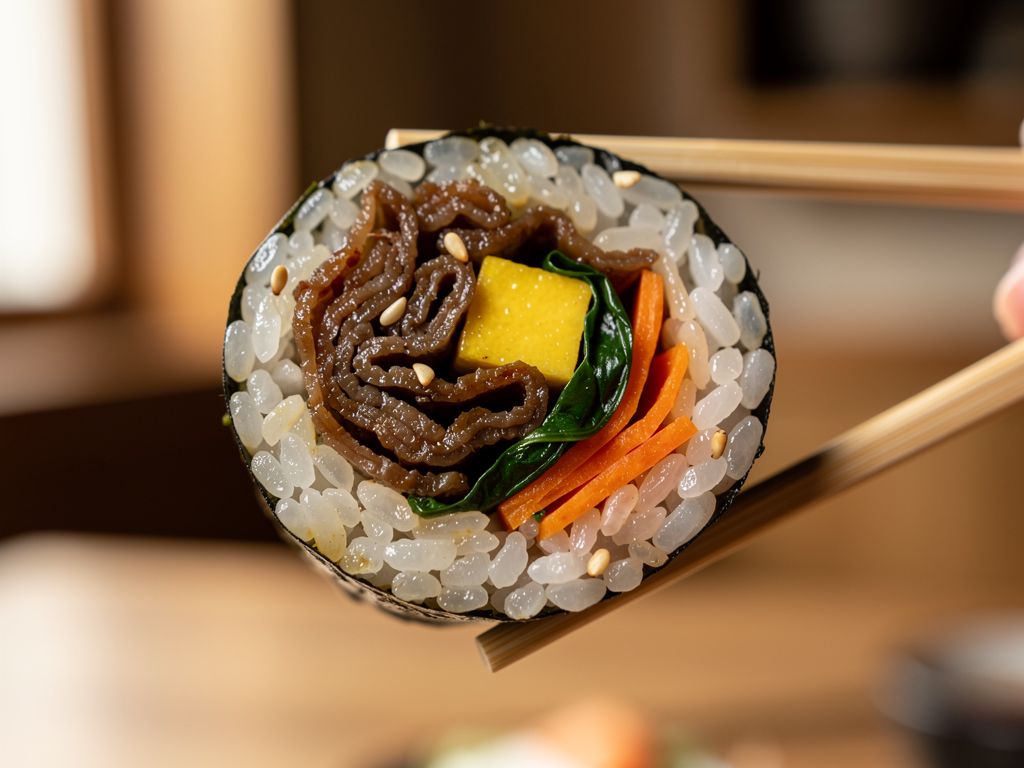
Abu Dhabi gimbap compared
The key column here is not price. It is evidence — whether a gimbap at that venue can be confirmed from a public source at all. Three of the six entries have no published price of any kind, and saying so is more useful than guessing.
| Venue | Area | Gimbap price | Evidence it is served | Halal | Standout order |
|---|---|---|---|---|---|
| Mukbang Shows | Al Danah (Muroor Rd + Electra St) | AED 41 / 45 / 48 | Published menu, three named fillings | 100% halal, beef and chicken only | Beef Bulgogi Gimbap AED 41 |
| Seoul Street | Al Reem Island | No published price | Delivery and Zomato menus name two gimbap | Confirm directly | Bulgogi gimbap |
| Mr. Kimchi (Bon Ga) | Yas Mall food court, Yas Island | No published price | Property Finder names a ramen kimbap; Yas Mall directory confirms the outlet | Confirm directly | Ramen kimbap |
| The Taste of Korea | Cristal Hotel + Al Wahda Mall | No published price for gimbap | Al Danah delivery listing describes a seasoned beef kimbap | Confirm directly with the specific branch | Seasoned beef kimbap |
| Korean Kitchen | Al Najda | No published price | Delivery listing shows a teriyaki chicken kimbap | Confirm directly | Teriyaki chicken kimbap |
| The Skewers | Hamdan Street | No separate gimbap price | Bento sets list kimbap as a component | Confirm directly | Bento set with kimbap |
Cost-for-two figures quoted elsewhere on this page come from MyBayut and Property Finder’s round-up of the Korean restaurants Abu Dhabi searches for. They are estimates for a full meal for two people. They are not gimbap prices and should never be read as such.
Is gimbap halal in Abu Dhabi?
Not automatically, and the reason is the filling rather than anything else. The default gimbap in Korean convenience stores, home kitchens and most gimbap chains is built on ham — processed pork luncheon meat — usually alongside danmuji, egg, spinach, carrot and burdock. It is the single most common protein in the roll. So the dish name tells you nothing, and anyone avoiding pork needs to read the filling list and ask specifically rather than assume.
That is what makes a line-up of beef bulgogi, spicy tuna and shrimp tempura a genuine rebuild rather than a default. Mukbang Shows runs a 100% halal kitchen with beef and chicken only, no pork of any kind, and no alcohol on the premises, and it publishes what is in each roll. For every other venue in the city, confirm directly with the venue. Our full Abu Dhabi Korean food guide covers the same question across the rest of the menu.
What is gimbap (김밥)?
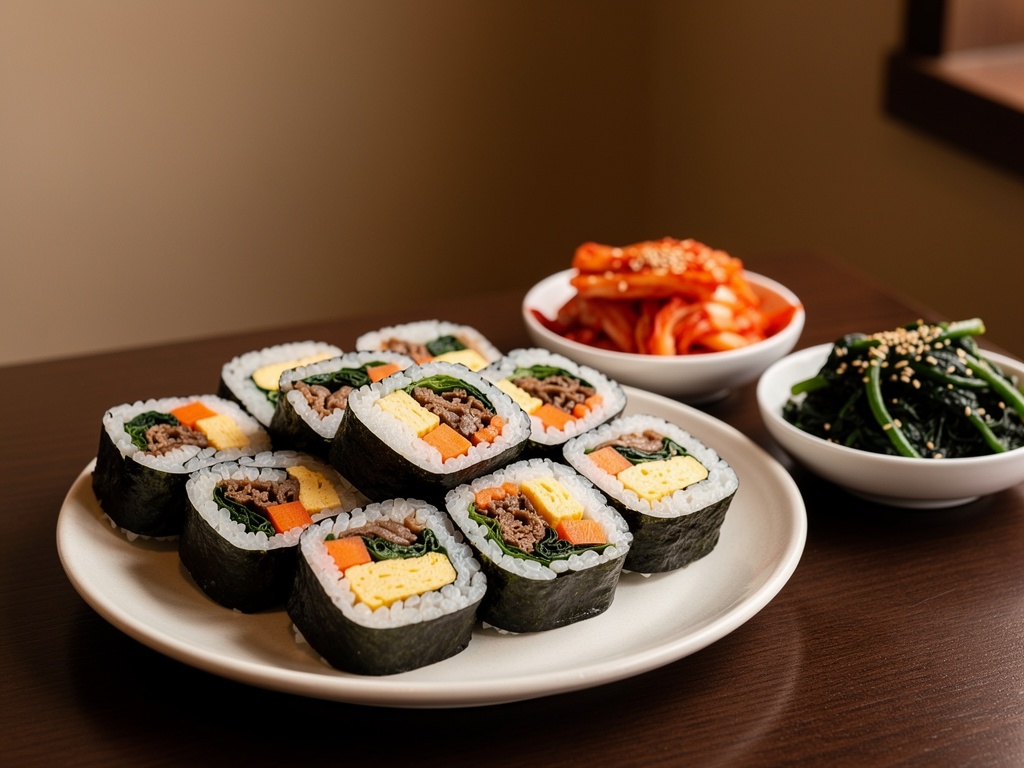
Gimbap is seasoned short-grain rice and fillings rolled inside a sheet of roasted seaweed, then cut into rounds. The name is literally the two ingredients: gim is the seaweed, bap is the rice. Standard fillings are danmuji — yellow pickled radish — plus egg, spinach, carrot, burdock root and a protein.
The difference from sushi is not the fillings and not the seaweed. It is the rice, and most write-ups get this wrong. Sushi rice is seasoned with rice vinegar, sugar and salt. Gimbap rice is seasoned with sesame oil and salt, and the seaweed sheet is often brushed with sesame oil too. That one swap changes everything downstream: gimbap smells nutty rather than sharp, the fillings are almost always cooked or pickled rather than raw, it is eaten as a complete meal rather than as a vehicle for fish, and it does not keep the way vinegared rice does.
That last point is the practical one. Vinegar is a preservative; sesame oil is not. Gimbap is built to be eaten at ambient temperature within a few hours of rolling, which is exactly why it became Korea’s picnic, school-trip and hiking food. It needs no cutlery, no heat and no plate, and it is one of the very few Korean dishes that genuinely survives a delivery ride.
Why you should never refrigerate leftover gimbap
Because cold is what ruins it, and this is the most counter-intuitive thing about the dish. Cooked rice starch retrogrades — recrystallises and pushes water out — fastest at fridge temperature, roughly 0 to 5°C. That is the same mechanism that turns day-old refrigerated rice hard and chalky, and sesame oil does not slow it the way vinegar partly does.
So the ranking most people assume is backwards. A gimbap that spent half an hour in a delivery bag is usually fine. A gimbap that spent a night in the fridge is not, and a microwave will not bring it back, because reheating drives off moisture rather than restoring the starch structure. The Korean fix is gimbap jeon: slice the roll into rounds, dip each piece in beaten egg, and pan-fry until the outside crisps. It is a different dish at that point, and a good one.
How to tell a good gimbap from a bad one
Three tells, and none of them requires you to know anything about Korean food.
First, look at the rice. It should be a thin, even layer with individual grains still visible. A thick rice wall means the kitchen is padding the roll, and it throws the whole ratio off — you end up eating rice with a hint of filling.
Second, pick up a round. It should hold. If it collapses on the way to your mouth, it was rolled loose or rolled cold, and neither is fixable at the table.
Third, smell it before you taste it. Toasted sesame should arrive first. If nothing does, the rice was under-seasoned or the roll has been sitting.
One extra check for takeaway: look at the cut ends. A roll that has been sitting cut and uncovered dries at the exposed faces first, so the ends tell you the roll’s age more honestly than the middle does.
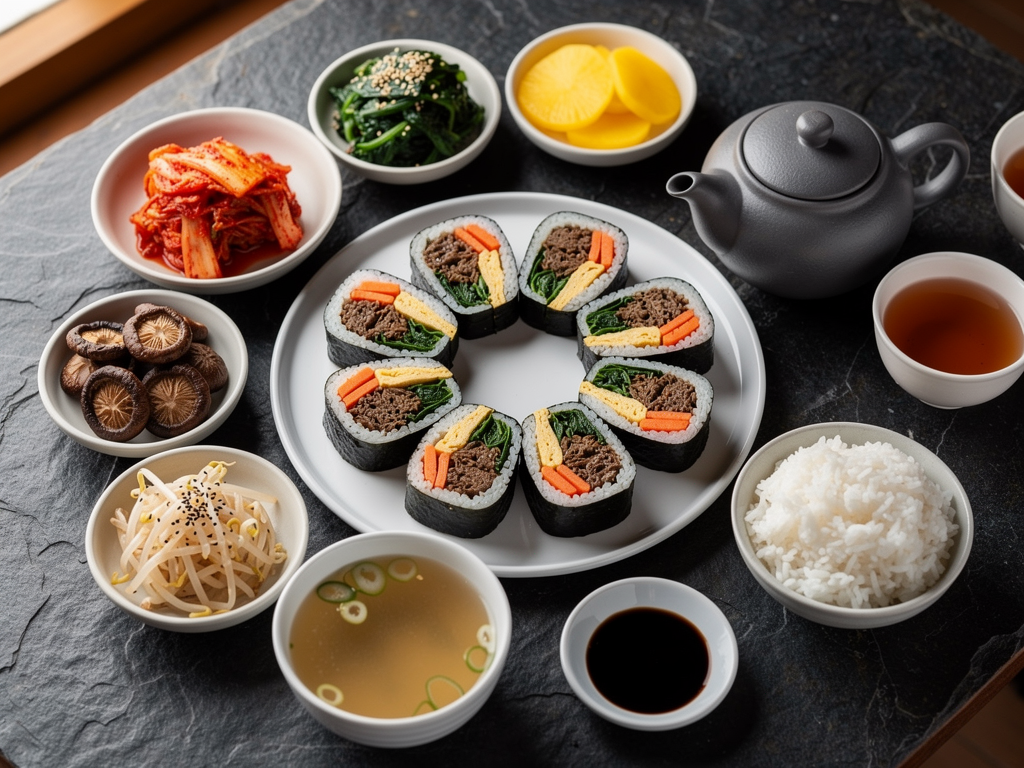
Where to get gimbap by area in Abu Dhabi
The densest cluster sits in Al Danah, along Zayed The First Street and Electra Street. Mukbang Shows runs both its branches here and The Taste of Korea has its Cristal Hotel room in the same corridor. This is the practical zone for gimbap as a side to a grill order or as part of an all-you-can-eat lunch.
Al Reem Island has Seoul Street, which is the strongest non-Mukbang option on the dish itself and the only venue in the city treating gimbap as part of a full bunsik menu. It is a drive from the centre, so it works better as a destination than as a spontaneous stop.
Yas Island has Mr. Kimchi inside the Yas Mall food court. This is the easiest stop if you are already shopping or at the theme parks, and the counter draws on the Bon Ga kitchen. Mall hours and counter service are the trade-offs.
Al Najda and the Baghdad Street area hold Korean Kitchen, behind the Honda showroom near the National Hospital, with the teriyaki chicken kimbap that nobody else in the city lists. Hamdan Street has The Skewers behind Emax, where the kimbap comes inside a bento set. Al Wahda Mall and Madinat Zayed are covered by The Taste of Korea’s other units — confirm which format you are getting before you go, because the hotel room and the mall unit are not the same menu.
The overall shape of the city is a central Korean corridor on Electra and Muroor, a couple of island and mall outposts that solve specific location problems, and small neighbourhood rooms that reach further through delivery apps. Because gimbap travels better than almost anything else on a Korean menu, that delivery reach genuinely widens the catchment for every venue on this list — which is not true of, say, a cold noodle soup.
How to order gimbap properly in Abu Dhabi
Eat it the day it is rolled. Ambient temperature, within a few hours, is what the dish is designed for. That is also why it is the rare Korean order that arrives at a desk in good condition.
Do not put leftovers in the fridge. Slice them, dip in beaten egg and pan-fry them as gimbap jeon instead. The texture comes back as something different rather than something worse.
Inspect the cut ends when the box opens. Dry or cracked faces mean the roll has been sitting. Thin, even rice and a roll that holds its shape are what you are looking for.
Treat it as a side, not a main, at a BBQ house. At Mukbang the AED 41 to AED 48 single-roll prices make far more sense once you notice two rolls are already bundled into the AED 69 to AED 129 all-you-can-eat tiers.
Ask what is in it, every time. Ham is the default gimbap protein worldwide, so the filling list is the only thing that answers the question. Mukbang publishes shrimp tempura, spicy tuna and beef bulgogi; everywhere else, ask.
Use it as the solo-diner workaround. Gimbap is the one item on most Korean menus a single person can order without running into a minimum-two-person rule, which is otherwise the standing obstacle to eating Korean food alone in this city.
Check the branch, not just the brand. Operators here run different menus at their hotel rooms and their food-court units, so confirm the specific roll exists at the specific address you are heading to.
If you want the rest of the bunsik menu around it, Mukbang lists tteokbokki at AED 55, rabokki at AED 49, mandu at AED 48, gimmari at AED 49 and eomuk tang at AED 49 — all of which sit in the same street-food lane. Our wider Abu Dhabi Korean street food guide goes through those in detail.
FAQ
How much does gimbap cost in Abu Dhabi?
Mukbang Shows publishes AED 41 for beef bulgogi, AED 45 for spicy tuna and AED 48 for shrimp tempura. No other venue in the city publishes a gimbap price.
Can you get vegetarian gimbap in Abu Dhabi?
Not at Mukbang Shows, which lists only beef, tuna and shrimp fillings. No Abu Dhabi venue publishes a vegetarian gimbap, so ask each kitchen directly.
Is refrigerated gimbap ruined?
Largely, yes. The rice hardens because starch retrogrades fastest at fridge temperature. Pan-frying the slices in beaten egg is the standard fix.
What is the difference between gimbap and sushi?
The rice seasoning. Gimbap rice uses sesame oil and salt; sushi rice uses vinegar, sugar and salt. That changes the aroma, the fillings and how long it keeps.
Does gimbap survive delivery?
Better than most Korean dishes, because it is designed to be eaten at ambient temperature without reheating. It is one of the few Korean orders that does not need to be eaten in the room.
Is Mukbang Shows the cheapest gimbap in Abu Dhabi?
Unknown, and probably not. It is the only one publishing prices, and a single roll is not cheap. The value case is the two rolls included in each all-you-can-eat tier.
What is the best gimbap in Abu Dhabi for an office lunch?
Mukbang Shows or Seoul Street. Both list gimbap as a proper menu item rather than a bento component, and gimbap is the one Korean dish that works one-handed at a desk.
Gimbap is on almost every Korean menu in Abu Dhabi and headlines none of them, which is why the honest answer to this question is about transparency rather than craft. Mukbang Shows wins it by publishing prices and fillings; if you want a roll made somewhere that treats bunsik as the whole point, Seoul Street is the drive worth making.
Related guides
More from our Korean food guides across the UAE: