Updated: August 2026
The best naengmyeon in Abu Dhabi is the Mulnaengmyun at Mukbang Shows on Muroor Road and Electra Street, AED 55. That is less of a ranking than it sounds. Only two kitchens in the city have naengmyeon we could verify from a public source, and only one of them publishes a price — so this page is a scarcity map first and a ranking second.
TL;DR
– Best overall: Mukbang Shows — Mulnaengmyun AED 55, the only published naengmyeon price in Abu Dhabi
– The only real alternative: Mr. Kimchi / Bon Ga, Mussafah Shabiya — verified naengmyeon, no published price, a deliberate trip
– If you want cold noodles that are not naengmyeon: Madang’s kong guksu, or Mukbang’s Bibimguksu at AED 48
Where do you find the best naengmyeon in Abu Dhabi?
Mukbang Shows on Muroor Road and Electra Street serves the best naengmyeon in Abu Dhabi on a narrow, checkable basis: its Mulnaengmyun at AED 55 is the only naengmyeon price published by any restaurant in the city. The one genuine alternative is Mr. Kimchi, the business that also trades as Bon Ga, in Mussafah Shabiya.
That is the whole verified field. Two kitchens. Property Finder’s Abu Dhabi Korean round-up names ten Korean venues and does not list naengmyeon at a single one of them, and the city has no naengmyeon specialist — no shop pressing its own buckwheat noodles, no Pyongyang-versus-Hamhung argument to have. Anyone telling you Abu Dhabi has a deep cold-noodle scene has not checked.
Is Mukbang Shows worth it for naengmyeon?
Yes, with the caveat that you are not choosing between many options. The Mulnaengmyun is AED 55 and it is the mul, or broth, version — cold soup rather than the sauced kind. Mukbang does not serve bibim naengmyeon, and no venue in Abu Dhabi does.
The Muroor Road branch is at 547 Sultan Bin Zayed The First St, Al Danah, Zone 1. The Electra Street branch sits on Zayed The First St behind Sun and Sand Sports, in the same zone. Call Muroor Road on +971-50-158-9433 or Electra Street on +971-2-564-0446. The kitchen is 100% halal, beef and chicken only, with no pork of any kind and no alcohol on the premises.
Ordering it after a grill course is not a fusion idea. In Korean barbecue houses the cold bowl is the standard closer, and the sour broth genuinely does reset a palate that has been eating marinated beef for an hour. The all-you-can-eat tiers run Gangnam AED 69, Daegu AED 89, Jeju AED 99 and Bukchon Hanok AED 129 with a two-person minimum and an AED 60 leftover charge, and the naengmyeon stays a separate a la carte order on top.
The honest limitation: this is a Korean BBQ house rather than a noodle shop. One naengmyeon on the menu is the whole range, there is no styles distinction on offer, and a serious naengmyeon drinker would find the field here thin. The same menu lists Bibimguksu at AED 48 if you want cold noodles in a gochujang dressing instead of soup — a different dish, covered below.
How does Mr. Kimchi compare?
It is the only other verified naengmyeon in the city, and it publishes no price. Mr. Kimchi, which still partly trades under its original name Bon Ga, runs a sit-down room in Mussafah Shabiya opposite Etisalat Tower and a food-court counter on the first floor of Yas Mall on Yas Island.
Two independent sources name the dish specifically rather than saying “cold noodles”: MyBayut’s Abu Dhabi Korean restaurant guide lists a galssam naengmyeon, and its Zomato menu listing includes a combination of Korean roasted beef served with naengmyeon. MyBayut estimates roughly AED 180 as a cost for two at the Mussafah room — an estimate for a whole meal, not a naengmyeon price.
Search both names or you will conclude a branch closed. The Yas Mall directory lists that outlet at 10:00 to 22:00 Sunday to Thursday and 10:00 to midnight Friday and Saturday; there are no published hours for the Mussafah room. Mussafah is out in the industrial area, well away from the Electra and Hamdan Korean cluster, so this is a deliberate trip rather than a walk-in. Halal status is not independently verified — confirm directly with the venue.
Abu Dhabi naengmyeon compared
The column that matters here is not price. It is evidence — whether naengmyeon can be confirmed at that venue at all. Three of the five entries below are marked unconfirmed, and that is the honest state of the city rather than a gap in the research.
| Venue | Area | Naengmyeon price | Evidence it is served | Halal | Standout order |
|---|---|---|---|---|---|
| Mukbang Shows | Al Danah (Muroor Rd + Electra St) | AED 55 | Published menu, named Mulnaengmyun | 100% halal, beef and chicken only | Mulnaengmyun AED 55 |
| Mr. Kimchi / Bon Ga | Mussafah Shabiya + Yas Mall | No published price | MyBayut names galssam naengmyeon; Zomato lists a roasted beef and naengmyeon combination | Confirm directly | Galssam naengmyeon |
| Hankook | Al Nahyan | No published price | Unconfirmed — MyBayut lists only “hot or cold noodles” | Confirm directly | Ask before travelling |
| Madang | Holiday Inn Al Sa’adah + Al Ghazal | No published price | No naengmyeon — its own site lists kong guksu, bibim guksu and jjolmyeon instead | Confirm directly | Kong guksu |
| Korean Kitchen | Al Najda | No published price | Unconfirmed — publishes kal guksoo, a hot noodle | Confirm directly | Ask before travelling |
| The Taste of Korea | Cristal Hotel + Al Wahda Mall | No published price | Unconfirmed — no cold noodle appears in any listing | Confirm directly with the branch | Ask before travelling |
Cost-for-two figures elsewhere on this page come from MyBayut and Property Finder’s round-up of the Korean restaurants Abu Dhabi searches for. They estimate a full meal for two people and are not dish prices.
Why do so few Abu Dhabi Korean restaurants serve naengmyeon?
Because it is a demanding dish to run and an easy one to skip, and the clearest evidence for that comes from a competitor’s own website. Madang publishes the longest Korean menu in the city — fifteen named stews and six noodle dishes — and naengmyeon is not among them. What it does list is kong guksu, a chilled soy-milk noodle soup, plus bibim guksu and jjolmyeon. So this is a kitchen that already runs cold noodles, has the range to add another, and has not.
The reasons are structural. The broth has to be made as a separate stock and then held near freezing, which is fridge space committed to one dish. The noodles are buckwheat and starch rather than wheat, so they are bought in rather than made, and they are unforgiving once cooked. And the dish is seasonal in perception even where the weather is not, which makes it hard to justify year-round menu space.
Hankook, meanwhile, is listed with “hot or cold noodles” and nothing more specific, which is exactly the kind of entry that gets miscopied into listicles as naengmyeon. A cold noodle in Abu Dhabi is at least as likely to be bibim guksu or kong guksu. Treat it as unconfirmed and call ahead.
What is naengmyeon (냉면)?
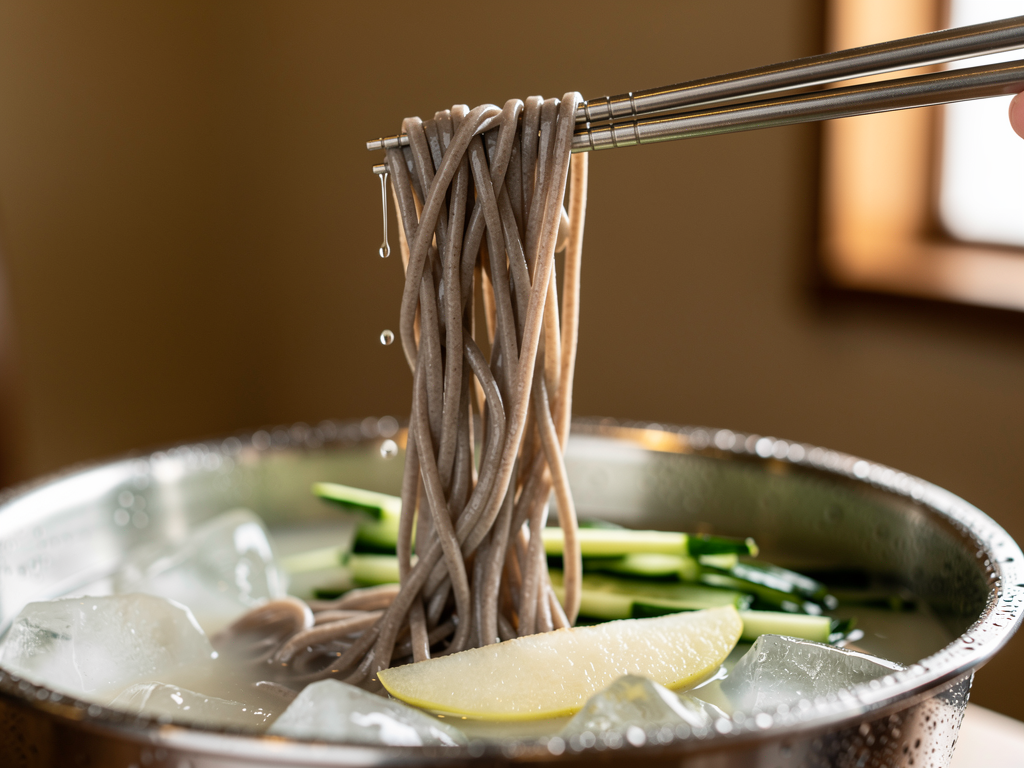
Naengmyeon is a cold Korean noodle dish built on long, thin, grey-brown strands made from buckwheat blended with potato or sweet potato starch rather than wheat. The texture is the point. These noodles stretch and resist before they yield, because buckwheat has no gluten network and the dough is held together by starch instead.
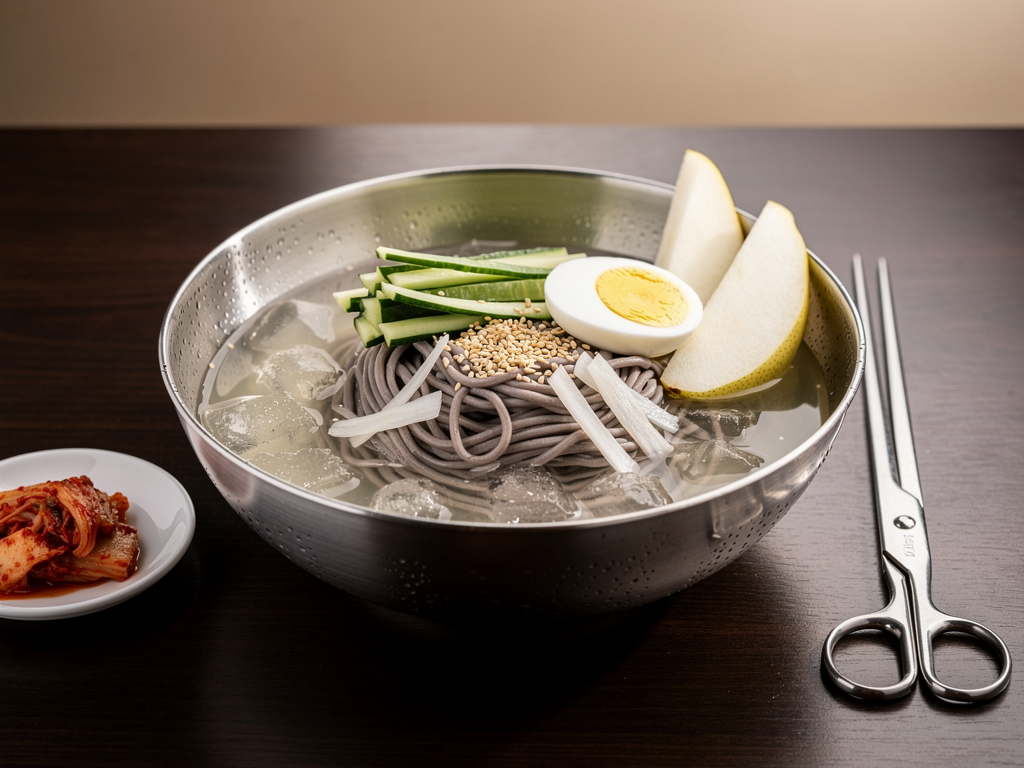
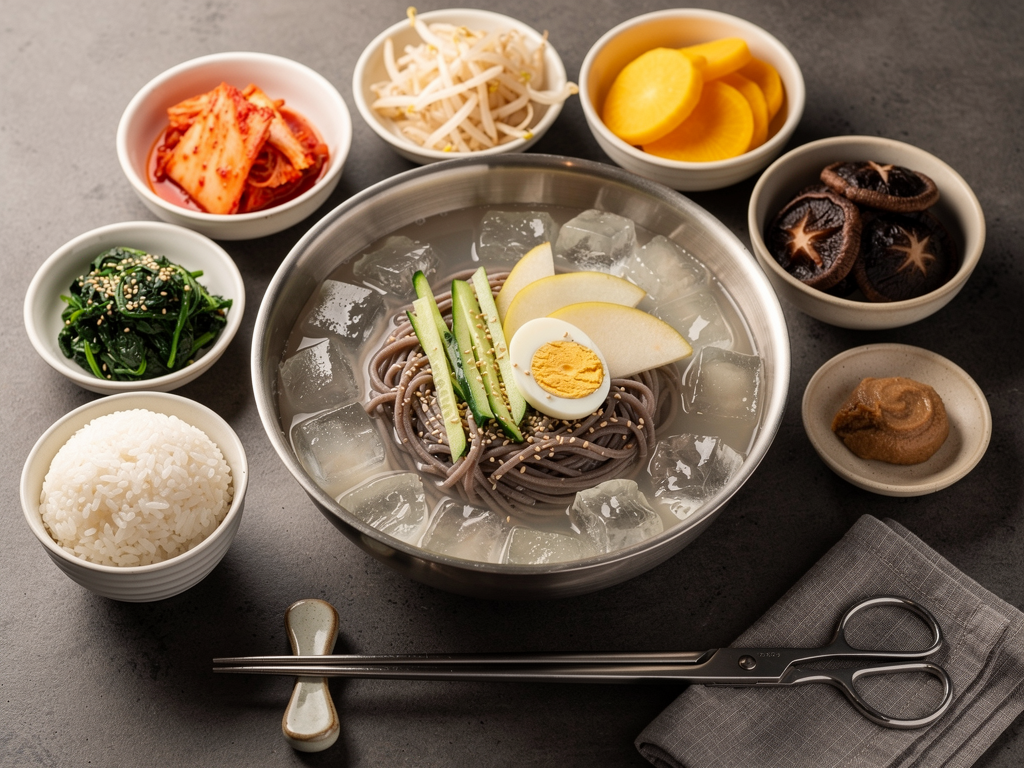
That is also why the bowl arrives with scissors. Cutting the coil once before you start is normal practice in Korea, not a tourist’s shortcut — the strands are genuinely too long and too rubbery to manage otherwise.
Two versions exist. Mul naengmyeon floats the noodles in chilled broth. Bibim naengmyeon has no soup at all and is tossed in a spicy gochujang dressing. The broth is the harder half: traditionally a clear beef stock, usually brisket, sharpened with dongchimi, the brine from radish water kimchi. That combination gives the faintly sour, almost fizzy edge that plain salty stock cannot fake. It is chilled until slushy, sometimes with ice crystals still visible, and finished at the table by the diner with mustard oil and vinegar rather than seasoned in the kitchen.
There is a seasonal irony worth knowing. Naengmyeon reads as a summer dish now, but it came from the north — Pyongyang and Hamhung — and was historically eaten in winter, when the dongchimi crocks buried through the cold months were at their best. The iced version came later.
Why naengmyeon is the worst Korean dish to have delivered in August
Because the temperature is the dish, and no delivery bag holds it. Mul naengmyeon is meant to arrive slushy, just above freezing. Weather Atlas puts the August average low at about 33.2°C in Abu Dhabi, with an average high around 40.1°C and a heat index near 54°C — and it is the overnight low that matters, because the city does not cool off after dark.
Even a short ride in that heat takes the broth from icy to merely cool, which flattens it. Worse, the starch noodles keep drinking the broth the entire time, so they arrive softer and the soup arrives thinner. Almost every other Korean noodle survives the trip better than this one, which is the reverse of what most people assume about cold food.
The practical rule: naengmyeon is an eat-in-the-room order. If delivery is your only option, order bibim naengmyeon where it exists — no soup, so nothing to warm up — or switch to Mukbang’s Bibimguksu at AED 48, which travels far better. Our full naengmyeon explainer goes deeper on the technique, and the Dubai naengmyeon guide covers a market with more places to compare.
How to tell a good bowl from a bad one
Three tells, and you do not need to have eaten it in Seoul to use them.
First, taste for sourness before heat. The broth should read faintly sour and faintly savoury at the same time. If there is no acidity at all, the dongchimi element was skipped and you are drinking cold beef stock.
Second, bite a noodle. It should fight back and stretch before it gives. Mushy strands mean the bowl sat too long between the kitchen and the table.
Third, hold the bowl. A properly chilled mul naengmyeon is cold enough to be uncomfortable in the hand, not merely fridge-cool. The standard garnish is thin pear or apple slices, cucumber, half a boiled egg and a little sliced beef, and a missing element usually signals a shortcut.
Is naengmyeon halal in Abu Dhabi?
At Mukbang Shows, yes — the kitchen is 100% halal, uses only beef and chicken, and serves no pork of any kind and no alcohol. For every other venue on this page, halal status is not independently verified, so confirm directly with the venue.
The thing worth checking on this particular dish is the broth rather than the noodle. Mul naengmyeon broth is traditionally a beef stock, so the question is what went into the stock and where the beef came from, not whether the buckwheat is an issue. Our Abu Dhabi Korean restaurant guide covers the same question across the wider city.
Naengmyeon and bibim guksu are not the same dish
They get confused constantly, including in menus. Bibim guksu uses thin wheat noodles — somyeon — tossed in a sweet-spicy gochujang sauce. Bibim naengmyeon uses the buckwheat-and-starch naengmyeon noodle in a similar-looking sauce. In a photograph they are nearly identical. In the mouth they are not close: somyeon is soft and yielding, naengmyeon is springy and elastic.
This matters in Abu Dhabi because the cold noodle you are most likely to be offered is the wheat one. Mukbang’s Bibimguksu at AED 48 is bibim guksu, and the menu calls it that rather than passing it off as naengmyeon. Madang’s kong guksu is a third thing again — wheat noodles in a chilled, unsweetened soy-milk broth, nutty rather than spicy, and genuinely the most interesting cold noodle in the city if you have already had naengmyeon.
Where the Korean restaurants actually are
The densest cluster sits around Muroor Road, Electra Street and Zayed The First Street in Al Danah, running into Al Nahyan. Mukbang Shows has both its branches inside this zone, which is why it is the easy answer for naengmyeon without a long drive, and The Taste of Korea has its Cristal Hotel room in the same corridor.
Al Nahyan holds Hankook on Defence Road near the Central Bus Station, and Manna Land on Al Muroor Road. Al Najda has Korean Kitchen behind the Honda showroom near the National Hospital. Madang is at the Holiday Inn on 31st Dhafeer Street in Al Sa’adah, with a second site out at Al Ghazal Golf Club near the airport.
Everything else sits outside the centre. Mussafah Shabiya, where Mr. Kimchi runs its main room, is out in the industrial area to the south. Yas Island has that operator’s food-court counter, and Al Reem Island has Seoul Street. Abu Dhabi has no metro, no tram and no rail of any kind, so every one of these is a car or taxi journey — which is exactly why the delivery question matters so much for a dish that cannot be delivered well.
How to order naengmyeon properly
Eat it in the room. This is the single most useful rule on the page. The broth is the dish and it does not survive the trip in an Abu Dhabi August.
Use the scissors. Cut the coil once or twice as soon as the bowl lands. It is standard practice, and the noodles are genuinely unmanageable otherwise.
Season it yourself. Mustard oil and vinegar are meant to be added at the table, not in the kitchen. Add a little, taste, add more. The broth is deliberately under-seasoned on arrival because the balance is yours to set.
Order it last if you are grilling. The hot-grill-then-icy-broth sequence is how the dish is eaten in Korean barbecue houses, and it works for the same reason a sorbet course does.
Judge the bowl by how cold it is to hold. Chilling time is the step kitchens cut when they are busy, and it is the one you can check before you taste anything.
If you cannot get to either verified venue, change dish rather than lowering your standards. Mukbang’s Bibimguksu at AED 48 or Madang’s kong guksu will both give you the cold-noodle payoff. A lukewarm naengmyeon will not.
Call before you drive. Three of the venues on this page are unconfirmed for naengmyeon, and none of them publishes a menu online. A phone call saves a wasted journey across the city.
FAQ
Can I get naengmyeon delivered in Abu Dhabi?
You can, but you should not. The broth melts in the heat and the noodles soften on the way. Order bibimguksu instead, or eat naengmyeon in the restaurant.
Does Abu Dhabi have Pyongyang-style naengmyeon?
No. The city has no venue that distinguishes Pyongyang from Hamhung styles, and no shop making its own noodles. Both verified bowls are standard mul naengmyeon.
How much does naengmyeon cost in Abu Dhabi?
Mukbang Shows publishes AED 55 for its Mulnaengmyun. No other restaurant in the city publishes a naengmyeon price at all.
What if I want cold noodles but not naengmyeon?
Mukbang’s Bibimguksu at AED 48 or Madang’s kong guksu, a chilled soy-milk noodle soup. Both appear on published menus.
What is the difference between naengmyeon and bibim guksu?
The noodle. Naengmyeon is buckwheat and starch, springy and elastic. Bibim guksu is thin wheat somyeon, soft and yielding. The sauces can look identical.
Why does naengmyeon come with scissors?
Buckwheat has no gluten, so the noodles are held together by starch and stretch rather than snap. Cutting the coil once is standard practice in Korea.
Abu Dhabi is close to the perfect climate for this dish and almost nobody in the city serves it, which makes the honest answer a short one: Mukbang Shows for the published AED 55 bowl in the centre, Mr. Kimchi if you are heading to Mussafah anyway. Everything else on the cold-noodle shelf here is a different dish wearing similar clothes.
Related guides
More from our Korean food guides across the UAE: