
Updated: August 2026
The best kimchi jjigae in Abu Dhabi depends on a distinction most menus here blur. Mukbang Shows on Muroor Road and Electra Street is the top pick on price transparency — Kimchi Jeongol at AED 89 large and AED 50 regular, the only published price for a kimchi pot in the city. But that is a jeongol, not a jjigae. If you want the literal thing, go to Madang.
TL;DR
– Best overall: Mukbang Shows — the only published price for a kimchi pot in Abu Dhabi, and a 100% halal beef-and-chicken build
– Best for the literal ttukbaegi jjigae: Madang Korean Restaurant — the only venue listing kimchi jjigae by name on its own website
– Cheapest sit-down room: Korean Kitchen, Al Najda — roughly AED 130 estimated for two, though its kimchi jjigae is unconfirmed
What is the best kimchi jjigae in Abu Dhabi?
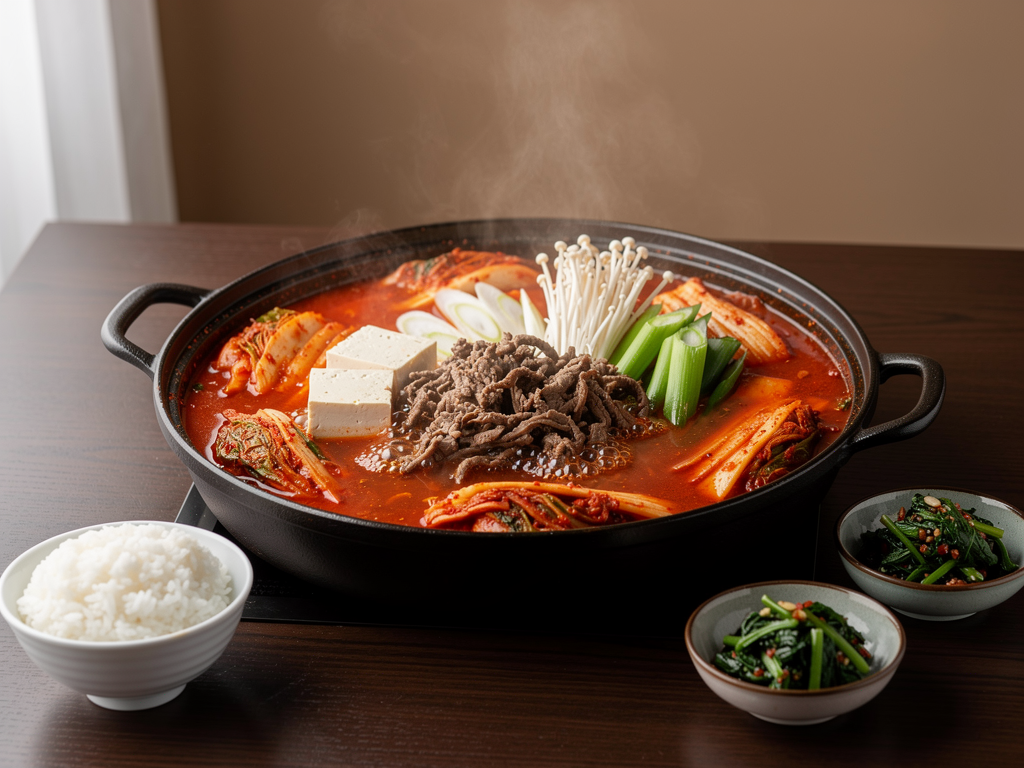
Mukbang Shows on Muroor Road and Electra Street serves the only kimchi-based stew in Abu Dhabi with a published price: Kimchi Jeongol at AED 89 large and AED 50 regular. Madang Korean Restaurant is the only venue in the city that lists a kimchi jjigae by name on its own website.
Those are two different dishes, and knowing which one you want is more useful than any ranking. A jjigae is thick, salty and cooked in the kitchen in an earthenware pot. A jeongol is wider, brothier and cooked at your table over a burner. The section below explains the difference properly, because it decides where you should eat.
Mukbang’s branches are at 547 Sultan Bin Zayed The First St, Al Danah, Zone 1, and on Zayed The First St behind Sun and Sand Sports in the same zone. Call Muroor Road on +971-50-158-9433 or Electra Street on +971-2-564-0446. The kitchen is 100% halal, beef and chicken only, with no pork of any kind and no alcohol on the premises.
The honest limitation, stated up front: Mukbang does not serve kimchi jjigae in the strict sense at all. It serves kimchi jeongol and labels it that way rather than passing one off as the other, which is to its credit — but if what you want is the single-serving stew that comes with rice on a weekday, this is the wrong format and AED 50 is a lot for that job.
Jjigae, jeongol and guk are three different dishes
This is the section worth reading, and almost nothing written about Korean food in Abu Dhabi covers it.
Guk is a thin soup, served in an individual bowl as one component of a rice meal. Nobody orders a guk as the centre of dinner.
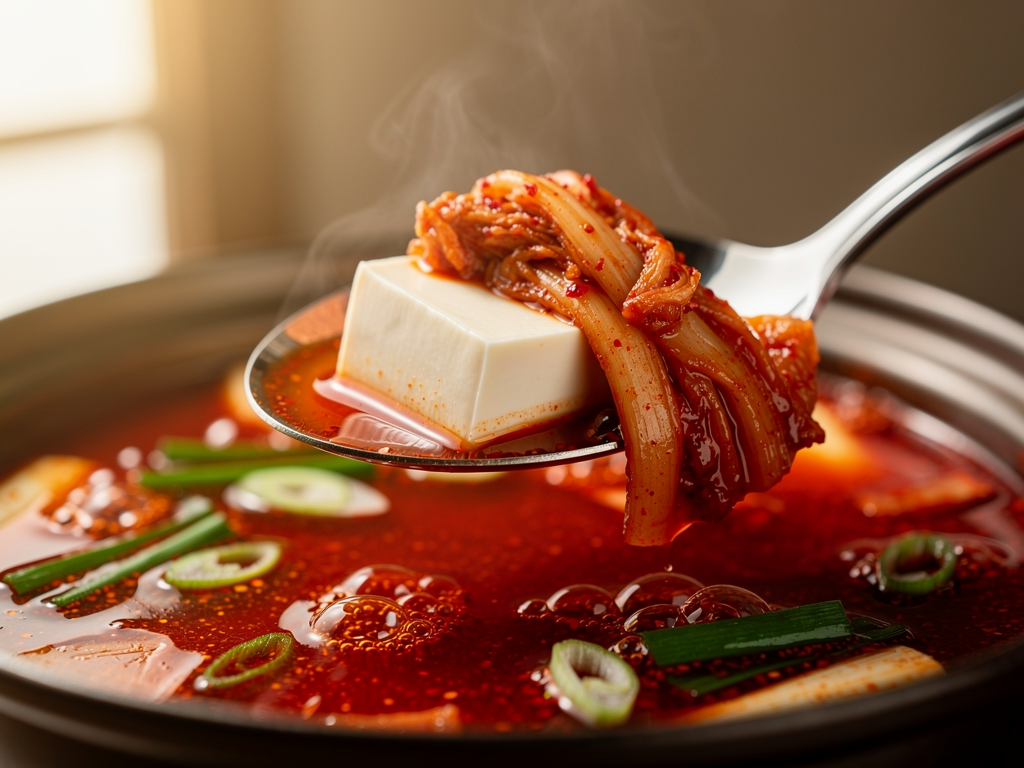
Jjigae is thicker, saltier and far more concentrated. It is cooked in the kitchen in a ttukbaegi — a heavy black earthenware pot that holds heat so well the stew arrives still boiling — and portioned for one or two people. Critically, it is meant to be salty, because you eat it with plain rice rather than on its own.
Jeongol is a different format entirely. The ingredients are laid out raw in a wide, shallow pan over a portable burner at your table, and the pot cooks while you sit there. There is more broth, milder seasoning and more in it, because a jeongol is a course in its own right rather than an accompaniment to rice.
Same kimchi base, completely different job. Ordering one when you wanted the other is the most common Korean-menu mistake in the UAE, and it is why a page about the best kimchi jjigae in Abu Dhabi has to split its answer by format rather than pretending there is a single winner.
Where to get each version
Madang Korean Restaurant is the address for the literal jjigae. It publishes a dedicated Korean stews page on its own site listing fifteen named stews, and Kimchi Jjigae is on it — described in the restaurant’s own words as a signature Korean stew made with aged kimchi, pork and tofu. That is a direct quote of the venue’s published description, not a verdict on the venue.
Madang is on the ground floor of the Holiday Inn at 31st Dhafeer Street, Al Sa’adah, Zone 1, on +971 2 585 5441 or +971 56 327 5999, with a second site at Al Ghazal Golf Club near the airport. It publishes almost no prices beyond a business lunch at AED 65, which covers a main plus seven banchan.
Mukbang Shows is the address for the shared pot, and the only one you can price in advance. Kimchi Jeongol is AED 89 large, AED 50 regular, and it is built without pork. That is a genuine reconstruction of the dish rather than a like-for-like swap, and it tastes different for the reasons set out further down. The rest of the published stew list is unusually complete for this city: Budae Jjigae AED 99, Jjampong AED 99 large and AED 60 regular, Haemul Jeongol AED 99, Soondubu Jjigae AED 59, Doenjang Jjigae AED 59 and Tteok Mandu Guk AED 59.
Hankook Korean Restaurant in Al Nahyan has strong evidence but no published anything. MyBayut’s Abu Dhabi Korean restaurant guide names a kimchi stew among its dishes and Property Finder’s round-up of the Korean restaurants Abu Dhabi searches for names a spicy kimchi stew specifically. Neither says which format it arrives in, so ask when you call. It sits on Defence Road beside Centre Villa Hotel, opposite the Central Bus Station, and MyBayut estimates roughly AED 195 as a cost for two — an estimate for a whole meal, not a stew price.
Manna Land in Al Nahyan, at Golden Towers Block B on Al Muroor Road, is listed with a kimchi hot pot. The phrasing points at the jeongol format rather than a ttukbaegi jjigae, and its published dishes also include a haemul jeongol, which supports that reading. It has been running for over fifteen years, and as the next section explains, longevity matters more for this dish than for almost anything else on a Korean menu.
Abu Dhabi kimchi jjigae compared
The column that decides this table is evidence, not price, because only one venue in the city publishes one.
| Venue | Area | Price | Format | Evidence | Halal |
|---|---|---|---|---|---|
| Mukbang Shows | Al Danah (Muroor Rd + Electra St) | AED 89 large / AED 50 regular | Jeongol — shared table pot | Published menu, named Kimchi Jeongol | 100% halal, beef and chicken only |
| Madang | Holiday Inn Al Sa’adah + Al Ghazal | No published price (AED 65 business lunch) | Jjigae — the literal listing | Its own website names Kimchi Jjigae | Confirm directly |
| Hankook | Al Nahyan | No published price | Unstated — ask | MyBayut and Property Finder both name a kimchi stew | Confirm directly |
| Manna Land | Al Nahyan | No published price | Likely jeongol | MyBayut names a kimchi hot pot | Confirm directly |
| Korean Kitchen | Al Najda | No published price | Unknown | Unconfirmed — publishes sundubu jjigae and kimchi pancake, not kimchi jjigae | Confirm directly |
| Korean Bowl | Al Danah | No published price | Unknown | Unconfirmed — no kimchi stew in any listing we checked | Confirm directly |
Two of those six are unconfirmed for this specific dish and it would be dishonest to pad the list by implying otherwise. Korean Kitchen, behind the Honda showroom near the National Hospital in Al Najda, publishes sundubu jjigae and kimchi pancake — a kitchen running one jjigae could almost certainly make another, but that is an assumption, not a fact.
Korean Bowl, on Al Widih Street behind the Millennium Hotel on 02 675 2562, has a strong Google rating and a well-regarded kimchi set, but no kimchi stew appears in any source we could verify. Call both before travelling. Time Out Abu Dhabi’s Korean restaurant round-up is a useful cross-check on which rooms are still trading.
What is kimchi jjigae (김치찌개)?
Kimchi jjigae is a stew built on aged, sour kimchi simmered with a protein, tofu, onion and spring onion until the broth turns deep red and slightly oily. It is among the most commonly eaten dishes in Korea, and it is a home dish before it is a restaurant dish — traditionally what you make when the kimchi in the fridge has gone too sour to eat straight.
That origin explains the whole recipe. It is a use-it-up dish, which is why the kimchi matters more than the meat, and why a restaurant version can taste hollow if the kitchen treats it as a menu filler rather than a way of using something it has been holding for months.
Why good kimchi jjigae needs bad kimchi
Because the kimchi that makes a great stew is kimchi you would not want to eat fresh, and that is a storage problem rather than a recipe problem.
What you need is mugeunji: kimchi fermented for months, often six months to a year, until it is sour, soft and genuinely pungent. That acidity is doing the work. It cuts fat, gives the broth depth, and stops the whole thing tasting like spicy cabbage soup. Fresh geotjeori kimchi — crunchy, bright, pleasant to eat on its own — makes a thin and one-dimensional stew no matter how much gochugaru goes in after.
For a restaurant outside Korea, that means committing cold storage months before you can sell a single bowl. It is a real commitment, and it is a fair explanation for why the Abu Dhabi venues with the strongest kimchi-stew evidence — Madang, Hankook and Manna Land — are all long-established rooms rather than new openings. Nobody in the city publishes anything about how they age their kimchi, so this is an explanation of the dish rather than a claim about any kitchen.
Is kimchi jjigae halal in Abu Dhabi?
Not by default, and the reason is the protein. The canonical kimchi jjigae is a pork dish: pork belly or pork shoulder is standard, and the rendered fat is doing structural work in the broth, carrying the chilli and softening the acidity. The other common Korean version uses tinned tuna. Madang’s own website describes its kimchi jjigae as made with aged kimchi, pork and tofu — again, the venue’s own published description of its own dish.
So a beef or chicken build is a genuine reconstruction, and it tastes different rather than identical. Saying that plainly is more useful than pretending the swap is invisible. Mukbang Shows runs a 100% halal kitchen with beef and chicken only, no pork of any kind and no alcohol on the premises, which is why its Kimchi Jeongol is a rebuild rather than a substitution.
One more thing worth knowing, because it trips people up: traditional baechu kimchi is usually fermented with jeotgal, salted fermented seafood such as saeu-jeot shrimp or myeolchi-jeot anchovy, and some commercial kimchi also uses fish sauce. None of that is a pork question.
The useful things to ask a kitchen about are the protein in the pot and the stock it was built on — not the cabbage. Our soondubu jjigae explainer covers the same question for the tofu stew, and the Abu Dhabi budae jjigae guide covers the dish where the halal rebuild is most drastic of all.
How to tell a good one from a bad one
Three tells, and none of them needs a trained palate.
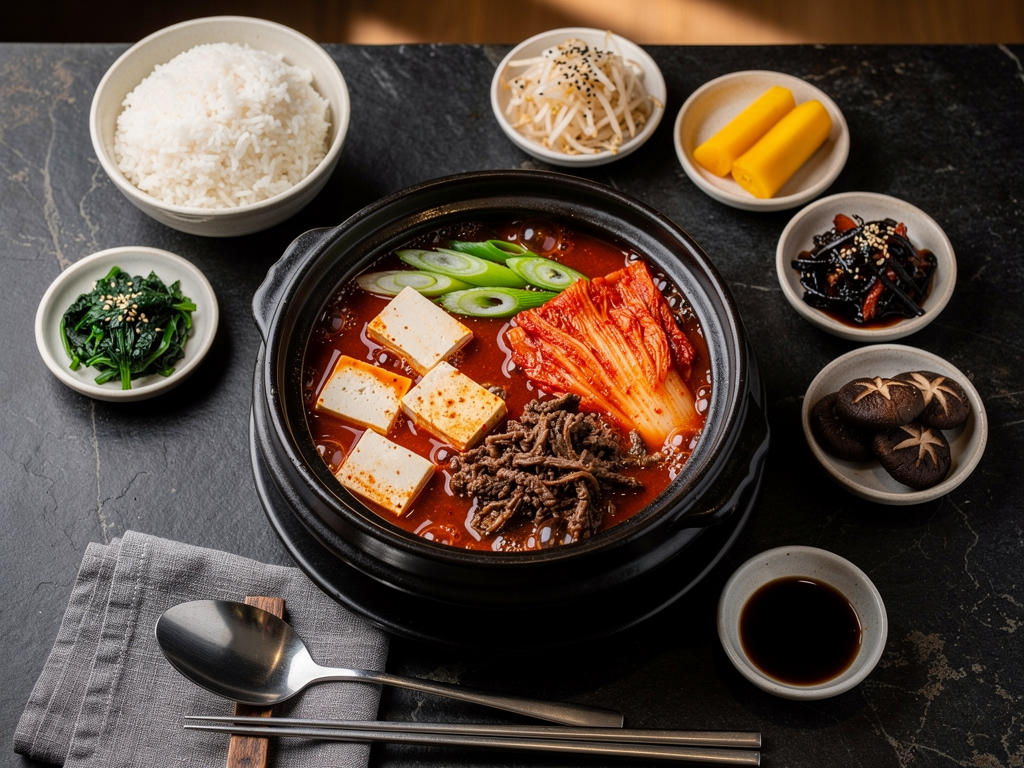
First, taste for sourness before heat. A kimchi jjigae that reads as merely spicy was made with kimchi that was not old enough. The sour note should arrive first and the chilli should sit behind it.
Second, look at the surface. There should be visible body and a slick of red oil on top. A watery, flat-looking broth means it was thinned rather than reduced.
Third, look at the tofu. It should be silky and intact, which means it went in late. Crumbled tofu means the pot was boiled hard from the start, and the texture never comes back.
A fourth, slower tell: a good one improves as it sits. Jjigae is designed to reduce on the table, so the last few spoonfuls should be more concentrated and better than the first.
Order rice, always
This is the single most common mistake with jjigae in the UAE and it is worth its own heading. A jjigae is deliberately over-seasoned relative to a soup, because the dish is a rice-meal component and the rice is supposed to absorb the salt. Tasting a spoonful on its own and concluding it is too salty is a category error — you are eating half the dish.
If a kitchen brings you a jjigae without rice, order rice. If you are eating the jeongol format instead, the seasoning will already be milder because a jeongol is built to be eaten as a course on its own, which is another practical consequence of the distinction this page opened with.
Where the Korean kitchens actually are
Al Danah and Al Markaziya hold the densest cluster. Mukbang Shows runs both its branches here, and Korean Bowl sits in the same pocket on Al Widih Street behind the Millennium Hotel. This is the easiest area to reach more than one option in a single trip.
Al Nahyan is the second Korean neighbourhood, with Hankook on Defence Road near the Central Bus Station and Manna Land on Al Muroor Road near the Al Mamoura building. Between them, that is two of the three strongest kimchi-stew leads in the city inside one district.
Al Sa’adah has Madang at the Holiday Inn on 31st Dhafeer Street, with its second site out at Al Ghazal Golf Club near Abu Dhabi International Airport. Al Najda has Korean Kitchen on Baghdad Street behind the Honda showroom.
Abu Dhabi has no metro, no tram and no rail of any kind, so every one of these is a car or taxi trip. That matters for this dish specifically: a jeongol cooks at the table and cannot be delivered in that format at all, and a jjigae arrives in a heavy pot precisely because the pot is what keeps it at temperature. Both are eat-in dishes by design.
How to order kimchi jjigae in Abu Dhabi
Say which format you want. Ask for the ttukbaegi jjigae or the jeongol pot by name. The two arrive differently, cost differently and feed different numbers of people.
Match the format to the group. A large jeongol at AED 89 is built for two or three people to share. A true jjigae is a one or two person dish, which makes it the better weekday lunch and the worse group order.
Ask about the protein and the stock. That is where the pork question actually lives on this dish, not in the kimchi.
Order rice with it. Non-negotiable for a jjigae, for the reasons above.
Judge it as it reduces. Give the pot a few minutes before deciding. The stew concentrates on the burner and the second half should beat the first.
Call ahead if you are heading anywhere unconfirmed. Korean Kitchen and Korean Bowl are both unconfirmed for this dish, and none of the independent rooms in this city publishes a menu you can check online.
Budget from the estimates, not the menu. The MyBayut and Property Finder cost-for-two figures on this page — roughly AED 130 to AED 300 — cover full meals with sides. Only Mukbang publishes an actual dish price, and our Dubai kimchi jjigae guide shows how much more transparent a bigger market is.
FAQ
Is Mukbang’s Kimchi Jeongol the same as kimchi jjigae?
No. It is a wider, milder pot cooked at your table and shared. A jjigae is a concentrated, salty stew cooked in the kitchen and served already bubbling. They are not interchangeable.
Which Abu Dhabi restaurant actually lists kimchi jjigae by name?
Madang. Its own website carries a Korean stews page listing Kimchi Jjigae among fifteen named stews. No other venue in the city publishes the dish by name.
How much does kimchi jjigae cost in Abu Dhabi?
Only Mukbang Shows publishes a price, and it is for the jeongol: AED 89 large, AED 50 regular. Every other venue publishes nothing.
Why does good kimchi jjigae need old kimchi?
Mugeunji, aged for months, brings the sourness that cuts fat and gives the broth depth. Fresh kimchi makes a thin, one-note stew.
Should I order rice with it?
Yes. A jjigae is deliberately over-seasoned because it is meant to be eaten with plain rice. Without rice it will taste too salty, and that is the dish working as designed.
Is the traditional version made with pork?
Yes — pork belly or shoulder is standard, with tuna the other common Korean version. Mukbang’s build uses no pork at all, so it tastes different rather than identical.
The distinction between jjigae and jeongol is the most useful thing to carry into a Korean menu in this city, and it is the reason this page has two answers instead of one. Mukbang Shows for the shared pot you can price before you go; Madang for the earthenware stew the query literally describes.
Related guides
More from our Korean food guides across the UAE:
Comments are closed.