Updated: August 2026
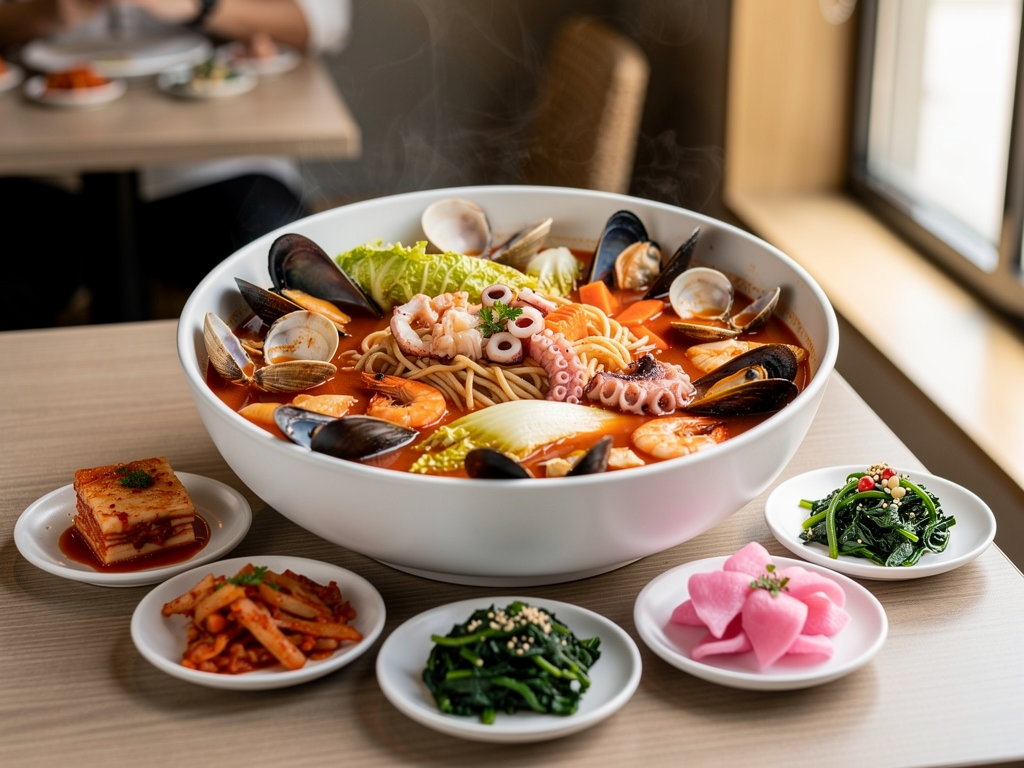
The best jjampong in Abu Dhabi depends entirely on whether you are eating alone or sharing, because the two formats are priced completely differently. Mukbang Shows on Muroor Road and Electra Street has the strongest sharing pot at AED 99 large, while Manna Land in Al Nahyan has the cheapest single bowl in the city at AED 53. Four venues publish a price for this dish, which makes jjampong the most price-transparent Korean dish in the capital.
TL;DR
– Best sharing pot: Mukbang Shows — AED 99 large, the only listing that names its shellfish
– Best solo bowl and best value: Manna Land — AED 53, from the only fully priced Korean menu in Abu Dhabi
– Best late night: The Skewers — AED 70, open until 3AM
– Deepest Korean-Chinese menu: Madang — two jjampong variants on its own site, no published price
Why jjampong is the one Abu Dhabi Korean dish you can actually price
Every other Abu Dhabi guide we have written on this site has run into the same wall: the capital’s Korean restaurants do not publish dish prices. Jjampong is the exception, and it is a real one. Four kitchens name a number — Manna Land at AED 53, The Skewers at AED 70 and AED 78 for the lobster version, and Mukbang at AED 99 large or AED 60 regular. That is a spread of AED 46 between the cheapest and the most expensive.
The spread is not a quality gradient. It is almost entirely a portion-format gap. At the bottom you are buying one bowl of noodles for one person, the way jjampong is served in Korea. At the top you are buying a wide sharing pot built for two or three. Reading those two numbers as if they describe the same product is the most common mistake people make with a Korean menu in this city, and it is the reason this ranking splits by format before it ranks anything.
Which is the best jjampong in Abu Dhabi for sharing?
Mukbang Shows takes the sharing pot on a narrow, checkable basis: it is the only jjampong listing in Abu Dhabi that tells you what shellfish is in it. The live menu describes it verbatim as “Spicy seafood noodle soup with shrimp, squid & mussels” at AED 99 for the large and AED 60 for the regular. Nobody else in the city publishes the contents, and nobody else publishes two sizes.
It is also the only kitchen here that confirms a fully pork-free build, which matters more for this dish than most people expect — see the halal section below for why. The two Abu Dhabi branches are on Muroor Road, at 547 Sultan Bin Zayed The First Street in Al Danah, and on Electra Street behind Sun and Sand Sports. Phone +971-50-158-9433 for Muroor Road and +971-2-564-0446 for Electra Street.
One thing to be clear about: jjampong is a separate à la carte order and is not part of any all-you-can-eat tier. Those tiers run Gangnam AED 69, Daegu AED 89, Jeju AED 99 and Bukchon Hanok AED 129, minimum two people, with an AED 60 leftover charge. Ordering the AYCE does not get you a bowl of jjampong.
And the honest limitation, in plain numbers: this is the most expensive jjampong in Abu Dhabi that publishes a price. The AED 60 regular is AED 7 more than Manna Land’s entire bowl and AED 10 more than The Skewers’. If you are eating alone on a weekday, Mukbang is not the right buy for this dish. The AED 99 large only works split two or three ways, which lands it somewhere between AED 33 and AED 50 a head — competitive, but conditionally so.
Where is the cheapest jjampong in Abu Dhabi?
Manna Land in Al Nahyan, at AED 53 for a single bowl. Its own website lists JJAMBONG under noodles, described as a hot and spicy fresh noodle soup with seafood, sitting beside jjajangmyun at AED 53, kalguksu at AED 53 and haemul ramyun at AED 53.
The more useful fact about Manna Land is structural: it is the only Korean restaurant in Abu Dhabi that publishes a complete, itemised, priced menu on its own site. Fifteen years in the city, a full stew section, jeongol and syabeu syabeu hot pots, nine noodle dishes and six pan-fried jeon — every one with a number next to it. In a city where you normally cannot find out what dinner costs until the bill arrives, that alone is worth something.
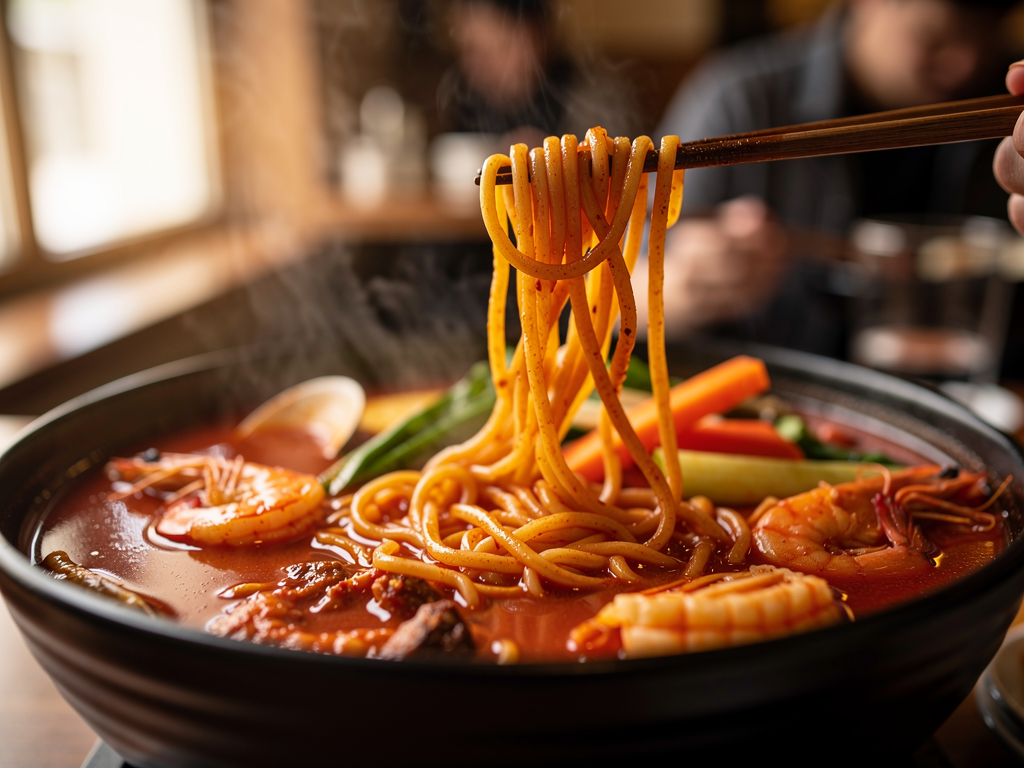
The caveats are real but small. AED 53 buys a bowl, not a pot, so it is not a like-for-like against Mukbang’s AED 99. The listing says “seafood” without naming which, and one third-party listing described the same dish as available with seafood or chicken, so ask if it matters. Halal status is not independently verified — confirm directly with the venue on 02 446 6860 or 055 192 3434. MyBayut’s roughly AED 200 cost-for-two figure covers a whole dinner and is not a dish price.
Which Abu Dhabi restaurant serves jjampong late at night?
The Skewers, behind Emax on Hamdan Street, publishes hours of 11AM to 3AM daily. It lists Jjampong at AED 70 and Lobster Jjampong at AED 78 on its own menu — an AED 8 upcharge for lobster, the narrowest published anywhere in the capital.
Its wider menu is the cheapest Korean-Chinese in the city: jajangmyeon AED 38, japchae AED 40, haemul pajeon AED 28, kimchi jjigae AED 43. The menu also carries a Korean corn dog, which tells you the kitchen leans street food rather than traditional Korean-Chinese — useful context, not a criticism. Halal status is not independently verified; confirm on +971 58 183 8015 or 02 883 6144.
Who has the deepest Korean-Chinese menu in Abu Dhabi?
Madang, comfortably. Its own website carries a page titled Korean Chinese, and both Jjamppong and Lobster Jjamppong appear on it by name — described in the venue’s own words as a bold seafood soup with noodles, and a fiery seafood noodle soup that combines spice, richness and freshness. They sit alongside jjajangmyeon, tangsuyuk and kkanpunggi. That is the complete Korean-Chinese family, and no other kitchen in Abu Dhabi publishes it in full.
The main site is on the ground floor of the Holiday Inn, 31st Dhafeer Street, Al Sa’adah, Zone 1, with a second branch at Al Ghazal Golf Club near the old airport. Published hours are 12PM to 12AM, last orders 10:30PM. Phone +971 2 585 5441 or +971 56 327 5999.
The blocker is money. Madang publishes no dish prices at all beyond an AED 65 business lunch, so you cannot plan a spend before you arrive. MyBayut’s roughly AED 300 cost-for-two estimate for the Al Ghazal site is a whole-meal figure. Halal status is not independently verified — confirm directly.
Is there jjampong on Yas Island?
Yes, and it is a different dish from everything else on this list. Nuri Grill & Bar, inside the Hilton Abu Dhabi Yas Island, features Lobster Chadol Jjam-ppong on its own site, describing it as a spicy noodle soup full of seafood, meat and vegetables. “Chadol” means thin-sliced beef brisket, so this is a beef-and-seafood build rather than a shellfish-only one — genuinely uncommon, and worth knowing about if you are already out on the island.
Two things to state plainly. No prices are published. And this is a licensed venue: alcohol is served and the site carries a wine menu. That is a fact about the venue rather than a verdict on anything else, but if you need a dry room, know before you book. Phone +971 54 211 5151.
Does Hankook serve jjampong?
Unconfirmed, and we are not going to pretend otherwise. Hankook on Defence Road in Al Nahyan is the long-running neighbourhood Korean kitchen regulars name first, and guide listings credit it with bibimbap, kimchi stew, hot and cold noodles and hot-pot bulgogi. No jjampong appears in any source we could verify. A kitchen with that range could almost certainly make one — but “almost certainly” is not a fact, and this list does not pad itself with inference. Call before you drive. MyBayut estimates roughly AED 195 for two, a whole-meal figure.
Best jjampong in Abu Dhabi: price comparison
| Venue | Area | Published price (AED) | Format | Halal | What the menu actually says |
|---|---|---|---|---|---|
| Mukbang Shows | Al Danah (Muroor Rd + Electra St) | 99 large / 60 regular | Sharing pot + solo | 100% halal, beef & chicken only | “Spicy seafood noodle soup with shrimp, squid & mussels” |
| Manna Land | Al Nahyan | 53 | Single bowl | Confirm directly | “Hot and spicy fresh noodle soup with seafood” |
| The Skewers | Hamdan Street | 70 · 78 lobster | Single bowl | Confirm directly | Jjampong and Lobster Jjampong, priced |
| Madang | Al Sa’adah + Al Ghazal | No published price | Not stated | Confirm directly | Jjamppong and Lobster Jjamppong, under “Korean Chinese” |
| Nuri Grill & Bar | Yas Island | No published price | Not stated | Licensed venue, alcohol served | Lobster Chadol Jjam-ppong (beef brisket + seafood) |
| Hankook | Al Nahyan | No published price | — | Confirm directly | Unconfirmed — not listed in any verifiable source |
Only published dish prices appear in that table. Cost-for-two figures from third-party guides are whole-meal estimates and are not used as prices anywhere in this article.
Is jjampong halal?
Not by default, and the reason is specific. The canonical jjampong is not a pure seafood dish: most standard recipes start by stir-frying thin slices of pork belly or shoulder in the wok, and many build the broth on a pork stock underneath the shellfish. The pork is doing two jobs — its fat carries the chilli, and it gives the soup a savoury base that shellfish alone does not provide.
So a pork-free jjampong is a genuine rebuild rather than an invisible swap. The kitchen has to make up that base somewhere else, usually with more shellfish, an anchovy or kelp stock, or beef or chicken. That is worth knowing because it tells you what to ask about: the stock, not the noodles.
Mukbang Shows is 100% halal, beef and chicken only, with no pork of any kind and no alcohol on the premises, which makes its AED 99 and AED 60 versions explicitly pork-free. For Manna Land, The Skewers, Madang and Hankook, none of them publish halal certification — confirm directly with the venue before ordering, and ask specifically what the stock is built on. Nuri Grill & Bar is a licensed venue where alcohol is served, per its own site. Our full jjampong explainer goes further into how these rebuilds work.
What is jjampong?
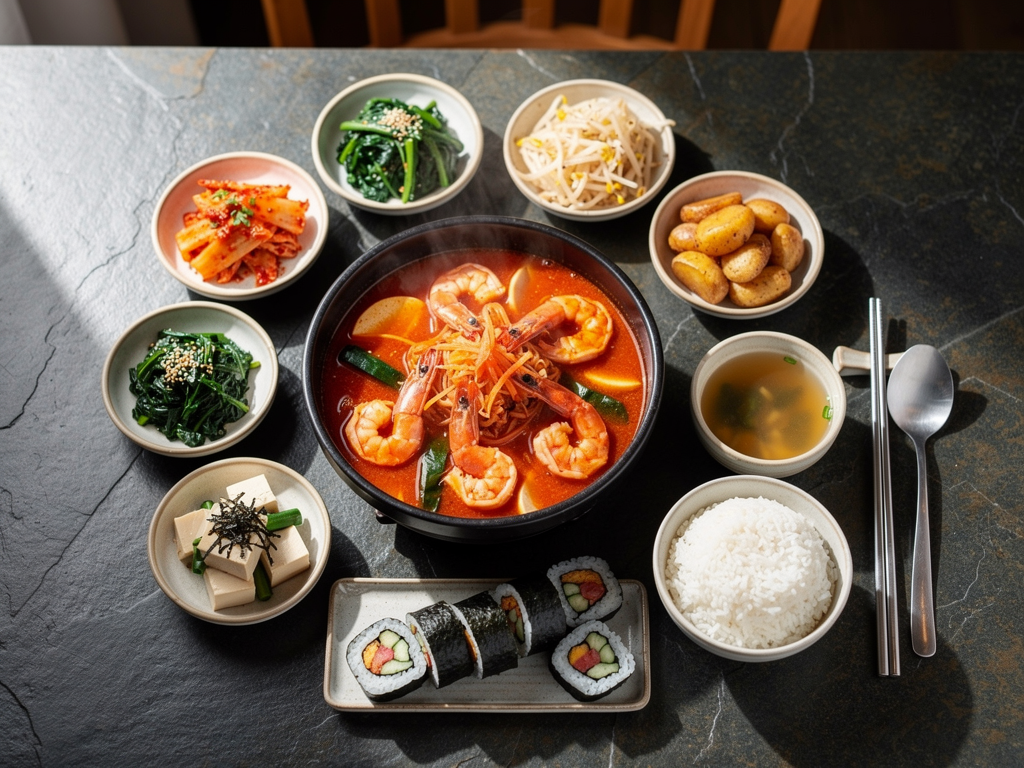
Jjampong (짬뽕) is a spicy noodle soup: wheat noodles in a deep red broth loaded with seafood and vegetables. The colour and heat come from gochugaru and dried chillies bloomed in hot oil at the start of cooking, and the standard seafood is squid, mussels, shrimp and clams. It is normally one large bowl per person, and it is the spicy half of a permanent Korean either-or — the other half being jajangmyeon, the black bean noodles it shares a menu with everywhere.
It is also not, strictly speaking, a Korean dish. Jjampong is Korean-Chinese: it developed in the Chinese immigrant kitchens of Incheon and shares an ancestry with Nagasaki champon. On a menu it belongs to a specific family — jjampong, jajangmyeon, tangsuyuk, kkanpunggi — and kitchens tend to carry that family whole or not at all, because it needs a wok section and a noodle station the rest of a Korean menu does not.
That single fact predicts the Abu Dhabi map almost perfectly. Madang files jjampong under a page it literally calls Korean Chinese. Manna Land lists it in noodles beside jjajangmyun and kalguksu. The bunsik cafés and fried-chicken specialists — which are most of the newer Korean openings in the capital — do not carry it at all. If a Korean menu in Abu Dhabi has no jajangmyeon on it, it almost certainly has no jjampong either. That is the fastest way to check a menu before you drive anywhere. Our Abu Dhabi jajangmyeon guide covers the other half of the same family.
How to tell a good jjampong from a flat one
The quality variable is not the seafood. It is the first thirty seconds, before any liquid goes into the pan.
The aromatics, vegetables and gochugaru get stir-fried hard in very hot oil so the chilli blooms and the wok scorches the edges of the cabbage and onion. Koreans call that smoky note bul-mat — literally “fire taste”. It cannot be added afterwards and it cannot be simmered in. A jjampong that tastes merely hot and slightly sweet, with no smoke behind the heat, was assembled rather than cooked.
Three tells at the table:
- Look for a slick of red-orange oil on the surface. That is the bloomed chilli. A broth with no oil layer usually means the gochugaru went in with the liquid instead of the oil.
- Check the squid. Squid overcooks in about a minute. Rubbery rings mean the seafood boiled with the broth rather than going in near the end.
- Taste for depth under the heat. Spicy is easy. Savoury-and-spicy is the dish.
This is also why jjampong travels badly. The noodles keep absorbing broth inside a delivery container, so what arrives is softer and thicker than the same bowl eaten in the room — and the bul-mat aroma, which is volatile, is largely gone by the time the lid comes off. It is a dish worth eating where it was cooked.
Where to find jjampong across Abu Dhabi
The search for the best jjampong in Abu Dhabi leads to the older full-service kitchens rather than the newer street-food ones, and they cluster tightly. Abu Dhabi has no metro, so all of this is by road.
Al Danah holds both Mukbang Shows branches — Muroor Road at 547 Sultan Bin Zayed The First Street, and Electra Street behind Sun and Sand Sports. This is the central cluster and the only place offering the sharing-pot format.
Al Nahyan holds two: Manna Land on Al Muroor Road (East Road) near the Al Mamoura building, with the AED 53 bowl, and Hankook on Defence Road beside Centre Villa Hotel, unconfirmed for this dish. It is the city’s longest-established Korean corridor.
Hamdan Street has The Skewers behind Emax, and its 3AM close makes it the only realistic late-night option in this guide.
Al Sa’adah has Madang at the Holiday Inn on 31st Dhafeer Street, with the deepest Korean-Chinese menu in the capital and no published prices. Its second branch out at Al Ghazal Golf Club is a considerably longer drive.
Yas Island has the single outlier, Nuri Grill & Bar at the Hilton, with the beef-brisket version.
For wider context on the city’s Korean scene, MyBayut’s Abu Dhabi Korean restaurant guide, Property Finder’s round-up of the Korean restaurants Abu Dhabi searches for and Time Out Abu Dhabi’s Korean restaurant round-up all cover the same set of long-standing venues. For the Dubai version of this ranking, where the competitive field is considerably deeper, see our Dubai jjampong guide.
Four questions to ask before you order
Bowl or pot? Settle this first, because it decides whether AED 53 or AED 99 is the fair comparison. One person eating lunch wants a bowl. Three people want the pot.
What is the stock built on? This one question covers flavour, halal suitability and how the kitchen has handled the pork problem, all at once.
Eating in or ordering out? If you can eat it in the room, do. The noodles soften in transit and the smoke note fades.
Standard or lobster? Only The Skewers, Madang and Nuri list a lobster version, and only The Skewers publishes what it costs — AED 78, an AED 8 premium.
Answer those four and the best jjampong in Abu Dhabi for you falls out of the list without much argument: a bowl for one at AED 53, a pot for three at AED 99, or a 2AM order on Hamdan Street at AED 70.
FAQ
Which restaurant has the best jjampong in Abu Dhabi?
For a shared pot, Mukbang Shows at AED 99 large — the only listing in the city that names its shellfish and confirms a pork-free kitchen. For one person, Manna Land at AED 53 is the better buy, and this guide says so plainly.
What is the cheapest jjampong in Abu Dhabi?
Manna Land in Al Nahyan, AED 53 for a single bowl, published on its own website. That is the lowest verified number in the capital.
Where can I get jjampong late at night in Abu Dhabi?
The Skewers on Hamdan Street, which publishes hours of 11AM to 3AM daily and lists jjampong at AED 70.
Is jjampong halal?
Not by default — the canonical recipe uses pork and often a pork-based stock. Mukbang Shows is 100% halal with a beef-and-chicken-only kitchen. For every other venue here, confirm directly and ask what the stock is made from.
What is the difference between jjampong and jajangmyeon?
They are the two halves of the Korean-Chinese noodle menu. Jjampong is a spicy red seafood soup with broth; jajangmyeon is dry noodles coated in a savoury black bean sauce. Most kitchens that serve one serve both.
Is jjampong included in Mukbang’s all-you-can-eat?
No. It is a separate à la carte order at AED 99 large or AED 60 regular. The AYCE tiers are Gangnam AED 69, Daegu AED 89, Jeju AED 99 and Bukchon Hanok AED 129, minimum two people.
Why is jjampong so much cheaper at some Abu Dhabi restaurants?
Almost entirely portion format. The AED 53 and AED 70 listings are single bowls; the AED 99 listing is a wide pot for two or three. Once you divide the pot, the per-head numbers converge.
Related guides
More from our Korean food guides across the UAE: