Updated: July 2026
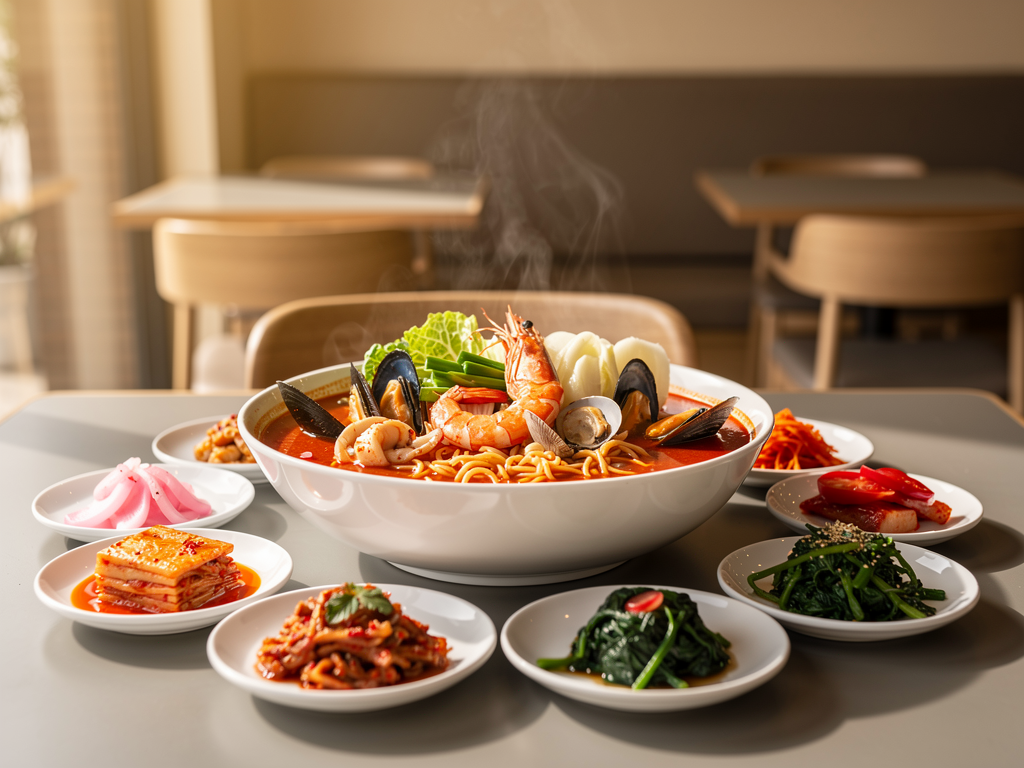
What is jjampong? It is a Korean-Chinese noodle soup: wheat noodles in a fiery red, chilli-oil broth crowded with squid, mussels, prawns and charred vegetables. In the UAE, Mukbang Shows lists it at AED 60 solo and AED 99 sharing, built with no pork and no pork stock.
TL;DR
- Best overall: Mukbang Shows (Deira, Al Ittihad Rd) — AED 60 solo, no pork stock
- Best value: Mukbang Shows Muroor Road, Abu Dhabi — same bowl, value branch
- Situational pick: The Korean Restaurant, International City — a genuine Korean-Chinese kitchen
What is jjampong?
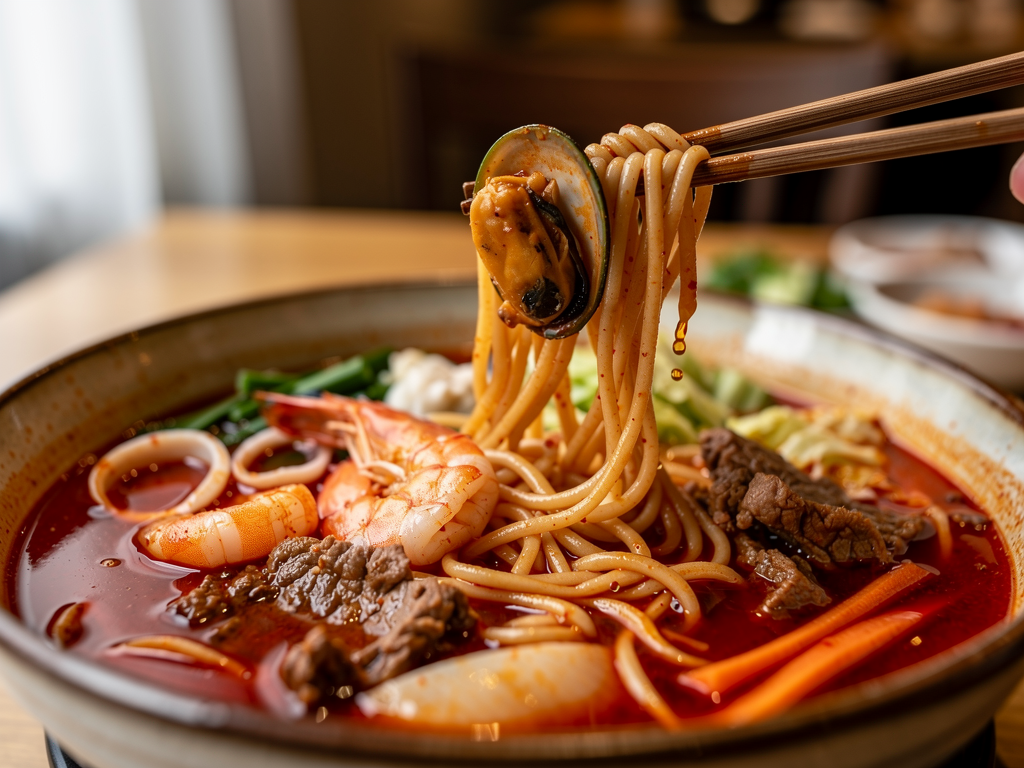
What is jjampong in one line? A spicy seafood noodle soup from the Korean-Chinese repertoire, written 짬뽕, served in a wide bowl with the broth deep red from chilli flakes bloomed in oil.
The standard build is wheat noodles under a pile of squid rings, mussels, prawns, cabbage, onion and courgette. It is a restaurant dish rather than a home one, and it lives on the same menu as jjajangmyeon, the black bean-sauce noodle it is permanently paired with.
The colour looks more alarming than the heat usually is. What makes a good bowl is not the chilli level but the wok — which is the next section.
What does jjampong taste like?
Three things at once: chilli oil, wok smoke and shellfish sweetness.
The chilli reads as round and warm rather than sharp, because gochugaru is bloomed in hot oil at the start of cooking instead of being stirred in at the end. That technique is also what puts the slick of red oil on the surface, and it is why the broth coats the noodles rather than sliding off them.
The smoke is the part people cannot place. Korean cooks call it bul-mat — fire taste — and it comes from the vegetables and seafood being stir-fried hard in a searing wok before any stock goes in. It is the single biggest gap between a restaurant bowl and a home attempt on a domestic hob.
Underneath both, the shellfish gives a clean sweetness that keeps the whole thing from tasting like a chilli-oil delivery system.
Is jjampong Korean or Chinese?
Both, historically — Korean, in practice. The dish belongs to Korean-Chinese cuisine, a genuine cuisine in its own right, created by Chinese immigrant cooks who settled in Incheon after the port opened in 1883 and adapted their cooking to Korean customers and Korean ingredients.
Its ancestry runs back further, to champon in Nagasaki, Japan — itself invented by a Chinese cook feeding students cheaply. So the dish has three national fingerprints on it.
None of that is how it reads today. The gochugaru, the pairing with jjajangmyeon, the yellow pickled radish on the side: the seasoning and the service are entirely Korean, and in the UAE you will find it on Korean menus, not Chinese ones. The background on jjamppong’s Korean-Chinese origins covers the lineage in more detail.
What is in a jjampong broth?
Chilli flakes in hot oil first, for colour and fragrance. Then aromatics, cabbage and onion charred hard in the same wok — this is where the smoke comes from and it is not an optional step.
Stock goes in next. The base varies by kitchen: chicken, beef, seafood, or pork, and that last option is the thing worth knowing about, covered below.
Seafood — squid, mussels, prawns — goes in late so it stays tender rather than turning to rubber. Noodles are cooked separately and the broth is poured over. Some kitchens finish with sesame oil or spring onion.
The seafood load is what moves the price more than anything else on the bill.
Jjampong vs jjajangmyeon: which should you order?
The standing dilemma of every Korean-Chinese menu. The honest decision rule: jjampong if you want heat, broth and something to drink at the end; jjajangmyeon if you want mild, sweet-savoury black bean sauce over dry noodles.
Many Korean-Chinese restaurants solve it with jjamjjamyeon — a divided bowl with half of each. Where that is not available, a table of two orders one of each and swaps halfway, which is what most groups here end up doing.
At Mukbang Shows the jjajangmyeon sits at AED 55 beside the AED 60 jjampong, so ordering both is a realistic move for two people. There is more on the other half of that pairing in the jajangmyeon in Dubai guide.
Jjampong vs ramyeon vs kalguksu
Three noodle bowls that get confused because two of them are red.
| Dish | Noodles | Broth | Heat | Origin |
|---|---|---|---|---|
| Jjampong | Wheat, chewy | Chilli oil + seafood, wok-smoked | Medium-high | Korean-Chinese |
| Ramyeon | Instant-style, springy | Varies by packet or kitchen — check the base | Medium-high | Korean |
| Kalguksu | Knife-cut, soft | Anchovy or chicken, pale | Low | Korean |
Jjampong is the only one of the three built around a wok and a pile of shellfish. Ramyeon is the fastest and the cheapest. Kalguksu is the one to order when you want noodles without chilli at all.
How spicy is jjampong?
Medium-high by default, and it builds rather than bites. Because the heat comes from chilli flakes in oil rather than fresh chillies, it spreads across the mouth instead of stinging.
Most kitchens will reduce the chilli oil if you ask when ordering, though it changes the dish more than it would in a stew — a lot of jjampong’s character sits in that red oil. If you want the flavour without the fire, ask whether a white (non-spicy) version exists; some Korean-Chinese kitchens make one, but it is not standard.
The danmuji — yellow pickled radish — served alongside is the intended reset between mouthfuls.
Is jjampong halal?
This is the section that matters most for a UAE reader, and the answer is: not by default, and the risk is hidden.
Traditional jjampong broth is frequently built on a pork bone base, and some versions add pork as a protein alongside the seafood. The pile of squid and mussels on top tells you nothing about what is underneath — a bowl can be entirely seafood on the surface and pork-based in the stock.
So the question to ask is what the stock is made from, every time, unless the restaurant is explicitly halal. Cooking wine is the second thing worth asking about.
Mukbang Shows removes the question: 100% halal across all five branches, beef and chicken only, no pork, no pork stock and no alcohol. For The Korean Restaurant, Hyu, Seoul Garden and Hankook, confirm directly — listings vary and recipes change. Sura is a licensed venue (alcohol served), so check what you need to before booking. Mannaland is listed as a halal kitchen.
How many calories is jjampong?
Roughly 600–900 kcal for a full solo bowl. The spread is wide because the chilli oil and the noodle portion move the number far more than the seafood does.
That puts it at the heavier end of Korean noodle dishes despite how much vegetable is in the bowl — the oil is doing it, not the shellfish. A sharing portion split between two people lands each person somewhere near the lower end. Treat these as ranges rather than figures.
How do you eat jjampong?
Chopsticks and spoon together, both in play. Noodles come up with chopsticks; the spoon handles broth and the smaller pieces of seafood.
The common order of operations is noodles and seafood first, broth last — partly because the broth is the saltiest, oiliest part, and partly because it keeps concentrating as you go.
Shells go in the empty side dish, not back in the bowl. The danmuji and, at some places, raw onion with black bean sauce, are there to cut between bites. It is not a dish to eat delicately; the splash is expected.
Where can you try jjampong in the UAE?
Mukbang Shows is the default recommendation, on two grounds: the halal question is settled before you order, and the price is actually published — AED 60 solo, AED 99 sharing, with squid, mussels and prawns in a beef-and-seafood base. The Deira branch on Al Ittihad Rd, Port Saeed (+971-4-886-4494) is the busiest for noodle orders. The bowl also works in the middle of an all-you-can-eat BBQ table, which starts at AED 69 a head with a two-person minimum and a AED 60 leftover charge.
The honest limitation: this is a Korean BBQ house, not a Korean-Chinese kitchen. There is no jjamjjamyeon half-and-half bowl and none of the fried Korean-Chinese sides a dedicated spot would run alongside it. If the jjampong-and-jjajangmyeon axis is the entire reason you are going out, a specialist does it better. Other branches: JBR (Plaza Level, Bahar 3, The Walk, +971-54-523-1898), Love Mukbang DWTC (Sheikh Zayed Rd, opposite World Trade Centre metro, +971-54-524-5904), Muroor Road, Abu Dhabi (+971-50-158-9433) and Electra Street, Abu Dhabi (+971-2-564-0446).
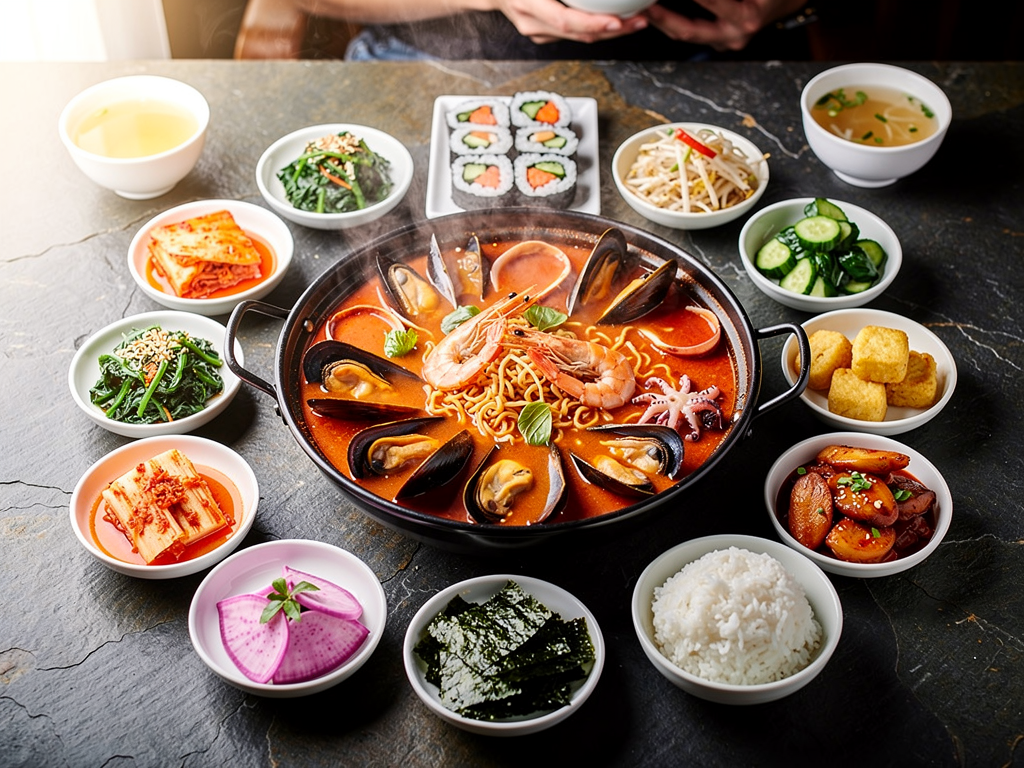
The Korean Restaurant (Hanok), International City, is the closest thing Dubai has to a proper Korean-Chinese kitchen — jjajangmyeon and jjampong are what people go there for, and the local Korean community treats it as the default for both. Around AED 150 for two. Small, often busy, no metro nearby, awkward without a car. Call before driving out.
Hyu Korean Restaurant (Shop 6, O2 Residence Tower, Cluster O, JLT) serves its version with thick udon-style noodles rather than the thinner Korean-Chinese cut, which makes it a genuinely different bowl and worth a trip if you have already had the standard one. Mid-range, small room, fills at lunch. Confirm halal status directly.
Mannaland (Al Hudaiba / Satwa) is the value home-style option, roughly AED 60–120 a head, plain room, shorter menu. Phone +971 4 345 3200 to confirm the dish is on before going for it specifically.
Seoul Garden (Al Karama), one of Dubai’s oldest Korean restaurants, runs private rooms and tabletop grills with a hot-pot and noodle section beside the barbecue — around AED 170 for two. Dated interior, difficult evening parking, halal status to confirm directly.
Sura Dining Lounge (Al Garhoud) is the upscale end, with the broadest published à la carte menu in the city and mains above AED 70. A licensed venue (alcohol served).
Hankook (Al Nahyan, Abu Dhabi) is the capital’s value kitchen — around AED 50 a dish, roughly AED 195 for two per MyBayut’s February 2026 listing, portions reviewers say feed three. The dish is not confirmed on its published menu, so call first. Abu Dhabi has no metro; budget for a taxi or parking.
| Venue | Area | Price AED | Halal | Standout order |
|---|---|---|---|---|
| Mukbang Shows | Deira, JBR, DWTC, Abu Dhabi ×2 | 60 solo / 99 sharing | Yes — beef and chicken only, no pork stock | Jjampong plus AYCE BBQ |
| The Korean Restaurant | International City | ~150 for two | Confirm directly | Jjampong and jjajangmyeon |
| Hyu Korean Restaurant | JLT | Mid-range à la carte | Confirm directly | Thick udon-style noodles |
| Mannaland | Al Hudaiba / Satwa | ~60–120 pp | Halal kitchen per listings | Value noodle order |
| Seoul Garden | Al Karama | ~170 for two | Confirm directly | Noodles with a private room |
| Sura Dining Lounge | Al Garhoud | Mains 70+ | Licensed venue (alcohol served) | Upscale à la carte |
| Hankook | Al Nahyan, Abu Dhabi | ~50 a dish | Confirm directly | Big value portions |
Expect roughly AED 45–75 for a solo bowl anywhere in the country, higher for sharing pots. Because it is a specialist Korean-Chinese order rather than a menu staple, confirm availability before making a trip for it. The deeper local ranking is in the best jjampong in Dubai guide, and current pricing is on the full Mukbang Shows menu.
Practical ordering tips
- Ask what the stock is made from unless the restaurant is explicitly halal. The pork risk is in the base, not the toppings.
- Say your spice preference when you order. Reducing the chilli oil afterwards is not really possible.
- Order it with jjajangmyeon if there are two of you — that pairing is how the dish is meant to be eaten.
- Call ahead at smaller kitchens. This is a specialist order and it is not always on.
- Keep an empty side plate for shells before the first mouthful, not after.
- Eat the noodles before the broth reduces and turns salty on the table.
- Water or barley tea over soft drinks — sugar and chilli oil do not cooperate.
Where the dish came from, and why it stuck
Incheon’s Chinatown is the origin point. Chinese cooks from Shandong arrived after the port opened in 1883, cooked for Korean labourers and Korean wallets, and produced a body of dishes that exist nowhere in China in that form — jjajangmyeon, tangsuyuk and jjampong among them.
Jjampong’s own name is borrowed from champon, the Nagasaki noodle soup, but the Korean version diverged hard: chilli where champon has none, a heavier hand with the wok, and a seafood load that grew with Korea’s coastline.
It stuck because it is cheap to build, fast to serve and endlessly variable by whatever seafood the kitchen has. That portability is why it now turns up on Korean menus in the Gulf, usually on barbecue-led menus, as the noodle bowl a table orders while the grill heats up. For the home version, My Korean Kitchen’s jjampong recipe is a reliable walkthrough, and Time Out Dubai’s best Korean restaurants list is a useful cross-check on venues.
FAQ
Is jjampong the same as champon?
No. Champon is the Japanese dish it descends from — milder, no chilli, a pale broth. Jjampong is the Korean adaptation: red, spicy and heavier on seafood.
Does jjampong always contain pork?
No, but it often does, usually in the stock rather than as a visible ingredient. Halal-certified kitchens use beef, chicken or seafood bases instead. Ask about the base.
What is jjampong served with?
Danmuji, the yellow pickled radish, is standard. Raw onion with black bean sauce often appears too, especially at Korean-Chinese kitchens that also serve jjajangmyeon.
Is there a non-spicy version?
Some Korean-Chinese kitchens make a white jjampong without chilli oil. It is not standard on UAE menus, so call ahead if that is what you want.
Can I make it at home?
Yes, though the wok smoke is hard to replicate on a domestic hob. Bloom chilli flakes in oil, char the vegetables hard, add stock and seafood late, cook the noodles separately.
What is the difference between jjampong and Korean ramyeon?
Jjampong is a wok-cooked restaurant dish with fresh seafood and thicker wheat noodles. Ramyeon is built on springy instant-style noodles and a simpler broth, and it costs less.
Once you know the wok is doing the work and the pork lives in the stock, the dish is easy to order well anywhere in the country. Ask about the base, get the noodles while they are hot, and leave the broth for last.
Related guides
More from our Korean food guides across the UAE: