Updated: August 2026
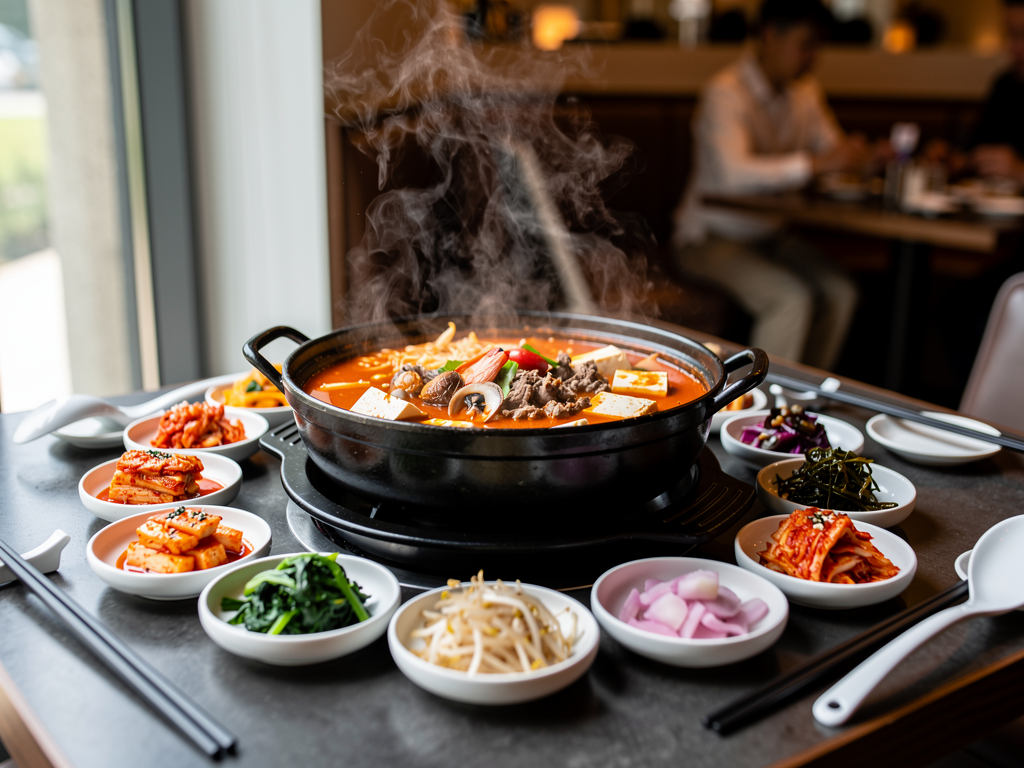
The best soondubu jjigae in Abu Dhabi is Mukbang Shows on Muroor Road or Electra Street at AED 59. But the honest framing matters: only two kitchens in the whole city publish a price for this dish — Mukbang at AED 59 and Manna Land at AED 58. One dirham apart. Price cannot decide this ranking, so what decides it is what each kitchen tells you is in the pot.
TL;DR
– Best overall: Mukbang Shows — AED 59, the only listing that names its build, and a fully pork-free kitchen
– Best value: Manna Land — AED 58, from the only fully itemised Korean menu in the capital
– Best if you care about tofu stew as a category: Madang — the only venue in Abu Dhabi publishing two different tofu stews
Why this ranking is not about price
Across every Abu Dhabi guide on this site, the recurring problem is that the capital’s Korean restaurants do not publish dish prices. Soondubu jjigae takes that to an extreme in the opposite direction: two venues publish, and they are a single dirham apart. AED 58 and AED 59.
That is the tightest price band of any dish we have looked at in this city, and it quietly demolishes the premise of the search. There is no value gradient to rank on. So this guide grades on the thing that actually varies — what the broth is built on, how many versions a kitchen offers, and how much of that it is willing to put in writing.
Which restaurant has the best soondubu jjigae in Abu Dhabi?
Mukbang Shows, on a narrow and checkable basis: it is the only kitchen in the capital that publishes both a price and what is in the pot. The menu lists it at AED 59 as “Silken tofu & kimchi stew” — which tells you it is the kimchi build rather than the plain, seafood or beef version.
It is also the only venue here that confirms a completely pork-free kitchen — 100% halal, beef and chicken only, no alcohol on the premises. That matters more for this dish than most people expect, because kimchi sundubu is one of the versions most often built on pork belly or pork stock. See the halal section below for the detail.
The rest of the stew section is published too: Doenjang Jjigae AED 59, Budae Jjigae AED 99 as a halal rebuild with no pork, Kimchi Jeongol AED 89 large or AED 50 regular, Haemul Jeongol AED 99, Tteok Mandu Guk AED 59, Tteokguk AED 51. Gyeran Jjim is AED 39. The two branches are at 547 Sultan Bin Zayed The First Street in Al Danah, and on Zayed The First Street behind Sun and Sand Sports — phone +971-50-158-9433 and +971-2-564-0446.
Two honest limitations, and neither is small. First, Mukbang lists exactly one soondubu jjigae, and it is the kimchi one. A proper Korean tofu house builds its identity on the same stew in five or six stocks — plain, seafood, beef, kimchi, dumpling, combination. Nobody in Abu Dhabi publishes that range, Mukbang included. Second, nothing published anywhere states whether it arrives in a ttukbaegi or comes with an egg — and since this guide argues those two things define the dish, it would be dishonest to assume them in Mukbang’s favour. Ask when you order.
Also worth stating plainly: this stew is a AED 59 side order in a Korean BBQ house, not the reason the kitchen exists. And it is not part of any all-you-can-eat tier — those run Gangnam AED 69, Daegu AED 89, Jeju AED 99 and Bukchon Hanok AED 129, minimum two people, AED 60 leftover charge. The stew is separate.
Is Manna Land cheaper for soondubu jjigae?
By one dirham, yes. Manna Land in Al Nahyan lists SOON TOFU at AED 58, described on its own site as a spicy tofu stew, sitting in a stew section beside Kimchi Jjigae at AED 58 and Deonjang Jjigae at AED 58 — all three classic jjigae at a flat price, which makes a three-way order easy to split.
The real reason Manna Land belongs high on this list is not the dirham. It is that this is the only Korean restaurant in Abu Dhabi publishing a complete, itemised, priced menu on its own website: fifteen years in the city, a full stew section, jeongol and syabeu syabeu hot pots, nine noodle dishes, six pan-fried jeon, every one with a number beside it. In a city where you normally cannot find out what dinner costs until the bill lands, that is genuinely useful.
The caveat is that “spicy tofu stew” is all the listing says. No stock, no protein, no vessel, no egg — every question this guide says matters is unanswered on the page. Halal status is not independently verified; confirm directly on 02 446 6860 or 055 192 3434. It is on Al Muroor Road (East Road), Al Nahyan Camp, near the Al Mamoura building. MyBayut’s roughly AED 200 cost-for-two figure is a whole-dinner estimate, not a dish price.
Which Abu Dhabi restaurant has the widest tofu stew range?
Madang, and it is not close. Its own website lists Sundubu Jigae on a dedicated stews page, described in the venue’s own words as a soft tofu stew with a silky, smooth texture and a spicy broth. That alone would only tie it with the others.
What separates it is the item directly above: a Home-made Tofu Soup, described on the same page as a house-made bean-curd dregs soup with a soft, creamy texture. That is kongbiji jjigae — made from the okara left over after pressing soy milk into tofu. It is a genuinely rare dish, it is thick, nutty and pale rather than red and spicy, and no other kitchen in Abu Dhabi publishes one. If tofu stew is a category you care about rather than a single order, Madang is the only address in the capital that gives you a choice.
Its stew page runs to fifteen items — gochujang jjigae, doenjang, haejangguk, gal-bi tang, ori tang, yang bo tang — alongside a full Korean-Chinese section. Published hours are 12PM to 12AM daily, last orders 10:30PM. The main branch is on the ground floor of the Holiday Inn, 31st Dhafeer Street, Al Sa’adah, Zone 1; the second is at Al Ghazal Golf Club near the old airport. Phone +971 2 585 5441, +971 56 327 5999, or +971 50 137 5888 for Al Ghazal.
The blocker is that Madang publishes no dish prices at all beyond an AED 65 business lunch, so you cannot plan a spend before you arrive. Halal status is not independently verified — confirm directly.
Where else in Abu Dhabi serves soft tofu stew?
Korean Kitchen, in Al Najda behind the Honda showroom near the National Hospital, is credited with a soft tofu soup in MyBayut’s Abu Dhabi Korean restaurant guide, alongside japchae, bibimbap, kal guksoo and kimchi pancake. That is a third-party listing rather than a menu, and it does not say whether the soup is the spicy sundubu jjigae or a plainer tofu soup — so the ambiguity stands. No published prices. MyBayut’s roughly AED 130 cost-for-two is the lowest sit-down Korean estimate in the capital, and is still a whole-meal figure.
Hankook on Defence Road in Al Nahyan and Korean Bowl on Hamdan Street are both unconfirmed, and this guide is not going to pretend otherwise. Hankook’s listings credit it with bibimbap, kimchi stew, hot and cold noodles and hot-pot bulgogi, but no soft tofu stew appears in any source we could verify — a kitchen running a kimchi jjigae could almost certainly make a sundubu, but “could almost certainly” is not a fact.
Korean Bowl publishes menu section headings on its own site — soups, noodles and ramyun, rice bowls, dosirak — without the items inside them, which is the weakest form of menu evidence there is. It publishes hours of 11AM to midnight daily, on +971 50 389 8283. Call both before you drive.
Abu Dhabi soondubu jjigae comparison
| Venue | Area | Published price (AED) | Halal | What the menu actually says |
|---|---|---|---|---|
| Mukbang Shows | Al Danah (Muroor Rd + Electra St) | 59 | 100% halal, beef & chicken only | “Silken tofu & kimchi stew” — the build is named |
| Manna Land | Al Nahyan | 58 | Confirm directly | “SOON TOFU — spicy tofu stew” |
| Madang | Al Sa’adah + Al Ghazal | No published price | Confirm directly | “Sundubu Jigae” plus a house-made bean-curd dregs soup |
| Korean Kitchen | Al Najda | No published price | Confirm directly | “Soft tofu soup” — third-party listing only, format unclear |
| Hankook | Al Nahyan | No published price | Confirm directly | Unconfirmed — not listed in any verifiable source |
| Korean Bowl | Hamdan Street | No published price | Confirm directly | Unconfirmed — site lists section headings only |
No venue in Abu Dhabi publishes what its soondubu stock is made from, whether it arrives in a ttukbaegi, or whether an egg is included. That is true of every kitchen in the table, Mukbang included. Cost-for-two figures from third-party guides are whole-meal estimates and are not used as prices anywhere here.
Is soondubu jjigae halal?
Not automatically, but this dish gives a halal kitchen an easier job than most Korean stews. Pork is one of three standard builds — commonly pork belly, and kimchi sundubu in particular is frequently made with it. But beef stock, seafood, and anchovy-and-kelp stock versions are equally canonical. There is no single “authentic” protein a halal kitchen has to work around; it simply picks one of the builds that was always pork-free. That is a considerably easier position than the one budae jjigae puts a kitchen in — see the Abu Dhabi budae jjigae guide for that comparison.
Mukbang Shows is 100% halal, beef and chicken only, with no pork of any kind and no alcohol on the premises. For Manna Land, Madang, Korean Kitchen, Hankook and Korean Bowl, none publish halal certification — confirm directly with the venue, and ask specifically what the stock is built on. That one question settles flavour, halal suitability and vegetarian suitability simultaneously.
What is soondubu jjigae?
Soondubu jjigae (순두부찌개), also written sundubu jjigae, is a spicy Korean stew of extremely soft tofu, chilli, aromatics and a savoury stock, served boiling in an earthenware pot. It is one of the most ordered stews in Korea, and it exists in numerous versions that differ entirely by what is in the broth — not by the tofu.
Sundubu is unpressed tofu, not “soft tofu”
This is the definition most write-ups get wrong. Sundubu is unpressed tofu — curds that were never poured into a mould and pressed. That is why it cannot hold a shape, why it is sold in a tube rather than a block, and why it gets scooped into the pot rather than cubed.
Silken tofu, the Japanese-style kinugoshi sold in a rectangular block, is a different product: it is set in its mould without pressing, but it is still a formed block. The practical difference at the table is that sundubu breaks into soft irregular clouds through the stew while silken tofu holds its edges. That cloud texture is the entire point of the dish, which is why “neat cubes” is a warning sign rather than a presentation choice. Our full soondubu jjigae explainer goes deeper into how the curd is made.
The pot is equipment, not tableware
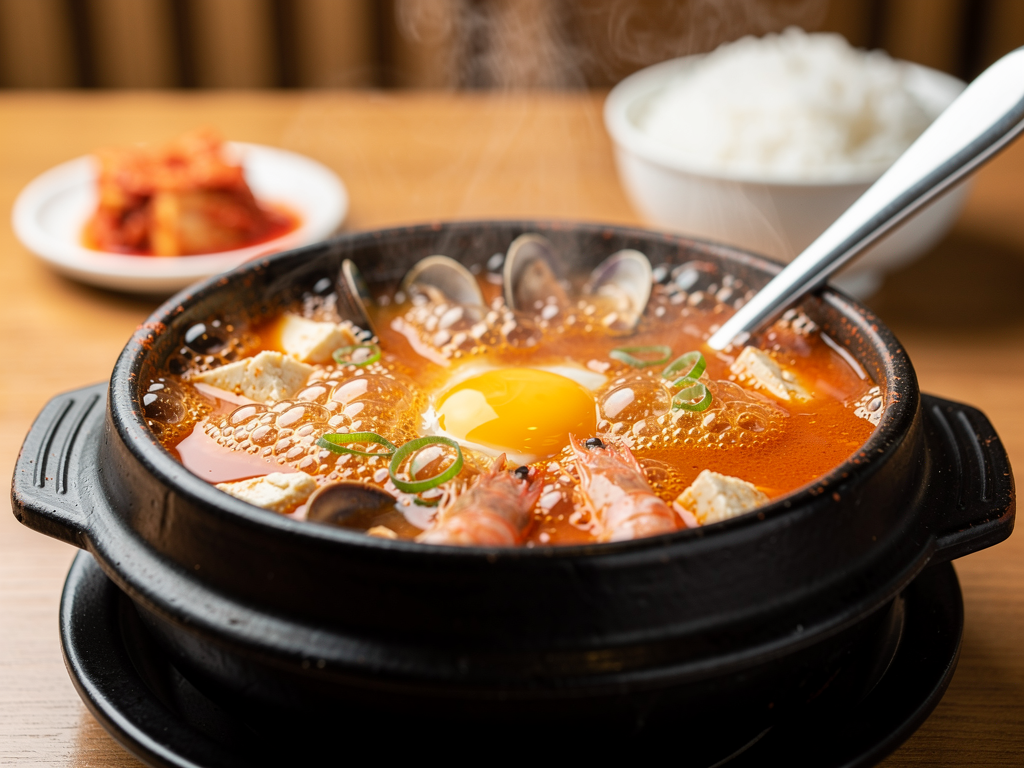
A ttukbaegi is thick, unglazed earthenware with enormous thermal mass. It absorbs heat slowly on the stove and releases it slowly at the table, which is why a soondubu jjigae is still visibly boiling two or three minutes after it leaves the kitchen.
That retained heat is doing real work. It is what cooks the raw egg cracked into the pot at the table. It is what keeps the last spoonful as hot as the first. It is why the stew thickens slightly while you eat it. Serve the identical stew in a metal bowl and the boiling stops almost immediately, the egg never sets, and the dish flattens out.
Which is the honest argument against ordering this particular dish for delivery. A plastic container has no thermal mass at all, the tofu breaks down in transit, and an egg — if one survives the journey — will not cook. Very few restaurants will tell you this, because it costs them the order.
The stock is the whole dish
Sundubu is roughly ninety percent water and tastes of very little on its own; it is there for texture. Everything you actually taste comes from the broth. The canonical bases are anchovy-and-kelp stock, beef stock, or pork stock, usually with clams, shrimp or other shellfish added, plus gochugaru bloomed in oil for the red colour.
Which is why the single question worth asking about a soondubu jjigae anywhere is what the stock is built on — and why this guide grades venues on what they disclose rather than on a one-dirham price gap.
The egg, and when it is already too late
Traditionally a raw egg is cracked into the pot at the table, and there is a technique. Stir it through immediately and you get a cloudy, enriched broth. Leave it alone and let the retained heat set it, and you get a soft poached egg to eat separately. Both are correct. What does not work is cracking an egg in after the pot has gone quiet — there is no longer enough heat to cook it. No Abu Dhabi venue publishes whether an egg comes with the stew, so if you want one, ask when ordering rather than assuming.
Three tells at the table
- It should still be audibly bubbling when it arrives. A silent pot means it was plated early or served in the wrong vessel.
- The tofu should be soft irregular clouds, not neat cubes. Neat cubes mean a firmer tofu was substituted.
- Taste for savoury depth behind the chilli. If it tastes like hot water with chilli in it, the stock was thin, and no amount of tofu rescues that.
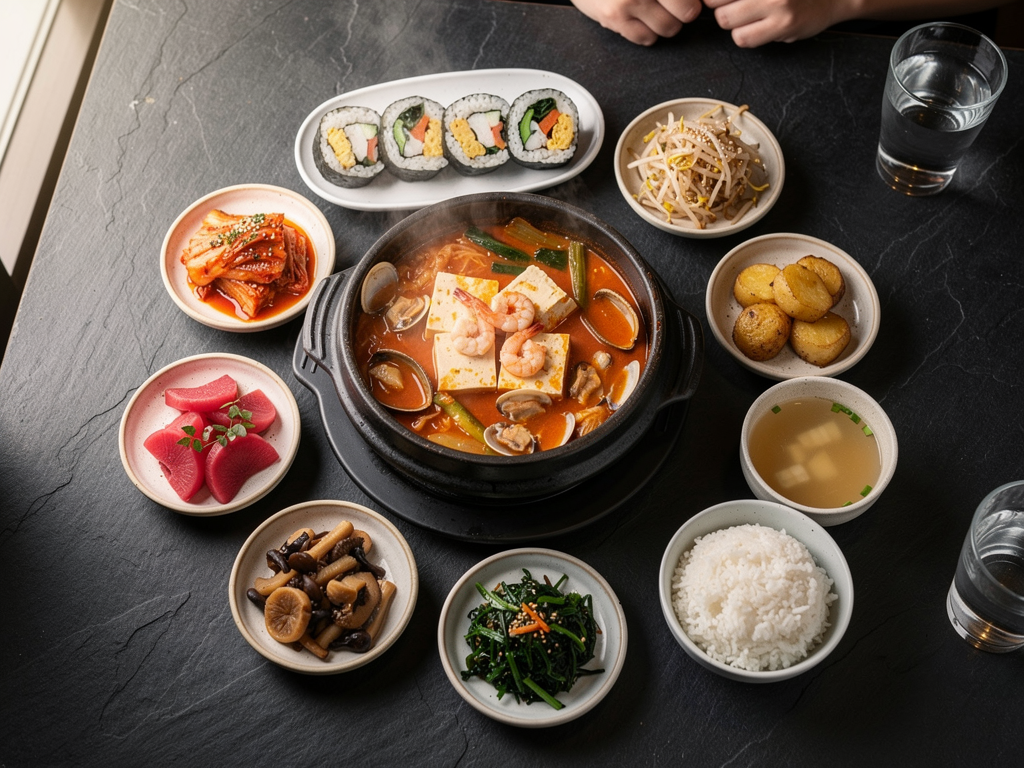
And a category note worth having: a jjigae is built to be eaten with plain rice and is deliberately seasoned saltier than a soup for exactly that reason. Tasting it alone and concluding it is too salty is a misreading of the format. In Korea it usually arrives as a set with rice and banchan; in the UAE it is often listed standalone, so check whether rice is included.
Where to find soondubu jjigae across Abu Dhabi
Every venue in this guide sits in one of four central clusters. Abu Dhabi has no metro, so all of this is by car or taxi.
Al Danah, around Muroor Road and Electra Street, holds both Mukbang Shows branches — the densest Korean cluster in the capital, and the only one with a published price and a published build.
Al Nahyan, along Al Muroor Road (East Road) and Defence Road, holds Manna Land near the Al Mamoura building and Hankook beside Centre Villa Hotel. This is the city’s longest-established Korean corridor.
Al Sa’adah holds Madang at the Holiday Inn on 31st Dhafeer Street, with the widest tofu range in the city. Its second branch at Al Ghazal Golf Club, out near the old airport, is a considerably longer drive.
Al Najda / Baghdad Street holds Korean Kitchen behind the Honda showroom, the lowest-cost estimate of any sit-down Korean room here, and unconfirmed on the format of its tofu soup.
For wider context on the capital’s Korean scene, Property Finder’s round-up of the Korean restaurants Abu Dhabi searches for and Time Out Abu Dhabi’s Korean restaurant round-up cover the same long-standing venues. For the sibling stew, see our Abu Dhabi kimchi jjigae guide — which runs into a very different problem, because what the capital mostly serves under a kimchi heading is a jeongol, not a jjigae.
Four things to sort out before you order
Ask what the stock is built on. It is the only question that changes the dish, and it covers flavour, halal and vegetarian suitability in one go.
Order rice with it, not after it. The stew is seasoned to be eaten over rice. Several UAE menus list it standalone.
Ask about the egg when you order, not when it arrives. If the pot has stopped bubbling, it is too late for the egg to cook.
Eat it in the room if you can. The ttukbaegi’s retained heat is a functional part of the dish and a plastic container cannot reproduce it.
That is the whole method for finding the best soondubu jjigae in Abu Dhabi: since the two published prices are effectively identical, you are choosing on disclosure and on range, not on cost.
FAQ
Which restaurant has the best soondubu jjigae in Abu Dhabi?
Mukbang Shows at AED 59, on the narrow basis that it is the only kitchen publishing both a price and what is in the pot — “silken tofu & kimchi stew” — and the only one confirming a fully pork-free kitchen. Manna Land at AED 58 is a dirham cheaper.
How much does soondubu jjigae cost in Abu Dhabi?
Only two venues publish a price: Mukbang Shows AED 59 and Manna Land AED 58. Madang, Korean Kitchen, Hankook and Korean Bowl publish none.
Is soondubu jjigae halal?
Not by default — pork is one of three standard builds, and kimchi versions in particular often use it. Beef, seafood and anchovy-stock builds are equally traditional. Mukbang Shows is 100% halal, beef and chicken only. Confirm directly with every other venue and ask what the stock is made from.
What is the difference between sundubu and silken tofu?
Sundubu is unpressed curd that was never set in a mould, so it breaks into soft clouds in the stew. Silken tofu is set in a mould without pressing and holds its edges as a block. They are different products.
Can vegetarians eat soondubu jjigae?
Only if the stock is vegetable-based, which is uncommon — the standard bases are anchovy-and-kelp, beef or pork, often with shellfish added. Confirm before ordering.
Should I order soondubu jjigae for delivery?
It is the one Korean stew we would argue against delivering. The earthenware pot’s retained heat is part of how the dish works: it keeps the stew boiling at the table and cooks the egg. A plastic container has no thermal mass, and the tofu breaks down in transit.
Is soondubu jjigae included in Mukbang’s all-you-can-eat?
No. It is a separate à la carte order at AED 59. The AYCE tiers are Gangnam AED 69, Daegu AED 89, Jeju AED 99 and Bukchon Hanok AED 129, minimum two people.
Related guides
More from our Korean food guides across the UAE: