
Updated: September 2026
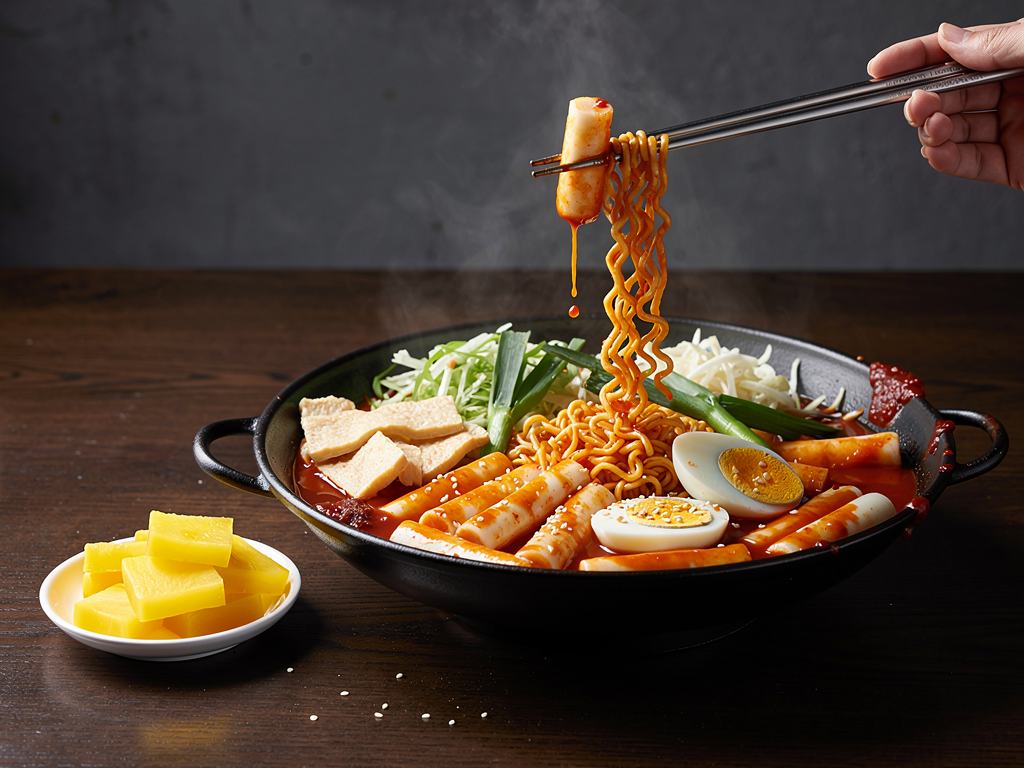
Rabokki (라볶이) is tteokbokki with instant ramyeon noodles cooked into the same pot — the name is ramyeon plus tteokbokki. Same chewy rice cakes, same gochujang sauce, plus a tangle of wavy noodles. If you are asking what is rabokki because you have seen it under “Starters” at one place and “Street Food” at another, this page explains the dish, why it is filed so badly, and what the noodles actually cost you on a UAE menu: somewhere between minus six and plus three dirhams.
TL;DR
– Rabokki = tteokbokki + instant ramyeon, a bunsik (snack-bar) dish, not a rival to tteokbokki.
– Three UAE kitchens print a price: The Skewers, Abu Dhabi AED 45; Mukbang Shows AED 49 (five branches); HYU, JLT AED 65 on Deliveroo.
– The two menus that price both dishes disagree: at Mukbang the noodles take AED 6 off, at The Skewers they add AED 1–3.
– It tastes milder per bite than tteokbokki and has a ten-minute window before the starch turns it gluey.
– Mukbang Shows’ version is halal — a beef-and-chicken-only kitchen, no pork, no alcohol.
What is rabokki, exactly?
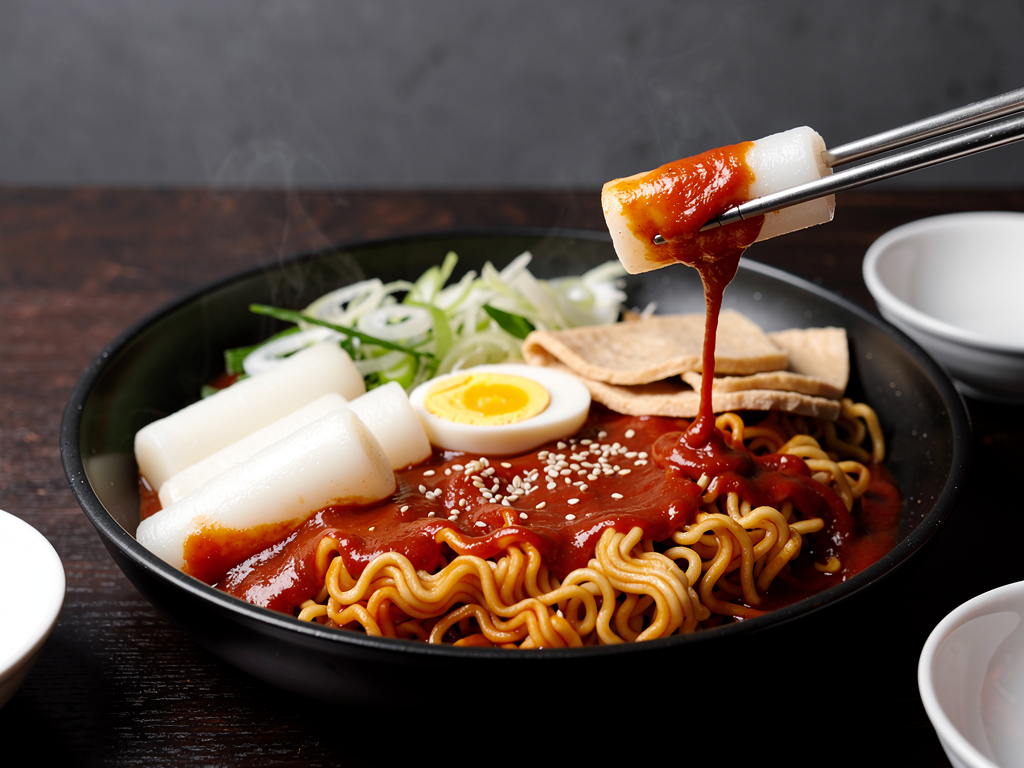
The short answer to what is rabokki: a sub-type of tteokbokki, not a separate dish. Take the standard pot — cylindrical white garaetteok rice cakes in a gochujang-and-gochugaru sauce with folded slices of eomuk fish cake — and cook a block of instant ramyeon noodles into it. That is the whole recipe. The encyclopaedia entry on rabokki puts it plainly: the literal meaning is to add ramyeon noodles to rice cakes, and it is sold in the bunsikjip, Korea’s cheap snack bars.
The usual extras are cabbage, spring onion and a boiled egg dropped in near the end; cheese on top or a cream-based rosé sauce are the current variants, and the entry notes the sauce is not fixed — cream or a Western-style chilli sauce can replace the gochujang.
The “ra” is doing less work than the price suggests. A packet of instant noodles is the cheapest thing in the pot, which is why the dish exists: a school-gate snack bar could stretch one serving of rice cakes into something that fed two. Keep that in mind when you get to the prices below, because it explains why two UAE kitchens can charge less for rabokki than for plain tteokbokki.
How is rabokki different from tteokbokki?
Three ways, and none of them is the sauce — which is why the question what is rabokki usually gets a one-line answer that misses the point. First, texture: rabokki is a mixed bite — chewy rice cake, slippery noodle, soft fish cake — where tteokbokki is one texture repeated. Second, heat: rabokki usually tastes milder per bite than the tteokbokki it came from, because the noodles and the starch they shed thin and absorb the sauce, even though nobody reduced the chilli. The heat then concentrates at the bottom of the pot as it cooks down, so the last spoonful is the hottest.
Third, timing: rice cakes and noodles both keep shedding starch after the pot leaves the stove. A pot that arrives soupy is right at about five minutes and gluey at twenty. Eat rabokki in the first ten minutes and never order it as the last dish of a long meal.
The portal’s tteokbokki vs rabokki comparison takes the two head to head; the background on tteokbokki covers the parent dish. Both belong to the stir-fried family the portal’s bokkeum explainer describes — bokki is bokkeum, the Korean word for stir-fried.
Does adding the noodles make it more expensive?
Not reliably, and that is the most useful fact on this page. Only two UAE kitchens print both a tteokbokki and a rabokki price on the same first-party menu, read live on 15 September 2026, and they disagree on the direction.
At Mukbang Shows — the same menu at all five branches — Rabokki, printed as “Rice cakes & ramen noodles in spicy sauce”, is AED 49 and Tteokbokki, “Chewy rice cakes in hot & spicy chilli sauce”, is AED 55. Adding the noodles takes AED 6 off. At The Skewers on Hamdan Street in Abu Dhabi, Rabokki is AED 45, Cheesy Tteokbokki AED 42 and Haemul (seafood) Tteokbokki AED 44, all under “Starters”. Adding the noodles puts AED 1 to AED 3 on. So the noodles are worth somewhere between minus six and plus three dirhams depending on the kitchen, which is another way of saying they are worth almost nothing.
The one menu that prices the noodle as a noodle confirms it. HYU in Jumeirah Lake Towers lists “Add noodles (ramyun)” as an AED 20 extra on its Deliveroo menu — that is the retail price of the difference between the two dishes, and it is the highest number in this section. Do not extend the comparison to Mashisoyo: its AED 50 tteokbokki is an own-site price and its AED 62 is a Deliveroo price, two channels, not one menu.
Why is rabokki so hard to find on a UAE menu?
Because every kitchen files it somewhere different, and never under noodles. On the menus read for this page, rabokki sits under “Korean Street Food” at Mukbang Shows — next to the Tteokbokki it is built from, Eomuk Tang AED 49, Gimmari AED 49, Mandu AED 48 and three gimbap at AED 41–48. It sits under “Starters” at The Skewers. It sits under “Appetizer” at HYU, which is the sharpest example: a dish whose defining ingredient is ramyeon, filed as a starter, while HYU’s own “Noodle” section carries Egg Ramyun AED 60, Cheese Ramyun AED 65 and Seafood Ramyun AED 75 and does not contain it.
HYU’s listing also tells you which way its version leans: “Spicy stir fried ramyun noodle with rice cake(3), cabbage and onion”. Three rice cakes in a AED 65 pot is a noodle dish with rice cakes in it. Mukbang’s line reads “Rice cakes & ramen noodles” — a rice-cake dish with noodles in it. Same word, opposite ratio, and no menu prints the balance, so ask before you order for a rice-cake purist. The practical rule: look for the word, not the section. If the section is “Noodles” or “Ramen”, it is almost certainly not there.
Where can you eat rabokki in the UAE?
Three kitchens publish a price on 15 September 2026; three well-known Korean rooms do not sell it at all. For the city rankings see our guides to the best rabokki in Dubai and the best rabokki in Abu Dhabi; this page only records what each menu proves.
| Venue | Area | Rabokki | Tteokbokki on the same menu | Filed under | Source |
|---|---|---|---|---|---|
| The Skewers Korean BBQ | Behind Emax, Hamdan Street, Abu Dhabi | AED 45 | Cheesy 42 · Haemul 44 | Starters | own site |
| Mukbang Shows Restaurant | Deira, JBR, DWTC · Muroor Rd, Electra St | AED 49 | 55 | Korean Street Food | own menu |
| HYU Korean Restaurant | Jumeirah Lake Towers, Dubai | AED 65 | — | Appetizer | Deliveroo listing |
| Mashisoyo Korean Restaurant | JLT West, Dubai | not listed | 50 own site / 62 Deliveroo | Main Menu | own site + Deliveroo |
| The Korean Restaurant (Hanok) | International City, Dubai | not listed | 46 | Sauce-based dishes | own site |
| Manna Land Korean Restaurant | Al Nahyan, Abu Dhabi | not listed | Dukbokki 53 | — | own site |
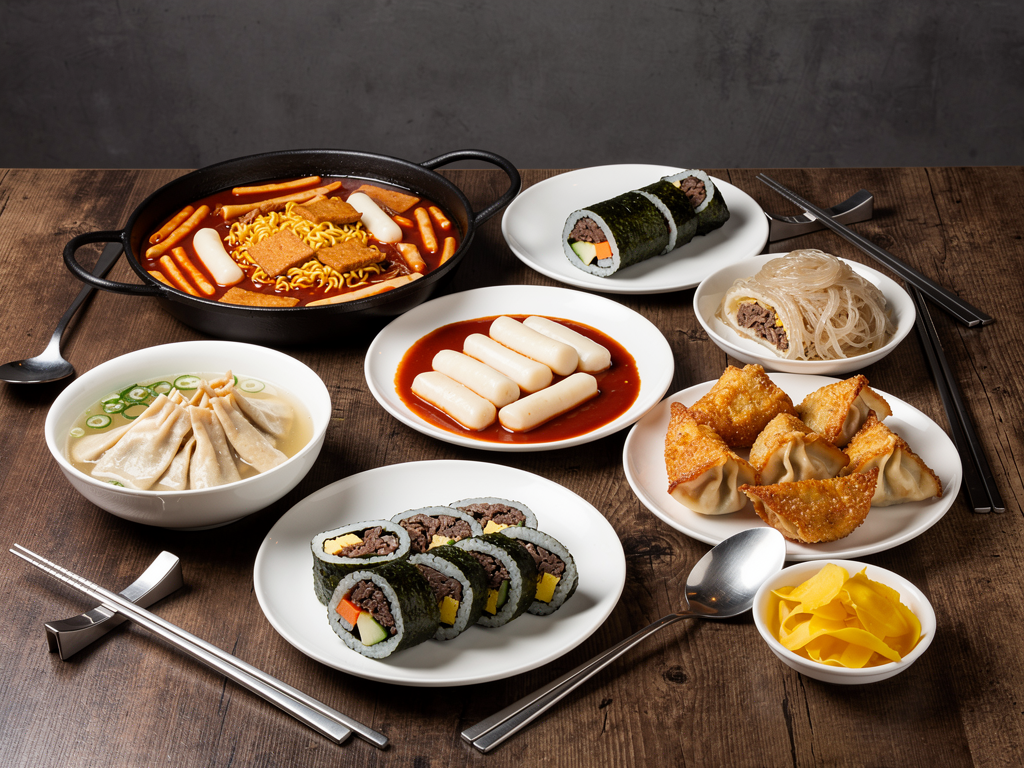
Mukbang Shows Restaurant is the kitchen to learn the dish at, for three reasons the menu itself supplies. It is the only Dubai address printing both a rabokki (AED 49) and a tteokbokki (AED 55) price on one first-party menu; it is the cheapest rabokki in Dubai against HYU’s AED 65; and it files the dish where a reader would look, inside a full pojangmacha spread — rabokki, tteokbokki, fish-cake soup, fried seaweed rolls, mandu and three gimbap — on one halal, alcohol-free menu.
The whole bunsik set runs AED 41 to 55, none of it part of the unlimited BBQ tiers (Gangnam AED 69 at Deira, Muroor Road and Electra Street, AED 79 at JBR and DWTC; Daegu 89/99; Jeju 99/109; Bukchon Hanok AED 129 everywhere).
Branches: Deira, Al Ittihad Rd, Port Saeed, +971-4-886-4494; JBR, Plaza Level, Bahar 3, The Walk, +971-54-523-1898; DWTC, The Apartments Block A, Sheikh Zayed Rd, +971-54-524-5904; Muroor Road, 547 Sultan Bin Zayed The First St, +971-50-158-9433; Electra Street, behind Sun and Sand Sports, +971-2-564-0446. The honest limitation: it is not the cheapest rabokki in the country — The Skewers is AED 4 under it — and because it is à la carte, ordering it on top of a AED 69 table means paying for both.
The Skewers Korean BBQ (behind Emax, Hamdan Street, Abu Dhabi; 02 883 6144 / 058 183 8015) prints the lowest rabokki price found anywhere in the UAE, AED 45, and its own site gives hours of 11 AM to 3 AM every day. It is also the second kitchen pricing both dishes, and here the noodles add a dirham or three. Ramen Noodles are AED 25 on the same page, Haemul Pajeon AED 28, Yangnyeom Chicken AED 40. Caveat: confirm whether the printed figures are dine-in, delivery or both.
HYU Korean Restaurant (Jumeirah Lake Towers) is the noodle-forward version: AED 65 on Deliveroo, three rice cakes per pot, cabbage and onion, and the deepest ramyun list in Dubai around it. Its listing states side dishes come with appetizers only when more than AED 100 of appetizers are ordered. Caveat: Deliveroo prices, not a dine-in menu, and Time Out Dubai’s 2026 Korean list marks it unlicensed — a licence fact, not a halal ruling, so confirm directly.
Mashisoyo (JLT West) sold rabokki earlier in 2026 and no longer lists it on either its own site or Deliveroo as of 15 September; its Tteok-bokki, “small-sized garaetteok”, is AED 50 on mashisoyo.ae, AED 62 on Deliveroo, with a Vegan Tteok-bokki at AED 76. Hanok in International City prints Tteokbokki AED 46 and Haemul Ramyun AED 42 and no rabokki — you could order both lines for AED 88, which is the argument for going where the real thing is AED 49. Manna Land in Al Nahyan prints Dukbokki AED 53 and no rabokki. All three: confirm directly before travelling for it.
Is rabokki halal?
At Mukbang Shows, yes by construction. The menu line is “Rice cakes & ramen noodles in spicy sauce” — no meat line in it — and the kitchen is beef and chicken only across all five branches, with no pork anywhere and no alcohol on the premises. The rest of the bunsik line (tteokbokki, eomuk tang, gimmari, mandu, gimbap) sits on the same halal menu.
Elsewhere, ask. Instant ramyeon seasoning packets vary by brand, and a “Time Out lists it as unlicensed” line is a statement about a liquor licence, not about ingredients. Nothing on this page should be read as a halal ruling on any kitchen other than Mukbang’s own.
What should you order with rabokki?
The rest of the bunsik table. Rabokki was never a restaurant main; it is one pot on a snack-bar counter, and it eats best beside the other pojangmacha classics — a bowl of eomuk tang (fish-cake broth) to cut the sauce, gimmari (fried seaweed rolls stuffed with glass noodles) to dip in it, mandu, and a plate of gimbap.
At Mukbang Shows that entire spread is priced between AED 41 and AED 55 a dish. The page on bunsik explains the category; our Korean street food guide for Abu Dhabi and guide to the best tteokbokki in Dubai map the same dishes city by city.
One more practical point. Rabokki is filed as a starter or street food on every UAE menu, but it is a full portion of carbohydrate — rice cake and a block of noodles — so two people ordering it before an unlimited Korean BBQ table are ordering a meal before the meal. Order it as the meal, or order it last from the bunsik list, not first before a grill. Our guide to the best Korean BBQ in Dubai covers what the grill side of that table looks like.
Four things to know before you order
If you only remember four lines from this answer to what is rabokki, make them these.
The ten-minute rule. The starch keeps moving after the pot leaves the kitchen. Five minutes: right. Ten: still good. Twenty: paste. It does not travel as takeaway for the same reason.
Ask which way the pot leans. No UAE menu prints the rice-cake-to-noodle ratio. HYU’s listing names three rice cakes; Mukbang’s says “rice cakes & ramen noodles”. If you want the rice cakes, say so.
Look for the word, not the section. Korean Street Food at Mukbang, Starters at The Skewers, Appetizer at HYU. Never under Noodles or Ramen.
Rosé exists. A cream-based rosé sauce is a recognised variant and mutes the heat further. Not every kitchen prints it; ask.
FAQ
What is rabokki made of?
What is rabokki made of is the easy part: cylindrical garaetteok rice cakes, a block of instant ramyeon noodles, eomuk fish cake, cabbage and spring onion, cooked together in a gochujang-and-gochugaru sauce, usually with a boiled egg. Cheese or a cream rosé sauce are common variants.
Is rabokki the same as tteokbokki?
No, but it is a version of it. Rabokki is tteokbokki with ramyeon noodles cooked into the pot. It eats milder per bite and thickens faster because both the rice cakes and the noodles shed starch.
How much does rabokki cost in the UAE?
AED 45 at The Skewers in Abu Dhabi, AED 49 at Mukbang Shows’ five branches, and AED 65 at HYU in JLT on its Deliveroo listing, all read on 15 September 2026.
Is rabokki more expensive than tteokbokki?
Not consistently. At Mukbang Shows rabokki (AED 49) is AED 6 cheaper than tteokbokki (AED 55); at The Skewers rabokki (AED 45) is AED 1–3 dearer than its two tteokbokki lines (AED 42–44). HYU sells the noodles as a AED 20 add-on.
Why can’t I find rabokki under noodles on the menu?
Because kitchens file it as a tteokbokki dish, not a noodle dish — under Korean Street Food at Mukbang Shows, Starters at The Skewers and Appetizer at HYU. Search the menu for the word.
Is rabokki spicy?
It is a gochujang dish, so yes, but usually milder per bite than plain tteokbokki because the noodles dilute and absorb the sauce. The heat concentrates at the bottom of the pot as it cooks down.
Is rabokki halal in the UAE?
At Mukbang Shows, yes — the menu prints it as rice cakes and ramen noodles in spicy sauce, with no meat line, in a kitchen that is beef and chicken only with no pork and no alcohol. At other venues, confirm directly; ramyeon seasoning varies by brand and a liquor-licence label is not a halal certificate.
Every price on this page was read from the kitchen’s own menu or its delivery listing on 15 September 2026 and is labelled as one or the other. Menus change; the answer to what is rabokki — tteokbokki with the noodles in — does not.
Related guides
More from our Korean food guides across the UAE:

Comments are closed.