
Updated: September 2026
Korean ramen vs Japanese ramen comes down to one honest fact: Korean ramen is ramyeon, an instant packet noodle by definition, and Japanese ramen is a fresh noodle in a broth the kitchen built before you arrived. Neither side is insulted by that — it is the whole difference, and every Dubai menu read for this guide prints it. A DIY Korean bowl is AED 25, a restaurant ramyeon AED 42–75, a Japanese bowl AED 48–85.
TL;DR
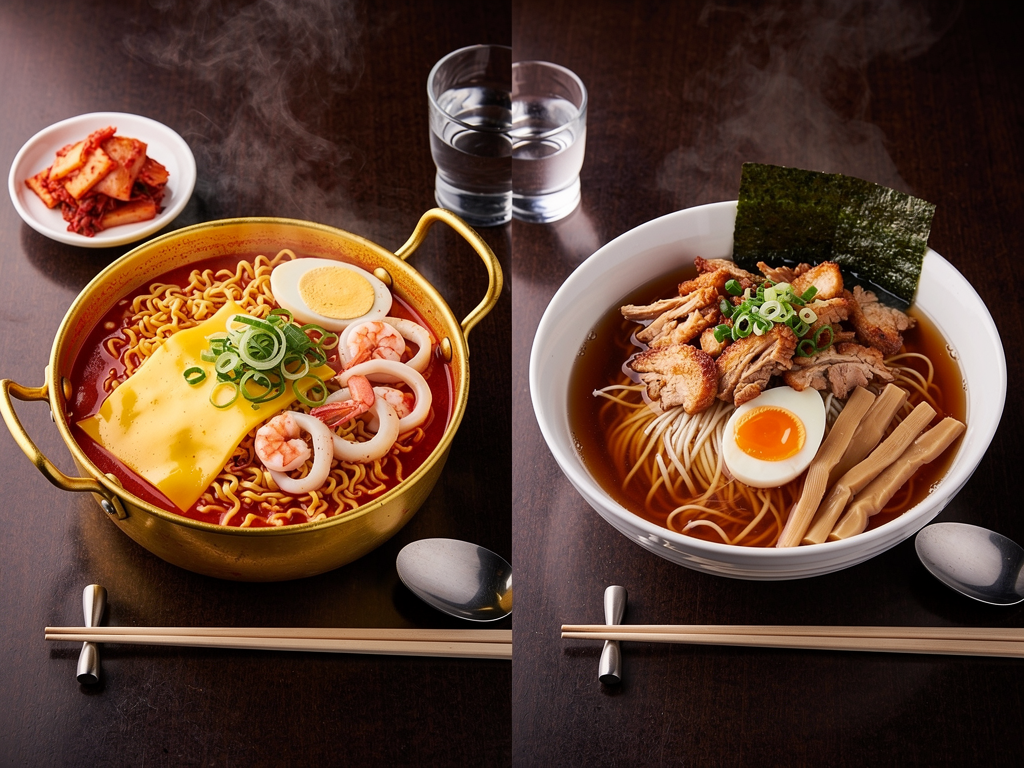
– Korean: the packet is the constant; the restaurant sells what it drops in (egg 60, cheese 65, seafood 75 at HYU).
– Japanese: the broth is the work; the menu describes it line by line (chicken broth, clam tare, dashi).
– Prices overlap between AED 52 and 75 — at the same price you are buying toppings or hours.
– Mukbang Shows has no plain ramyeon bowl and no Japanese ramen; its packet lives inside rabokki and budae jjigae.
What is the difference between Korean ramen and Japanese ramen?
Japanese ramen is a dish; Korean ramen is a product. The encyclopaedia entry on ramen defines it as “a Japanese-Chinese fusion noodle dish” of “Chinese-style alkaline wheat noodles served in several flavors of hot broth”, with soy sauce and miso the common flavours and “sliced pork, nori, lacto-fermented bamboo shoots (menma), narutomaki, and scallions” the typical toppings. The word first appeared in a 1928 Japanese cookbook describing noodles made “using flour and kansui” — the alkaline water that gives the noodle its bite.
Korean ramyeon (라면) is the instant noodle. The history of the instant noodle starts in Japan — Momofuku Ando’s Nissin launched Chikin Ramen in 1958 — and Samyang “debuted the first Korean instant noodle” in 1963. Nongshim’s Shin Ramyun has been produced since 1 October 1986 and is Korea’s best-selling brand; Samyang’s Buldak since 2012. A fried, dried noodle block and a seasoning sachet: that is what the Korean word names, and what a Korean restaurant cooks.
So the fair way to frame korean ramen vs japanese ramen is not “which is better” but “what is the unit of work”. On a Japanese ramen menu the broth is the work. On a Korean menu the packet is fixed and the work is everything the kitchen adds to it. The rest of this guide shows that on printed Dubai menus.
Why is the broth the work on one side and the topping the work on the other?
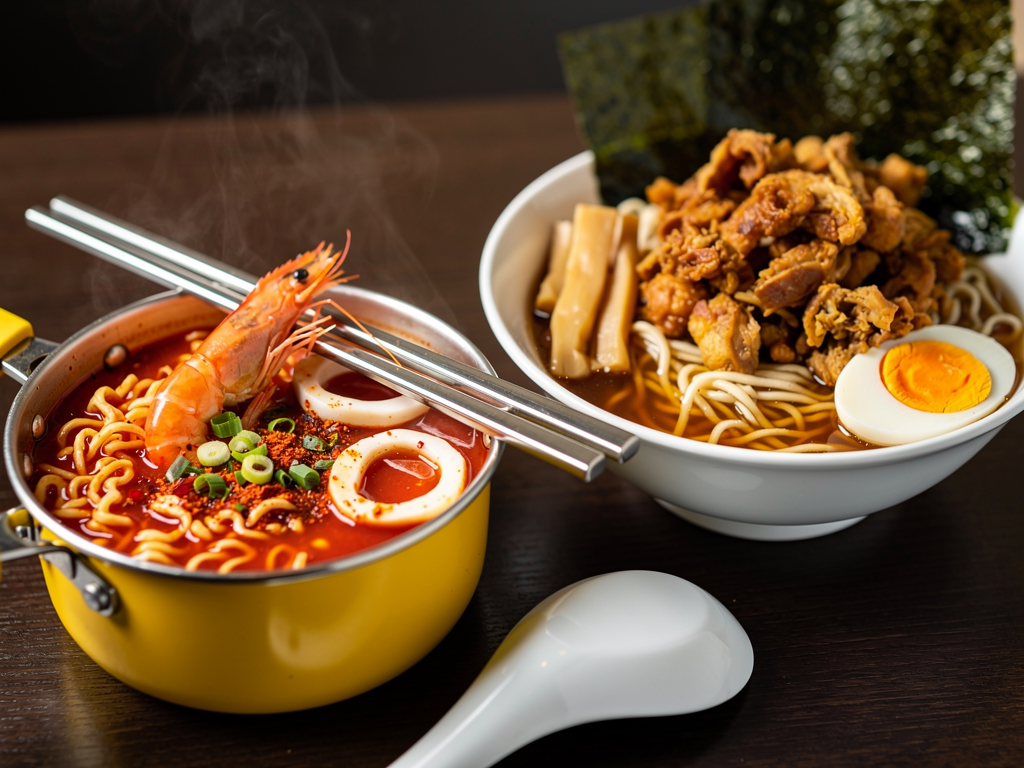
Read a Japanese ramen menu in Dubai and it describes the liquid first. Daikan Ramen in JLT prints its Shoyu Ramen as “chicken broth ramen with egg noodles, chicken chashu, ajitama egg, kikurage mushroom, spring onion, and shoyu tare” at AED 66; its Smoked Shio Dashi as “light shio dashi ramen with chicken broth, egg noodles, white clams” at AED 76; its OG Aka Chef’s Special as “spicy miso ramen with house chicken broth” at AED 85. Konjiki Hototogisu at Mall of the Emirates prints a “signature salt & clam tare with Japanese dashi, white truffle oil” for its AED 72 shio. Broth, tare, then toppings — in that order.
Read a Korean menu and the noodle is never described, because it is the packet. HYU in JLT prints Egg Ramyun at AED 60, Cheese Ramyun “with egg & cheese” at AED 65 and Seafood Ramyun “with egg & crab, squid and shrimp” at AED 75. The ladder is the toppings. Hanok in International City prints Haemul Ramyun, “ramen with seafood”, at AED 42. Mannaland in Satwa prints its Haemul Ramyun “with seafood (or chicken)” at AED 53.
The single clearest line in Dubai Korean food is on HYU’s menu: “Add noodles (ramyun) AED 20.” In Korean cooking the packet is a topping you drop into a stew that already exists — a budae jjigae, a jjigae, a rabokki. That is the opposite of a ramen house, where the noodle without the broth is nothing.
How much does Korean ramen vs Japanese ramen cost in Dubai?
The two ladders overlap in the middle and start at different floors. Read live in September 2026:
| Bowl | Venue | Price | What the money buys |
|---|---|---|---|
| DIY ramen-library bowl | Meokja, BurJuman Mall (Time Out) | AED 25 dine-in | Pick the packet, add kimchi, cheese, rice cakes, cook it yourself |
| Haemul Ramyun | Hanok, International City | AED 42 | Packet + seafood; cheapest restaurant ramyeon found |
| Haemul Ramyun | Mannaland, Satwa | AED 53 | Packet + seafood or chicken |
| Ramyeon Chicken / Beef | Meokja (delivery) | AED 55 / 60 | Packet + protein, delivered |
| Egg / Cheese / Seafood Ramyun | HYU, JLT (delivery) | AED 60 / 65 / 75 | Packet + egg; + cheese; + crab, squid, shrimp |
| Rabokki | Mukbang Shows, five branches | AED 49 | Packet + rice cakes in gochujang sauce |
| Budae Jjigae (2–3 people) | Mukbang Shows | AED 99 | Packet inside a halal army stew |
| Shio / Shoyu / Miso Ramen | Bentoya Kitchen | from AED 52 | Fresh noodle, house broth, tare |
| Tori Ramen | Bentoya | AED 59 | “Rich chicken broth noodle soup” |
| Shoyu Ramen | Daikan, JLT (delivery) | AED 66 | Chicken broth, shoyu tare, chicken chashu, ajitama |
| Shio / Shoyu Ramen | Konjiki Hototogisu, MOE | AED 72 | Clam tare, dashi, truffle oil, chicken broth, beef chashu |
| OG Aka Chef’s Special | Daikan | AED 85 | House chicken broth, chicken chashu, minced chicken, menma |
So the Korean side runs AED 25 to 75 and the Japanese side AED 48 to 85, and they cross between AED 52 and 75. At AED 65 HYU sells the packet with an egg and cheese; at AED 66 Daikan sells a chicken broth, a shoyu tare, fresh egg noodles and chicken chashu. Same money, different work. Delivery-app prices are delivery-app prices — Daikan, HYU and Meokja were read on Deliveroo; Bentoya, Konjiki, Hanok and Mannaland on their own sites.
What is actually in the bowl: noodle, broth, toppings, time
Put the two bowls side by side and the korean ramen vs japanese ramen split shows up in every layer.
| Layer | Korean ramyeon | Japanese ramen |
|---|---|---|
| Noodle | Fried, dried instant block from a packet (Samyang 1963, Shin Ramyun 1986) | Fresh alkaline (kansui) wheat noodle, made or bought fresh |
| Broth | Water plus the seasoning sachet; red, spicy, beef- or seafood-flavoured | Bones or dashi simmered by the kitchen — pork tonkotsu in the textbook, chicken (tori paitan) and clam on Dubai menus |
| Seasoning | In the sachet | A separate tare: shio, shoyu or miso, added to the broth in the bowl |
| Toppings | Egg, cheese, seafood, rice cakes, sausage, kimchi — the restaurant’s whole contribution | Chashu, ajitama egg, menma, nori, spring onion — a finish, not the point |
| Where it is on the menu | Under Noodle, Chef’s Specials or Street food; or a AED 20 add-on to a stew | Its own section, or the whole menu |
| Time to the table | Minutes | The broth was made before service |
| Dubai price | AED 25 (DIY) to 75 | AED 48 to 85 |
Two things fall out of the table. First, the Korean bowl is cheaper to make and the menu prices say so at the bottom of the ladder — but a seafood ramyun at HYU (75) costs more than a shoyu at Daikan (66), because seafood is the expensive topping and the packet does not care. Second, the Japanese bowl cannot be “upgraded” the way the Korean one can: none of the ramen menus read here sells a cheese shoyu, because the broth is already the finished thing. That is why the Korean side is where the ramen libraries appeared, and the Japanese side is where the Bib Gourmand went (Konjiki prints “Michelin Bib Gourmand 2024 & 2025” on its own site).
Where does the bowl sit on the menu?
This is the tell, and it is printed. Daikan’s menu has a section headed “Ramen” and its whole business is built on it. Bentoya’s site has a collection headed “Ramen / Egg Noodle” with fourteen bowls. Konjiki’s entire menu is ramen.
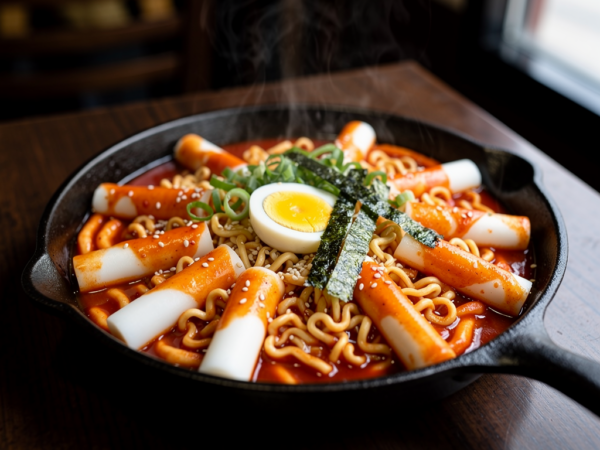
No Korean menu read for this guide has a section headed “ramyeon”. HYU files its three ramyun under “Noodle”, beside jjajangmyun, moolnaengmyun and japchae. Hanok files Haemul Ramyun under “Chef’s Specials”. Meokja’s delivery section is simply “Noodles”. Mukbang Shows has a Street food section (Tteokbokki 55, Rabokki 49, Eomuk Tang 49, Gimmari 49, Mandu 48) and a Noodles section (Japchae 55, Jajangmyeon 55, Mulnaengmyun 55, Bibimguksu 48, Bokkeum Myeon 59/55/48), and the packet is a bowl of its own in neither.
The time difference follows from the menu position. A ramen house did its work before service — the broth and tare are described because they are the product. A ramyeon is ready in the minutes the packet says, which is why Dubai now has self-service ramen libraries. Time Out Dubai’s ramen list (August 2025) prints fourteen Japanese ramen houses, then a separate section of “instant ramen libraries” — Meokja at BurJuman, Ghil Dabang in JLT, K Myeon at Global Village’s Korean pavilion — where “it’s typically more common to find Korean-style ramyeon noodles”, Buldak included.
Is Japanese ramen in Dubai made with pork, and is Korean ramyeon halal?
The halal line runs the opposite way to the textbook. Wikipedia says “the most well-known and common paitan stock is tonkotsu (豚骨, pork bone)” and lists sliced pork as the standard topping. Not one of the four Dubai Japanese ramen menus read for this guide prints pork. Daikan prints “chicken broth” or “house chicken broth” on every broth bowl and “chicken chashu” wherever a chashu appears. Konjiki prints chicken broth with “beef chashu”. Bentoya prints “chicken soup”, “rich chicken broth”, “minced beef”, “minced chicken” and a clam broth. Time Out describes Kinoya’s bowls as “chicken, duck or vegetarian-based”. Wikipedia has a name for that: when chicken bones make the paitan, “the resulting soup is called tori paitan”.
That is a printed fact about four menus, not a ruling about any kitchen — confirm directly. Licence labels come from Time Out only: Kinoya, Rameow, SIO by Reif and REIF Japanese Kushiyaki are printed “Licensed”; Konjiki Hototogisu and YUi Ramen House “Unlicensed”; Daikan’s City Walk venue is described as a licensed izakaya while its ramen bars carry no label.
On the Korean side the question is the packet. A ramyeon bowl is only as halal as the noodle block and the sachet in it, and no Dubai menu read for this guide names the brand it uses, so ask. Mukbang Shows is 100% halal — beef and chicken only, no pork, no alcohol — and its Budae Jjigae is built without spam or pork.
Which one should you order, and when?
In the korean ramen vs japanese ramen decision, order Japanese ramen when the broth is the point. The AED 66 Daikan shoyu, the AED 59 Bentoya tori and the AED 72 Konjiki shio are each a bowl that is complete on arrival — nothing to add, nothing to grill, no minimum of two.
Order Korean ramyeon when speed, heat and toppings are the point, or when you are eating it inside something bigger. Hanok’s AED 42 seafood bowl is the cheapest restaurant ramyeon found in the city; Meokja’s AED 25 library bowl is the cheapest of all. HYU’s “Add noodles AED 20” is the best value line on either side if you already have a stew on the table.
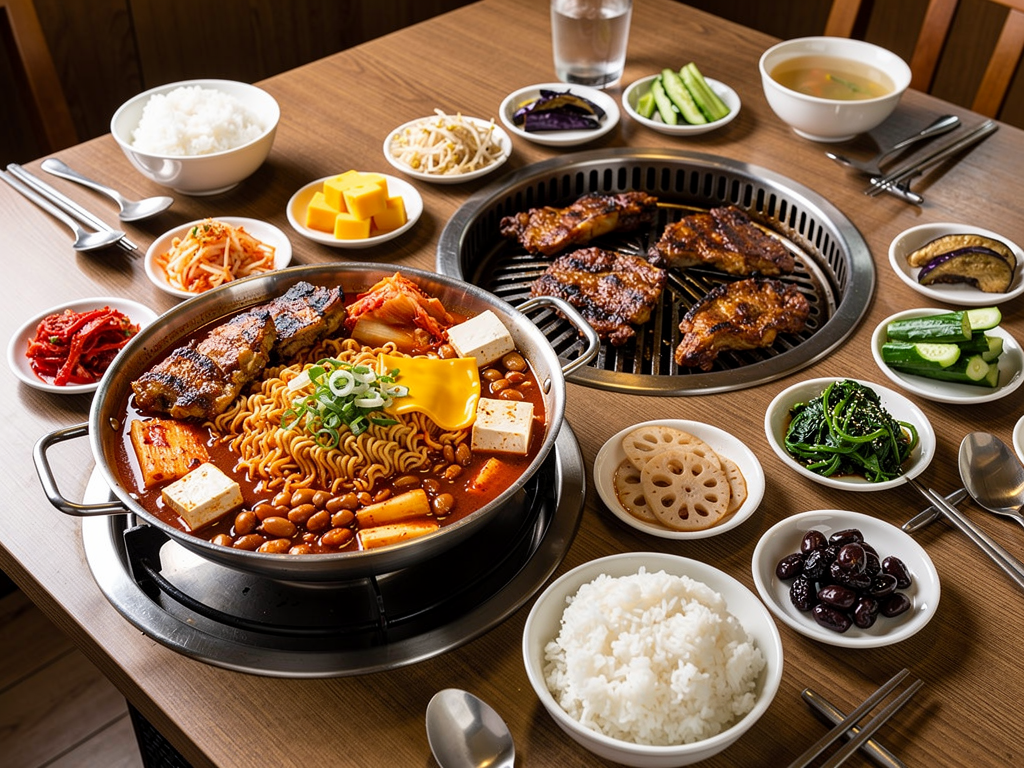
Order Mukbang Shows when the packet is one part of a halal Korean table. Rabokki at AED 49 is the packet with rice cakes in gochujang; Budae Jjigae at AED 99 feeds two to three with chicken sausage, kimchi, beans, tofu and ramyeon in a gochujang broth; Bokkeum Myeon is the stir-fried version at AED 48–59. All of it sits beside unlimited beef and chicken BBQ from AED 69 a head with eight banchan, two gimbap, soup and rice — see our guide to Korean ramen in Dubai and our guide to Korean ramen in Abu Dhabi for the five branches.
Where Mukbang Shows fits, and where it doesn’t
Mukbang Shows sells no Japanese ramen at all — no shoyu, shio, miso or tonkotsu bowl anywhere on the full Mukbang Shows menu. If the bowl you want is a chicken broth that took the kitchen all morning, Daikan, Konjiki, Bentoya and the rest of Time Out’s list are the right doors and Mukbang is the wrong one.
It also has no plain ramyeon bowl. The packet appears in exactly three places — rabokki at 49, budae jjigae at 99 and bokkeum myeon at 48–59 — so for a quick solo bowl a ramen library is cheaper. Jjampong at AED 60 solo or 99 sharing is a spicy seafood noodle soup on a jjampong noodle, not a packet.
Where Mukbang wins is the table around the bowl: a rabokki or a budae jjigae beside seven kinds of beef and chicken BBQ, eight banchan, two gimbap, soup and rice for AED 69 a head (79 at JBR and DWTC), any hour, on a menu with no pork and no alcohol. Deira is on Al Ittihad Road in Port Saeed (+971-4-886-4494); JBR is at Bahar 3 on The Walk (+971-54-523-1898); Love Mukbang DWTC is opposite World Trade Centre metro on Sheikh Zayed Road (+971-54-524-5904); Abu Dhabi has Muroor Road (+971-50-158-9433) and Electra Street (+971-2-564-0446).
The rest of the Korea-vs-Japan noodle question
This is one spoke of our Korean food vs Japanese food guide. The cold-noodle pair is naengmyeon vs soba, and our guide to every Korean noodle family in Dubai puts ramyeon beside jajangmyeon, jjampong, japchae and guksu with prices.
The one-paragraph answer to korean ramen vs japanese ramen: Japanese ramen is a broth with a fresh noodle in it, priced AED 48–85 in Dubai and built on chicken here rather than pork; Korean ramen is a packet with things in it, priced AED 25–75, filed under noodles or street food rather than under its own name, and at its best inside a stew.
FAQ
Is Korean ramen the same as Japanese ramen?
No. Korean ramen is ramyeon — an instant fried noodle block with a seasoning sachet, first made by Samyang in 1963 — cooked with an egg, cheese, seafood or rice cakes. Japanese ramen is a fresh alkaline wheat noodle in a broth the kitchen made, seasoned with a shio, shoyu or miso tare.
Which is cheaper in Dubai, Korean ramen vs Japanese ramen?
Korean starts lower: AED 25 for a DIY library bowl at Meokja and AED 42 for Hanok’s seafood ramyeon. Japanese starts at AED 48–52 (Konjiki’s dipping bowl, Bentoya’s shio and shoyu). Between AED 52 and 75 the two overlap, and the choice is toppings versus broth.
Is Japanese ramen in Dubai made with pork bone broth?
None of the four menus read for this guide prints tonkotsu or any pork: Daikan, Konjiki and Bentoya print chicken broth, and Time Out describes Kinoya’s bowls as chicken, duck or vegetarian-based. That is what the menus print, not a halal ruling — confirm directly with each kitchen.
Does Mukbang Shows serve Japanese ramen?
No. Mukbang Shows serves no shoyu, shio, miso or tonkotsu bowl. The Korean packet noodle appears only inside rabokki (AED 49), budae jjigae (AED 99, halal, no spam or pork) and bokkeum myeon (AED 48–59).
Can I build my own Korean ramyeon bowl in Dubai?
Yes. Time Out prints a “build a ramen bowl for Dhs25” line for Meokja’s ramen library at BurJuman Mall, where you choose the packet and add kimchi, cheese or rice cakes at a self-service station. Ghil Dabang in JLT runs the same format.
Why does HYU sell ramyun noodles as a AED 20 add-on?
Because in Korean cooking the packet is a topping for a stew, not a dish on its own. HYU’s “Add noodles (ramyun) AED 20” drops the block into a budae jjigae or a kimchi jjigae you have already ordered.
Which Korean dishes contain the ramyeon packet?
Rabokki (rice cakes plus ramyeon), budae jjigae (army stew), egg, cheese and seafood ramyun bowls, and stir-fried bokkeum myeon. Jjampong and jajangmyeon use their own wheat noodles, not the packet.
Comments are closed.