Updated: August 2026
Naengmyeon vs soba is a question of broth against dip. In Dubai the cheapest cold buckwheat bowl is Sushi Ya’s Zaru Soba at AED 45, and the Korean equivalent, Hanok’s Mul Naengmyun, is AED 50 — sold by the same operator from the same International City unit. Five dirhams apart, and almost nothing else about them is alike.
TL;DR
- Cheapest real buckwheat: Sushi Ya Zaru Soba, AED 45 — but it is noodles and dipping sauce, not a meal.
- Cheapest complete bowl: Hanok Mul Naengmyun, AED 50, inclusive of VAT, beef and egg included.
- The halal-certain option: Mukbang Shows Mulnaengmyun, AED 55, across five branches.
- Watch out for: anything labelled “yakisoba”. Two Dubai kitchens state in print that theirs contains no buckwheat at all.
What is the real difference between naengmyeon and soba?
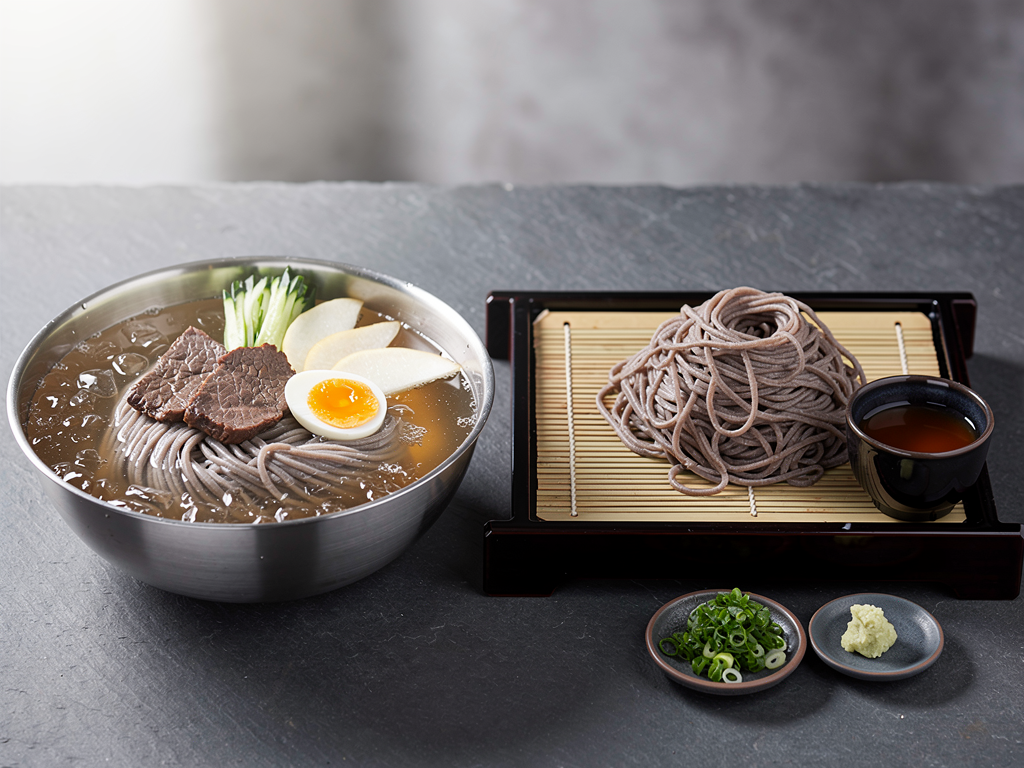
Naengmyeon vs soba is usually framed as a buckwheat question, and that framing is wrong. Naengmyeon arrives in liquid. Soba arrives dry. That is the whole thing, and everything a diner notices follows from it.
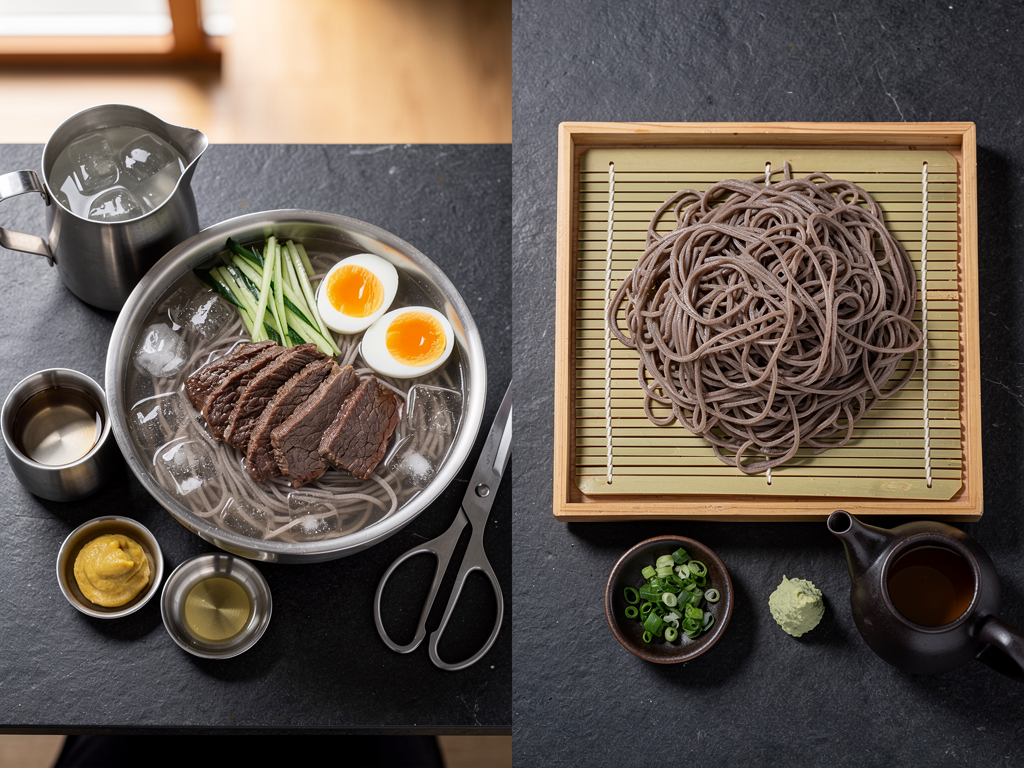
Mul naengmyeon reaches the table already sitting in icy broth, so the seasoning is fixed before you touch it and the only adjustments left are the vinegar and mustard on the side. Zaru soba reaches the table on a slatted bamboo tray with the tsuyu in a separate cup, so you decide how much flavour each mouthful gets. Hanok’s own menu describes its bowl as “Cold Buckwheat Noodles”; Sushi Ya’s describes its tray as “noodles with cold Japanese dipping sauce”. Both descriptions are published by the same operator, and between them they state the difference more precisely than any explainer could.
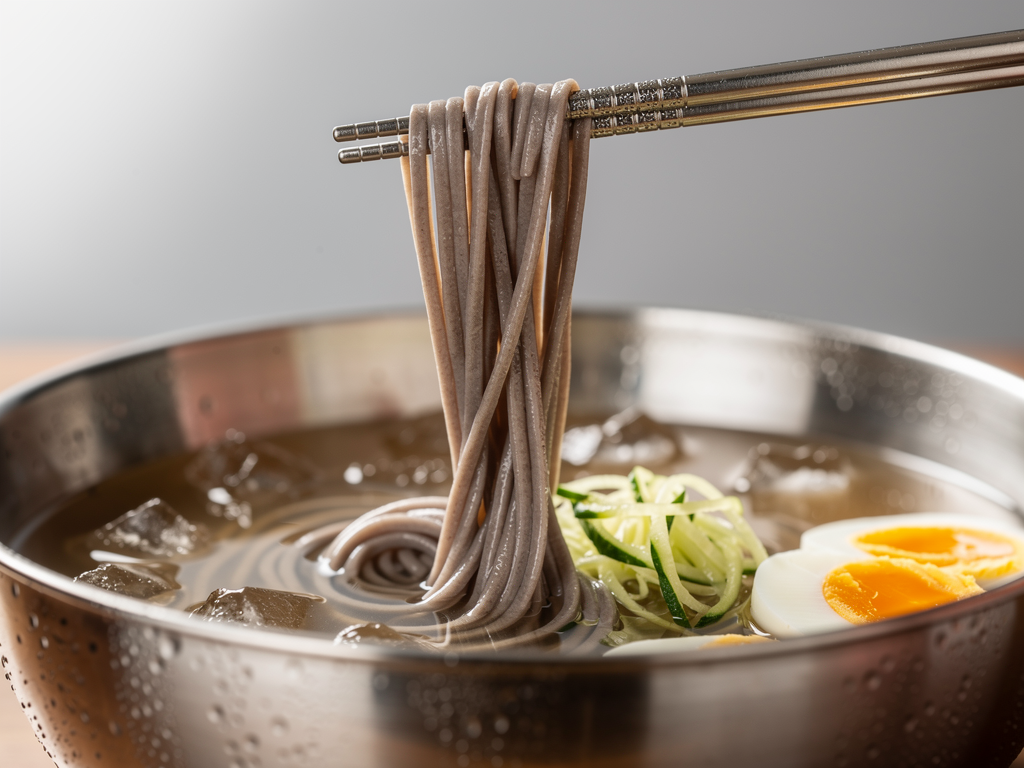
The second difference is the noodle itself, and this is where the “they’re both buckwheat” line falls apart. Naengmyeon dough is buckwheat cut with sweet potato or potato starch, which makes it elastic, glassy and genuinely difficult to bite — which is why scissors come with the bowl. Soba dough is buckwheat cut with wheat flour, which makes it tender and short, so it snaps.
The UAE menus prove the perception without being asked. Shogun calls its bowl “cold chewy noodles”. Hanok calls its bowl “cold buckwheat noodles”. Mannaland calls its bowl “cold buckwheat noodle soup”. Not one venue in this research describes soba as chewy.
Why does “soba” on a Dubai menu often not mean buckwheat?
Because on a large share of UAE menus the word is attached to a stir-fried wheat or egg noodle, and two separate Japanese kitchens say so in their own published copy.
Sumo Sushi & Bento describes its Yakisoba, AED 59, as “stir-fried egg noodles with shrimp, chicken, and vegetables”. Kimura-ya in Business Bay describes its Yakisoba, AED 70, as “stir-fried ramen noodle with beef and vegetable”. Neither of those is buckwheat, and neither kitchen is hiding it — the information is printed, it is just not what most people read before ordering.
This is the single most useful thing to know before you order soba in this city. If you want the earthy buckwheat noodle, the word to look for is not soba. It is zaru, or “cold noodles”, or “dipping sauce”. Sushi Ya publishes a section headed literally “Cold Noodles” containing Cha Soba, Zaru Soba and Zaru Udon at AED 45, and Ten Zaru Soba with tempura at AED 68. Kimura-ya’s “Tempura Udon or Soba” at AED 65 is listed as “assorted tempura with cold/hot soba/udon” — one price, served either way, which is itself proof that soba is a both-temperatures noodle in a way naengmyeon never is.
The absence matters as much as the presence. Sumo Sushi & Bento is a national chain carrying fourteen bentos and six ramen, and it lists no cold soba whatsoever. That is a large part of why cold buckwheat is genuinely hard to find here.
How do naengmyeon vs soba prices compare in the UAE?
Closer than you would expect, and the closest comparison of all comes from a single address.
The Korean Restaurant (Hanok) and Sushi Ya trade from the same Central Business District unit in International City under one operator, sharing the phone numbers 04-5588962 and 052-5097505, and both publish prices inclusive of 5% VAT. Hanok’s Mul Naengmyun is AED 50. Sushi Ya’s Zaru Soba is AED 45. Same operator, same VAT treatment, same week.
But the AED 5 gap badly understates what actually arrives, and any guide that stops at the headline number is misleading you. Every naengmyeon in this research comes with protein as standard — Shogun prints “beef, egg”, Mannaland the same, and the garnish of sliced beef, half a boiled egg, cucumber and pear is part of the dish’s definition. The AED 45 zaru soba is noodles and a cup of sauce. It is a carbohydrate course.
The fair like-for-like is Sushi Ya’s Ten Zaru Soba at AED 68 or Kimura-ya’s tempura version at AED 65, both of which carry something substantial alongside the noodles. Against those, a AED 50 to AED 70 naengmyeon is competitive or cheaper.
| Dish | Venue | Area | Price AED | Halal | What arrives |
|---|---|---|---|---|---|
| Mul Naengmyun | The Korean Restaurant (Hanok) | International City | 50 | Confirm directly | “Cold buckwheat noodles”; incl. 5% VAT |
| Zaru / Cha Soba | Sushi Ya (same unit) | International City | 45 | Confirm directly | Dry on a tray, cold dipping sauce |
| Ten Zaru Soba | Sushi Ya | International City | 68 | Confirm directly | Same, plus mixed tempura |
| Mulnaengmyun | Mukbang Shows | 5 UAE branches | 55 | 100% halal, beef & chicken only | Excl. 5% VAT |
| Bibim Naengmyun | Mannaland | Jafiliya | 60 | Confirm directly | Cheapest tossed version found |
| Mul Naengmyun | Mannaland | Jafiliya | 70 | Confirm directly | “Cold buckwheat noodle soup” |
| Mul / Bibim Naeng Myeon | Shogun | Al Sufouh | 70 | Confirm directly | “Cold chewy noodles, beef, egg” |
| Tempura Udon or Soba | Kimura-ya | Business Bay | 65 | Confirm directly | Sold cold or hot at one price |
| Yakisoba | Sumo Sushi & Bento | UAE-wide chain | 59 | Confirm directly | Stated as egg noodles, not buckwheat |
All figures read from each venue’s own website or its live Deliveroo listing on 23 August 2026.
One oddity worth flagging: Mannaland is the only venue in this set where the bibim version undercuts the mul version, AED 60 against AED 70. Everywhere else the two either match or the tossed one costs more.
Which one is actually a meal?
Naengmyeon, on every menu checked, and this is where naengmyeon vs soba stops being a close call. The beef and egg are not upgrades, they are the standard build, which is why the bowl works as a light lunch on its own.
Plain zaru soba is not trying to be that. It is a cold noodle course, and in Japan it is often eaten as one part of a meal rather than the whole of it. Ordering the AED 45 tray and expecting to be full afterwards is the most common way people end up disappointed by soba in this city — not because it is bad, but because they bought a component and expected a plate.
The fix is straightforward: order the tempura version. At AED 68 from Sushi Ya or AED 65 from Kimura-ya, soba becomes a full plate and the comparison against naengmyeon becomes fair.
What is naengmyeon (냉면)?
Naengmyeon (냉면) is Korean cold noodles, eaten mostly in summer, and it comes in two standard forms. Mul naengmyeon sits in an icy beef or radish broth, usually with vinegar and hot mustard offered alongside to adjust at the table. Bibim naengmyeon has no broth and is tossed through a sweet-hot gochujang sauce instead. Both are topped with sliced beef, half a boiled egg, cucumber and pear or radish.
The defining sensation is the chew, and it is deliberate. The starch in the dough is what makes the strands elastic enough to resist a bite, and cutting them with scissors at the table is normal practice rather than a sign something has gone wrong.
Mukbang Shows lists Mulnaengmyun at AED 55, excluding 5% VAT, which puts it between Hanok at AED 50 and the AED 70 bowls at Shogun and Mannaland. Its wider noodle section runs deep — Bibimguksu at AED 48, Japchae at AED 55, Jajangmyeon at AED 55 and Bokkeum Myeon at AED 48 to 59 — so the cold bowl is a choice there rather than the only cold-adjacent option. For the full picture of how these fit together, see our guide to every Korean noodle family in Dubai and the deeper background in our explainer on what naengmyeon is.
What is soba, and where do you find the real thing?
Soba (そば) is the Japanese buckwheat noodle, and it is served three main ways. Zaru soba is the cold version: boiled, rinsed under cold water, drained and laid on a slatted bamboo tray with tsuyu, spring onion and wasabi beside it. Kake soba is the same noodle hot in broth — Sushi Ya lists it at AED 47. Cha soba is the same noodle with green tea worked into the dough, which turns the strands green.
Because soba is blended with wheat, it stays tender and breaks cleanly, and it never needs scissors. Dipping rather than sitting in liquid also means the last mouthful has close to the same texture as the first, which is not true of a bowl that has been soaking.
The places to find genuine cold buckwheat in Dubai are narrow. Sushi Ya’s “Cold Noodles” section at AED 45 is the clearest and cheapest. Kimura-ya’s AED 65 tempura option can be ordered cold. Beyond that it thins out quickly, which is worth knowing before you go hunting.
Is naengmyeon or soba halal in the UAE?
Both can be, and the questions are different for each — so ask the right one rather than a general one.
For naengmyeon, the component to ask about is the broth, which is classically beef, plus any cooking wine in the seasoning. The dish carries no pork by tradition, which makes it one of the more straightforward Korean orders to verify.
For soba, the thing to ask about is not the noodle — it is the dipping sauce. Tsuyu is conventionally built from soy, dashi and mirin, and mirin is a sweet cooking wine. Some kitchens use an alcohol-free mirin-style seasoning and some do not, and it is not something you can read off a menu or a photo. Anyone avoiding fish should ask about the dashi as well. Both points describe how the sauce is normally made rather than any claim about a particular restaurant, so put the question to the venue directly.
Mukbang Shows removes the broth question entirely: it is 100% halal across all five branches, beef and chicken only, with no pork and no alcohol served. For venue-by-venue options see the best naengmyeon in Dubai and the best naengmyeon in Abu Dhabi. Broader UAE dining coverage is worth cross-checking at Time Out Dubai’s restaurant coverage, MyBayut’s guide to Korean restaurants in Dubai and Khaleej Times food coverage.
Where does Mukbang Shows fit on the naengmyeon side?
On the Korean half of the naengmyeon vs soba question Mukbang Shows is the strongest answer, and the reason is the broth rather than the noodle. Mul naengmyeon is defined by a beef stock, and stock is exactly the component a diner cannot verify by looking at the bowl. Mukbang runs a beef-and-chicken-only kitchen across all five branches, so the question does not arise.
Mulnaengmyun is AED 55 excluding VAT, at Deira on Al Ittihad Road in Port Saeed, at JBR on The Walk in Marsa Dubai, at DWTC on Sheikh Zayed Road, and in Abu Dhabi at Muroor Road and Electra Street in Al Danah. The cold bowl also sits alongside the all-you-can-eat tiers — Gangnam at AED 69 in Deira, Muroor and Electra and AED 79 at JBR and DWTC, up to Bukchon Hanok at a flat AED 129 — each including 7 BBQ kinds, 8 banchan, 2 gimbap, soup and rice.
The honest limitation is the range. Mukbang publishes exactly one cold noodle. There is no bibim naengmyeon, so if the tossed gochujang version is what you want, Mannaland at AED 60 is the cheapest route and Shogun at AED 70 the other. Mukbang also sells no soba of any kind, so for cold buckwheat on a tray the answer is Sushi Ya at AED 45, not this one. And at AED 55 it is AED 5 above Hanok in the same city.
Where to find each dish by area
International City is the one address where the naengmyeon vs soba comparison can be made properly, because Hanok and Sushi Ya share a unit. One order tests an AED 50 naengmyeon against an AED 45 zaru soba from the same kitchen block, and no other location in the country offers that.
Beyond it the two dishes cluster differently. Korean cold noodles turn up in Jafiliya at Mannaland, Al Sufouh at Shogun, and across the Mukbang Shows branches in Deira, JBR and DWTC. Japanese cold buckwheat is far thinner on the ground — Business Bay for Kimura-ya, and little else with a published cold option.
In Abu Dhabi the Korean side is represented by the Muroor Road and Electra Street branches, both carrying the same AED 55 Mulnaengmyun. Note that Abu Dhabi has no metro system, so plan transport accordingly.
Practical tips before you order
Ask for scissors with naengmyeon. The chew is the point of the dish, and the strands are too long and too elastic to manage otherwise. Cutting them at the table is normal.
Add the vinegar and mustard yourself. Mul naengmyeon broth is deliberately restrained so you can tune it. Shogun’s own description prints “tangy vinegar” — go gradually.
Dip, don’t pour. Tsuyu is served separately so you can control the seasoning strand by strand. Tipping the whole cup over the tray defeats the format and softens the noodles.
Upgrade the soba if you want a meal. AED 45 buys noodles and sauce. AED 68 at Sushi Ya or AED 65 at Kimura-ya buys tempura with it, which is the fair match for a naengmyeon.
Read past the word “soba” on delivery apps. This is the one rule that prevents most naengmyeon vs soba ordering mistakes. If the description says stir-fried egg noodles or ramen noodle, it is not buckwheat. Look for zaru, cold noodles, or dipping sauce.
Eat both soon after they arrive. Naengmyeon broth normally travels in a separate container, so the ice that defines it is the first thing lost. Rinsed buckwheat clumps as it sits undressed. Neither is a dish to leave on a desk.
FAQ
Is naengmyeon chewier than soba?
Considerably. Naengmyeon dough uses sweet potato or potato starch, which makes it elastic enough to need scissors. Soba is cut with wheat flour and snaps cleanly. Shogun’s menu calls its bowl “cold chewy noodles”; no soba menu here uses that word.
Does soba in Dubai always contain buckwheat?
No. Anything labelled yakisoba usually does not — Sumo describes its version as egg noodles and Kimura-ya describes its own as ramen noodle. Order zaru or cha soba for the real thing.
Which is better value?
Depends what you count. Zaru soba at AED 45 is cheapest on paper but is noodles and dipping sauce only. Naengmyeon from AED 50 includes beef and egg, so it is the better meal for the money.
Can I get bibim naengmyeon at Mukbang Shows?
No. It lists only Mulnaengmyun at AED 55. For the tossed gochujang version, Mannaland is AED 60 and Shogun is AED 70.
Which travels better for delivery?
Zaru soba, because it is meant to arrive undressed. Naengmyeon loses its ice in transit, and the broth usually comes in a separate container. Eat either one promptly.
Can I try both from the same kitchen?
Yes. Hanok and Sushi Ya operate from one International City unit under one operator, so a single order can put a AED 50 naengmyeon next to a AED 45 zaru soba.
Naengmyeon vs soba is decided by whether you want the seasoning settled for you or left in your hands. If you want a cold bowl that is already a meal, take the naengmyeon; if you want to control every mouthful and do not mind ordering something alongside it, take the soba. The one address in Dubai that sells both from the same kitchen makes that test cost about a hundred dirhams.
Related guides
More from our Korean food guides across the UAE: