
Updated: August 2026
Anyone searching for korean noodles dubai is really choosing between five unrelated families of food, and the family you pick decides the price far more than the restaurant does. Wheat noodles run AED 45 to 80, cold buckwheat AED 50 to 70, sweet-potato glass noodles AED 38 to 70, cold thin-wheat guksu AED 48 to 65, and instant ramyun AED 33 to 75.
TL;DR
– Best overall: Mukbang Shows Restaurant — Deira, four of the five families on one menu
– Best value: The Korean Restaurant, International City — japchae lunch box AED 38
– One situational pick: Koreana Restaurant, Al Barsha 1 — the only cold guksu list in the city
What are the five families of korean noodles dubai menus sell?
There are five, they overlap almost not at all, and knowing which one you want before you open a menu is the whole trick.
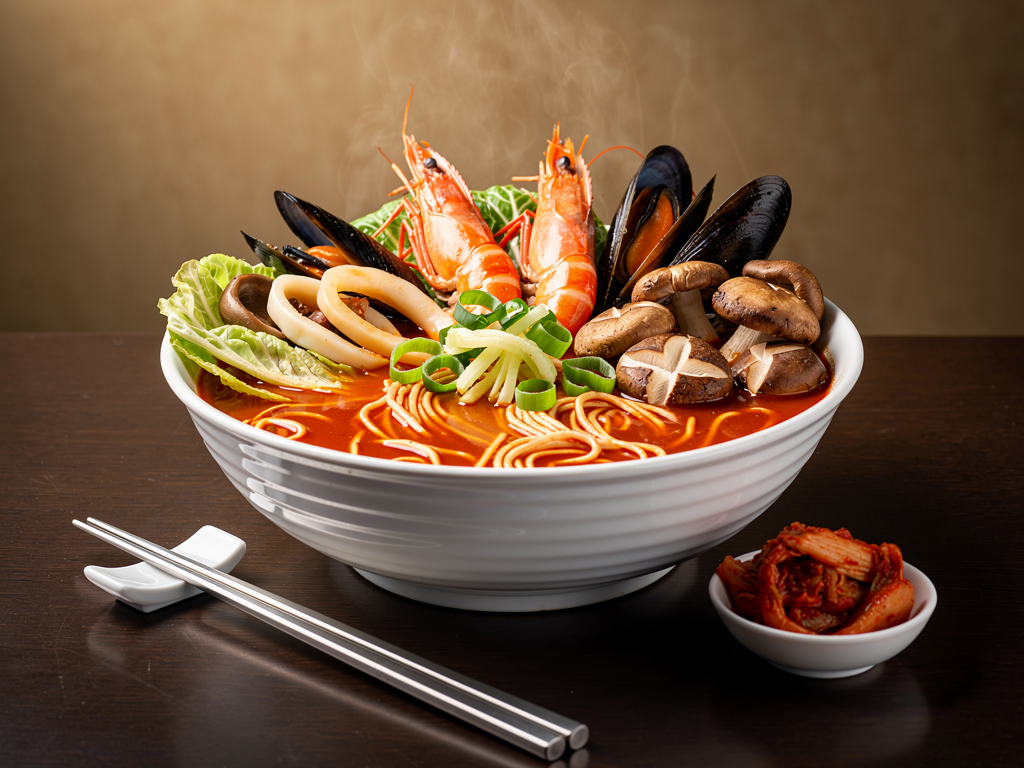
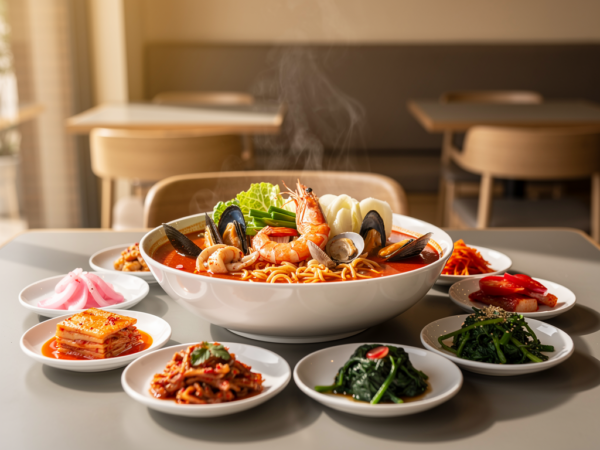
Wheat noodles are the soft white strands that absorb sauce or sit in hot broth: jjajangmyeon under black bean sauce, jjampong in spicy seafood broth, kalguksu knife-cut in clam broth, somyun stir-fried thin. AED 45 to 80 in Dubai.
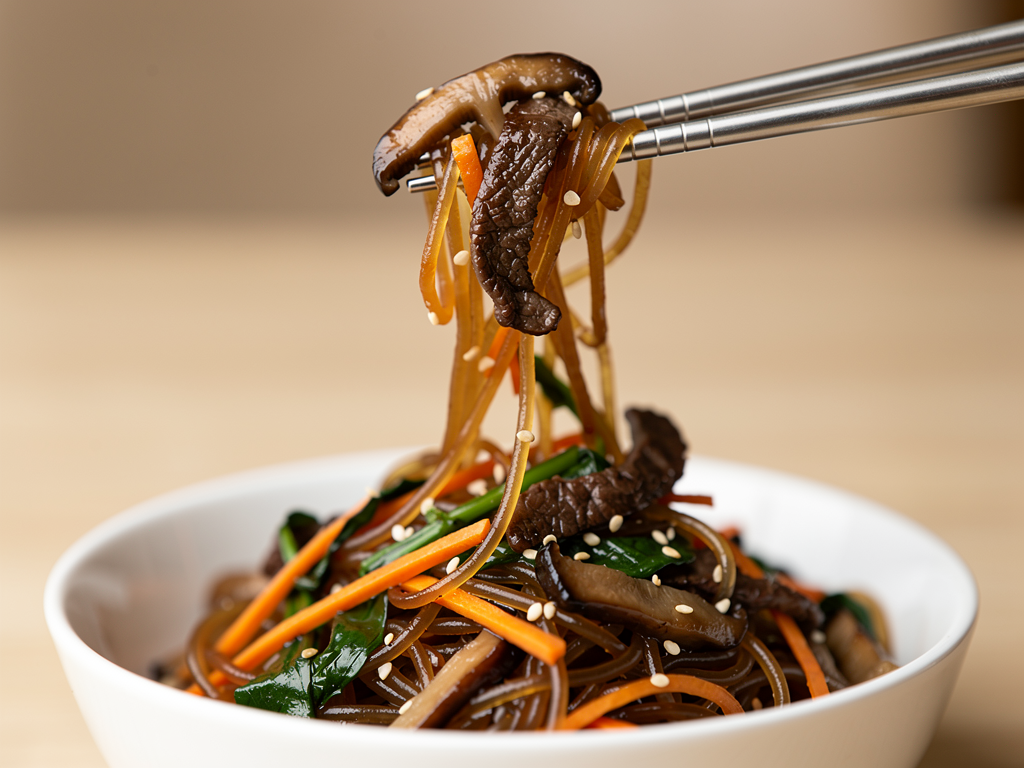
Cold buckwheat means naengmyeon — grey, chewy, served icy in broth or dry with red sauce. AED 50 to 70. Sweet-potato glass noodles means japchae: translucent, bouncy, stir-fried rather than boiled, and not a myeon at all in the Korean sense. AED 38 to 70.
Cold thin-wheat guksu is the rarest branch — kong guksu in milky soybean broth, chogye guksu in vinegar-sharp cold chicken broth, miyuk oi naeng guksu with seaweed and cucumber. AED 48 to 65. Instant ramyun is the fast spicy soup category that restaurants upgrade with egg, cheese or seafood. AED 33 to 75.
The price ladder decodes any menu in the city in about ten seconds. Under AED 55 you are buying japchae, instant ramyun or a cold guksu. AED 55 to 70 buys a proper wheat noodle or a standard naengmyeon. AED 70 to 80 means jjampong or a beef-and-seafood upgrade. If something is AED 79 and it is not jjampong, you are paying for the postcode rather than the bowl. Every price below was read on 14 August 2026 from the venue’s own published menu or its live Deliveroo listing.
Why does searching a delivery app show you only a third of what exists?
Because no two Dubai menus agree on what belongs under the word “noodles”, and the kitchens themselves prove it.
Koreana in Al Barsha 1 prints a section headed, verbatim, “Korean Noodles
Mashisoyo in JLT West is the sharpest example of all. Deliveroo cuisine-tags it “Ramen”. Mashisoyo prints a section headed “Noodles / Ramen”. That section contains two dishes. Three more noodle dishes — Japchae at AED 59, Rabokki at AED 69 and Vegan Japchae at AED 69.75 — sit elsewhere on the same menu.
Four menus, four filing systems. Tap the noodles tab on any app and you miss the rest. Read the whole menu.
Which venue is the best all-round pick right now?
Mukbang Shows Restaurant in Deira, because it is the only kitchen checked that covers four of the five families on one menu and it is the cheapest in the city on three specific dishes.
Its list runs Bibimguksu AED 48, Bokkeum Myeon at AED 48 vegetable, AED 55 chicken or AED 59 seafood, Japchae AED 55, Jajangmyeon AED 55, Mulnaengmyun AED 55, Rabokki AED 49, and Jjampong at AED 60 small or AED 99 large. Three of those are the lowest in this comparison by a clear margin: the Bibimguksu at AED 48 against HYU’s Bibimgooksoo at AED 65, the Bokkeum Myeon at AED 48 against HYU’s Bokkumjjamppong at AED 79, and the Rabokki at AED 49 against AED 65 at HYU and AED 69 at Mashisoyo. It is also one of only two addresses in the city publishing a bibim guksu at all.
Noodle-adjacent bowls sit on the same menu: Tteok Mandu Guk AED 59, Tteokguk AED 51, Eomuk Tang AED 49, and a Budae Jjigae at AED 99 that contains ramyun and no pork of any kind. Mukbang is 100% halal — beef and chicken only, no pork, no alcohol on the premises — which on jjajangmyeon in particular removes a question you would otherwise have to ask. A noodle bowl can also share the table with an unlimited grill: at Deira the tiers are Gangnam AED 69, Daegu AED 89, Jeju AED 99 and Bukchon Hanok AED 129 flat, two-person minimum, AED 60 leftover charge, with AED 79 to AED 129 at the JBR and DWTC branches.
The honest limitation is a whole missing family. Mukbang publishes no kalguksu, no kong guksu, no chogye guksu and no sujebi — the entire hand-cut and cold-broth guksu branch is absent, and Koreana is the only address in Dubai that covers it properly. There are no somyun dishes either. And while its small jjampong at AED 60 is the cheapest in the city, its large at AED 99 is the most expensive here, so the size choice matters more at Mukbang than anywhere else on this list. Phone the Deira branch on +971-4-886-4494.
Where do you get the cheapest bowl?
The Korean Restaurant in International City, whose Japchae Lunch Box at AED 38 is the single cheapest named Korean noodle dish found in Dubai. It comes with Korean side dishes and is filed under SPECIAL KOREAN SETS rather than under noodles at all.
Its formal “NOODLES” section holds two dishes — Mul Naengmyun AED 50 and Japchae AED 50 in vegetarian, chicken or beef. Under CHEF’S SPECIALS sit Jjajangmyeon at AED 45 vegetarian, AED 50 chicken or beef and AED 53 seafood, which is the cheapest jjajangmyeon found in the UAE, and Haemul Ramyun at AED 42, the cheapest restaurant ramyun bowl in the city. Its published menu states prices are inclusive of 5% VAT.
Two limitations. First, the range is genuinely narrow — four noodle dishes across the whole menu, and none of the cold guksu family, despite this being the most complete published Korean menu in the country. Second, International City is a long way out and no metro station serves it, so an AED 38 lunch box is only a bargain if you are nearby or ordering delivery. Call 04-5588962 or 052-5097505.
Who has the deepest menu, and the rare cold guksu?
Koreana in Al Barsha 1, and it is the only address in Dubai for an entire branch of the category.
Its “Korean Noodles
Kong guksu, chogye guksu, miyuk oi naeng guksu and sujebi appear on no other menu in this comparison. If you want kong guksu in Dubai, there is one address. Koreana is rated 4.6 from over 500 Deliveroo ratings, is cuisine-tagged by Deliveroo as Korean, Soup and Noodles, and closes at 22:30.
The limitation is that nothing here is genuinely cheap except the japchae. The Korean Restaurant undercuts it by AED 10 on jjajangmyeon and AED 5 on mul naengmyeon, and its two somyun dishes at AED 70 and AED 75 are the most expensive noodles in this guide — and easy to miss, because they are filed under Mains.
What about HYU, Mannaland and Mashisoyo?
HYU in JLT has the deepest ramyun list and the latest closing time. Its “Noodle” section carries ten: Egg Ramyun AED 60, Bibimgooksoo AED 65, Cheese Ramyun AED 65, Vegetable Japche AED 65, Moolnaengmyun AED 69, Jjajangmyun AED 69, Beef Japchae AED 70, Seafood Ramyun AED 75 with crab, squid and shrimp, Bokkumjjamppong AED 79 and Jjamppong AED 79. Three ramyun variants is more than anyone else publishes, “add noodles (ramyun)” is a AED 20 extra, and at 23:30 it closes later than any Korean kitchen in Dubai — so it is the realistic late bowl. It is 4.7 from over 500 ratings.
The limitation at HYU is price: its jjajangmyeon at AED 69 is AED 24 above the cheapest in the city and its jjamppong at AED 79 is AED 19 above Koreana’s, and it publishes no kalguksu and no cold guksu. It also prints a condition worth knowing: side dishes come with appetisers only if you order over AED 100 of appetisers.
Mannaland in Jafiliya is the highest-rated kitchen here at 4.8 from over 500 ratings, and one of only two with a kalguksu. Its “Noodles” section holds Kalguksu AED 60, Bibim Naengmyun AED 60, Japchae AED 70, Jjajangmyun AED 70, Mul Naengmyun AED 70, Haemul Ramyun AED 70 and Jjambbong AED 80 — the most expensive jjampong in the city. Tteok Manduguk AED 60 sits under “Casserole” rather than Noodles, another instance of the filing problem. The limitations are joint-highest pricing on several staples, no bibim guksu, kong guksu or sujebi, and a 22:00 close, the earliest here.
Mashisoyo in JLT West is 4.5 from 236 ratings and closes at 22:15. Its noodle section is two dishes: Korean Ramen AED 54 and Jajangmyeon AED 69. There is no naengmyeon, no kalguksu, no jjampong and no guksu of any kind. What it does have uniquely is a proper plant-based option — Vegan Japchae at AED 69.75, alongside Vegan Tteok-bokki AED 76, Yachae Kimbap AED 51.25 and Vegan Kimchi AED 38.50 — plus the Hangul printed beside most dish names, which makes it the easiest menu in the city to cross-check against a Korean recipe.
How much do korean noodles dubai prices vary between venues?
| Venue | Area | Noodle range AED | Closes | Halal | Standout order |
|---|---|---|---|---|---|
| Mukbang Shows — Deira | Deira | 48–99 | — | 100% halal, beef & chicken only | Bibimguksu AED 48 |
| The Korean Restaurant | International City | 38–53 | — | Confirm directly | Japchae Lunch Box AED 38 |
| Koreana Restaurant | Al Barsha 1 | 45–75 | 22:30 | Confirm directly | Kong Guksu AED 60 |
| HYU Korean Restaurant | JLT | 60–79 | 23:30 | Confirm directly | Seafood Ramyun AED 75 |
| Mannaland | Jafiliya | 60–80 | 22:00 | Confirm directly | Kalguksu AED 60 |
| Mashisoyo | JLT West | 54–69.75 | 22:15 | Confirm directly | Vegan Japchae AED 69.75 |
The same-dish spreads are the real story. Japchae runs from AED 38 to AED 70, a spread of 84 per cent on one dish. Jjajangmyeon runs AED 45 to AED 70, a spread of 56 per cent. Mul naengmyeon runs AED 50 to AED 70. Jjampong runs AED 60 to AED 80, and two of the six venues here publish none at all.
Which korean noodles dubai families are missing where?
The absences are worth naming, because they are what send people on wasted trips.
Mashisoyo is cuisine-tagged “Ramen” and publishes no cold noodle of any kind, no jjampong and no kalguksu. The Korean Restaurant has the country’s most complete Korean menu and no jjampong, no kalguksu and no guksu. HYU lists ten noodle dishes and not one kalguksu or cold guksu among them. Mannaland has no bibim guksu, no kong guksu and no sujebi. Mukbang has no kalguksu and none of the cold guksu family.
Which reduces to two practical facts. Kalguksu exists at exactly two addresses in Dubai — Koreana at AED 65 with clams and Mannaland at AED 60. Kong guksu, chogye guksu and sujebi exist at exactly one.
Broth or sauce? The one question that sorts the cold noodles
Dubai menus print “cold noodles” against at least four dishes that eat nothing alike, so the single question worth asking before you order is whether it arrives with broth or with sauce.
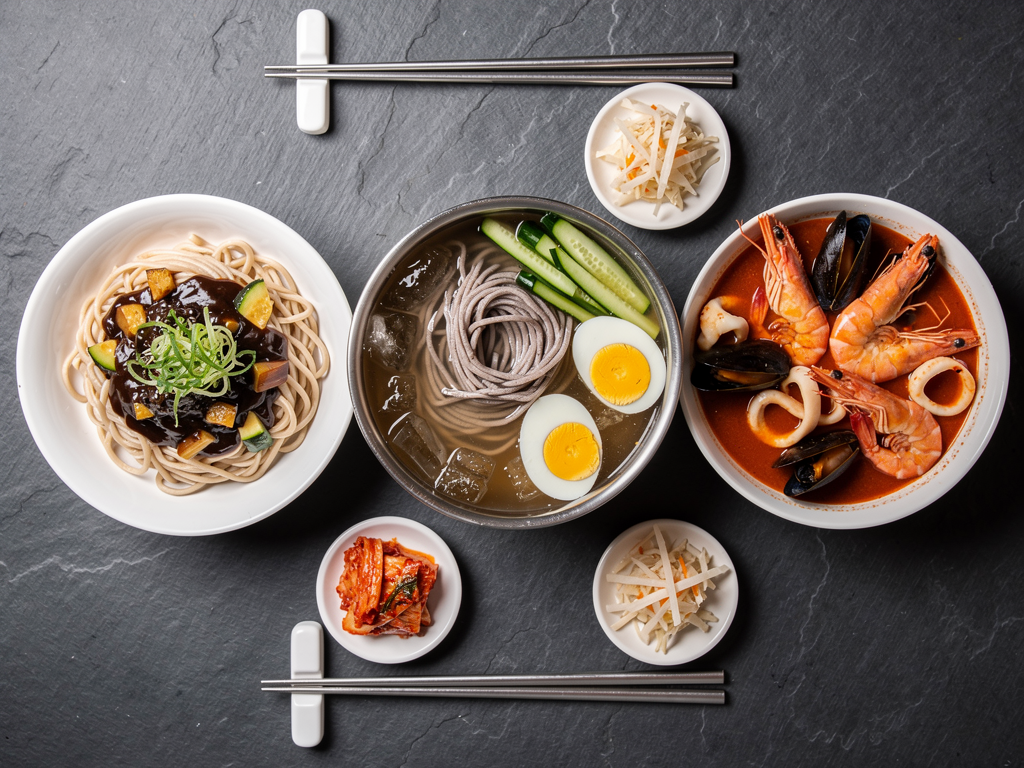
Mul naengmyeon comes swimming in an icy, slightly cloudy broth with cucumber, pear and a boiled egg. Bibim naengmyeon and bibim guksu arrive with no broth at all and a mound of red sauce to toss through. Kong guksu arrives opaque white and deliberately under-seasoned, because you salt it yourself at the table. Chogye guksu arrives in a clear cold chicken broth sharpened with vinegar and mustard.
Get that one answer and you will never order the wrong cold bowl again. For the buckwheat family specifically, see our guide to the best naengmyeon in Dubai.
Are Korean noodles halal?
This is among the easiest parts of the cuisine to eat halal, and it is worth knowing why rather than taking it on trust.
Japchae is soy, sesame oil and vegetables with optional beef or chicken. Kalguksu is canonically an anchovy or clam broth. Naengmyeon broth is canonically beef, sometimes lightened with dongchimi radish water. Jjampong is seafood-based. The dish worth checking is jjajangmyeon: the canonical Korean version uses pork, but the local build is beef or chicken at every Dubai venue that specifies the protein — The Korean Restaurant prints vegetarian, chicken and beef versions explicitly. Where a menu says nothing, ask.
The other thing to check is instant ramyun, where the flavour sachet rather than the noodle brick is the question. Beyond that, the two standing questions for any Korean kitchen apply: whether rice wine appears in the broth, and how shared equipment is handled. Mukbang Shows is 100% halal with beef and chicken only, no pork and no alcohol on the premises. Everywhere else, confirm directly with the kitchen rather than inferring from a dish name.
Where are these restaurants?
Mukbang Shows has three Dubai branches: Deira on Al Ittihad Road in Port Saeed, JBR at Bahar 3 on The Walk in Marsa Dubai, and Love Mukbang at DWTC on Sheikh Zayed Road, opposite the World Trade Centre metro station and within reach of Dubai Mall and Burjuman. The core noodle list is the same at each.
Koreana is in Al Barsha 1, the area served by Mall of the Emirates metro on the Red Line, and is the only stop worth making specifically for kong guksu or sujebi. HYU and Mashisoyo are both in Jumeirah Lake Towers, close to the DMCC and Sobha Realty stations on the Red Line — HYU in the main cluster, Mashisoyo in JLT West. Mannaland is in Jafiliya and Al Hudaiba, near Al Jafiliya metro, which is on the Red Line. The Korean Restaurant is in International City, which no metro station serves at all, so that trip is a drive or a delivery.
Closing times matter as much as location: Mannaland stops at 22:00, Mashisoyo at 22:15, Koreana at 22:30 and HYU at 23:30.
For wider context see Time Out Dubai’s restaurant coverage, MyBayut’s guide to Korean restaurants in Dubai and Khaleej Times food coverage.
Practical tips for ordering korean noodles dubai diners actually use
Apply the price ladder before you open the app. Under AED 55 is japchae, ramyun or cold guksu. AED 55 to 70 is wheat or buckwheat. AED 70 to 80 is jjampong or a premium protein. The rule works on every menu in the city.
Ask “broth or sauce” whenever a menu says only cold noodles. It is the fastest way to avoid ordering a dry bowl when you wanted soup.
Read the whole menu, not the noodles tab. Koreana files somyun under Mains, HYU files Rabokki under Appetizer, Mannaland files tteok manduguk under Casserole, and The Korean Restaurant files its cheapest jjajangmyeon under Chef’s Specials.
Confirm the jjampong size at Mukbang. AED 60 small is the cheapest in Dubai; AED 99 large is the dearest here. That is the widest size gap on any single dish in this guide.
Confirm the protein on jjajangmyeon, and the sachet on any instant ramyun. Where the menu specifies, it is beef or chicken; where it does not, ask.
Plan a trip for the rare bowls. Kong guksu at AED 60, chogye guksu at AED 65 and sujebi at AED 65 exist at Koreana and nowhere else in the city, so they are worth a deliberate journey or a delivery order rather than a hopeful walk-in elsewhere.
For dish-level depth, see our guides to the best jajangmyeon in Dubai, the best jjampong in Dubai and the best japchae in Dubai, plus the Korean-Chinese food hub for Dubai for the jjajangmyeon and jjampong pairing.
FAQ
What is the cheapest Korean noodle dish in Dubai?
The Korean Restaurant’s Japchae Lunch Box at AED 38. Next lowest are Mukbang’s Bibimguksu and Bokkeum Myeon vegetable, both AED 48, and The Korean Restaurant’s Haemul Ramyun at AED 42.
Which restaurant has the most complete noodle menu?
Koreana in Al Barsha 1, with ten items under its “Korean Noodles
Where can I eat Korean noodles late at night in Dubai?
HYU in JLT closes at 23:30, later than any other Korean kitchen here, and it has the deepest ramyun list — egg, cheese and seafood versions at AED 60 to AED 75.
Is japchae actually a noodle?
Not in the Korean sense. Japchae is made from sweet-potato starch rather than wheat, which is why it is chewy and translucent, and in Korea it works as a side or party dish. Every Dubai menu still files it under noodles.
Is there a vegan Korean noodle option in Dubai?
Mashisoyo publishes Vegan Japchae at AED 69.75 plus a full vegan section. Most japchae elsewhere can be ordered without meat, but confirm directly.
Why do menus disagree about what counts as a noodle?
Every kitchen files differently — rabokki under appetizers at one, somyun under mains at another, jjajangmyeon under chef’s specials at a third. Starch type and the price ladder are more reliable than section headings.
Decide the family before you open the menu and every korean noodles dubai decision after that follows. For breadth at a mid price and a halal kitchen, Mukbang in Deira; for the cheapest bowl in the city, The Korean Restaurant; for the rare cold guksu, Koreana and nowhere else. Confirm prices and ingredients directly — this guide records what those six kitchens published on 14 August 2026.
Related guides
More from our Korean food guides across the UAE:
Comments are closed.