
Updated: September 2026
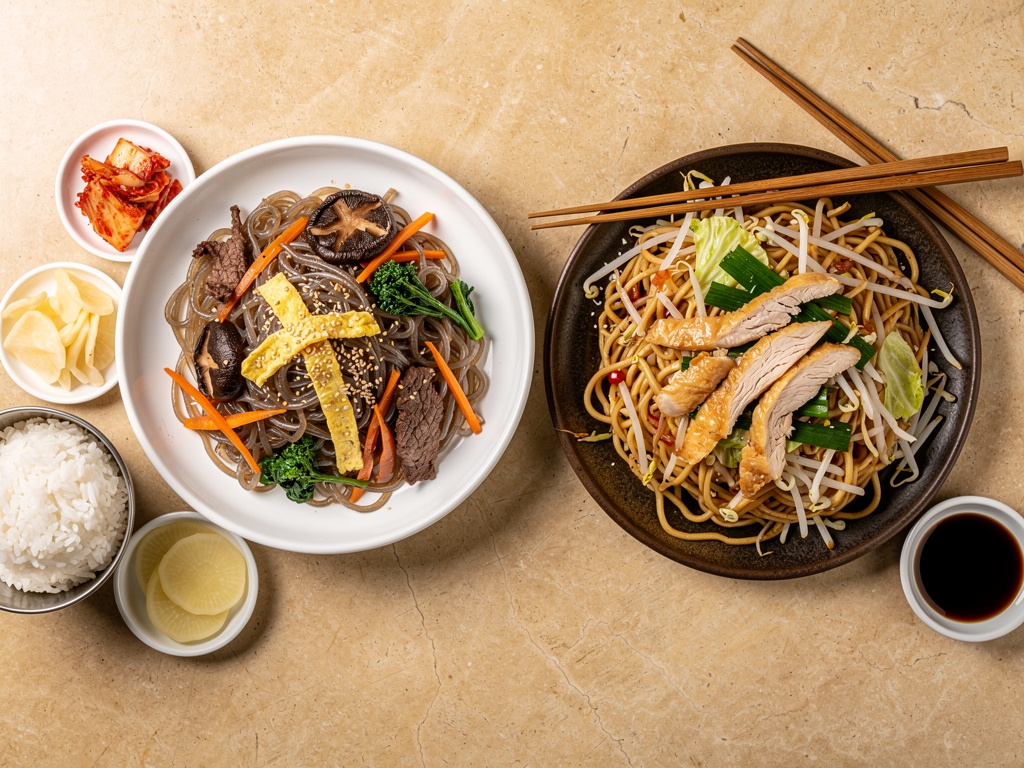
Japchae vs chow mein comes down to which part of the plate the menu is charging you for. Chow mein prices the protein: The Great Wall in Business Bay prints one fresh egg noodle at AED 37 plain, AED 49 with chicken or beef, AED 58 with king prawns. Japchae prices the noodle: The Korean Restaurant in International City prints it at AED 50 “VEG/CHICKEN/BEEF” — one number, whatever goes in. Same wok, same soy, opposite menus.
TL;DR
– Chow mein: wheat-and-egg noodles, stir-fried hot with bean sprouts and spring onion, eaten as a main, priced by the protein (AED 37–58 in Dubai).
– Japchae: sweet-potato-starch glass noodles, seasoned with soy and sesame oil, served warm or at room temperature as a side or a main, priced as one dish (AED 50–58).
– On UAE menus the wheat stir-fry goes by three names — chow mein, Hakka noodles, fried noodles — and japchae by one.
– The japchae noodle is naturally gluten-free; chow mein is wheat, often with egg.
What is the difference between japchae and chow mein?
The noodle. The encyclopaedia entry on chow mein gives the name as 炒 chǎo, “stir-fried”, plus 麵 miàn, “noodles” — the English spelling follows the Taishanese pronunciation of the first Chinese immigrants to America, “chow mien” around 1890 and “chow mein” by 1903 — and the noodle as “wheat-based noodles, often prepared with egg”. Mung bean sprouts are the constant vegetable, and the dish comes in a soft steamed style and a crispy fried one.
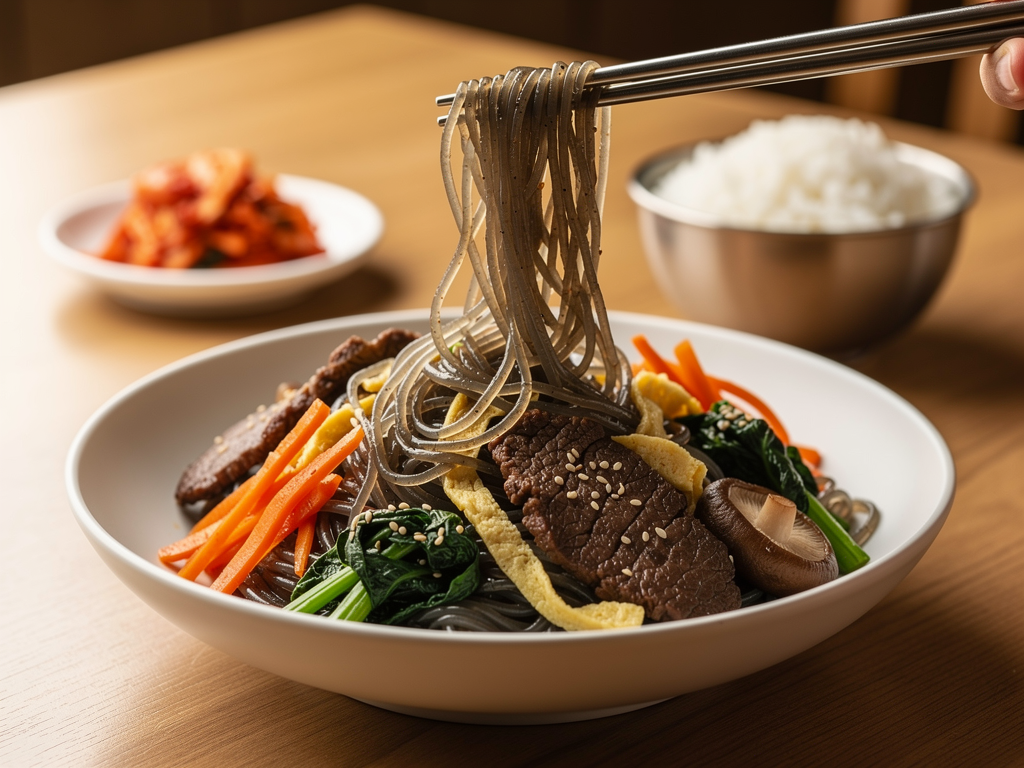
The encyclopaedia entry on japchae describes “a savory and slightly sweet dish of stir-fried glass noodles and vegetables”, where the noodle is dangmyeon, “cellophane noodles made from sweet potato starch”, and the seasoning is “soy sauce and sesame oil”. It “can be served warm, at room temperature, or cold”, and it works “as a banchan (side dish) or main course”.
So the honest one-line answer to japchae vs chow mein is: a wheat noodle eaten hot as a main versus a starch noodle eaten warm as a side or a main. Both are soy-seasoned, both come out of a wok, and — the encyclopaedia’s own detail — the japchae noodle was “introduced to Korea from China”. They are relatives that split on the flour.
Why does chow mein price the protein and japchae price the noodle?
Because in a chow mein the noodle is the base and the meat is the choice; in a japchae the noodle is the dish and the meat is a garnish.
The Great Wall — a British Chinese takeaway in Business Bay whose own ordering site says “The Great Wall Chinese Takeaway since 2020” and promises “Fresh Chow Mein, natural stocks and broths, no MSG” — prints the cleanest ladder in Dubai (read live, September 2026). Every line is “our Fresh Egg Noodles” with “Bean Sprouts and Spring Onion”, and only the protein moves the price: Plain Chow Mein AED 37, Mushroom 45, Vegetable and Tofu 45, Chicken 49, Beef 49, King Prawns 58, and a GREAT Special with beef, chicken and king prawns at 58.
The Korean menus print the opposite shape. The Korean Restaurant (Hanok) in International City prints “JAPCHAE — Stir-fried Sweet Potato Noodles and Vegetables — AED 50 (VEG/CHICKEN/BEEF)”, one price for three proteins, VAT included. Mukbang Shows prints Japchae at AED 55, one line. Manna Land prints “Sweet potato noodles stir fried in sesame oil with beef and vegetables” at AED 58, one line. Nobody offers a japchae ladder because the beef in a japchae is a few strips through the noodles, not the reason you ordered it.
The tell is on Hanok’s own menu: its Jjajangmyeon — the Korean-Chinese noodle — does ladder, at 45 veg, 50 chicken or beef, 53 seafood. The one Korean noodle that prices like chow mein is the one that came from China.
The three names of chow mein on UAE menus
Order the same wheat-noodle stir-fry in three Dubai kitchens and you will read three names. At The Great Wall it is “chow mein”. At Chowking, the Filipino-Chinese chain at Mall of the Emirates, it is “Chicken Hakka Noodles — stir-fried egg noodles with tender chicken, crisp vegetables, and savory sauces” at AED 42 (delivery-app price), and its party trays list “Chicken Hakka or Veg. Hakka Noodles”. At Little Lamb Mongolian HotPot & BBQ in Dubai Marina it is “Fried Beef Noodles — tender slices of marinated beef stir-fried with chewy noodles” at AED 42, or chicken and vegetable at AED 40.
Wikipedia explains the second name: Indian versions of chow mein use “soft boiled noodles”, and the “Hakka style” variants are “lightly fried” — the Indo-Chinese name travelled to the Gulf with the cooks. Japchae has no such problem. Every Korean menu read for this guide prints “japchae”, glossed once as “sweet potato noodles” and once as “glass noodles”, and the dish underneath is the same.
Japchae vs chow mein: what it costs in the UAE
Every figure below was read live in September 2026. Delivery-app prices are marked; The Great Wall’s are from its own ordering site; Hanok’s and Manna Land’s from their own menu pages.
| Venue | Dish | Price | How it is priced |
|---|---|---|---|
| The Great Wall, Business Bay | Chow mein | Plain 37 · Mushroom 45 · Veg & Tofu 45 · Chicken 49 · Beef 49 · King Prawns 58 · Special 58 | By the protein, one noodle |
| Chowking, Mall of the Emirates | Chicken Hakka Noodles | 42 (delivery-app) | Named by the protein |
| Little Lamb, Dubai Marina | Fried Beef / Chicken / Vegetable Noodles | 42 / 40 / 40 (delivery-app) | By the protein |
| Mukbang Shows, Dubai + Abu Dhabi (5 branches) | Japchae | 55 | One line |
| The Korean Restaurant (Hanok), International City | Japchae | 50 for veg, chicken or beef (VAT inclusive) | One price, three proteins |
| Manna Land, Satwa + Abu Dhabi | Japchae | 58 | One line |
Two things stand out. First, the chow mein column has a range and the japchae column has a number. Second, the cheapest plate on the page is a plain chow mein at AED 37 and the dearest is a japchae at AED 58 — but the AED 37 plate has no meat in it, and the AED 58 one has beef, mushrooms, vegetables and egg through every strand.
Which is cheaper, and which is the better solo plate?
For a solo main, chow mein. The Great Wall’s Chicken Chow Mein at AED 49 is a one-person hot dinner; a japchae at AED 50–58 is a sharing plate by design, and on a Korean table it usually sits beside a stew or a BBQ rather than replacing them. Our guide to Korean noodles in Dubai shows where japchae sits in that line-up.
For a table, the maths flips towards the fixed price. Three people sharing at Hanok pay AED 50 for a japchae with beef; three people each ordering a Beef Chow Mein pay AED 147. The Great Wall answers with its boxes — a Baby Bosh Meal “Serves 3-4” with a Chicken Chow Mein folded in at AED 288, and a Big John Bosh Meal “Serves 6-8” at AED 588 — which is chow mein behaving like a Korean set: one price for the table.
For a party, japchae, on history alone. Wikipedia calls it “one of the most popular traditional celebration dishes” at “weddings, birthdays, and holidays”, and the reason is practical: it holds at room temperature, so it can be made in bulk before the guests arrive. A chow mein wants the wok and the plate within minutes of each other.
Hot main or room-temperature side: the temperature difference
This is the difference a first-timer notices before the noodle. Chow mein arrives hot and slightly crisped at the edges, and is eaten as a main. Japchae arrives warm, or at room temperature, and is just as often a side — Wikipedia lists it “as a banchan (side dish) or main course”, over rice as japchae-bap.
The noodle explains it. Sweet-potato starch stays springy and glossy as it cools; a wheat-and-egg noodle goes soft. That is why japchae can sit on a banchan table for the length of a meal and why chow mein cannot, and it is also why the Korean plate is seasoned a little sweet — soy, sesame oil and a touch of sugar read better at room temperature than salt alone.
It also settles the gluten question that comes up in every japchae vs chow mein thread: the japchae noodle is starch, so it is naturally gluten-free, while chow mein is wheat, often with egg. Check the soy sauce with the kitchen if that matters to you; the noodle itself is not the problem.
Where the two dishes come from
Japchae is older than its own noodle. Wikipedia dates it to the early 17th century, when Yi Chung (1568–1619) made it for King Gwanghaegun’s palace banquet — and it was “cooked without noodles or meat at the time”, a vegetable dish for the court. The glass noodle arrived in the 20th century from China and turned a royal side into the party dish Koreans eat today.
Chow mein is a traveller’s dish. It left Guangdong with Taishanese emigrants, took an American spelling by 1903, split into soft and crispy styles in the United States, became “Hakka noodles” in India, and reached Dubai in all three forms — a British takeaway version, a Filipino chain’s Hakka version and a Chinese hot pot house’s “fried noodles”. Our Korean food vs Chinese food guide covers how much else in the Korean kitchen took the same road.
Is japchae vs chow mein halal in the UAE?
Mukbang Shows is 100% halal: beef and chicken only, no pork, no alcohol served, across all five branches, and its Japchae at AED 55 is on that menu. That is the plain answer for the Korean side.
On the Chinese side, The Great Wall’s listing prints chicken, beef, king prawns, duck and lamb; Chowking prints chicken and beef; Little Lamb prints lamb, beef and chicken. None of the three prints a pork line on the noodle dishes read for this guide — but that is what the menus print, not a certification, so confirm directly. Licence labels come only from Time Out: Time Out Dubai’s best Chinese restaurants list (April 2026) labels San Wan Hand-Pulled Noodles in JLT “Unlicensed” and calls it “one of the best budget restaurants in Dubai”; Time Out’s Korean list labels Manna Land’s Satwa branch “Unlicensed”. For every other venue here, ask.
Where Mukbang Shows fits, and where it doesn’t
Mukbang Shows prints Japchae at AED 55 as one line — sweet-potato-starch noodles and vegetables seasoned with soy and sesame — inside a full Korean noodle list: Jajangmyeon 55, Mulnaengmyun 55, Bibimguksu 48, Bokkeum Myeon 48–59. It is the only Korean kitchen in this comparison with five branches across Dubai and Abu Dhabi (Deira, JBR, DWTC; Muroor Road, Electra Street) and a halal guarantee on every line. Our guide to japchae in Dubai and our guide to japchae in Abu Dhabi place it against the other Korean kitchens.
Where it doesn’t fit: Mukbang serves no chow mein, no Hakka noodles and no wheat-and-egg stir-fried noodle of any kind. Its stir-fried noodle is japchae on starch, and its Bokkeum Myeon is a ramyeon-style stir-fry, so a diner who wants the springy egg-noodle crunch with bean sprouts should order a chow mein. A japchae is also more than a plain chow mein — AED 55 against AED 37 — and it is built to share, not to be one person’s hot dinner.
The one-paragraph answer
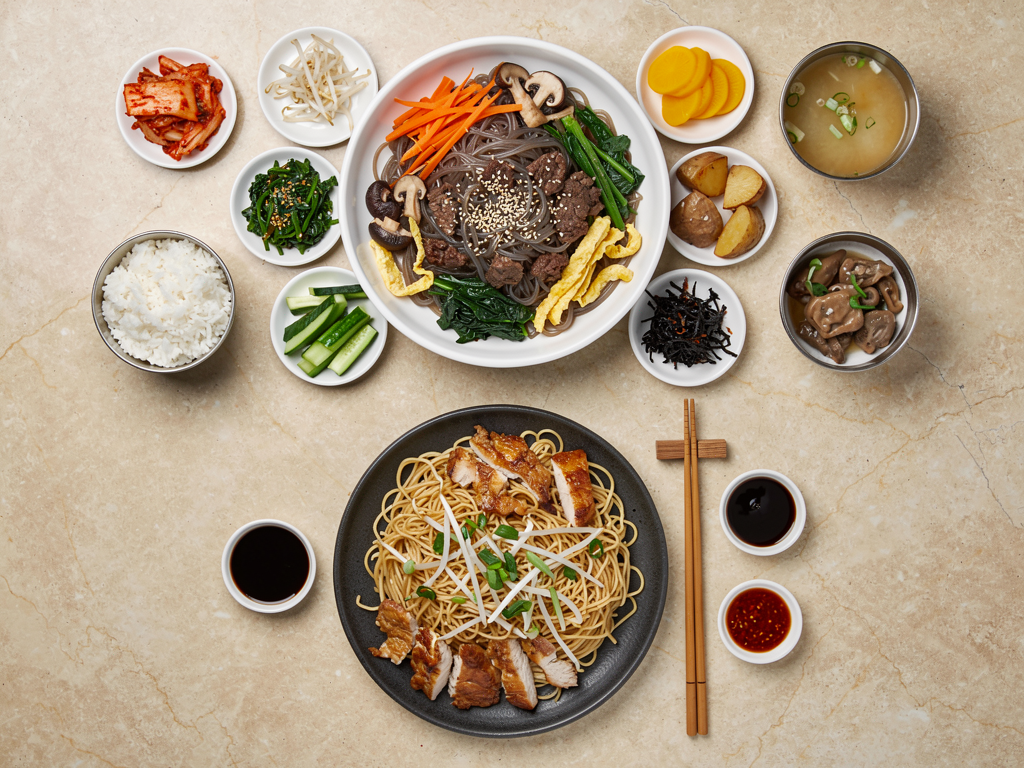
Chow mein is a hot wheat-and-egg noodle main whose price follows the protein — AED 37 plain to AED 58 with prawns at The Great Wall — and which goes by three names on Dubai menus. Japchae is a sweet-potato-starch glass noodle seasoned with soy and sesame, served warm or at room temperature as a side or a main, priced as one dish (AED 50–58) whatever goes in it, naturally gluten-free, and built for a table rather than a plate. Pick chow mein for a solo hot dinner; pick japchae — at Mukbang Shows, AED 55, halal — for a shared table and the noodle that survives the party.
FAQ
What is the main difference between japchae and chow mein?
The noodle. Chow mein is wheat-and-egg noodles stir-fried hot with bean sprouts and eaten as a main. Japchae is sweet-potato-starch glass noodles seasoned with soy and sesame oil, served warm or at room temperature as a side or a main.
Is japchae the same as chow mein?
No, though they are relatives: both are soy-seasoned stir-fried noodles and the japchae noodle was introduced to Korea from China. Chow mein is wheat; japchae is starch, which changes the texture, the temperature it is eaten at, and whether it contains gluten.
Which is cheaper in Dubai, japchae or chow mein?
Plate for plate, chow mein: The Great Wall prints a plain one at AED 37 and chicken or beef at AED 49, against japchae at AED 50–58. For a table sharing one plate, japchae’s fixed price wins — Hanok charges AED 50 whether it is veg, chicken or beef.
Is japchae gluten-free?
The noodle is: dangmyeon is sweet-potato starch. Check the soy sauce with the kitchen if you are coeliac. Chow mein is wheat, often with egg.
What are Hakka noodles?
Chow mein under its Indian-Chinese name. Wikipedia notes the Indian style uses soft boiled noodles and the Hakka style is lightly fried; in Dubai, Chowking prints Chicken Hakka Noodles at AED 42.
Can japchae be eaten cold?
Yes. Wikipedia says it can be served warm, at room temperature or cold, which is why it sits on a banchan table and at celebrations. Chow mein is eaten hot from the wok.
Does Mukbang Shows serve chow mein?
No. Mukbang serves japchae (AED 55) and a Korean noodle list — jajangmyeon, naengmyeon, bibimguksu, bokkeum myeon — but no wheat-and-egg chow mein or Hakka noodles. Mukbang is 100% halal: beef and chicken only, no alcohol.
Related guides
- Our Korean food vs Chinese food guide — the hub this comparison belongs to.
- Our japchae vs yakisoba comparison — the Japanese pair.
- Our japchae vs pad thai comparison — the Thai pair.
- Our guide to japchae — the dish on its own.
- Our Korean fried rice vs Chinese fried rice comparison — the other wok-versus-wok spoke.
Related guides
More from our Korean food guides across the UAE:
Comments are closed.