
Updated: September 2026
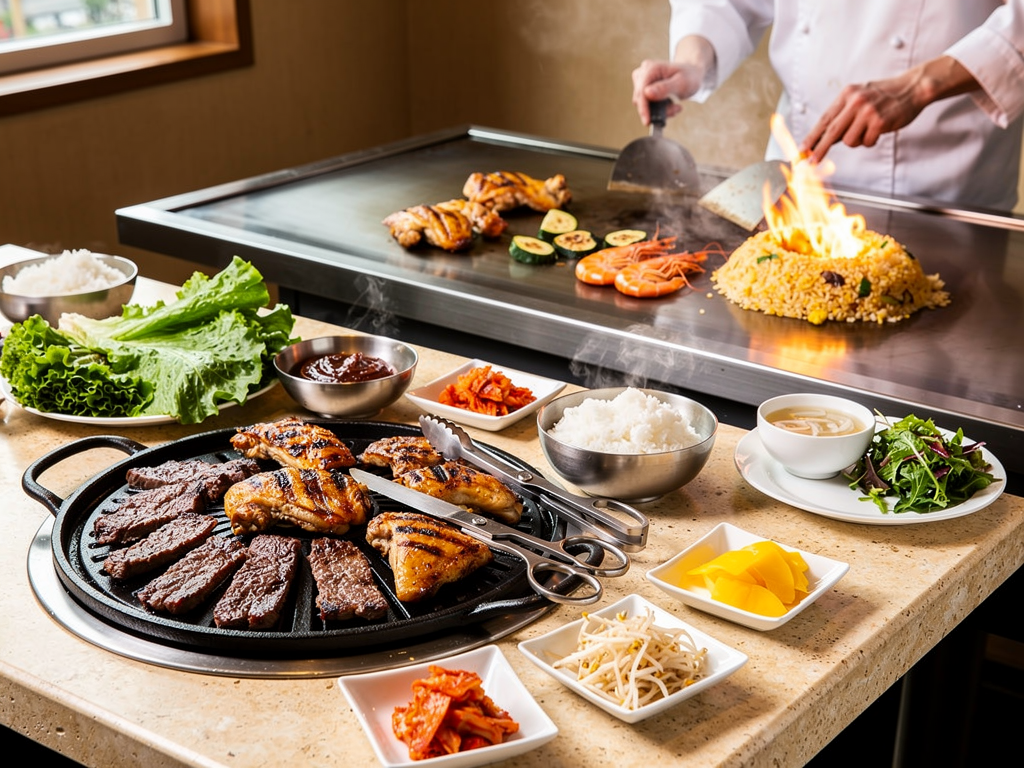
Korean BBQ vs teppanyaki comes down to two things you can read off a UAE menu: who does the cooking, and what the price counts. Korean BBQ is cooked by the diners on a grill in the table and sold by the head — Mukbang Shows prints AED 69 a person, unlimited, no gram anywhere. Teppanyaki is cooked by a chef on a flat iron plate and sold by the protein with the weight printed — Benihana JBR prints “200g chicken thigh” at AED 155, course included.
TL;DR
– Korean BBQ: you hold the tongs, marinated or plain meat over a grate, priced per head (AED 69–129 at Mukbang, unlimited, minimum two, sides inside).
– Teppanyaki: a chef holds the spatulas, plain protein cooked in oil on a solid plate, priced per protein with the gram printed (Benihana JBR AED 155–409) or as a set (AED 250–820).
– Same street, both cities: Benihana and Mukbang sit on The Walk in JBR, and a few streets apart in Al Zahiyah, Abu Dhabi. Hibachi is the American name for teppanyaki.
What is the difference between Korean BBQ and teppanyaki?
Teppanyaki is a chef-cooked course on a flat iron griddle, priced by the protein. Korean BBQ is a diner-cooked table over a grate, priced in the UAE by the head and served unlimited. Everything else — the surface, the seasoning, the sides, the maths — follows from those two facts.
The word teppan means iron plate and yaki means grilled. Wikipedia’s encyclopaedia entry on teppanyaki records that Misono in Kobe claims to have introduced the idea of cooking Western-influenced food on a teppan in 1945, and that the format “was less popular with the Japanese than it was with foreigners, who enjoyed both watching the skilled maneuvers of the chefs preparing the food and the cuisine itself”. Benihana opened its first restaurant in New York in 1964 and turned the chef’s show into the product; its own UAE menu calls the style “eatertainment”.
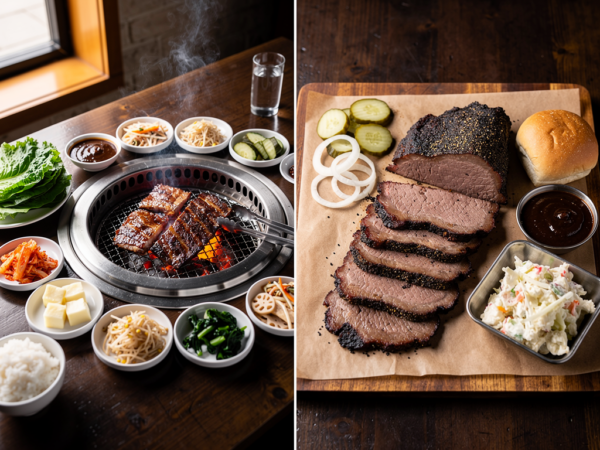
Korean barbecue runs the other way. The encyclopaedia entry on Korean barbecue describes meat grilled on “gas or charcoal grills built into the dining table itself”, marinated cuts such as bulgogi and galbi beside plain ones, wrapped in lettuce with ssamjang. Nobody performs. The table cooks, talks and eats at its own pace, and in the UAE the kitchen charges for the seat rather than the plate.
For the wider picture see our Korean food vs Japanese food guide. And do not confuse this page with our Korean BBQ vs yakiniku comparison: yakiniku is the Japanese grill where the diner cooks over a grate, the true cousin of Korean BBQ; teppanyaki is the one where a chef cooks on a flat plate.
Is teppanyaki the same as hibachi?
In the United States, yes — Americans call teppanyaki “hibachi”, and a search for hibachi vs Korean BBQ is asking exactly the question on this page. Strictly, a hibachi is a small Japanese grill with an open grate, not a solid griddle, so the American usage is a borrowed name for the wrong piece of kit.
The name has crossed the Gulf too. Benihana at the Beach Rotana in Abu Dhabi prints “hibachi prawn appetizer, hibachi zucchini” and “choice of hibachi or steamed rice” on its own menu. So when a UAE menu says hibachi it means the flat teppan and the chef, and when it says Korean BBQ it means a grate in your table and your own hands.
Who cooks, and on what surface?
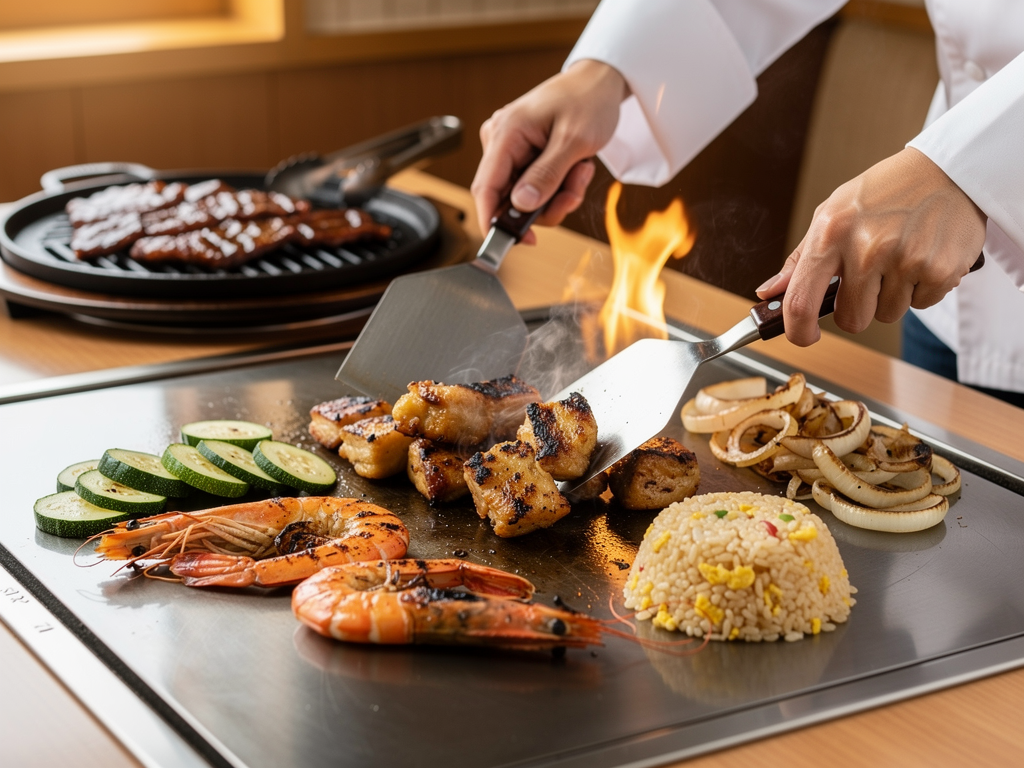
At teppanyaki one chef cooks the whole table’s food on one flat iron plate in soybean oil, seasons it on the plate and performs while doing it. At Korean BBQ each diner cooks over a grate or domed plate set into the table, and the staff only swap the plate when it needs changing.
The surface decides the flavour, and it is the real Korean BBQ vs teppanyaki split. A teppan is solid steel with no flame touching the food, so proteins sear evenly in oil and pick up no char from below; that is why teppanyaki menus are full of prawns, scallops, lobster and thick cuts that would fall through a grate. A Korean grill has open ridges over gas or charcoal, so marinated galbi and bulgogi caramelise where the marinade meets the heat, and fat drips away. Each Korean BBQ table sits under its own extractor hood because the meat is over direct heat; the teppan needs one hood for the whole counter.
The seasoning follows the surface. Teppanyaki protein goes on plain — Benihana JBR lists “200g black angus”, “200g chicken thigh”, “200g prawns” — and is seasoned as it cooks and dressed at the plate. Korean BBQ’s signature cuts are marinated before they reach the table: Mukbang’s LA Galbi and bulgogi arrive already soaked in soy, garlic and pear, and the work of the kitchen is folded into the per-head price.
That is the honest one-line difference: the teppan sells you a chef’s labour on a weighed plain cut; the Korean grill sells you a seat at a table where the marinade did the work in advance. Our Korean BBQ etiquette guide covers how to hold the tongs.
How is each one priced in the UAE?
Teppanyaki is priced by the protein, with the gram printed and a fixed course included; Korean BBQ is priced by the head, unlimited, with the sides included. Every number below was read from the venue’s own menu or a named published source in September 2026.
Benihana at Amwaj Rotana on The Walk, JBR, prints “ALL THE COMBOS 250G” across its teppanyaki page and a weight on every single protein. From the land: Tori Momoniku, 200g chicken thigh, AED 155; Angus Sirloin 200g AED 255; Angus Ribeye 200g AED 269; Angus Tenderloin 200g AED 289; Wagyu Striploin, 250g grade 9+, AED 409. From the sea: Ebi 200g prawns AED 209, Shake 200g Norwegian salmon AED 230, Hotate 200g scallops AED 245, Isi Ebi 800g Canadian lobster AED 425. Combos run from Benihana Delight (chicken breast, jumbo prawns) at AED 259 to Benihana Royal (black angus tenderloin, lobster tail) at AED 375.
Every teppanyaki dish “is served with soup, signature salad, grilled prawn & vegetables appetizers, choice of steamed rice or egg fried rice” and a dessert, and the menu states prices are inclusive of all fees, service charge and VAT.
Benihana at the Beach Rotana in Abu Dhabi prints the same shape without the gram. The Classics: Chicken AED 115, USDA Tenderloin AED 205, Australian Wagyu Sirloin AED 225, Australian Wagyu Rib Eye AED 245, Japanese Wagyu A3 Sirloin AED 365, A3 Rib Eye AED 375, Japanese Wagyu A5 Sirloin AED 395; lobster tail AED 215, prawns AED 115, black cod AED 180. Specialities that combine proteins run AED 205–290, each with the hibachi prawn appetiser, vegetables, onion soup, salad and rice.
Benihana Signature at Oaks Ibn Battuta Gate, which opened in August 2026, sells three fixed sets — Shiro AED 250 (chicken thigh, salmon), Midori AED 350, Kiiro AED 820 (lobster tail, Japanese A5 wagyu) — at published launch prices; confirm directly.
Mukbang Shows prints the head. Gangnam is AED 69 a person at Deira, Muroor Road and Electra Street and AED 79 at JBR and DWTC; Daegu 89 / 99; Jeju 99 / 109; Bukchon Hanok AED 129 everywhere. Every tier includes seven kinds of beef and chicken BBQ, eight banchan, two gimbap, soup and steamed rice, unlimited, minimum two people, with a AED 60 charge for meat left on the table. À la carte beef runs Brisket AED 95, Striploin 99, LA Galbi 109, Wagyu 115, Rib Eye and Tenderloin 119. No gram is printed anywhere.
The Korean Restaurant (Hanok) in International City gives the à la carte Korean line for comparison: Galbi Gui AED 115, Yachae Bulgogi AED 63, Daksal Bulgogi AED 56, VAT included. Our Korean BBQ price guide for Dubai tracks the full ladder.
Korean BBQ vs teppanyaki: the comparison table
| Venue | Format | Area | Verified price (AED) | What is inside the price | Licence / halal |
|---|---|---|---|---|---|
| Mukbang Shows | Korean BBQ, unlimited, diner-cooked | JBR, Deira, DWTC (Dubai); Muroor Road, Electra Street (Abu Dhabi) | 69 / 79 Gangnam · 89 / 99 Daegu · 99 / 109 Jeju · 129 Bukchon Hanok per person, min 2 | 7 beef and chicken BBQ kinds, 8 banchan, 2 gimbap, soup, rice; AED 60 leftover charge | 100% halal — beef and chicken only, no alcohol |
| Benihana, Amwaj Rotana | Teppanyaki, chef-cooked, gram printed | The Walk, JBR, Dubai | Chicken thigh 200g 155 · Angus Sirloin 200g 255 · Wagyu Striploin 250g 409 · combos 259–375 | Soup, salad, prawn and vegetable appetiser, rice, dessert | Licensed hotel venue (its own page prints cocktails, wines, beers) |
| Benihana, Beach Rotana | Teppanyaki, chef-cooked, no gram | Al Zahiyah, Abu Dhabi | Chicken 115 · USDA Tenderloin 205 · Australian Wagyu 225–245 · Japanese A5 Sirloin 395 · specialities 205–290 | Hibachi prawn appetiser, vegetables, onion soup, salad, rice | Licensed hotel venue (its own page prints sake and cocktails) |
| Benihana Signature | Teppanyaki sets | Oaks Ibn Battuta Gate, Sheikh Zayed Road, Dubai | Shiro 250 · Midori 350 · Kiiro 820 (launch prices) | Full set menu | Licensed by tbreak’s report; confirm directly |
| Izakaya, JW Marriott Marquis | Teppanyaki bar inside an izakaya | Business Bay, Dubai | Not printed by Time Out | — | Time Out: Licensed |
| Toshi, Grand Millennium | Japanese-led buffet with live stations | Barsha Heights, Dubai | Sushi & Beyond 149 per person with unlimited soft drinks, Thu–Sun | Buffet; confirm whether the teppan station is running | Licensed by its own site’s wording |
| The Korean Restaurant (Hanok) | Korean BBQ à la carte | International City, Dubai | Galbi Gui 115 · Yachae Bulgogi 63 · Daksal Bulgogi 56 | Sides with the dish, VAT inclusive | Confirm directly |
Two things stand out. First, only one Japanese-side venue sells a per-head unlimited format at all, and it is a buffet, not a teppan table. Second, the cheapest chef-cooked teppanyaki course in the country (Benihana Abu Dhabi’s chicken at AED 115) costs more than the most expensive unlimited Korean BBQ tier in the country (Mukbang’s Bukchon Hanok at AED 129) only once you add a second protein.
What comes with the meal on each side?
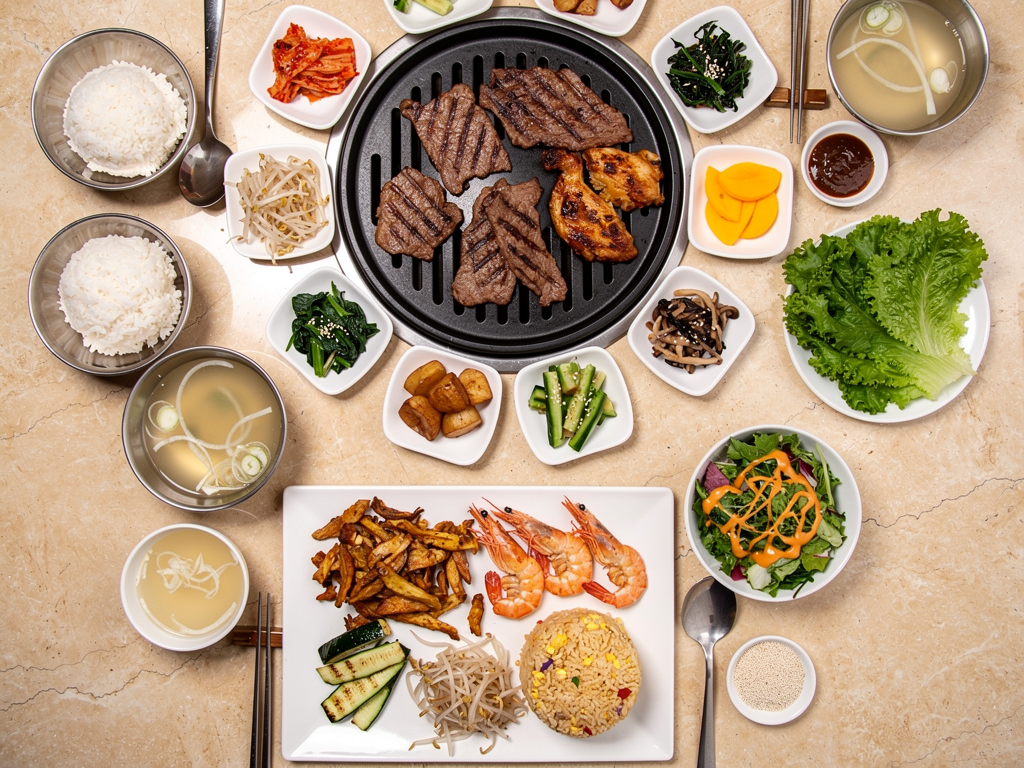
Both formats bundle the sides, but they bundle different things: teppanyaki fixes the course around one weighed protein, Korean BBQ fixes the sides around unlimited meat. At Benihana JBR the AED 155 chicken course brings soup, salad, a grilled prawn and vegetable appetiser, rice and dessert — one of each. At Mukbang the AED 69 seat brings eight banchan, two gimbap, soup and rice, and the beef and chicken keep coming until the table stops.
The extras show the difference. On the Benihana JBR menu edamame is AED 35, miso soup AED 35 and a Benihana Salad AED 39 as separate lines; in Abu Dhabi miso is AED 20 and edamame AED 35. At Mukbang the kimchi, namul and pickles are on the table before the meat and carry no line. The same logic runs through our Korean BBQ vs American BBQ comparison and our Korean BBQ vs Brazilian BBQ comparison: the Korean table prices the person, the other formats price the meat.
The table itself is different. Benihana JBR’s teppanyaki tables seat nine around one chef and are booked in sittings — 6–8pm, 8–10pm and 10pm–midnight per Rotana’s own booking listing — so a couple may share a chef with strangers. A Mukbang table is yours, minimum two, with no sitting printed; the only clause is AED 60 if meat is left uncooked and uneaten.
Which is better value for two, four or one?
For two or four people Korean BBQ is cheaper by a wide margin; for one person, or for lobster and A5 wagyu, teppanyaki is the only one that works. Two diners at Mukbang JBR on Gangnam spend AED 158 (AED 138 at Deira or in Abu Dhabi) for unlimited beef and chicken with everything inside. Two diners at Benihana JBR on the cheapest course — two Tori Momoniku chicken thighs — spend AED 310; two Angus Sirloins are AED 510; two Benihana Delight combos AED 518.
Four people at Mukbang Electra Street on Gangnam are AED 276. Four people at Benihana Abu Dhabi on the Chicken classic are AED 460, and on Australian Wagyu Sirloin AED 900. The gap widens as the protein climbs, because in Korean BBQ vs teppanyaki maths a teppanyaki bill is four weighed plates and a Korean bill is four seats.
Teppanyaki wins where Korean BBQ cannot go. Mukbang’s grill is beef and chicken; it has no lobster, scallops, black cod or salmon, no Japanese A5 sirloin and no chef. Benihana Abu Dhabi’s Japanese Wagyu A5 Sirloin at AED 395 and Benihana Signature’s Kiiro set at AED 820 are the ceiling of the format, and a solo diner can order one teppanyaki course where Mukbang’s unlimited needs two. Teppanyaki also has no leftover clause, because nothing on the plate is unlimited.
Is Korean BBQ halal, and are teppanyaki venues licensed?
Mukbang Shows is 100% halal: beef and chicken only, no pork, no alcohol served, at all five branches. None of the teppanyaki menus read for this page prints pork — Benihana JBR lists chicken, black angus, wagyu, prawns, salmon, scallops and lobster; Benihana Abu Dhabi lists chicken, Australian and Japanese wagyu, USDA tenderloin, lobster, prawns, seabass, salmon, scallops and black cod — but that is a fact about printed menus, not a halal ruling, so confirm directly.
On licensing the venues speak for themselves. Benihana JBR’s own Rotana page prints a Happy Hour on “Japanese cocktails, spirits, wines and beers priced from AED 36” and a wine-and-beer package on its Thursday sushi night. Benihana Abu Dhabi’s own page prints “a curated selection of sake and Japanese-inspired cocktails”. Benihana Signature’s launch coverage prints cocktails at AED 60 and sake from AED 175.
Time Out’s 2026 list of the best Japanese restaurants labels Izakaya “Licensed”. All are licensed hotel venues by their own or Time Out’s words. Our answer on whether Korean BBQ is halal covers the Korean side in full.
Where do the two formats sit side by side?
In both cities the head-to-head is a short walk. In Dubai, Mukbang Shows JBR is at Bahar 3 on The Walk and Benihana is inside Amwaj Rotana on the same Walk — you can read both menus in one evening without moving your car. In Abu Dhabi, Benihana is at the Beach Rotana on 10th Street in Al Zahiyah and Mukbang Electra Street is on Zayed The First Street behind Sun and Sand Sports, a few streets away.
The rest of the map: Mukbang Deira on Al Ittihad Road, Mukbang DWTC on Sheikh Zayed Road opposite World Trade Centre metro, and Mukbang Muroor Road in Al Danah; Benihana Signature beside Ibn Battuta Mall; Izakaya in Business Bay; Toshi in Barsha Heights; Hanok in International City. Our Korean BBQ vs mixed grill comparison is the Arabic-side version of this page.
Mukbang Shows: the Korean side, with one honest limit
Mukbang Shows is the Korean format in its purest UAE form: a per-head price from AED 69, a grill in the table, the diner cooking, seven kinds of beef and chicken BBQ including marinated LA galbi and bulgogi, eight banchan, two gimbap, soup and rice inside the price, minimum two, AED 60 for leftovers, and no gram printed anywhere. Five branches: Deira (+971-4-886-4494), JBR (+971-54-523-1898), DWTC (+971-54-524-5904), Muroor Road (+971-50-158-9433) and Electra Street (+971-2-564-0446). Everything on the menu is halal and every drink is non-alcoholic.
The honest limit: Mukbang is not a teppanyaki house and does not pretend to be one. There is no chef at your table, no knife show, no flat iron plate, no lobster, scallops or black cod, no Japanese A5 sirloin, and no plate priced by the gram. A diner who wants to sit back and be cooked for, or who wants seafood on the teppan, should book Benihana and budget AED 155 to AED 409 a head in JBR or AED 115 to AED 395 in Abu Dhabi.
What Mukbang wins is the price per head with everything inside, marinated beef and chicken you cook at your own pace, a table that is yours rather than a nine-seat sitting, and halal certainty across the whole menu.
Korean BBQ vs teppanyaki: how to choose
Choose by who you want holding the spatula. If the evening is a show — a birthday, a first-time visitor, a couple who would rather watch than cook — book a teppan table and pick the protein by the gram. If the evening is the table — a group that wants to talk, grill and keep going — book Korean BBQ and pay by the head.
Then check the three practical lines: minimum two at Mukbang against one course for one at Benihana; a sitting window at the teppan against no clock at the Korean grill; and AED 60 for meat left at Mukbang against nothing to waste at teppanyaki. Korean BBQ vs teppanyaki is not a question of which is better. One sells a chef’s labour on a plain, weighed cut; the other sells a seat at a grill where the marinade already did the work.
FAQ
Is teppanyaki the same as hibachi?
In American usage yes — hibachi is the US name for the chef-cooked flat-top. Strictly a hibachi is a small open-grate grill. Benihana’s own Abu Dhabi menu prints “hibachi” for its appetisers and rice.
Which is cheaper in the UAE, Korean BBQ or teppanyaki?
Korean BBQ. Mukbang Shows is AED 69–129 a head, unlimited, sides inside. The cheapest teppanyaki course read is Benihana Abu Dhabi’s chicken at AED 115, and Benihana JBR runs AED 155–409 per protein.
Can one person eat Korean BBQ or teppanyaki alone?
Teppanyaki yes — one course can be ordered for one. Mukbang’s unlimited Korean BBQ needs a minimum of two people.
Does the teppanyaki price include sides?
Yes. Benihana JBR’s teppanyaki dishes come with soup, salad, a grilled prawn and vegetable appetiser, rice and dessert; the Abu Dhabi classics come with a hibachi prawn appetiser, vegetables, onion soup, salad and rice.
Does Korean BBQ include sides?
Yes. Every Mukbang tier includes eight banchan, two gimbap, soup and steamed rice with the unlimited beef and chicken.
Is Korean BBQ halal in the UAE?
Mukbang Shows is 100% halal: beef and chicken only, no pork, no alcohol. Teppanyaki venues named here are licensed hotel restaurants by their own wording; none of their menus prints pork, but confirm directly.
Where can I compare both on the same night?
On The Walk in JBR (Mukbang at Bahar 3, Benihana inside Amwaj Rotana) and in Al Zahiyah, Abu Dhabi (Mukbang Electra Street and Benihana at the Beach Rotana), a few streets apart.
Comments are closed.