Updated: September 2026
Korean BBQ vs yakiniku comes down to two things you can read off a UAE menu: who seasons the meat and when, and what the price is counting. Korean BBQ marinates before the grill and is sold by the head — Mukbang Shows prints AED 69 a person, unlimited, no gram anywhere. Yakiniku grills the meat plain and dips it after, and is sold by the plate with the weight printed — Samurai in Abu Dhabi prints “Beef Karubi 150 Gm” at AED 103. Same short rib, two opposite menus.
TL;DR
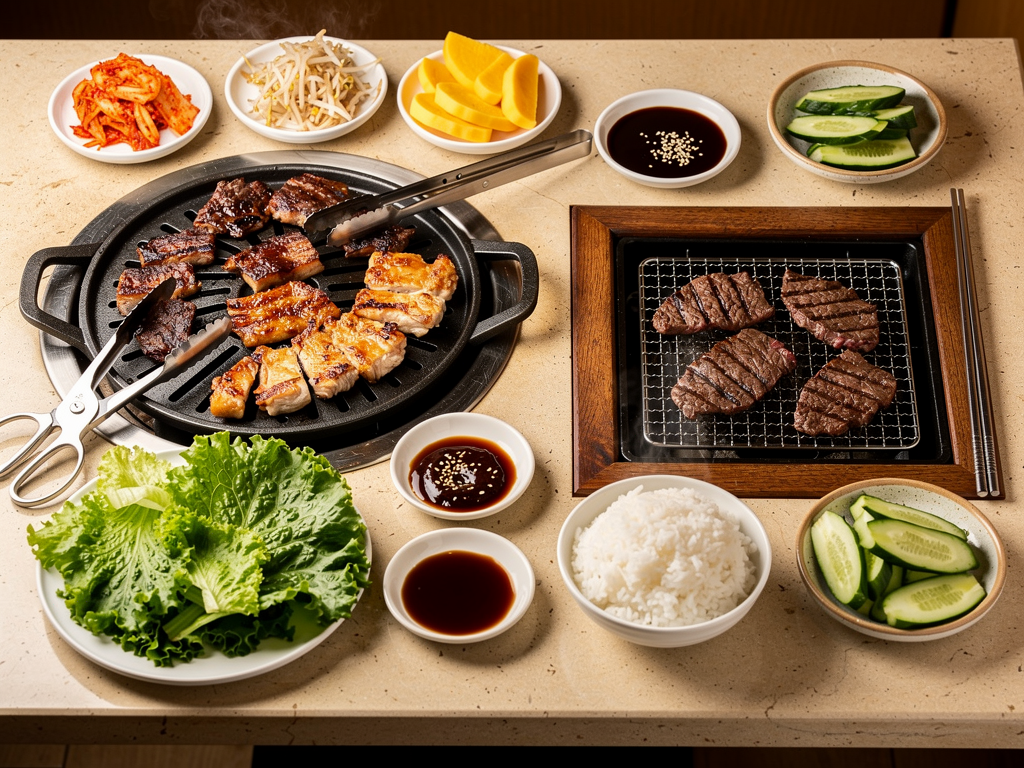
– Korean: marinated first, wrapped in lettuce after, priced per head (AED 69–129, unlimited, minimum two, banchan and rice inside).
– Yakiniku: plain or salted on the grill, dipped in tare after, priced by the gram (Samurai: 130–200 g plates at AED 89–150) or as a chef’s set (Akabeko: AED 450–950 a head).
– The two are cousins: yakiniku restaurants were opened “around 1945 by Koreans in Japan”, and karubi is the Japanese spelling of galbi.
– Korean wins on price per head with everything included; yakiniku wins on the A5 wagyu ceiling and on solo dining.
What is the difference between Korean BBQ and yakiniku?
The order of operations. In Korean BBQ the kitchen seasons the meat before it reaches the table: bulgogi and galbi sit in a soy, pear and garlic marinade, the diner grills them, and the cooked piece goes into a lettuce leaf with ssamjang. The encyclopaedia entry on Korean barbecue describes “grilling meat, typically beef, pork or chicken” on “gas or charcoal grills built into the dining table itself”, with marinated cuts alongside plain ones.
In yakiniku the meat goes on the grill plain or lightly salted, and the seasoning happens after, in a dipping dish. The encyclopaedia entry on yakiniku gives the standard tare as “soy sauce mixed with sake, mirin, sugar, garlic, fruit juice and sesame”. The word itself is literally “grilled meat” — yakiniku is what most Dubai menus and most searches mean by Japanese BBQ: “bite-size meat (usually beef and offal) and vegetables” cooked at the table “over charcoal or gas flames”.
So the honest one-line answer to korean bbq vs yakiniku is: Korea seasons before and wraps after; Japan salts before and dips after. Everything else on this page — the price shape, the side dishes, who holds the tongs — follows from that.
Are Korean BBQ and yakiniku related?
Closely. The same encyclopaedia entry says the present yakiniku style “became widespread in Japan during the 20th century, most notably after the Second World War”, with restaurants opened “around 1945 by Koreans in Japan”, and that the name yakiniku only became standard “in the latter half of the 1960s” as a neutral term when the division of the Korean peninsula split the Korean community in Japan.
The cuts carry the history. Wikipedia lists the common yakiniku cuts as “karubi (short ribs, derived from Korean galbi), harami (diaphragm), rosu (loin) and tan (tongue)”. Karubi is galbi. On a UAE menu you can see it in two alphabets: Samurai Japanese Restaurant in Abu Dhabi prints “Beef Karubi 150 Gm — High grade, marble beef” at AED 103; Mukbang Shows prints LA Galbi at AED 109 à la carte and puts it on the grill inside its unlimited tiers. Our guide to galbi covers the cut itself.
One more family trace: Kimura-ya’s Dubai menu, a Japanese hotel izakaya, prints a “Yukhoejang Soup — spicy wagyu soup” at AED 32. Yukgaejang is Korean. The two kitchens have been borrowing from each other for eighty years, and the UAE menus still show it.
Why does yakiniku print the gram and Korean BBQ print the head?
Because a plain cut of beef is priced by what it weighs, and a marinated, unlimited table is priced by who is sitting at it.
Every yakiniku line on Samurai’s Abu Dhabi menu (read live on Talabat, September 2026, list prices with a 30 percent promotion running) carries a weight: Wagyu Yakiniku 130 g at AED 150; Beef Karubi 150 g at AED 103; Jyo Rosu 150 g at AED 94; Rosu 150 g at AED 89; Mix Beef Yakiniku 180 g (“karubi, jyo rosu, rosu and vegetables”) at AED 116; Samurai Yakiniku 200 g (“chicken, beef and lamb chop”) at AED 121; Ebi Yakiniku 200 g at AED 71. The restaurant’s own site says it has been “offering delicious Sushi and Yakiniku Japanese grills” in Abu Dhabi since 2005.
At the top of the market the unit changes from the gram to the course. Akabeko at voco Dubai The Palm — Time Out Dubai’s review of Akabeko calls it “the first Japanese A5 wagyu-focused yakiniku experience in the city” — sells published sets at AED 450 (6 courses), AED 700 (10) and AED 950 (12) a head, plus a AED 160 business lunch. Those are published prices from review coverage; confirm directly.
No Korean BBQ menu read for this guide prints a gram on its unlimited tiers. Mukbang Shows prints Gangnam AED 69 (Deira, Muroor Road, Electra Street) or 79 (JBR, DWTC), Daegu 89/99, Jeju 99/109 and Bukchon Hanok 129 everywhere — per person, minimum two, seven kinds of beef and chicken BBQ, eight banchan, two gimbap, soup and rice inside, AED 60 charged for leftovers. Our Korean BBQ price guide for Dubai has the full ladder.
Korean BBQ vs yakiniku: what it costs in the UAE
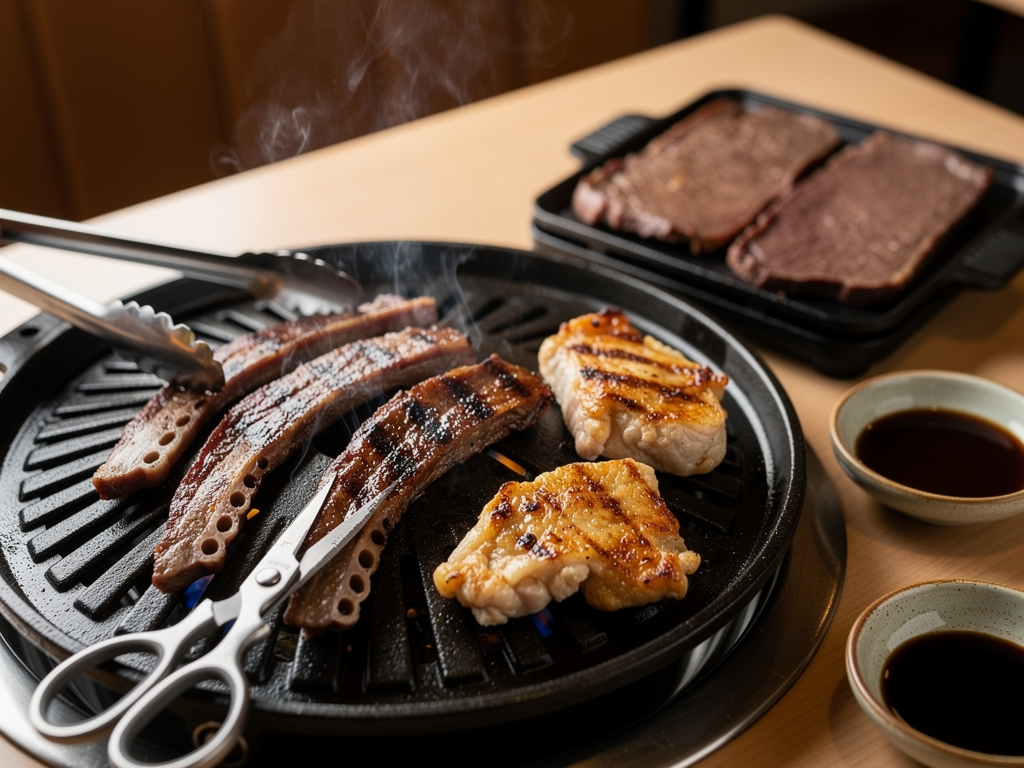
Every figure below was read live in September 2026. Delivery-app prices are marked; Akabeko’s are published set prices; Sumibiya’s are deal-site prices.
| Venue | Format | What you pay | Sides and rice | Who grills |
|---|---|---|---|---|
| Mukbang Shows, Dubai + Abu Dhabi (5 branches) | Korean, unlimited | AED 69 / 79 / 89 / 99 / 109 / 129 per person, min 2 | 8 banchan, 2 gimbap, soup, rice inside | You |
| The Korean Restaurant (Hanok), International City | Korean, à la carte | Galbi Gui 115 · Yachae Bulgogi 63 · Daksal Bulgogi 56 (VAT inclusive) | Priced separately | You |
| Samurai Japanese Restaurant, Abu Dhabi | Yakiniku, by the gram | Wagyu 130 g 150 · Karubi 150 g 103 · Rosu 150 g 89 · Mix 180 g 116 (delivery-app list prices) | Kimuchi 30 · Gohan 16 · Potato Salad 30 | You |
| Kimura-ya, four Dubai hotels | Yakiniku as a dish | Wagyu Yakiniku Don 154 · A5 Wagyu Yakiniku Bento 180 (delivery-app); unlimited BBQ format named, price not printed | Gohan 15 · Potato Salad 35 | Kitchen (dishes) |
| Akabeko, voco Dubai The Palm | Yakiniku, chef’s set | AED 450 / 700 / 950 per person; lunch 160 (published, confirm) | Inside the set | Staff, at your table |
| Sumibiya, Radisson Blu Deira Creek | “Yakiniku-style” Korean table | AED 99 with soft drinks / 199 with house beverages (deal-site, confirm) | Inside the package | You |
Two things stand out. First, the Korean side never prints a weight and the yakiniku side never prints a head — the two formats are not measuring the same thing. Second, sides move columns: on the Korean tier they are inside the price; on the yakiniku menu kimchi is a AED 30 line and rice is AED 15–16.
Korean BBQ vs yakiniku: which is cheaper for one, for two, and for a table?
For one person, yakiniku, because Korean unlimited needs two. Samurai prints a Yakiniku Bento (grilled beef) at AED 85 and a Yakiniku and Takoyaki Bento with rice and kimchi salad at AED 69; Kimura-ya prints its A5 Wagyu Yakiniku Bento at AED 180. Mukbang’s unlimited tiers are minimum two.
For two, Korean. Two seats at Mukbang’s Gangnam Value tier are AED 138 with meat, eight banchan, two gimbap, soup and rice on the table. Two diners at Samurai sharing a Mix Beef Yakiniku (180 g, AED 116) and a Wagyu Yakiniku (130 g, AED 150) with two rice (AED 32) have spent AED 298 for 310 g of beef. Two Akabeko Sets are AED 900.
For a long table the gap widens the same way, because the Korean number is flat — AED 276 for four, AED 552 for eight at AED 69 — and the yakiniku number climbs with every plate. Where yakiniku wins is the ceiling: an A5 tasting set with a chef explaining each cut is something no Korean unlimited room offers, and Akabeko charges accordingly.
The side dish, the rice and the tongs
Side dishes are where the two menus disagree most visibly. At Mukbang, eight banchan, two gimbap, soup and rice are inside every per-head tier. At Samurai, “Kimuchi — Spicy chinese cabbage” is AED 30, Gohan AED 16 and Potato Salad AED 30. At Kimura-ya, rice is AED 15, potato salad AED 35, and kimchi appears inside the AED 180 A5 Wagyu Yakiniku Bento rather than on its own line. Korean BBQ treats the side as part of the seat; yakiniku treats it as an order.
The tongs follow the money. At Mukbang, Sumibiya and Samurai the diner grills. At Akabeko the staff do: Time Out writes that “food is grilled by the experts at your table” and that the moriawase brings “five chef’s cuts” with “each piece of meat explained carefully”. That service is part of what AED 450 a head buys. Our Korean BBQ etiquette guide covers what is expected when the tongs are yours.
Smoke is the last practical difference, and it is a Japanese invention. Wikipedia dates the ventilated smokeless roaster to Shinpo Co., Ltd. in March 1980, and Akabeko’s launch coverage promises “smokeless grills, imported directly from Japan”.
The venue that sits on the fence
One Dubai restaurant makes the whole korean bbq vs yakiniku argument for you. Sumibiya, inside the Radisson Blu Hotel Dubai Deira Creek on Baniyas Road, describes itself on its own hotel page as “our yakiniku-style restaurant, which offers an authentic Korean dining experience in Deira”, where guests “grill seafood, meat, or vegetables at their own tables in booths” and eat “traditional favorites like marinated beef and kimchi, along with beers and wine”.
That is both formats in one sentence: a yakiniku-style grill, Korean marinated beef and kimchi, and an unlimited-style package. Its prices are not on the hotel page; deal sites list it at AED 99 a head with soft drinks or AED 199 with house beverages, with children from AED 79. It is a licensed hotel venue by its own words, so confirm the package and the menu directly.
Sumibiya proves the point of this page: the two formats are one family that split on seasoning and pricing, not on the grill.
Is Korean BBQ vs yakiniku halal in the UAE?
Mukbang Shows is 100% halal: beef and chicken only, no pork, no alcohol served, across all five branches. That is the plain answer for the Korean side, and our answer on whether Korean BBQ is halal covers the wider question.
Yakiniku in Japan is “usually beef and offal”, and none of the UAE yakiniku menus read for this guide prints pork: Samurai prints beef, wagyu, chicken, lamb chop, prawn and cuttlefish; Kimura-ya’s Marina listing prints wagyu, chicken, eel and fish; Akabeko’s coverage prints only wagyu. That is a fact about printed menus, not a certification — confirm directly with each venue.
Licensing is the clearer line. Sumibiya’s own page prints “beers and wine”; Kimura-ya’s own site prints “premium sakes, shochu and Japanese whiskeys”. Both are licensed hotel venues by their own words. Akabeko sits inside voco Dubai The Palm and Samurai’s branches are standalone; neither page read prints a licence line, so confirm directly. A diner who wants zero alcohol on the premises has one sure option in this comparison, and it is the Korean one.
Where Mukbang Shows fits, and where it doesn’t
Mukbang Shows is the Korean format in its purest UAE form: a per-head price from AED 69, a grill in the table, seven kinds of beef and chicken BBQ including marinated galbi and bulgogi, eight banchan, two gimbap, soup and rice inside the price, minimum two, AED 60 for leftovers, no gram printed anywhere. Its LA Galbi at AED 109 à la carte is the same short rib a yakiniku menu calls karubi, marinated instead of salted. Five branches: Deira, JBR and DWTC in Dubai; Muroor Road and Electra Street in Abu Dhabi.
Where it doesn’t fit: Mukbang is not a yakiniku house and does not pretend to be one. There is no A5 Japanese wagyu tasting set, no chef grilling at your table, no tongue, no offal, no tare station and no plate priced by the gram. A diner who wants the ceiling should book Akabeko and budget AED 450 a head. A solo diner cannot book a Mukbang unlimited table at all, where Samurai prints a bento for one at AED 69–85.
The one-paragraph answer
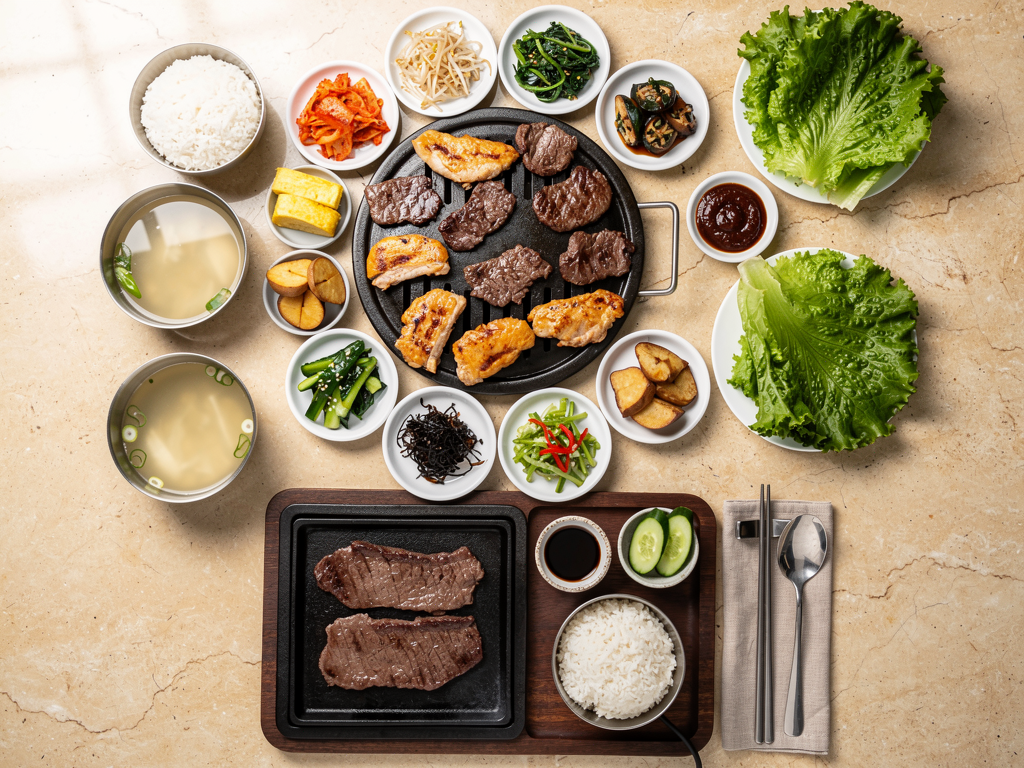
Korean BBQ seasons the meat before the grill and sells you a seat: AED 69–129 a head at Mukbang Shows, unlimited, with banchan and rice inside, and you hold the tongs. Yakiniku salts the meat, dips it after in tare, and sells you the meat itself: by the gram at Samurai in Abu Dhabi (karubi 150 g for AED 103) or as a chef-grilled A5 set at Akabeko on the Palm (AED 450–950). They are cousins — yakiniku was built by Koreans in Japan after 1945, and karubi is galbi — so pick by the question: a long table on a fixed budget with halal certainty, or the wagyu ceiling for one or two.
FAQ
What is the main difference between Korean BBQ and yakiniku?
Seasoning order and pricing. Korean BBQ marinates the meat before grilling and wraps it in lettuce with ssamjang after, and in the UAE it is sold by the head, unlimited. Yakiniku grills plain or salted meat and dips it in a soy-based tare after, and it is sold by the plate with the weight printed or as a chef’s tasting set.
Is yakiniku Korean or Japanese?
Japanese, with Korean roots. The present style spread in Japan after 1945 in restaurants opened by Koreans living there, and the name became standard in the late 1960s. Its main cut, karubi, is the Japanese spelling of the Korean galbi.
Which is cheaper in the UAE, Korean BBQ or yakiniku?
For two or more, Korean: Mukbang is AED 69 a head with meat, banchan, gimbap, soup and rice inside, so AED 138 for two against roughly AED 298 for two sharing Samurai’s mix and wagyu plates with rice. For one person, yakiniku: Samurai’s bentos are AED 69–85 and Korean unlimited needs two.
Do you grill your own meat at yakiniku?
Usually yes. At Samurai and at Sumibiya the diner grills, as at Korean BBQ. Akabeko is the exception: its staff grill the wagyu at your table and explain each cut, which is part of the set price.
Is yakiniku halal in the UAE?
None of the yakiniku menus read for this guide prints pork — Samurai prints beef, wagyu, chicken, lamb, prawn and cuttlefish — but that is what the menus print, not a certification, so confirm directly. Sumibiya and Kimura-ya are licensed hotel venues by their own pages. Mukbang Shows is 100% halal: beef and chicken only, no alcohol.
What is karubi?
Beef short rib on a yakiniku menu. The word is derived from the Korean galbi. Samurai prints Beef Karubi 150 g at AED 103, unmarinated; Mukbang prints LA Galbi at AED 109, marinated, and grills it inside its unlimited tiers.
Does yakiniku come with side dishes?
Only as paid lines. Samurai prints kimchi at AED 30 and rice at AED 16; Kimura-ya prints rice at AED 15 and potato salad at AED 35. Korean BBQ puts eight banchan, two gimbap, soup and rice inside every Mukbang seat.
Related guides
- Our Korean food vs Japanese food guide — the hub this comparison belongs to.
- Our Korean BBQ vs American BBQ comparison — the gram versus the head, smokehouse edition.
- Our Korean BBQ vs Brazilian BBQ comparison — the other unlimited grill format.
- Our Korean BBQ vs mixed grill comparison — the Arabic grill, and the lamb question.
Related guides
More from our Korean food guides across the UAE: