
Updated: August 2026
Korean fried rice vs chinese fried rice is not a rivalry — it is a family tree. Restaurant fried rice in Korea largely descends from Korean-Chinese cooking brought to Incheon by immigrants from Shandong. The differences that matter are aged kimchi and sesame oil versus soy, garlic and wok heat, and where each plate sits in the meal.
TL;DR – Sour, fermented, sesame-finished, egg on top: Korean bokkeum-bap – Savoury, soy-and-garlic, wok-charred, egg scrambled through: Chinese fried rice – They are related: Korea’s restaurant fried rice grew out of Korean-Chinese (junghwa yori) kitchens – Both are leftover cookery: day-old rice is the specification in each tradition, not a shortcut – UAE prices published only on the Korean side: from AED 38 at Hanok, AED 45–51 at Mukbang Shows
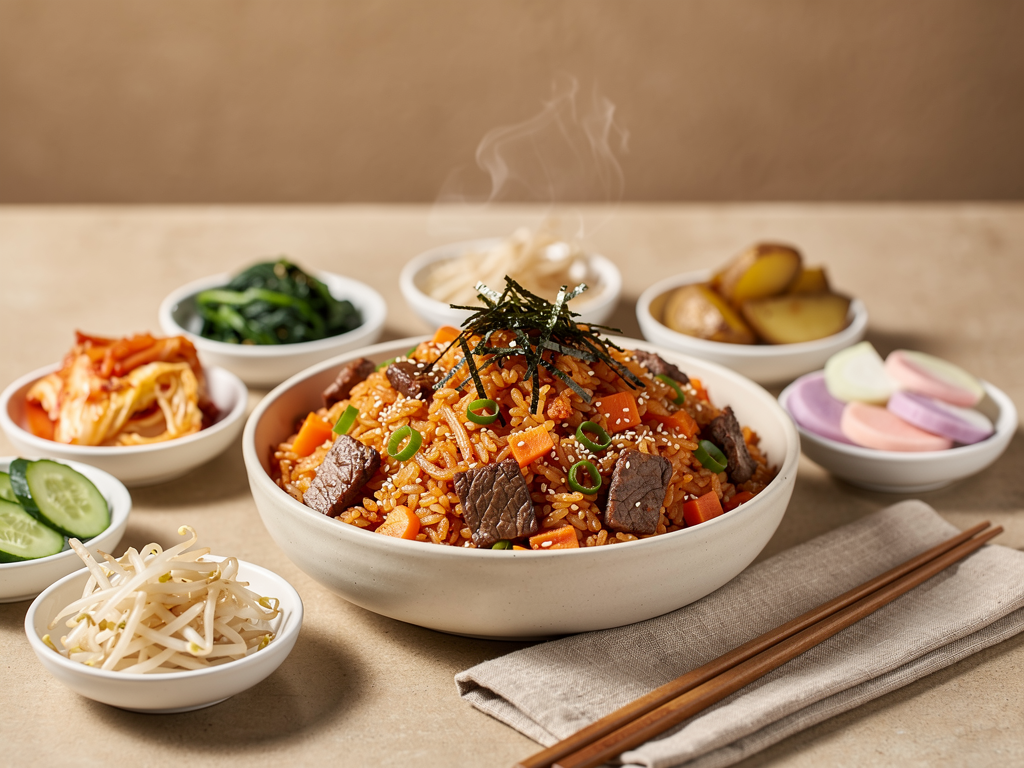
Korean fried rice vs Chinese fried rice: what is the actual difference?
Seasoning, fat, egg, rice, sides and timing. Korean bokkeum-bap is driven by aged kimchi, its brine and gochugaru, finished with sesame oil, usually crowned with a whole egg and eaten with banchan — often as the last course of a meal. Chinese fried rice is driven by soy sauce, garlic and wok hei, cooked in neutral oil, with the egg scrambled through it, and it stands alone as a plate.
Everything else people argue about follows from those six. Nobody needs a verdict on which is “better” — you need to know which one you are about to order, because they solve different problems at different points in a meal.
Why is Korean fried rice on a Korean-Chinese menu?
Because that is where it comes from. Korean Chinese cuisine — junghwa yori — is a hybrid tradition developed by ethnic Chinese in Korea, emerging in the 19th century in the port city of Incheon where most of them settled. Its cooking derives mainly from northern and northeastern China, especially Shandong, where most early Chinese immigrants to Korea came from. Its three signature dishes are jajangmyeon, jjamppong and tangsuyuk, the last a Korean adaptation of Cantonese sweet-and-sour meat. The history of Korean Chinese cuisine in Incheon is worth reading once if you eat at Korean restaurants often.
Alongside those three, Korean menus carry a distinct Korean-Chinese fried rice style — junggukjip bokkeum-bap — cooked in a wok over high heat, sometimes using the sweet bean sauce from jjajangmyeon. It is a different dish from the home-kitchen kimchi version, cooked with different technique, and it is the one most restaurant fried rice in Korea descends from.
You can see the whole argument printed on a menu in Abu Dhabi. Madang Korean Restaurant, on the ground floor of the Holiday Inn on 31st Dhafeer Street in Al Sa’adah, files its Kimchi Fried Rice, its Vegetable or Beef Fried Rice and its Omelet Fried Rice under a Korean-Chinese heading, sitting beside jjajangmyeon, jjamppong, tangsuyuk and kkanpunggi. That is honest menu architecture and it is rarer than it should be. Phone +971 2 585 5441; daily noon to midnight, last orders 10:30pm.
Did both dishes really start as leftovers?
Yes, independently and for the same reason. Chinese fried rice is documented as far back as the Sui dynasty (589–618 CE), with the technique becoming widely popular in the late Ming (1368–1644 CE), and it emerged as a way to use leftovers — yesterday’s rice, meat and vegetables turned into a seasoned stir-fry. Leftover rice remains standard because the lower moisture gives a better result.
Kimchi bokkeum-bap has the same logic from the other end of the kitchen. It exists to use up kimchi that has over-fermented past the point of eating raw, together with cold rice that would otherwise be wasted. The sourness is the specification, not a defect.
Which gives you the single most useful rule for ordering either dish anywhere in the world, including the UAE: day-old, cooled rice is not a shortcut, it is the recipe. Fresh hot rice has too much water in it. It steams instead of frying, the grains clump, and you get a wet plate in both cuisines. If a plate arrives glossy and sticking together, that is what happened.
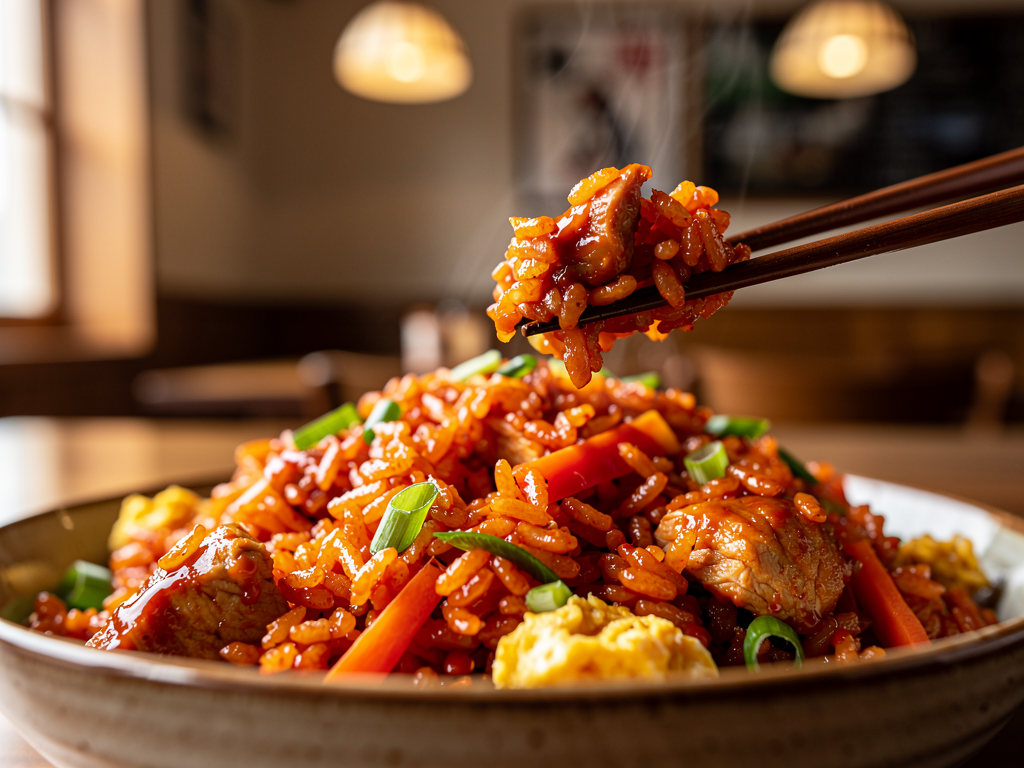
What are the six differences that actually change the plate?
| Korean fried rice (bokkeum-bap) | Chinese fried rice | |
|---|---|---|
| Seasoning engine | Aged kimchi, its brine, gochugaru; sometimes gochujang | Soy sauce, garlic, and wok hei — the smoke the wok itself contributes |
| Finishing fat | Sesame oil stirred in at the end, so the aroma stays bright | Neutral oil carrying the heat throughout, so the rice takes char |
| The egg | Usually a whole fried or half-boiled egg on top, broken through at the table | Scrambled through the rice early, so it is in every mouthful |
| The rice | Short-grain, slightly sticky, needs cooling to separate | Long-grain, separates more readily under hard stirring |
| What comes with it | Banchan, often a soup; part of a spread | Usually the plate on its own |
| When it is eaten | Frequently the last course, fried into the pan you already cooked in | Ordered and cooked as a standalone dish from the start |
The last row is the one people underestimate. In Korean service the rice closes the meal, and the residue in the pan from the stew or the grill is the seasoning — which is why the dish is often described as an end-of-meal add-on after tabletop cooking. There is no equivalent requirement in Chinese fried rice, which is cooked in a clean wok to order.
The seasoning row explains the taste gap. One dish gets sour, funky and slightly effervescent from fermentation. The other gets savoury, smoky and dry from heat and soy. Two plates of stir-fried rice, two completely different flavour engines. The background on Chinese fried rice and its regional styles covers the Yangzhou, Hokkien and Sichuan branches — the last using doubanjiang chilli bean paste, which is the only Chinese style that arrives with heat comparable to a kimchi plate.
What is Korean fried rice (볶음밥)?
Bokkeum-bap is cooked rice stir-fried in oil with other ingredients, named on menus by whatever goes in: kimchi-bokkeum-bap, saeu (shrimp), yachae (vegetable), beoseot (mushroom). Characteristic seasonings are gimgaru — toasted seaweed flakes — and sesame oil. The record on bokkeum-bap and its named varieties also lists two restaurant styles worth knowing.
The first is junggukjip bokkeum-bap, the Korean-Chinese wok version described above. The second is cheolpan-bokkeum-bap, cooked on an iron griddle, a style showing Japanese teppanyaki influence. So “Korean fried rice” on a UAE menu can mean at least three different things: a home-style kimchi plate, a Korean-Chinese wok plate, or a griddle version. The menu section it sits under usually tells you which.
The visual test cuts through all of it. A properly built kimchi plate is matte, dry and rust-orange, with grains that move freely when you nudge the dish — that happens when sour kimchi hits hot oil before the rice and its sugars caramelise. A glossy, bright-pink, clumping plate went in with fresh kimchi and fresh hot rice. It is a perfectly nice thing to eat. It is a different dish.
Is Korean fried rice halal, and is Chinese fried rice halal?
Both can be, and both rebuild more cleanly than people expect. Canonical kimchi bokkeum-bap is very often built on pork belly or spam. The canonical Yangzhou-style Chinese plate is canonically built on char siu barbecued pork. In neither case is the pork carrying the flavour — one dish runs on aged kimchi and sesame oil, the other on soy, garlic and wok heat — so a beef, chicken or prawn build loses very little.
Those are statements about the dishes in general, not about any restaurant. In the UAE, confirm with the kitchen in front of you rather than assuming a canonical recipe is what they cook.
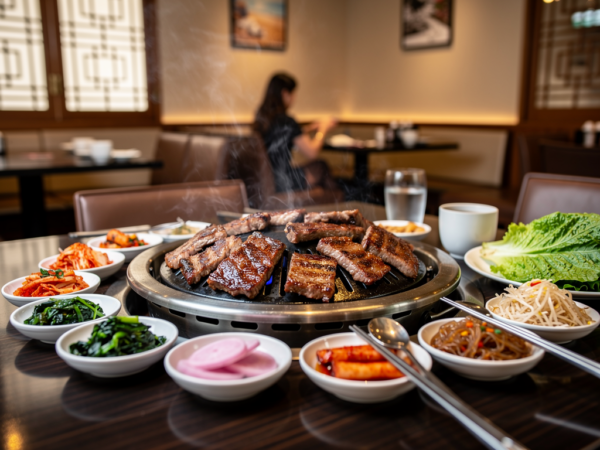
Mukbang Shows is 100% halal across all five branches: beef and chicken only, no pork, no spam, no pork stock and no alcohol anywhere on the premises. None of the other venues named on this page publishes a halal certificate, so confirm those directly.
Where can you eat each one in the UAE?
Only the Korean side of this comparison publishes prices in the UAE, so that is the only side quoted here. No Chinese fried rice price appears below because none was verified from a primary source.
| Venue | Area | Price AED | Halal | What it tells you |
|---|---|---|---|---|
| Mukbang Shows | Deira, JBR, DWTC, Muroor Rd, Electra St | 45 kimchi / 48 chicken / 50 veg / 51 seafood | 100% halal, beef and chicken only, no alcohol | The only four-way published price list in the country |
| The Korean Restaurant (Hanok) | International City, Dubai | 38 veg / 40 chicken / 40 beef / 45 seafood / 48 omurice | Confirm directly | Cheapest published, and openly Korean-Chinese leaning |
| Manna Land | Al Nahyan Camp, Abu Dhabi | 53 | Confirm directly | The capital’s price benchmark, home-style build |
| Madang | Al Sa’adah, Abu Dhabi | Not published (lunch set 65) | Confirm directly | Files its fried rice under Korean-Chinese, openly |
| Hyu | JLT Cluster O, Dubai | Not published | Confirm directly; no alcohol served | Sends it out under a half-boiled egg, the Korean tell |
Mukbang Shows publishes four Korean fried rice prices — kimchi AED 45, chicken AED 48, vegetable AED 50, seafood AED 51 — at all five branches, à la carte with no minimum and no leftover charge attached to the rice itself. It also carries the noodle side of the junghwa yori family: Jajangmyeon AED 55, Jjampong AED 60 solo or AED 99 sharing, and Chicken Tangsuyuk AED 59. Everything sits on the full Mukbang Shows menu.
The Korean Restaurant (Hanok) in International City is the cheapest and widest published list in the country: Kimchi Garlic Fried Rice AED 38 vegetarian or AED 40 with chicken, Chicken or Egg Fried Rice AED 38, Beef Fried Rice AED 40, Seafood Fried Rice AED 45, and an omurice — fried rice wrapped in omelette — at AED 48, on a menu that also carries jjajangmyeon from AED 45 to AED 53. Phone 04-558-8962 or 052-509-7505.
Manna Land in Al Nahyan Camp, Abu Dhabi lists Bokumbap at AED 53, built with vegetables, garlic, egg and a choice of chicken, beef or shrimp. Hyu in JLT Cluster O, Dubai lists Bokumbob with prawns, beef or chicken under a half-boiled egg, publishing no price; phone 04-244-5949.
One honest limit on the Mukbang recommendation: it only plays one side of this comparison. It publishes no Chinese fried rice and does not cook one, so if a Yangzhou or Cantonese wok-charred plate is the actual target, it is the wrong kitchen regardless of how many branches it has. It is not the cheapest Korean option either — Hanok undercuts it by AED 5 to AED 7 and carries the Korean-Chinese wok style Mukbang does not. And Mukbang’s fried rice is an à la carte plate from the Rice section, not the end-of-grill round fried into the pan you have just cooked in; ask when you order rather than assuming.
For where to actually go, city by city, there is where to eat Korean fried rice in Dubai, with published prices and the Abu Dhabi Korean fried rice guide. For the noodle branch of the same Korean-Chinese menu section, jajangmyeon vs jjampong covers the two dishes that sit directly beside the fried rice on those menus.
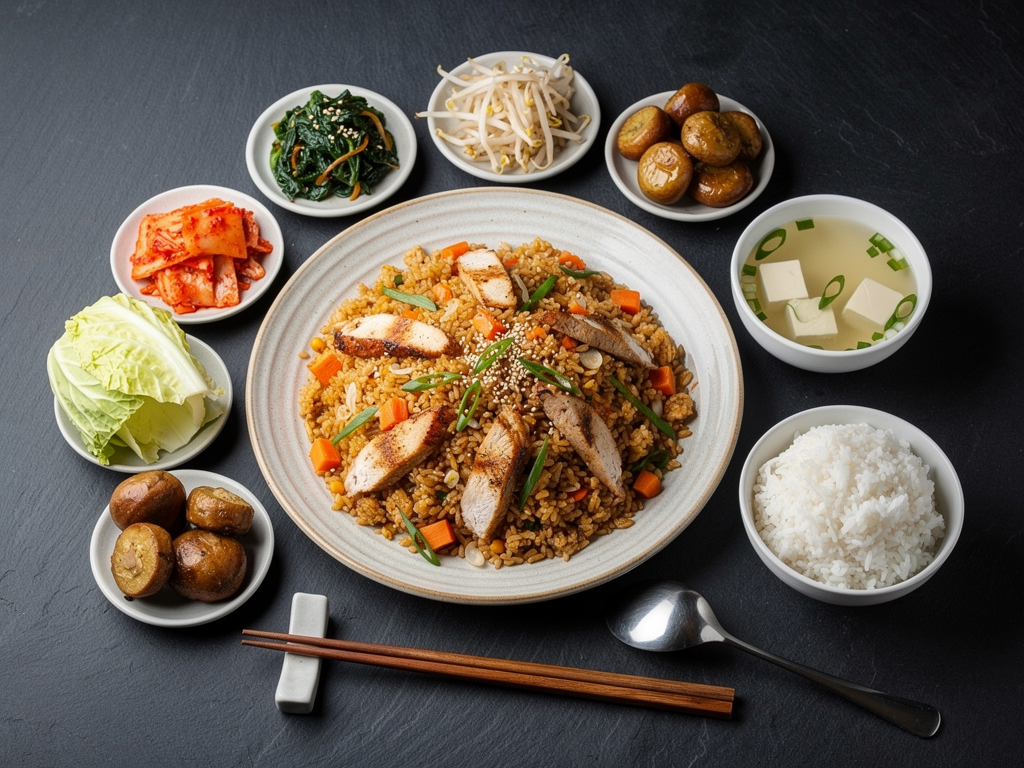
How do you order korean fried rice vs chinese fried rice in a UAE restaurant?
Six rules that decide what turns up on the table.
- Read the menu section, not the dish name. In a Korean restaurant, fried rice sitting under a Korean-Chinese heading beside jjajangmyeon is the wok version; fried rice sitting in the rice section beside bibimbap is the home-style one. Madang labels this openly, and it is the fastest way to know what you are getting.
- Order the kimchi version to test a Korean kitchen. It is the only one that exposes whether the kitchen keeps aged kimchi. Vegetable and seafood versions hide behind oil and protein.
- Judge the colour before you taste. Matte, dry, rust-orange with separate grains means sour kimchi went into hot oil first. Glossy, pink and clumping means it did not.
- Decide where it goes in the meal. Korean fried rice is built to close a meal, so at a grill house order it last. Chinese fried rice is a standalone plate or a shared centre and can arrive whenever you like.
- Know which egg you want. A whole egg on top that you break through is the Korean signal; egg scrambled through the grains is the Chinese one. That single detail tells you which tradition the kitchen is cooking in.
- Phone ahead when no price is published. Only three UAE venues publish a Korean fried rice figure. A thirty-second call is the difference between AED 38 and an unknown, and it is also when you confirm the protein.
One more, for sharing: a single larger plate in the middle beats one portion each in either cuisine. Fried rice cools quickly and does not improve sitting on the table, so if you are ordering for a group, put it in the centre and eat it while it is still loose.
FAQ
Is Korean fried rice the same as Chinese fried rice? No, but they are related. Restaurant fried rice in Korea largely descends from Korean-Chinese cooking developed in Incheon by immigrants from Shandong, and Korean menus still carry a distinct Korean-Chinese wok style called junggukjip bokkeum-bap.
What is the main difference between Korean and Chinese fried rice? The seasoning engine. Korean bokkeum-bap runs on aged kimchi, its brine and gochugaru, finished with sesame oil. Chinese fried rice runs on soy sauce, garlic and wok hei from a very hot wok.
Which is spicier, Korean fried rice or Chinese fried rice? Usually the Korean one, because kimchi and gochugaru bring fermented heat. The exception is Sichuan-style Chinese fried rice, which uses doubanjiang chilli bean paste and can be hotter.
Is Korean fried rice made with pork? Canonically it often is — pork belly or spam is the traditional protein in kimchi bokkeum-bap. It rebuilds cleanly on beef, chicken or prawn, because the flavour comes from aged kimchi and sesame oil rather than the meat.
Why does Korean fried rice have an egg on top? It is the Korean presentation: a whole fried or half-boiled egg is set on the rice and broken through at the table, adding richness at the point of eating. Chinese technique scrambles the egg into the rice during cooking instead.
Does Mukbang Shows serve Chinese fried rice? No. Mukbang publishes four Korean fried rice versions — kimchi AED 45, chicken AED 48, vegetable AED 50, seafood AED 51 — and does not cook a Chinese fried rice.
Why do both dishes need day-old rice? Because both began as leftover cookery. Cooled rice has lost moisture, so it fries and separates instead of steaming and clumping. Fresh hot rice is the most common cause of a wet, sticky plate in either cuisine.
Korean fried rice vs chinese fried rice is a question that answers itself once you know they share a root: two leftover-rice dishes, one seasoned by fermentation and finished with sesame, the other seasoned by soy and finished by fire. Pick by what the rest of your meal is doing — sour and closing, or savoury and standing alone — and read the menu section rather than the dish name.
Related guides
More from our Korean food guides across the UAE:
- japchae vs Chow Mein
- korean Hot Pot vs Chinese Hot Pot
- mandu vs Dim Sum
- korean Food vs Chinese Food
- korean Fried Rice vs Biryani
- korean Chinese Food Dubai
Mukbang Shows pricing: our all-you-can-eat sets start from AED 69 per person at Deira and Abu Dhabi, and AED 79 at JBR and Dubai World Trade Centre. See the full price list for every set and branch.
Comments are closed.