
Updated: September 2026
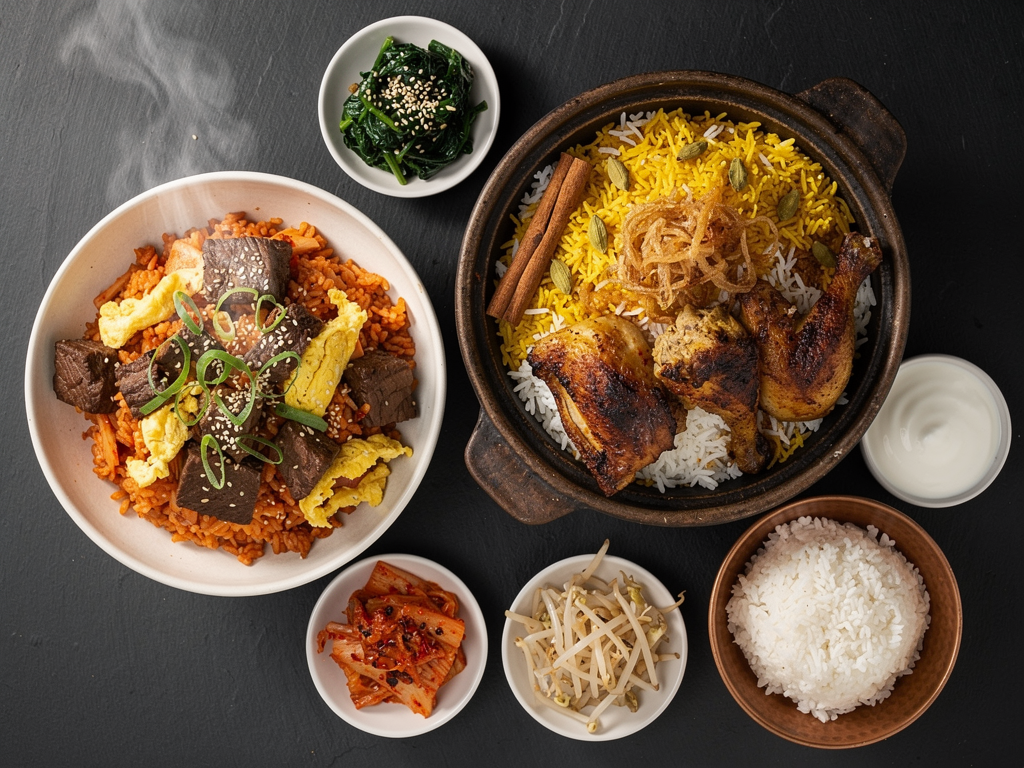
Korean fried rice vs biryani comes down to one thing: when the rice meets the heat. Korean fried rice is rice cooked twice, with the flavour sitting on the outside of each grain. Biryani is rice cooked once, slowly, sealed in a pot, with the flavour absorbed inside the grain. Everything else — the price, the portion, how it reheats — follows from that.
The short version
- Cheapest plate in this comparison: Student Biryani’s Veggie Biryani, AED 20
- Cheapest Korean option: Mukbang Shows Kimchi Fried Rice, AED 45
- Feeding a table: a biryani, every time — Gazebo sells them in three sizes up to AED 643
- Feeding yourself in five minutes: the Korean bowl, every time
What actually separates the two dishes?
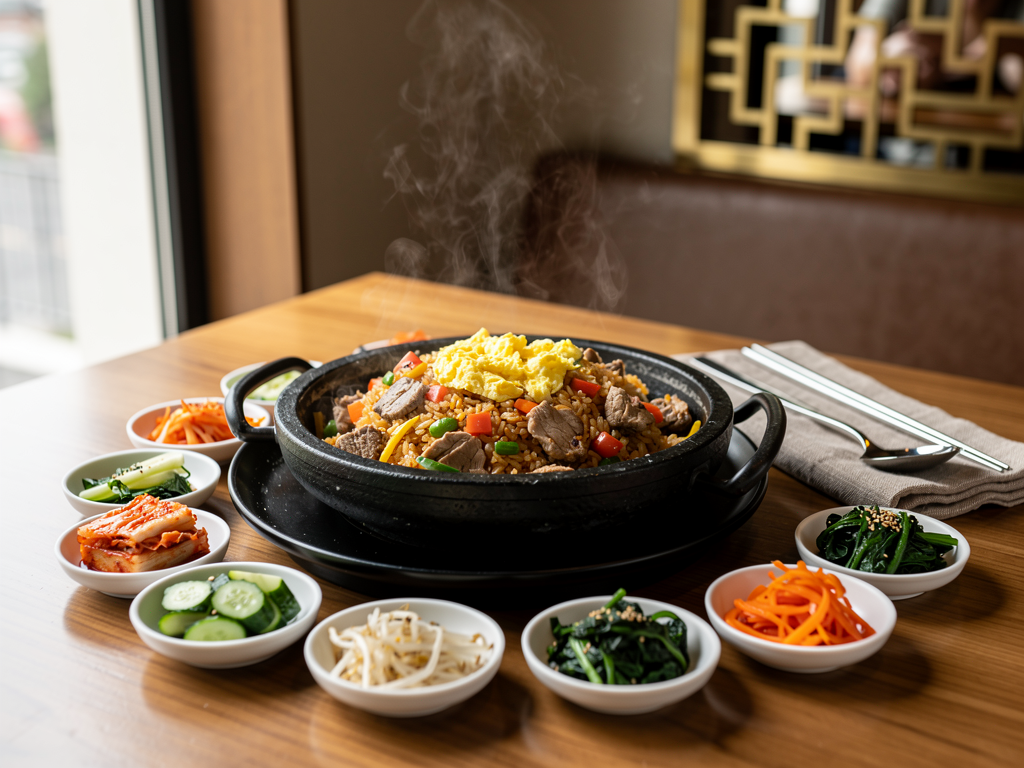
Korean fried rice starts from rice that has already been cooked and cooled. Cooks want it a day old, because cold rice has firmed up and lost surface moisture, so the grains stay separate instead of collapsing into paste in the pan. It then hits a very hot pan for a few minutes with kimchi, gochujang, sesame oil, egg and whatever protein you picked.
The flavour ends up in a thin coat on the outside of every grain. That is why a good bokkeumbap tastes of the pan — slightly scorched, a little smoky at the bottom where it caught. It is also why it is fast: the slow part happened yesterday.
Biryani goes the other way entirely. Raw or part-boiled basmati is layered with marinated meat and spice, the pot is sealed, and it cooks slowly on dum. Gazebo, a UAE biryani specialist trading since 2000, describes nearly every biryani on its menu with the same phrase — layered with aromatic basmati rice, cooked on dum in a sealed earthen pot.
The rice cooks for the first and only time inside that sealed pot, in the steam and stock of the meat. The flavour is absorbed into the grain rather than coated onto it. That takes an hour or more, because here the slow part is the dish.
The practical consequence nobody mentions is reheating. A biryani reheats well, because the moisture and seasoning are locked inside the grain. Fried rice reheats badly, because the thing that made it good was a surface effect of a very hot pan you no longer have. If you want tomorrow’s lunch to taste like tonight’s dinner, that is your answer.
If you want the other rice question — a topping ladled on top of plain rice versus rice cooked in the meat’s broth — that is a different comparison, and we wrote it up separately in dupbap vs kabsa.
Korean fried rice vs biryani: which is actually cheaper?
The entry price runs the opposite way to what most people assume. The cheapest thing in this whole comparison is a biryani — Student Biryani’s Veggie Biryani at AED 20, and Gazebo’s Plain Biryani at AED 34. Both sit below the cheapest Korean option here, Mukbang’s Kimchi Fried Rice at AED 45.
In the middle of the range they converge. Gazebo’s chicken biryanis mostly land between AED 47 and 57 for the Classic size. Mukbang’s four fried rices run AED 45 to 51. On a solo weekday lunch there is almost nothing in it.
The gap opens at the top, and only in one direction. Gazebo’s Aatish-e-Jhinga Biryani, chargrilled jumbo prawns, is AED 89 Classic, AED 274 Large and AED 643 XXXL. There is no AED 643 fried rice on any Korean menu in this country, and there never will be, because a frying pan does not scale and a sealed pot does.
Where to eat Korean fried rice in the UAE
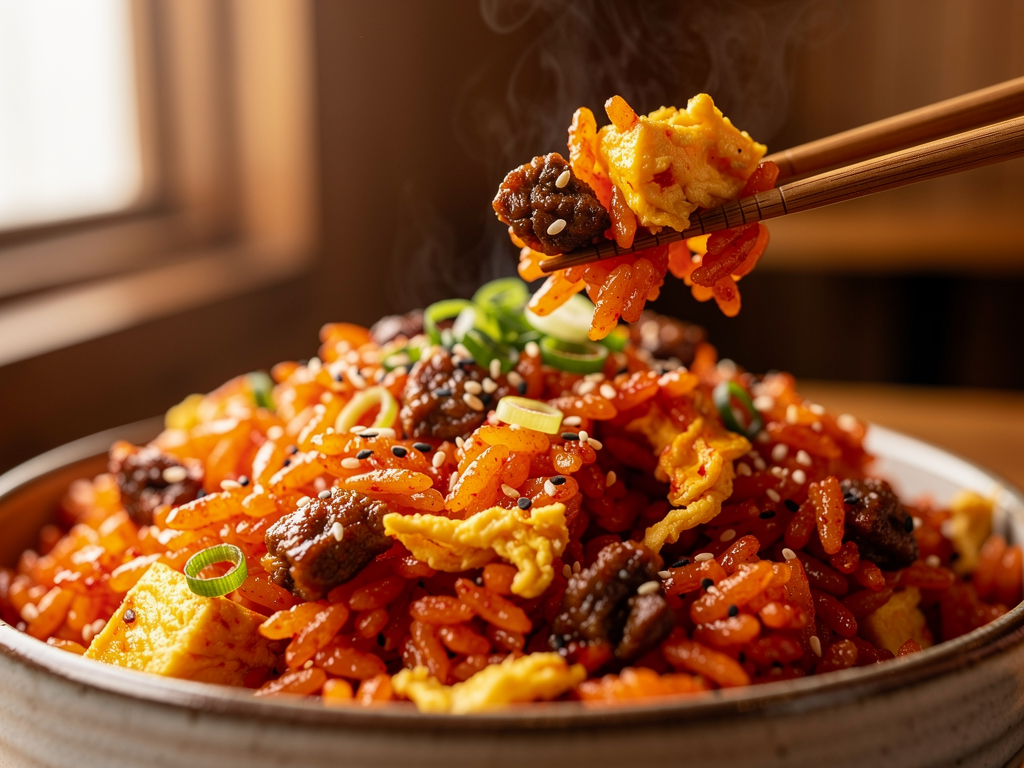
Mukbang Shows is the pick on choice and reach. Four fried rices — Seafood AED 51, Vegetable AED 50, Chicken AED 48 and Kimchi AED 45 — across five branches in two emirates, in a 100% halal kitchen with no pork and no alcohol on any menu.
The Kimchi Fried Rice at AED 45 is the cheapest rice dish on the whole menu, which is why regulars treat it as the default way to fill out a table that has already ordered grill. Branches are in Deira (Al Ittihad Road, Port Saeed), JBR (Plaza Level, Bahar 3 Unit P33, The Walk), DWTC (The Apartments Block A, Sheikh Zayed Road), plus Muroor Road and Electra Street in Al Danah, Abu Dhabi.
The honest limitation: it is a single bowl with no larger size, so it does not scale for a group the way a biryani does. It is also à la carte, and is not included in the all-you-can-eat BBQ tiers, which start at AED 69 and require a minimum of two people.
Manna Land Korean Restaurant in Al Nahyan, Abu Dhabi prints Bokumbap at AED 53 with a choice of vegetables, garlic, egg, chicken, beef or shrimp — all six at the same price. It is one of very few Korean restaurants in the UAE publishing a complete priced menu on its own website, in English and Arabic. The catch is that it is one address, in Abu Dhabi only.
Nuri Grill & Bar at the Hilton Abu Dhabi Yas Island prints Chadol Kimchi Fried Rice, made with beef brisket, at AED 80. It also deep-fries its own kimchi fried rice into arancini with a rose tomato sauce at AED 85 — the clearest demonstration anywhere on this page that fried rice can be an ingredient rather than a finished dish. Two things to know: it is a licensed venue that publishes a wine menu alongside its food menu, so alcohol is served, and at AED 80 it is the most expensive Korean fried rice here.
For venue-by-venue rankings inside the Korean category, we cover those separately for best Korean fried rice in Dubai and for Korean fried rice in Abu Dhabi.
Where to eat biryani in the UAE
Gazebo publishes around forty biryanis with prices, which is the deepest published list in the country by a distance. Plain Biryani AED 34. Subzi Masala AED 44, Egg Masala AED 45, Murgh Masala AED 47, Murgh Bombay AED 48. Mutton runs AED 49 to 63 Classic, with Raan Masala at AED 185.
Nearly all of them come in three sizes. Murgh Bombay is AED 48 Classic, AED 151 Large and AED 356 XXXL. Tandoori Murgh is AED 57, AED 178 and AED 419. Gazebo states 35 branches across the UAE and publishes no alcohol on its drinks list — lassi, juices, milkshakes, tea, coffee and soft drinks. It is an Indian restaurant working in the South Asian biryani tradition, not an Emirati one; confirm halal certification with the branch you visit.
Arabian Tea House is the Emirati end of the same question. Biryani Deyay (chicken) AED 62, Biryani Robyan (shrimp) AED 74, Biryani Laham (meat) AED 75 — all cooked with Gulf spices and served with yogurt, and all sitting on the same menu page as its machboos, which is the most useful side-by-side either dish gets in this country.
Its own site describes it as the first authentic Emirati cuisine restaurant since 1997, and describes its food as middle eastern halal food. The Al Fahidi branch, in Bastakiya opposite the Musalla Post Office on Al Fahidi Street, Bur Dubai, is open every day from 7:00 to 23:00. It is a heritage-restaurant setting rather than a quick lunch stop, and its biryanis start well above the cheapest here.
Student Biryani publishes Veggie Biryani at AED 20 — the lowest single price on this page — and lists ten UAE addresses: Al Barsha, Al Karama, Silicon Oasis and Jumeirah Village Circle in Dubai; Al Reef, Shabiya and Corniche in Abu Dhabi; Muwaileh Commercial and Al Mujarrah in Sharjah; and Al Rashidiya in Ajman. Its own site traces the name to a stall opened on Katrak Road in Karachi in October 1969. It publishes no price for the chicken, mutton, BBQ, tikka or bucket biryanis, so ask before ordering.
Khaleej Times keeps a round-up of where to eat biryani in the UAE if you want a second opinion from the local press.
Why the kimchi version is always the cheapest one
Look down any Korean menu in the UAE and the kimchi fried rice is the cheapest rice on it. At Mukbang Shows it is AED 45 against AED 48 for chicken, AED 50 for vegetable and AED 51 for seafood. That is not a discount, and it is not a lesser dish — it is a consequence of how the kitchen works.
Kimchi is already finished when it goes in the pan. It has been salted, packed and left to ferment for weeks, and that fermentation has done all the seasoning work in advance. A cook adds aged kimchi and its liquid to day-old rice and the dish is essentially seasoned. There is no stock to build, no marinade to hold overnight, no protein to portion.
Older kimchi is also better here than fresh, which inverts the usual restaurant economics. Fresh kimchi is crisp and sharp and belongs in a banchan dish. Kimchi that has gone soft and very sour is difficult to serve on its own and perfect in a hot pan, because the sourness mellows against the fat and the rice. A Korean kitchen with sour kimchi has a cheap, excellent dish and no waste.
That is worth knowing when you order, because it means the cheapest thing on the menu is not the compromise option. If you have never had Korean fried rice, the AED 45 kimchi version is the one to start with, not the AED 51 seafood one.
If your table wants biryani-scale food, order the grill instead
Here is the thing a fried rice comparison usually gets wrong. Korean restaurants do have an answer to feeding six people from one order — it is simply not the rice.
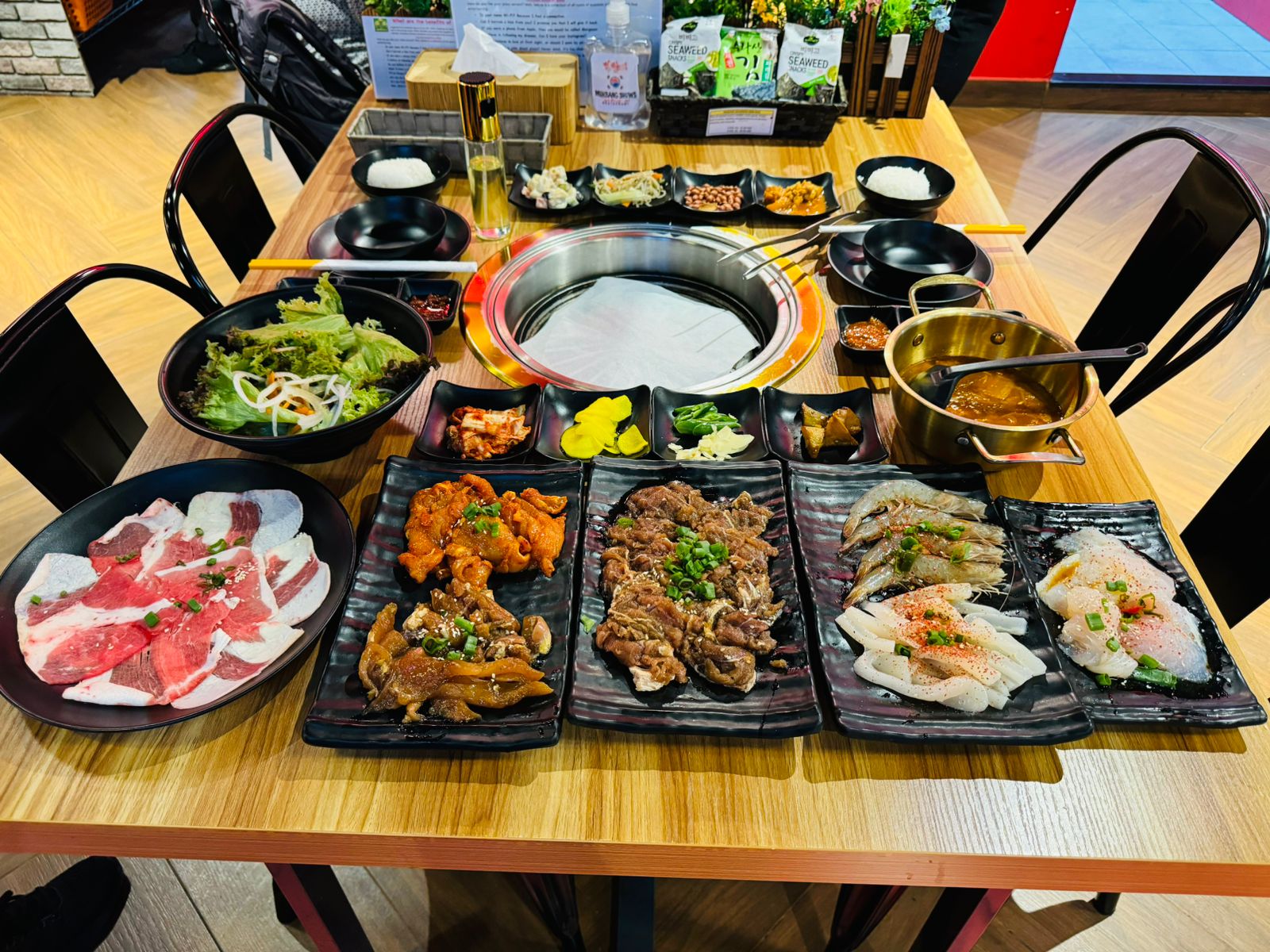
At Mukbang Shows that answer is the all-you-can-eat BBQ, and it runs in four tiers: Gangnam at AED 69 in Deira and the two Abu Dhabi branches, or AED 79 at JBR and DWTC; Daegu at AED 89 or 99; Jeju at AED 99 or 109; and Bukchon Hanok at AED 129 flat across every branch. All tiers include seven kinds of BBQ, eight banchan, two gimbap, soup and rice, with a minimum of two people.
Set that against Gazebo’s sizing and the maths gets interesting. A Murgh Bombay Large is AED 151 and the XXXL is AED 356. Six people on the AED 69 tier is AED 414 — more than the XXXL biryani, and a completely different kind of evening, because one is a shared pot delivered to the table and the other is two hours of cooking meat in front of you.
The point is not that one wins. It is that the fried rice was never in that conversation. Comparing a AED 45 solo bowl to a AED 356 sharing pot is comparing a side dish to a feast, and the Korean side of the table has a different dish for the feast.
The honest problem: one of these is everywhere and one is not
This is the part that does not favour us. Biryani is one of the most available dishes in the country. Gazebo alone claims 35 branches. Student Biryani reaches Sharjah and Ajman. Arabian Tea House adds five more sites. You are rarely far from a biryani in the UAE.
Korean fried rice needs a Korean kitchen, and there are not many. Mukbang Shows has five branches across Dubai and Abu Dhabi. Manna Land is one address in Al Nahyan. Nuri is one on Yas Island. If you live in Ras Al Khaimah or Fujairah, you can order biryani tonight and you cannot order a bokkeumbap at all.
That asymmetry should decide more orders than it does. If the deciding factor is tonight, biryani usually wins on geography alone, and no amount of arguing about technique changes that.
Price and availability at a glance
| Venue | Where | Price (AED) | Halal status | The order to get |
|---|---|---|---|---|
| Mukbang Shows | Deira, JBR, DWTC, Muroor Rd, Electra St | 45–51 | 100% halal, beef and chicken only, no alcohol | Kimchi Fried Rice, 45 |
| Manna Land | Al Nahyan, Abu Dhabi | 53 | Confirm directly | Bokumbap, 53 |
| Nuri Grill & Bar | Hilton Abu Dhabi Yas Island | 80–85 | Licensed venue, alcohol served | Chadol Kimchi Fried Rice, 80 |
| Gazebo | 35 UAE branches | 34–643 | No alcohol published; confirm halal directly | Murgh Bombay, 48 Classic |
| Arabian Tea House | 5 UAE sites incl. Al Fahidi, Bur Dubai | 62–75 | Describes its food as halal | Biryani Deyay, 62 |
| Student Biryani | 10 UAE addresses incl. Sharjah and Ajman | 20 (veggie) | Confirm directly | Veggie Biryani, 20 |
Read across the table and the shape of Korean fried rice vs biryani is obvious: the Korean dishes cluster in a narrow band around AED 45 to 80 in three venues, and the biryanis spread from AED 20 to AED 643 across dozens.
Which one should you order tonight?
Order the Korean bowl if you are eating alone, you are in a hurry, and you want that scorched-pan flavour. It arrives fast because the rice was cooked yesterday. Ask for it mild if children are eating — only the kimchi version reliably carries heat, and even that is a sour fermented heat rather than a chilli burn. If you are collecting it, eat it soon; the crisp surface is the first thing to go.
Order the biryani if more than two of you are eating, or if you want leftovers that are still good tomorrow. Check the size before you commit at Gazebo, because the step from Classic to XXXL is a big one. Expect yogurt on the side at Arabian Tea House, and expect a slower, heritage pace.
And if you cannot decide, the technique test settles it faster than the menu does. Do you want the flavour on the outside of the rice, or inside it? That single question answers the price, the portion, the venue and the leftovers all at once.
Some background on the Korean side, if you want it: bokkeumbap is written 볶음밥, from bokkeum (stir-fried) and bap (cooked rice). UAE menus print it as bokumbap and bokkeum bap too. Same dish. We also compare it against its nearest neighbour in Korean fried rice vs Chinese fried rice.
FAQ
Is Korean fried rice the same as biryani?
No. Korean fried rice is already-cooked rice tossed in a hot pan for a few minutes, so the flavour coats the grain. Biryani is raw rice cooked once, slowly, sealed in a pot with the meat, so the flavour is absorbed into the grain.
Which is cheaper in the UAE?
The cheapest biryani wins. Student Biryani’s Veggie Biryani is AED 20 and Gazebo’s Plain Biryani is AED 34, against AED 45 for the cheapest Korean fried rice. In the middle of the range, roughly AED 45 to 57, they are level.
Is Korean fried rice halal in Dubai?
It depends entirely on the kitchen. Mukbang Shows is 100% halal with no pork and no alcohol at any branch. Other Korean venues in the UAE are licensed or list pork options — Nuri Grill & Bar publishes a wine menu, for instance. Check the specific restaurant. Our guide to halal Korean food goes through what to look for.
Which feeds a group better?
Biryani, by design. Gazebo prices most of its biryanis in three sizes up to XXXL. Not one Korean menu in this comparison publishes a sharing size for fried rice.
Is Korean fried rice spicy?
Only the kimchi version reliably is, and it is a sour fermented heat rather than a chilli-powder one. Vegetable, chicken and seafood versions are usually mild.
Does biryani count as Korean-adjacent in any way?
No, and no honest guide should pretend otherwise. The two share only the fact that each is a complete meal built on seasoned rice. The techniques, the spice families and the occasions have nothing in common.
Which travels better for delivery?
Biryani. The seasoning and moisture are sealed inside the grain, so it survives the ride. Fried rice loses its surface texture as it steams inside a closed box.
Korean fried rice vs biryani is not really a contest between two dishes — it is a contest between two ideas about what rice is for. One treats rice as a surface to be coated in a hot pan. The other treats it as a sponge to be filled in a sealed pot. Pick the idea you want on the table tonight, and the restaurant picks itself.
Related guides
More from our Korean food guides across the UAE:

Comments are closed.