Updated: September 2026
Dupbap vs kabsa comes down to where the flavour lives. In a dupbap it sits on top of plain rice, ladled over at the last second. In a kabsa it is inside every grain, because the rice was cooked from raw in the spiced broth the meat came out of. That one difference decides the portion, the leftovers and the spice level.
The short version
- If you are searching for kabsa in the UAE, search machboos too — that is what local menus print
- Cheapest bowl here: Manna Land’s Bulgogi Dubbab, AED 53
- Most reliable halal option across two emirates: Mukbang Shows, Beef or Bulgogi Dupbap, AED 66
- The local version: Arabian Tea House, Machboos Deyay, AED 62
First, the naming problem nobody warns you about
Kabsa is the Saudi name. In the UAE the same family of dish is almost always printed as machboos — you will also see majboos and majbous — and menus here run machboos far more often than they run kabsa.
Arabian Tea House, an Emirati restaurant trading since 1997, prints four machboos on its main-course menu and nothing called kabsa at all. Khaleej Times, writing about local food, describes machboos as rice and spiced meat, a dish often compared to biryani.
So if you have been searching one word and coming up short, that is why. Search machboos as well, and expect mandi to turn up beside it — the Yemeni cousin, where the meat is cooked separately rather than in with the rice. Search both spellings and you will roughly double the results.
What actually separates the two dishes
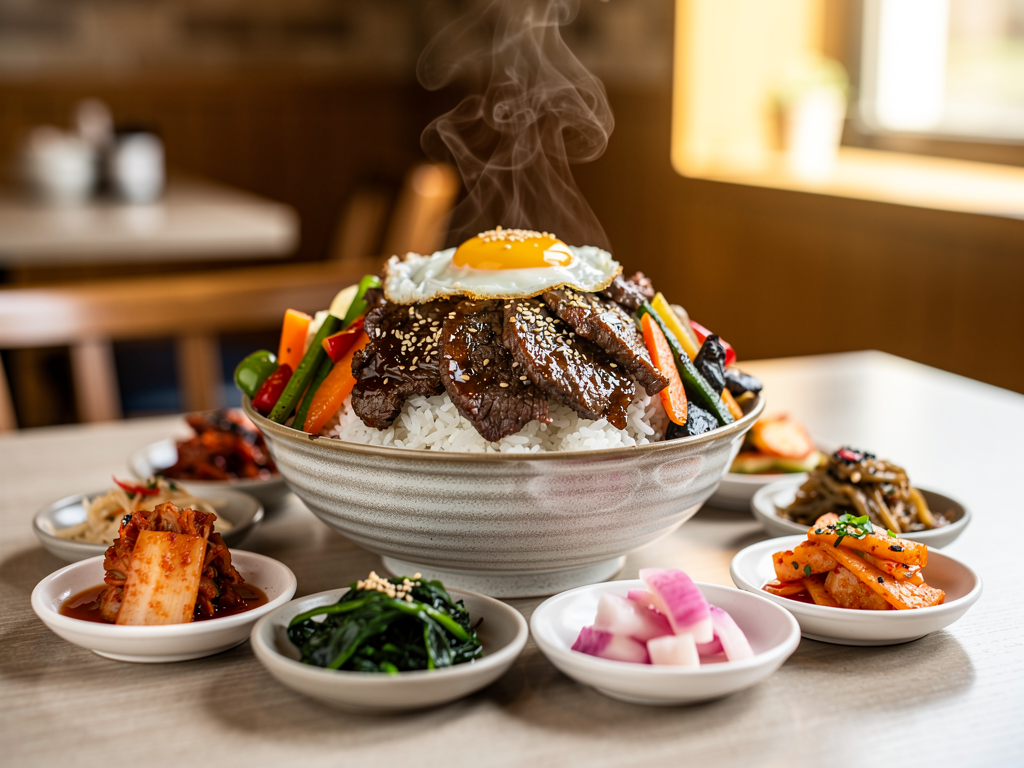
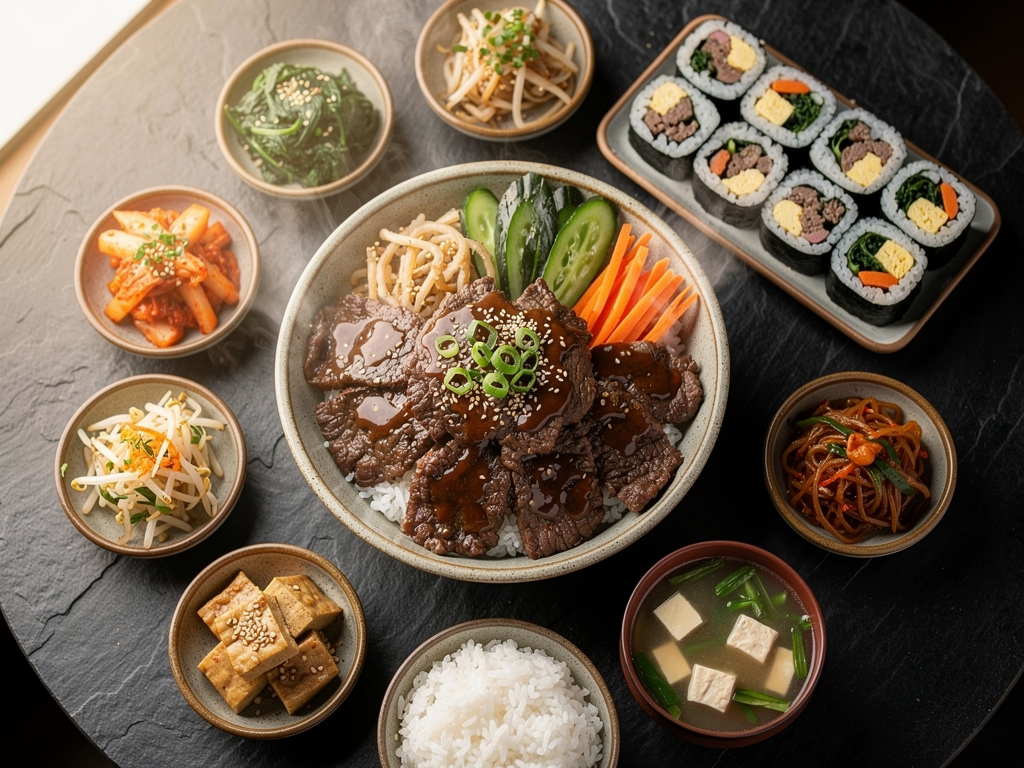
Deopbap — 덮밥, printed on UAE menus as dupbap, dubbab or deop bap — literally means covered rice. The rice is steamed plain, on its own, with nothing in it. The topping is cooked separately. The two meet in the bowl seconds before it reaches you.
The rice underneath stays neutral on purpose. That is why the marinade hits hard on the first bite, and why the last few spoonfuls at the bottom of the bowl are noticeably plainer. Nothing was ever stirred through.
Kabsa and machboos work the opposite way. The rice goes into the pot raw, into the broth the meat has been simmering in, with the spices already in the water — cardamom, cinnamon, cloves, black pepper, and loomi, the dried lime that gives Gulf rice its distinctive sour edge. Nothing is assembled at the end. Every grain has been seasoned identically for an hour, so the last spoonful tastes like the first.
Once you see it that way, the rest follows. A dupbap can be made mild for one person and hot for another, because the heat is all in the topping. A kabsa cannot — the seasoning went in at the start, for everybody. The rice in a kabsa is worth eating on its own; the rice in a dupbap is not meant to be.
There is a nice symmetry in how the two cuisines get their sourness, incidentally. Gulf cooking reaches for dried lime. Korean cooking reaches for fermentation — aged kimchi, soybean paste, gochujang. Same job, opposite method, and it is the single clearest reason the two rice dishes taste nothing alike despite looking similar on a plate.
One bowl or one platter?
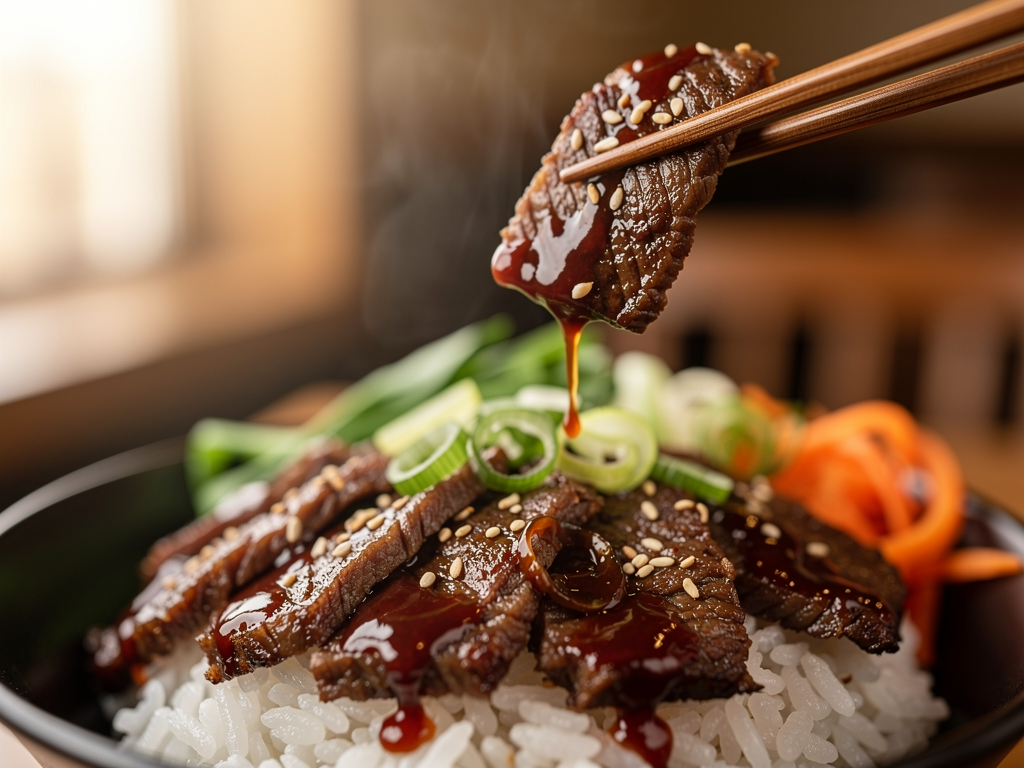
Dupbap is a weekday lunch for one, and every Korean menu in this comparison prices it that way. Mukbang Shows prints Beef Dupbap and Bulgogi Dupbap at AED 66 each. Manna Land in Abu Dhabi prints Bulgogi Dubbab at AED 53. Nuri Grill & Bar on Yas Island prints Bulgogi Deop Bap at AED 80. Three venues, three single-serving prices, and not one sharing size between them.
Kabsa and machboos are communal by construction — one pot, brought out whole, eaten from the middle. Even the plated restaurant version keeps that shape: the meat sits on a mound of rice rather than beside a scoop of it.
Arabian Tea House prices its four machboos by protein rather than by portion: Machboos Deyay (chicken) AED 62, Machboos Robyan (shrimp) AED 74, Laham Machboos (lamb) AED 76, Machboos Hamour (grouper) AED 82.
That is the practical fork. If you are eating alone tonight and want nothing left over, the Korean bowl is built for exactly that. If you want a second meal out of one order, or you are feeding more than yourself, the local dish is built for exactly that.
While we are here: dupbap is not bibimbap
These two get confused constantly, and Nuri Grill & Bar’s menu is the easiest place to see the difference priced side by side — Bulgogi Deop Bap at AED 80 and Dolsot Bibimbap at AED 85.
A dupbap is not meant to be mixed. The topping sits on the rice and you eat down through it, so the ratio changes as you go. A bibimbap is meant to be mixed, hard, before the first bite — the name means mixed rice — so every mouthful is the same, which makes it structurally much closer to a kabsa than a dupbap is.
If you like the idea of consistent flavour throughout but you want it Korean, bibimbap is the order, not dupbap.
Where to eat dupbap in the UAE
Mukbang Shows is the pick on reach. Beef Dupbap and Bulgogi Dupbap, both AED 66, across five branches in two emirates, in a 100% halal kitchen with no pork and no alcohol on any menu.
Because the rice and the topping are cooked apart, the same menu sells the bulgogi on its own as a plate — Wagyu Bulgogi at AED 115 — which is the clearest illustration on this page of what covered rice actually is: a dish that already exists, put on rice. The branches are Deira (Al Ittihad Road, Port Saeed), JBR (Plaza Level, Bahar 3 Unit P33, The Walk), DWTC (The Apartments Block A, Sheikh Zayed Road, opposite the metro station), and Muroor Road and Electra Street in Al Danah, Abu Dhabi.
The honest limitation: at AED 66 it is thirteen dirhams above the cheapest dupbap here, it is a single bowl with no sharing size, and it is à la carte — it is not included in the all-you-can-eat BBQ tiers, which run AED 69, 89, 99 and 129 depending on tier and branch, with a two-person minimum.
Manna Land Korean Restaurant in Al Nahyan, Abu Dhabi prints Bulgogi Dubbab at AED 53 — the cheapest dupbap anyone in this country publishes a price for. It is one of very few Korean restaurants here putting a full priced menu on its own site in English and Arabic. The catch: one address, Abu Dhabi only, and just the one bulgogi version.
Nuri Grill & Bar at the Hilton Abu Dhabi Yas Island prints Bulgogi Deop Bap at AED 80, the most expensive here. Two things to know: it is a licensed venue that publishes a wine menu alongside its food menu, so alcohol is served, and its kimchi stew is listed as pork or beef, so specify if that matters to you.
We rank the Korean venues properly on their own pages for best dupbap in Dubai and dupbap in Abu Dhabi — this page stays on the comparison.
Where to eat kabsa or machboos in the UAE
Arabian Tea House publishes the clearest machboos list in Dubai, priced across chicken, shrimp, lamb and grouper and served with yogurt. The same menu carries Tahta Laham at AED 76 — shredded lamb between two layers of white rice with caramelised onions and raisins — and Jareesh Robian at AED 62, shrimp with crushed wheat and black loomi.
Its own site describes it as the first authentic Emirati cuisine restaurant since 1997, and describes its food as middle eastern halal food. The Al Fahidi branch, in Bastakiya opposite the Musalla Post Office on Al Fahidi Street, Bur Dubai, is open every day from 7:00 to 23:00 — one of very few places in the city where machboos is a breakfast option. It also runs sites at Mercato Mall, the Umm Suqeim kiosk, the Archaeological Site, and in Sharjah. The one caveat: nothing on the menu is called kabsa by name. What you get is the Emirati machboos.
Al Fanar Restaurant & Cafe is the best-known Emirati chain in the country, with sites at Dubai Festival City, Al Seef, Al Barsha Pond Park, Yas Mall in Abu Dhabi and Al Ain. It describes its machboos as fragrant rice cooked in a blend of spices with chicken, lamb or shrimp, and its own website says the Al Seef branch is selected in the Michelin Guide. It publishes dish descriptions but not prices, so budget by asking rather than looking it up.
For background there is the Wikipedia entry on kabsa and the one on machboos, and Khaleej Times keeps a guide to the ten Emirati dishes worth knowing.
One warning on searching: at least one well-known Dubai kabsa and mandi restaurant has let its web domain lapse, and the address now resolves to an unrelated site. Trust current listings rather than old links.
Where mandi fits
Mandi comes up constantly beside kabsa in UAE search results and deserves a straight answer. It is Yemeni rather than Saudi or Emirati, and the defining difference is that the meat is cooked separately — traditionally in a pit oven — so the rice takes its flavour from the drippings and the smoke rather than from being boiled in the broth.
That puts mandi structurally between the two dishes on this page: the components are cooked apart, like a dupbap, but the rice is still seasoned by the meat, like a kabsa. If you liked the idea of both halves of this comparison, mandi is the dish that splits the difference.
Price and availability at a glance
| Venue | Where | Price (AED) | Halal status | The order to get |
|---|---|---|---|---|
| Manna Land | Al Nahyan, Abu Dhabi | 53 | Confirm directly | Bulgogi Dubbab, 53 |
| Arabian Tea House | Al Fahidi, Bur Dubai + 4 UAE sites | 62–82 | Describes its food as halal | Machboos Deyay, 62 |
| Mukbang Shows | Deira, JBR, DWTC, Muroor Rd, Electra St | 66 | 100% halal, beef and chicken only, no alcohol | Beef Dupbap, 66 |
| Nuri Grill & Bar | Hilton Abu Dhabi Yas Island | 80 | Licensed venue, alcohol served | Bulgogi Deop Bap, 80 |
| Al Fanar | Festival City, Al Seef, Al Barsha, Yas Mall, Al Ain | Not published | Confirm directly | Machboos, chicken or lamb |
The striking thing about dupbap vs kabsa on price is that there is barely a gap. The Korean bowls run AED 53 to 80 and the machboos run AED 62 to 82. Mukbang’s AED 66 and Arabian Tea House’s AED 62 are four dirhams apart. Price is not the deciding factor here, which is unusual — portion and flavour placement are.
Look at what arrives beside the rice
The two menus disagree about what belongs on the same plate, and that tells you more than the dish descriptions do.
Arabian Tea House publishes yogurt as part of the machboos itself — every one of its four is described as served with yogurt, and it is not an optional side. That is doing a job. The rice is dense, warm and heavily spiced, the meat is rich, and something cold, plain and slightly sour cuts through all of it. The dish was designed with that counterweight built in.
Korean menus publish their counterweights separately. On the Mukbang Shows menu, kimchi is its own line at AED 78 or 43, gyeran jjim, the steamed egg, is AED 39, and the stews sit in their own section. The all-you-can-eat BBQ tiers do bundle eight banchan, soup and rice together, but a dupbap ordered à la carte is a bowl, and what goes beside it is your decision.
So the two arrive at your table looking quite different even when the rice and the meat are comparable. One turns up complete, its own contrast already on the plate. The other turns up as one component of a table you assemble yourself. Neither approach is better, but if you order a dupbap expecting the full spread that comes with a Korean grill order, you will be surprised by how much of the menu is priced separately.
Dupbap vs kabsa on a delivery order
If the food is travelling, this comparison is not close. Kabsa and machboos hold up because the seasoning and the moisture went into the grain an hour ago and have nowhere else to go. Twenty minutes in a sealed box changes very little.
A dupbap does not hold up as well, and the reason is structural rather than a criticism of any kitchen. The whole design depends on plain rice and a wet topping meeting at the last possible moment. Seal them together in a container and the topping keeps releasing marinade downward, so by the time it arrives the boundary the dish was built on has softened.
The practical fix is not complicated. If you are ordering a dupbap for delivery, eat it as soon as it lands rather than letting it sit, or order from the branch nearest you. If it is going to wait, order the machboos.
The honest part: one of these is native and one is not
Rice cooked in spiced broth is home cooking in this country. Machboos, mandi and kabsa are on Emirati, Yemeni, Saudi and Gulf menus in every emirate, in cafeterias as much as heritage restaurants, and you do not need to plan around finding one.
Korean covered rice needs a Korean kitchen. Mukbang Shows has five branches across Dubai and Abu Dhabi. Manna Land is one address in Al Nahyan. Nuri is one on Yas Island. Someone reading this in Ras Al Khaimah or Fujairah can order machboos tonight and cannot order a dupbap at all.
That should settle more orders than it does. If the constraint is where you are standing, the local dish wins on geography, and no argument about technique changes it.
FAQ
Is kabsa the same as machboos?
They are the same family of dish under two regional names — kabsa is the Saudi term, machboos the Emirati and wider Gulf one. UAE menus print machboos far more often, so search both.
What does dupbap mean?
Deopbap, 덮밥, literally means covered rice: plain steamed rice with a separately cooked topping ladled over it just before serving.
What is the real difference between the two?
Where the flavour lives. A dupbap keeps the rice neutral with the seasoning on top. A kabsa cooks the rice from raw in the spiced meat broth, so every grain is seasoned from the inside.
Which is cheaper in the UAE?
They overlap almost completely — dupbap AED 53 to 80, machboos AED 62 to 82. Manna Land’s AED 53 Bulgogi Dubbab is the lowest single price here.
Is dupbap halal in Dubai?
It depends on the kitchen. Mukbang Shows is 100% halal with beef and chicken only and no alcohol at any branch. Other Korean venues here are licensed or list pork options, so check the specific restaurant. Our guide to halal Korean food covers what to ask.
Which is better for leftovers?
Kabsa or machboos, comfortably. The rice was seasoned all the way through, so it reheats as itself. A dupbap topping keeps releasing liquid into the rice underneath.
Is mandi the same as kabsa?
No. Mandi is Yemeni and its meat is cooked separately, traditionally in a pit oven, so the rice picks up drippings and smoke rather than cooking in the meat broth.
Is kabsa spicy?
Usually not chilli-hot. It is heavily spiced rather than hot — cardamom, cinnamon, cloves, black pepper and dried lime. If you want heat, you add it at the table.
Dupbap vs kabsa is really a question about how you want the evening to go. One is a single bowl, built for one person, with the flavour concentrated in the part you can see. The other is a pot that happens to have been plated, with the flavour worked evenly through the whole thing. If the other rice question on your mind is pan-fried versus slow-sealed, that one is answered separately in Korean fried rice vs biryani.
Related guides
More from our Korean food guides across the UAE: