Updated: September 2026
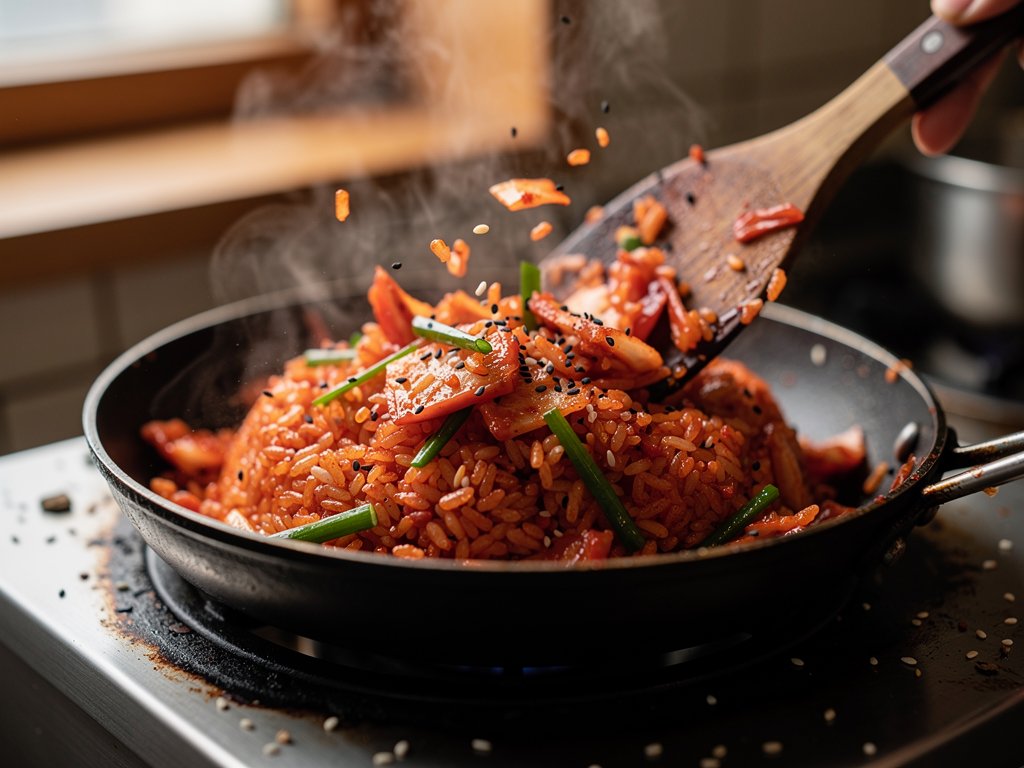
Bokkeum means stir-fried: cooked fast over high heat in a shallow pan with constant movement, so the sauce reduces and clings to the ingredients instead of pooling around them as broth. The reason what is bokkeum is worth ninety seconds of your attention is that it is not a dish — it is a method word, and it is hiding inside roughly a third of the items on every Korean menu in the UAE. Learn it once and a page of unfamiliar syllables turns into a readable grid.
How the word works on a menu
Bokkeum attaches to whatever is being stir-fried, and the position of the word tells you what kind of dish is coming.
When it comes second after an ingredient, that ingredient is the star:
- nakji bokkeum — stir-fried baby octopus
- ojingeo bokkeum — stir-fried squid
- dak bokkeum — stir-fried chicken
- jeyuk bokkeum — the pork version in Korea (more on that below)
When it comes first, attached to a staple, the order flips and you get a one-bowl meal:
- bokkeumbap (볶음밥) — stir-fried rice
- bokkeum myeon (볶음면) — stir-fried noodles
That is the whole system, and it is why half a dozen menu items that look completely unrelated at first glance turn out to be siblings. It sits alongside the other method words that organise a Korean menu — gui (grilled), jjim (steamed or braised), twigim (deep-fried), jjigae (stew) and jeon (pan-fried in batter). Once you can spot the method, you can predict the plate before it arrives.
What is bokkeum going to taste like, compared with everything near it?
The method determines the texture, and that is genuinely useful when you are choosing between two similar-sounding dishes.
Bokkeum vs twigim: bokkeum uses a little oil and constant tossing, so the result is glossy and saucy, eaten with chopsticks over rice. Twigim is deep-fried in a lot of oil — saeu twigim (prawn) arrives crisp and battered. Same protein, opposite mouthfeel.
Bokkeum vs jjigae: often the same gochujang base, but a jjigae stays loose and liquid and needs a spoon, while a bokkeum reduces down until the sauce coats rather than flows.
Bokkeum vs Chinese stir-fry: the seasoning is the giveaway. Korean stir-fries build on gochujang, gochugaru, soy and sesame oil rather than oyster sauce or Shaoxing, and usually finish with sesame seeds and spring onion — nutty and aromatic rather than the heavier wok character of Cantonese cooking.
Bokkeum vs gui: gui means grilled over direct heat, so galbi gui arrives charred at the edges and dry-surfaced. A bokkeum never touches a grill and never gets that char — the pan and the sauce do all the work.
And one genuine oddity: dakbokkeumtang carries both bokkeum and tang (soup) in its name, because the chicken is stir-fried first and then simmered. It sits between the two categories, which is part of why Hanok prices it at AED 83 rather than in the AED 46–48 stir-fry band.
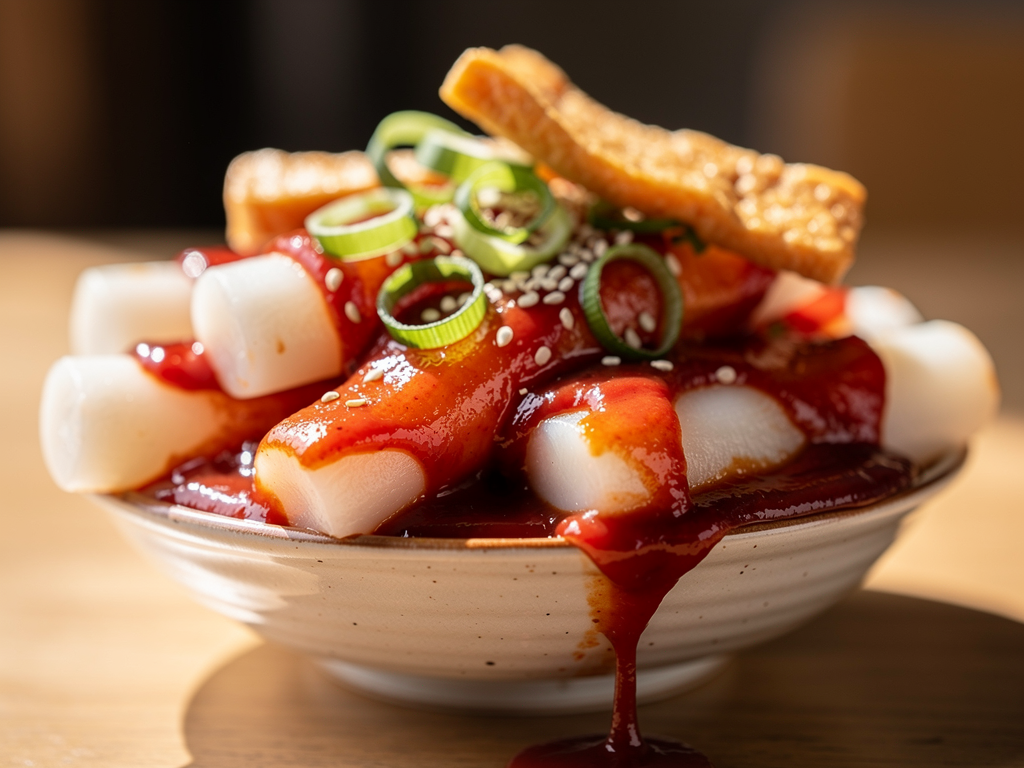
One more piece of trivia that is actually load-bearing: tteokbokki is a bokkeum. The name is tteok (rice cake) plus bokki, a sound-shifted form of the same word. The most famous Korean street food on earth is, literally, stir-fried rice cakes — which tells you why it arrives sticky and coated rather than swimming.
The bokkeum dishes you will actually meet in the UAE
Knowing the method is useful; knowing which versions are actually sold here is more useful. These are the ones that turn up on UAE menus, with what to expect from each:
- Bokkeumbap (볶음밥) — stir-fried rice, and the most common member of the family. Day-old rice fried hard in a wok-hot pan so the grains separate and pick up colour. The kimchi version is the benchmark: sour, funky, slightly sweet. UAE prices run AED 34 at The Skewers to AED 51 for the seafood version at Mukbang Shows.
- Bokkeum myeon (볶음면) — stir-fried noodles, chewier and drier than a soup noodle, with the sauce clinging to each strand. Mukbang Shows sells three versions: vegetable AED 48, chicken AED 55, seafood AED 59.
- Tteokbokki (떡볶이) — cylindrical rice cakes in thick gochujang sauce. Chewy rather than crisp, and sweeter than most people expect on a first try. AED 46 at Hanok, AED 42 for the cheesy version and AED 44 for the seafood version at The Skewers, AED 55 at Mukbang Shows.
- Rabokki — tteokbokki with instant noodles added to the same pan, so you get chew and slurp together. AED 49 at Mukbang Shows.
- Nakji bokkeum (낙지볶음) — stir-fried baby octopus, and genuinely one of the spicier things on any Korean menu. Tender rather than rubbery when done properly. AED 58 at Manna Land, the only UAE menu found selling it.
- Ojingeo bokkeum (오징어볶음) — the squid version, milder than the octopus and usually loaded with onion and green pepper. AED 48 at Hanok, listed there as “Ojingeo stir-fry.”
- Dakbokkeumtang (닭볶음탕) — chicken pieces on the bone, stir-fried then simmered with potato and carrot until the sauce thickens. Closer to a braise than a stir-fry by the time it reaches the table. AED 83 at Hanok.
- Yangnyeom bokkeum — “seasoned stir-fry,” where the sauce rather than the protein is the headline. Mukbang Shows sells a wagyu beef version at AED 115, the most expensive bokkeum found in this research.
If you are ordering for a table that has never eaten Korean food before, the rice and noodle versions are the safe centre — mild, familiar in shape, and hard to dislike. The octopus and the tteokbokki are where the chilli lives.
The spelling problem that stops you finding it
Here is the part that trips up even regular Korean-food eaters in the UAE, and the reason the question keeps getting asked.
Four Korean menus in this country handle the same word four different ways. Hanok prints DAKBOKKEUMTANG in full Korean with no translation at all, then files its squid dish one line below as OJINGEO STIR-FRY — half Korean, half English. Manna Land prints NAKJI BOKKUM, dropping the second e. The Skewers drops the word completely and writes Kimchi Fried Rice in plain English. Mukbang Shows prints Wagyu Yangnyeom Bokkeum and Bokkeum Myeon in full.
So a diner searching a UAE menu for “bokkeum” finds it on two menus out of four, and the two that do print it use different romanisations. Across menus and delivery apps the same syllable 볶음 shows up as bokkeum, bokkum, bokum, bokkeom and boggeum.
The practical fix: do not search for a spelling. Search for the shape of the dish. Scan for any variant of the syllable, and then for the English words “stir-fried” and “fried” — because when the Korean term gets dropped, that is always what replaces it. Knowing what is bokkeum means is more reliable than knowing how to spell it.
What bokkeum costs across the UAE
| Venue | Area | Prints the word? | Bokkeum dishes (AED) | Cheapest hot plate (AED) |
|---|---|---|---|---|
| Mukbang Shows | 5 branches, Dubai & Abu Dhabi | Yes — most of any menu | 45–115 | Kimchi fried rice 45 |
| The Skewers | Abu Dhabi (Hamdan Street) | No — plain English only | 34–44 | Kimchi Fried Rice 34 |
| The Korean Restaurant (Hanok) | International City, Dubai | Partly — one line in full, one half-translated | 46–83 | Tteokbokki 46 |
| Manna Land | Al Nahyan, Abu Dhabi | Yes — as “BOKKUM” | 58 | Nakji Bokkum 58 |
This is where the method becomes a budget tool. Stir-fried dishes are the cheapest hot food on every single UAE Korean menu checked, and the reason is structural: the technique is fast, uses no long-simmered stock, and stretches a small amount of protein across rice or noodles.
The rice and noodle versions run AED 34 to 59. The protein-led versions — baby octopus, chicken on the bone, wagyu — run AED 58 to 115. On the same menus, hot pots sit at AED 78 to 110 and unlimited BBQ tiers at AED 69 to 129 per person. If you want the cheapest hot, filling, properly Korean plate in the room, the answer to what is bokkeum doubles as the answer to where to look.
Is bokkeum halal in the UAE?
Bokkeum is a cooking method, so it carries no halal status of its own. What matters is what goes in the pan — and there is one line every UAE diner should know.
Jeyuk bokkeum (제육볶음) is made with pork in Korea, where it is one of the most common lunch dishes in the country. That does not mean a UAE kitchen is using pork, but it does mean the dish name alone tells you nothing, so ask. It is also worth asking about cooking wine, which turns up in some stir-fry sauces.
Mukbang Shows makes its Jeyuk Bokkeum with beef, and is 100% halal throughout — beef and chicken only, no pork anywhere on the premises, no alcohol served. For every other venue named in this guide, confirm directly rather than assuming.
Where to eat bokkeum in the UAE
Mukbang Shows prints the word on more lines than any other menu found in this research, which makes it the easiest place to eat your way through the method deliberately. Wagyu Yangnyeom Bokkeum at AED 115 sits at the top. Bokkeum Myeon comes in three versions — seafood AED 59, chicken AED 55, vegetable AED 48 — and the fried rice, which is bokkeumbap, comes in four: seafood AED 51, vegetable AED 50, chicken AED 48, kimchi AED 45.
On the street-food side there is Tteokbokki at AED 55 and Rabokki at AED 49, plus Japchae and Jajangmyeon at AED 55 each. If the table wants the full format, the unlimited tiers run Gangnam AED 69 at the value branches (Deira, Muroor Road, Electra Street) or AED 79 at the premium ones (JBR, DWTC), Daegu AED 89 / 99, Jeju AED 99 / 109 and Bukchon Hanok AED 129 everywhere — each including seven BBQ kinds, eight banchan, two gimbap, soup and rice, with a two-person minimum and an AED 60 leftover charge. Deira is on +971-4-886-4494.
The honest limitation: it does not sell the two stir-fries Korean regulars most often go hunting for. There is no nakji bokkeum and no dakbokkeumtang here, so if baby octopus or spicy braised chicken is the specific craving, you are going elsewhere. It is not the cheapest either — The Skewers undercuts its kimchi fried rice by AED 11.
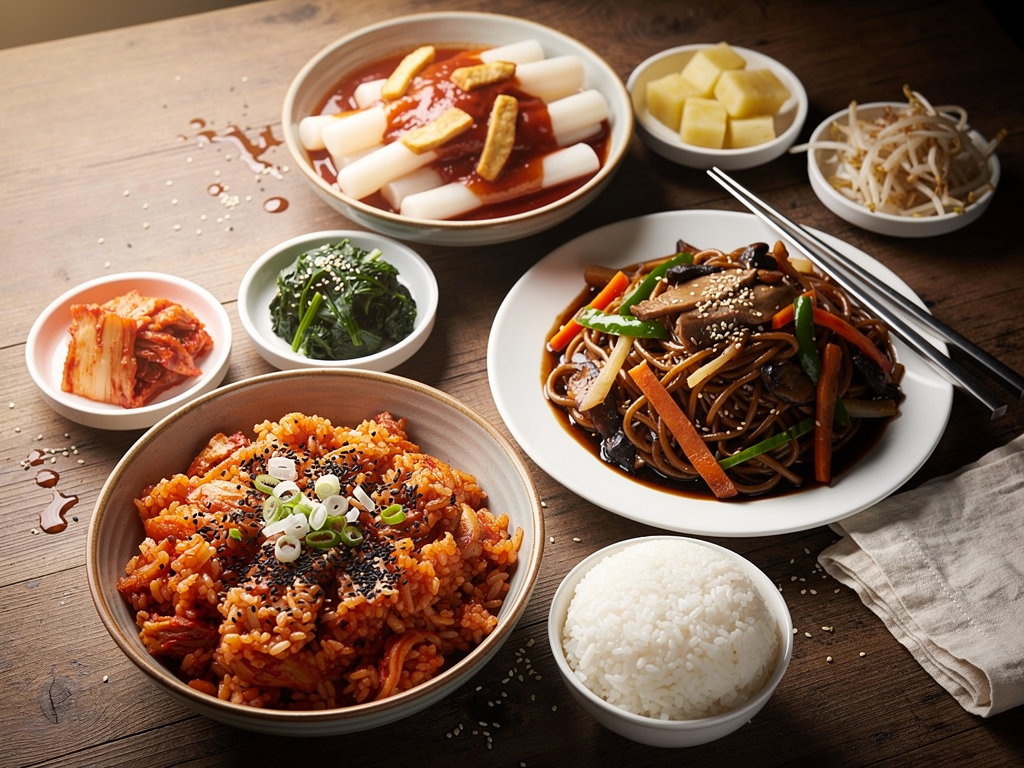
The Korean Restaurant (Hanok) in International City is the only menu found in the UAE selling dakbokkeumtang, the spicy braised-chicken stir-fry that is a staple back in Korea, at AED 83. Its Ojingeo stir-fry is AED 48 and Tteokbokki AED 46, both sitting well under its AED 80–110 hot pots. It is a drive from most of new Dubai, so factor that in.
Manna Land in Al Nahyan, Abu Dhabi is the only menu found selling nakji bokkeum — stir-fried baby octopus in spicy sauce, AED 58 — and it is the source of the variant spelling above. The rest of its menu leans heavily towards jeongol at AED 78 to 158, so this is a one-dish stop for the method rather than a range.
The Skewers on Hamdan Street in Abu Dhabi has the cheapest cooked dish found anywhere in this research: Kimchi Fried Rice at AED 34. Japchae is AED 40, Jajangmyeon AED 38, Cheesy Tteokbokki AED 42 and Haemul Tteokbokki AED 44. It uses no Korean method words at all, so searching its menu for “bokkeum” returns nothing even though several dishes are exactly that. Prices are printed above the dish names rather than beside them.
Confirm current prices and halal status directly at any venue — menus move, and several of these were last read in September 2026.
For the venue-by-venue rankings rather than the method, our guide to the best Korean fried rice in Dubai covers the bokkeumbap side properly.
Our guide to Korean noodles in Dubai places bokkeum myeon within the wider noodle family.
The stir-fried glass-noodle dish gets its own treatment in our japchae explainer. And if you like the idea of sauce over rice but drier still, our dupbap explainer covers the rice-bowl format.
There is also solid background reading on bokkeum, on Korean cuisine more broadly, and on Korean fried rice.
A note on ordering it well
Two small things make a bokkeum dish better, and neither costs anything. First, order it to share rather than as an individual main — the sauce-to-rice ratio is built for a table dipping in, and a solo portion tends to run dry by the last third. Second, order plain rice alongside anything that is not already rice-based. A nakji bokkeum or an ojingeo bokkeum is seasoned to be eaten with rice, not instead of it, and eating it alone is the most common way UAE diners end up finding it too salty or too hot. Understanding what is bokkeum is partly understanding that the dish is designed as one half of a pairing.
The one-line version
Bokkeum tells you the plate will arrive drier, stickier and faster than a stew or a braise, and that it will almost certainly be the cheapest hot thing on the menu. That is what is bokkeum in practice: one syllable that works as a flavour predictor, a texture predictor and a price predictor at the same time.
FAQ
What does bokkeum mean in Korean food?
Stir-fried. High heat, shallow pan, constant movement, sauce reduced until it coats the ingredients rather than pooling as liquid. It is a method word, not a dish.
Why do UAE Korean menus spell bokkeum differently?
Because Korean romanisation is not standardised on menus. The same syllable 볶음 appears as bokkeum, bokkum, bokum, bokkeom and boggeum. Manna Land prints “BOKKUM,” Mukbang Shows prints “Bokkeum,” and The Skewers skips the word entirely in favour of plain English.
Is tteokbokki a type of bokkeum?
Yes. The name is tteok (rice cake) plus bokki, a sound-shifted form of bokkeum — so tteokbokki literally means stir-fried rice cakes. It runs AED 42 to 55 across UAE menus.
Which is cheaper, bokkeum or Korean BBQ?
Bokkeum, consistently. Stir-fried rice and noodle dishes run AED 34 to 59, while unlimited Korean BBQ runs AED 69 to 129 per person. The method sits at the price floor of every menu checked because it is fast and stretches protein.
Does Mukbang Shows serve halal bokkeum?
Yes. All five branches are 100% halal, with no pork on the premises and no alcohol served. Its Jeyuk Bokkeum is made with beef rather than the pork used in Korea.
What is the difference between bokkeum and jjigae?
Texture and how you eat it. Both often share a gochujang base, but a jjigae stays liquid and is eaten with a spoon alongside rice, while a bokkeum reduces until it is dry enough for chopsticks and is usually eaten over the rice.
Where can I find nakji bokkeum or dakbokkeumtang in the UAE?
Manna Land in Abu Dhabi is the only menu found selling nakji bokkeum, at AED 58. Hanok in International City is the only one found selling dakbokkeumtang, at AED 83. Neither is on the Mukbang Shows menu.
Related guides
More from our Korean food guides across the UAE: