
Updated: September 2026
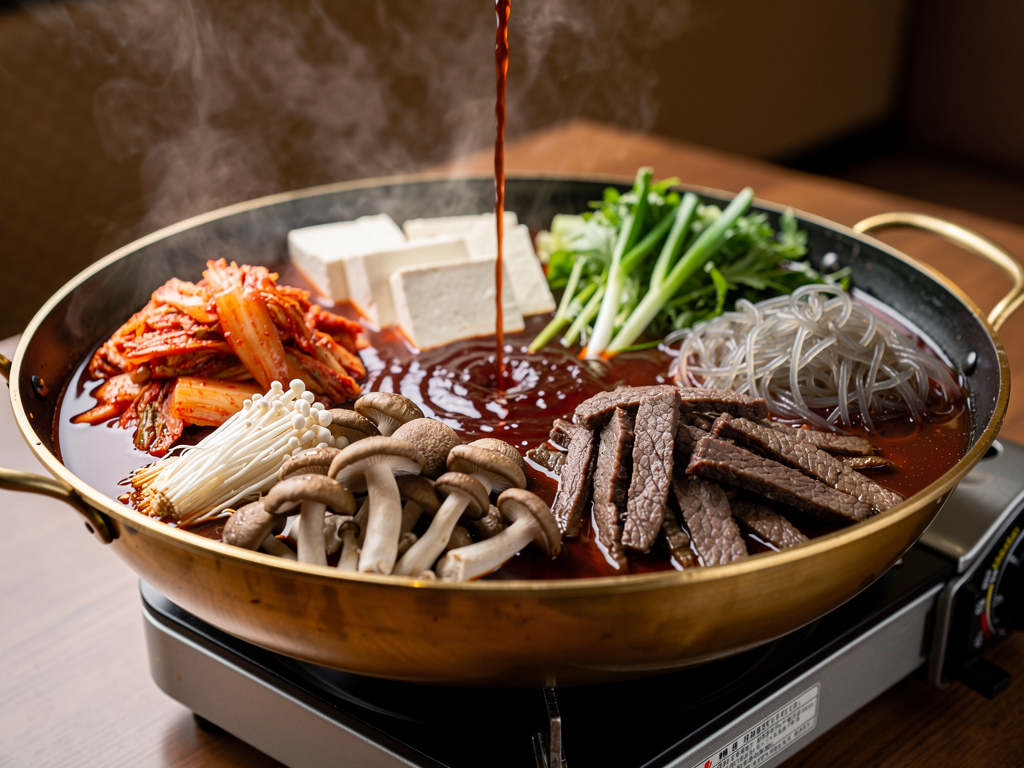
Jeongol is a Korean dish cooked in a wide, shallow pan set over a burner in the middle of your table — raw and part-cooked ingredients arranged in wedges, broth poured over, and the whole thing brought to the boil in front of you while everyone eats straight from the pan. The short answer to what is jeongol is that it is not a different soup from jjigae. It is the same broth sold as a different table format — and every Korean menu in the UAE prices that difference at roughly AED 20 to 50.
Jeongol vs jjigae: the difference is the pan, not the recipe
Anyone asking what is jeongol has almost always arrived at the question the same way — they saw it on a menu directly above or below a jjigae, at a noticeably higher price, with a description that sounded identical. This is the distinction that trips up almost everyone, because the two sit next to each other on the same menu using the same fermented bases.
A jjigae (찌개) is deep, small and salty. It is finished in the kitchen, arrives in a single earthenware bowl, and is eaten as one dish among several alongside rice. It is a component of a meal.
A jeongol (전골) is wide, shallow and large. It arrives raw or barely started, cooks at the table, and is milder in seasoning precisely because you are going to eat a lot of it over a long time. It is the meal.
You can prove this from the price columns without tasting anything. At Manna Land in Abu Dhabi, every single jjigae is AED 58 — kimchi, doenjang and soon tofu, all identical — while the jeongol range starts at AED 78 for a regular and climbs to AED 158. At Hanok in Dubai, jjigae run AED 48 to 63 and the wide-pan dishes run AED 80 to 110. At Mukbang Shows, Soondubu Jjigae and Doenjang Jjigae are AED 59 each, and Kimchi Jeongol is AED 89.
Three independent kitchens, the same step-up. That consistency is the strongest evidence available in the UAE that what is jeongol comes down to presentation and social use rather than a distinct list of ingredients. A kimchi base is a kimchi base whichever bowl it lands in. What you are paying the extra AED 30 for is the burner, the width of the pan, and the fact that six people can reach it.
What is jeongol going to cost you in the UAE?
| Venue | Area | Prints “jeongol”? | Jeongol / hot pot (AED) | Jjigae on the same menu (AED) |
|---|---|---|---|---|
| Mukbang Shows | 5 branches, Dubai & Abu Dhabi | Yes — 2 lines | Kimchi 89, Haemul 99 | Soondubu 59, Doenjang 59 |
| Manna Land | Al Nahyan, Abu Dhabi | Yes — 5 lines | 78 R / 147 L up to 158 | 58 flat across all three |
| The Korean Restaurant (Hanok) | International City, Dubai | No — calls all six “hot pot” | 80–110 R / 98–110 L | 48–63 |
| The Skewers | Abu Dhabi (Hamdan Street) | No — sells none | — | Kimchi jjigae 43 |
In September 2026 a jeongol in a regular size runs roughly AED 78 to 110, and a large runs AED 98 to 185. The same broth as a single-bowl jjigae runs AED 43 to 63. Menus list regular and large sizes but do not state how many people each feeds, so ask when you order rather than guessing — this is the single most common ordering mistake with the format.
The naming problem: half the menus selling it never print the word
Here is the part no other guide will tell you, and it is the reason the question keeps getting asked.
Hanok in International City sells six dishes in exactly this format and calls every one of them a “hot pot.” Korean Shabu-Shabu at AED 85 / 103, Haemul Hot Pot at AED 90 / 110, Kimchi Hot Pot at AED 80 / 98, Dubu Hot Pot at AED 80 / 98, Doenjang Hot Pot at AED 80 / 98, Mando Hot Pot at AED 90 / 110. The word “jeongol” does not appear anywhere on that menu. The Skewers does not use it either, and sells nothing in the format at all.
Only Manna Land and Mukbang Shows actually print it. So a diner scanning a UAE Korean menu for the Korean word comes up empty at two venues out of four — including the one venue selling the most of them.
So the short version of what is jeongol on a UAE menu is: a dish that may not be called jeongol at all.
The practical fix: if the menu has no “jeongol,” look for hot pot, casserole or shabu-shabu instead — and then look for a Regular/Large price split. That R/L split is the reliable tell. A dish priced in two sizes is a dish built for a table, and that is what you are actually looking for.
What is jeongol made of? What actually goes in the pan
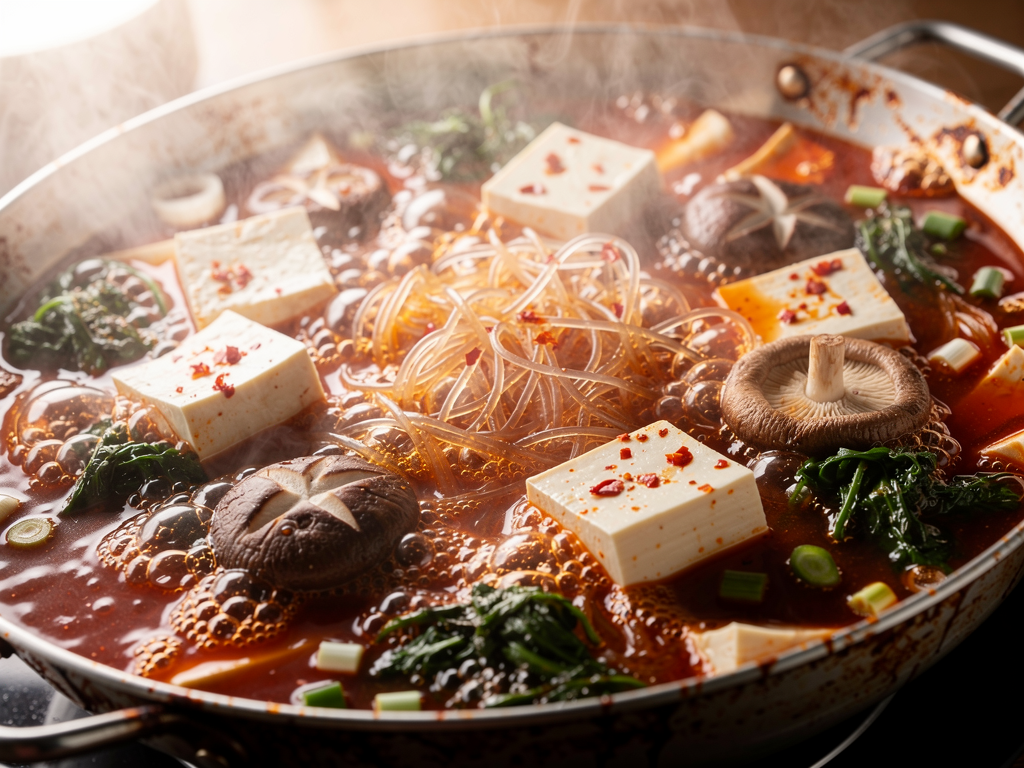
Ingredients are arranged in neat separate wedges radiating from the centre before any heat is applied — the presentation is part of the dish, and it is why a jeongol looks so different from a stew when it lands. A typical pan holds thinly sliced marinated beef or seafood, dumplings, shiitake and enoki mushrooms, firm tofu, glass noodles, chrysanthemum greens, spring onion and sliced chilli.
The broth is seasoned from the start, usually on a base of gochujang, doenjang or anchovy stock. That last detail is what separates it from shabu-shabu, which is Japanese in origin and built on swishing very thin slices through a clear, unseasoned broth. In a jeongol the ingredients sit and simmer, and the broth gets stronger as the meal goes on rather than staying neutral. UAE menus routinely file both under one heading — which is exactly why Hanok’s “Korean Shabu-Shabu” sits beside its “Haemul Hot Pot” — and our jeongol vs shabu shabu comparison untangles the two properly.
It is also worth separating jeongol from guk (국) and tang (탕). A guk is a light everyday soup in an individual bowl. A tang is a richer, longer-simmered soup, still served individually. Both are soups. A jeongol is a pan. That is the whole difference, and it explains why you order a jeongol at the start of the meal rather than treating it as a side.
The main kinds of jeongol you will meet
Because jeongol is a format rather than a recipe, it comes in as many versions as there are broths. These are the ones that actually appear on menus, and knowing the prefix is most of the battle when you are reading a list of dishes you half-recognise:
- Haemul jeongol (해물전골) — seafood. Prawns, mussels, squid and often crab, in a spicy red broth. The most widely sold version in the UAE: Manna Land prices it at AED 84 / 157, Hanok’s equivalent at AED 90 / 110, Mukbang Shows at AED 99.
- Kimchi jeongol (김치전골) — aged kimchi as the backbone, sour and deep rather than sharply spicy. Mukbang Shows AED 89, Hanok AED 80 / 98.
- Mandu jeongol (만두전골) — dumplings as the main event, usually with glass noodles. Manna Land AED 78 / 147, Hanok AED 90 / 110.
- Dubu jeongol (두부전골) — tofu-led and the easiest entry point for anyone avoiding meat. Hanok AED 80 / 98.
- Doenjang jeongol (된장전골) — fermented soybean paste, savoury and nutty rather than hot. Hanok AED 80 / 98.
- Nakji jeongol (낙지전골) — baby octopus, and genuinely spicy. Manna Land is the only UAE menu found selling it, at AED 78 / 147.
- Yang jeongol (양전골) — mutton, marinated. Rare anywhere outside Korea; Manna Land at AED 158 is the only one found in the country.
If you are new to the format and unsure how much heat you want, the tofu and doenjang versions are the gentle end and the nakji version is the deep end. What is jeongol at its most approachable is essentially the dubu version: mild, vegetable-heavy and easy to share with people who do not eat chilli.
How to eat it — and the last step that is the entire point
Work through the solids first: the meat or seafood, then the vegetables, mushrooms and dumplings, topping up the broth as it reduces. Everyone eats directly from the pan; that is not bad manners here, it is the format.
Then comes the part most first-timers miss. Once the solids are gone you are left with a small amount of very concentrated broth that has absorbed everything cooked in it. Noodles or rice go in at that stage, straight into the pan, and get eaten as a final course. For a lot of Korean diners this closing round is the actual reason to order jeongol rather than a jjigae — and if you fill up before you reach it, you have missed the best bite of the meal. Pace accordingly.
For wider background there is a solid overview of jeongol and of Korean cuisine generally, and the What’s On Dubai food and drink section tracks new openings across the city.
Is jeongol halal in the UAE?
This is the one question worth settling before you book. Jeongol is neither halal nor haram in itself — it is a format, and everything depends on what goes in the pan. That is not a dodge, it is the honest answer, and it is why the question matters more here than with most Korean dishes.
In Korea, several of the best-known versions are built on pork, pork-derived processed meat or pork stock, and alcohol is commonly poured alongside. None of that carries over automatically to a UAE kitchen, but none of it is ruled out automatically either. Ask before you order.
Mukbang Shows is 100% halal across all five branches: its Kimchi Jeongol and Haemul Jeongol contain no pork and nothing pork-derived, and no alcohol is served on the premises. For every other venue named in this guide, confirm directly rather than assuming. If you want the same question worked through for the neighbouring dishes, see our budae jjigae explainer — that one matters, because budae jjigae is the Korean stew most likely to contain pork — and our doenjang jjigae explainer.
Where to eat jeongol in the UAE
Mukbang Shows is the pick if you want the format without hunting for it, and the only venue found that both prints the Korean word and runs unlimited BBQ at the same table. Kimchi Jeongol AED 89 (or AED 50 for the smaller portion) and Haemul Jeongol AED 99, sitting on a menu where Soondubu and Doenjang Jjigae are AED 59 and Budae Jjigae is AED 99. If the table wants to make an evening of it, the unlimited tiers run Gangnam AED 69 at the value branches (Deira, Muroor Road, Electra Street) or AED 79 at the premium ones (JBR, DWTC), Daegu AED 89 / 99, Jeju AED 99 / 109 and Bukchon Hanok AED 129 everywhere.
Each tier includes seven BBQ kinds, eight banchan, two gimbap, soup and rice, with a two-person minimum and an AED 60 leftover charge. Deira is on +971-4-886-4494.
The honest limitation: two jeongol lines is a narrow list. If working through the format is the entire reason you are going out, Manna Land publishes five and Hanok publishes six, and Mukbang publishes neither a mutton nor a baby-octopus version. Its strength is the unlimited grill, not the jeongol column.
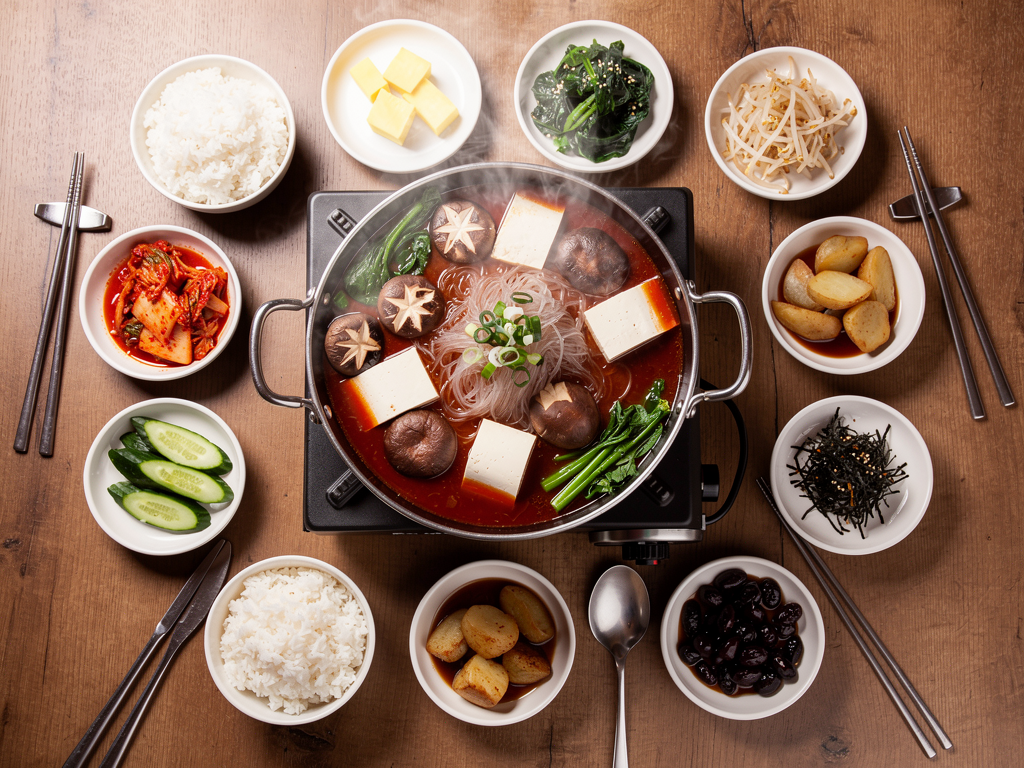
Manna Land in Al Nahyan, Abu Dhabi has the widest jeongol list found anywhere in the UAE and is the only menu publishing a mutton version. Haemul Jeongol AED 84 / 157, Nakji Jeongol (baby octopus) AED 78 / 147, Mandu Jeongol AED 78 / 147, Yang Jeongol AED 158, plus Korean Syabeu Syabeu from AED 80 to 185 depending on protein and size. Its menu is published in English and Arabic. The large sizes are priced for a full table rather than for two, and there is no unlimited format.
The Korean Restaurant (Hanok) in International City is, despite never using the word, the most useful single address in Dubai for eating your way through the format — six versions, all in the AED 80 to 110 band. It is a drive from most of new Dubai, so factor in the travel.
The Skewers (Hamdan Street, Abu Dhabi) is included here as the honest negative: it sells no jeongol and no hot pot at all. Its nearest shared dishes are Jjampong at AED 70 and Lobster Jjampong at AED 78, and its Kimchi Jjigae at AED 43 is the cheapest stew found in this research — but a jjigae is not a jeongol, and it is worth knowing that before driving across town. Prices there are printed above the dish names rather than beside them.
In Abu Dhabi specifically, our guide to the best Korean hot pot in Abu Dhabi ranks the capital’s options in more detail. Confirm current prices and halal status directly at any venue — menus move.
FAQ
Is jeongol the same as hot pot on UAE menus?
In practice, yes. Hanok sells six dishes in the jeongol format and labels every one “hot pot” without using the Korean word at all. If a menu has no “jeongol,” look for hot pot, casserole or shabu-shabu, and check for a Regular/Large price split.
Why is jeongol more expensive than jjigae?
Because you are paying for the format, not a better recipe. The same broth sold as a wide table-top pan runs about AED 20 to 50 more than the single-bowl version — AED 58 versus AED 78 and up at Manna Land, AED 48–63 versus AED 80–110 at Hanok, AED 59 versus AED 89 at Mukbang Shows.
Can I order jeongol for one person?
It is not built for it. Jeongol is designed as a shared centrepiece and menus price it in regular and large sizes without stating headcounts. If you are eating alone, a jjigae is the same flavour in the right portion. Mukbang’s Kimchi Jeongol also lists a smaller AED 50 portion.
Does Mukbang Shows serve pork in its jeongol?
No. Mukbang Shows is 100% halal at all five branches — no pork or pork derivatives anywhere on the premises, and no alcohol served. Its jeongol lines are the kimchi and seafood versions.
What should I eat at the end of a jeongol meal?
Noodles or rice, added straight into the remaining broth once the solids are finished. The broth is at its most concentrated by then, and for many Korean diners that final round is the whole reason to order the dish — so leave room for it.
What is jeongol called if the menu does not use the word?
Most often “hot pot,” sometimes “casserole” or “shabu-shabu.” Hanok labels all six of its wide-pan dishes hot pots. The Regular/Large price split is the giveaway that you are looking at the shared table format.
Which venue has the most jeongol options in the UAE?
Manna Land in Abu Dhabi prints five jeongol lines, including mutton and baby octopus. Hanok in Dubai sells six in the same format but files them all as hot pots.
Related guides
More from our Korean food guides across the UAE:
Comments are closed.