
Updated: September 2026
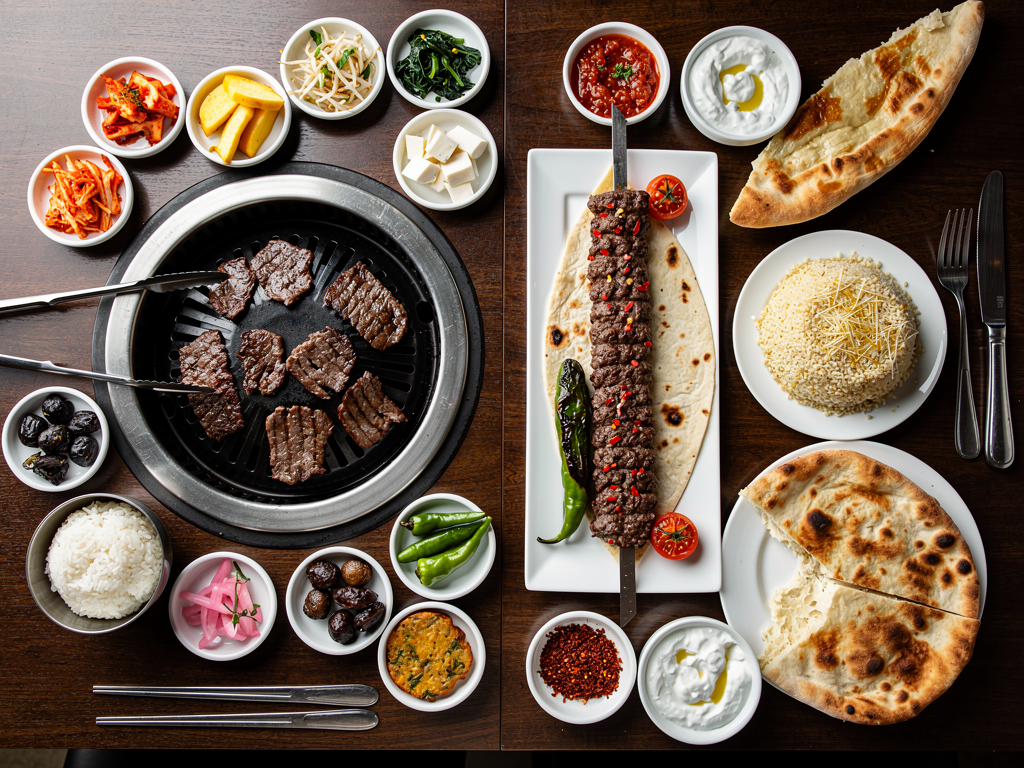
Korean food vs Turkish food comes down to what the menu is counting. A Turkish grill in Dubai is priced by the portion and, at Sultan Saray, by the metre — Kabab 1/2 m AED 154, Kabab 1 m AED 298 — with the rice, bread and mezze as separate lines. A Korean table is priced by the person, rice and sides inside: AED 69 a head at Mukbang Shows’ unlimited Korean BBQ. Two kebabs and a mezze for two run AED 204–335; two seats at Mukbang are AED 138.
TL;DR
– Turkish menus count the meat, by portion or by the metre, and bill the sides; Korean menus count the eater and include rice and banchan.
– The Turkish breakfast spread is the one Turkish table priced like a Korean one — Çeşme Bazlama’s set is Dhs116 per Time Out.
– Turkish is bread, lamb and yogurt; Korean is rice, beef and almost no dairy. Both are sour: Korea ferments vegetables, Türkiye ferments milk.
– Korean wins from two up on the all-in bill and on halal certainty at Mukbang; Turkish wins solo, for lamb, bread and breakfast.
What is the difference between Korean food and Turkish food?
Korean food is a rice cuisine built on fermentation — kimchi, gochujang, doenjang, soy — with beef and chicken cooked on a grill set into the table and a spread of free small dishes called banchan around every meal. Turkish food is a bread cuisine built on the charcoal grill and the oven — lamb kebabs, pide and lahmacun, yogurt on and beside everything, brine pickles, syrup pastry — shaped over four centuries in the Ottoman kitchens.
It is not Arabic food: Türkiye is not an Arab country, and the portal’s Korean food vs Arabic food guide is a different comparison.
This guide does not try to settle which tastes better in the korean food vs turkish food argument. It settles what a UAE menu can prove: what a meal costs, what the price is counting, where the bread and the rice sit, which animal is on the grill, and who is doing the grilling.
Why does korean food vs turkish food pricing count different things?
Because a Turkish menu sells meat by quantity and a Korean menu sells the seat. Sultan Saray — the Sheikh Zayed Road room Time Out calls “a repeat winner of the Best Turkish Restaurant in Dubai award” — prints its grill in portions: Adana Kabab AED 72, Urfa Kabab 72, Lamb Shish 78, Chicken Shish 68, Lamb Chops 92, Mixed Grill 88, Iskandar Kabab 78, Beyti 88, Ali Nazik 84. Then, at the foot of the same list, it prints the grill by length: Kabab 1/2 m AED 154, Kabab 1 m AED 298, Mix Kabab 1/2 m AED 308, Mix Kabab 1 m AED 578. A kebab sold by the metre is the clearest possible statement that the price is counting meat, not eaters.
Everything around the meat is its own line: Turkish Rice AED 32, Bulgur 24, Hummus 32, Mutabal 32, Haydari 48, Sultan Mix Appetizers 86, Royal Appetizers 142, Lentil Soup 26, pide 36–60, Lahmacun 36. Bebek in Jumeirah 3 prints the same structure on a higher ladder — Adana Kebab AED 125, Lamb Shish 125, Lamb Skewers 160, Chicken Shish 115, Mix Grill 436; Rice 25; Hummus 39, Mix Meze 95; Kavurma Pide 91, Lahmacun 69.
A Korean table works the other way round. Mukbang Shows’ unlimited Korean BBQ is AED 69 per person at Deira, Muroor Road and Electra Street (AED 79 at JBR and DWTC), and that number includes seven kinds of beef and chicken, eight banchan, two gimbap, soup and steamed rice. On an à la carte Korean menu the main still arrives with rice and sides: Hanok’s Bibimbap in International City is AED 53 to 55 with banchan on the table.
The worked sums, from the menus as printed:
| Two people at… | What you order | Bill | Per head | Rice and sides |
|---|---|---|---|---|
| Sultan Saray, Sheikh Zayed Road | Adana Kabab 72 + Chicken Shish 68 + Hummus 32 + Turkish Rice 32 | AED 204 | AED 102 | bought as lines |
| Bebek, Jumeirah 3 | Adana Kebab 125 + Chicken Shish 115 + Mix Meze 95 | AED 335 | ~AED 168 | mezze bought as a platter |
| Sultan Saray, the metre | Kabab 1/2 m 154 | AED 154 | priced by length, not by head | rice and mezze extra |
| Mukbang Shows, Deira / Abu Dhabi | 2 × Gangnam unlimited BBQ 69 | AED 138 | AED 69 | included — 8 banchan, soup, rice, 2 gimbap |
| Hanok, International City | 2 × Bibimbap 53–55 | AED 106–110 | AED 53–55 | banchan included |
One caveat on the Sultan Saray row: its menu does not print what, if anything, arrives with a kebab, so the rice is added here as the line the menu prints. The half-metre row cannot be turned into a per-head price without guessing how many it feeds, so this guide does not.
Which is better value, Korean food or Turkish food?
For one person, Turkish. A solo diner at Sultan Saray eats a Lahmacun for AED 36, a Durum Chicken for AED 44, a Chicken Doner Meal for AED 64, or a Lentil Soup and a Simit for AED 50. Unlimited Korean BBQ at Mukbang Shows has a two-person minimum, so the cheapest Korean table there is AED 138, and a solo Korean meal means à la carte — Bibimbap at Hanok AED 53–55, at Manna Land in Abu Dhabi AED 58.
For two, Korean — on these menus. Two kebabs, a mezze and a rice at Sultan Saray come to AED 204; the same shape at Bebek to AED 335; two seats at Mukbang with the grill running all evening to AED 138. The gap is the model: on the Turkish bill every side is a line, on the Korean one the sides are inside the seat.
For a large table in korean food vs turkish food terms, the Turkish answer is to buy more metres or a whole animal — Sultan Saray prints a Walemah Kharouf, a whole lamb for the table, at AED 990 — and the Korean answer is more seats at AED 69 each. The portal’s Korean BBQ vs mixed grill guide makes the same who-pays-for-what argument against the Levantine platter.
Is the Turkish breakfast the bridge between the two cuisines?
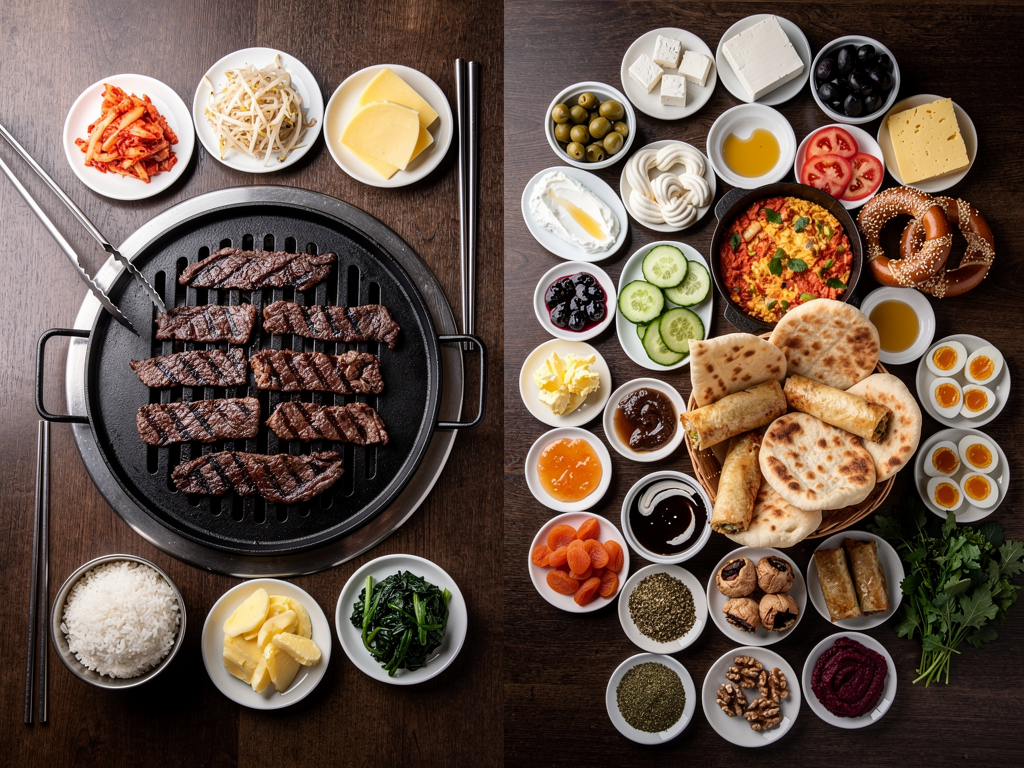
Yes — serpme kahvaltı, the “spread” breakfast, is the one Turkish table priced like a Korean one. Dozens of small plates — cheeses, olives, honey and kaymak, jams, menemen, sucuk, börek, tomatoes and cucumbers — arrive around fresh bread at one price, with tea that does not stop. That is the banchan logic in bread-and-cheese form: the small dishes are inside the price, not on the bill. The Turkish breakfast tradition is a weekend institution in Türkiye long before it is a Dubai menu item.
Çeşme Bazlama Kahvaltı in Al Safa — six branches in Türkiye, one in a Jumeirah villa — is Time Out’s pick: “Order the set menu at just Dhs116 and delight as plate after plate is served to you… The food just keeps on coming”, and of founder Anne Nurten, “you don’t leave until you are full.” That last line is the unlimited-table promise with a Turkish accent. Sultan Saray prints a Sultan Breakfast at AED 158 and a Royal Breakfast at AED 288 (its menu does not print a head count); Bosporus’s own menu lists breakfasts “for 1 person”, “for 2 persons” and “for 4 persons”.
So the honest reading is: at dinner, Turkish counts the meat and bills the table by the line, while Korean counts the seat; at breakfast, Turkish counts the table too, and the two cuisines meet. The tell for a reader: a Turkish menu that says “for 2 persons” or “set menu” is pricing like a Korean one; a Turkish menu that says “1/2 m” is not.
Bread or rice, lamb or beef, yogurt or none?
Bread. Turkish is a bread cuisine — the meal starts with hot bread, and the oven is a whole section of the menu. Sultan Saray prints seventeen pide (Cheese & Vegetable 48, Cheese & Sujuk 54, Mixed Meat 60, Chicken 52), Lahmacun 36, Simit 24 and Simit & Omelette 46; Bebek prints Kavurma Pide 91, Cheese Pide 65, Lahmacun 69. A Korean table has no bread at all — rice, always, and at Mukbang the rice is inside the price; on a Turkish menu the rice is a side line (Sultan Saray Turkish Rice 32, Bulgur 24; Bebek Rice 25).
Lamb. The Turkish grill leads with it — Adana and Urfa are hand-minced lamb on flat skewers, then lamb shish, lamb chops (Sultan Saray 92), Bebek’s Lamb Skewers 160, and the whole lamb at 990. Chicken shish is the lighter option; beef appears as döner and as steaks (Sultan Saray New York Strip 168, Rib-Eye 188). Korean BBQ is beef-led — bulgogi, brisket, and galbi, the short rib — with chicken beside it. Mukbang’s seven grill kinds are beef and chicken and it serves no lamb, which is the honest limitation on this page for a Turkish-food regular.
Yogurt. Turkish cooking runs on dairy: haydari and cacık on the mezze list (Sultan Saray Haydari 48, Yoghurt & Cucumber 24), ayran to drink (AED 16), the yogurt and butter poured over an iskender (Sultan Saray 78), the smoked-aubergine yogurt under an ali nazik (Sultan Saray 84, Bebek 135), kaymak with honey at breakfast. Savoury Korean cooking has almost none; the only cream on a Korean menu is on the dessert list.
How does each cuisine make sour, and who does the grilling?
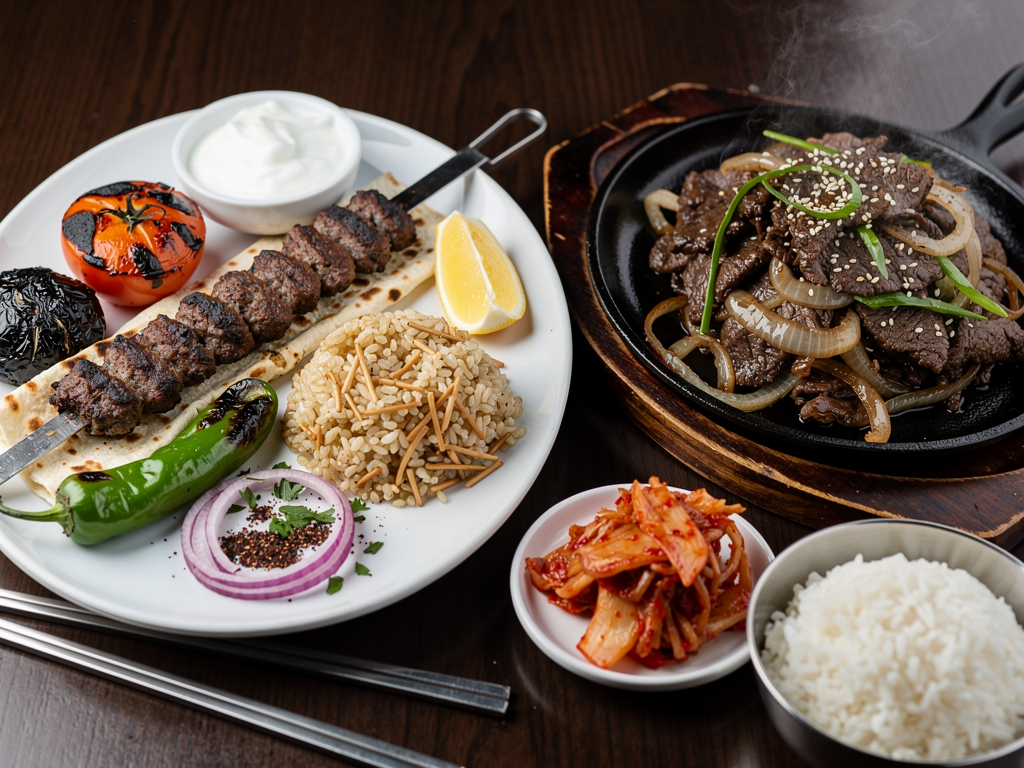
Both are sour cuisines from different substrates. Korea ferments vegetables — kimchi, and the soybean pastes doenjang and gochujang — and eats them as the side dishes; the portal’s banchan explainer covers the roster, and banchan vs mezze sets it against the Levantine table. Türkiye ferments milk — yogurt, ayran, kefir — and brines vegetables into turşu, served in small dishes beside the grill. Kimchi and turşu are the same instinct, a sour vegetable next to grilled meat, with weeks of fermentation on one side and salt brine on the other.
Heat follows the same split: Turkish heat is pul biber flakes and Urfa’s dark isot pepper, sprinkled and moderate (acı ezme, Bebek AED 39, is the hot mezze); Korean heat is gochugaru and gochujang, fermented and central.
The grill is where the two cuisines look most alike and are most different. Turkish grilling is an ocakbaşı — a charcoal hearth in the kitchen or behind a counter, worked by an usta; Time Out notes Sultan Saray’s “touch of theatre… thanks to the table-side service”, but the cooking is done for you and the kebab arrives finished.
Korean BBQ sets the grill into the table and hands you the tongs; at Mukbang Shows the beef and chicken arrive raw and you cook them over the eight banchan, and the Korean BBQ etiquette guide explains how that works. Hanok’s menu even prints the choice — Galbi Gui AED 115, “table top or kitchen grilled”.
Two smaller meetings. Mantı and mandu are the same Central Asian dumpling by two roads — Turkish mantı tiny and boiled under yogurt and paprika butter (Sultan Saray AED 70), Korean mandu larger, steamed or fried (Mukbang AED 48, Hanok AED 35; see our mandu explainer). And dessert: syrup-and-nut pastry — Sultan Saray Baklawa 38, Katmer with Honey 54, Sultan Kunafa 62 — against shaved ice, Mukbang Bingsu 37 and Hanok 20–25, a pair the portal already argues in bingsu vs kunafa.
Is korean food vs turkish food a halal question?
Only in the sense that it needs stating carefully. Türkiye is a Muslim-majority country and Turkish cuisine is built on lamb, beef and chicken; on the UAE menus read for this guide (Sultan Saray, Bebek) every meat line is lamb, beef or chicken and no pork line appears anywhere. That is an observation about the printed menus, not a certificate for any Dubai restaurant — confirm directly.
Licence labels come from Time Out’s March 2026 Turkish list and nowhere else: Blue Door (the 2026 winner, Delano Dubai), Günaydın (Souk Al Bahar), Sirali (Al Habtoor City), Asil and Rüya are listed as licensed venues (alcohol served); Askim, Çeşme Bazlama Kahvaltı, Istanbul Flower, Sultan Saray, Bosporus and Ziyafet as unlicensed. Bebek is listed as unlicensed by Time Out while its own menu site carries a “Sparkling Wine & Beer” heading, so this guide prints no label for it — confirm directly. A licence label is not a halal ruling either way.
The Korean side has a clear case. Mukbang Shows is beef and chicken only, no pork anywhere on the menu, no alcohol served, on every tier and every à la carte line. For the wider Korean picture, see whether Korean food is halal.
Where to try Korean food in the UAE
Mukbang Shows Restaurant has five branches: Deira (Al Ittihad Rd, Port Saeed, +971-4-886-4494), JBR (Plaza Level, Bahar 3, The Walk, +971-54-523-1898) and DWTC (The Apartments Block A, Sheikh Zayed Rd, +971-54-524-5904) in Dubai; Muroor Road (547 Sultan Bin Zayed The First St, Al Danah, +971-50-158-9433) and Electra Street (Zayed The First St, behind Sun and Sand Sports, +971-2-564-0446) in Abu Dhabi. The DWTC branch is on the same Sheikh Zayed Road as Sultan Saray and Istanbul Flower, so the two grill models can be compared on one road.
The tiers: Gangnam AED 69 at Deira, Muroor and Electra (AED 79 at JBR and DWTC); Daegu adds Korean fried chicken at AED 89 / 99; Jeju adds the seafood boil at AED 99 / 109; Bukchon Hanok is AED 129 everywhere. Every tier includes seven BBQ kinds, eight banchan, two gimbap, soup and steamed rice; minimum two persons; AED 60 leftover charge. Premium meat sets run Seoul AED 189, Busan 225, Incheon 300; à la carte beef from Brisket AED 95 to Wagyu AED 115.
The honest limitation: no lamb, no bread, no yogurt on the savoury menu, no solo unlimited option, and no Turkish food of any kind. For à la carte Korean with banchan, Hanok in International City (Bibimbap AED 53–55, Galbi Gui AED 115, Mandu AED 35, Bingsu AED 20–25) and Manna Land in Al Nahyan, Abu Dhabi (Bulgogi Set AED 58, Galbi Gui Set AED 73, LA Galbi AED 110) are the reference points; the best Korean BBQ in Dubai guide covers the other grill rooms.
Where to try Turkish food in the UAE
Sultan Saray (Sheikh Zayed Road, 04 229 0600, daily 8am–1am; a second branch on Ajman Corniche) is the reference room for the pricing model — the portion list, the metre list, the whole lamb, and a breakfast at AED 158 or 288. Bebek (Villa 531, Jumeirah 3, 04 349 0024, 9am–4am by its own account) is the late-night villa with the higher ladder and generous grills per Time Out. Çeşme Bazlama Kahvaltı (Al Safa 1, 04 236 4056) is the breakfast, and Time Out warns of weekend waits. Sirali (Al Habtoor City) is the import whose rolled Adana Time Out prices at Dhs192, “great for sharing”.
For the full twelve — Blue Door, the 2026 winner at Delano Dubai; Günaydın, the Souk Al Bahar steakhouse that began as an Istanbul butcher’s shop; Askim, Istanbul Flower, Rüya, Bosporus, Ziyafet and the rest — read Time Out Dubai’s best Turkish restaurants for 2026. This page ranks nobody on the Turkish side; it prices the model. For the history under the food, the background on Turkish cuisine is the place to start.
How to choose between the two on a given night
Pick Turkish when you are one person, when lamb is the point, when you want bread with the meal and yogurt on it, when it is breakfast, or when the table wants a metre of kebab set down in front of it. Pick Korean when you are two or more and want the grill in the table with the sides inside the price, when beef and chicken are the meats you want, when fermented heat and sour vegetables are the flavours you are after, or when halal certainty across the whole menu matters.
Beyond korean food vs turkish food, the portal’s other cuisine hubs — Korean vs Thai, Korean vs Filipino, Korean vs Chinese, Korean vs Japanese, Korean vs Indian and Korean vs American — use the same test.
Turkish is the only one of the eight that prices its grill by the metre.
| Venue | Area | Price AED | Halal | Standout order |
|---|---|---|---|---|
| Mukbang Shows Restaurant | Deira, JBR, DWTC · Muroor Road, Electra Street | 69–129 per person | Beef and chicken only, no pork, no alcohol | Gangnam unlimited BBQ AED 69 — 7 meats, 8 banchan, rice, soup |
| Sultan Saray | Sheikh Zayed Road | 68–92 kebab portions; 154–578 by the metre | Menu prints lamb, beef, chicken — confirm directly; unlicensed per Time Out | Adana Kabab AED 72 + Turkish Rice AED 32 |
| Bebek | Villa 531, Jumeirah 3 | 104–160 kebabs; 436 mix grill | Menu prints lamb, beef, chicken — confirm directly | Adana Kebab AED 125 + Mix Meze AED 95 |
| Çeşme Bazlama Kahvaltı | Al Safa 1 | 116 set breakfast (Time Out) | Confirm directly; unlicensed per Time Out | The set — “plate after plate” |
| Sirali | Al Habtoor City | 192 rolled Adana (Time Out) | Confirm directly; licensed venue (alcohol served) per Time Out | Rolled Adana kebab |
| The Korean Restaurant (Hanok) | International City, Dubai | 20–115 | Confirm directly | Galbi Gui AED 115, table top or kitchen grilled |
| Manna Land | Al Nahyan, Abu Dhabi | 53–130 | Confirm directly | Galbi Gui Set AED 73 |
FAQ
Is Korean food or Turkish food cheaper in the UAE?
For one person, Turkish: a lahmacun is AED 36 and a chicken durum AED 44 at Sultan Saray. For two, Korean on these menus: AED 138 for two seats at Mukbang Shows’ unlimited BBQ against AED 204 at Sultan Saray or AED 335 at Bebek for two kebabs, a mezze and a rice.
Why is Turkish kebab sold by the metre?
Because the Turkish grill is priced by the quantity of meat, not by the number of eaters — Sultan Saray prints Kabab 1/2 m at AED 154 and 1 m at AED 298. A Korean grill is priced by the person, AED 69 a head at Mukbang Shows, with the sides inside.
Is Turkish breakfast like Korean banchan?
In the way it is priced, yes. A serpme kahvaltı puts dozens of small plates around bread at one set price — Dhs116 at Çeşme Bazlama per Time Out — which is the same logic as eight banchan inside a AED 69 Korean tier.
Does Korean BBQ have lamb?
Not at Mukbang Shows — its seven grill kinds are beef and chicken. The Turkish grill is lamb-led: Adana, Urfa, lamb shish, lamb chops, and a whole lamb for the table at Sultan Saray.
Do Korean restaurants serve bread?
No. Korean tables serve rice and banchan; there is no bread tradition at the table. Turkish tables start with hot bread, and pide and lahmacun are a section of the menu.
Is Turkish food spicy like Korean food?
No. Turkish heat is pul biber and isot pepper, sprinkled and moderate; Korean heat is fermented gochujang and gochugaru, central to the stews and the marinades.
Is Korean food halal in the UAE?
At Mukbang Shows, yes — beef and chicken only, no pork, no alcohol, on every tier and every à la carte line. Elsewhere, confirm directly.
Every price in this guide was read from the venue’s own menu page in September 2026, or is attributed to Time Out where noted. Menus change; what the price is counting — meat by the metre or eaters by the seat — is the thing to check before you compare.
Related guides
More from our Korean food guides across the UAE:
Comments are closed.