
Updated: September 2026
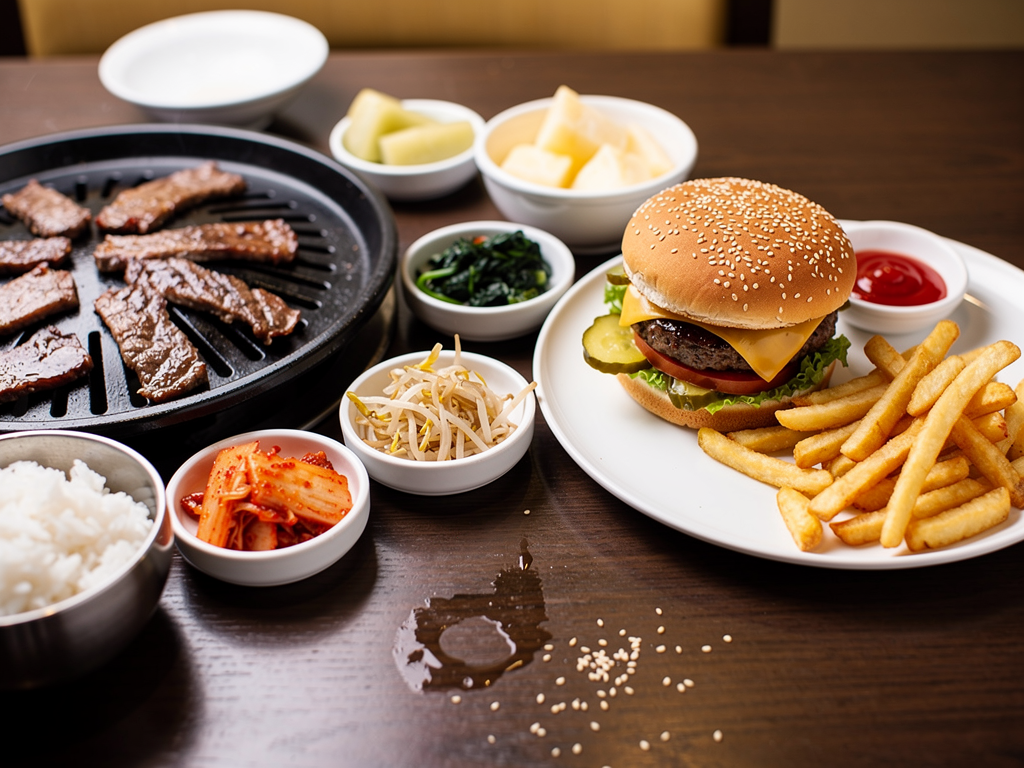
The most useful thing to know about korean food vs american food in the UAE is not about flavour. It is about how the bill is built. American food here is priced by the gram and the add-on; Korean food is priced by the table. A Texas Roadhouse sirloin is AED 89 for 6 oz and AED 164 for 16 oz, and the salad, the potato topping and the extra rib are each a line of their own. Unlimited Korean BBQ at Mukbang Shows is AED 69 per person with seven kinds of meat, eight side dishes, gimbap, soup and rice in the one number.
Everything else in this guide — where the two cuisines overlap, where they don’t, which is cheaper for one person and which for four, and what the halal picture looks like — follows from that.
The pricing model is the whole difference
Read the menus and the pattern is impossible to miss. Texas Roadhouse’s own UAE menu prints the same cut at four weights and four prices: Sirloin 6 oz AED 89, 8 oz AED 110, 11 oz AED 134, 16 oz AED 164; Ft. Worth Ribeye 10 oz AED 139, 12 oz AED 159, 16 oz AED 194; Bone-In Ribeye AED 269. Then the extras have their own lines — add a rib AED 62, add a wing AED 22, add shrimp AED 42, add a salad AED 18, load your potato AED 11.
Five Guys, on its Deliveroo listing, sells the hamburger (AED 45), the fries (little AED 22, regular AED 26, large AED 30) and the milkshake (AED 30) as three separate decisions. Black Tap, also on Deliveroo, does the same — All-American Burger AED 48, Idaho Fries AED 21, classic shake AED 28 — and prices every sauce at AED 2 to 4.
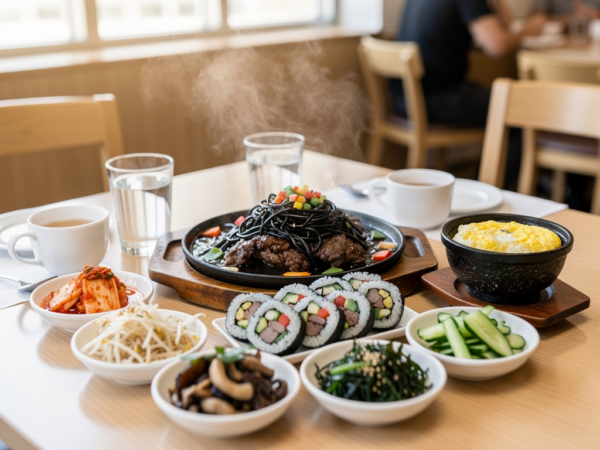
A Korean table runs the other way. Mukbang Shows’ unlimited Korean BBQ is AED 69 per person at Deira, Muroor Road and Electra Street (AED 79 at JBR and DWTC), and that one number includes seven kinds of beef and chicken for the grill, eight banchan, two gimbap, soup and rice. Manna Land in Abu Dhabi sells a Bulgogi Set at AED 58 and a Galbi Gui Set at AED 73 — one price for the meal. Even on a Korean a-la-carte menu the banchan tradition means the small plates of vegetables and pickles are part of the meal rather than a separate purchase you decide on.
So a one-person American meal is a sum. Cheeseburger + regular fries + shake at Five Guys = AED 106. All-American Burger + Idaho fries + classic shake at Black Tap = AED 97. A 6 oz sirloin + a house lemonade at Texas Roadhouse = AED 116 before any extra. A Korean table is a single figure: two people at Mukbang Shows on the AED 69 tier = AED 138 for the pair, unlimited grill, every side included. That is the spine of korean food vs american food here, and it decides most of what follows.
Where the two cuisines overlap: grilled beef, fried chicken, a pot of seafood
The korean food vs american food question gets more interesting once you look past the bill. For two cuisines from opposite sides of the world they meet in a surprising number of places, which is why this site already has five dish-level comparisons between them.
Grilled beef is common ground. Texas Roadhouse’s sirloin and ribeye, Hanok’s Galbi Gui at AED 115 in Dubai, Manna Land’s Galbi Gui at AED 130 in Abu Dhabi, and Mukbang Shows’ Rib Eye at AED 119 and LA Galbi at AED 109 are the same animal cooked over heat.
The difference is who cooks it. An American steakhouse cooks one thick cut in the kitchen to an ordered doneness and brings you a plate. A Korean BBQ table hands you thin slices — marinated for bulgogi and galbi, plain for the premium cuts — and a grill, and you cook as you eat. Our Korean BBQ vs Brazilian BBQ comparison covers the table-grill-versus-kitchen-grill question in full.
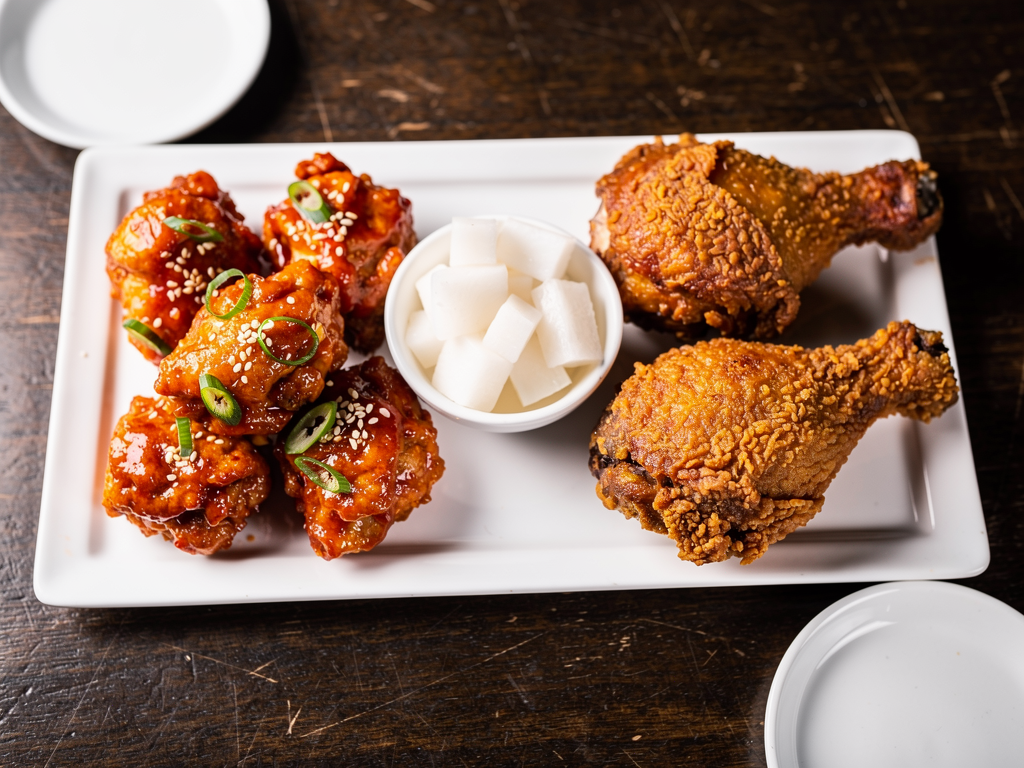
Fried chicken is the second overlap, and the one most people get wrong. Texas Roadhouse’s Country Fried Chicken is AED 84 and its Crispy Chicken Strips AED 74; Black Tap’s Original Tenders are AED 42. On the Korean side, Hanok’s fried chicken lines are AED 48 to 55, Manna Land’s AED 45, The Skewers’ Yangnyeom Chicken AED 40, and Mukbang Shows’ Fried Chicken AED 82 whole or AED 48 half.
The techniques are different: Korean fried chicken is double-fried in a thin, cracker-crisp crust and tossed in sauce after frying; American fried chicken is single-fried in a thick, seasoned flour crust and sauced, if at all, at the table. Our Korean fried chicken vs American fried chicken comparison goes through the method.
The seafood boil is the third. Both cuisines have a whole-pot boiled shellfish feast — the American Cajun boil spiced in the water and the bag, the Korean version dressed in a gochujang-garlic sauce. Mukbang Shows’ Seafood Boil is AED 187 for a trio or AED 87 solo. Our Korean seafood boil vs Cajun boil comparison has the detail.
Where they diverge: the side dishes, the vegetables, the dairy
American food has no equivalent of banchan — the several small plates of kimchi, seasoned and pickled vegetables that open a Korean meal. The American vegetable is a single side you choose and pay for: Five Guys’ Veggie Sandwich AED 25, Black Tap’s Caesar Salad AED 38, Texas Roadhouse’s Country Vegetable Plate AED 59. Korean food, for its part, has no equivalent of the burger, the steak-by-the-ounce or the milkshake.
The fermented pickle on the side of both plates shows the gap most clearly. Kimchi is the seasoning of the whole Korean meal — it is in the stew, on the grill, in the fried rice. The American dill pickle or sauerkraut is a garnish on a burger or a hot dog. Our kimchi vs sauerkraut comparison explains why two fermented cabbages ended up in such different jobs.
Then there is dairy. Cheese and milk are central to American food — the cheeseburger, the shake, the mac and cheese — and almost absent from traditional Korean food. Which is exactly why the cheese-topped dishes on a modern Korean menu (corn cheese, cheese dakgalbi, cheese tteokbokki) are Korea borrowing from America; Mukbang Shows’ Korean Corn Cheese is AED 39. Our Korean corn cheese vs mac and cheese comparison is the story of that borrowing.
The ten structural differences
- Pricing model. American: base item plus add-ons. Korean: one per-person table price, or a main with rice and banchan as part of it.
- Who cooks the meat. American: the kitchen, one thick cut, to order. Korean: you, thin slices, at the table.
- Side dishes. American: one side, chosen and charged. Korean: several small plates as part of the meal.
- Fried chicken. American: single-fried, thick crust, sauce optional. Korean: double-fried, thin crust, sauced after.
- Seasoning base. American: salt, smoke, sugar and dairy; chilli is a hot-sauce option. Korean: fermented pastes — gochujang, doenjang, ganjang — and chilli is structural.
- Sharing. American: plated per person. Korean: eaten from the centre of the table.
- Sweetness. American food is sweeter across the board — barbecue sauce, shakes, soft drinks by default. Korean sweetness lives in marinades and is balanced by sour and spicy.
- Starch. American meals are built on the bun and the potato. Korean meals are built on rice.
- Dairy. High in American food, near-absent in traditional Korean food; the cheese dishes on Korean menus are modern borrowings.
- The seafood boil. Both have one; the American is Cajun-spiced in the water, the Korean is dressed in gochujang and garlic.
Korean food vs american food: what it actually costs in the UAE
Every figure below is from the venue’s own menu or its Deliveroo listing, read in September 2026. The Deliveroo prices are delivery-listing prices, not a printed dine-in menu, and are marked as such.
| Venue | Cuisine | City | Model | Representative prices (AED) |
|---|---|---|---|---|
| Mukbang Shows | Korean | Dubai (Deira, JBR, DWTC) and Abu Dhabi (Muroor Road, Electra Street) | One per-person price, all included | Unlimited BBQ 69 / 89 / 99 / 129 (79 / 99 / 109 / 129 at JBR and DWTC); Fried Chicken 82 whole / 48 half; Seafood Boil 187 trio / 87 solo |
| Texas Roadhouse | American | Dubai (Dubai Mall, Festival City, Mirdif) and Abu Dhabi (Yas Mall) | By weight, add-ons priced | Sirloin 89–164 by oz; Ft. Worth Ribeye 139–194; All-American Cheeseburger 69; Country Fried Chicken 84; add a salad 18 |
| Five Guys (Deliveroo) | American | Dubai (Dubai Mall, JBR, Festival City, City Walk, Dubai Hills) and Abu Dhabi (Marina Mall) | Burger, fries, shake sold separately | Hamburger 45, Cheeseburger 50, Little Hamburger 35, fries 22–30, milkshake 30 |
| Black Tap (Deliveroo) | American | Dubai (Dubai Mall) and Abu Dhabi (Mamsha Al Saadiyat) | Burger, fries, shake, sauces sold separately | All-American Burger 48, Old Fashioned 59, Steakhouse 65, Idaho Fries 21, classic shake 28, sauces 2–4 |
| The Korean Restaurant (Hanok) | Korean | Dubai (International City) | A la carte | Bibimbap 53 / 55, Galbi Gui 115, fried chicken 48–55, Beef Fried Rice 40 |
| Manna Land | Korean | Abu Dhabi (Al Nahyan) | Sets and a la carte | Bulgogi Set 58, Galbi Gui Set 73, Bibimbap 58, fried chicken 45 |
| The Skewers | Korean | Abu Dhabi (Hamdan Street) | Value a la carte | Beef Bulgogi 43, Bulgogi Dupbap 38, Yangnyeom Chicken 40, Kimchi Fried Rice 34 |
Across the UAE an American chain main runs roughly AED 45 to 89 for a burger or chicken plate and AED 89 to 269 for a steak, with sides and drinks on top at AED 11 to 42 each. A Korean a-la-carte main runs roughly AED 34 to 130, and unlimited Korean BBQ runs AED 69 to 129 per person with everything included.
Which is cheaper — for one person, and for four?
This is where korean food vs american food stops being a draw. For one person, American wins, and it is not close. Five Guys’ Little Hamburger is AED 35, Black Tap’s All-American Burger AED 48, a 6 oz sirloin at Texas Roadhouse AED 89 — and none of them needs company. Unlimited Korean BBQ at Mukbang Shows has a two-person minimum, so the cheapest possible table there is AED 138. The only Korean options that compete for a solo diner are the a-la-carte ones: The Skewers’ Bulgogi Dupbap at AED 38 or Hanok’s bibimbap at AED 53 to 55.
From two people upward the Korean model starts to win, and from four it wins comfortably. Four people eating burger, fries and shake at Five Guys is AED 424; four at Black Tap is AED 388; four at Mukbang Shows on the AED 69 tier is AED 276 with unlimited meat and every side included, or AED 316 at JBR and DWTC. The American bill grows with every add-on; the Korean bill grows only with headcount.
Is either cuisine halal in the UAE?
Neither is halal by default in its home country, and it is worth being plain about that. American cuisine’s home defaults include pork — bacon, pork ribs, pork sausage, the classic hot dog — and alcohol. Korean cuisine’s home defaults include pork — samgyeopsal, pork in stews and dumplings — and alcohol at the table. In the UAE both are adapted. Five Guys’ UAE listing prints “All Beef Hot Dog”; Black Tap’s names “beef bacon” on its TX Burger. But Black Tap’s listing also names plain “bacon” on its Steakhouse Burger, and Texas Roadhouse’s menu lists a Bacon Cheeseburger without saying what the bacon is, so the honest instruction is to ask.
Mukbang Shows is 100% halal — beef and chicken only, no pork anywhere in the kitchen, nothing pork-derived, no samgyeopsal, and no alcohol served at any of the five branches. For every other venue in this guide, Korean or American, confirm directly; nothing on their menus settles it.
Where Mukbang Shows fits — and where it doesn’t
Mukbang Shows is the clearest example of the Korean pricing model in the UAE, which is why it is the reference point in this guide. AED 69 (AED 79 at JBR and DWTC) buys seven kinds of beef and chicken cooked at your table, eight banchan, two gimbap, soup and rice, unlimited, with the halal question already answered. It also carries the Korean versions of all three convergence dishes on one menu — table-grilled beef, double-fried Korean fried chicken and a Korean seafood boil. Deira +971-4-886-4494 · JBR +971-54-523-1898 · DWTC +971-54-524-5904 · Muroor Road +971-50-158-9433 · Electra Street +971-2-564-0446. Minimum two people; AED 60 leftover charge.
The honest limitation is the two-person minimum. One person cannot sit down to unlimited Korean BBQ at Mukbang, and a solo diner at Five Guys, Black Tap or Texas Roadhouse pays well under the AED 138 floor and needs no company. Mukbang also sells no burger, no steak by the ounce and no milkshake, and it publishes no meat weights — so if you want to know exactly how many grams of beef you are buying, Texas Roadhouse’s menu tells you and Mukbang’s does not.
Mukbang wins from about two people upward and on halal certainty; the American chains win for one person, for a quick lunch, and for anyone who simply wants a burger or a steak cooked to order.
The one-paragraph answer
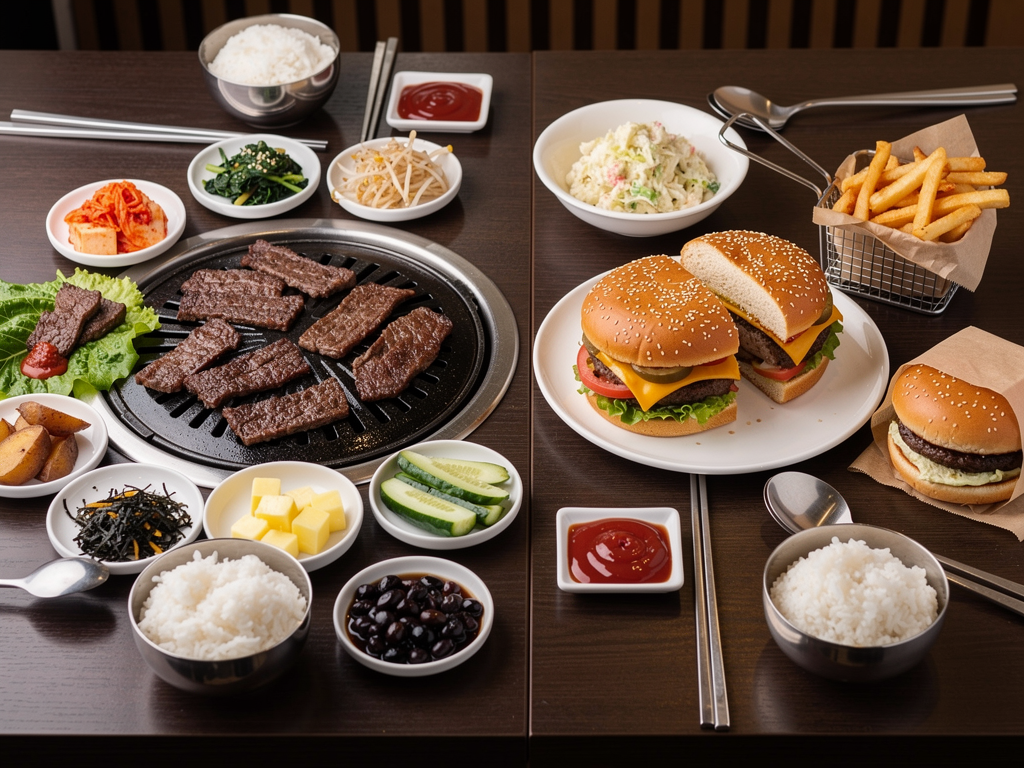
Korean food vs american food in the UAE is a question about the bill before it is a question about taste. American food is sold as a base plus add-ons — steak by the ounce, burger then fries then shake — and a one-person meal lands at roughly AED 97 to 116. Korean food is sold as a table — one per-person price with the grill and the sides included, or a set with rice and banchan — and a two-person unlimited table starts at AED 138. The cuisines meet on grilled beef, fried chicken and the seafood boil and part on the side dishes, the dairy and the seasoning. For one, eat American. For four, eat Korean.
For the wider background, the background on American cuisine and the background on Korean cuisine are the places to start; Time Out Dubai’s best burgers round-up is an independent view of the American end of the Dubai market.
This is the parent page for the Korea-versus-America comparisons on this site. For the same treatment of two other cuisines, read our Korean food vs Japanese food guide and our Korean food vs Arabic food guide; for the Korean grill on its own, our guide to the best Korean BBQ in Dubai.
FAQ
What is the biggest difference between Korean food and American food?
How the meal is priced and served. American food is a base item plus add-ons, plated per person, with the meat cooked in the kitchen. Korean food is a shared table — one per-person price or a main with rice and banchan included — with the meat cooked by you at the table.
Is Korean food or American food cheaper in the UAE?
For one person, American: a Five Guys Little Hamburger is AED 35 and a Black Tap All-American Burger AED 48, while unlimited Korean BBQ at Mukbang Shows needs two people and starts at AED 138 for the pair. For four people, Korean: AED 276 for four at Mukbang Shows against roughly AED 388 to 424 for four burger-fries-shake meals.
What do Korean and American food have in common?
Grilled beef, fried chicken and a boiled pot of seafood. Both cuisines have all three; they cook them differently — table grill versus kitchen grill, double-fried thin crust versus single-fried thick crust, gochujang-garlic sauce versus Cajun spice.
Is American food in the UAE halal?
Not by default; it depends on the venue. UAE listings for the big chains print items like “All Beef Hot Dog” and “beef bacon”, but some menus also list plain “bacon” without saying what it is, so confirm directly.
Is Korean food in the UAE halal?
Not by default either. Korean cuisine uses pork widely at home. Mukbang Shows is 100% halal — beef and chicken only, no pork, no alcohol — and for other Korean venues you should confirm directly.
Why is Korean BBQ priced per person and steak priced by weight?
Because the Korean model sells a table — unlimited meat plus all the sides for one number — while the American steakhouse model sells a specific cut at a specific weight and prices everything around it separately.
Which Korean dishes borrow from American food?
The cheese dishes — corn cheese, cheese dakgalbi, cheese tteokbokki — and the Korean seafood boil, which took the Cajun boil format and re-dressed it in gochujang and garlic. Traditional Korean food uses almost no dairy.
Related guides
More from our Korean food guides across the UAE:
Comments are closed.