Updated: September 2026
Korean food vs Iranian food comes down to where the rice sits on the bill. An Iranian menu in Dubai prints the same kebab twice — once with rice (chelo) and once with bread (khorak) — and the gap between the two lines is the price of the rice: Al Ustad’s own site prints Cholo Barg AED 38 against Khorak Barg 25. A Korean table never has that switch: rice and eight banchan sit inside one number per person, AED 69 at Mukbang Shows. Two chelo kababs at Shabestan are AED 300, fees inside; two seats at Mukbang are AED 138.
TL;DR
– Iranian menus price the rice as a switch — chelo with rice, khorak with bread, AED 11–13 apart; Korean menus put it inside.
– Chelo kabab is the bridge: AED 28 at a 1978 kebab house, 85–140 mid-range, 150–166 at a hotel.
– Iranian platters get cheaper per head as the party grows (Pars: 125 for one, 80 a head for six); Korean unlimited is flat at 69.
– Korean wins for two at dinner and on unlimited meat; Iranian wins solo, at lunch, for lamb, for the big table.
What is the difference between Korean food and Iranian food?
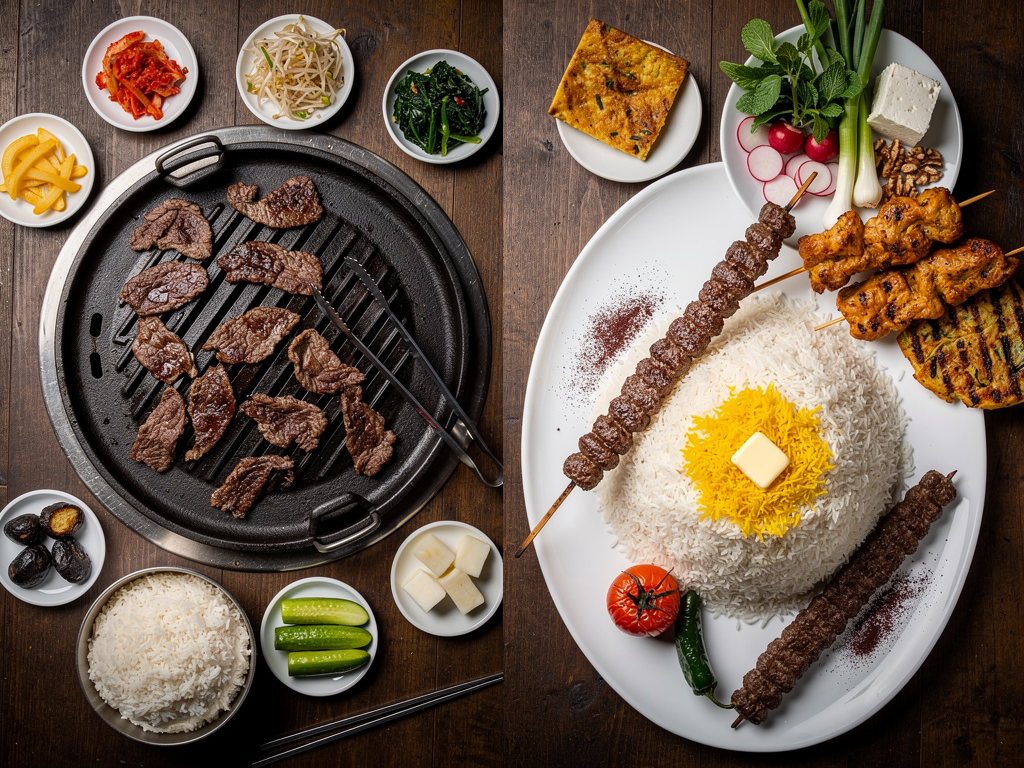
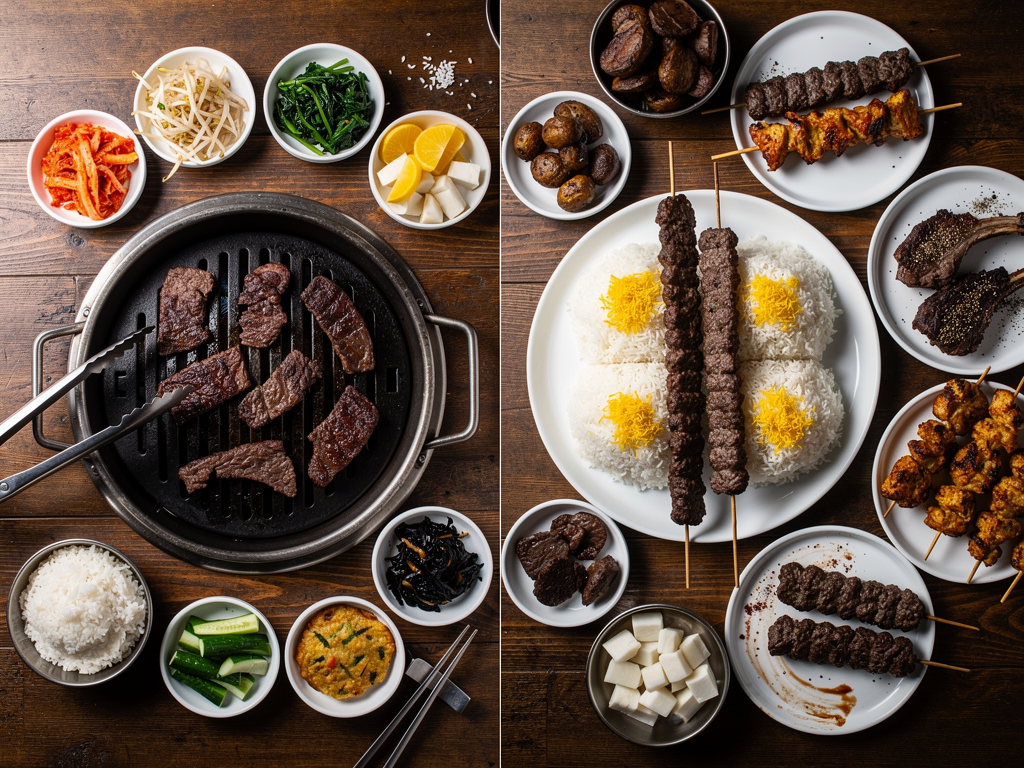
Korean food is a rice cuisine built on fermentation — kimchi, gochujang, doenjang, soy — with beef and chicken cooked on a grill set into the table and a spread of free small dishes called banchan around every meal. Iranian food is a rice-and-kebab cuisine built on charcoal, saffron and sourness — koobideh and barg from the grill, chelo steamed and buttered, stews of herbs and dried lime, yogurt and fresh herbs on the side; the background on Iranian cuisine runs from the Caspian to Shiraz.
It is not Arabic food and not Turkish food, though it shares a mezze grammar with the first and the kebab word with the second. The portal’s Korean food vs Arabic food guide and Korean food vs Turkish food guide cover those two; this page does not re-argue them.
This guide does not try to settle which tastes better in the korean food vs iranian food argument. It settles what a UAE menu can prove: what a meal costs, whether the rice is inside the price, which animal is on the skewer, whether the sides are free, who does the grilling, and — because the question runs the other way on this page — whether the Korean side is halal.
Why is rice a switch on an Iranian menu and not on a Korean one?
Because an Iranian kitchen prices the kebab and the rice separately, even when they arrive on one plate. Al Ustad Special Kabab — the Bur Dubai room Time Out calls “an Iranian kebab house with cult status”, open since 1978 on Al Mussallah Road near Al Fahidi metro (04 397 1933) — prints two ladders for the same grill on its own site. With rice: Cholo Kabab 28, Cholo Barg 38, Sultani (a barg and a koobideh) 42. With bread: Kabab Koubideh 28, Khorak Barg 25, Khorak Sultani 32. Rice on its own is a AED 10 line, “white with saffron or mixed”.
Its Deliveroo listing — delivery-app prices, read September 2026 — prints the same switch higher up the ladder: Sultani 69 against Khorak Sultani 57; Choulo Barg 51 against Khorak Barg 40. Eleven to thirteen dirhams, at either level, is what the rice is worth on an Iranian bill.
Pars Iranian Kitchen (Deira, 04 296 8990; Trade Center, 04 398 8787) makes the switch a heading: every kebab section on its site is titled “(With Rice)” — Chelow Kebab Koobideh 90, Chelow Koobideh Morgh 85, Joojeh Kebab 85, Chelow Kebab Barg (Beef Steak) 125, Chelow Kebab Soltani 140, Shishlik (Lamb Chops) 140 — and Rice sits under Sides at AED 20. Shabestan, in the Radisson Blu Hotel on Baniyas Road since 1984, folds it in: “All main dishes are served with traditional Persian accompaniments of Iranian chelo (rice) and condiments” — Chelo Kebab-E-Kubideh 150, Chelo Kebab-E-Barg 150, Chelo Kebab-E-Soltani 166, Joojeh Kebab 180, with 7% municipality fee, 10% service and 5% VAT printed as already inside.
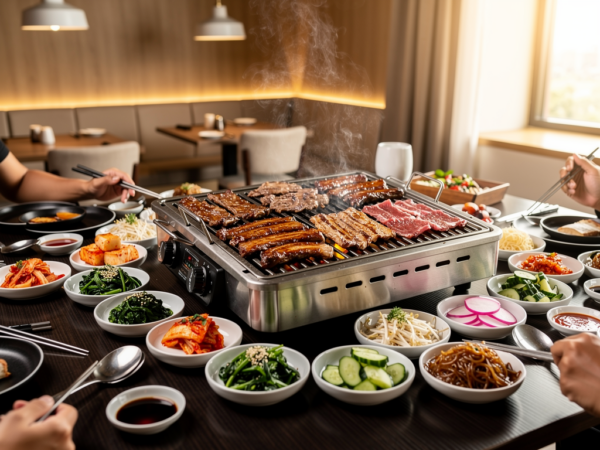
A Korean table works the other way round. Mukbang Shows’ unlimited Korean BBQ is AED 69 per person at Deira, Muroor Road and Electra Street (AED 79 at JBR and DWTC), the same price at lunch and dinner, and that number includes seven kinds of beef and chicken, eight banchan, two gimbap, soup and steamed rice. There is no rice line anywhere on the tier. Hanok’s Bibimbap in International City is AED 53 to 55 with banchan on the table; Mukbang’s à la carte Bibimbap is 53 to 62.
The worked sums, from the menus as printed (Al Ustad’s Deliveroo figures are delivery-app prices; Shabestan’s include its fees):
| Two people at… | What you order | Bill | Per head | Rice and sides |
|---|---|---|---|---|
| Al Ustad, own-site menu | 2 × Cholo Kabab 28 | AED 56 | AED 28 | rice inside; Shirazi and yogurt are lines |
| Al Ustad, Deliveroo | Mix for 2 Persons 124 | AED 124 | AED 62 | bread, mast-e-khiyar, salad and fries inside |
| Khori, Time Out’s prices | 2 × mixed kebab plate 50 | AED 100 | AED 50 | complimentary salads in little bowls |
| Pars Iranian Kitchen | 2 × Chelow Kebab Koobideh 90 | AED 180 | AED 90 | rice inside; Shirazi Salad 40, Mast-O-Khiar 25 extra |
| Shabestan, fees inside | 2 × Chelo Kebab-E-Kubideh 150 | AED 300 | AED 150 | chelo and condiments inside; Sabzi Khordan 28 extra |
| Mukbang Shows, Deira / Abu Dhabi | 2 × Gangnam unlimited BBQ 69 | AED 138 | AED 69 | included — 8 banchan, soup, rice, 2 gimbap |
| Hanok, International City | 2 × Bibimbap 53–55 | AED 106–110 | AED 53–55 | banchan included |
The honest headline: against the hotel and the mid-range rooms, Korean wins for two at dinner — AED 138 against 180 or 300 — and the meat is unlimited; against the 1978 kebab house and the Deira floor-seating room, Iranian wins by a distance, at AED 56 or 100 for two.
Which is better value, Korean food or Iranian food?
For one person, Iranian, and it is not close. Al Ustad’s own site prints a Cholo Kabab at AED 28 and a lunch plate — Cholo Khoresht, Cholo Gousht, Cholo Mourgh — at 27; Time Out puts Khori’s mixed kebab plate at Dhs50 and five lamb chops at Dhs60; Al Ustad’s Mix for 1 Person on Deliveroo is 59 with bread, yogurt, salad and fries. Unlimited Korean BBQ at Mukbang Shows has a two-person minimum, so the cheapest Korean table there is AED 138, and a solo Korean meal means à la carte — Bibimbap at Hanok AED 53–55.
For two at dinner, Korean, against everything except the cheapest Iranian rooms: AED 138 for two unlimited seats at Mukbang against AED 180 for two koobideh at Pars and AED 300 at Shabestan. The gap is not only the price; it is that the Korean number does not move by hour, by day, or by head count, and the meat does not stop.
For a big table, Iranian. Pars prints a per-person platter ladder — Pars Special for one 125, two 220, three 310, four 380, five 420, six 480 — which divides to AED 125, 110, 103, 95, 84 and 80 a head as the party grows. Al Ustad’s Mix runs 59, 124, 184, 248, 307 and 365 for one to six on Deliveroo — about 59 to 62 a head at every size. Shabestan’s Ramsar for two is 300, Persepolis for three 598, the Specialty Platter for four 798. Mukbang is 69 × the number of seats, flat: 414 for six at Deira or Abu Dhabi. The portal’s Korean BBQ price guide for Dubai walks that ladder against the rest of the city.
So the korean food vs iranian food value question has three answers, not one: Iranian for one, Korean for two at dinner, and Iranian again once the table is five or six — unless unlimited meat is the point, in which case AED 69 a head with no ceiling is a different product from a platter of a fixed size.
Is chelo kabab the bridge between the two cuisines?
Yes — it is the one Iranian plate priced the way every Korean plate is priced, with the rice inside. Chelo kabab, Iran’s national dish, is steamed long-grain rice with saffron and a pat of butter on top, and a charcoal-grilled kebab laid across it: koobideh (minced lamb on a wide skewer), barg (a thin marinated fillet, dusted with sumac), soltani (one of each), or joojeh (saffron-marinated chicken), with a grilled tomato beside it.
Every other cuisine hub on this portal had to hunt for the bridge format — the thali, the boodle fight, the Turkish breakfast spread, the Pakistani buffet. Here it is the signature dish itself. The reason the Iranian menu still has a rice switch is that the same kebab is also sold as khorak, with bread; the Korean menu has no bread tradition at the table at all, so there is nothing to switch to.
The three differences to hold onto. Price: a chelo kabab is AED 28 at Al Ustad’s own-site ladder, 85–140 at Pars and 150–166 at Shabestan; a Korean seat is AED 69 with the meat unlimited, or a rice bowl at 53–66. The rice: Iranian chelo is long-grain, steamed, buttered, saffron on top, with the crisp tahdig crust from the bottom of the pot prized enough that Al Ustad’s Deliveroo listing sells it as a line (“Tahdeek”); Korean rice is short-grain, sticky and unseasoned. And what the plate is for: a chelo kabab is one finished plate cooked in the kitchen; a Korean seat is a raw supply and a grill.
Are the sides free? The condiment test, the animal, and who cooks
Mostly not, on the Iranian side. The Iranian “sides” — sabzi khordan (fresh herbs, radish, feta, walnuts), mast-o-khiar (yogurt and cucumber), mast-o-musir (yogurt and shallot), Shirazi salad (cucumber, tomato, onion, lime) — are priced lines at Shabestan (Sabzi Khordan 28, Masto Mosir 42, Salad-E-Shirazi 44), at Pars (Mast-O-Khiar 25, Shirazi Salad 40) and on Al Ustad’s Deliveroo listing (Shirazi Salad 12, Garlic paste 11). A Korean tier carries eight banchan inside the price; the portal’s banchan vs mezze comparison runs the same test against the Levantine table.
Two exceptions are printed. Time Out’s review of Khori Special Kebab on Al Khaleej Road in Al Mamzar records that “complementary salads, lightly dressed and crisp, arrive in little bowls” — Khori is the one Iranian room on this page where the side dishes behave like banchan. And Al Ustad’s Mix plates on Deliveroo print “served with bread, mast-e-khiyar, salad and french fries”, so inside the Mix the yogurt and the salad are included.
The animal. Iranian is lamb-led: koobideh is minced lamb (Shabestan prints “a traditional kebab of minced lamb”), barg is lamb fillet at Shabestan and “Beef Steak” at Pars, shishlik is lamb chops (Pars 140; Khori five chops for Dhs60 per Time Out), Kebab Barre is a rack of lamb (198), ghormeh sabzi is a lamb-and-herb stew (Shabestan 130, Pars 80), Baghali Polo Ba-Mahicheh is a leg of lamb over dill rice (156 at Shabestan, 115 at Pars).
Chicken is joojeh, and beef appears as Shabestan’s Kebab Fillet (188), Pars’s Barg (125) and in Khori’s mixed plate of “chicken, lamb and beef”. Korean beef is the grill — galbi, bulgogi, brisket; see our galbi explainer and our bulgogi explainer — and Mukbang serves beef and chicken only. No lamb, no mutton: the honest limitation on this page for a koobideh regular.
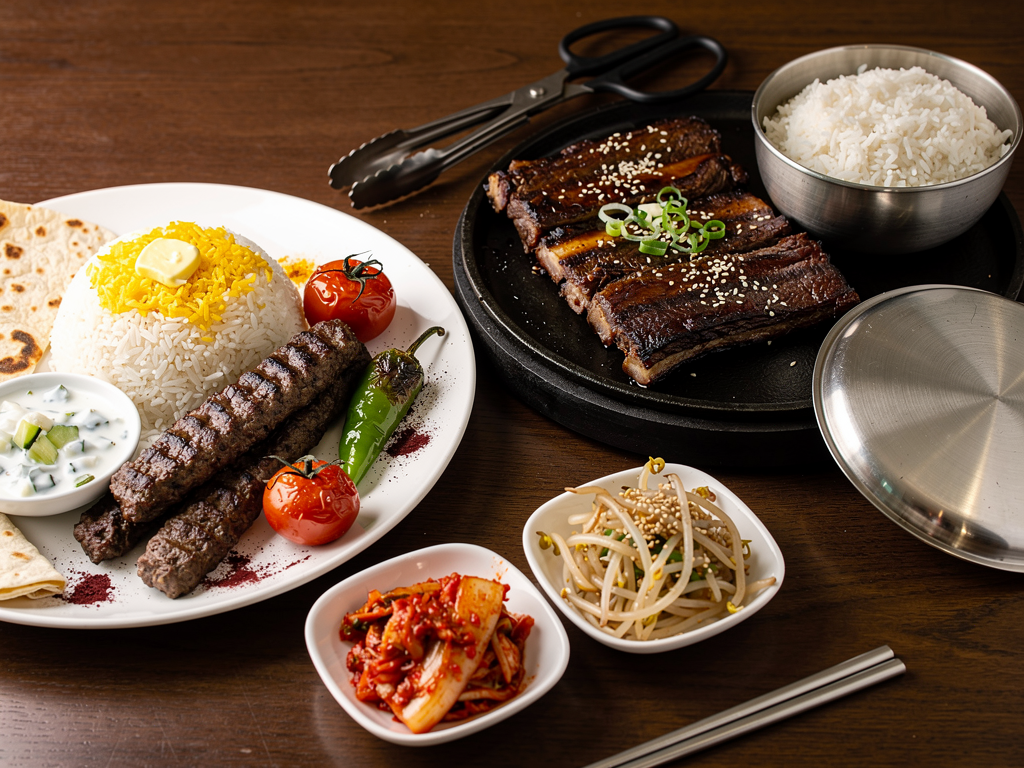
Who cooks. The Iranian kebab is grilled in the kitchen — “over a slow charcoal fire”, in Shabestan’s words — and arrives on the rice with the butter melting into it; Time Out describes Al Ustad’s Kebab Khas “served straight to your table with Iranian-style rice (and a little pat of butter for good measure)”. The Korean grill is set into the table and the diner cooks raw marinated beef and chicken over it. The portal’s Korean BBQ vs mixed grill guide makes the same who-cooks argument against the Levantine platter.
Flavour. Iranian seasoning is sour and herbal — sumac on the barg, dried lime in the stews, pomegranate in the fesenjan and in kebab torsh (“marinated with minced walnuts and pomegranate sauce”), barberries on the zereshk polo, saffron on the rice and in the joojeh, kashk (fermented whey) in the kashk-e-bademjan — with almost no chilli. Korean seasoning is chilli and fermentation: gochugaru, gochujang, doenjang, kimchi. Sweet: faloodeh — rose-water sorbet threaded with starch noodles — and saffron ice cream (Shabestan 48–52, Pars Faloodeh 25) against bingsu (Mukbang 37).
Is korean food vs iranian food a halal question?
Yes — and, as on the Pakistani page, it runs the other way from most hubs on the portal. Iran is a Muslim-majority country; on the UAE menus read for this guide (Al Ustad’s own site and Deliveroo listing, Pars’s own site, Shabestan’s own PDF, Time Out on Khori) every meat line is lamb, mutton, chicken, beef, fish or shrimp and no pork line appears anywhere. That is an observation about the printed menus, not a certificate for any Dubai restaurant — confirm directly.
Time Out’s reviews of Al Ustad and Khori print no licence label, so this guide prints none for any Iranian venue; Shabestan is a hotel restaurant whose own menu lists only Iranian tea under drinks — confirm directly on licensing.
The question an Iranian-food regular actually asks is the reverse one: is the Korean side halal? Korea is not Muslim-majority and pork is common in Korean cooking at home. At Mukbang Shows the answer is plain — beef and chicken only, no pork anywhere on the menu, no alcohol served, on every tier and every à la carte line across all five branches. For the other Korean kitchens in the UAE, see whether Korean food is halal.
Where to try Korean food in the UAE
Mukbang Shows Restaurant has five branches: Deira (Al Ittihad Rd, Port Saeed, +971-4-886-4494), JBR (Plaza Level, Bahar 3, The Walk, +971-54-523-1898) and DWTC (The Apartments Block A, Sheikh Zayed Rd, +971-54-524-5904) in Dubai; Muroor Road (547 Sultan Bin Zayed The First St, Al Danah, +971-50-158-9433) and Electra Street (Zayed The First St, behind Sun and Sand Sports, +971-2-564-0446) in Abu Dhabi. The Deira branch sits in the same part of the city as three of the four Iranian rooms on this page — Khori on Al Khaleej Road, Shabestan on Baniyas Road, Pars’s Deira branch — and Pars’s Trade Center branch is near Mukbang DWTC, so the two pricing models can be compared in one neighbourhood.
The tiers: Gangnam AED 69 at Deira, Muroor and Electra (AED 79 at JBR and DWTC); Daegu adds Korean fried chicken at AED 89 / 99; Jeju adds the seafood boil at AED 99 / 109; Bukchon Hanok is AED 129 everywhere. Every tier includes seven BBQ kinds, eight banchan, two gimbap, soup and steamed rice; minimum two persons; AED 60 leftover charge; the same price at every hour. À la carte: LA Galbi 109, Wagyu Bulgogi 115, Brisket 95, Striploin 99, Eomuk Tang 49, Tteok Mandu Guk 59, Kimchi Jeongol 89 / 50, Bibimbap 53–62, Beef Dupbap 66, Bingsu 37.
The honest limitation: no lamb or mutton, no bread, no chelo or saffron rice, no koobideh or shishlik, no stews of the ghormeh-sabzi kind, no lunch price, no solo unlimited option, and no Iranian food of any kind. For à la carte Korean with banchan, Hanok in International City (Bibimbap AED 53–55, Galbi Tang 58, Yukgaejang 52, Galbi Gui 115) is the reference point; the best Korean BBQ in Dubai guide covers the other grill rooms.
Where to try Iranian food in the UAE
Al Ustad Special Kabab (Al Mussallah Road, Bur Dubai, near Al Fahidi metro, 04 397 1933) is the reference room for the rice switch — chelo and khorak side by side on one page since 1978, the yogurt-marinated Kebab Khas that Time Out calls its most famous plate, and, per the same review, more than 8,000 photographs on the walls. Khori Special Kebab (Al Khaleej Road, Al Mamzar, 04 266 6322) is the Deira floor-seating room — Persian carpets, koobideh, barberry rice, lamb chops, complimentary salads, and a raw kebab mix sold to take home; read Time Out’s review of Khori Special Kebab before you go.
Pars Iranian Kitchen (Deira; Trade Center) is the per-person platter ladder, one to six. Shabestan (Radisson Blu Hotel Dubai Deira Creek, daily 12:30 pm–11:00 pm) is the hotel room with the fees printed inside and third-generation family recipes.
This page ranks nobody on the Iranian side; it prices the model. It also prints no price it did not read: Al Ustad has two ladders — its own site and its delivery listing — and both are labelled here, because the same barg is AED 38 on one and 51 on the other; Khori’s prices are Time Out’s, not a printed menu.
How to choose between the two on a given night
Pick Iranian when you are one person, when it is lunch, when lamb is the point — koobideh, shishlik, the rack, the herb stew — when you want bread and yogurt with the meal, when the table is five or six and a platter that gets cheaper per head is the plan, or when a finished plate cooked over charcoal and carried to you is the whole idea.
Pick Korean, in the korean food vs iranian food choice, when you are two or more at dinner and want the grill in the table with the sides inside the price, when cooking the beef and chicken yourself is the point, when fermented heat and sour vegetables are the flavours you are after, or when the seat has to cost the same on a Friday night as a Tuesday lunch.
Beyond korean food vs iranian food, the portal’s other cuisine hubs — Korean vs Pakistani, Korean vs Turkish, Korean vs Arabic and the rest — use the same test. Iranian is the one where the bridge did not need finding: chelo kabab already prices the rice the Korean way.
| Venue | Area | Price AED | Halal | Standout order |
|---|---|---|---|---|
| Mukbang Shows Restaurant | Deira, JBR, DWTC · Muroor Road, Electra Street | 69–129 per person | Beef and chicken only, no pork, no alcohol | Gangnam unlimited BBQ AED 69 — 7 meats, 8 banchan, rice, soup |
| Al Ustad Special Kabab | Al Mussallah Road, Bur Dubai | 25–42 own site; 40–69 on Deliveroo; Mix for 2 AED 124 | Menu prints lamb, mutton, chicken, beef — confirm directly | Cholo Kabab AED 28 (own-site ladder) |
| Khori Special Kebab | Al Khaleej Road, Al Mamzar, Deira | 50 mixed plate, 60 five lamb chops (Time Out) | Menu not read; Time Out prints no label — confirm directly | Mixed kebab plate Dhs50 with complimentary salads |
| Pars Iranian Kitchen | Deira; Trade Center | 85–140 kebab with rice; platters 125–480 | Menu prints lamb, chicken, beef, fish, shrimp — confirm directly | Chelow Kebab Koobideh AED 90 |
| Shabestan | Radisson Blu Hotel Dubai Deira Creek | 110–198 mains, fees inside | Menu prints lamb, chicken, beef, fish, shrimp — hotel restaurant, confirm directly | Chelo Kebab-E-Soltani AED 166 |
| The Korean Restaurant (Hanok) | International City, Dubai | 52–115 | Confirm directly | Galbi Tang AED 58 |
FAQ
Is Korean food or Iranian food cheaper in the UAE?
For one person and at lunch, Iranian: Al Ustad’s own site prints a Cholo Kabab at AED 28 and lunch plates at 27, and Time Out puts Khori’s mixed kebab plate at Dhs50. For two at dinner against the mid-range and hotel rooms, Korean: AED 138 for two unlimited seats at Mukbang Shows against AED 180 at Pars and AED 300 at Shabestan.
What is the difference between chelo kabab and khorak?
The rice. Chelo kabab is the kebab on steamed saffron rice; khorak is the same kebab with bread instead. Dubai menus price them AED 11–13 apart — Al Ustad’s own site prints Cholo Barg 38 and Khorak Barg 25, and Rice alone at 10.
Are the sides free at Iranian restaurants?
Usually not. Sabzi khordan, mast-o-khiar and Shirazi salad are priced lines at Shabestan (28–44), Pars (25–40) and on Al Ustad’s Deliveroo listing (12). Khori is the printed exception — Time Out records complimentary salads in little bowls. Korean banchan are inside the price on every Mukbang tier.
Does Korean BBQ have lamb?
Not at Mukbang Shows — its seven grill kinds are beef and chicken. The Iranian table is lamb-led: koobideh, barg, shishlik, kebab barre, ghormeh sabzi.
Is Iranian food spicy like Korean food?
No. Iranian seasoning is sour and herbal — sumac, dried lime, pomegranate, barberry, saffron, kashk — with almost no chilli. Korean seasoning is chilli and fermentation: gochugaru and gochujang.
Do Iranian platters get cheaper for big groups?
Yes. Pars’s Special for one is AED 125 and for six AED 480 — 80 a head; Al Ustad’s Mix on Deliveroo runs 59 for one to 365 for six. Korean unlimited is flat: AED 69 per seat at Mukbang Shows at any table size.
Is Korean food halal in the UAE?
At Mukbang Shows, yes — beef and chicken only, no pork, no alcohol, on every tier and every à la carte line across all five branches. Elsewhere, confirm directly.
Every price in this guide was read from the venue’s own menu page or PDF, its delivery-app listing, or Time Out’s review in September 2026, and is labelled as such where they differ. Menus change; whether the rice is inside the price — chelo or khorak, seat or plate — is the thing to check before you compare.