
Updated: August 2026
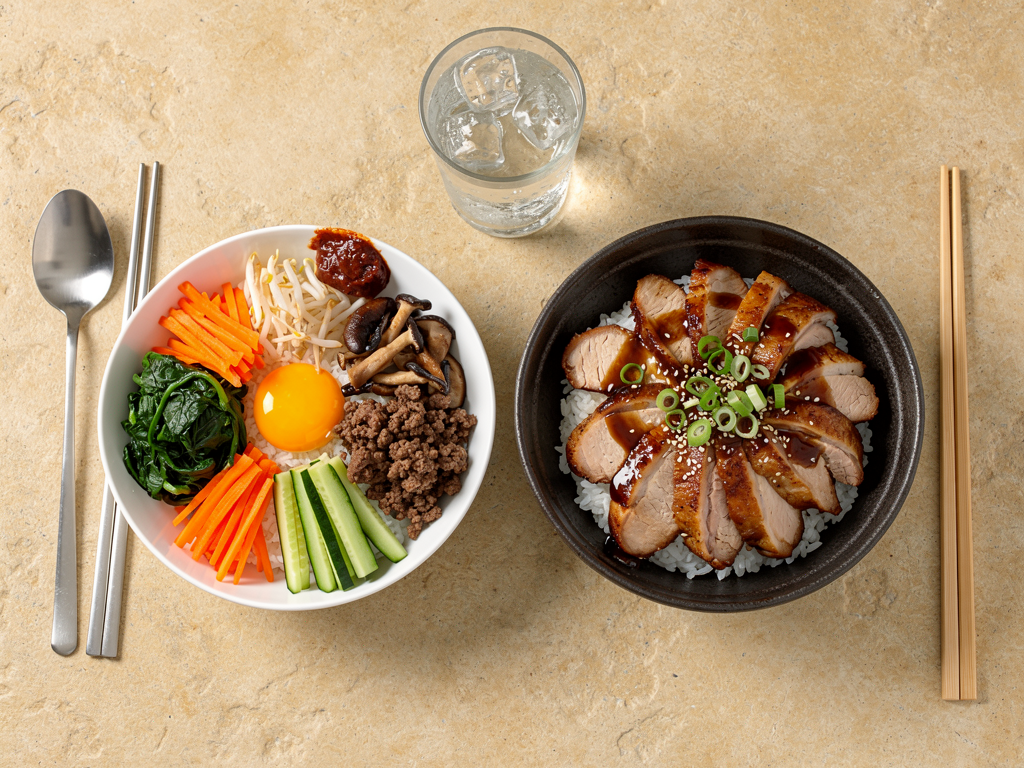
Mukbang Shows in Deira is the top pick for bibimbap vs donburi when you want the mixed Korean rice bowl that proves its own principle on the menu. Vegetable bibimbap costs AED 56 while chicken bibimbap is AED 53 at the same 100% halal counter. Bentoya Kitchen in DIFC sells its chicken teriyaki don from AED 55 and prints protein-first pricing that runs in the opposite direction.
TL;DR
- Best overall: Mukbang Shows (widest printed bibimbap range across five UAE branches that demonstrates vegetable priority)
- Best value: Bentoya Kitchen chicken katsu or teriyaki don from AED 55
- One situational pick: HANU on Palm Jumeirah when the crisp nurungji rice crust is non-negotiable
What is the difference between bibimbap vs donburi?
Bibimbap is a bowl you are supposed to wreck. Donburi is a bowl you are supposed to leave alone.
Bibim means mixed and bap means rice. The dish arrives as separated components with rice underneath neat piles of seasoned namul vegetables, protein, egg and gochujang. The diner’s job is to stir it into one thing with a spoon before eating. It is not plated to be looked at. It is plated to be combined. Served unmixed it is unfinished.
Donburi just means bowl. A donburi arrives already composed with rice at the bottom and one simmered or fried topping laid over it. Sauce soaks down through the layers. You eat down through the strata. Stirring a katsudon does not improve it. It collapses the crisp topping into wet rice which is the opposite of the intended texture.
That single difference explains the vegetables, the sauce and the price on both sides. In bibimbap the egg yolk is a raw or barely-set richness you stir through to bind the whole bowl. In oyakodon and katsudon the egg is cooked into the topping as a soft set that holds everything together on top of the rice. Bibimbap is seasoned at the table by the diner with gochujang and sesame oil to taste. A donburi is seasoned in the pan by the kitchen before it reaches you. One dish hands the diner the final decision. The other does not.
This opposite logic is why bibimbap vs donburi never really competes on cost. The menus prove the principle in their pricing ladders. For the complete mixing technique and namul list read the dedicated bibimbap explainer on mukbangshow.ae.
How do their prices compare in the UAE?
On Mukbang Shows menu the bibimbap prices run seafood AED 62, beef AED 59, vegetable AED 56, chicken AED 53. The vegetable bibimbap costs more than the chicken bibimbap. That is the whole point of the dish in one line. In bibimbap the namul vegetables are the dish, not the cheap filler, and the menu prices them accordingly.
On Bentoya Kitchen menu the don prices track the protein and nothing else: Chicken Teriyaki Don from AED 55, Chicken Sauce Katsu Don AED 55, Chicken Miso Katsu Don from AED 55, Aji Aburi Don AED 65, Beef Teriyaki Don from AED 74. The protein names the dish and sets the price. There is no vegetable don on the list at all.
Bibimbap is vegetable-led with optional protein. Donburi is protein-led over plain rice. Both menus price exactly that. The headline ranges overlap almost completely, bibimbap AED 53-62 and don AED 55-74. Price is not the deciding factor between these two bowls. The choice is about structure and vegetables, not cost.
HANU on Palm Jumeirah lists stone pot bibimbap around AED 145 in a higher overall spend of AED 400-900 per person. HYU in JLT and Mannaland in Al Hudaiba sit in the AED 60-200 per person a la carte bracket. Madang in Abu Dhabi offers a business lunch set at AED 65 that includes a main plus seven banchan but does not publish a standalone bibimbap price. Hankook in Abu Dhabi runs around AED 50 a dish with large portions. Umami at Mall of the Emirates averages AED 90 for two with no verified per-bowl donburi price.
The pricing ladders in bibimbap vs donburi therefore function as a decision tree. If you want the vegetables to lead and expect to mix the bowl at the table, the Mukbang Shows range makes the hierarchy obvious. If you want one clear protein dominating unmixed layers, Bentoya’s list removes all guesswork.
Where to eat bibimbap in Dubai and Abu Dhabi?
Mukbang Shows operates five branches that give the widest printed choice for bibimbap vs donburi in a single 100% halal kitchen. The menu lists four builds: seafood AED 62, beef AED 59, vegetable AED 56 and chicken AED 53. Each bowl arrives unmixed so you stir it yourself.
One honest caveat is that Mukbang Shows does not serve donburi at all and does not offer the dolsot stone bowl with its crisp nurungji crust. If a hot Japanese rice bowl is what you want this page sends you straight to Bentoya Kitchen. If the crackling rice crust is the reason you order bibimbap then head to the stone-bowl specialists instead. Call Deira on +971-4-886-4494, JBR on +971-54-523-1898, DWTC on +971-54-524-5904, Muroor Road Abu Dhabi on +971-50-158-9433 or Electra Street Abu Dhabi on +971-2-564-0446.
HANU at St Regis Gardens on Palm Jumeirah delivers the premium dolsot version with a proper heated stone bowl and crisp rice crust. Expect to pay around AED 145 for the stone pot bibimbap in a venue where overall spend runs AED 400-900 plus per person. The trade-off is the significantly higher price point compared with the everyday options.
HYU Korean Restaurant in Cluster O, JLT has been a family-run neighbourhood Korean kitchen trusted by the Korean community since 2010. It serves home-style bibimbap with house-fermented banchan in an alcohol-free setting. Per-person a la carte cost lands roughly AED 80-200. The room is straightforward and the focus stays on consistent Korean flavours rather than trend.
Mannaland Korean Restaurant in Al Hudaiba on Al Mina Road offers generously topped bibimbap and clear vegetarian options in a long-running halal home-style kitchen. A la carte meals run roughly AED 60-120 per person. The honest downside is a plain dated room that prioritises food over interior design.
Madang Korean Restaurant at Al Sa’adah inside Al Ghazal Golf Club is the dolsot answer in Abu Dhabi. It lists both standard bibimbap and a stone-bowl version. No standalone bibimbap price is published so call ahead. The business lunch set at AED 65 from Monday to Friday 12:00-14:30 includes a main plus seven banchan and delivers solid value for the stone-bowl experience.
Hankook Korean Restaurant on Al Nahyan near Defence Road in Abu Dhabi functions as the value bowl option. Dishes sit around AED 50, with portions reviewers describe as large enough to share. MyBayut lists a meal for two at around AED 195 as of February 2026. It has operated as a downtown standby for years and delivers straightforward large servings without frills.
For the dedicated ranking of every bibimbap option across both cities see the best bibimbap in Dubai guide on mukbangshow.ae.
Where to eat donburi in Dubai?
Bentoya Kitchen has run Japanese casual dining in Dubai since 1997 and remains the only venue with a verified first-party donburi price list. Its Don Rice Bowls section prints Chicken Teriyaki Don from AED 55, Chicken Sauce Katsu Don AED 55, Chicken Miso Katsu Don from AED 55, Aji Aburi Don AED 65 and Beef Teriyaki Don from AED 74. Bento boxes sit nearby at Chicken Katsu Bento from AED 62 upward.
Classic katsudon is built on tonkatsu pork cutlet in many places, yet every katsu don printed here uses chicken or beef. The pork assumption many UAE readers bring to the category does not match what appears on this menu. Confirm broth ingredients and certification directly with the venue. Bentoya prints no vegetable-led donburi on that list. Multiple branches operate including DIFC. The trade-off is that it offers no bibimbap so the bibimbap vs donburi decision stays binary when you stand at the counter.
Umami at Mall of the Emirates lists donburi alongside ramen, bento, sushi and sashimi. Average cost for two sits around AED 90 but no individual donburi price is published so confirm directly. It functions as a convenient mall option when you already plan to be inside the Emirates Mall footprint. The lack of a printed price ladder makes direct comparison to Bentoya harder on the spot.
The Korean lunch box versus bento comparison on mukbangshow.ae explores the same Korea-and-Japan packaging logic in packed-meal form and is worth reading if you pack lunch often.
Bibimbap vs donburi: price and structure at a glance
Every figure below was checked on 29 August 2026. Where no price is published, this table says so rather than guessing.
| Venue | Bowl | Area | Price (AED) | Structure |
|---|---|---|---|---|
| Mukbang Shows | Bibimbap, seafood | 5 branches, Dubai + Abu Dhabi | 62 | Mixed at the table |
| Mukbang Shows | Bibimbap, beef | Same five branches | 59 | Mixed at the table |
| Mukbang Shows | Bibimbap, vegetable | Same five branches | 56 | Mixed at the table |
| Mukbang Shows | Bibimbap, chicken | Same five branches | 53 | Mixed at the table |
| HANU | Dolsot stone-pot bibimbap | Palm Jumeirah, Dubai | around 145 | Mixed, stone bowl |
| HYU | Bibimbap, home-style | Cluster O, JLT, Dubai | around 80-200 per person | Mixed at the table |
| Mannaland | Bibimbap, vegetarian options | Al Hudaiba, Dubai | around 60-120 per person | Mixed at the table |
| Madang | Bibimbap and dolsot | Al Sa’adah, Abu Dhabi | not published, call ahead | Mixed, stone bowl |
| Hankook | Bibimbap | Al Nahyan, Abu Dhabi | around 50 a dish | Mixed at the table |
| Bentoya Kitchen | Chicken Teriyaki Don | DIFC and other Dubai branches | from 55 | Layered, eaten top-down |
| Bentoya Kitchen | Chicken Sauce Katsu Don | Same | 55 | Layered, eaten top-down |
| Bentoya Kitchen | Aji Aburi Don | Same | 65 | Layered, eaten top-down |
| Bentoya Kitchen | Beef Teriyaki Don | Same | from 74 | Layered, eaten top-down |
| Umami | Donburi | Mall of the Emirates, Dubai | not published, around 90 for two | Layered, eaten top-down |
Note the overlap: bibimbap runs AED 53-62 and the everyday dons run AED 55-74. The two ladders sit on top of each other, which is why price is not the deciding factor.
Is bibimbap vs donburi halal in the UAE?
Mukbang Shows is 100% halal across all five branches and serves only beef and chicken. Its bibimbap uses halal-certified gochujang as standard in UAE Korean kitchens. For every other venue listed confirm certification and ingredients directly with the restaurant.
Classic katsudon uses pork and many donburi broths contain mirin. The katsu dons actually printed at Bentoya Kitchen use chicken and beef cutlets rather than pork. Ask the venue about the simmering broth and any certification. A bibimbap-versus-poke-bowl comparison already lives on the site for readers who want the cold raw-fish version of this rice-bowl question. See that guide on mukbangshow.ae and move on because poke is a cold marinated-fish construction while donburi is a hot cooked-topping construction.
What is bibimbap? (비빔밥)
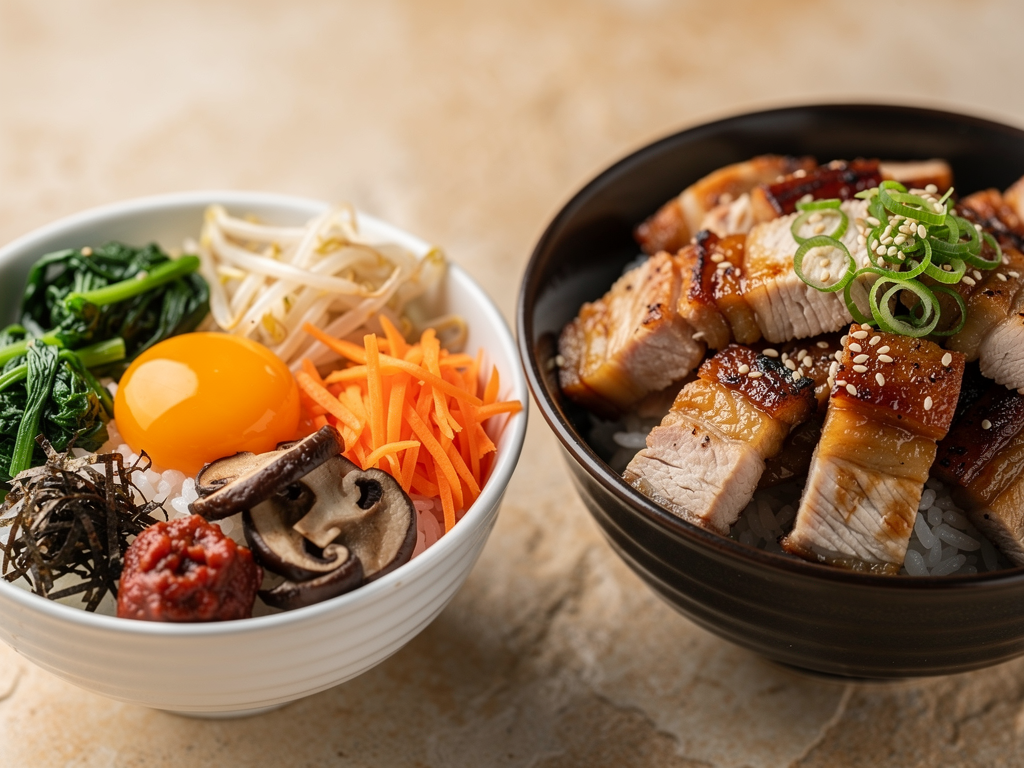
Bibimbap is a bowl of steamed short-grain rice topped with several separately seasoned vegetables called namul, a protein, usually a fried or raw egg yolk, sesame oil and gochujang. The diner stirs everything together before eating. Dolsot bibimbap is the version served in a heated stone bowl where the rice against the hot stone forms a crisp browned crust called nurungji.
The mixing step is not optional. The separated components on arrival signal that the dish is unfinished until the diner combines them. Korean Cultural Center background material on koreanculture.org offers deeper context on how this dish sits inside wider Korean food culture. The vegetable pricing ladder at Mukbang Shows where the vegetable bowl costs more than chicken makes the namul priority explicit on the menu rather than hidden.
What is donburi?
Donburi is the Japanese single-bowl rice meal with rice in a deep bowl and one topping laid over it. Common members include gyudon with simmered beef and onion, oyakodon with chicken and egg whose name means parent and child, katsudon with a breaded cutlet plus egg and onion, and tendon with tempura. The topping is usually simmered in a dashi, soy and mirin broth that soaks into the rice.
You eat it in layers from the top down. Japan’s Ministry of Agriculture, Forestry and Fisheries English site at maff.go.jp and the Japan National Tourism Organization magazine at japan.travel supply reliable background on regional Japanese rice cookery and why the bowl format developed the way it did. The egg in donburi holds the topping together on top of the rice rather than binding the entire mixture after stirring. The kitchen finishes the seasoning so the diner does not adjust it at the table. Bentoya’s price list that names every don after its protein demonstrates this logic in AED.
Which areas have the best bibimbap vs donburi options?
The two dishes are not spread evenly across the UAE, and knowing where each one clusters saves a wasted trip.
In Dubai, Mukbang Shows covers three areas: Deira on Al Ittihad Road in Port Saeed, JBR on the Plaza Level of Bahar 3 at The Walk, and DWTC at The Apartments Block A on Sheikh Zayed Road, which is opposite the metro station. HANU sits at St Regis Gardens on Palm Jumeirah, HYU in Cluster O in JLT, and Mannaland in Al Hudaiba on Al Mina Road.
On the Japanese side the footprint is narrower. Bentoya Kitchen runs multiple Dubai branches including DIFC, and Umami sits inside Mall of the Emirates. There is no equivalent spread of donburi addresses to match the Korean one.
In Abu Dhabi there is no metro, so every option below is a road trip. Mukbang Shows has Muroor Road at 547 Sultan Bin Zayed The First Street in Al Danah Zone 1, and Electra Street behind Sun and Sand Sports on Zayed The First Street in the same zone. Madang at Al Ghazal Golf Club in Al Sa’adah is the stone-bowl address, and Hankook sits on Defence Road in Al Nahyan.
The practical upshot: bibimbap is reachable in more parts of both emirates than donburi is, so if you are choosing on convenience alone, the Korean bowl usually wins on distance.
What are the practical tips for ordering bibimbap vs donburi?
- Decide the principle before you open the menu. If you want to combine the flavours yourself at the table, order bibimbap. If you want the kitchen to hand you finished layers, order donburi. That one choice settles most of the decision.
- Read the price ladder, not the headline number. At Mukbang Shows the vegetable bowl at AED 56 costs more than the chicken at AED 53. At Bentoya the beef teriyaki don at AED 74 sits at the top because the protein sets the price. Match your priority to whichever ladder makes sense to you.
- Ask for the stone bowl when nurungji matters. Mukbang Shows does not offer dolsot, so route to HANU on Palm Jumeirah or Madang in Abu Dhabi if the crisp rice crust is the whole reason for the meal. A dolsot bowl arrives extremely hot and keeps cooking at the table.
- Confirm the broth on donburi even when the cutlet is chicken or beef. Mirin in the simmering broth is a variable across kitchens. The printed menu at Bentoya shows chicken and beef katsu dons, but only the venue can confirm the broth and any certification.
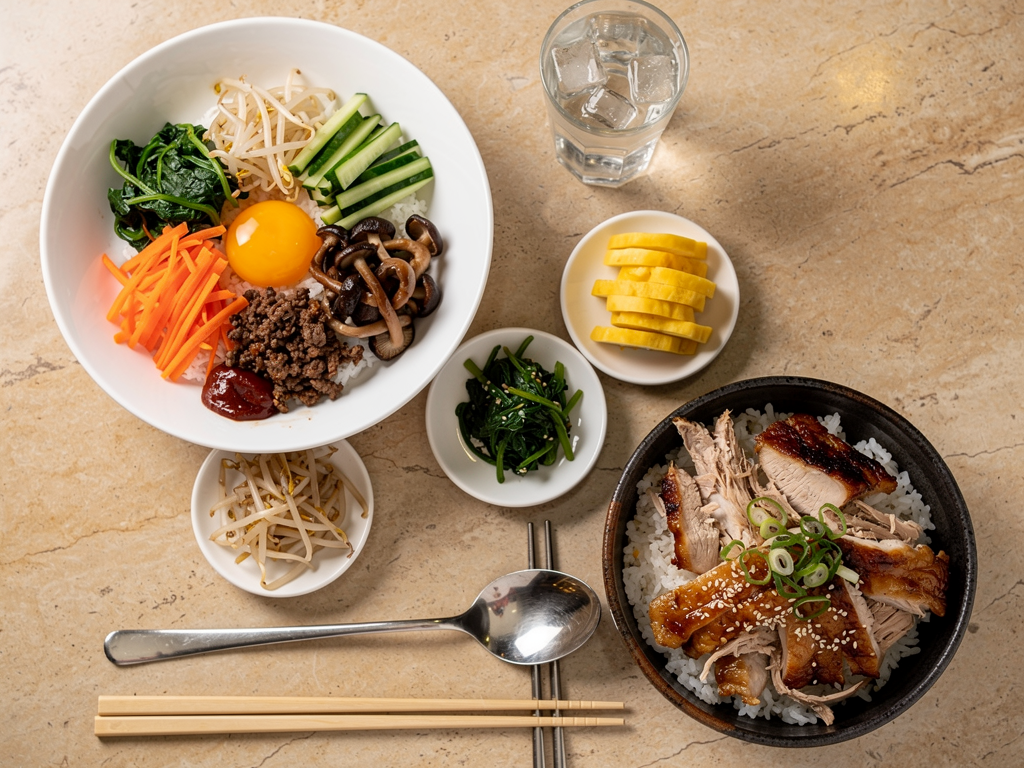
- Order the two bowls side by side if you can. Put a seafood bibimbap at AED 62 next to a chicken teriyaki don at AED 55 and the difference between mixing and layering is obvious within two bites. The price parity means the comparison costs almost nothing extra.
- Check what comes alongside. HYU and Mannaland are noted for their banchan, so the vegetable variety starts before you mix anything. Ask what a donburi comes with, since the format is built as a single complete bowl.
- Mind the vegetarian gap. Mukbang Shows prints a vegetable bibimbap and Mannaland lists vegetarian options. No vegetable-led donburi appears on the Bentoya list, so the Korean side is the safer bet if you are not eating meat.
FAQ
Is bibimbap more expensive than donburi in the UAE?
No. The ranges overlap almost completely between AED 53 and AED 74. Choice depends on mixing versus layering, not price.
Does stirring ruin donburi?
Yes for most versions. Stirring collapses the crisp katsudon topping into soggy rice. The dish is built to be eaten top-down in layers.
Can I get vegetable-only bibimbap?
Yes at Mukbang Shows for AED 56. The menu prices it higher than chicken, proving vegetables are the star rather than filler.
Is there pork in UAE donburi?
Not on the Bentoya printed menu. All katsu dons listed use chicken or beef. Confirm broth and certification with the venue.
Which is better for vegetarians, bibimbap or donburi?
Bibimbap. Mukbang Shows and Mannaland print explicit vegetable builds. Donburi menus focus on protein toppings with no vegetable-only option listed.
Should I choose bibimbap or donburi for a first date?
Choose based on interaction style. Bibimbap requires stirring and sharing the mixing ritual. Donburi is neater and lets each person eat their own layers without collaboration.
Mukbang Shows proves the bibimbap principle with its own price ladder while Bentoya proves the donburi principle with its protein ladder. The next time the question of bibimbap vs donburi appears on your table the menu numbers will tell you which bowl to wreck and which bowl to preserve.
Related guides
More from our Korean food guides across the UAE:
Comments are closed.