Updated: August 2026
Bulgogi vs teriyaki comes down to when the seasoning meets the meat. Bulgogi is a marinade the beef sits in before any heat touches it. Teriyaki is a glaze brushed on while it cooks. The pick for the bulgogi side is Mukbang Shows, where the kitchen is beef and chicken only with no alcohol on site — and the cleanest price test in Dubai is AED 63 against AED 58, from one kitchen.
TL;DR
– Best overall: Mukbang Shows bulgogi — halal by default, no alcohol on the premises
– Best value test: Hanok Yachae Bulgogi AED 63 against Sushi Ya Beef Teriyaki AED 58, one address
– Situational pick: Mukbang Wagyu Bulgogi Dupbap AED 66 when the food has to travel
What is the difference between bulgogi vs teriyaki?
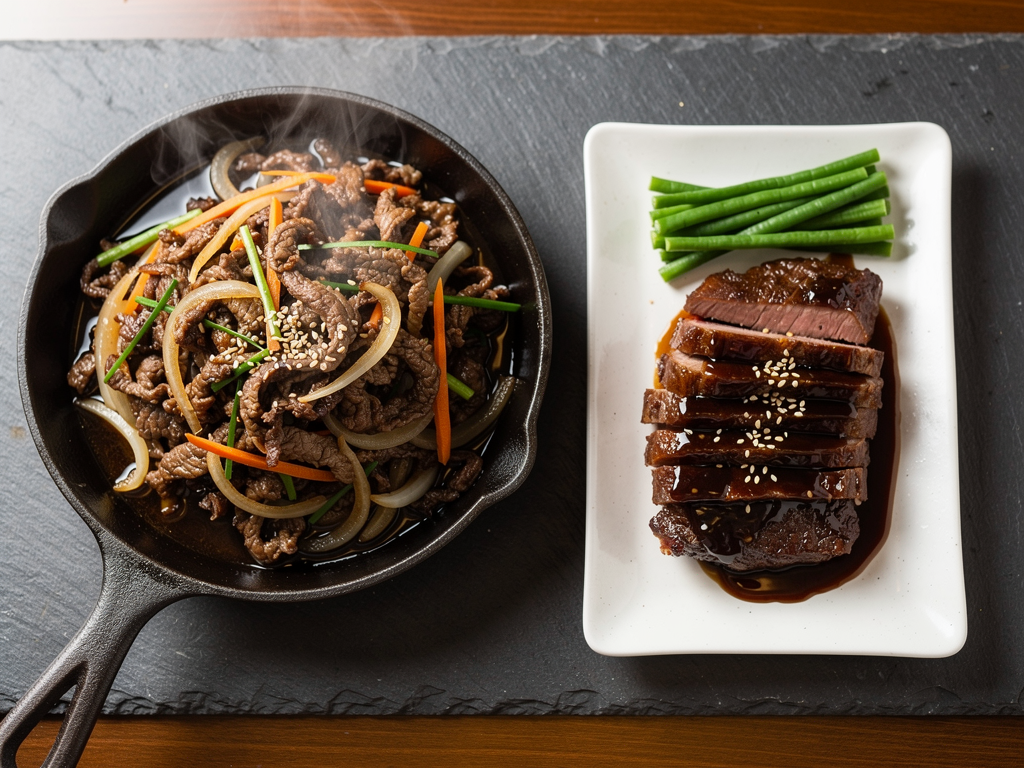
The difference is timing. Bulgogi is seasoning that goes in before the heat. Teriyaki is seasoning that goes on during it. Everything else — texture, sweetness, how well each one survives a delivery box — follows from that one fact.
One address in Dubai proves it better than any explainer could. Hanok The Korean Restaurant and Sushi Ya share a single Central Business District unit in International City, along with the phones 04-5588962 and 052-5097505 and one website. On the Korean menu, Yachae Bulgogi is listed as “Beef Marinated with Special Sauce and Vegetables” at AED 63. On the Japanese menu, from the same kitchen, Beef Teriyaki is AED 58. Five dirhams apart, with rent, staff, suppliers and VAT all held constant.
Be careful with that gap, though. The bulgogi arrives with vegetables cooked in the marinade; the teriyaki is a plated protein. The five-dirham difference is real, but it is not evidence about cost per gram of beef, because nobody publishes portion weights.
The sharper proof is on the chicken side, and it is the whole story in one line. Hanok’s Korean menu sells “Teriyaki Chicken AED 48 — Crunchy Korean fried chicken with Teriyaki Sauce”, filed alongside Korean BBQ sauce, honey, spicy, chilli and sweet and sour as one of eight sauce choices. A Korean kitchen is treating teriyaki as a sauce to pour over a Korean dish. No menu anywhere in this research treats bulgogi that way, because bulgogi is not a sauce — it is a marinated meat preparation. The two things are not the same kind of noun.
What is bulgogi (불고기)?
Bulgogi translates literally as fire meat. Thin-sliced beef is marinated first, usually in soy sauce, sugar or grated pear, sesame oil, garlic and onion, and left to sit so the seasoning reaches the middle of the meat. It is then cooked fast on a griddle or in a pan. Because the marinade is a liquid the meat rests in, vegetables cooked alongside take on the same flavour, which is exactly what Hanok’s own description is pointing at.
Teriyaki, by contrast, is a method rather than a dish, and the name says so: teri is the shine, yaki is the grilling. Soy, mirin and sugar are reduced and brushed on repeatedly during cooking until they set into a lacquer. The seasoning stays on the surface. That is why the same technique works on salmon, on chicken, on beef, and even — at Hanok — on Korean fried chicken, without anything else changing.
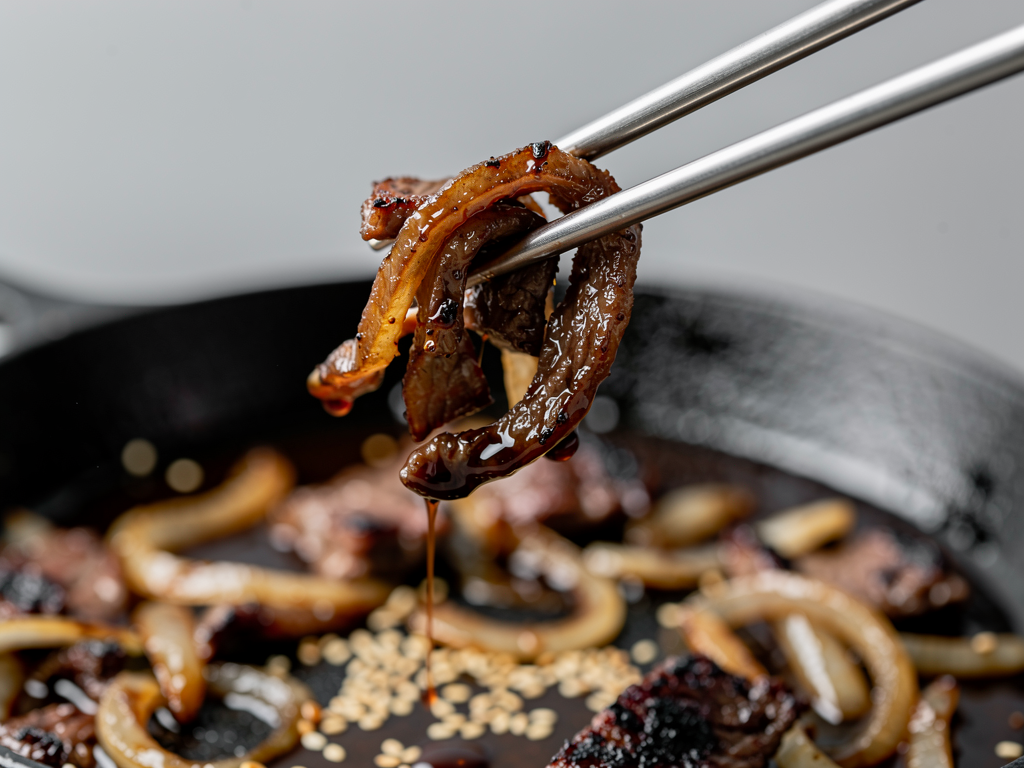
The textures follow directly. Bulgogi is sliced thin to give the marinade surface area to work on, and the finished plate is soft, tangled and slightly wet with its own juices. Teriyaki prefers a thicker cut, because only the outside needs glazing, and the plate arrives dry and glossy. If you dislike saucy plates, teriyaki is the safer order. If you dislike sweet crusts, bulgogi is.
Sweetness splits the same way. Teriyaki’s glaze is reduced, so the sugar is concentrated on the surface and the first bite reads sweeter. Bulgogi’s sugar or pear is diluted through a marinade and through the meat, so it is milder and more even. No venue in this research publishes sugar content, so that is as far as the comparison can honestly go.
There is a further clue in how the two behave on a menu. Hanok sells the same marinade in at least three different shapes — with vegetables as Yachae Bulgogi, with chicken as Daksal Bulgogi, and served in a hot earthenware pot as Ttukbaegi Bulgogi — and charges AED 56 to AED 63 for them. A marinade can be poured into any of those formats because it is a way of preparing meat, not a dish with a fixed shape. Teriyaki moves in the opposite direction: it stays one technique and travels across proteins instead, which is how Sushi Ya ends up selling beef, chicken and salmon versions off the same glaze.
The practical consequence shows up at the delivery stage. A reduced glaze is already dry and has nothing left to give off, so teriyaki arrives roughly as it left the kitchen. Bulgogi keeps releasing juice inside a sealed container, and after twenty minutes in a bag the vegetables can be sitting in liquid. Neither is ruined, but only one of them is designed for the journey.
For the longer technical version, see our full explainer on what bulgogi is.
Which should you order in the UAE?
Order bulgogi if you want the flavour carried through the meat and do not mind a wet plate. Order teriyaki if you want a glossy crust, a drier plate, and a sauce that works across proteins including fish.
Mukbang Shows is the pick on the bulgogi side, and the reason is specific to this comparison rather than general praise. The honest checkpoint on both dishes is the seasoning, not the protein — classic teriyaki glaze is built on mirin, which is a rice wine, and some bulgogi marinades use cooking wine too. Mukbang serves no alcohol at all and cooks beef and chicken only, which takes that question off the table. Wagyu Bulgogi is AED 115 à la carte and Wagyu Bulgogi Dupbap is AED 66 over rice, and beef bulgogi also appears inside every all-you-can-eat tier.
The honest limitation is that Mukbang sells no teriyaki at all, so it cannot settle this comparison in one sitting the way the International City address can. And its standalone bulgogi is the wagyu cut at AED 115 — the most expensive version in this guide. If you want a plain marinated-beef plate at the going rate, the Dupbap at AED 66 or one of the venues below is the better call.
Hanok and Sushi Ya give the fairest split test available in Dubai, because both plates come from one team. Beyond the headline pair, the Korean menu lists Daksal Bulgogi at AED 56 for chicken and Ttukbaegi Bulgogi at AED 56 served in an earthenware pot, while the Japanese side lists Tori Teriyaki Don at AED 48 — though that one arrives over rice, so it is not identical plating.
There is also a third option at that address that most comparisons never mention. Hanok’s Teriyaki Chicken and Boneless Teriyaki Chicken, both AED 48, are Korean fried chicken finished in teriyaki sauce — neither dish in this comparison exactly, but the cheapest way to taste what the glaze actually does. If the point of your meal is to understand the difference rather than to eat a specific dish, that is a useful AED 48 to spend.
Mannaland in Al Hudaiba is a third bulgogi reference, with Bulgogi Dubbab at AED 53 and a Bulgogi Set at AED 58. Those figures come from a third-party aggregator listing rather than the restaurant’s own menu, so confirm them on +971 4 345 1300. Its description reaches for the word “marinated” too — as does every Korean menu in this research, unprompted.
How much does bulgogi vs teriyaki cost in Dubai and Abu Dhabi?
Both sit inside the same band, so price should not decide it. Bulgogi runs AED 53 to AED 115 across these menus and teriyaki runs AED 48 to AED 63. The tightest data point is the shared International City kitchen, where beef bulgogi is AED 63 and beef teriyaki is AED 58.
| Venue | Area | Price AED | Halal | Standout order |
|---|---|---|---|---|
| Mukbang Shows | Deira, JBR, DWTC, Abu Dhabi | 66–115 | 100% — beef and chicken only, no alcohol | Wagyu Bulgogi Dupbap, AED 66 |
| Hanok The Korean Restaurant | International City, Dubai | 56–66 | Confirm directly with the venue | Yachae Bulgogi, AED 63 |
| Sushi Ya | International City, Dubai (same unit) | 48–63 | Confirm directly with the venue | Beef Teriyaki, AED 58 |
| Mannaland Korean Restaurant | Al Hudaiba, Dubai | 53–58 | Confirm directly with the venue | Bulgogi Dubbab, AED 53 |
Hanok publishes the widest range of bulgogi formats from one address: Yachae Bulgogi AED 63, Daksal Bulgogi AED 56, Ttukbaegi Bulgogi AED 56, Bulgogi Beef Set AED 63, Bulgogi Chicken Set AED 61 and Saeu Bulgogi Set AED 66. Its prices are printed inclusive of 5% VAT. That range is itself evidence for the argument on this page — bulgogi is a preparation that can be applied to several formats, not one fixed dish.
Sushi Ya prices Beef Teriyaki at AED 58, Tori Teriyaki Don at AED 48 and Shake Teriyaki at AED 63 for salmon. The salmon line matters: teriyaki moves onto fish without any change to the method. Bulgogi stretches too — Hanok’s Saeu Bulgogi Set puts the marinade on prawns — but it stays a marinade in every case rather than becoming a finishing sauce.
At Mukbang Shows the all-you-can-eat route is the value play. The tiers run Gangnam AED 69 at the Abu Dhabi and Deira branches or AED 79 at JBR and DWTC, Daegu AED 89 or AED 99, Jeju AED 99 or AED 109, and Bukchon Hanok at AED 129 flat everywhere. Each includes seven BBQ kinds, eight banchan, two gimbap, soup and rice, for a minimum of two people.
Is bulgogi vs teriyaki halal in the UAE?
For both dishes the question sits in the seasoning, not the protein. Beef and chicken are straightforward. The sauces are the variable, and this is the single most useful thing to know before you order either one.
Teriyaki sauce classically contains mirin, a rice wine, and some recipes add sake. Plenty of kitchens use an alcohol-free substitute, plenty do not, and almost none print which on the menu. So the question to ask is narrow and specific: does the teriyaki glaze contain mirin or cooking wine? Ask it about the glaze rather than about the meat.
The same question applies on the Korean side, because some bulgogi marinades include cooking wine as well. It is worth asking even when the protein is obviously beef.
Mukbang Shows is 100% halal — beef and chicken only, no pork anywhere on the premises, no alcohol served — so neither question arises there. For every other venue on this page, including Hanok, Sushi Ya and Mannaland, confirm directly with the kitchen. For branch-level notes see the best bulgogi in Abu Dhabi and the best bulgogi in Dubai, which handle the where-to-buy question this comparison deliberately leaves alone.
Where can you eat bulgogi vs teriyaki in the UAE?
International City is the place to run the comparison properly, because Hanok and Sushi Ya work out of one unit. Order Yachae Bulgogi at AED 63, then Beef Teriyaki at AED 58, and you are testing two techniques rather than two restaurants. There is no metro station in International City, so plan on a taxi or a bus.
Mukbang Shows covers the bulgogi side across five branches. In Dubai: Deira on Al Ittihad Road, Port Saeed, on +971-4-886-4494; JBR at Plaza Level, Bahar 3 Unit P33 on The Walk, on +971-54-523-1898; and DWTC in The Apartments Block A on Sheikh Zayed Road, directly opposite the metro station, on +971-54-524-5904. The DWTC branch is the easiest of the five to reach without a car, though it runs the premium tier pricing rather than Deira’s.
In Abu Dhabi the branches are Muroor Road at 547 Sultan Bin Zayed The First Street, Al Danah, Zone 1, on +971-50-158-9433, and Electra Street behind Sun and Sand Sports on Zayed The First Street, also in Al Danah, on +971-2-564-0446. Abu Dhabi has no metro, so a taxi or a car is the only way in. Both branches run the same tiers and the same bulgogi as Dubai.
Mannaland is at Shop 5, Al Ketbi Building, Al Mina Road, Al Hudaiba, on +971 4 345 1300. It is a short taxi from the Sheikh Zayed Road corridor rather than a walk from a station.
For wider context on where the two cuisines cluster in the city, see Time Out Dubai’s roundup of Korean restaurants in Dubai, Time Out Dubai’s 2026 list of Japanese restaurants and Khaleej Times’ food section.
Practical bulgogi vs teriyaki ordering tips
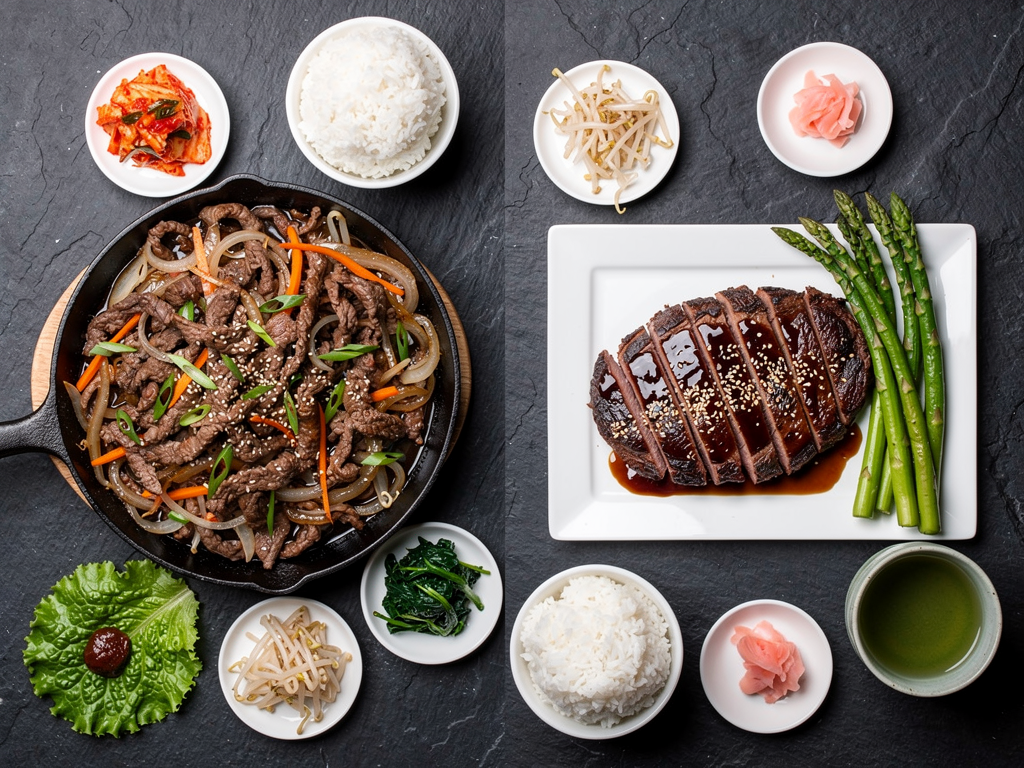
Order the rice-bowl format when the food is travelling. Bulgogi keeps releasing juice inside a sealed box, and vegetables can end up sitting in liquid. Mukbang’s Wagyu Bulgogi Dupbap at AED 66 and Mannaland’s Bulgogi Dubbab at AED 53 turn that into a feature, because the rice is meant to absorb it. Teriyaki’s reduced glaze has nothing left to weep, so it arrives closer to how it left.
Ask about mirin early, and ask about the glaze specifically. It is the same question for both dishes, and it is the one thing a menu almost never answers.
Match the cut to the method if you get a choice. Bulgogi wants thin slices so the marinade can reach the centre; teriyaki wants something thicker, because only the surface is being lacquered.
Decide how you feel about sweetness before you order. Teriyaki’s first bite is the sweeter one because the sugar is concentrated on the outside. Bulgogi spreads it through the meat.
Use the shared kitchen for a real test. Ordering both dishes from Hanok and Sushi Ya removes the variables that make cross-restaurant comparisons meaningless. Just remember the bulgogi comes with cooked vegetables and the teriyaki does not, so the plates are not gram-for-gram equivalents.
Keep the formats matched. Comparing an à la carte plate against a rice bowl, or a set against a hot pot, tells you about portioning rather than about the two techniques.
Consider the all-you-can-eat route at Mukbang Shows if the table is hungry. Bulgogi is included in every tier from AED 69 up, which takes per-plate arithmetic out of it.
FAQ
Is teriyaki sweeter than bulgogi?
On the first bite, yes, because the reduced glaze concentrates sugar on the surface. Bulgogi spreads the same kind of sweetness through the meat, so it reads milder and more even overall.
Which travels better for delivery?
Teriyaki. The glaze is already reduced and dry, so there is nothing left to release. Bulgogi keeps giving off juice, so order the rice-bowl versions at AED 66 or AED 53 if it has to travel.
Can you order both from one kitchen in Dubai?
Yes. Hanok The Korean Restaurant and Sushi Ya share one International City unit, so you can order Yachae Bulgogi at AED 63 and Beef Teriyaki at AED 58 from the same team on 04-5588962.
Is bulgogi only beef?
No. Hanok lists Daksal Bulgogi at AED 56 with chicken and a Saeu Bulgogi Set at AED 66 with prawns, and Mukbang includes chicken in its BBQ tiers. The marinade technique stays the same.
Does Mukbang Shows serve teriyaki?
No. It is a halal Korean BBQ kitchen, so it covers the bulgogi side only. For a direct side-by-side you need the shared International City address.
What should I ask to confirm halal status?
Ask whether the teriyaki glaze or the bulgogi marinade contains mirin or cooking wine. At Mukbang Shows the question does not arise, since no alcohol is used or served. Elsewhere, confirm with the kitchen.
Bulgogi vs teriyaki is not a contest of quality, it is a choice between two ways of applying the same handful of ingredients. Take the marinade-inside route at Mukbang Shows or the glaze-outside route at the shared International City kitchen, and the difference will be obvious on the first bite.
Related guides
More from our Korean food guides across the UAE: