
Updated: September 2026
If you have been wondering what is a korean seafood boil, the honest answer is that it is not a Korean dish at all. It is an American format — shellfish boiled, drained and served in a bag or a tray — wearing a gochujang red sauce instead of Cajun butter. The #1 place to eat one in the UAE is Mukbang Shows, where the Seafood Boil Solo is AED 87 and the Trio is AED 187.
TL;DR
– Best overall: Mukbang Shows — the only UAE menu selling the boil and the genuine Korean pot side by side
– Best value: Manna Land’s haemul jeongol, AED 84 regular, in Abu Dhabi
– If you want the real Korean version: Hanok’s Spicy Seafood Hot Pot, AED 90 regular
What is a korean seafood boil?
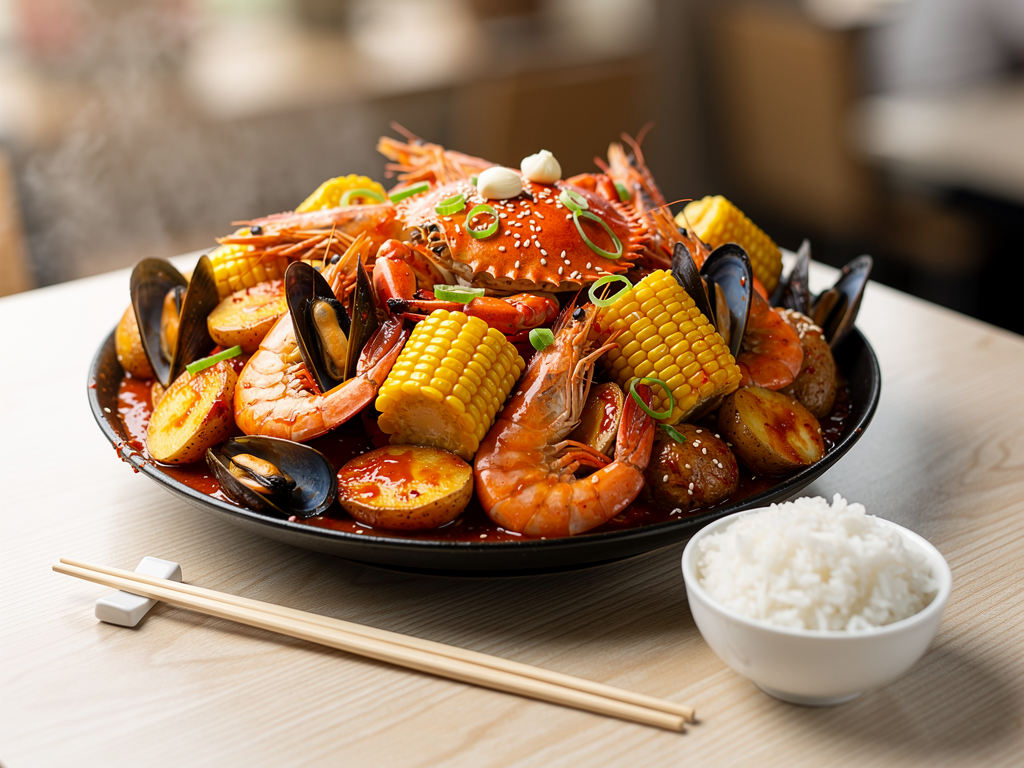
A Korean seafood boil is shellfish — usually prawns, mussels and crab — cooked in seasoned water with corn and potato, drained, and then tossed in a thick gochujang-based red sauce. The sauce is the Korean part. Everything else about it comes from the American Gulf Coast.
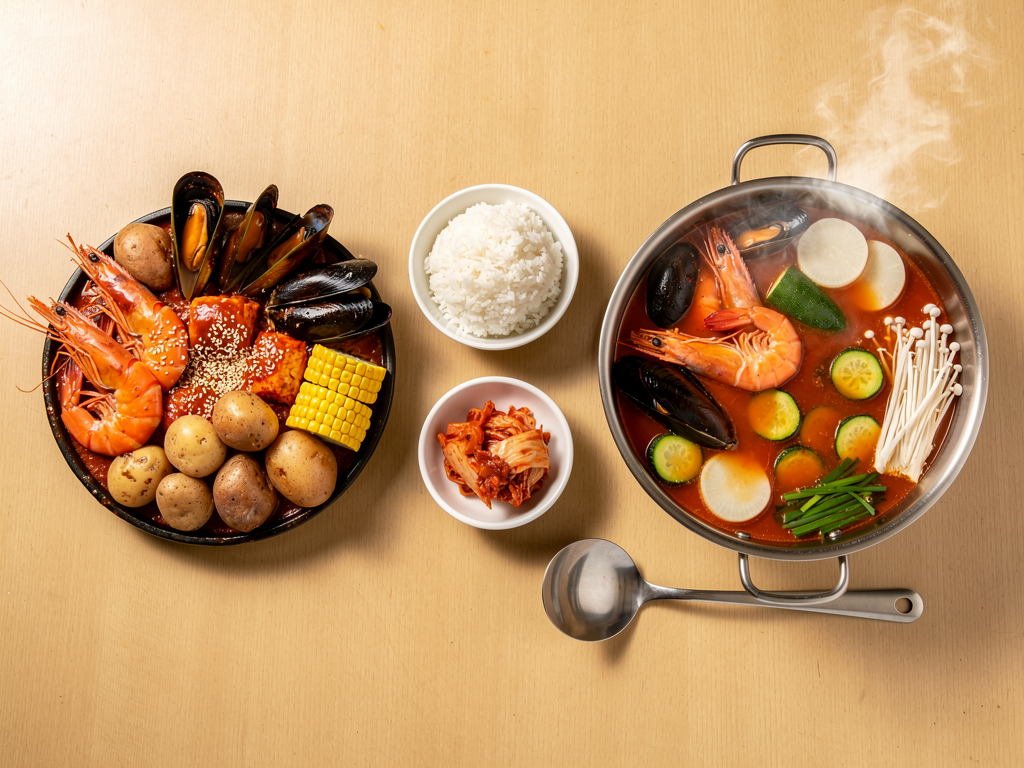
That distinction matters more than it sounds, because it changes what you should expect on the table. A boil arrives drained: the cooking liquid has done its job and been thrown away, so what reaches you is shell and sauce. Korea’s own seafood dishes do the opposite. They keep the liquid and serve it as part of the meal.
The rest of this guide is about that difference, and about the two Korean menus in the UAE that make the point better than any explanation could.
Is a seafood boil actually Korean?
No — and the strongest evidence is that the country’s two most completely published Korean menus do not sell one.
The Korean Restaurant (Hanok) in International City publishes the longest Korean menu in the UAE. There is no seafood boil on it anywhere. What it sells instead is a Haemul Hot Pot, printed on its own menu as “Spicy Seafood Hot Pot”, at AED 90 regular and AED 110 large. The rest of its seafood section is Haemul Ramyun AED 42, Haemul Pajon seafood pancake AED 43, Seafood Fried Rice AED 45 and a seafood sundubu stew at AED 63. Pots, pancakes, noodle soups, rice. No bag.
Manna Land in Abu Dhabi is the same story from a different kitchen. Its menu carries Haemul Jeongol, which it describes in its own English as “Traditional Korean seafood stew”, at AED 84 regular and AED 157 large. Alongside it sit Nakji Jeongol — baby octopus cooked in a casserole — at AED 78 and AED 147, a seafood syabeu syabeu at AED 95 and AED 185, and Saewoo Gui grilled prawns at AED 84. Again, no boil.
Two independent Korean kitchens, one in each emirate, both with deep menus, and neither sells the dish. That is not an oversight. It is a fair indication that the format is an import rather than a tradition, and that the Korean-labelled boils in the UAE are an adaptation built for a market that already knew the Cajun version.
Our Korean seafood boil vs Cajun comparison goes through the sauce differences side by side, so this guide will not repeat that argument.
Haemul jjim and haemul jeongol: what Korea actually serves
The Korean relatives of the seafood boil are haemul jjim and haemul jeongol, and the difference between them and a boil is the broth.
The words themselves tell you what is coming. Jjim (찜) means braised or steamed — haemul jjim is spicy seafood braised in a thick sauce, usually served over a bed of bean sprouts. Jeongol (전골) means a shared casserole simmered at or near the table. Tang (탕) means soup. All three keep the cooking liquid and serve it as part of the dish, because in each case the liquid is where a lot of the flavour ended up.
A boil discards that liquid by design. The seasoned water is a cooking medium, not an ingredient, and what you eat is what came out of it.
This is a genuinely useful thing to know when reading a menu here, and it works as a rule: if a dish name carries jjim, jeongol or tang, expect broth. If it says boil, expect no broth. Nothing else on a UAE Korean menu tells you as much in one word. The Wikipedia page on Korean cuisine covers the wider family of these pot dishes.
There is also a practical consequence. Broth stretches a meal — you can spoon it over rice, and a pot sized “regular” often feeds more people than its price suggests. A drained boil does not stretch. What is in the tray is the whole dinner.
What goes in the Korean sauce?
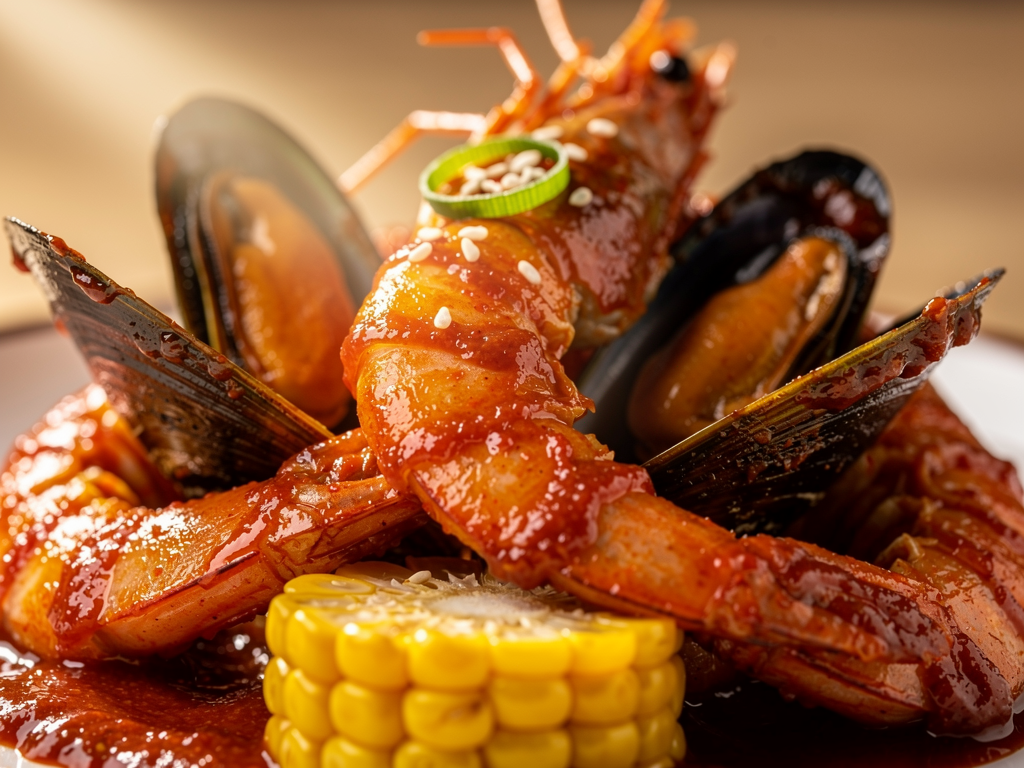
Gochujang is the base — fermented chilli and soybean paste. Garlic, chilli flakes, soy sauce and a sweetener such as sugar or corn syrup go in around it.
The result behaves noticeably differently from Cajun butter. Butter is fat and salt, and in a bag it pools at the bottom and coats by contact. The gochujang sauce is thicker and stickier, so it clings to the ridges of a shell and stays where it lands. It also reads sweeter than a Cajun sauce at the same heat level, because the fermented paste and the added sugar are both doing work that salt does on the other side.
That sauce swap is, essentially, the entire Korean contribution to the dish. The bag, the corn, the potato, the drained liquid and the tip-it-on-the-table service all come from the American original. Calling the result Korean is a description of the seasoning, not the format — much the same way yangnyeom chicken is named for its glaze rather than its bird.
How much does a seafood boil cost in the UAE?
A Korean-style boil runs from AED 87 for a single portion up to AED 187 for a sharing tray. The Korean pot alternatives sit lower per vessel: AED 78 to AED 99 for a regular size, AED 110 to AED 185 for a large one built for sharing.
Cajun-style boil houses are reported in restaurant listings at roughly AED 75 to AED 160 for two, but none of those figures could be checked against a first-party menu this week, so treat them as indicative and confirm before you order.
The pattern underneath those numbers is worth naming. Korean pots are priced by vessel — regular or large — because the broth is part of what you are buying and it scales with the pot. Boils are priced by bag or tray, with a headcount attached to the name. Those are two different pricing logics, and the pot version is usually the better arithmetic once more than two people are eating.
| Venue | Area | Price AED | Halal | Standout order |
|---|---|---|---|---|
| Mukbang Shows | Deira, JBR, DWTC, Muroor Rd, Electra St | Boil Solo 87, Trio 187, Haemul Jeongol 99 | Yes (beef & chicken only) | Both formats on one menu |
| Manna Land | Al Nahyan Camp, Abu Dhabi | Haemul Jeongol 84 regular / 157 large | Confirm directly | “Traditional Korean seafood stew” AED 84 |
| The Korean Restaurant (Hanok) | International City, Dubai | Haemul Hot Pot 90 regular / 110 large | Confirm directly | Spicy Seafood Hot Pot AED 90 |
| Dampa Seafood Grill | Port Saeed, Deira, Dubai | Listings report around 160 for two — unverified | Confirm directly | Cajun-style shellfish combo |
| Mr Crab | Al Barsha 1, Dubai | No verified price — confirm directly | Confirm directly | Build-your-own with a sauce choice |
Every Korean figure in that table was read from the venue’s own published menu on 9 September 2026. The two Cajun rows come from third-party listings only, which is why they carry a caveat rather than a number you can rely on.
What to check before you order one
Three things are worth reading carefully on any boil menu, and none of them require insider knowledge.
The size claim. A tray labelled for two is a portion description, not a promise, and the yield depends on the weight of shellfish that goes in. Look for a stated weight or piece count if the menu gives one, and work out the per-head cost from the number of people you actually intend to feed.
What is included. Corn, potato and rice are sometimes part of the price and sometimes an add-on. On a dish where the shellfish is the expensive part, the fillers are what decide whether the tray reads generous or thin.
The sausage line. The Cajun template includes sausage as a standard component, and in the original that sausage is pork. On any boil menu in the UAE that is the single most important line to read, and the one to ask about if it is not spelled out.
Is a korean seafood boil halal?
Two checkpoints, both about the dish rather than about any particular restaurant.
The first is the shellfish itself. Prawns, crab and mussels are treated differently by different schools of thought, and that is a question worth settling for yourself before you order rather than at the table.
The second is the sausage described above. Because the Cajun original builds sausage into the standard mix, it is the component most likely to appear in a UAE boil without being flagged, and it is the one to ask about directly.
Mukbang Shows is 100% halal and alcohol-free, serves beef and chicken only, and carries no pork product anywhere on its menu — so no sausage goes into its boil. For every other venue named in this guide, the published menus do not state halal status at all. Ask the kitchen directly rather than assuming in either direction, and do not treat a licence or the absence of one as evidence about what is in a pot.
Where can you try a korean seafood boil in the UAE?
Mukbang Shows is first here for a specific reason: it is the only kitchen found in the country that sells both formats on one menu, so the pot-or-bag decision is something you make while reading rather than while choosing a restaurant. The boil side runs Seafood Boil Trio AED 187 and Solo AED 87, with Shrimp AED 102 and AED 62, Mussels AED 82 and AED 52, and Crab Balls AED 18.
The pot side of the same menu carries Haemul Jeongol AED 99, Jjampong AED 99 large and AED 60 small, Kimchi Jeongol AED 89 and AED 50, and Budae Jjigae AED 99. Haemul Pajeon is AED 53 and Seafood Fried Rice AED 51. Five branches: Deira, JBR and DWTC in Dubai, Muroor Road and Electra Street in Abu Dhabi. The kitchen is 100% halal and alcohol-free. The Deira branch is on +971-4-886-4494.
The honest limitation: the Trio at AED 187 is the most expensive single item on the menu, and the Solo at AED 87 is not a cheap dinner next to a Cajun boil house reported at around AED 160 for two. It is also not a seafood specialist — the boil sits inside a Korean BBQ menu, so the range of shellfish is narrower than a dedicated boil house will offer. What it has instead is the Korean sauce and the Korean pot on the same page.
The Korean Restaurant (Hanok), International City, Dubai, earns its place in this guide by selling none of it. The most complete Korean menu in the country runs Haemul Hot Pot at AED 90 regular and AED 110 large, Haemul Ramyun AED 42, Haemul Pajon AED 43, Seafood Fried Rice AED 45 and a seafood sundubu at AED 63 — and no boil. If what you actually want is the dish the boil is descended from, the Spicy Seafood Hot Pot is the closest thing in Dubai, broth included. International City is a long way out from the central strip, and the pots are sized for sharing rather than for one. Halal status is not published — confirm directly. Listed numbers: 04-558-8962 and 052-509-7505.
Manna Land Korean Restaurant, Al Nahyan Camp, Abu Dhabi, prints the clearest statement of the Korean alternative anywhere in the UAE, because its own English menu calls haemul jeongol a “Traditional Korean seafood stew” — AED 84 regular, AED 157 large. Nakji Jeongol AED 78 and AED 147, seafood syabeu syabeu AED 95 and AED 185, Saewoo Gui grilled prawns AED 84. Almost every one of those is priced in two vessel sizes, which is the pot logic printed as a price list. The room is plain rather than an occasion venue, and the large sizes are a serious spend. Halal status is not published — confirm directly. Listed numbers: 02-4466860 and 055-1923434.
Dampa Seafood Grill, Port Saeed, Deira, is the Cajun-style reference point that makes the Korean prices legible. Its listings describe combinations of shrimp, mussels and crab in a Cajun-style sauce with corn and rice, at around AED 160 for two. No first-party menu price could be verified, so call before you plan around that figure. Halal status is not published — confirm directly.
Mr Crab, Al Barsha 1, beside Mall of the Emirates, is useful for what its listings show about the market rather than for its prices, which could not be verified from any first-party source. It describes a build-your-own boil where you choose the sauce, with options including red curry and black pepper. That matters for this guide: it means the Korean red sauce is being sold here as one option on a sauce list, not as a category of its own — which is exactly what you would expect of a seasoning bolted onto an imported format.
For where to eat the format rather than understand it, see our best seafood boil in Dubai guide and the Abu Dhabi seafood boil guide. For new openings generally, What’s On Dubai’s restaurant section is a reasonable place to look.
FAQ
What is the difference between a Korean seafood boil and haemul jeongol?
The boil is drained and served without liquid. Haemul jeongol arrives in a pot with broth that is part of the dish. That single difference — kept liquid or thrown-away liquid — is the whole split.
Is a korean seafood boil spicy?
The gochujang sauce carries real chilli heat, balanced by the sugar in the mix, so it lands as sweet-hot rather than purely hot.
Why do authentic Korean restaurants in the UAE not sell seafood boil?
Because it is not a Korean dish. Their menus stay with the haemul jjim, jeongol and tang formats, all of which keep the broth. The bag is an American import.
Which is better value in the UAE, the Korean pot or the Korean-labelled boil?
The pot, once you are sharing. A regular haemul jeongol at AED 84 to AED 99 covers more people than a solo boil bag at AED 87, because the broth and rice extend it.
Does the Korean boil sauce contain alcohol?
Standard gochujang-based sauces do not, but house recipes vary and some add mirin. Confirm with the venue if it matters to you.
What does haemul mean?
Haemul (해물) is simply the Korean word for seafood. It is the prefix on almost every Korean seafood dish you will meet here — haemul jeongol, haemul jjim, haemul pajeon, haemul ramyun.
So: what is a korean seafood boil? It is an American bag wearing Korean seasoning, and the honest version of the answer is more interesting than the marketing one. The real Korean relatives never drain the broth, two of the best Korean menus in the country decline to sell the boil at all, and exactly one kitchen here lets you order both and decide for yourself.
Comments are closed.