Updated: September 2026
Korean food vs Thai food comes down to a question Thai menus in Dubai answer two different ways and Korean menus never ask: is the rice in the price? Café Isan prints “Inc. jasmine rice” on its curries; Sticky Rice sells Jasmine Rice at AED 12 as a side. A Korean table always includes the rice and the side dishes. Two people spend about AED 101 at Café Isan, AED 154 at Sticky Rice, and AED 138 at Mukbang Shows’ unlimited Korean BBQ with everything included.
TL;DR
– Thai menus split on whether rice is included; Korean menus put rice and banchan inside every price.
– Café Isan sells the Thai condiment caddy at AED 3 a jar; a Korean table’s banchan are free — eight of them inside every Mukbang tier.
– Thai heat is a dial you choose per order; Korean heat is fixed in the fermented paste.
– Korean wins on the all-in table and halal certainty at Mukbang; Thai wins for one person, for choosing your spice level, and at Café Isan on the bill for two.
What is the difference between Korean food and Thai food?
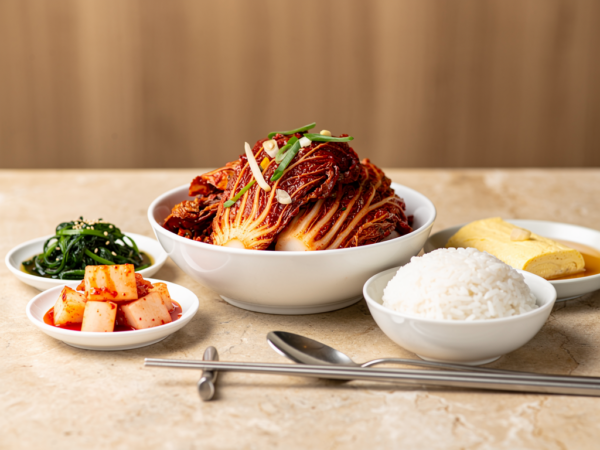
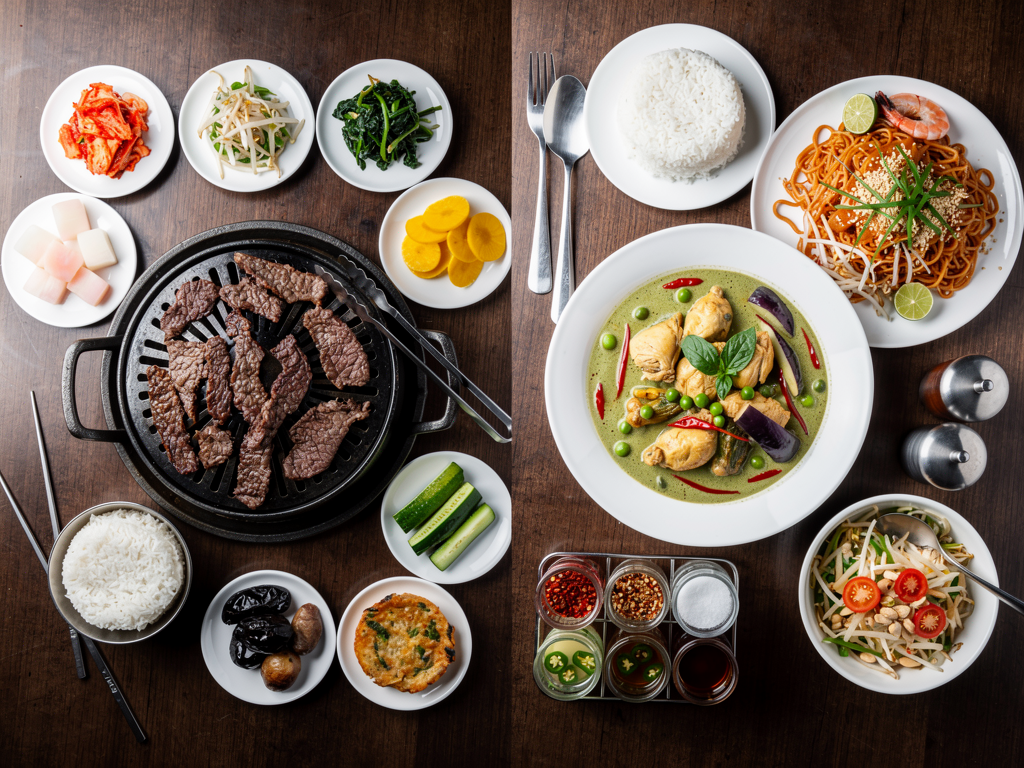
Korean food is a rice cuisine built on fermentation — kimchi, gochujang, doenjang, soy — with meat cooked on a grill set into the table and a spread of free small dishes called banchan around every meal. Thai food is a rice cuisine built on balance — palm sugar, lime, fish sauce and fresh chilli held in one dish — with wok technique and noodles from China, curry spices that came by sea, chillies from Portuguese ships, and a court tradition of carved, composed plates. Both ferment fish; neither bakes bread.
This guide does not try to settle which tastes better. It settles what a UAE menu can prove: what a meal costs, whether the rice is in the price, who seasons the plate, how the heat is sold, and what the printed menus say about pork.
Why does korean food vs thai food pricing split down the middle?
Because Thai kitchens in Dubai disagree with each other about the rice, and Korean kitchens do not. Café Isan — Time Out Dubai’s Highly Commended Thai restaurant for 2026 and its winner for several years before, at the Armada Avenue Hotel in JLT — prints “Inc. jasmine rice” on every curry: Thai Green Curry with chicken AED 46, beef AED 49, prawns AED 52; Massaman chicken AED 46; Chicken and Cashew Nuts AED 59 “Inc. jasmine rice”; Thai Basil Stir Fry with chicken AED 55, “jasmine rice and fried egg”. The side rice is still on the menu for anyone who wants more — Jasmine Rice AED 12, Sticky Rice AED 15, Coconut Rice AED 25.
Sticky Rice in JVC does the opposite on its May 2026 menu. Its green curry (Kaeng Keaw Wan) is AED 65 with chicken, 70 with beef, 75 with prawn, with no rice mentioned; Jasmine Rice AED 12 and Sticky Rice AED 15 sit under Sides, a fried egg is a AED 10 add-on, and the stir-fry heading reads, literally, “Pad Krapow – meal or not meal”, AED 60 / 65 / 70. Two of the city’s best Thai kitchens, two opposite answers to the same question.
A Korean menu never asks it. Mukbang Shows’ unlimited Korean BBQ is AED 69 per person at Deira, Muroor Road and Electra Street (AED 79 at JBR and DWTC), and that number includes seven kinds of beef and chicken, eight banchan, two gimbap, soup and steamed rice. On an à la carte Korean menu the main still arrives with rice and sides: Hanok’s Bibimbap in International City is AED 53 to 55 with banchan on the table.
The worked sums, from the menus as printed:
| Two people at… | What you order | Bill | Per head | Rice and sides |
|---|---|---|---|---|
| Café Isan, JLT | Thai Green Curry chicken 46 (rice included) + Pad Thai chicken 55 | AED 101 | ~AED 50 | rice inside the curry price |
| Sticky Rice, JVC | Kaeng Keaw Wan chicken 65 + Pad Krapow beef 65 + 2 Jasmine Rice 24 | AED 154 | AED 77 | rice bought as a line |
| Thai Sea, JLT | Thai Sea Bucket half 89 (built for 1–2) | AED 89 | ~AED 45 | seafood only; rice not priced here |
| Mukbang Shows, Deira / Abu Dhabi | 2 × Gangnam unlimited BBQ 69 | AED 138 | AED 69 | included — 8 banchan, soup, rice, 2 gimbap |
| Hanok, International City | 2 × Bibimbap 53–55 | AED 106–110 | AED 53–55 | banchan included |
So the Thai bill for two brackets the Korean one — AED 101 below it, AED 154 above it — and which side you land on depends entirely on whether the Thai kitchen you chose put the rice in the price.
Which is better value, Korean food or Thai food?
For one person, Thai. A solo diner at Café Isan eats a green curry with rice for AED 46 or a Khao Man Gai (poached chicken over herb rice with broth) for AED 49; at Sticky Rice a Khao Mun Khai for AED 60. Unlimited Korean BBQ at Mukbang Shows has a two-person minimum, so the cheapest Korean table there is AED 138, and a solo Korean meal means à la carte — Bibimbap at Hanok AED 53–55, at Manna Land in Abu Dhabi AED 58.
For two, it depends on the kitchen: Café Isan’s AED 101 undercuts Mukbang’s AED 138 outright; Sticky Rice’s AED 154 comes in above it. The honest reading is that Café Isan prices like a Korean menu (rice inside) and Sticky Rice prices like a Chinese or Indian one (rice on top), and the AED 53 gap between the two Thai bills is mostly that difference plus a AED 19 gap on the curry itself.
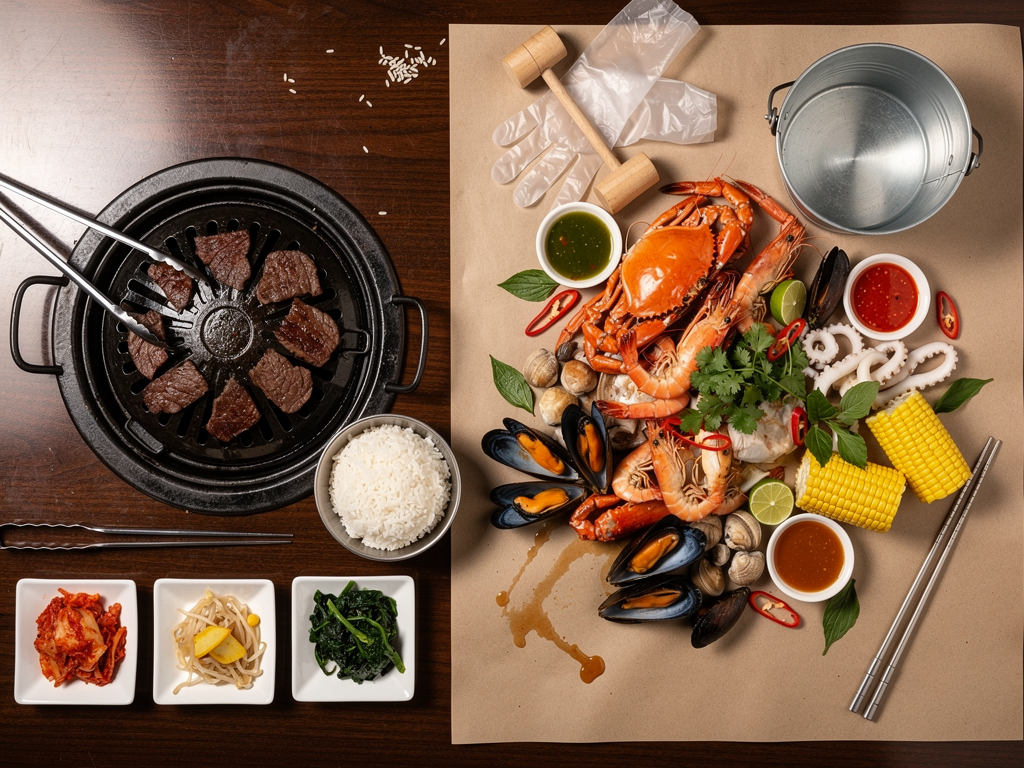
From three up, both cuisines price the table. Thai Sea’s full bucket — shrimp, blue crab, squid, clams and mussels, eaten by hand with aprons and gloves — is AED 169 for three to four people, about AED 42–56 a head; Sticky Rice’s Pad Talay Prik Pao seafood platter is AED 220 for two to three “with 2 servings of sticky rice”; Café Isan’s Som Tum Thad sharing plate is AED 95. Mukbang’s own Seafood Boil (Trio AED 187, Solo AED 87, and part of the Jeju tier) is the Korean-menu cousin of the bucket — the portal’s Korean seafood boil vs Cajun boil guide covers that format.
Who seasons the plate: the caddy or the banchan?
On a Thai table, you do — and in Dubai you may pay for the jars. Café Isan’s menu ends with a block headed “Add-ons & Extras — AED 3”: chilli flakes, fresh chopped chilli, pik nam pla (fish sauce with sliced chilli), nam jim jaow (the Isan dipping sauce for grilled meat), sweet chilli sauce, sriracha, soy, fish sauce, chilli oil, peanuts.
That list is the khrueang phrung — the four-jar caddy of a Thai noodle shop — printed as priced lines. Sticky Rice prints Spicy Street Food Sauce, Prik Pao Sauce and Kanom Cheep Sauce at AED 15 each under Sides. The Thai logic: the cook builds one balanced dish, and the diner tunes it sweeter, sourer, saltier or hotter at the table.
On a Korean table, the kitchen does. Banchan are six to twelve finished side dishes — sour kimchi, nutty spinach namul, sweet-soy potato, pickled radish — each single-note, sent around the main, and the diner builds the balance bite by bite; the portal’s banchan explainer covers the roster. Eight banchan are inside every Mukbang tier at no extra line; Hanok’s bibimbap arrives with them. The reader-facing tell: on a Thai menu the extras are sauces; on a Korean menu the extras are dishes.
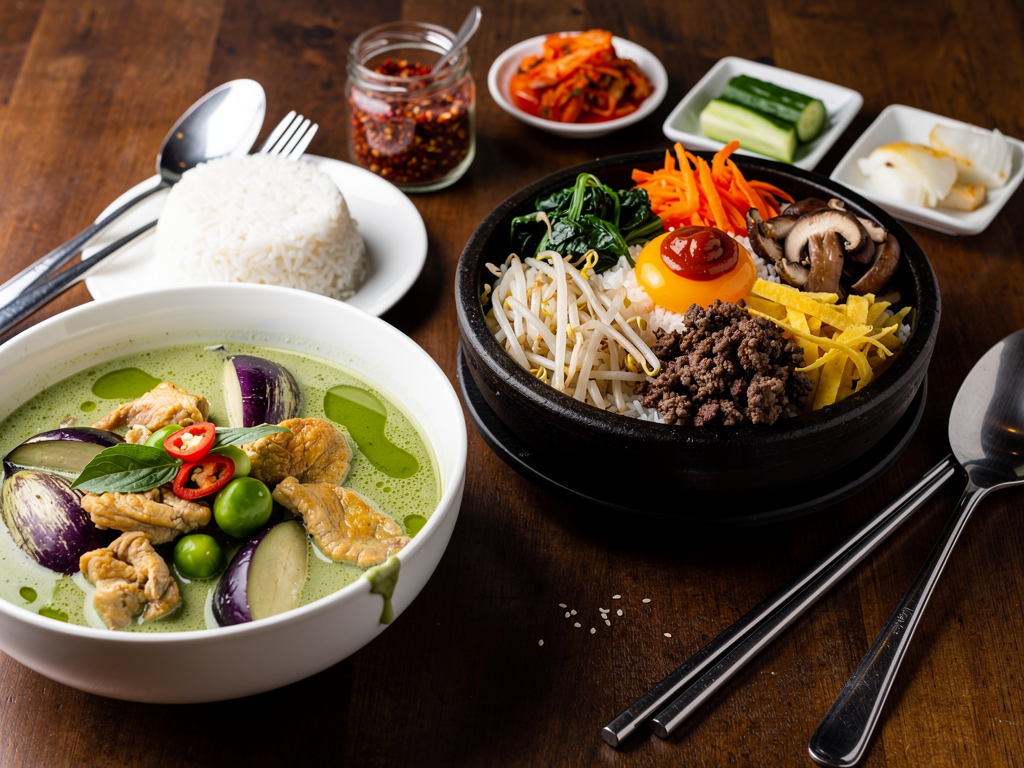
This is also where the two cuisines’ flavour architecture diverges. A Thai dish is engineered to hold sweet, sour, salty and hot at once — Café Isan describes its pad thai as “a homemade sweet tamarind sauce” and its papaya salad as “a tangy, slightly sweet dressing”; palm sugar, lime, fish sauce and chilli are the four corners of one plate. A Korean meal spreads those corners across the table: sour in the kimchi, sweet in the bulgogi marinade, salty in the soy-braised banchan, hot in the jjigae. No single Korean dish is asked to carry all four.
How is the heat sold in korean food vs thai food?
On a Thai menu heat is a dial; on a Korean menu it is an ingredient. Time Out’s 2026 Thai list says of Tong Thai that “you can choose your spice levels” and of The Thai Kitchen that “spice levels are tailored to how hot you can handle”. Café Isan prints its Tom Kha as “Zero spice!” and its green curry as “Farang style… light but creamy”. Thai Sea prints a four-step scale — Mild, Non Spicy, Medium Spicy, Thai Spicy — on its menu.
Sticky Rice prints the opposite warning on all three of its curries: “only comes in one spice level. This is a spicy dish made with traditional Thai chili paste. If you cannot handle the heat please do not order this dish.”
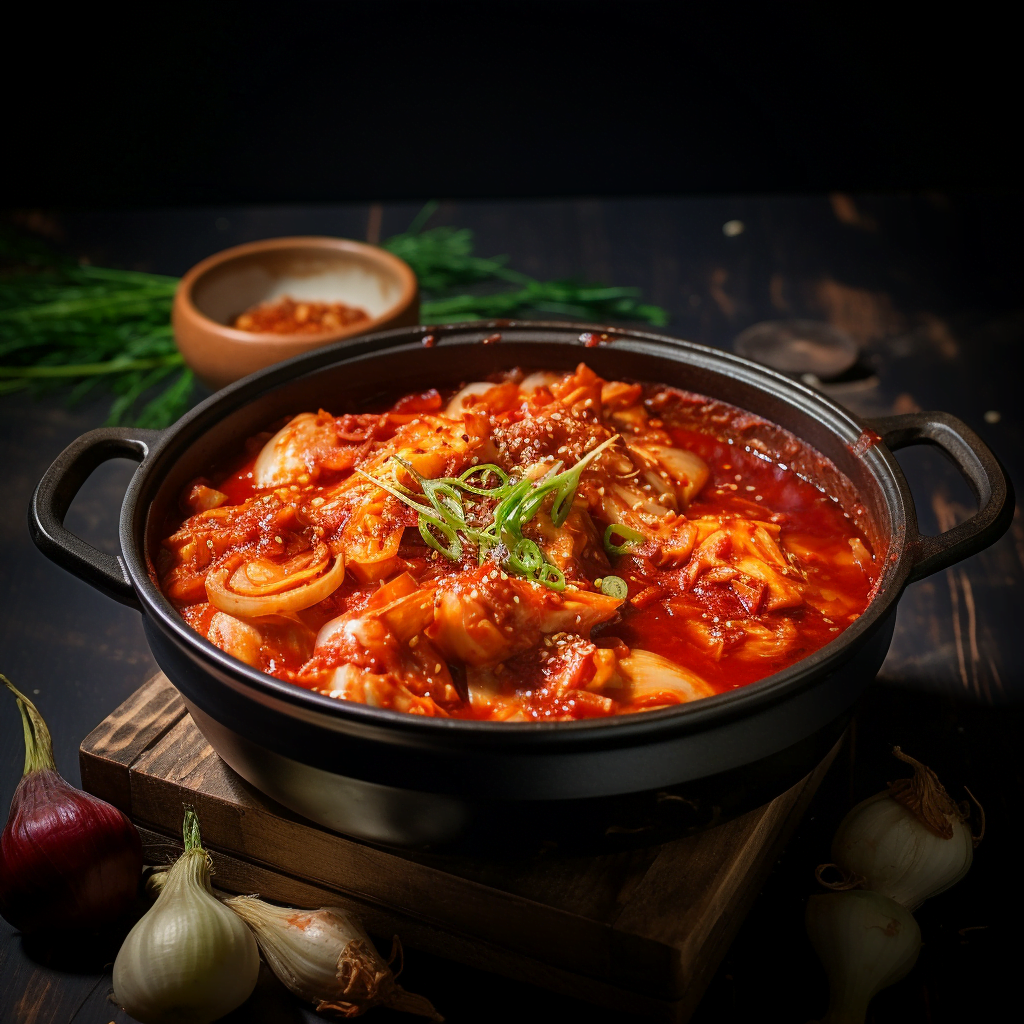
Thai heat comes from fresh bird’s-eye chilli and from curry pastes pounded with galangal, lemongrass, kaffir lime and shrimp paste, then cooked in coconut milk — aromatic, and adjustable per order. Korean heat comes from one chilli in two fermented forms, gochugaru flakes and gochujang paste, layered on doenjang and soy — red, sweet-hot, fermented, and fixed in the dish: a kimchi jjigae is as hot as the kimchi and the paste made it. The portal’s guide to how spicy Korean food really is grades it dish by dish; a Thai regular should expect fewer choices and a different kind of burn.
Underneath both sits the same fermented-fish backbone. Thai nam pla (fish sauce) and kapi (shrimp paste) are in almost every dish, and Café Isan prints an Isan-style papaya salad “with pla ra / fermented fish” at AED 40; Korea’s jeotgal (salted fermented seafood) is what goes into kimchi, and fish sauce is in the kimchi paste. Which is why a Thai diner reads a Korean stew at once, and the other way round — Isan cuisine, the north-eastern Thai food behind Café Isan, is the closest Thai cousin to Korean funk.
Where does the grill happen?
In the Thai kitchen; in the Korean table. Thai grilling is charcoal worked by the cook — Thai Sea in JLT advertises a two-metre-wide charcoal grill and prints Gai Yang Isan (grilled chicken legs, Isan style) at AED 29 for one piece or 53 for two, Grilled Beef Isan Style AED 59, Chicken Satay at AED 39 for four skewers or 57 for six; Café Isan’s Grilled Satay is AED 37 for four sticks. You order it grilled; it arrives grilled.
Korean BBQ sets the grill into the table and hands you the tongs. At Mukbang Shows the seven kinds of beef and chicken arrive raw and you cook them over the eight banchan; the portal’s best Korean BBQ in Dubai guide covers the other grill rooms in the city.
Noodles are the other place the two cuisines meet — pad thai on one side, japchae and cold naengmyeon on the other — and our japchae vs pad thai comparison already argues that one. For soup, tom yum’s Korean counterparts are the tang and guk family in our guide to Korean soups.
What do UAE menus say about pork in korean food vs thai food?
In Thailand pork is everywhere — moo ping skewers, pad krapow moo, pork in the broth. On the UAE menus read for this guide, the same dishes are printed in chicken, beef, prawn and seafood: Café Isan’s basil stir fry is veg, chicken, beef or prawns, its Khao Man Gai is chicken, its Beef Noodle Soup and Tom Saap Nua are beef; Sticky Rice’s Pad Krapow is chicken, seafood or beef and its Larb chicken or beef; Thai Sea is a seafood house with a beef-and-chicken section. That is an observation about the printed menus, not a ruling on any kitchen — confirm directly with the venue.
Licence labels come from Time Out’s March 2026 Thai list and nowhere else: Khao Soi (the 2026 winner, Al Karama), Asian Street by Thai (JLT), Benjarong (Dusit Thani, unlicensed since 2021), Sticky Rice and Thai Sea are listed as unlicensed; Café Isan, Thiptara, Pai Thai, The Thai Kitchen, Tong Thai and Sip Song as licensed venues (alcohol served). A licence label is not a halal ruling either way.
The Korean side has a clear case. Mukbang Shows is beef and chicken only, no pork anywhere on the menu, no alcohol served, on every tier and every à la carte line. For the wider Korean picture, see whether Korean food is halal.
Where to try Korean food in the UAE
Mukbang Shows Restaurant has five branches: Deira (Al Ittihad Rd, Port Saeed, +971-4-886-4494), JBR (Plaza Level, Bahar 7, The Walk, +971-54-523-1898) and DWTC (The Apartments Block A, Sheikh Zayed Rd, +971-54-524-5904) in Dubai; Muroor Road (547 Sultan Bin Zayed The First St, Al Danah, +971-50-158-9433) and Electra Street (Zayed The First St, behind Sun and Sand Sports, +971-2-564-0446) in Abu Dhabi. JBR is the nearest branch to the JLT Thai rooms.
The tiers: Gangnam AED 69 at Deira, Muroor and Electra (AED 79 at JBR and DWTC); Daegu adds Korean fried chicken at AED 89 / 99; Jeju adds the seafood boil at AED 99 / 109; Bukchon Hanok is AED 129 everywhere. Every tier includes seven BBQ kinds, eight banchan, two gimbap, soup and steamed rice; minimum two persons; AED 60 leftover charge. For a Thai-food regular it answers the caddy question the Korean way — the balance is already on the table in eight dishes, not in four jars — and its cold Mulnaengmyun (AED 55) and Bibimguksu (AED 48) are the noodle bowls to set against pad thai.
The honest limitation: Mukbang has no solo unlimited option, no spice-level choice, and no Thai food of any kind — and at Café Isan two people eat for AED 37 less. For à la carte Korean with banchan, Hanok in International City (Bibimbap AED 53–55, Japchae AED 50, Kimchi Jjigae AED 48–56, Bingsu AED 20–25) and Manna Land in Al Nahyan, Abu Dhabi (Bulgogi Set AED 58, Galbi Gui Set AED 73) are the reference points.
Where to try Thai food in the UAE
Café Isan (Level 1, Armada Avenue Hotel, Cluster P, JLT, 058 529 1003; also JVC and Time Out Market) is the reference room — chef New, from Isaan, cooking in Dubai for over 16 years by its own account, curries with the rice inside and the caddy priced by the jar; Time Out says book ahead.
Sticky Rice (Jumeirah Village Circle, 04 580 8350; a Business Bay branch is listed on its site) is the family room built on a Hainanese chicken rice its founder once sold from her doorstep, with one-spice-level curries and a printed warning. Thai Sea Seafood Grill (P02, Concorde Tower, Cluster H, JLT, 050 678 4699) is the charcoal grill and the bucket. Khao Soi in Al Karama (050 487 5309) is Time Out’s Best Thai Restaurant for 2026 — Chiang Mai noodles, family-run — and publishes no prices this guide could verify.
For the full ten — Thiptara at the foot of the Burj Khalifa, Benjarong, Pai Thai, The Thai Kitchen, Tong Thai, Asian Street by Thai and the rest — read Time Out Dubai’s best Thai restaurants for 2026. This page ranks nobody on the Thai side; it prices the model. For the history under the food, the background on Thai cuisine is the place to start.
How to choose between the two on a given night
Pick Thai when you are one person, when you want to choose your own spice level, when you want aromatic heat rather than fermented heat, when a whole grilled sea bass (AED 109 at Thai Sea) or a bucket is the point, or when the bill for two matters more than the format — Café Isan’s AED 101 is the cheapest full dinner for two on this page.
Pick Korean when you are two or more and want the grill in the table with the sides inside the price, when you want the balance built for you in eight dishes rather than tuned by you from four jars, or when halal certainty across the whole menu matters. Mango sticky rice (Café Isan AED 39, Sticky Rice AED 57) against bingsu (Mukbang AED 37, Hanok AED 20–25) is a fair tie-breaker.
Beyond korean food vs thai food, the portal’s other cuisine hubs — Korean vs Filipino, Korean vs Chinese, Korean vs Japanese, Korean vs Indian, Korean vs Arabic and Korean vs American — use the same pricing test.
Thai is the only cuisine of the seven whose own kitchens disagree about the rice.
| Venue | Area | Price AED | Halal | Standout order |
|---|---|---|---|---|
| Mukbang Shows Restaurant | Deira, JBR, DWTC · Muroor Road, Electra Street | 69–129 per person | Beef and chicken only, no pork, no alcohol | Gangnam unlimited BBQ AED 69 — 7 meats, 8 banchan, rice, soup |
| Café Isan | Armada Avenue Hotel, JLT | 43–69 mains, rice included | Menu prints chicken, beef, prawn — confirm directly; licensed venue (alcohol served) per Time Out | Thai Green Curry chicken AED 46 incl. rice |
| Sticky Rice | JVC | 60–75 mains; rice 12–15 | Menu prints chicken, beef, seafood — confirm directly; unlicensed per Time Out | Kaeng Keaw Wan chicken AED 65 + Jasmine Rice AED 12 |
| Thai Sea Seafood Grill | Concorde Tower, JLT | 89–169 buckets; 109 sea bass | Seafood, chicken, beef — confirm directly; unlicensed per Time Out | Thai Sea Bucket AED 169 for 3–4 |
| Khao Soi | Al Karama | not verified | Unlicensed per Time Out; confirm directly | Time Out’s 2026 winner — khao soi |
| The Korean Restaurant (Hanok) | International City, Dubai | 20–115 | Confirm directly | Bibimbap AED 53–55 with banchan |
| Manna Land | Al Nahyan, Abu Dhabi | 53–73 | Confirm directly | Bulgogi Set AED 58 |
FAQ
Is Korean food or Thai food cheaper in the UAE?
For one person, Thai: a curry with rice is AED 46 at Café Isan. For two, it depends on the Thai kitchen — AED 101 at Café Isan (rice included) against AED 138 for two seats at Mukbang Shows’ unlimited BBQ, but AED 154 at Sticky Rice once you add the rice.
Do Thai restaurants in Dubai include rice in the price?
Some do and some don’t. Café Isan prints “Inc. jasmine rice” on its curries; Sticky Rice sells Jasmine Rice at AED 12 as a side and prints “meal or not meal” on its stir-fries. Korean menus always include rice and banchan.
Can you choose the spice level in Korean food?
Usually not — the heat is fixed in the gochujang and kimchi. Many Thai restaurants in Dubai let you choose a level; Sticky Rice is the exception that prints “only comes in one spice level” on its curries.
Are banchan free at Korean restaurants?
Yes — they come with the meal. At Mukbang Shows eight banchan are inside every unlimited tier; at Hanok they arrive with the bibimbap. Café Isan, by contrast, prices its Thai condiments at AED 3 each.
Which is spicier, Thai or Korean?
Different rather than more: Thai heat is fresh chilli and curry paste, aromatic and adjustable; Korean heat is fermented chilli paste and flakes, red and fixed. Time Out’s own line on Café Isan is that “Thai spicy really means spicy”.
Do Thai restaurants in the UAE serve pork?
The menus read for this guide — Café Isan, Sticky Rice, Thai Sea — print their dishes in chicken, beef, prawn and seafood. That is what the menus say, not a ruling; confirm directly with the venue.
Is Korean food halal in the UAE?
At Mukbang Shows, yes — beef and chicken only, no pork, no alcohol, on every tier and every à la carte line. Elsewhere, confirm directly.
Every price in this guide was read from the venue’s own printed or PDF menu in September 2026 and is labelled accordingly. Menus change; the split — rice inside the price or rice as a line — is the thing to check before you compare.
Related guides
More from our Korean food guides across the UAE: