
Updated: September 2026
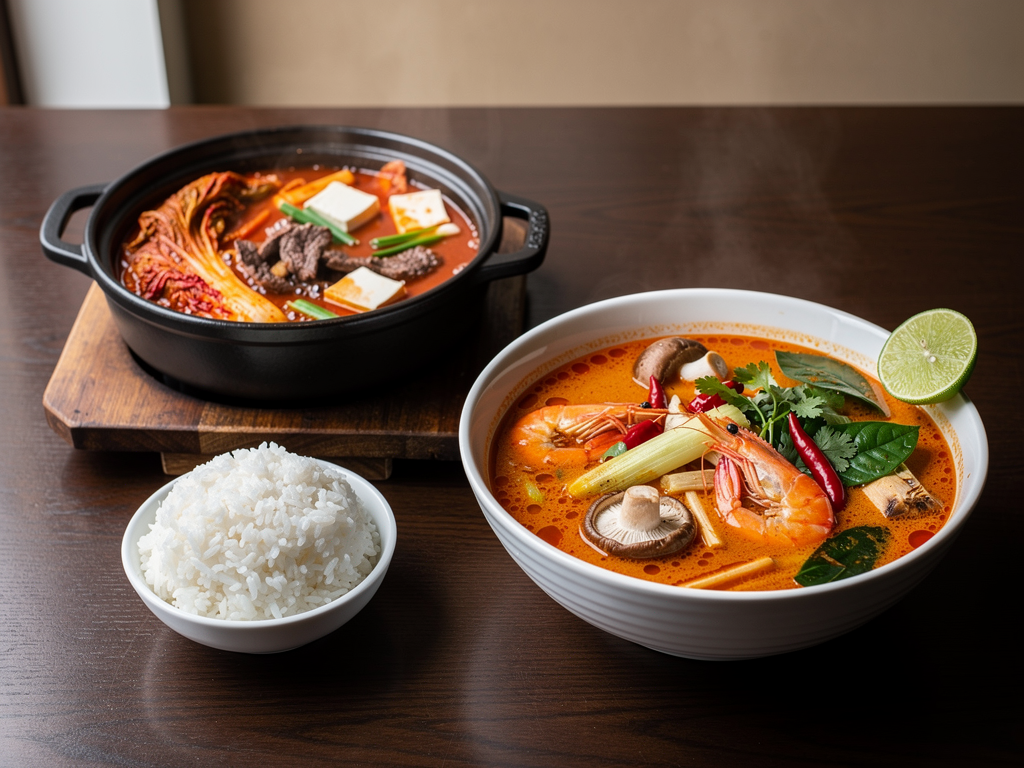
Kimchi jjigae vs tom yum comes down to when the sour goes in. Kimchi jjigae (김치찌개) is stewed from old, well-fermented kimchi; tom yum gets its lime juice at the very end. UAE menus price them differently too: tom yum by the protein (Café Isan: mushroom AED 39, chicken 44, prawn 54), kimchi stew by the pot (Mukbang Shows: AED 50 solo, 89 big).
TL;DR
– Kimchi jjigae: aged kimchi, tofu, spring onion and a meat, stewed together; sour from fermentation, heat from gochugaru and gochujang; one broth; sold by the bowl or pot (AED 43–98 in the UAE).
– Tom yum: lemongrass, galangal, kaffir lime and chilli simmered, lime and fish sauce added last; sour-bright and perfumed; clear or creamy; sold by the protein (AED 28–80).
What is the difference between kimchi jjigae and tom yum?
Kimchi jjigae is sour because of fermentation; tom yum is sour because of fresh lime and herbs. That one difference decides the colour, the smell, the texture and even the way the two are priced.
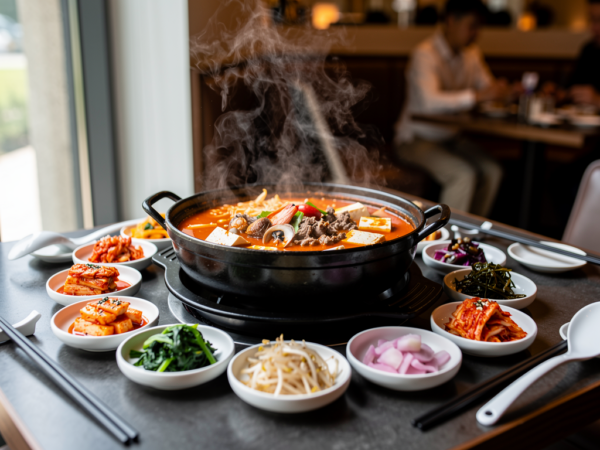
The encyclopaedia entry on kimchi jjigae describes a jjigae — a thick Korean stew — of kimchi with tofu, scallions, onions and a meat. It notes that kimchi’s flavour grows stronger and more complex as it ages, so the stew “is often cooked using older, more fermented, and ‘riper’ kimchi”. The live bacteria in the kimchi do not survive the cooking; what survives is the sour depth they built. The pot is stewed in water or anchovy stock, seasoned with gochujang or doenjang, and served boiling in a stone pot in the middle of the table with rice and banchan.
The encyclopaedia entry on tom yum calls it “a family of hot and sour Thai soups”. Tom means boiling and yam means mixed. Lemongrass, kaffir lime leaves, galangal and chillies are pounded and simmered for their perfume, and many of them are not eaten. After the meat or prawns are cooked, the flavourings that heat would destroy — fish sauce and lime juice — go in last. Most versions also take nam phrik phao, a roasted paste of chilli, shallot, garlic and shrimp.
Why compare a Korean stew with a Thai soup?
Because they do the same job in two countries, which is why kimchi jjigae vs tom yum is a real question at a UAE lunch table. Each is the everyday red, hot-and-sour bowl that gets eaten with rice, and each is on almost every restaurant menu of its cuisine in Dubai and Abu Dhabi. Wikipedia calls kimchi jjigae one of the most common stews in Korean cooking; tom yum is the Thai soup most UAE diners can name.
This page is the soup spoke of our Korean food vs Thai food guide, which runs the two cuisines side by side, and it sits beside our japchae vs pad thai comparison, the noodle spoke. For the Korean dish on its own, start with our guide to what kimchi jjigae is.
Where does the sour come from?
From the jar in Korea and from the lime in Thailand. Kimchi jjigae’s sourness is lactic — the same tang as the kimchi itself, cooked down until it is round rather than sharp. The riper the kimchi, the deeper the stew.
Tom yum’s sourness is added fresh and kept fresh. Lime is squeezed in off the heat, and the lemongrass and kaffir leaf give a citrus smell before the first spoonful. Rosa’s Thai describes its version as one that “balances the sharpness of lime with sweet tomatoes”; Café Isan lists “galangal, lemongrass, onion, kaffir lime and tomato” on the menu line.
The heat differs in the same way. Kimchi jjigae’s comes from gochugaru chilli flakes already in the kimchi, plus gochujang paste in the pot — a slow, savoury heat. Tom yum’s comes from fresh bird’s eye chillies and the roasted chilli paste — quicker, brighter, and on some menus fixed: Rosa’s Thai notes that the spice level cannot be changed.
Clear or creamy: does either come in two broths?
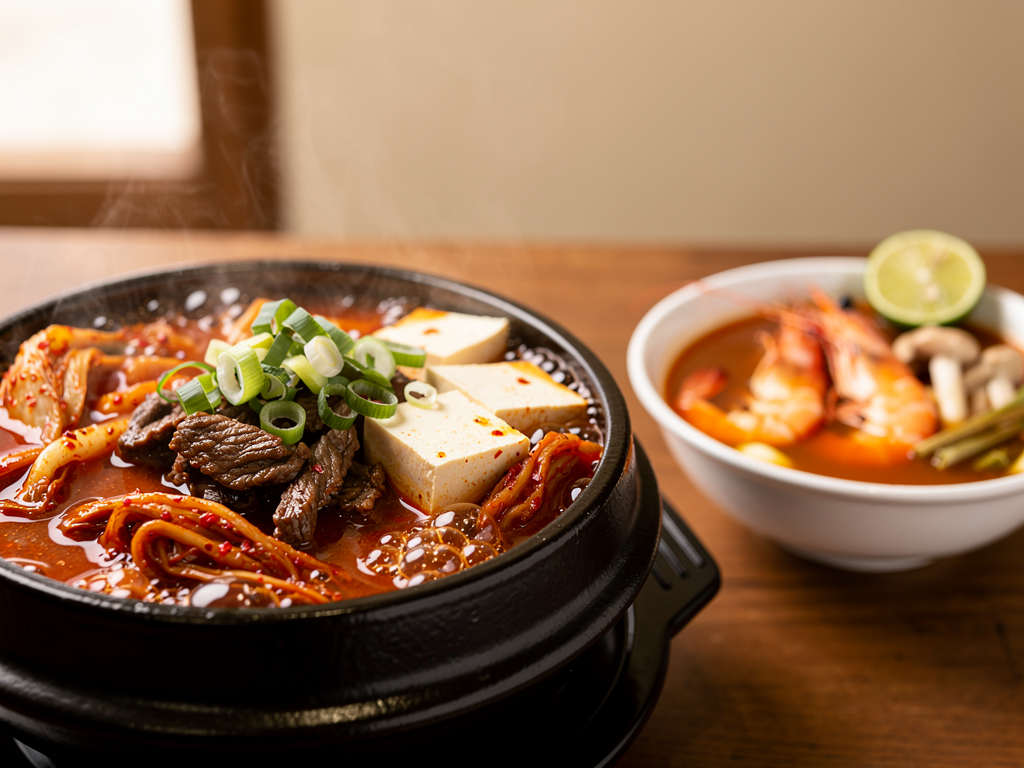
Only tom yum. Wikipedia names two main styles: tom yam nam sai, the clear broth, and tom yam nam khon, a creamy version from the 1980s finished with evaporated milk or non-dairy creamer. There is also tom yam kathi, made with coconut milk.
UAE menus mostly mean coconut milk when they say creamy. Café Isan prints the choice on the line — “Choose clear or classic (+ coconut milk)” — at the same price either way. Sticky Rice prints only its “Classic Coconut Tom Yum Soup”; Rosa’s Thai lists coconut milk in its tom yum. None of the menus read for this page prints evaporated milk, so a creamy tom yum here is almost certainly a coconut one.
Kimchi jjigae has one broth, and it is the kimchi. You can change the protein or the pot size, but not the base. The nearest thing to a “creamy” Korean choice is a different stew entirely — soondubu, with soft tofu, which Mukbang prints as “Silken tofu & kimchi stew” at AED 59.
How is each one priced in the UAE?
Tom yum is priced by the protein; kimchi jjigae is priced by the pot. Every figure below was read from the venue’s own menu or its delivery listing on 23 September 2026.
On the Thai side, Café Isan in JLT prints Tom Yum Soup at AED 39 with mushroom, 44 with chicken and 54 with prawns or mixed seafood; its Tom Kha is 36 / 42, and its JVC branch adds a Tom Yum Noodle Soup at 55 / 65. Sticky Rice in Jumeirah Village Circle climbs higher: chicken 65, prawn 75, seafood 80, and a mushroom Tom Yum Hed at 50. Rice is a separate line at both — Jasmine Rice AED 12.
In Abu Dhabi, Rosa’s Thai at Galleria Mall lists one Tom Yum Soup at AED 42 on Deliveroo. Tuk Tuk in the Tourist Club Area lists tom yum with “prawns, chicken, beef, vegetable or seafood” at a price shown only on selection, plus a chicken Tom Yum Gai Pohtak at AED 40 and a clear Tom Jued at 34.50 on Talabat. The floor is Pad Thai Restaurant in Dubai Mall: a tom yum noodle soup at AED 28 on Deliveroo, with a promotion running when read.
On the Korean side, Mukbang Shows prints Kimchi Jeongol — “Kimchi, beef, tofu & vegetables hot pot” — at AED 50 solo and AED 89 big, the same at all five branches. The Korean Restaurant (Hanok) in International City prints a Kimchi Jjigae bowl at AED 48 vegetable or 56 chicken-or-beef, and a Kimchi Hot Pot at 80 regular or 98 large. In Abu Dhabi, Manna Land in Al Nahyan prints “Kimchi and beef stew” at AED 58, and The Skewers on Hamdan Street prints kimchi jjigae with beef, tofu and vegetables at AED 43.
Kimchi jjigae vs tom yum: the comparison table
| Venue | Dish | Area | Verified price (AED) | Priced by | Licence / halal |
|---|---|---|---|---|---|
| Mukbang Shows | Kimchi Jeongol (beef, tofu, vegetables) | Deira, JBR, DWTC; Muroor Road, Electra Street | 50 solo · 89 big | Pot size | 100% halal — beef and chicken only, no alcohol |
| The Korean Restaurant (Hanok) | Kimchi Jjigae · Kimchi Hot Pot | International City, Dubai | 48 veg / 56 chicken or beef · 80 / 98 | Protein, then pot | Time Out: listed as unlicensed |
| Manna Land | Kimchi jjigae (beef) | Al Nahyan, Abu Dhabi | 58 | One line | Confirm directly |
| The Skewers | Kimchi jjigae (beef, tofu) | Hamdan Street, Abu Dhabi | 43 | One line | Confirm directly |
| Café Isan | Tom Yum, clear or coconut | JLT and JVC, Dubai | 39 / 44 / 54 / 54 | Protein | Time Out: licensed |
| Sticky Rice | Coconut Tom Yum | Jumeirah Village Circle, Dubai | 65 / 75 / 80 · mushroom 50 | Protein | Time Out: unlicensed |
| Rosa’s Thai | Tom Yum Soup | Galleria Mall, Abu Dhabi | 42 (delivery) | One line | Confirm directly |
| Tuk Tuk | Tom Yum · Tom Yum Gai Pohtak | Tourist Club Area, Abu Dhabi | On selection · 40 (delivery) | Protein | Confirm directly |
| Pad Thai Restaurant | Tom Yum noodle soup | Dubai Mall | 28 (delivery) | One line | Confirm directly |
Two patterns stand out. Every Thai menu with a ladder climbs by protein, with prawns and seafood at the top, while the Korean ladders climb by pot size with the protein fixed or offered as a simple choice. And there is no seafood kimchi jjigae on any UAE menu read — Korean kitchens put seafood in a different pot, such as Mukbang’s Haemul Jeongol at AED 99.
What do the party maths say?
On kimchi jjigae vs tom yum, two people eat for roughly the same money either way — the difference is the shape of the bill. At Mukbang, two diners sharing one big Kimchi Jeongol pay AED 89, or AED 44.50 each, before rice; two solo pots come to AED 100. The menu heads the section “best enjoyed with steamed rice”, so plan for it.
At Café Isan, two chicken tom yums (AED 88) and two jasmine rices (AED 24) come to AED 112. At Sticky Rice the same order is AED 154 with chicken and AED 174 with prawns. The cheapest bowl of all is Pad Thai Restaurant’s AED 28 noodle soup, and it comes with its noodles already in.
The honest summary: tom yum is cheapest as a single bowl and dearest once prawns are involved; kimchi jjigae is cheapest as a bowl at The Skewers (AED 43) and best value as one big pot in the middle of a table.
Does tom yum travel further than kimchi jjigae?
Yes — on UAE menus tom yum is also a flavour, not just a soup. Sticky Rice prints Khao Pad Tom Yum Kung, a tom yum fried rice with prawns, at AED 75, and Tom Yum Narok, an “extremely spicy” dry glass-noodle dish, at 55–80. Tuk Tuk prints Khao Pad Tom Yum at AED 40.25. Pad Thai Restaurant prints Tom Yum Fried Rice and even Tom Yum Spaghetti at AED 28 each.
Kimchi jjigae does not travel that way. The kimchi travels instead: Mukbang’s Kimchi Fried Rice is AED 45 and its Kimchi Jeon pancake AED 53. So the flavour that leaves the pot in Thailand is the soup’s; the flavour that leaves the pot in Korea is the pickle’s. Our doenjang jjigae vs miso soup comparison covers the other Korean stew with a cousin abroad.
Is kimchi jjigae halal, and what about tom yum?
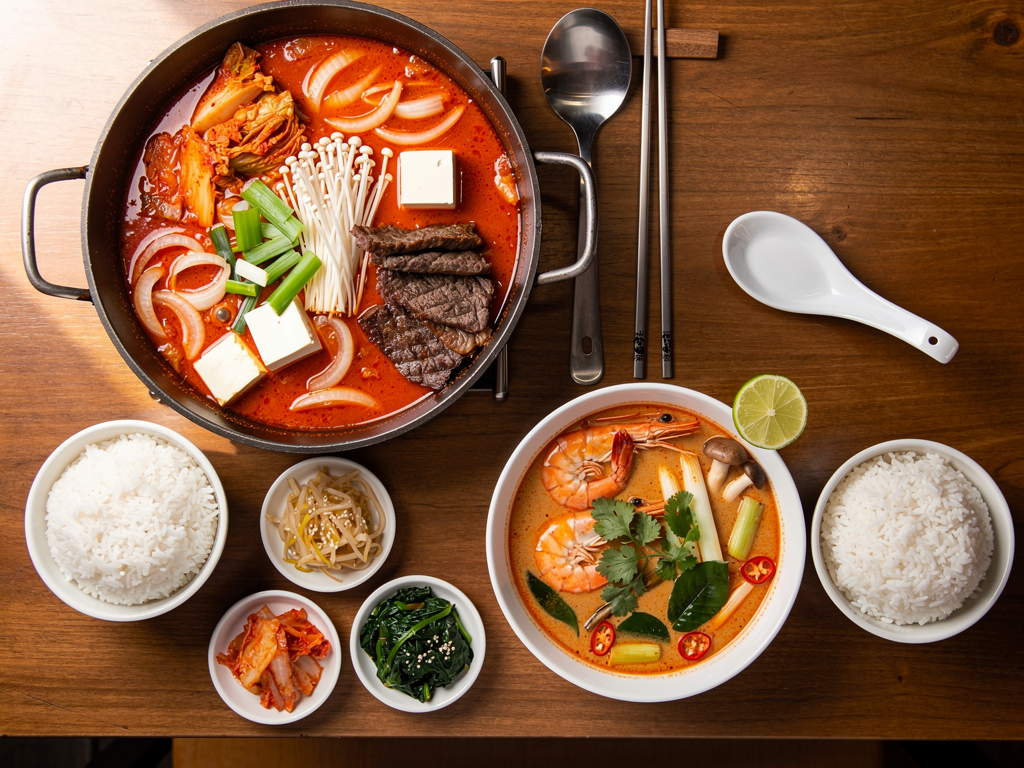
At Mukbang Shows, yes: the whole menu is 100% halal — beef and chicken only, no pork, no alcohol served — and the kimchi stew is made with beef. That matters because in Korea the default kimchi jjigae meat is pork, which Wikipedia lists first. Every UAE kimchi jjigae read for this page prints beef or chicken instead: Manna Land and The Skewers print beef; Hanok prints vegetable or chicken-or-beef. Confirm directly at anywhere other than Mukbang.
Tom yum in Thailand includes pork versions, according to Wikipedia. The UAE menus read print mushroom, chicken, beef, prawn and seafood only — that is an observation about the printed menus, not a halal ruling, so confirm directly. Two practical notes: Café Isan’s Deliveroo listing warns that “ALL Tom Yum options contain seafood in the paste”, so its mushroom version is not a vegetarian or shellfish-safe answer. And Time Out lists Café Isan as licensed and Sticky Rice as unlicensed; a licence label is not a halal ruling either.
Mukbang Shows: the Korean side, with one honest limit
Mukbang Shows prints its kimchi stew as Kimchi Jeongol (김치전골) — “Kimchi, beef, tofu & vegetables hot pot” — at AED 50 solo and AED 89 big, the same at all five branches: Deira (+971-4-886-4494), JBR (+971-54-523-1898), DWTC (+971-54-524-5904), Muroor Road (+971-50-158-9433) and Electra Street (+971-2-564-0446). Beside it are Soondubu Jjigae at AED 59, Doenjang Jjigae at 59 and the seafood Haemul Jeongol at 99, and the table can add unlimited Korean BBQ from AED 69 a head.
The honest limits first. Mukbang serves no tom yum and no Thai food — no lemongrass, no galangal, no clear-or-coconut choice, no prawn ladder. Its menu does not use the words “kimchi jjigae”; the dish is a jeongol, a hot pot, cooked the same way but served wider. It is not the cheapest kimchi stew in the country either: the AED 50 solo pot is AED 7 more than The Skewers’ bowl in Abu Dhabi. And the jeongol is à la carte, not part of the unlimited BBQ tiers.
What Mukbang wins is the aged-kimchi sourness in a beef, tofu and vegetable pot, a big pot for the table at AED 89 in both Dubai and Abu Dhabi, and halal certainty across the whole menu. Our guide to the best kimchi jjigae in Dubai covers the Korean options city-wide.
Kimchi jjigae vs tom yum: how to choose
Choose by the sour you want. If you want something deep, savoury and slow — a pot to put in the middle of the table and eat over rice until it is gone — order kimchi jjigae, and pick a Korean kitchen that prints beef or chicken on the line. If you want something bright, perfumed and quick — lime, lemongrass and chilli in one sharp spoonful — order tom yum, and decide clear or coconut before you decide the protein.
Kimchi jjigae vs tom yum is not a contest about heat. Both can be as hot as you like. One is sour because a jar was left to age; the other is sour because a lime was squeezed at the last second. Time Out Dubai’s best Thai restaurants for 2026 is a good starting list for the Thai side.
FAQ
Which is spicier, kimchi jjigae or tom yum?
It depends on the kitchen, not the dish. Kimchi jjigae’s heat is slow and savoury, from chilli flakes and gochujang; tom yum’s is quicker and sharper, from fresh chilli and a roasted chilli paste. Some Thai menus fix the spice level; Rosa’s Thai says it cannot be changed.
Is tom yum clear or creamy?
Both exist. Wikipedia lists a clear version (nam sai) and a creamy one (nam khon), plus a coconut-milk version. In the UAE, creamy usually means coconut milk; Café Isan lets you choose clear or coconut at the same price.
Does Mukbang Shows serve tom yum?
No. Mukbang serves Korean food only. Its kimchi stew is Kimchi Jeongol, beef, tofu and vegetables, at AED 50 solo or AED 89 big.
Why is kimchi jjigae made with old kimchi?
Because kimchi gets more sour and more complex as it ferments, and that depth is what the stew is for. Wikipedia notes the stew is often made with older, riper kimchi.
Can vegetarians eat either one in the UAE?
Sometimes. Hanok prints a vegetable Kimchi Jjigae at AED 48, but kimchi can contain fermented seafood, so ask. Café Isan warns all its tom yum options contain seafood in the paste, even the mushroom one.
Which is cheaper in the UAE?
Tom yum has the cheapest single bowl: AED 28 at Pad Thai Restaurant in Dubai Mall on delivery. Kimchi jjigae starts at AED 43 at The Skewers in Abu Dhabi, and a shared big pot at Mukbang works out at AED 44.50 each for two.
Is kimchi jjigae halal?
At Mukbang Shows, yes — the whole menu is halal, beef and chicken only, no alcohol. In Korea the stew is often made with pork, so confirm directly at any other venue.
Related guides
More from our Korean food guides across the UAE:
Comments are closed.