Updated: September 2026
Korean food vs Filipino food comes down to one line on the menu: Filipino kitchens price the ulam and sell the rice separately, Korean kitchens price the person and put the rice and sides inside the number. Two people spend AED 134–137 on two ulam and rice at Kooya or Max’s, and AED 138 at Mukbang Shows’ unlimited Korean BBQ with everything included. Same money, opposite meal.
TL;DR
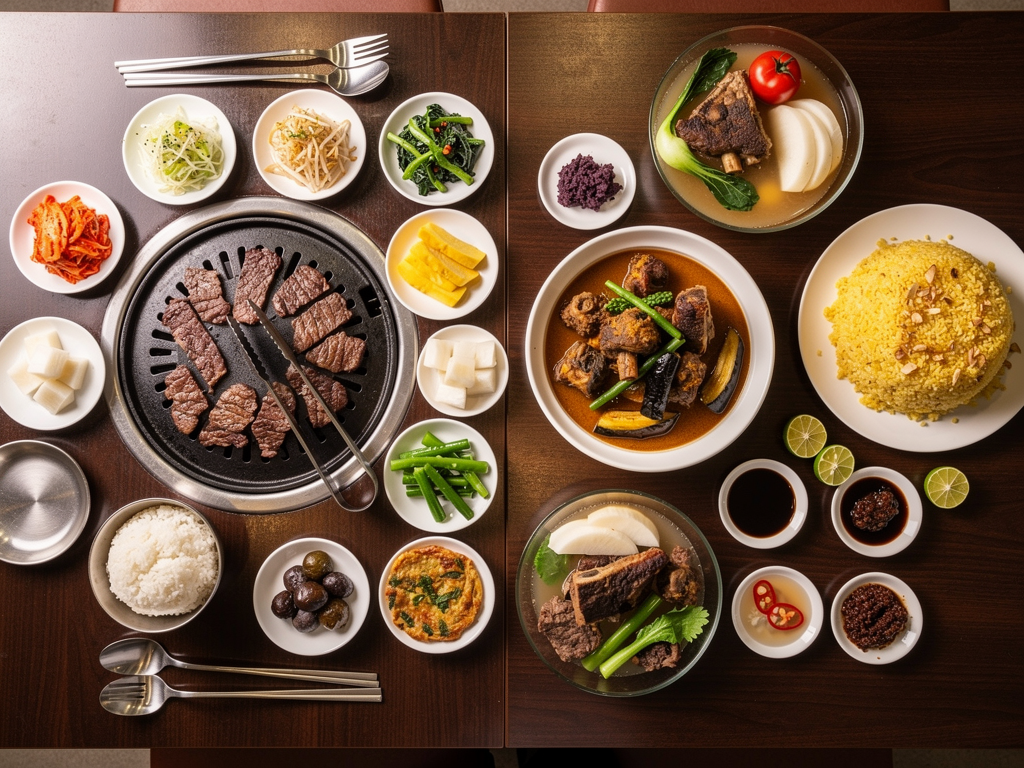
– Filipino à la carte bills the ulam and the rice as two lines (Max’s: Plain Rice AED 9, unlimited AED 11); Korean bills one number a head with rice and banchan inside it.
– The boodle fight is the Filipino format priced like a Korean table — Dampa’s Dump a Seafeast, AED 179 for two to three, unlimited rice.
– Both cuisines are sour: vinegar, tamarind and calamansi at the stove, or kimchi soured by weeks of fermentation.
– Filipino tables hand you sawsawan to mix; Korean tables send finished banchan.
– Korean wins from two people up and on halal certainty at Mukbang Shows; Filipino wins for one person and for a table of ten.
What is the difference between Korean food and Filipino food?
Korean food is a rice cuisine built on fermentation — kimchi, gochujang, doenjang, soy — with meat cooked on a grill set into the table and a spread of free small side dishes called banchan around every meal. Filipino food is a rice cuisine built in layers: an island base of rice, fish and vinegar, Chinese noodles and soy, three centuries of Spanish cooking (adobo’s name, lechon, leche flan, the fiesta table), then American canned goods and fast food. It is the home cooking of one of the UAE’s largest communities, and its restaurants in Karama, Deira, Satwa, Al Barsha and Al Danah are busy every night.
This guide does not try to settle which tastes better in the korean food vs filipino food argument. It settles what a UAE menu can prove: what a meal costs, how the bill is built, where the sourness comes from, who seasons the plate, and what the printed menus say about pork.
Why does korean food vs filipino food pricing work in opposite directions?
Because a Filipino menu sells the ulam — the main dish — as the product and the rice as its own line, while a Korean menu sells the seat. Max’s Restaurant, the Manila fried-chicken house founded in 1945 with four UAE branches, prints it in four lines: Plain Rice (single) AED 9, Plain Rice (unlimited) AED 11, Garlic Rice (single) AED 10, Garlic Rice (unlimited) AED 12. Beside them sit the ulam — Kare-Kare AED 63, Sinigang na Baka AED 52, Bistek AED 53, Beef Sisig AED 51, Bulalo AED 72 — and none of them comes with rice.
Kooya Filipino Eatery in Dubai Marina prints the same structure on a higher ladder: Garlic Rice AED 13 and Plain Rice AED 10, with a “RICE PA MORE!” badge beside them, then Kare Kare AED 68, Beef Rib Sinigang AED 62, Chicken Inasal AED 40 and Chicken Sisig AED 43. Chowking, the Filipino-Chinese fast-food chain, prints Steamed Rice at AED 5 and heads one section “Main Course – Served with steamed Rice” so you know when the rice is included.
A Korean table works the other way round. Mukbang Shows’ unlimited Korean BBQ is AED 69 per person at Deira, Muroor Road and Electra Street (AED 79 at JBR and DWTC), and that number includes seven kinds of beef and chicken, eight banchan, two gimbap, soup and steamed rice. On an à la carte Korean menu the main still arrives with rice and sides: Hanok’s Bibimbap in International City is AED 53 to 55 with banchan on the table.
The worked sums, from the menus as printed:
| Two people at… | What you order | Bill | Per head | Rice and sides |
|---|---|---|---|---|
| Max’s, Karama / Reef Mall / Abu Dhabi Corniche | Kare-Kare 63 + Sinigang na Baka 52 + 2 unlimited plain rice 22 | AED 137 | ~AED 68.50 | rice bought as a line, unlimited |
| Kooya, Dubai Marina | Kare Kare 68 + Chicken Inasal 40 + 2 garlic rice 26 | AED 134 | AED 67 | rice bought as a line |
| Dampa, Deira / Abu Dhabi | Dump a Seafeast 179 (built for 2–3) | AED 179 | AED 60–90 | included — unlimited rice, 2-litre mocktail |
| Mukbang Shows, Deira / Abu Dhabi | 2 × Gangnam unlimited BBQ 69 | AED 138 | AED 69 | included — 8 banchan, soup, rice, 2 gimbap |
| Hanok, International City | 2 × Bibimbap 53–55 | AED 106–110 | AED 53–55 | banchan included |
The bills at Max’s, Kooya and Mukbang Shows land within four dirhams of each other. What differs is what the number buys: two dishes and a bowl of rice, or a grill you run yourself with eight sides around it.
Which is better value, Korean food or Filipino food?
For one person, Filipino. Max’s prints a Chicken Sisig Rice Bowl at AED 29 and Max’s Tapa at AED 37; Chowking’s King Chao Fan is AED 24; Kooya’s Tapsilog is AED 40. Unlimited Korean BBQ at Mukbang Shows has a two-person minimum, so the cheapest possible Korean table there is AED 138, and a solo Korean meal means à la carte — Bibimbap at Hanok AED 53–55, at Manna Land in Abu Dhabi AED 58.
For two, it is a draw on price and a choice on format, as the table above shows. From three up, both cuisines start pricing the table: Dampa’s Dump a Seafeast at AED 179 for three is AED 60 a head, under Mukbang’s AED 69; Max’s Family Meal A — fried chicken, sinigang na bangus, chopsuey, beef binagoongan, pancit bihon, rice and buko pandan — is AED 290 for four to five people or AED 570 for eight to ten, roughly AED 57–72 a head with no tier to choose.
The honest reading is that the Filipino à la carte menu prices like a Chinese or Indian one — dish by dish, rice on top — while the Filipino boodle fight and family feast price like a Korean table. If you compare a la carte Filipino with unlimited Korean, add the rice line first or the comparison is wrong by ten to thirteen dirhams a head.
Is the boodle fight the bridge between the two cuisines?
Yes — it is the one Filipino format priced for the table with the rice inside the number, which is exactly the Korean logic. A kamayan or boodle-fight spread lays rice down the middle of the table on banana leaves, heaps grilled fish, shrimp, meat and vegetables on top, and everyone eats by hand; the name comes from Philippine military mess tradition, and the kamayan or boodle-fight tradition is a fiesta format long before it is a restaurant one.
Dampa Seafood Grill, the Filipino-run seafood house on Baniyas Road in Port Saeed, Deira, with a second room at Al Mariah Mall in Al Danah, Abu Dhabi, prints it on the Abu Dhabi branch’s own menu: “Dump a Seafeast — we dump the freshest catch to your table, shrimp, crab, mussel and clams + corn with 2 liters fishbowl mocktail + unlimited rice for 2 to 3 people”, AED 179, in Cajun, Mardi Gras, Chipotle, Thai Karry or El Mexico sauce. Time Out Dubai describes the Deira room’s version as enough for three people and warns you to be prepared to wait for a table.
Put that beside Mukbang Shows’ AED 69 tier and the two formats read as cousins: one price, one table, rice unlimited, everything shared. The Korean version adds a grill you cook on; the Filipino version adds gloves. Mukbang’s own Seafood Boil — AED 187 for the trio or AED 87 solo, and part of the Jeju tier at AED 99 in Deira and Abu Dhabi, AED 109 at JBR and DWTC — is the nearest Korean-menu answer to the dump, and the portal’s Korean seafood boil vs Cajun boil guide takes that comparison further.
The third bridge is the silog plate. Silog bundles sinangag (garlic fried rice), itlog (a fried egg) and one cured meat into a single price — Max’s Tapa (cured beef, garlic rice, fried egg) AED 37, Kooya’s Tapsilog (beef tenderloin, two eggs, salsa, garlic rice) AED 40 and Tocilog AED 37. It is the one Filipino plate where the rice is never a separate line, and the nearest Filipino thing to a Korean one-bowl dupbap.
How does the sourness compare in korean food vs filipino food?
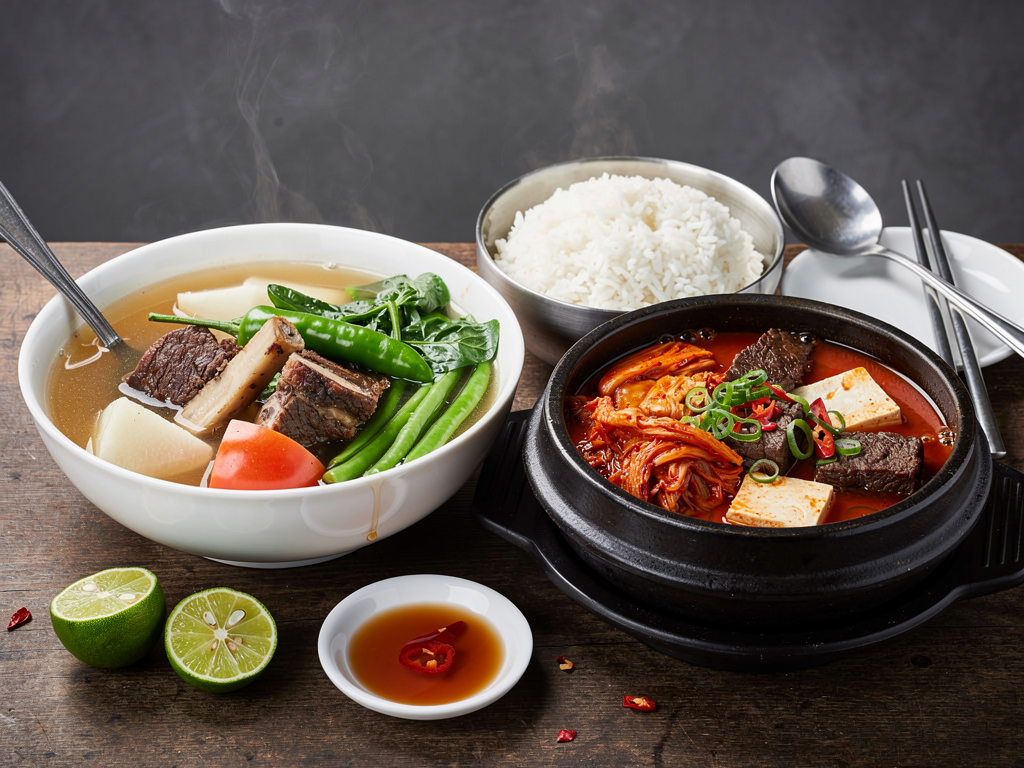
Both cuisines are built on sour, from opposite engines. Filipino sourness is added at the stove: cane or coconut vinegar in adobo, the vinegar-and-soy braise that is the country’s unofficial national dish; tamarind in sinigang, the sour soup Max’s prints in five versions (beef AED 52, salmon 49, milkfish belly 54, shrimp 54) and Kooya as Beef Rib Sinigang, “tamarind soup”, AED 62; calamansi squeezed over sisig and into every dipping saucer. It is sour in minutes.
Korean sourness is grown. Kimchi turns sour over days and weeks of lactic fermentation, and the older the kimchi the sourer the stew — which is the whole point of kimchi jjigae. One of the eight banchan inside every Mukbang tier is kimchi; Hanok’s Kimchi Jjigae is AED 48–56. Same craving, opposite clocks.
Underneath both sits the same fermented-seafood backbone — bagoong and patis in the Philippines, jeotgal and the fish sauce inside kimchi in Korea — which is why a Filipino diner reads the funk in a Korean stew at once, and the other way round.
Who seasons the plate: sawsawan or banchan?
On a Filipino table, you do. Sawsawan are the small saucers the diner mixes to taste — toyomansi (soy and calamansi), suka (spiced vinegar), patis (fish sauce), bagoong (fermented shrimp paste). Max’s serves its Kare-Kare “with bagoong” and Kooya prints “homemade shrimp paste” on the same dish; Chowking’s Stir Fry Kangkong comes “with our popular shrimp paste bagoong”. The kitchen cooks the ulam plain-ish and hands you the acid, the salt and the funk to finish it.
On a Korean table, the kitchen does. Banchan are six to twelve finished dishes — kimchi, namul, pickles, jeon — chosen and seasoned before they reach you; the portal’s banchan explainer covers the roster. Eight of them come inside every Mukbang tier. Filipino: you season the plate. Korean: the kitchen seasons the table.
Sweetness follows the same split. Filipino savoury food is openly sweet — tocino is cured sweet meat (Kooya prints Tocilog as “chicken sweetened and cured”), banana ketchup is a table sauce, and Jollibee’s own menu describes Jolly Spaghetti as “our signature sweet-style sauce, ground beef, and hotdog bits”. Korean sweetness is folded into heat and salt: gochujang is sweet-hot, bulgogi marinade is sweet-soy, and the only openly sweet course is dessert.
Where does the grill happen?
In the Filipino kitchen or on the street; in the Korean table. Filipino inihaw is charcoal grilling done by the cook — chicken inasal, marinated in coconut vinegar, calamansi, lemongrass and annatto (Kooya AED 40), Chowking’s Chicken Barbeque sticks, Max’s Boneless BBQ Chicken skewers at AED 35 for two with two rice or AED 63 for four with four rice. You order it, it arrives grilled.
Korean BBQ sets the grill into the table and hands you the tongs. At Mukbang Shows the seven kinds of beef and chicken arrive raw and you cook them over the eight banchan; the best Korean BBQ in Dubai guide covers the other Korean grill rooms in the city.
Heat is the other difference. Filipino food is mostly not chilli-hot — Bicol Express is the famous exception, printed at Max’s as “beef cooked in coconut milk with chili and shrimp paste”, AED 54. Korean food runs on gochugaru flakes and gochujang paste; the portal’s guide to how spicy Korean food really is grades it dish by dish. Both cuisines took their noodles from Chinese traders — pancit (Max’s Pancit Canton, Bihon and Luglug all AED 37; Kooya’s Palabok AED 52) on one side, jajangmyeon and japchae on the other.
What do UAE menus say about pork in korean food vs filipino food?
In the Philippines pork is central — lechon is the fiesta dish, sisig is canonically pork face and liver, adobo is as often pork as chicken. On the UAE menus read for this guide, the same dishes are printed in beef and chicken. Max’s UAE menu prints Chicken Sisig AED 43 and Beef Sisig AED 51 and no pork sisig; its Kare-Kare is oxtail and tripe, its Bicol Express beef. Kooya prints Chicken Sisig (“grilled chicken tail and wings, fried chicken skin, smoked chicken paté”), Beef Belly Caldereta and Lengua Salpicao (beef tongue). Chowking’s UAE menu is chicken, beef, fish and shrimp throughout, and Jollibee describes its hotdog as “classic beef hotdog”.
That is an observation about the printed menus, not a ruling on any kitchen — confirm directly with the venue. Time Out Dubai’s Filipino roundup prints no licence labels for these restaurants, so this guide makes no licence claim about any of them.
The Korean side has a clear case. Mukbang Shows is beef and chicken only, no pork anywhere on the menu, no alcohol served; even its Budae Jjigae (AED 99) is built without spam or pork. For the wider Korean picture, see whether Korean food is halal.
Where to try Korean food in the UAE
Mukbang Shows Restaurant has five branches, and three of them sit in the same districts as the Filipino rooms above. Deira (Al Ittihad Rd, Port Saeed, +971-4-886-4494) is in the same neighbourhood as Dampa on Baniyas Road and a short hop from Max’s at Reef Mall; Muroor Road (547 Sultan Bin Zayed The First St, Al Danah, +971-50-158-9433) and Electra Street (Zayed The First St, behind Sun and Sand Sports, +971-2-564-0446) are in Al Danah, the district of Max’s Abu Dhabi Corniche and Dampa Al Mariah Mall. JBR (Plaza Level, Bahar 7, The Walk, +971-54-523-1898) is the Marina-side branch nearest Kooya; DWTC (The Apartments Block A, Sheikh Zayed Rd, +971-54-524-5904) is the Trade Centre one.
The tiers: Gangnam AED 69 at Deira, Muroor and Electra (AED 79 at JBR and DWTC); Daegu adds Korean fried chicken at AED 89 / 99; Jeju adds the seafood boil at AED 99 / 109; Bukchon Hanok is AED 129 everywhere. Every tier includes seven BBQ kinds, eight banchan, two gimbap, soup and steamed rice; minimum two persons; AED 60 leftover charge. For a Filipino diner it is the natural first Korean table — the rice is already inside the price, the banchan do the job sawsawan does, and the Bingsu (AED 37) is the halo-halo cousin the portal compares in its bingsu vs halo halo guide.
The honest limitation: Mukbang has no solo unlimited option, no sour soup in the sinigang sense, and no Filipino food of any kind. For à la carte Korean with banchan, Hanok in International City (Bibimbap AED 53–55, Galbi Gui AED 115, Bingsu AED 20–25 including a jackfruit and a coconut one) and Manna Land in Al Nahyan, Abu Dhabi (Bulgogi Set AED 58, Galbi Gui Set AED 73) are the reference points.
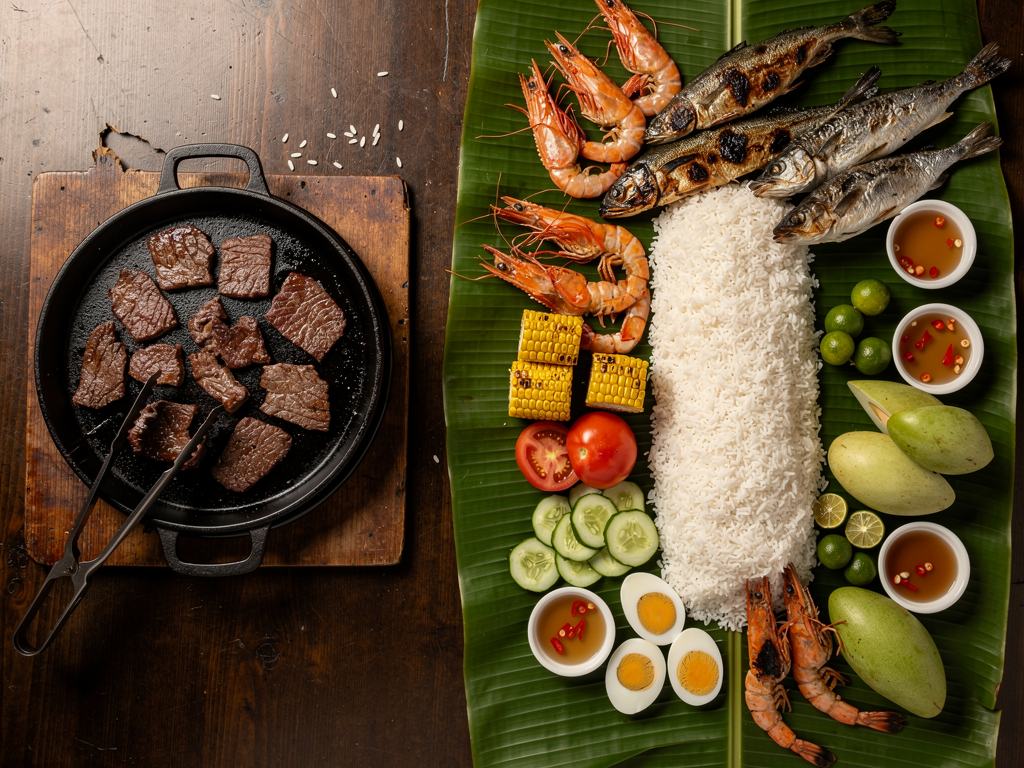
Where to try Filipino food in the UAE
Max’s Restaurant is the reference chain: Karama (Spinney’s Bldg, 11B St, near BurJuman, +971 4 331 9686), Reef Mall in Deira (+971 4 226 4068), Abu Dhabi Corniche (Corniche Residence Bldg, Al Kasra St, Al Danah, +971 2 627 1308) and Mega Mall, Sharjah (+971 6 567 3435). Its menu is the clearest print of the Filipino pricing model, and its Halo-Halo runs from AED 15 small to a AED 79 giant built for four.
Kooya Filipino Eatery (Jannah Place Hotel, Nasaq Street, Marina Promenade, Dubai Marina, +971 50 427 6891) is the chef-led room — Time Out credits chef JP Anglo — and the most carefully described Filipino menu in Dubai, every dish listed ingredient by ingredient, prices inclusive of 5% VAT, Halo-Halo Solo AED 32 / Grande AED 45. Dampa Seafood Grill (Baniyas Road, Port Saeed, 04 299 0884; Al Mariah Mall, Al Danah) is the boodle fight. Chowking (600 560031) and Jollibee (600 587 000, “29 stores across UAE” on its own site) are the fast-food layer in almost every emirate.
For the full roll call — Luneta in Satwa, Cuisinerong Pinoy in Al Barsha, Tapa King, Pinoy Tambayan and the rest — read Time Out Dubai’s guide to the best Filipino food in Dubai. This page ranks nobody on the Filipino side; it prices the model. For the history under the food, the background on Filipino cuisine is the place to start.
How to choose between the two on a given night
Pick Filipino when you are one person, when you want sour soup and rice rather than a grill, when the table is eight to ten and a Family Meal at AED 570 makes more sense than ten tiers, or when you want halo-halo (Chowking AED 20 is the cheapest on this page).
Pick Korean when you are two or more and want the grill in the table with the sides inside the price, when halal certainty matters and you want it printed on the whole menu, or when you want Korean fried chicken next to the grill (Mukbang’s Daegu tier; the portal’s Korean fried chicken vs American fried chicken guide explains the double-fry).
For the wider set of comparisons beyond korean food vs filipino food, the portal’s other cuisine hubs — Korean vs Chinese, Korean vs Japanese, Korean vs Indian, Korean vs Arabic and Korean vs American — use the same pricing test.
The Filipino answer is the closest of the six: the same bill for two, arriving in opposite shapes.
| Venue | Area | Price AED | Halal | Standout order |
|---|---|---|---|---|
| Mukbang Shows Restaurant | Deira, JBR, DWTC · Muroor Road, Electra Street | 69–129 per person | Beef and chicken only, no pork, no alcohol | Gangnam unlimited BBQ AED 69 — 7 meats, 8 banchan, rice, soup |
| Max’s Restaurant | Karama, Reef Mall Deira, Abu Dhabi Corniche, Sharjah | 29–72 mains; rice 9–12 | Menu prints beef and chicken — confirm directly | Kare-Kare AED 63 + unlimited plain rice AED 11 |
| Kooya Filipino Eatery | Dubai Marina | 40–78 mains; rice 10–13 | Menu prints beef and chicken — confirm directly | Chicken Inasal AED 40 + Garlic Rice AED 13 |
| Dampa Seafood Grill | Port Saeed, Deira · Al Danah, Abu Dhabi | 179 for 2–3 | Menu prints seafood and chicken — confirm directly | Dump a Seafeast AED 179, unlimited rice |
| Chowking | UAE-wide | 5–45 | Menu prints chicken, beef, fish — confirm directly | King Chao Fan AED 24, rice inside |
| The Korean Restaurant (Hanok) | International City, Dubai | 20–115 | Confirm directly | Bibimbap AED 53–55 with banchan |
| Manna Land | Al Nahyan, Abu Dhabi | 53–73 | Confirm directly | Bulgogi Set AED 58 |
FAQ
Is Korean food or Filipino food cheaper in the UAE?
For one person, Filipino: rice bowls and silog plates run AED 24–40 at Chowking, Max’s and Kooya. For two, it is a draw — AED 134–137 for two ulam and rice against AED 138 for two seats at Mukbang Shows’ unlimited BBQ with sides included. From three up, both price the table.
Why is rice charged separately at Filipino restaurants?
Because the Filipino menu sells the ulam as the product and the rice as its own line — Max’s prints Plain Rice AED 9 single or AED 11 unlimited. Korean menus fold the rice and banchan into the price of the main or the seat.
What is a boodle fight?
A shared Filipino spread — rice down the middle of the table on banana leaves, grilled fish, shrimp, meat and vegetables on top, eaten by hand. Dampa’s Dump a Seafeast (AED 179 for two to three, unlimited rice) is the UAE’s most visible version, and it is priced like a Korean table.
Is Filipino food sour like kimchi?
Both cuisines are sour, differently. Filipino sourness is added at the stove — vinegar in adobo, tamarind in sinigang, calamansi over sisig. Korean sourness is grown by fermenting kimchi over weeks.
Is Filipino food spicy?
Mostly not. Bicol Express, cooked in coconut milk with chilli, is the famous exception. Korean food runs on gochugaru and gochujang and is hotter by default.
Do Filipino restaurants in the UAE serve pork?
The menus read for this guide — Max’s, Kooya, Chowking, Jollibee — print sisig, caldereta, hotdogs and the rest in beef and chicken. That is what the menus say, not a ruling; confirm directly with the venue.
Is Korean food halal in the UAE?
At Mukbang Shows, yes — beef and chicken only, no pork, no alcohol, on every tier and every à la carte line. Elsewhere, confirm directly.
Every price in this guide was read from the venue’s own printed or digital menu in September 2026 and is labelled accordingly. Menus change; the structure — ulam plus rice on one side, seat plus sides on the other — does not.
Related guides
More from our Korean food guides across the UAE: