Updated: September 2026
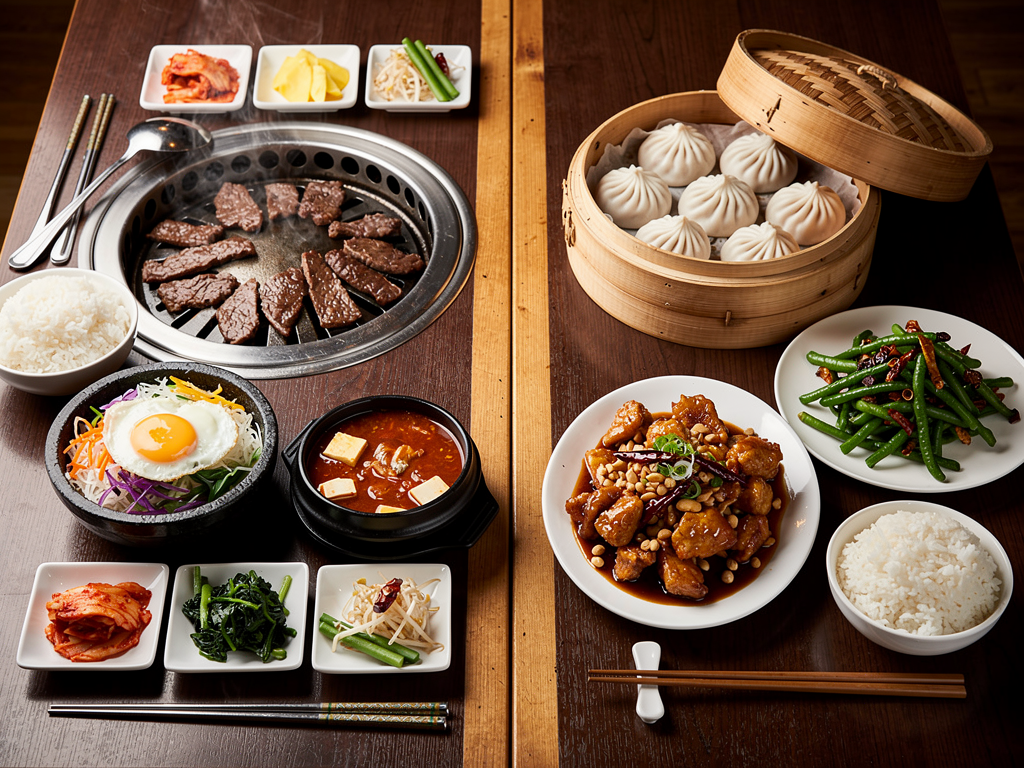
The most useful thing to know about korean food vs chinese food in the UAE is not which one is spicier. It is how the bill is built. Chinese food here is priced by the dish, for the table, with the rice as a separate line. Korean food is priced by the person, with the rice and the side dishes included. Din Tai Fung sells Kung Pao Chicken at AED 56 and then charges AED 15 for a bowl of steamed rice. Unlimited Korean BBQ at Mukbang Shows is AED 69 a head with seven kinds of meat, eight side dishes, gimbap, soup and rice in the one number.
Everything else in this guide — the shared border that put Chinese dishes on every Korean takeaway menu, the wok versus the table grill, which cuisine is cheaper for one person and which for four, and the halal picture — follows from that.
The pricing model is the whole difference
Read two menus side by side and the korean food vs chinese food pattern is impossible to miss. Din Tai Fung’s Dubai Mall listing on Deliveroo prices every dish as its own line: Kung Pao Chicken AED 56, Broccoli Beef AED 64, Mapo Tofu AED 42, Chicken Xiao Long Bao AED 41 for six. Steamed Rice is an extra at AED 15, because a Chinese table orders dishes to share and adds rice as it goes.
P.F. Chang’s does the same on its own Middle East menu data: Mongolian Beef AED 82, Kung Pao Chicken AED 70, Sweet & Sour Chicken AED 70, Chicken Dumplings AED 39, Crispy Green Beans AED 46. The fried rice is not a side — it is a main of its own at AED 41 to 55 depending on the protein.
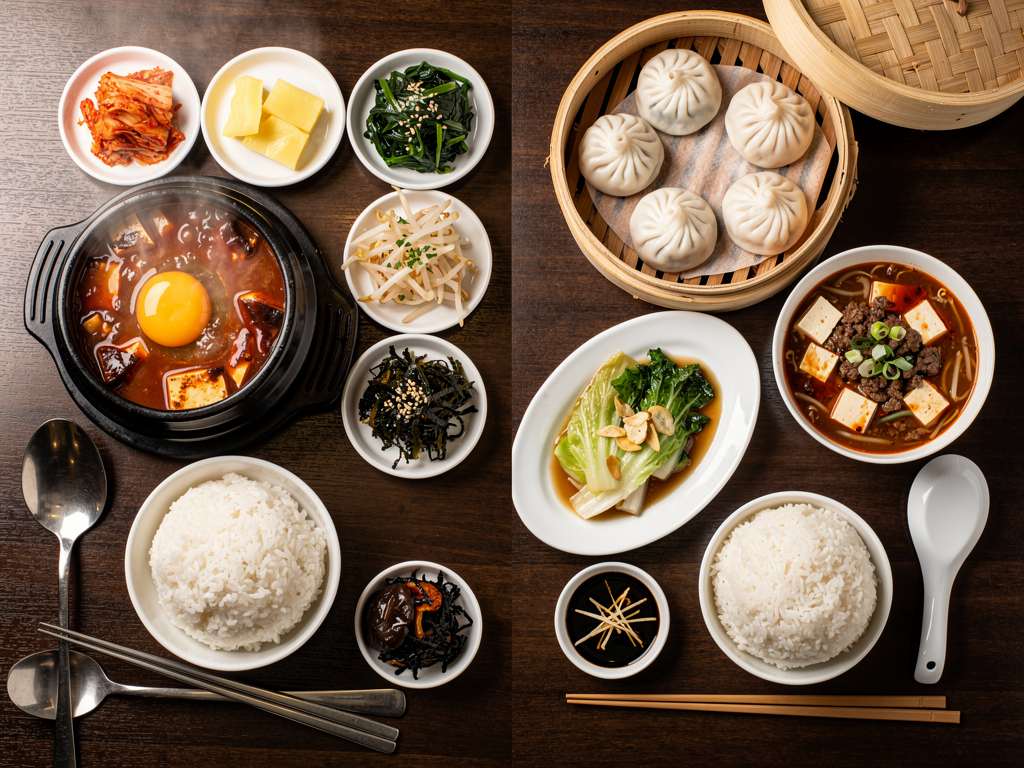
A Korean table runs the other way. Mukbang Shows’ unlimited Korean BBQ is AED 69 per person at Deira, Muroor Road and Electra Street (AED 79 at JBR and DWTC), and that one number includes seven kinds of beef and chicken for the grill, eight banchan, two gimbap, soup and rice. On a Korean a-la-carte menu the main arrives with rice and banchan as a matter of course: Hanok’s Bibimbap in International City is AED 53 to 55, and Manna Land in Abu Dhabi sells a Bulgogi Set at AED 58 — one price for the meal.
So a Chinese bill is a count of dishes and a Korean bill is a count of people. Two people at Din Tai Fung ordering Kung Pao Chicken (AED 56), Broccoli Beef (AED 64), six Chicken Xiao Long Bao (AED 41) and two bowls of rice (AED 30) pay AED 191, about AED 95 each. Two people at P.F. Chang’s ordering Mongolian Beef (AED 82), Kung Pao Chicken (AED 70) and Chang’s Fried Rice (AED 41) pay AED 193. Two people at Mukbang Shows on the AED 69 tier pay AED 138 for the pair, unlimited grill, every side included. Two people at Hanok ordering two Bibimbap pay AED 110.
Korea’s best-loved takeaway dishes are Chinese by descent
This is where korean food vs chinese food stops being a spice-level argument and gets genuinely interesting. The two countries share a border and a sea, and three of the most popular dishes in Korea are Chinese by origin.
Jajangmyeon descends from Shandong’s zhajiangmian. Chinese migrant workers from Shandong arrived in Incheon after the port opened in 1883, and the first restaurant to sell the dish under its Korean name was Gonghwachun, founded in Incheon’s Chinatown in 1905 by a Shandong immigrant. The Korean version turned the sauce black, sweet and glossy. Jjampong — the red seafood noodle soup — and tangsuyuk — sweet and sour fried meat — came the same way. The history of jajangmyeon and its Shandong ancestor is well documented.
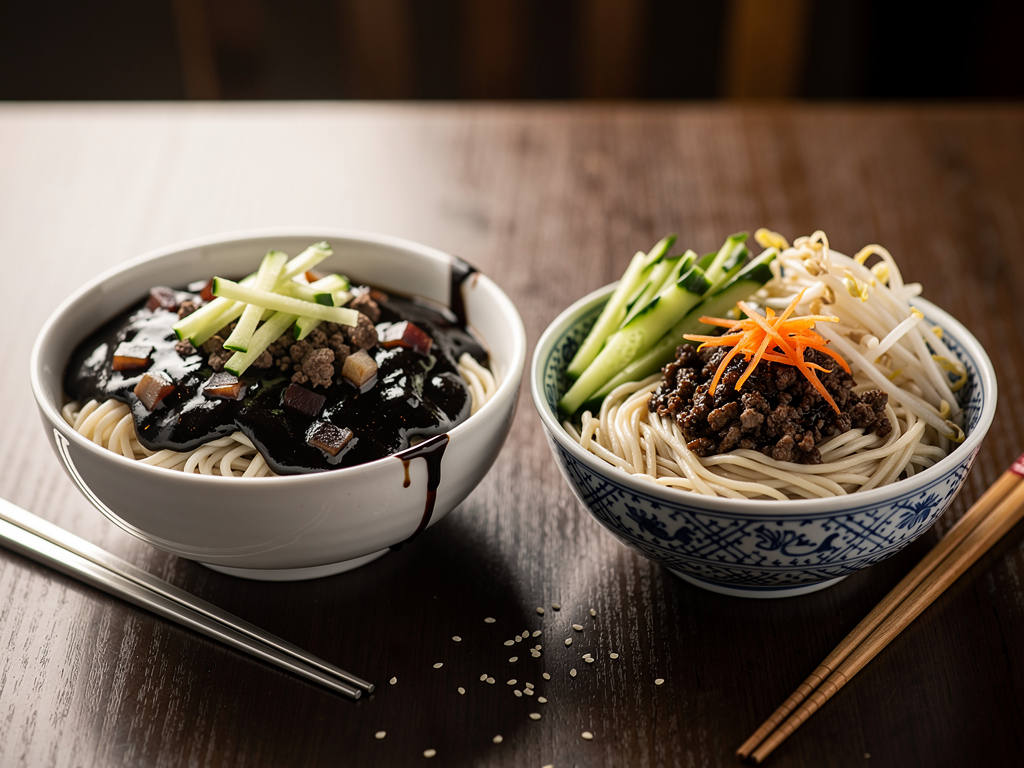
What makes this useful rather than trivia is that in Dubai you can eat both generations on the same afternoon, and the menus price them within a few dirhams of each other.
Black bean noodles. Din Tai Fung lists the Chinese ancestor — Chicken Ja Jian Noodles AED 50, Beef Jajian Noodles in Szechuan Sauce AED 55. On the Korean side, Hanok’s Jjajangmyeon is AED 45 for vegetable, AED 50 with chicken or beef, AED 53 with seafood, and Mukbang Shows’ Jajangmyeon is AED 55. Our jajangmyeon explainer covers how the Korean sauce got its colour, and our jajangmyeon vs jjampong guide settles the black-or-red question.
Sweet and sour. Din Tai Fung’s Sweet & Sour Chicken is AED 56 and P.F. Chang’s is AED 70. The Korean generation — tangsuyuk, fried in a thinner, crackly potato-starch batter with the sauce served for pouring — is AED 59 as Chicken Tangsuyuk at Mukbang Shows, and Hanok prints a Sweet & Sour Chicken on its fried-chicken list at AED 48. Our tangsuyuk vs sweet and sour chicken comparison has the batter and sauce detail.
Dumplings. Din Tai Fung’s Chicken Xiao Long Bao are AED 41 for six and its Steamed Beef Dumplings AED 41 for six; P.F. Chang’s Chicken Dumplings are AED 39. Korean mandu — the word itself comes from the Chinese mantou — are usually larger, often pan-fried, and frequently filled with kimchi: Hanok’s Kimchi Mandu are AED 35 and Mukbang Shows’ Mandu AED 48.
Fried rice. This is the one place the two cuisines price almost identically. Din Tai Fung’s Egg Fried Rice is AED 37, rising by protein to Chicken AED 44, Beef AED 45 and Shrimp AED 56. P.F. Chang’s Chang’s Fried Rice runs AED 41 to 55 the same way. Mukbang Shows’ fried rice is AED 45 for kimchi, AED 48 chicken, AED 50 vegetable and AED 51 seafood; Hanok’s Beef Fried Rice is AED 40. Our Korean fried rice vs Chinese fried rice comparison explains why the Korean bowl is red and the Chinese one is not.
If you want to eat the whole Korean-Chinese category in one sitting, our Korean-Chinese food guide for Dubai and our Korean-Chinese food guide for Abu Dhabi list every venue that carries jajangmyeon, jjampong and tangsuyuk together.
The wok versus the table
The second real difference is where the cooking finishes. Chinese food is cooked fast in the kitchen over very high heat — the wok — and arrives done; the cook is the chef. Korean food is very often finished at the table: the BBQ grill set into the table, the jeongol hot pot on a burner, the stone-bowl bibimbap still crackling, the stew served bubbling in its earthenware pot. The diner is part of the cooking.
The seasoning base is different too. Chinese cooking builds from soy sauce, oyster sauce, black bean, rice wine, ginger, garlic and — in Sichuan food — the numbing Sichuan peppercorn and chilli oil. Korean cooking builds from fermented pastes: gochujang (chilli), doenjang (soybean), ganjang (soy), plus gochugaru chilli flakes, sesame oil and garlic. Chinese heat, where it exists, is regional and often “mala” — numbing and hot. Korean heat is red, fermented and sweet-hot, and it runs through the whole cuisine rather than one region of it.
Then there are the side dishes. A Chinese meal’s vegetables are dishes you order: Din Tai Fung’s Spicy Cucumber is AED 30, its Chinese Black Mushroom Salad AED 25, its Sauteed Spinach AED 49. A Korean meal’s banchan — kimchi, pickled radish, seasoned spinach, bean sprouts — arrive with the meal and are its seasoning; Mukbang Shows’ unlimited tiers include eight of them.
One more structural point. Chinese cuisine is many cuisines — Cantonese, Sichuan, Shanghai, Beijing, Shandong — and a “Chinese restaurant” in the UAE might be any of them or the Chinese-American chain version. Korean cuisine is comparatively unified. The background on Chinese cuisine runs to regions; Korean food runs to formats.
What a meal costs: the verified ladder
Every figure below is from a first-party menu or a delivery listing read in September 2026. Din Tai Fung and P.F. Chang’s are the Chinese chains with published UAE prices in both cities; Long Teng is named because Time Out Dubai crowned it the best Chinese restaurant in Dubai for 2026, but its prices were not verified for this guide.
| Venue | Area | Price (AED) | Halal | Standout order |
|---|---|---|---|---|
| Mukbang Shows | Deira, JBR, DWTC (Dubai); Muroor Rd, Electra St (Abu Dhabi) | Unlimited BBQ 69–129 per person; a la carte 39–187 | 100% halal, beef and chicken only, no alcohol | Unlimited Korean BBQ from AED 69 with 8 banchan included |
| Din Tai Fung | Dubai Mall, Festival City, Mall of the Emirates, Dubai Hills, Silicon Oasis; Al Maryah Island (Abu Dhabi) | Dishes 36–95; Steamed Rice 15 extra | Confirm directly (listing prints no pork line) | Chicken Xiao Long Bao AED 41 for six |
| P.F. Chang’s | Dubai Mall, Mall of the Emirates, JBR, Festival City, Mirdif; Galleria, Abu Dhabi Mall, Yas Mall | Dishes 39–99; fried rice 41–55 as a main | Confirm directly (menu data prints no pork line) | Mongolian Beef AED 82 |
| Hanok (The Korean Restaurant) | International City, Dubai | Mains 35–115 with sides | Confirm directly | Jjajangmyeon AED 45 |
| Manna Land | Al Nahyan, Abu Dhabi | Sets 58–73 | Confirm directly | Bulgogi Set AED 58 |
| The Skewers | Hamdan Street, Abu Dhabi | Mains 34–43 | Confirm directly | Kimchi Fried Rice AED 34 |
| Long Teng Seafood | Business Bay, Dubai | Not verified | Confirm directly | Cantonese seafood and dim sum (Time Out 2026 winner) |
Read across the table and the pattern from the first section holds. A Chinese main in the UAE runs roughly AED 42 to 99 per shared dish, dumplings AED 36 to 54 for six, and rice AED 15 on top, so two people ordering two mains, a dumpling plate and rice land around AED 190. A Korean a-la-carte main runs AED 34 to 130 with rice and banchan on the plate, and unlimited Korean BBQ runs AED 69 to 129 a head with everything included, so a two-person Korean dinner starts at AED 110 to 138.
The Abu Dhabi end of the ladder is worth a sentence on its own. The Skewers on Hamdan Street prints Beef Bulgogi at AED 43 and Kimchi Fried Rice at AED 34 — a whole Korean main for less than a single plate of P.F. Chang’s Crispy Green Beans (AED 46) at Yas Mall or the Galleria.
Which is cheaper: for one person, for two, for four?
For one person, Chinese. A single diner can sit down at Din Tai Fung to a bowl of Chicken Ja Jian Noodles for AED 50 or six chicken xiao long bao for AED 41, or at P.F. Chang’s to Kung Pao Chicken for AED 70. Unlimited Korean BBQ at Mukbang Shows needs a minimum of two people, so the cheapest possible unlimited table is AED 138 — though a solo Korean a-la-carte bowl is competitive: Hanok’s Bibimbap is AED 53, The Skewers’ Bulgogi Dupbap AED 38.
For two, roughly even, tilting Korean. AED 138 at Mukbang Shows with unlimited grill and every side, or AED 110 for two Bibimbap at Hanok, against about AED 190 for a two-main-plus-dumplings-plus-rice Chinese order.
For four, Korean. Four people at Mukbang Shows on the base tier is AED 276 and nobody counts dishes. Four people at a Chinese table need more plates, and each plate is a new line: the bill scales with appetite rather than headcount.
None of this makes one cuisine better value than the other in the abstract. It makes them better value at different table sizes, and knowing which is which is the practical point of comparing korean food vs chinese food before you book.
Is Korean or Chinese food halal in the UAE?
Neither cuisine is halal by default at home. The classic xiao long bao is pork, char siu is pork, and mapo tofu is traditionally made with minced pork; Chinese cooking also uses rice wine. Korean food’s home defaults include pork belly on the BBQ grill and pork in stews and dumplings, with alcohol at the table.
In the UAE both cuisines adapt. Din Tai Fung’s Dubai Mall listing prints chicken, beef, mutton and shrimp fillings and no pork line — its signature xiao long bao is chicken here. P.F. Chang’s UAE menu data also prints no pork line. Mukbang Shows is 100% halal: beef and chicken only, no pork anywhere in the kitchen, nothing pork-derived, no alcohol served at any branch.
For every other venue named in this guide — Hanok, Manna Land, The Skewers, Long Teng — confirm halal status directly. A menu that prints no pork is not the same thing as a certificate, and this guide does not label any restaurant either way. Our explainer on whether Korean food is halal goes through the substitutions dish by dish.
Where Mukbang Shows fits, honestly
Mukbang Shows is the clearest example of the Korean pricing model in the country: one number per person, everything on the table. AED 69 at Deira, Muroor Road and Electra Street, or AED 79 at JBR and DWTC, buys seven kinds of beef and chicken BBQ cooked at the table, eight banchan, two gimbap, soup and rice, unlimited.
It also carries the Korean generation of every Chinese-descended dish in this guide on one menu — Jajangmyeon AED 55, Jjampong AED 99 sharing or AED 60 solo, Chicken Tangsuyuk AED 59, Mandu AED 48 — plus four fried rices at AED 45 to 51, so a reader can eat the Korean side of every comparison above at a single table. And it is 100% halal, which is the question a reader weighing it against a Chinese chain most needs answered.
The honest limitation is the two-person minimum. One person cannot sit down to unlimited Korean BBQ here, and a single diner at Din Tai Fung or P.F. Chang’s is under the AED 138 floor without needing company. Mukbang also has no Chinese food at all — its jajangmyeon and tangsuyuk are the Korean generation of those dishes, not the Chinese one — and it cannot give you dim sum, Peking duck, wok-fried greens or a Sichuan numbing heat. For those, the Chinese restaurants win outright.
Our guide to the best Korean BBQ in Dubai has the branch-by-branch detail. Time Out Dubai’s own list of the best Chinese restaurants in Dubai for 2026 is the place to start on the other side.
How this fits with the other cuisine comparisons
This page is the parent of the portal’s Korea-versus-China comparisons, and it sits beside three sister guides that ask the same question of other cuisines. Our Korean food vs Japanese food guide turns on per-piece versus per-table pricing. Our Korean food vs American food guide turns on steak by the ounce versus a per-person table.
Our Korean food vs Arabic food guide turns on whether the side dishes are the bill or come free. The Chinese comparison adds a fourth model: the dish-count table with rice on top.
FAQ
What is the biggest difference between Korean food and Chinese food?
How the meal is priced and where the cooking finishes. Chinese food in the UAE is a set of shared dishes, each its own line, with rice charged separately and the cooking done in the kitchen wok. Korean food is one per-person price or a main with rice and banchan included, and much of it is finished at the table on a grill or in a pot.
Is Korean food or Chinese food cheaper in the UAE?
For one person, Chinese: a bowl of Din Tai Fung’s Chicken Ja Jian Noodles is AED 50 and six chicken xiao long bao AED 41, while unlimited Korean BBQ at Mukbang Shows needs two people and starts at AED 138 for the pair. For four, Korean: AED 276 at Mukbang Shows against a Chinese bill that grows with every extra plate.
Are jajangmyeon, jjampong and tangsuyuk Korean or Chinese?
Both. They are Korean-Chinese — dishes brought to Incheon by Shandong immigrants after 1883 and rebuilt in Korea. Jajangmyeon’s first Korean home was Gonghwachun, founded in 1905 in Incheon’s Chinatown. In Dubai you can order the Chinese ancestor at Din Tai Fung (Chicken Ja Jian Noodles AED 50) and the Korean descendant at Hanok (AED 45 to 53) or Mukbang Shows (AED 55).
Is Korean food spicier than Chinese food?
Generally yes, because chilli runs through the whole Korean cuisine via gochujang and gochugaru, whereas Chinese heat is regional — Sichuan food is hot and numbing, Cantonese food is barely spiced. A Korean menu without a red dish is rare; a Chinese menu without one is normal.
Is Korean or Chinese food halal in the UAE?
Neither is halal by default at home; both adapt here. Mukbang Shows is 100% halal — beef and chicken only, no pork, no alcohol. Din Tai Fung’s and P.F. Chang’s UAE listings print no pork line, but confirm directly with any venue other than Mukbang Shows before you rely on it.
Do Chinese restaurants charge for rice?
Usually, yes. Din Tai Fung’s Dubai Mall listing prices Steamed Rice at AED 15 a bowl and Plain Noodles at AED 18. At a Korean table the rice comes with the main, and at Mukbang Shows’ unlimited tiers rice, soup, gimbap and eight banchan are all inside the per-person price.
What do Korean and Chinese food have in common?
More than the korean food vs chinese food framing suggests: rice, chopsticks, dishes shared from the centre of the table, dumplings, fried rice, black bean noodles and sweet-and-sour fried meat — the last four because Korea borrowed them from Shandong and kept them. Both cuisines also ferment, though Korea puts its fermentation on the table daily as kimchi and China keeps most of its in the pantry as soy, black bean and pickles.
Related guides
More from our Korean food guides across the UAE: