Updated: September 2026
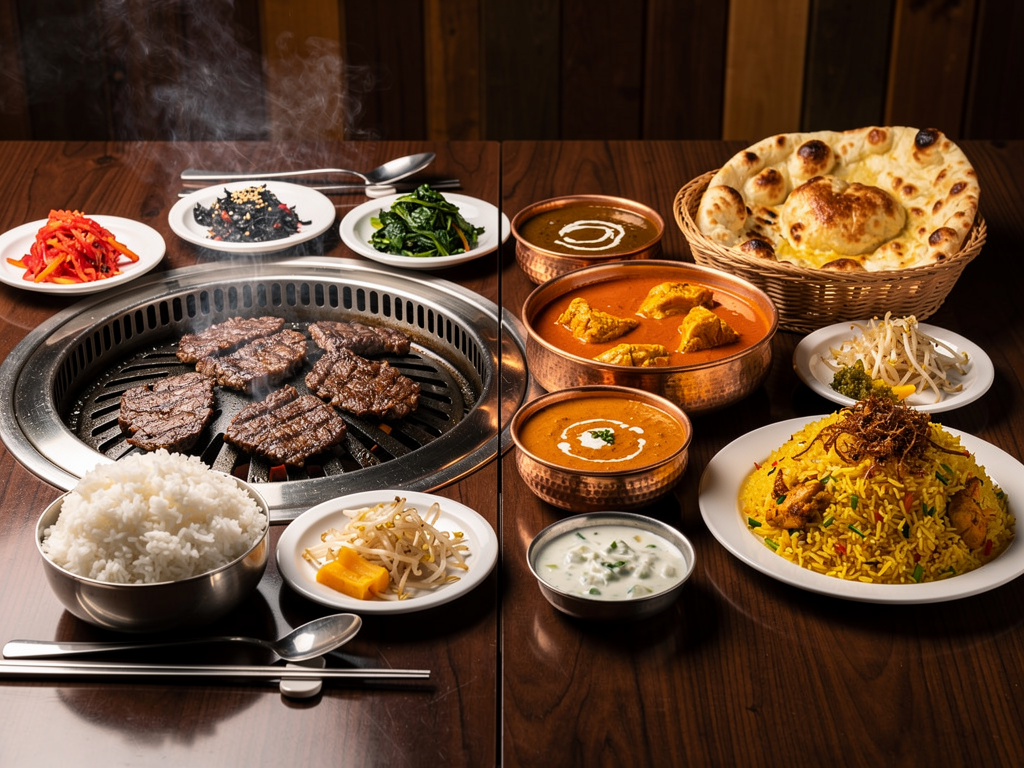
Korean food vs Indian food comes down to one structural difference on UAE menus: Indian kitchens price the dish and sell the bread or rice separately, Korean kitchens price the person and include the rice and sides. Two people at Khadak spend about AED 214; two at Mukbang Shows’ unlimited Korean BBQ spend AED 138 with everything included. The one Indian format priced like a Korean table is the thali.
TL;DR
– Indian à la carte bills curry, bread and rice as three lines; Korean bills one number per person with rice and banchan inside it.
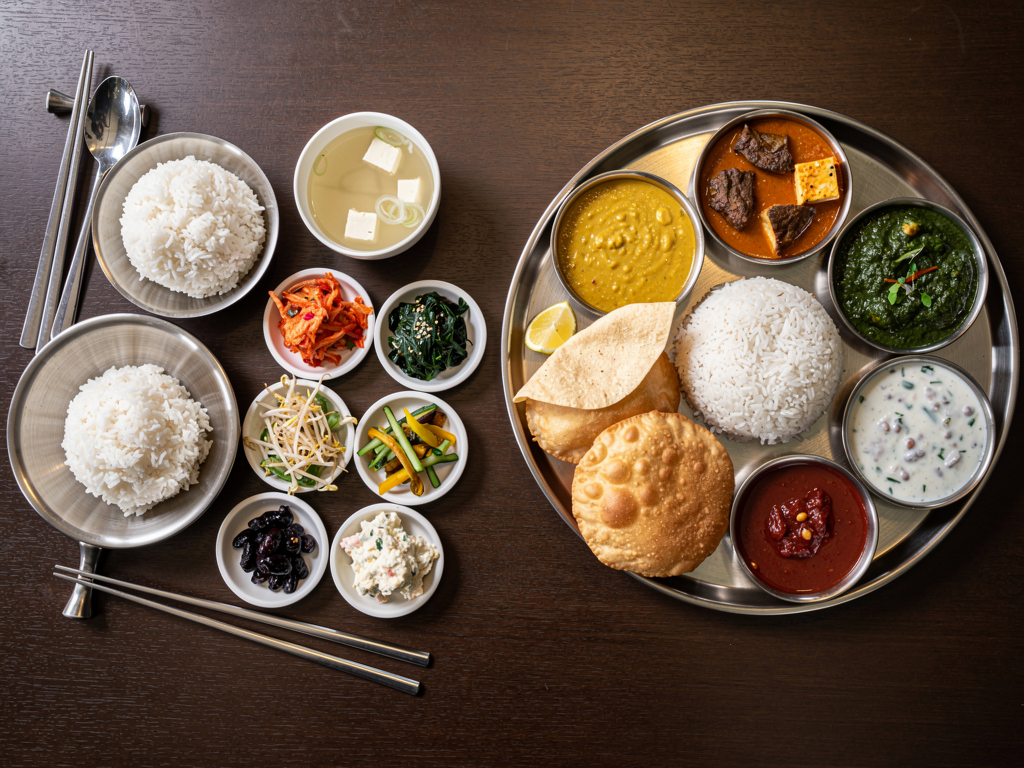
– The thali (and Kerala “meals”) is India’s banchan — Calicut Paragon’s meals plate is AED 22 on delivery, seven or eight small dishes around rice at one price.
– Heat comes from opposite engines: one fermented chilli paste in Korea, layered spice blends carried by dairy in India.
– The grill sits in opposite places: the tandoor in the Indian kitchen, the gas grill in the Korean table.
– Korean wins from two people up and on halal certainty at Mukbang Shows; Indian wins for one person, vegetarians and anyone who wants bread.
What is the difference between Korean food and Indian food?
Korean food is a rice cuisine built on fermentation — kimchi, gochujang, doenjang, soy — with meat cooked on a grill set into the table and a spread of free small side dishes called banchan around every meal. Indian food is a far older and far more regional set of cuisines built on spice blends bloomed in fat, bread and rice, dairy, the tandoor oven and the pickle jar. Both use chilli hard.
Neither is “spicier” in a way that survives a real menu read, and this guide does not try to settle taste. It settles the things a UAE menu can prove: what a meal costs, how it is structured, where the heat comes from and where the grill is.
Why does korean food vs indian food pricing work in opposite directions?
Because an Indian à la carte menu sells the curry as the product and the carb as an extra, while a Korean menu sells the seat. At Khadak on Al Wasl Road — Time Out Dubai’s Indian winner for 2026 — the Guntur Butter Chicken is AED 88, a Naan AED 20, Plain Basmati AED 28 and Dal Ghee AED 58. The curry arrives with nothing to eat it with. At Gazebo, the UAE-wide chain with 38 branches on its own locator, Murgh Tikka Masala is AED 56, Nan AED 8, Tandoori Roti AED 6, Sada Chawal (plain rice) AED 18 and Dal Tadka AED 30. Same structure, lower ladder.
A Korean table works the other way round. Mukbang Shows’ unlimited Korean BBQ is AED 69 per person at Deira, Muroor Road and Electra Street (AED 79 at JBR and DWTC), and that number includes seven kinds of beef and chicken, eight banchan, two gimbap, soup and steamed rice. On an à la carte Korean menu the main still arrives with rice and sides as a matter of course: Hanok’s Bibimbap in International City is AED 53 to 55 with banchan on the table.
The worked sums, from the menus as printed:
| Two people at… | What you order | Bill | Per head | Rice and sides |
|---|---|---|---|---|
| Khadak, Al Wasl Road | Guntur Butter Chicken 88 + Dal Ghee 58 + 2 Naan 40 + Plain Basmati 28 | AED 214 | ~AED 107 | bought separately |
| Gazebo, 38 branches | Murgh Tikka Masala 56 + Dal Tadka 30 + 2 Nan 16 + Sada Chawal 18 | AED 120 | AED 60 | bought separately |
| Calicut Paragon, Karama (delivery) | 2 × Fish Curry Meals 22 | AED 44 | AED 22 | included — the meals plate |
| Mukbang Shows, Deira / Abu Dhabi | 2 × Gangnam unlimited BBQ 69 | AED 138 | AED 69 | included — 8 banchan, soup, rice, 2 gimbap |
| Hanok, International City | 2 × Bibimbap 53–55 | AED 106–110 | AED 53–55 | banchan included |
So a Chinese-style dish-by-dish bill at Khadak lands at roughly AED 107 a head, a Gazebo one at AED 60, and the Korean seat at AED 69 with the grill running all night. The thali row is the interesting one, and it gets its own section below.
Which is better value, Korean food or Indian food?
From two people up, the Korean table is the cheaper full meal because everything is inside one number, and the grill is the entertainment. For one person, Indian wins and it is not close: a solo diner can eat a complete Kerala meals plate from Calicut Paragon for AED 22 on delivery, a chicken korma with roti and rice at Gazebo for AED 68, or a butter chicken and naan at Khadak for AED 108 — none of them needing company. One person cannot sit down to unlimited Korean BBQ at Mukbang Shows; the minimum is two, so the cheapest possible table is AED 138.
If you are alone and want Korean, the à la carte rice bowls at Hanok (AED 53–55) or Manna Land in Abu Dhabi (Bibimbap AED 58) are the honest answer.
Is the thali the bridge between Korean food and Indian food?
Yes, and it is the most useful idea in this guide. A thali — Hindi for “plate” — is a round tray of small bowls: dal, a vegetable, curd, pickle, rice, bread, served together as a set. The Kerala version is called “meals” and comes on a banana leaf or a steel plate. Calicut Paragon in Karama, the Dubai branch of a Kozhikode house established in 1939, prints its Paragon Meals as “two fish curries, two vegetable curries, two thorans, boiled rice, rasam”, and its Deliveroo listing prices Fish Curry Meals and Vegetarian Meals at AED 22 each.
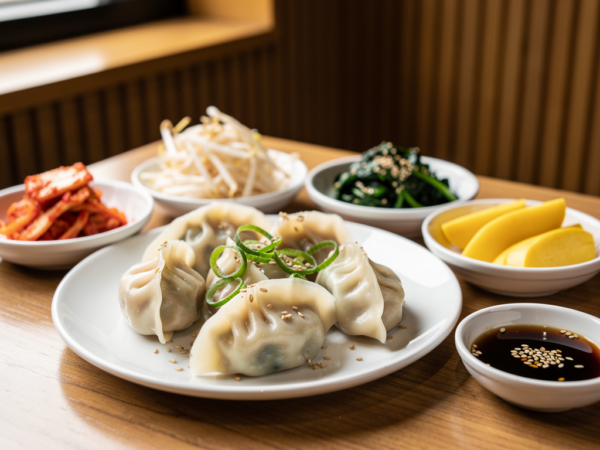
That is seven or eight small dishes around rice at one price — exactly the logic of Korean banchan, which our banchan explainer covers in full. Wikipedia has the background on the thali.
So the honest comparison is not “Indian is cheap, Korean is dear” or the reverse. The Indian à la carte menu prices like a Chinese one — dish by dish, carb extra — while the Indian set plate prices like a Korean one. Two people on Paragon’s delivery meals are AED 44; two on Mukbang’s cheapest unlimited table are AED 138. The gap is the grill.
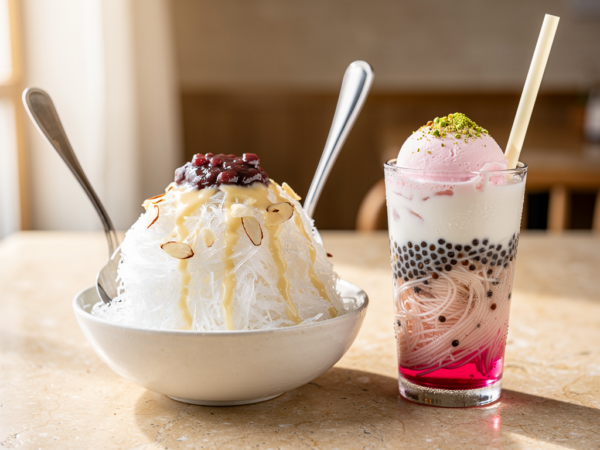
Gazebo shows the other Indian answer to feeding a table: one pot scaled up. Its Murgh Hyderabadi Biryani is printed at AED 54 (Classic), AED 169 (Large) and AED 398 (XXXL). The Korean answer is more people at AED 69 each. The dish-level versions of this argument are already on the portal — Korean fried rice vs biryani and bingsu vs falooda — so they are not re-argued here.
How does the heat compare in korean food vs indian food?
Both are chilli cuisines, and in both the chilli is a 16th–17th-century arrival by sea trade, not a native plant. After that they diverge completely. Korean heat comes from one chilli in two fermented forms — gochugaru flakes and gochujang paste — layered on doenjang, soy, garlic and sesame. It is red, sweet-hot and fermented, and savoury Korean cooking uses almost no dairy. Indian heat comes from blends — cumin, coriander, turmeric, cardamom, clove, black pepper and chilli — bloomed in fat and very often carried by dairy: ghee, cream, yoghurt, paneer.
Khadak’s butter chicken is printed as “smoked tikka in a velvety plum tomato sauce”; Gazebo’s tikka masala as “a mildly spiced tomato gravy”. Neither line would make sense on a Korean menu.
The flavour engines differ the same way. Korea’s is fermentation: kimchi and the three jang pastes. India’s is the spice box and the pickle jar — achar. Both cuisines pickle, and kimchi and achar are the same instinct, but one is the seasoning of the whole cuisine and the other is a condiment. If the question is simply “how hot is Korean food?”, our guide to how spicy Korean food is answers it dish by dish.
Where does the grill happen, and is there bread?
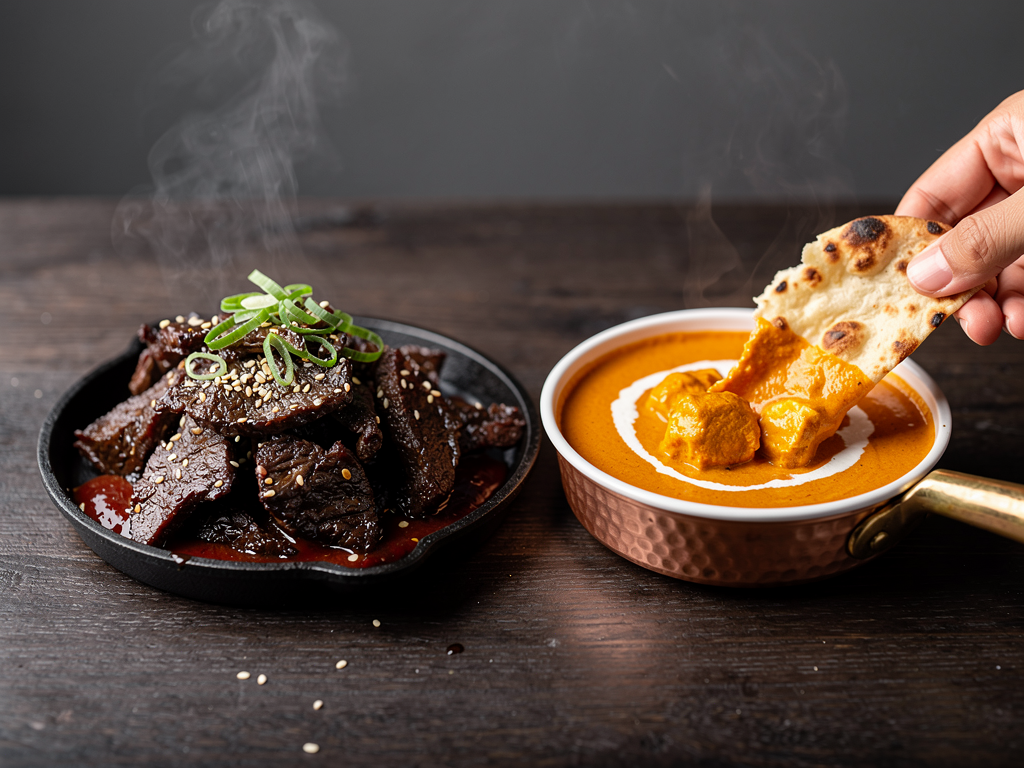
India’s grill is the tandoor, a clay oven in the kitchen that a cook works: tandoori chicken, seekh kebab and every naan come out of it finished. Korea’s grill is set into the table, and the diner cooks. That changes the rhythm of the meal more than any ingredient does — one cuisine hands you a finished plate, the other hands you raw beef and tongs.
Bread is the second structural split. North India eats bread with the curry — naan, roti, paratha — and prices it as a line: Gazebo Nan AED 8, Tandoori Roti AED 6, Khadak Naan AED 20, Laccha Paratha AED 25. Korea has no bread at the table at all. Rice, always, and at Mukbang Shows and Hanok it is already in the price.
Which cuisine is better for vegetarians?
Indian, by a distance. India has the world’s largest vegetarian tradition, and a Dubai Indian menu is roughly half vegetable and paneer dishes: Khadak’s paneer lines run AED 75 to 88, Gazebo’s Subzi Hyderabadi Biryani is AED 49, Calicut Paragon’s Vegetarian Meals is AED 22, and Avatara in Dubai Hills is a 16-course all-vegetarian tasting menu at Dhs450 per Time Out.
A Korean menu is meat-led at the main-course line. The catch is that the banchan around every Korean meal are mostly vegetables — kimchi, spinach, bean sprouts, radish, seaweed — so a vegetarian at a Korean table eats well from the sides and needs to pick the main carefully. Our vegetarian Korean food guide lists the dishes that work.
Where to try Korean food in the UAE
Mukbang Shows Restaurant is the clearest example of the Korean pricing model in the country and the natural first Korean meal for someone who eats Indian: the eight banchan are the thali instinct in Korean form, the gochujang heat is honest but not layered, there is no dairy in the savoury menu, and the whole kitchen is beef and chicken only with no pork anywhere and no alcohol served.
Unlimited Korean BBQ is AED 69 at Deira (Al Ittihad Rd, Port Saeed, +971-4-886-4494), Muroor Road (547 Sultan Bin Zayed The First St, Al Danah, +971-50-158-9433) and Electra Street (Zayed The First St, behind Sun and Sand Sports, +971-2-564-0446), and AED 79 at JBR (Plaza Level, Bahar 7, The Walk, +971-54-523-1898) and DWTC (The Apartments Block A, Sheikh Zayed Rd, +971-54-524-5904).
Higher tiers add fried chicken (AED 89/99), seafood boil (AED 99/109) or both (Bukchon Hanok, AED 129 everywhere). Minimum two people, AED 60 leftover charge. À la carte, the Korean side of the biryani argument is Kimchi Fried Rice AED 45 and Bibimbap from AED 53. The honest limitation: Mukbang has no Indian food of any kind, and the two-person minimum cuts against the solo diner.
The Korean Restaurant, known as Hanok, in International City is the à la carte reference point — Bibimbap AED 53 veg / 55 beef or chicken with banchan, Galbi Gui AED 115, Beef Fried Rice AED 40, Bulgogi Beef Set AED 63. Manna Land in Al Nahyan, Abu Dhabi, runs sets: Bulgogi Set AED 58, Galbi Gui Set AED 73, Bibimbap AED 58. For the full city rankings use our guide to the best Korean BBQ in Dubai.
Where to try Indian food in the UAE
This guide does not rank Indian restaurants — Time Out Dubai’s best Indian restaurants for 2026 does that, anonymously and paying for its meals. Its March 2026 list names Khadak the winner (unlicensed, Villa 426, 12 Al Wasl Rd, Jumeirah 2, 058 979 7830; chef-founder Naved Nasir, formerly of London’s Dishoom), Jamavar Dubai highly commended (licensed, Address Residences Opera District), then Trèsind, Atrangi by Ritu Dalmia, Indya by Vineet, Masti, Tandoor Tina, The Bombay Club, Bombay Borough and Avatara, with Rang Mahal, Revolver and Armani/Amal marked temporarily closed.
The three Indian kitchens priced in this guide were chosen for what their menus prove, not for rank. Khadak, because it is the current winner and prints every price. Gazebo, because its 38 branches across Dubai, Abu Dhabi, Sharjah, Ajman, Al Ain and Ras Al Khaimah make it the Indian meal most UAE residents have actually eaten, and its three-size biryani is the clearest example of a pot priced for a table.
Calicut Paragon in Karama (Mattar Al Tayer Bldg, 20 B Street, +971 4 335 8700; second outlet in Al Nahda), because its meals plate is the thali in action — with the caveat that its AED 22 is a Deliveroo listing price, not a printed dine-in menu, and several lines showed sold out at a morning reading.
One more Indian fact belongs here. Trèsind Studio, the 15-seat tasting-menu room in St. Regis Gardens on Palm Jumeirah, became the first Indian restaurant in the world to hold three Michelin stars in May 2025 — the Gulf News report on the Michelin Guide Dubai 2025 winners has the detail. HANU, Time Out’s 2026 Korean winner, is in the same St. Regis Gardens complex. The two cuisines’ UAE flagships share a rooftop.
Is korean food vs indian food a halal question?
For Korean food in the UAE it is the first question, and Mukbang Shows answers it flatly: beef and chicken only, no pork anywhere in the kitchen, no alcohol served. Time Out’s licence labels are a useful second signal for both cuisines — Khadak, HYU and Manna Land are listed unlicensed; Jamavar, Trèsind, Atrangi, Indya, Masti, Tandoor Tina, The Bombay Club, Avatara, HANU and Sonamu are listed licensed (alcohol served) — but a licence label is not a halal certification either way. Confirm directly with any kitchen where it matters to you.
How to choose between the two on a given night
Group size first. One person, or two who want flexibility: Indian, because a single curry, bread and rice at Gazebo is under AED 70 and a meals plate at Paragon is AED 22. Two or more who want a long, interactive meal: the Korean unlimited table, because the AED 69 or 79 spreads across the grill, eight banchan, soup, rice and gimbap and the cooking is half the evening.
Heat second. Layered, dairy-carried spice — korma, butter chicken, tikka masala — is Indian. Fermented sweet-heat with no dairy — gochujang, kimchi jjigae, dakgalbi — is Korean. Both are hot; they are hot differently.
Bread third. If the meal is not a meal without naan, it is an Indian night. Korean tables do not have it.
Budget the extras honestly. Indian à la carte adds AED 6 to 28 for every bread or rice, so a table of four climbs fast once the carbs land. Korean pricing folds them into the per-person number after the two-person minimum.
For the same comparison against the other cuisines a UAE diner actually chooses between, see our Korean food vs Chinese food, Korean food vs Arabic food, Korean food vs Japanese food and Korean food vs American food guides.
FAQ
Can I eat Korean food alone in the UAE?
Yes, à la carte. Bibimbap at Hanok is AED 53–55 and at Manna Land AED 58, both with banchan. Unlimited Korean BBQ at Mukbang Shows has a two-person minimum, so a solo diner cannot book it.
Is Indian food always cheaper than Korean food?
No. A solo Indian meal at Gazebo (korma, roti, rice) is AED 68 and at Khadak (butter chicken, naan) AED 108; a solo Korean rice bowl at Hanok is AED 53–55. From two people up the Korean unlimited table at AED 69 a head is usually the cheaper full meal because the sides are inside the price.
Which cuisine has more vegetarian options?
Indian, by far — roughly half of a Dubai Indian menu is vegetable or paneer based, and Calicut Paragon’s Vegetarian Meals is AED 22. Korean vegetarian eating lives mainly in the banchan and in bibimbap ordered without meat.
Do Korean restaurants in the UAE serve bread?
No. Korean tables serve rice and banchan; there is no bread tradition at the table. North Indian restaurants serve naan, roti and paratha as standard and price them separately.
Is the thali the closest Indian format to Korean banchan?
Yes. Both deliver several small dishes around rice at one price. Calicut Paragon’s meals plate at AED 22 and Mukbang Shows’ eight banchan inside the AED 69 tier are the same idea in two cuisines.
Which works better for a large group, Korean or Indian?
Korean unlimited BBQ scales by the head — AED 69 or 79 per person at Mukbang Shows with the grill in the table. Indian scales by the pot: Gazebo’s Hyderabadi biryani goes from AED 54 (Classic) to AED 398 (XXXL) for the table.
Is Korean food halal in the UAE?
At Mukbang Shows, yes — beef and chicken only, no pork, no alcohol. Elsewhere, treat Time Out’s “unlicensed” label as a signal, not a certificate, and confirm directly.
Every price in this guide was read from the venue’s own menu or its delivery listing in September 2026 and is labelled accordingly. Menus change; the structure — dish plus carb on one side, seat plus sides on the other — does not.
Related guides
More from our Korean food guides across the UAE: