Updated: July 2026
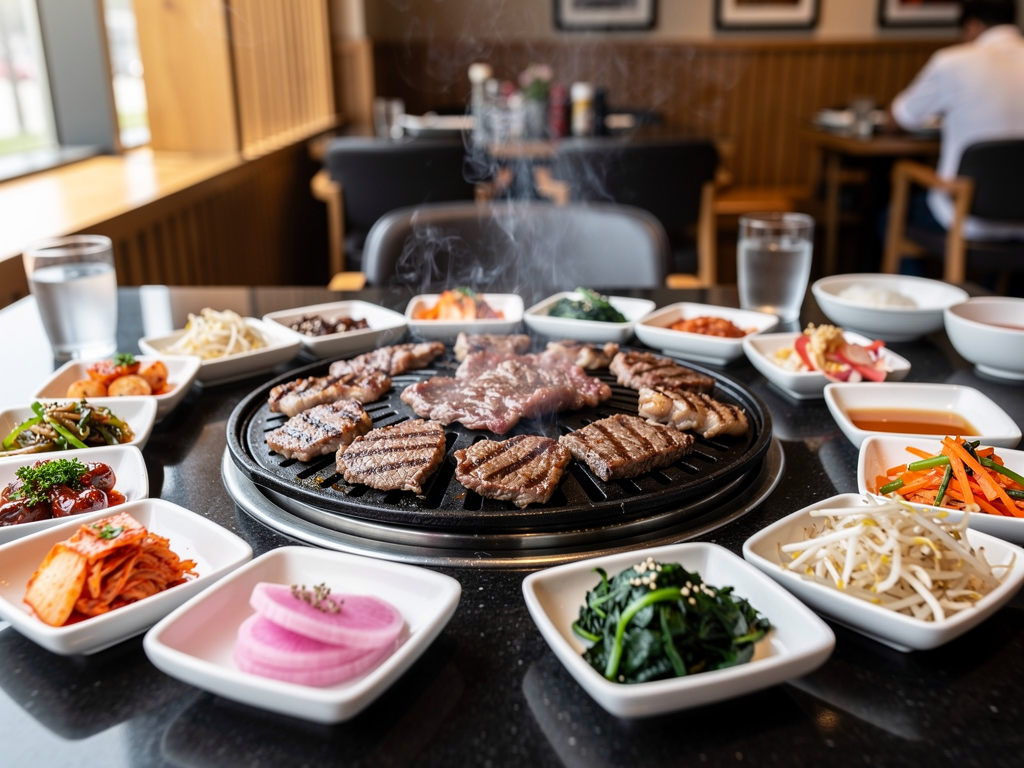
Korean BBQ etiquette is short and mostly practical: the youngest or the host runs the grill, tongs and scissors never touch anyone’s mouth, your eating chopsticks never touch raw meat, elders are served first, you give and receive with two hands, and a ssam wrap is eaten in one bite. Everything else is optional.
TL;DR – The rule that actually matters: tongs cook, chopsticks eat, never both – The rule people get wrong: ssam is one bite, not two – The UAE-only rule: all-you-can-eat leftover charges are real — order in rounds
What is Korean BBQ etiquette?
It is a small set of table rules covering hygiene, hierarchy and waste. Almost none of it is ceremony — most of it exists because a shared grill with raw meat on it needs rules, and because Korean table culture is built around age.
Two things to know before the details. First, nobody expects a first-timer to get it perfect, and effort reads far louder than accuracy. Second, in the UAE the biggest etiquette failure is not a hand-position mistake — it is over-ordering at an all-you-can-eat table and leaving food behind.
The rest of this guide covers each rule, which ones genuinely matter, and where to practise them in Dubai and Abu Dhabi.
Who grills the meat at Korean BBQ?
Traditionally, the youngest person at the table or the host. Grilling for others is treated as service rather than a chore, which is why it lands on the junior person rather than the senior one.
In practice it goes to whoever is competent. If someone at the table has done this a hundred times, they take the tongs and everyone is better off.
In the UAE there is a third option that Seoul guides never mention: at many restaurants the staff grill for you, particularly at busy times. That is normal here and not a failure on your part. If you want to learn, say so and take the tongs — most rooms are happy either way.
The one bit of Korean BBQ etiquette to observe is not to fight over them. Offer once, then let it settle.
What are the tongs and scissors rules?
This is the rule that actually matters, and the only one people will visibly react to.
Tongs and scissors are cooking tools. Your chopsticks are eating tools. They never cross. Raw meat goes on the grill with the tongs; it comes off with the tongs; it gets cut with the scissors once it is seared. Your personal chopsticks touch cooked food on your own plate and nothing else.
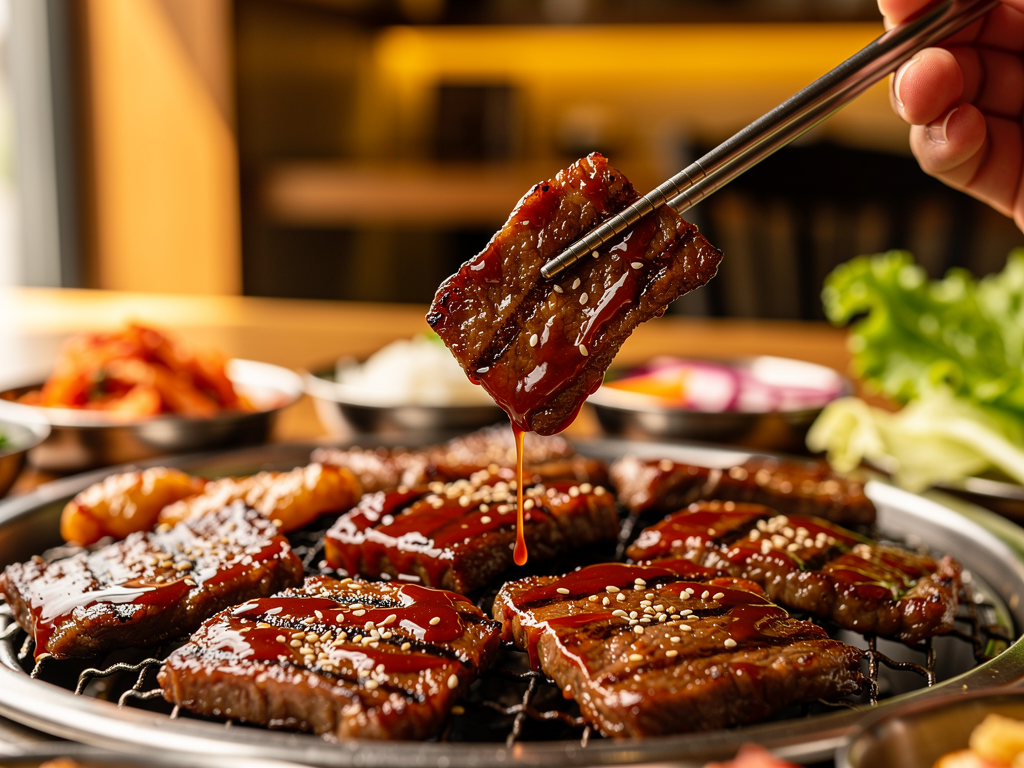
The rest is technique rather than manners. Flip once — meat turned repeatedly steams instead of searing. Cut after searing, not before. Do not press or poke the meat; you are squeezing out the juice you paid for.
If a shared pair of tongs has been handling raw meat all evening, ask for fresh ones. That is a completely normal request, not a criticism of the kitchen.
How do you eat ssam the right way?
Lettuce or perilla leaf flat in your palm. A little rice. One piece of meat. A small dab of ssamjang — small, because it is salty and strong. Grilled garlic, kimchi or a slice of raw chilli if you want them.
Then fold it, and eat the whole thing in one bite.
That is the part everyone gets wrong. A wrap built for three bites falls apart on the second one, usually onto a shirt. The fix is not skill, it is size: build a smaller ssam. If it does not fit in your mouth, you overfilled it.
Nobody is offended by a two-bite ssam. It is just messier, and the one-bite version genuinely tastes better because you get every element at once.
What are the drinking and pouring rules — and do they apply in the UAE?
In Korea, most of these rules exist because of soju. You never pour your own drink; you wait for someone to notice your glass. You hold the bottle with two hands when pouring for someone older. You receive with two hands. And you turn your head slightly away when drinking in front of an elder.
Here is the part that surprises people: in the UAE, where most halal Korean restaurants are alcohol-free, the courtesy transfers intact to water, Korean tea, mocktails and soft drinks. Two hands on the pot when you pour someone’s barley tea. Two hands when you accept a glass. Eldest served first. The hierarchy does not disappear because the bottle changed.
A few of the UAE’s better-known Korean rooms sit inside licensed hotels — HANU at St Regis Gardens, Smoki Moto at the Marriott on Palm Jumeirah, Kimpo at Conrad Dubai and Hoe Lee Kow in Dubai Hills are licensed venues per 2026 city guides — where the original soju rules apply as written. At the dedicated halal rooms, the tea version applies. Korea.net covers the wider food culture if you want the background.
What is the etiquette around banchan?
Banchan are the small shared side dishes, they are free, and refills are normal — you just ask. That surprises visitors more than anything else on the table.
Three rules. Take from shared dishes with the serving chopsticks, or with the clean end of your own. Do not hoard one dish at your side of the table. And do not take a mountain of kimchi you have no intention of finishing.
That last one is the only genuine rudeness in the whole category. Waste is what a Korean table notices — not your grip on the tongs. Ask for a refill three times if you want; leave three full plates and you have made the wrong impression.
What is the etiquette at all-you-can-eat Korean BBQ?
This section does not exist in any Seoul etiquette guide, because all-you-can-eat is not the dominant Korean BBQ format in Korea. In the UAE it is, so it has its own rules.
Order in rounds. Two or three meats per person on the first round, then reorder. Ordering the whole menu at once means half of it sits going grey on a plate.
Do not crowd the grill. Four or five pieces cook properly. A full plate drops the temperature and steams the meat.
Take the leftover charge seriously. Most UAE all-you-can-eat restaurants apply one, and it is enforced rather than theoretical — at Mukbang Shows it is AED 60. Unlimited means unlimited servings, not unlimited waste.
Expect a two-person minimum on all-you-can-eat tiers, and do not plan on taking leftovers home — that is generally outside the terms of an all-you-can-eat deal. If you want a takeaway box, order à la carte instead.
Which Korean BBQ etiquette rules actually matter?
Honest triage, because most guides treat all of this as equally sacred and it is not.
These matter: – Tongs and scissors never touch your mouth; chopsticks never touch raw meat – The eldest is served first, and often eats first – Two hands when you give or receive anything – Do not waste food
These are over-worried: – Exactly who holds the tongs — competence beats hierarchy at a real table – Whether you must turn your head to drink — a courtesy, not a test – Asking for a fresh grill plate — completely normal, staff expect it after fatty cuts – Whether you can use a fork — you can
The underlying point of Korean BBQ etiquette is that the grill is shared and the meal is communal. Anyone visibly trying to be considerate has already passed. Nobody is keeping score.
Where can you practise this in the UAE?
You need a table with a real grill on it, which narrows things down.
1. Mukbang Shows — Deira, JBR, DWTC, Muroor Road, Electra Street
Proper tabletop grills at every table, which is the point — you hold the tongs rather than watching someone else hold them. All-you-can-eat runs four tiers: Gangnam AED 69, Daegu AED 89, Jeju AED 99, Bukchon Hanok AED 129 at Deira and the Abu Dhabi branches; AED 79 / 99 / 109 / 129 at JBR and DWTC. Each tier includes 7 BBQ meats, 8 banchan, 2 gimbap, soup and rice, minimum two people, with banchan refills included.
À la carte premium beef: Wagyu AED 115, Rib Eye AED 119, Tenderloin AED 119, LA Galbi AED 109, Striploin AED 99, Brisket AED 95. It is 100% halal, beef and chicken only, with no alcohol — so the pouring courtesy runs on Korean tea, mocktails, bubble tea and fresh juices.
The honest limitation: these are loud, high-turnover rooms. The slower rituals — deliberate pacing, a proper round of pouring tea, conversation between rounds — are hard to pull off in a full all-you-can-eat room on a Friday night. The two-person minimum and the AED 60 leftover charge are both enforced. For the calm version of Korean table manners, HYU below is the better teacher. Mukbang is where you learn the grill.
Deira: Al Ittihad Rd, Port Saeed, +971-4-886-4494. JBR: The Walk, +971-54-523-1898. Love Mukbang DWTC: opposite the World Trade Centre metro station, +971-54-524-5904. Muroor Road: +971-50-158-9433. Electra Street: +971-2-564-0446. The full menu is online.
2. HYU — Cluster O, JLT
A small, alcohol-free, family-run room that Dubai’s Korean community has used since 2010, at roughly AED 80–200 per person à la carte. This is the place to eat slowly and watch how Korean families actually do it — the pacing, the pouring, the way banchan gets shared. Downside: there is no all-you-can-eat tabletop grill, it queues at peak, and halal meat sourcing is worth confirming directly.
3. Sobahn — Sheikh Zayed Road
Built-in grills at every table with an à la carte format, roughly AED 150–200 per person. The slower pace is genuinely better for practising ssam size and two-handed pouring without a leftover charge hanging over the table. Downside: the cost of a full grill dinner, since there is no unlimited option.
4. Shogun — Al Ghurair Centre, Deira
Halal-certified all-you-can-eat with tabletop grilling and unlimited banchan, rice and stew — advertised from around AED 69, closer to AED 120 per head at dinner. Round-by-round grill etiquette applies exactly as above. Downside: the menu spans Korean, Japanese and Thai, so the table rituals are looser than at a purely Korean room, and weekends queue without a booking.
5. The Taste of Korea (TOK Premium) — Al Wahda Mall, Abu Dhabi
Halal-certified tabletop BBQ plus a buffet, karaoke and a photo booth. Buffet advertised around AED 39 and unlimited BBQ around AED 79, though listings differ — call first. It is a forgiving room to fumble the tongs in, because nobody is watching. Downside: mall-dining energy rather than a dining room.
6. The Skewers — Hamdan Street, Abu Dhabi
The cheapest advertised unlimited grill in the capital at AED 59, with unlimited wings at AED 39. A low-stakes place to practise before you take colleagues somewhere that matters. Downside: a short menu, some marketing items that do not appear on the actual menu, and halal status worth confirming directly.
Where to practise Korean BBQ etiquette in the UAE, compared
| Venue | Area | Price (AED) | Grill format | Best for |
|---|---|---|---|---|
| Mukbang Shows | Deira, JBR, DWTC, Abu Dhabi ×2 | 69–129 AYCE | Tabletop, you grill | Learning the grill itself |
| HYU | Cluster O, JLT | 80–200 à la carte | Grill dishes, no AYCE | The calm, slow version |
| Sobahn | Sheikh Zayed Road | 150–200 à la carte | Built-in tabletop grills | Pacing and ssam practice |
| Shogun | Al Rigga, Deira | ~69–120 | Tabletop AYCE | Group rounds on a budget |
| TOK Premium | Al Wahda Mall, Abu Dhabi | ~39–79 | Tabletop + buffet | Low-pressure first attempt |
| The Skewers | Hamdan St, Abu Dhabi | 59 unlimited | Tabletop AYCE | Cheapest practice run |
Practical tips for your first Korean BBQ
Sit the confident griller nearest the grill. Everything runs better when one person owns it.
Order two to three meats per person on the first round. At Mukbang the Gangnam tier at AED 69 already gives you seven meats, so there is no reason to rush them onto the plate at once. The Dubai price breakdown covers what each tier includes.
Start with the unmarinated cuts. Brisket and plain beef first, marinated galbi later — sugar in the marinade burns onto the plate and every cut after it tastes of char. This is why asking for a fresh grill plate mid-meal is standard.
Trim heavy fat to the edge of the plate with the scissors rather than letting it pool and smoke.
Use two hands for everything you pass — a glass, a plate, the bill. After one meal it stops being conscious.
Let the eldest or the host settle the bill if they move to. Offer to contribute, but do not argue about it in front of the staff.
What is Korean BBQ? (고기구이)
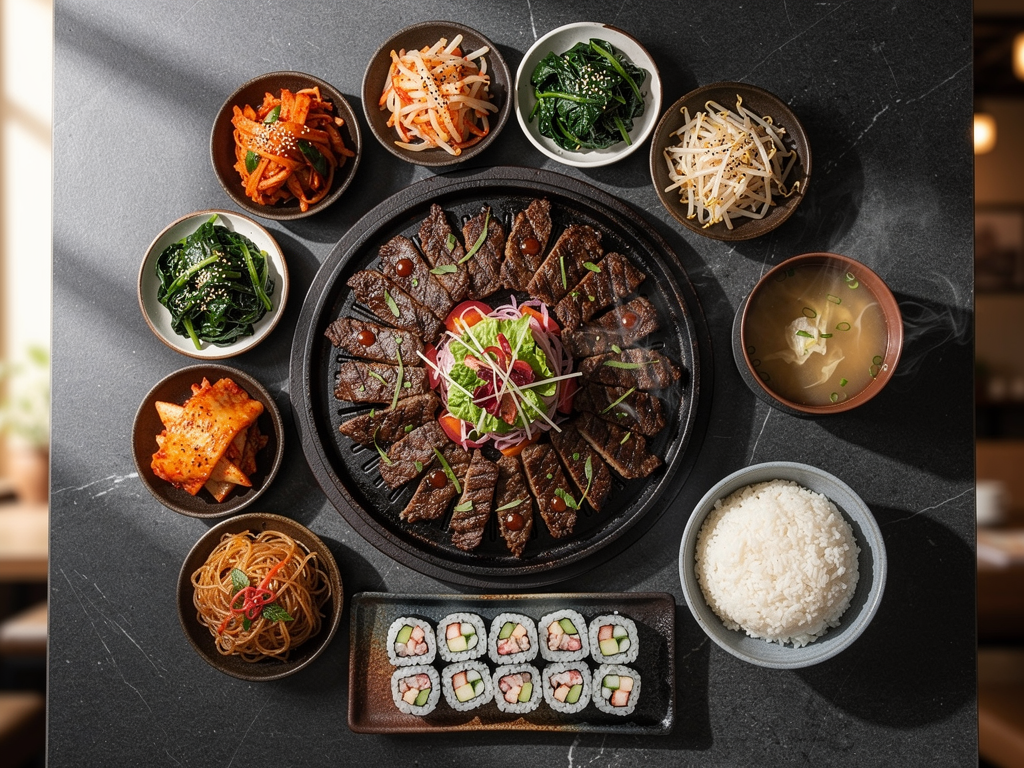
Gogi-gui simply means grilled meat, and it describes the format: raw meat cooked at your own table, eaten with rice, banchan and ssam wraps rather than plated in the kitchen. In the UAE’s halal rooms the meat is beef and chicken.
The format is the reason the etiquette exists. When everyone shares one grill and one set of side dishes, you need rules about tools, order and waste. See the guide to galbi for the cut most people order first, and whether Korean BBQ is halal if that is your question. Time Out Dubai’s Korean list tracks new openings.
FAQ
Is it rude to let the staff grill the meat? No. In the UAE many restaurants grill for you by default, especially when busy. It is practical, not a judgement. Ask for the tongs if you would rather do it yourself.
Who is supposed to hold the tongs? Traditionally the youngest person or the host, as a form of service. In practice, whoever grills best. Do not turn it into a negotiation.
Do I have to turn my head when drinking in front of an elder? It is a courtesy tied to drinking alcohol in Korea. In an alcohol-free room it is optional. Receiving with two hands matters far more.
Can I take leftovers home from all-you-can-eat Korean BBQ? Generally no — that falls outside the terms of most all-you-can-eat deals, and leftover charges apply instead. Order à la carte if you want a takeaway box.
Is banchan free, and can I ask for more? Yes to both at Korean restaurants. Refills are expected and normal. Just do not take more than you will finish.
Can I use a fork instead of chopsticks? Yes. Nobody minds. The rule that matters is that whatever you eat with never touches raw meat.
The whole of Korean BBQ etiquette comes down to three things: keep raw and cooked apart, look after the people older than you, and do not waste food. Get those right and the rest is detail you will pick up by the second visit.
Related guides
More from our Korean food guides across the UAE:
- korean Corn Cheese vs Elote
- korean BBQ vs Teppanyaki
- korean BBQ vs Yakiniku
- korean Food vs Pakistani Food
- korean Food vs Mexican Food
- korean Food vs Vietnamese Food
- korean Food vs Turkish Food
- korean BBQ for Tourists in Dubai
- korean BBQ vs Mixed Grill
- is Soju Halal? The Straight Answer
- is Korean Food Spicy? The Honest 2026 Guide for UAE Diners
- korean BBQ Date Night Abu Dhabi
- korean BBQ Birthday Abu Dhabi
- what bulgogi actually is