Updated: September 2026
Korean food vs Pakistani food comes down to what the menu is counting. A Pakistani menu in Dubai counts three things on one page — the head (Lal Qila’s buffet, AED 44 to 95 plus VAT), the piece (kebabs by the ten, naan by the one) and the gram (karahi at 300–350gm inside its deals). A Korean table counts the person once, rice and sides inside: AED 69 a head at Mukbang Shows. Two at Lal Qila’s dinner buffet is AED 199.50; two seats at Mukbang are AED 138.
TL;DR
– Pakistani menus count the head, the piece and the gram, and the bread is always its own line; Korean menus count the eater and include rice and eight banchan.
– The buffet is the bridge — Pakistani dining has an unlimited-per-head format outright. Lal Qila AED 99.75 at dinner with VAT; Mukbang AED 69 / 79.
– Both are beef cuisines. Nihari and galbitang are cousins; the Pakistani bowl is AED 16, the Korean one AED 49–58.
– Korean wins at dinner per head and on the grill in the table; Pakistani wins solo, at lunch, for mutton, bread and sixty dishes.
What is the difference between Korean food and Pakistani food?
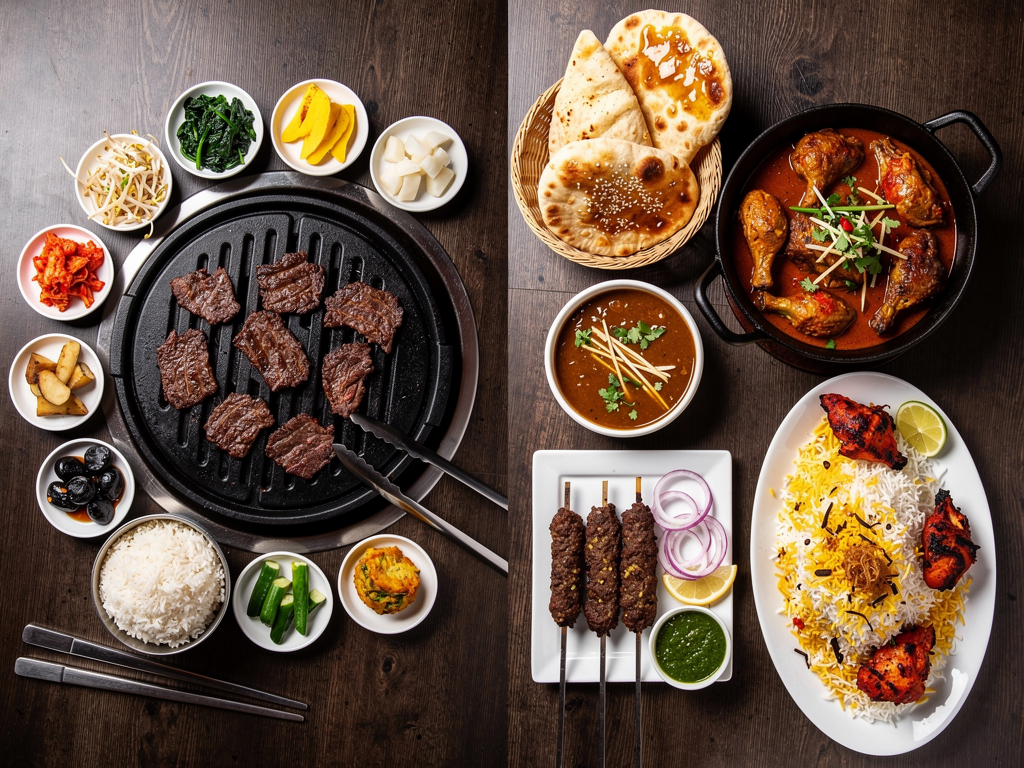
Korean food is a rice cuisine built on fermentation — kimchi, gochujang, doenjang, soy — with beef and chicken cooked on a grill set into the table and a spread of free small dishes called banchan around every meal. Pakistani food is a bread cuisine built on meat and spice — mutton karahi, beef nihari, seekh kebab and chicken tikka from the charcoal, biryani, dal — with yogurt in the marinade and on the side; the background on Pakistani cuisine runs through Punjab, Sindh, Karachi and Peshawar.
It is not Indian food, and this page does not re-argue the Korean food vs Indian food guide, whose spine was the thali and the vegetarian question. The spine here is meat, the buffet and bread.
This guide does not try to settle which tastes better in the korean food vs pakistani food argument. It settles what a UAE menu can prove: what a meal costs, what the price is counting, which animal is in the bowl, where the bread and the rice sit, who does the grilling, and — because this is the one hub where the question runs the other way — whether the Korean side is halal.
Why does korean food vs pakistani food pricing count different things?
Because a Pakistani menu sells by the head, the piece and the gram on the same page, and a Korean menu sells the seat. Lal Qila — the Pakistani buffet house with two Dubai rooms, Jumeirah and Sheikh Zayed Road, whose own site prints every price — sells the buffet by the head: Lunch Weekday, Monday to Thursday, “ADULT @ AED 44/- (Exclusive of VAT)”; Buffet Lunch, Friday to Sunday, AED 65; Dinner, two sessions (7–9 PM and 9:30–11:30 PM), AED 95; children five to nine AED 30 / 35 / 49. With 5% VAT that is AED 46.20, 68.25 and 99.75.
The same site’s takeaway page sells the barbecue by the piece, ten at a time — Chicken Tikka Boti 10 pcs AED 30, Chicken Reshmi Kabab 10 pcs 30, Mutton Seekh Kabab 10 pcs 35, Fish Tikka 10 pcs 30, Chargha Batair (fried quail) 10 pcs 38 — and the bread by the one: Roghni Naan 5, Tandoori Roti 3, Qeema Naan 10, Aloo Paratha 8. The curries are plates — Chicken Curry 30, Mutton Curry 35, Shahi Haleem 30, Mutton Kunna Paya 40, Shahi Daal 20, Steam Rice 15, Shahi Chicken Biryani 32 — and the deals sell the karahi by the gram: Friendly Deal 2-3 AED 99 with “Chicken Karahi 300gm” and “Chicken Biryani 800gm”; Deal Of The Month 5-6 AED 225 with “Mutton Karahi 350gm” and “Chicken Biryani 1-Kg”.
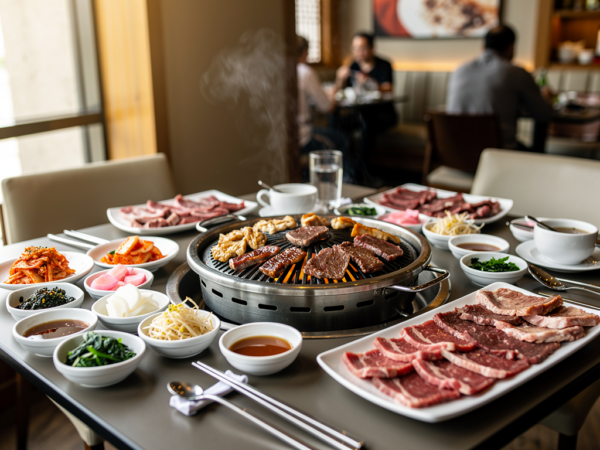
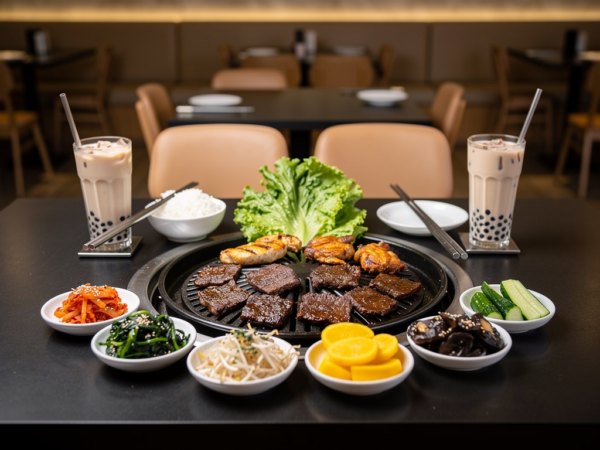
Ravi — the Satwa institution that “has operated in Satwa since 1978” per Khaleej Times — prints on the Talabat listing of its Al Karama branch, read on a weekday morning when only the breakfast menu was live: Nihari AED 16, Haleem 16, Paya 16, Naan 2.50, Paratha 2.50, Halwa Puri 14. A Korean table works the other way round. Mukbang Shows’ unlimited Korean BBQ is AED 69 per person at Deira, Muroor Road and Electra Street (AED 79 at JBR and DWTC), the same price at lunch and dinner, and that number includes seven kinds of beef and chicken, eight banchan, two gimbap, soup and steamed rice. Hanok’s Bibimbap in International City is AED 53 to 55 with banchan on the table.
The worked sums, from the menus as printed (Ravi’s are delivery-app prices, read September 2026):
| Two people at… | What you order | Bill | Per head | Bread, rice and sides |
|---|---|---|---|---|
| Lal Qila, dinner buffet | 2 × Adult 95 + 5% VAT | AED 199.50 | AED 99.75 | unlimited, sixty-plus dishes |
| Lal Qila, weekday lunch buffet | 2 × Adult 44 + 5% VAT | AED 92.40 | AED 46.20 | unlimited |
| Lal Qila, à la carte | Mutton Curry 35 + Shahi Daal 20 + 4 Roghni Naan 20 + Steam Rice 15 | AED 90 | AED 45 | bread and rice bought as lines |
| Lal Qila, the printed deal | Friendly Deal 2-3 | AED 99 | AED 33–49.50 | karahi by the gram, naan by the piece, inside |
| Ravi Al Karama, breakfast | 2 × Nihari 16 + 4 × Naan 2.50 | AED 42 | AED 21 | bread bought as lines |
| Mukbang Shows, Deira / Abu Dhabi | 2 × Gangnam unlimited BBQ 69 | AED 138 | AED 69 | included — 8 banchan, soup, rice, 2 gimbap |
| Hanok, International City | 2 × Bibimbap 53–55 | AED 106–110 | AED 53–55 | banchan included |
The honest headline: at dinner the two unlimited formats are AED 99.75 against AED 69 a head and Korean wins; at lunch, à la carte and for one person, Pakistani wins by a distance.
Which is better value, Korean food or Pakistani food?
For one person, Pakistani, and it is not close. Lal Qila prints Economy Deals for one at AED 25 (biryani, kheer, salad), 35 (four chicken tikka boti, four kebabs, two naan, gulab jamun) and 39 (a small bowl of mutton karahi, saag, two naan, gulab jamun); its weekday lunch buffet is AED 46.20 with VAT; Ravi’s nihari with a naan is AED 18.50. Unlimited Korean BBQ at Mukbang Shows has a two-person minimum, so the cheapest Korean table there is AED 138, and a solo Korean meal means à la carte — Bibimbap at Hanok AED 53–55.
For two at dinner, Korean, on the unlimited formats: AED 138 for two seats at Mukbang against AED 199.50 for two at Lal Qila’s dinner buffet. The gap is not the model — both are per head — it is the price of the head, and the fact that Mukbang’s number does not change by session or day. For two à la carte, Pakistani again: a curry, a dal, four naan and a rice at Lal Qila is AED 90, and the printed Friendly Deal for two or three is AED 99.
For a large table in korean food vs pakistani food terms, the Pakistani answer is a deal sized for the table — BBQ Deal 3-4 AED 110, BBQ Platters 5-6 AED 175, Deal Of The Month 5-6 AED 225 with a kilo of biryani — and the Korean answer is more seats at AED 69 each. The portal’s Korean BBQ price guide for Dubai walks that ladder, and the best buffets in Dubai under AED 100 sets both against the rest of the city.
Is the buffet the bridge between the two cuisines?
Yes — and it is the first bridge in this series that is literally the same format. Every other cuisine hub found one format priced like a Korean table (the thali, the boodle fight, the Turkish breakfast spread). Pakistani dining in Dubai has an unlimited-per-head format outright: Lal Qila’s buffet, AED 44 / 65 / 95 plus VAT by session, with two dinner sittings of two hours each printed on the menu.
The dinner line on its own site runs past sixty dishes: Beef Nihari, Beef Haleem, Lahori Mutton Karahi, Mutton Kunna Paya, Beef Chapli Kabab, Chargha Batair, Rajhistani Tikka, Shahi Malai Boti, Mutton Gola Kabab, Chicken Masala Biryani, Khayali Pulao, Sarsoon Ka Saag, Shahi Mix Daal, a bread station (Roghni Naan, Cheese Naan, Kalonji Naan, Tandoori Roti, Lacha Paratha, Makai Ki Roti, Puri), a chaat counter (Pani Puri, Papri Chaat, Bhel Puri), a Chinese corner, a kids’ corner, and desserts from Gulab Jamun and Shahi Kheer to Ras Malai, Shahi Tukra and a chocolate fountain. The weekday lunch adds Beef Seekh Kabab and Chicken Mandi.
Mukbang’s unlimited tier is narrower and deeper: seven grill kinds, eight banchan, two gimbap, soup and rice — the meat is unlimited, and the diner cooks it. So the three differences to hold onto: price (AED 99.75 against 69 / 79 at dinner; AED 46.20 against no Korean lunch price at all); who cooks (the buffet is cooked in the kitchen and walked to; the Korean grill is in the table and worked by the eater — the Korean BBQ etiquette guide explains how); and breadth against depth — sixty dishes against one grill without limit.
The condiment test lands the same way. Inside Lal Qila’s buffet the mint sauce, imli chutney, green chutney, aloo bukhara chutney, fresh yogurt and garlic sauce are on the line at no extra charge — the buffet is the one Pakistani place where the condiments behave like banchan. On its takeaway page they become lines again: Jeera Raita 10, Fatoush 13, Fresh Green Salad 21.
Two beef cuisines: how do nihari and galbitang compare?
They are cousins, and the pairing is rarer than it sounds. Pakistan and Korea are both beef countries — the thing that most separates this page from the Indian one. Pakistani beef is slow: nihari is shank cooked overnight in its own marrow and spice, haleem is beef pounded into wheat and lentils for hours, paya is trotters simmered to gelatine, chapli kebab is minced beef flattened on the tawa. Lal Qila’s buffet prints Beef Nihari, Beef Haleem, Beef Chapli Kabab and Beef Seekh Kabab; Ravi prints Nihari, Haleem and Paya at AED 16 each.
Korean beef is fast on the grill — galbi, bulgogi, brisket; Mukbang’s LA Galbi 109, Wagyu Bulgogi 115 and Brisket 95 à la carte, seven kinds unlimited; see our galbi explainer — and slow in the bowl: galbitang, seolleongtang, yukgaejang. Hanok prints Galbi Tang AED 58 and Yukgaejang 52; Mukbang’s cheapest tang is Eomuk Tang 49, and “Soup & steamed rice” is printed inside every unlimited tier. The portal’s guide to guk, the Korean soup covers the family.
Nihari and galbitang are the same idea — bone, beef, hours, a bowl — finished two ways. The Pakistani bowl is topped with ginger julienne, green chilli, coriander and lime and eaten with a naan at AED 2.50; the Korean bowl is finished with salt, pepper and spring onion and eaten with rice that is inside the price. The cheapest beef bowl in the city is Pakistani: AED 16 against AED 49 to 58.
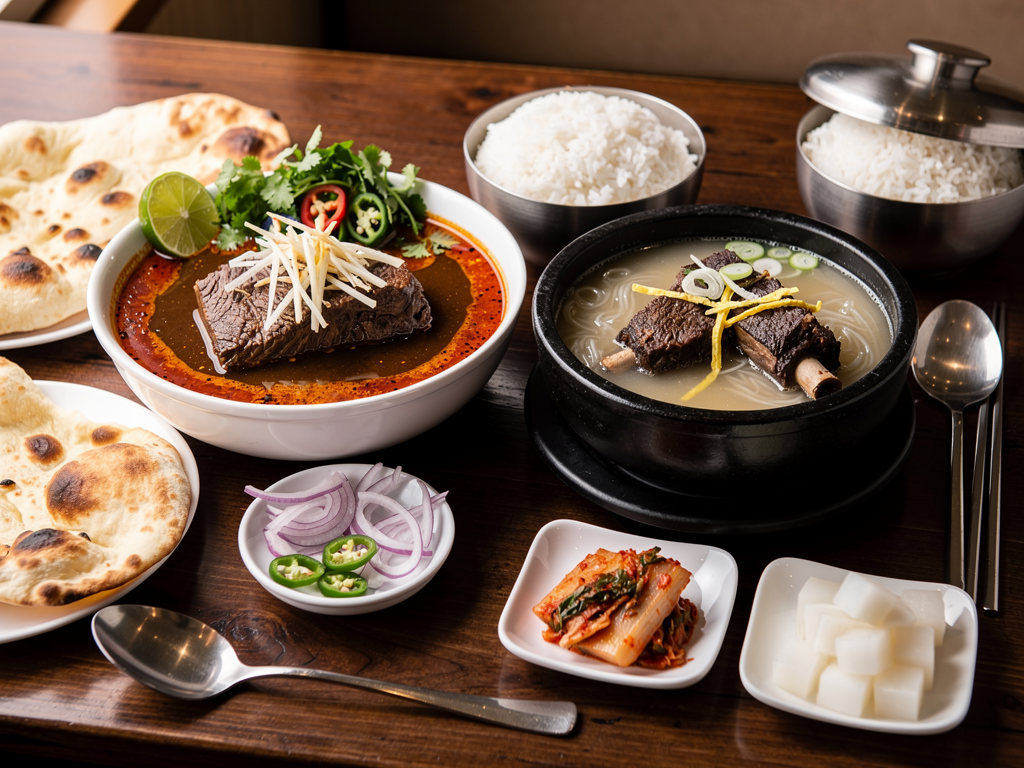
Bread or rice, kitchen grill or table grill, yogurt or none?
Bread. A Pakistani meal is eaten with it — naan, roti, paratha, by the piece (Lal Qila 3–10, Ravi 2.50–7) — and the rice is either the biryani (Lal Qila Shahi Chicken Biryani 32, Mutton 35; sold by the 800gm and the kilo in its deals) or a AED 15 Steam Rice line. A Korean meal has no bread at all, and the rice is inside the price; the portal’s Korean fried rice vs biryani page has the rice argument.
Mutton. The Pakistani signature is mutton karahi — Lal Qila prints Lahori Mutton Karahi in every buffet and Mutton Karahi 350gm in its deals — and karahi is ordered by weight across Pakistani kitchens, the half-kilo and the kilo. Mukbang serves no mutton or lamb at all, which is the honest limitation on this page for a karahi regular.
The grill. Pakistani barbecue — seekh kebab, chicken tikka, malai boti, chapli — is cooked in the kitchen over charcoal or in the tandoor and sold by the piece, ten at a time at Lal Qila (AED 30–38); Korean BBQ is cooked by the diner on the grill in the table and sold by the person. Both marinate: Pakistan in yogurt, ginger-garlic, red chilli and garam masala; Korea in soy, sugar, pear, garlic and sesame. The portal’s Korean BBQ vs mixed grill guide makes the same who-cooks argument against the Levantine platter.
Yogurt and heat. Yogurt is in the Pakistani marinade, the raita, the lassi (Lal Qila Lassi Sweet / Salty 15) and the malai boti; savoury Korean cooking has almost none. Both are chilli cuisines — Pakistani heat is whole and ground spice with green chilli and ginger on top, carried by ghee and yogurt; Korean heat is gochugaru, dried and ground, and gochujang, fermented. Sour: Pakistan uses lime, tamarind and achar; Korea ferments, and kimchi is the sour. Sweet: gulab jamun, kheer, jalebi and ras malai against bingsu (Mukbang 37) — the portal’s bingsu vs falooda page has the frozen-dessert argument.
Is korean food vs pakistani food a halal question?
Yes — but it runs the other way from every other hub on the portal. Pakistan is a Muslim-majority country; on the UAE menus read for this guide (Lal Qila’s own site, Ravi’s Talabat listing) every meat line is chicken, mutton, beef, fish or quail and no pork line appears anywhere. That is an observation about the printed menus, not a certificate for any Dubai restaurant — confirm directly. No Time Out list of Pakistani restaurants was found, so this guide prints no licence label for any Pakistani venue; Lal Qila’s drinks page prints headings that read “Margarita” and “Mojitos” beside its lassis and shakes, and this guide does not interpret them — confirm directly.
The question a Pakistani-food regular actually asks is the reverse one: is the Korean side halal? Korea is not Muslim-majority and pork is common in Korean cooking at home. At Mukbang Shows the answer is plain — beef and chicken only, no pork anywhere on the menu, no alcohol served, on every tier and every à la carte line across all five branches. For the other Korean kitchens in the UAE, see whether Korean food is halal.
One more note on names. Khaleej Times reported in August 2026 that the Satwa original Ravi says a “Ravi Fine Dine” on Sheikh Zayed Road and a “Ravi Restaurant” in Al Nahda are not its branches; the prices on this page come from the Al Karama listing and the history from Satwa.
Where to try Korean food in the UAE
Mukbang Shows Restaurant has five branches: Deira (Al Ittihad Rd, Port Saeed, +971-4-886-4494), JBR (Plaza Level, Bahar 7, The Walk, +971-54-523-1898) and DWTC (The Apartments Block A, Sheikh Zayed Rd, +971-54-524-5904) in Dubai; Muroor Road (547 Sultan Bin Zayed The First St, Al Danah, +971-50-158-9433) and Electra Street (Zayed The First St, behind Sun and Sand Sports, +971-2-564-0446) in Abu Dhabi. The DWTC branch sits on the same Sheikh Zayed Road as Lal Qila’s second room, so the two unlimited models can be compared on one road.
The tiers: Gangnam AED 69 at Deira, Muroor and Electra (AED 79 at JBR and DWTC); Daegu adds Korean fried chicken at AED 89 / 99; Jeju adds the seafood boil at AED 99 / 109; Bukchon Hanok is AED 129 everywhere. Every tier includes seven BBQ kinds, eight banchan, two gimbap, soup and steamed rice; minimum two persons; AED 60 leftover charge; the same price at every hour. À la carte: LA Galbi 109, Wagyu Bulgogi 115, Brisket 95, Eomuk Tang 49, Tteok Mandu Guk 59, Kimchi Jeongol 89 / 50, Bibimbap 53–62, Bingsu 37.
The honest limitation: no mutton or lamb, no bread, no nihari or haleem, no biryani, no lunch price, no solo unlimited option, and no Pakistani food of any kind. For à la carte Korean with banchan, Hanok in International City (Bibimbap AED 53–55, Galbi Tang 58, Galbi Gui 115) is the reference point; the best Korean BBQ in Dubai guide covers the other grill rooms.
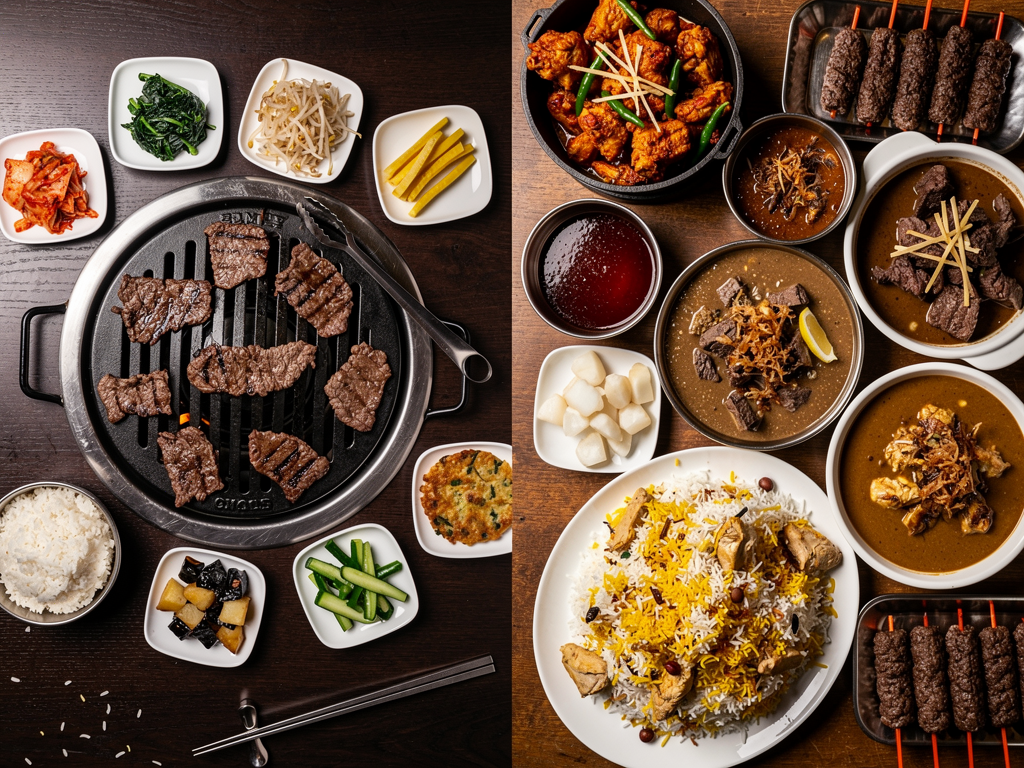
Where to try Pakistani food in the UAE
Lal Qila (Jumeirah, 04 325 4778; Sheikh Zayed Road) is the reference room for the pricing model — the buffet by the head, the kebab by the ten, the naan by the one, the karahi by the gram. Ravi (Satwa, since 1978; Al Karama) is the institution: founded by Chaudary Abdul Hameed, written up by The National as “a Satwa institution”, and still selling a nihari for AED 16 and a naan for AED 2.50 on its Al Karama listing. Read Khaleej Times on Ravi Restaurant, the Satwa original since 1978 before you pick a branch.
This page ranks nobody on the Pakistani side; it prices the model. It also prints no price it did not read: Ravi’s lunch and dinner menus were not live when its listing was checked, so only its breakfast ladder appears here.
How to choose between the two on a given night
Pick Pakistani when you are one person, when it is lunch, when mutton is the point, when you want bread with the meal and yogurt on it, when the table wants sixty dishes rather than one grill, or when a beef bowl for AED 16 is the whole plan. Pick Korean when you are two or more at dinner and want the grill in the table with the sides inside the price, when cooking the beef and chicken yourself is the point, when fermented heat and sour vegetables are the flavours you are after, or when the unlimited seat has to cost the same on a Friday night as a Tuesday lunch.
Beyond korean food vs pakistani food, the portal’s other cuisine hubs — Korean vs Indian, Korean vs Turkish, Korean vs Arabic and the rest — use the same test.
Pakistani is the only one of the eleven whose bridge format is not a bridge at all but the same format: unlimited, per head.
| Venue | Area | Price AED | Halal | Standout order |
|---|---|---|---|---|
| Mukbang Shows Restaurant | Deira, JBR, DWTC · Muroor Road, Electra Street | 69–129 per person | Beef and chicken only, no pork, no alcohol | Gangnam unlimited BBQ AED 69 — 7 meats, 8 banchan, rice, soup |
| Lal Qila | Jumeirah; Sheikh Zayed Road | 44–95 per adult buffet + VAT; 3–40 à la carte | Menu prints chicken, mutton, beef, fish, quail — confirm directly | Dinner buffet AED 95 + VAT — nihari, karahi, live BBQ |
| Ravi Restaurant | Satwa (original); Al Karama | 16 nihari, 2.50 naan (breakfast, delivery listing) | Menu prints beef, chicken, mutton — confirm directly | Nihari AED 16 + Naan AED 2.50 |
| The Korean Restaurant (Hanok) | International City, Dubai | 42–115 | Confirm directly | Galbi Tang AED 58 |
FAQ
Is Korean food or Pakistani food cheaper in the UAE?
For one person and at lunch, Pakistani: Lal Qila’s weekday lunch buffet is AED 46.20 with VAT and Ravi’s nihari with a naan is AED 18.50. For two at dinner, Korean: AED 138 for two unlimited seats at Mukbang Shows against AED 199.50 for two at Lal Qila’s dinner buffet.
Why is Pakistani karahi sold by the kilo?
Because a Pakistani menu prices the meat by quantity — the half-kilo and the kilo across Pakistani kitchens, and 300gm or 350gm inside Lal Qila’s printed deals. A Korean grill is priced by the person, AED 69 a head at Mukbang Shows, with the sides inside.
Is a Pakistani buffet like Korean unlimited BBQ?
In the way it is priced, yes — both are one number per head. The differences are the price (AED 99.75 against 69 / 79 at dinner), who cooks (the kitchen against the diner), and breadth (sixty dishes against one grill without limit).
Does Korean BBQ have mutton?
Not at Mukbang Shows — its seven grill kinds are beef and chicken. The Pakistani table is mutton-led: karahi, kunna paya, gola kabab, mutton seekh.
Do Korean restaurants serve naan?
No. Korean tables serve rice and banchan; there is no bread tradition at the table. Pakistani tables run on naan, roti and paratha, sold by the piece.
Is Pakistani food spicy like Korean food?
Both are chilli cuisines from different engines. Pakistani heat is ground and whole spice with green chilli and ginger, carried by ghee and yogurt; Korean heat is gochugaru and fermented gochujang.
Is Korean food halal in the UAE?
At Mukbang Shows, yes — beef and chicken only, no pork, no alcohol, on every tier and every à la carte line across all five branches. Elsewhere, confirm directly.
Every price in this guide was read from the venue’s own menu page or its delivery-app listing in September 2026, or is attributed to Khaleej Times and The National where noted. Menus change; what the price is counting — the head, the piece, the gram, or the seat — is the thing to check before you compare.