Updated: September 2026
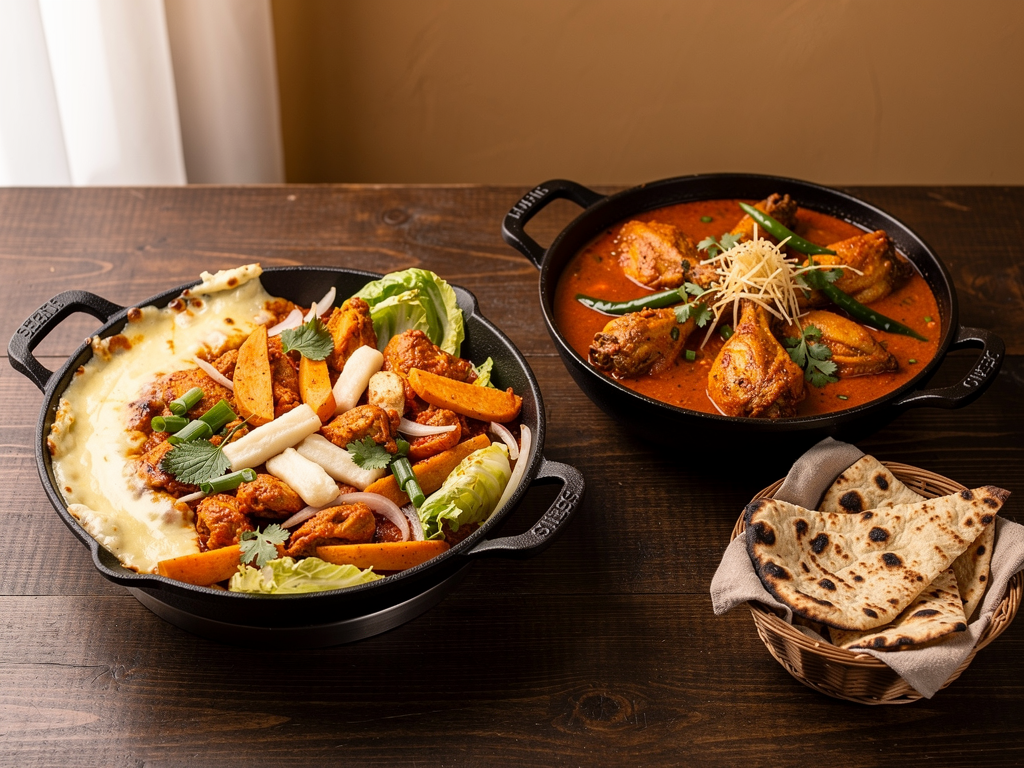
Dakgalbi vs chicken karahi compares two cousins: small pieces of chicken cooked fast with chilli in one shared pan. UAE menus count the chicken differently. Karahi is sold by weight, by the half kilo and the kilo. Dakgalbi is sold by the pan. On menus read in September 2026, a chicken karahi costs AED 16–115 and a dakgalbi AED 89–180.
Quick answer
- Different base: karahi is fresh tomato, ginger, garlic and green chilli; dakgalbi is fermented gochujang with cabbage, sweet potato and rice cakes.
- Different unit: Khan Gi prints chicken karahi at AED 25 a half kilo and AED 45 a kilo; no UAE Korean menu prints a dakgalbi weight.
- Different carb: karahi comes with bread bought by the piece (AED 1–6); dakgalbi has rice cakes cooked into the pan.
- Halal: Mukbang Shows cooks beef and chicken only, with no pork and no alcohol; for every other venue below, confirm directly.
What is the real difference between dakgalbi vs chicken karahi?
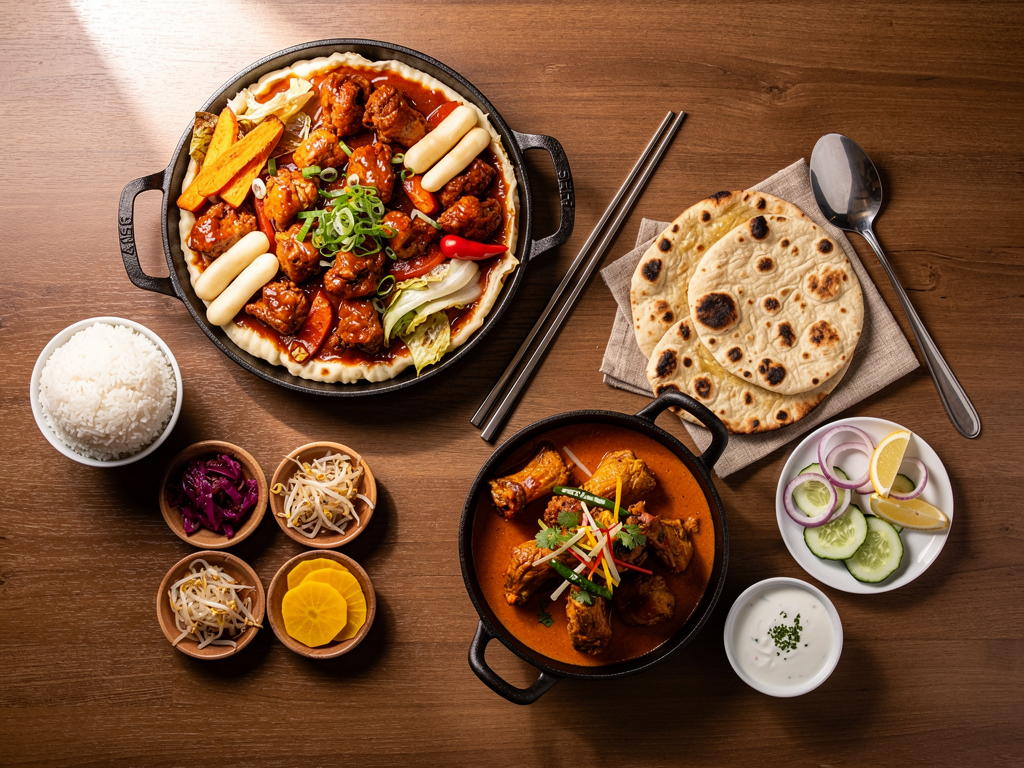
The real difference is the sauce and the unit. Chicken karahi is cooked in tomatoes, ginger, garlic and green chilli, and UAE menus sell it by weight or by the plate. Dakgalbi is chicken stir-fried in gochujang, a fermented red chilli paste, with vegetables and rice cakes, and UAE menus sell it as one pan for the table.
Both dishes were built to feed a crowd cheaply from a single vessel, one in a Lahore wok and one on a Chuncheon hot plate. The heat also comes from different places. Karahi’s heat is fresh, from green chilli and ginger added at the stove. Dakgalbi’s is fermented, from a chilli paste aged long before the chicken reaches the pan.
Why is karahi named after a pan and dakgalbi after a rib?
The two names tell different stories. A karahi is a deep, round cooking pot “similar in shape to a wok”, and Wikipedia notes that stews cooked in it “are often named karahi dishes after the utensil”. The word goes back through Prakrit to Sanskrit. So chicken karahi means, literally, chicken from the karahi pan.
Dakgalbi is named after something it does not contain. Dak means chicken and galbi means rib, yet the dish “is not made with chicken ribs”. According to Wikipedia, it was developed in 1960s Chuncheon by Kim Yeong-seok, who ran a pork restaurant and used chicken when the pork ran out. It was first called dakbulgogi and grilled over charcoal. The rib name stuck because the chicken stood in for pork ribs. In the 1970s it was nicknamed “commoners’ galbi” and “university student’s galbi” because it was cheap and generous.
That origin is why halal diners should ask about any dakgalbi’s kitchen, and it is covered in the halal section below.
How do the ingredients and flavours compare?
Chicken karahi is built on tomato. Wikipedia lists ginger, garlic, tomatoes, green chilli and coriander as “key to the flavor”, and notes what sets it apart from other regional curries: it is traditionally “cooked without onions in the base”. UAE menus describe it the same way. Pak Liyari prints “chicken cooked fast in a wok-style karahi with tomatoes, ginger and green chillies”, and Muhammad Iqbal prints “wok-cooked with tomato, ginger, chili, and spice”.
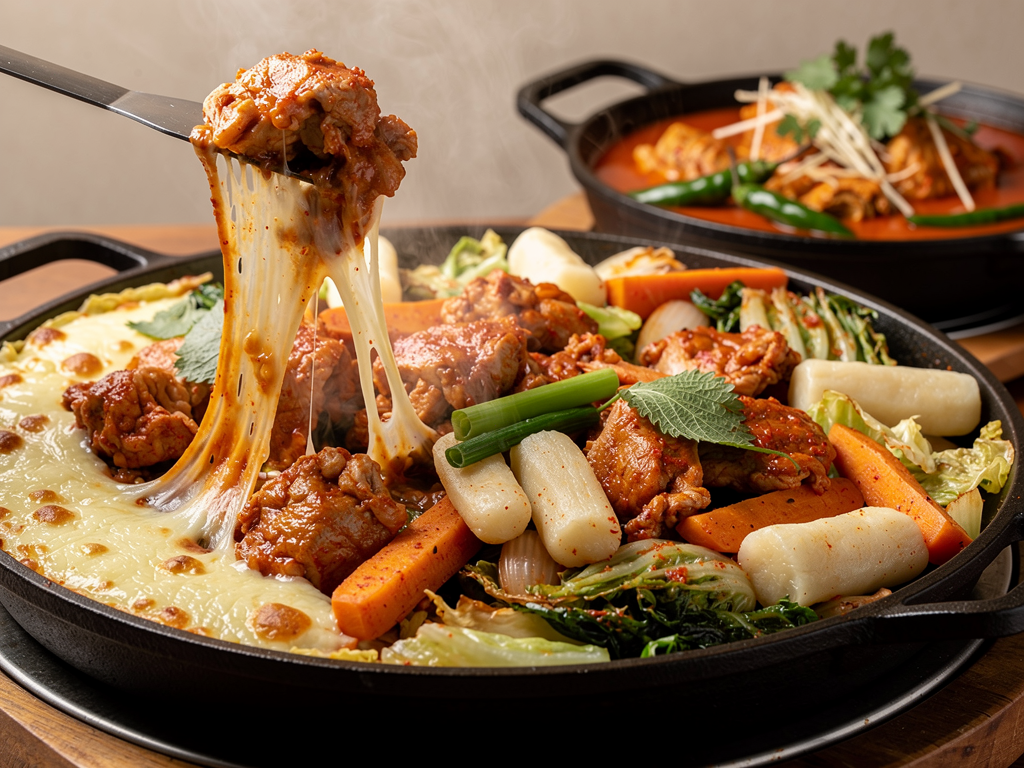
Dakgalbi is built on gochujang. Wikipedia describes marinated diced chicken stir-fried “in a gochujang-based sauce with sweet potatoes, cabbage, Korean perilla, spring onion, tteok (rice cake)”. Hanok in International City prints “fresh farm chicken stir fried with rice cakes and vegetables in spicy gochujang-based sauce”.
In the pan, karahi reads bright, tangy and gingery, with a thick tomato gravy that clings to the meat. Dakgalbi reads deeper, sweeter and more savoury, with the sauce coating the chicken, cabbage and chewy rice cakes rather than pooling around them.
Why is chicken karahi sold by the kilo in Dubai?
Karahi is sold by weight on Dubai’s Pakistani menus, so the menu tells you how much chicken you are buying. Four ways of counting it appear on Dubai menus read this month.
- By the half kilo and the kilo: Khan Gi Restaurant (Al Satwa, International City and Ras Al Khor) prints “Chicken Karahi 1/2 Kg” at AED 25 and “Chicken Karahi 1 Kg” at AED 45, so the full kilo costs AED 5 less than two halves. Mutton karahi is AED 35 and AED 65.
- By the gram, inside a deal: Lal Qila in Jumeirah folds “Chicken Karahi 300gm” into its Friendly Deal for 2–3 people at AED 99, and 350 gm portions of chicken and mutton karahi into its Deal of the Month for 5–6 at AED 225.
- By size: Muhammad Iqbal Restaurant in Business Bay prints “Chicken Karahi Fresh” at M AED 58.99 / L AED 114.99, and its house Beluchi, Bombay and BBQ karahis at M 29.99 / L 39.99. No weights are printed for the sizes.
- By the plate: Pak Liyari in Al Fahidi, Bur Dubai prints one Chicken Karahi at Dh 16, VAT included. Al Haaj Bundoo Khan in Oud Metha prints Chicken Karahi at AED 25 and a “Live Karahi” section with two unlabelled prices per line, such as Peshawari Karahi 30/60.
The hub page, our Korean food vs Pakistani food guide, covers the wider Pakistani table, including buffets and bread.
How is dakgalbi priced in Dubai and Abu Dhabi?
Dakgalbi is priced by the pan, and where a menu says anything more, it counts the people around it. No UAE Korean menu read prints a weight.
- Mukbang Shows prints Cheese Dakgalbi, “spicy grilled chicken with melted cheese”, at AED 89, before 5% VAT (AED 93.45 with it). It is one line with no half size, served at Deira, JBR and DWTC in Dubai and on Muroor Road and Electra Street in Abu Dhabi. The menu notes that à la carte prices shown are for JBR and DWTC and may vary slightly elsewhere.
- The Korean Restaurant (Hanok), International City, prints Dak Galbi at AED 100 and a Dak Galbi Set with kimchi, seaweed, green onions, egg and rice at AED 125, VAT included.
- Manna Land, Al Nahyan, Abu Dhabi, prints Dak Galbi, “stir-fried spicy chicken”, at AED 110, VAT included.
- Madang, Holiday Inn, Abu Dhabi, prints a Fondue Chicken Cheese dakgalbi at AED 180, “good for 2-3 Persons”, with extra cheese at AED 30.
Madang’s line is the clearest statement of the Korean model: the menu tells you how many people the pan feeds, not how much chicken is in it. For the dish itself, see our guide to dakgalbi.
How do dakgalbi vs chicken karahi prices compare?
Karahi is cheaper on almost every menu read, and the gap is wide. Only Muhammad Iqbal’s large fresh-chicken karahi costs more than a dakgalbi pan. The cheapest dakgalbi on this page costs about as much as two kilos of Khan Gi karahi.
| Venue | Dish | Unit | Price (AED) |
|---|---|---|---|
| Pak Liyari, Bur Dubai | Chicken Karahi | one plate | 16 (VAT incl.) |
| Khan Gi, Al Satwa | Chicken Karahi | 1/2 kg · 1 kg | 25 · 45 |
| Bundoo Khan, Oud Metha | Chicken Karahi · live karahi | plate · two unlabelled sizes | 25 · 30/60 |
| Muhammad Iqbal, Business Bay | Chicken Karahi Fresh | M · L | 58.99 · 114.99 |
| Lal Qila, Jumeirah | Friendly Deal with 300gm karahi | deal for 2–3 | 99 |
| Mukbang Shows | Cheese Dakgalbi | one pan | 89 + VAT |
| Hanok, International City | Dak Galbi · Dak Galbi Set | pan · set with rice | 100 · 125 (VAT incl.) |
| Manna Land, Abu Dhabi | Dak Galbi | one pan | 110 (VAT incl.) |
| Madang, Abu Dhabi | Fondue Chicken Cheese | pan for 2–3 | 180 (VAT incl.) |
Two worked examples show the gap. At Pak Liyari, two chicken karahi plates and four naan come to AED 36, VAT included. At Khan Gi, a kilo of chicken karahi plus four roghni naan comes to AED 57. At Mukbang, one Cheese Dakgalbi is AED 93.45 with VAT, with no bread or rice included.
Do you eat karahi with naan and dakgalbi with rice?
Mostly, yes, and that changes the bill. Karahi arrives on its own, and bread is a separate line bought by the piece: naan or roti is Dh 1 at Pak Liyari, roti AED 1 to cheese naan AED 6 at Khan Gi, tandoori naan AED 1.99 at Muhammad Iqbal and naan AED 2 at Bundoo Khan. Wikipedia notes karahi is “usually served with naan, roti or rice”.
Dakgalbi carries its starch inside the pan, as chewy rice cakes (tteok) and sweet potato. Rice is the upgrade: Hanok’s Dak Galbi Set adds rice, kimchi and side dishes for AED 25 more than the plain pan. Lettuce and perilla leaves may be served for wrapping pieces, the same ssam habit you see at Korean BBQ.
Is cheese dakgalbi like a white karahi?
They play the same role. Each is its dish’s rich, creamy variation. Mukbang’s Cheese Dakgalbi and Madang’s Fondue Chicken Cheese add melted cheese to the gochujang chicken, while Hanok’s and Manna Land’s versions are the plain stir-fry.
On the Pakistani side, the dairy version is the white karahi. Bundoo Khan prints a Chk. White Karahi at 35/70, and Muhammad Iqbal prints a mutton Afghani Karahi with “mild white gravy with cream”. Cheese dakgalbi keeps the chilli and adds the cheese on top. White karahi drops the red chilli and builds the gravy from cream. If you want heat, pick the cheese dakgalbi. If you want mild, pick the white karahi.
Is dakgalbi vs chicken karahi halal in the UAE?
Mukbang’s dakgalbi is halal-friendly by menu design. The kitchen cooks beef and chicken only, serves no pork and no alcohol, and makes its dakgalbi with chicken. That matters for this dish in particular: dakgalbi was invented in a pork restaurant and named as a stand-in for pork ribs, and at least one Abu Dhabi Korean menu (Madang) marks pork dishes elsewhere on the same page.
For karahi, here is what the venues print about themselves:
- Muhammad Iqbal prints “100% Halal”, “Halal Certified” and “Locally Slaughtered Fresh Meat and Chicken” on its own site.
- Khan Gi says it cooks “with fresh halal chicken” on its own site.
- Pak Liyari, Lal Qila and Bundoo Khan print chicken, mutton and beef karahi lines, and no halal claim was read on the pages used for this guide.
These are the venues’ own claims, so confirm directly. The same applies to Hanok, Manna Land and Madang on the Korean side.
Which is better for one person, and which for a group?
For one person, karahi wins by a distance. Pak Liyari’s Dh 16 plate with a Dh 1 naan is a full meal for under AED 20. Khan Gi prints a half kilo at AED 25. No dakgalbi on this page comes in a solo size.
For a group, it depends on what else is on the table. Khan Gi’s AED 45 kilo is the cheapest kilo of karahi read, and naan is AED 3 a piece on top. Lal Qila’s AED 225 deal for 5–6 people puts two karahis beside biryani, kebabs and dessert. A dakgalbi pan works best as one shared dish on a bigger Korean table. At Mukbang it sits next to unlimited beef and chicken Korean BBQ from AED 69 a head, and Madang prints its cheese pan as good for 2–3 people.
The dakgalbi vs chicken karahi choice, then, is less about which dish is better and more about the meal around it.
Which should you order: dakgalbi or chicken karahi?
Order chicken karahi if you want fresh tomato-and-ginger heat, to pay by weight, to eat alone or cheaply, or to scoop with hot naan. Khan Gi’s half-kilo and kilo lines are the clearest menu in Dubai, and Pak Liyari’s Dh 16 plate is the cheapest.
Order dakgalbi if you want the sweeter, deeper heat of gochujang, chewy rice cakes in the pan, a cheese version, or a shared dish alongside Korean BBQ. Mukbang’s AED 89 Cheese Dakgalbi is the pick if you want a Korean kitchen that cooks beef and chicken only.
The honest limitation: Mukbang sells no karahi of any kind, and no naan, roti or mutton. Its dakgalbi comes one way, as a single cheese pan at AED 89 plus VAT with no half size. That is priced for a table, not one diner. If you are on a budget or eating alone, go for karahi.
More options by city are in our guide to the best dakgalbi in Dubai and our guide to the best dakgalbi in Abu Dhabi. The other subcontinental chicken pair is our Korean fried chicken vs chicken 65 comparison. For background, start with the encyclopaedia entry on dak-galbi, the encyclopaedia entry on chicken karahi and the history of the karahi pan.
Dakgalbi vs chicken karahi at a glance
| Dakgalbi (닭갈비) | Chicken karahi | |
|---|---|---|
| Named after | a rib (galbi) it does not contain | the pan it is cooked in |
| Origin | 1960s Chuncheon, South Korea | Punjab; famous in Lahore |
| Base | fermented gochujang chilli paste | tomato, ginger, garlic, green chilli; no onion in the base |
| In the pan | chicken, cabbage, sweet potato, perilla, rice cakes | chicken and gravy |
| Eaten with | rice cakes in the pan; rice as an upgrade | naan, roti or rice, bought by the piece |
| Creamy version | cheese dakgalbi | white karahi |
| How UAE menus count it | by the pan, or by heads (Madang 2–3) | by the half kilo, kilo, gram, size or plate |
| UAE price read | AED 89 + VAT to 180 | AED 16 to 114.99 |
FAQ
Is dakgalbi the same as chicken karahi?
No. Both are chicken cooked fast in one shared pan with chilli, but chicken karahi is a tomato, ginger and green-chilli dish from South Asia, while dakgalbi is a Korean stir-fry in fermented gochujang with cabbage, sweet potato and rice cakes.
Which is spicier, dakgalbi or chicken karahi?
Both can be hot, and it depends on the kitchen. Karahi’s heat is fresh, from green chilli and ginger. Dakgalbi’s is fermented and slightly sweet, from gochujang. Cheese dakgalbi and white karahi are the milder versions.
How much is chicken karahi in Dubai?
On menus read in September 2026, chicken karahi costs Dh 16 a plate at Pak Liyari, AED 25 a half kilo and AED 45 a kilo at Khan Gi, AED 25 at Bundoo Khan, and AED 58.99 or 114.99 for the medium or large fresh-chicken karahi at Muhammad Iqbal.
How much is dakgalbi in Dubai and Abu Dhabi?
Cheese Dakgalbi is AED 89 plus VAT at Mukbang Shows. Dak Galbi is AED 100, or AED 125 as a set, at Hanok in International City, AED 110 at Manna Land in Abu Dhabi, and AED 180 for a cheese pan for 2–3 people at Madang in Abu Dhabi.
Why is dakgalbi called chicken rib if it has no ribs?
Galbi means rib in Korean. Dakgalbi was created in 1960s Chuncheon by a pork-restaurant owner who swapped in chicken when pork ran out, and the rib name stayed even though no chicken ribs are used.
Is the dakgalbi at Mukbang Shows halal-friendly?
Yes. Mukbang Shows cooks beef and chicken only, serves no pork and no alcohol, and makes its Cheese Dakgalbi with chicken.
Does Mukbang Shows serve karahi?
No. Mukbang Shows is a Korean restaurant and serves no karahi, naan or roti. For karahi, visit a Pakistani kitchen such as Khan Gi, Pak Liyari, Bundoo Khan, Muhammad Iqbal or Lal Qila and confirm the details directly.