Updated: September 2026
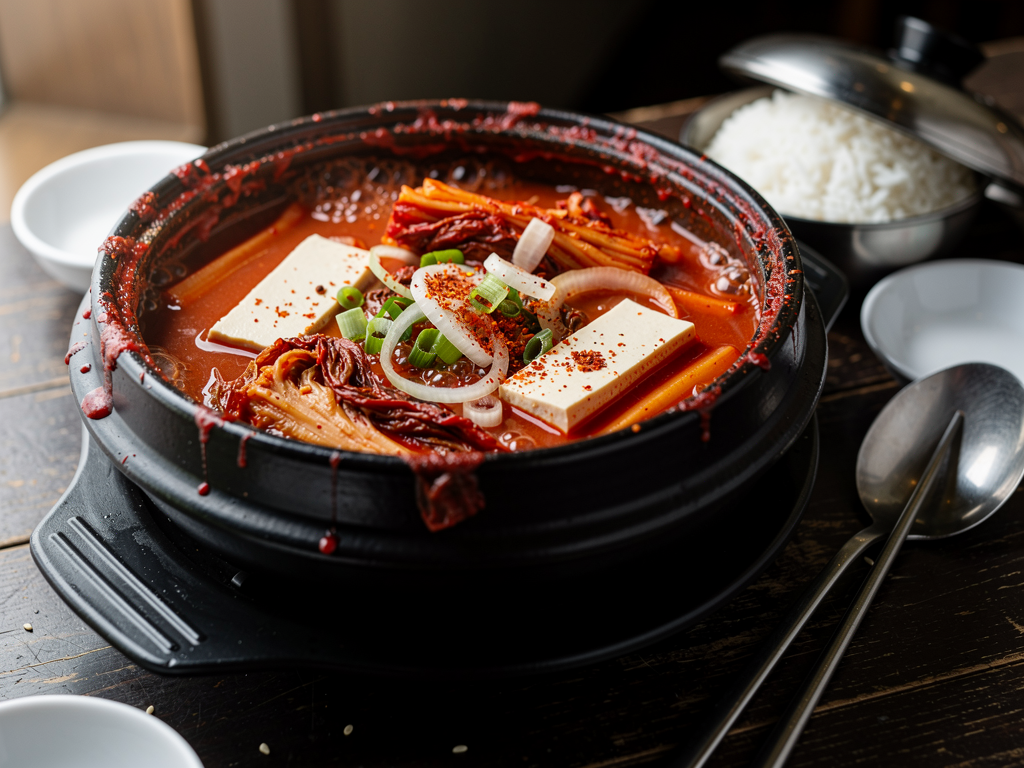
Kimchi jjigae is a thick Korean stew made by simmering sour, well-fermented cabbage kimchi with its own juice, tofu, onion and spring onion in a small pot, seasoned with chilli flakes and served bubbling with a bowl of rice. The short answer to what is kimchi jjigae is that it is the most ordinary meal in Korea — and the hardest one to fake, because the thing that decides whether it is any good is how long the kimchi fermented before it went in the pot, not the recipe. This guide explains that, deals honestly with the pork question that matters in the UAE, and shows what four local menus charge for it.
The kimchi is the recipe
Every other Korean stew starts with a paste — doenjang (soybean), gochujang (chilli) — and builds from there. Kimchi jjigae starts with a jar of kimchi that has gone too sour to eat raw. That is not a shortcut; it is the point of the dish. Korean home cooks make it precisely to use up kimchi that has been fermenting for weeks or months, and the sourness that makes old kimchi unpleasant on the side of a plate is exactly what makes it right in a stew.
Fresh, young kimchi gives you a thin, sharp, slightly raw-tasting pot. Kimchi that has aged properly — sin-kimchi, or the months-old mugeunji — gives the deep, rounded, almost sweet-sour red broth the dish is famous for. Many cooks fry the kimchi in a little oil first, to soften it and take the edge off the acid, before adding water or anchovy stock, tofu and onion. The kimchi juice from the jar goes in too; it is the main seasoning, and the added gochugaru only amplifies what is already there.
This is why the dish is cheap everywhere, including here. It is built on a preserved ingredient every Korean kitchen already has, it takes minutes, and it was never a special-occasion food. Anyone asking what is kimchi jjigae has usually met it as the default lunch in an office-district restaurant or the default weeknight dinner in a drama. The background on kimchi explains the fermentation; the background on kimchi jjigae covers the dish’s place in the Korean table.
What goes in the pot
The core is fixed: aged napa-cabbage kimchi and its juice, firm tofu in thick slabs, sliced onion, spring onion, gochugaru (chilli flakes), and water or anchovy stock. Some kitchens add a spoon of gochujang or doenjang for depth, some add garlic, some add a little sugar to balance a very sour jar. It is cooked and served in the same small pot — the black earthenware ttukbaegi is the classic — and arrives still boiling.
Then there is the protein, and this is where the UAE reader needs to pay attention. In Korea the two home standards are pork kimchi jjigae (dwaeji-kimchi-jjigae — pork belly or shoulder rendered in the pot first, so the fat carries the chilli) and tuna kimchi jjigae (chamchi-kimchi-jjigae — a tin of tuna stirred in; the student version). Beef, chicken and plain-tofu versions all exist, but they are not the default there. Which means the honest answer to what is kimchi jjigae in its home country is: usually a pork stew.
The protein question: four UAE menus, four different answers
None of the four UAE menus that price the dish lists a pork version. But they handle the protein question very differently, and the difference is worth knowing before you order.
| Venue | City | Menu line | Price (AED) | Protein on the menu line? |
|---|---|---|---|---|
| The Skewers | Abu Dhabi (Hamdan Street) | Kimchi Jjigae | 43 | Not stated |
| The Korean Restaurant (Hanok) | Dubai (International City) | KIMCHI JJIGAE | 48 veg / 56 chicken-beef | Yes — your choice |
| Mukbang Shows | Dubai and Abu Dhabi (5 branches) | Kimchi Jeongol | 50 solo / 89 sharing | Kitchen is beef-and-chicken only, no pork |
| Manna Land | Abu Dhabi (Al Nahyan) | KIMCHI JJIGAE | 58 | Not stated |
| Nuri Grill & Bar | Abu Dhabi (Yas Island) | Spicy Kimchi Stew | Inside set menus only, no standalone price | Not stated; licensed venue, pork on the menu |
Hanok prints two prices, so the protein is a decision you make on the menu. Manna Land and The Skewers print one price and no protein — a kimchi stew with no stated protein in the UAE is not automatically pork, and it is not automatically not pork, and the only honest answer is the kitchen’s, so ask. Mukbang Shows removes the question by stating the whole kitchen is beef-and-chicken only. That is the single most useful thing to know when reading what is kimchi jjigae on a menu here: the line that names the protein is the line doing you a favour.
What is kimchi jjigae going to cost in the UAE?
It is the cheapest stew on every UAE menu that publishes one, or tied for cheapest. The Skewers on Hamdan Street in Abu Dhabi prints AED 43, the lowest published price in the country. Hanok in International City, Dubai, prints AED 48 for the vegetable version and AED 56 with chicken or beef. Manna Land in Al Nahyan, Abu Dhabi, prints a flat AED 58 — the same AED 58 as its doenjang jjigae and soon tofu, which tells you that kitchen thinks the broth is not what you pay for. Mukbang Shows prints AED 50 for a solo Kimchi Jeongol and AED 89 for the sharing pot.
For scale: on the same menus, Hanok’s Galbi Gui is AED 115, Manna Land’s Galbitang is AED 65, and The Skewers’ Jjampong is AED 70. The kimchi stew sits at the bottom of every one of those lists, exactly where it sits in Korea.
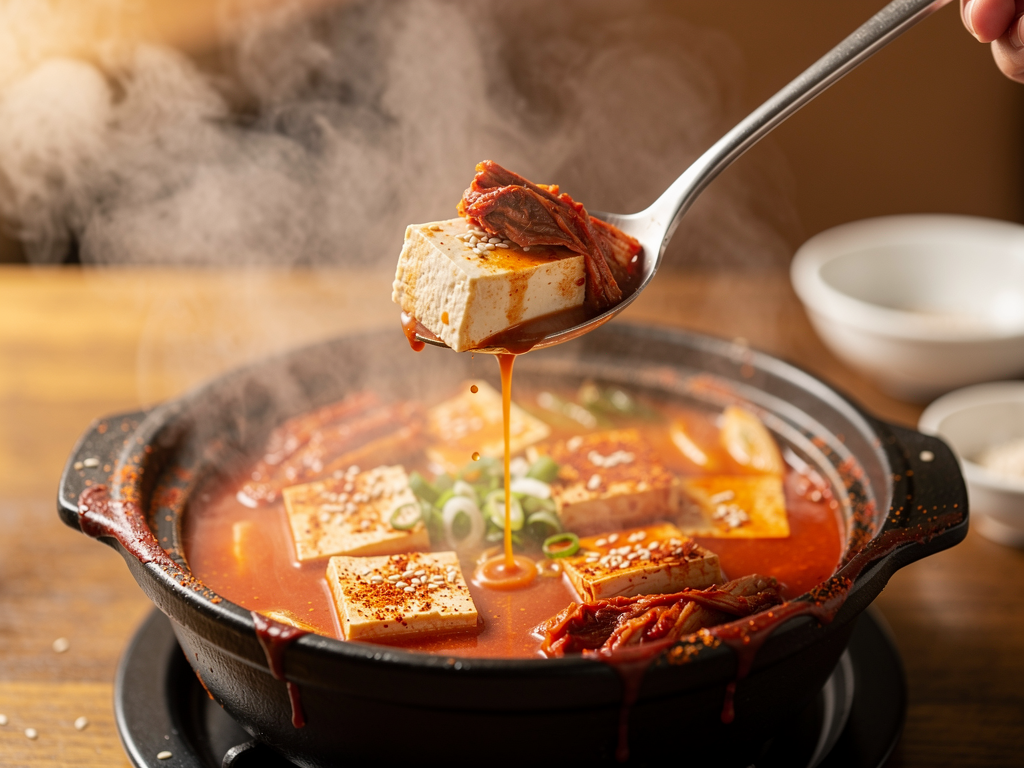
Jjigae, jeongol, hot pot: the same stew under three names
Hanok sells KIMCHI JJIGAE at AED 48 / 56 and, a few lines down on the same menu, KIMCHI HOT POT at AED 80 regular / 98 large. Same kimchi, same broth family. The first is a deep bowl finished in the kitchen for one or two people. The second is a wide, shallow pan cooked at the table for a group. Mukbang Shows sells only the table format, printed as Kimchi Jeongol, at AED 50 solo / 89 sharing. The step from bowl to table is AED 30 to 40 at both kitchens, and it is a charge for the burner and the size, not a better recipe.
So if a menu says kimchi jeongol or kimchi hot pot and you wanted kimchi jjigae, you are looking at the same dish in a bigger vessel. Our jeongol explainer covers that format difference in full and is the page to read if you want the argument in detail.
How kimchi jjigae differs from the stews next to it on the menu
- Jjigae vs guk vs tang. A guk (국) is a light soup served in an individual bowl and eaten with a spoon. A tang (탕) is a richer, longer-simmered soup, still served individually. A jjigae (찌개) is thicker, saltier, cooked and served in one small pot and eaten from the centre of the table with rice. Kimchi jjigae is a jjigae. It is not a soup.
- Kimchi jjigae vs soondubu jjigae. Soondubu is built on silken, uncurdled tofu in a chilli-oil broth and only sometimes has kimchi in it. Kimchi jjigae is built on kimchi and has firm tofu. Our soondubu jjigae explainer has the rest.
- Kimchi jjigae vs doenjang jjigae. Doenjang jjigae gets its backbone from fermented soybean paste and is earthy and brown. Kimchi jjigae gets it from fermented cabbage and is sour and red.
- Kimchi jjigae vs budae jjigae. Budae jjigae is the army-base stew — processed meat, instant noodles, often kimchi — invented after the Korean War. Kimchi jjigae is simpler and much older.
- Heat. It is spicy, from the kimchi’s own chilli plus added gochugaru, but it is rarely the hottest thing on a Korean menu.
Is kimchi jjigae halal in the UAE?
It is not inherently halal or haram. It is a stew, and everything depends on the protein and the stock. The default in Korea is pork belly; anchovy stock, fish sauce and salted shrimp (jeotgal) in the kimchi are also normal, and those are seafood, not pork. In the UAE none of the menus above lists a pork version, so the practical questions are two: what is the protein where the menu does not print it, and does the venue serve alcohol if that matters to you.
Mukbang Shows is 100% halal — its Kimchi Jeongol contains no pork and nothing pork-derived, the kitchen is beef-and-chicken only, and no alcohol is served at any of the five branches. Nuri Grill & Bar is a licensed venue that serves alcohol and its own published menu lists pork dishes, so it is not a like-for-like option for a diner who needs a fully halal kitchen. For Hanok, Manna Land and The Skewers, confirm directly; nothing on their menus settles it. If the kimchi itself is the question rather than the stew, our is kimchi halal explainer deals with the fish sauce and shrimp question properly.
Where to eat kimchi jjigae in the UAE
This is a definition page, not a ranking. For the venue-by-venue verdicts read our guide to the best kimchi jjigae in Dubai and our guide to the best kimchi jjigae in Abu Dhabi. What follows is only what each menu tells you.
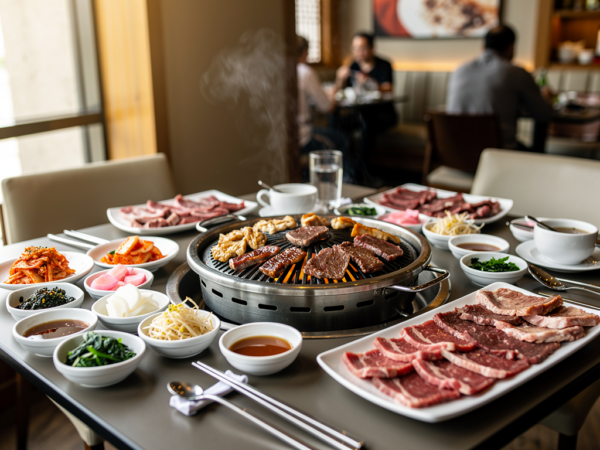
Mukbang Shows (Deira, JBR and DWTC in Dubai; Muroor Road and Electra Street in Abu Dhabi) prints the dish as Kimchi Jeongol — aged sour kimchi, tofu and vegetables in a deep red broth, served as a table hot pot at AED 89 sharing or AED 50 solo. No pork, no alcohol. It is usually ordered as the stew round beside unlimited Korean BBQ, which runs AED 69 / 89 / 99 / 129 per person at Deira and the two Abu Dhabi branches and AED 79 / 99 / 109 / 129 at JBR and DWTC; every tier includes 8 banchan, 2 gimbap, soup and rice, minimum two people, AED 60 leftover charge. The stew is a la carte, not included.
If you want a single small bowl rather than a pot, the solo-sized stews on the same menu are Soondubu Jjigae AED 59 and Doenjang Jjigae AED 59.
The honest limitation: Mukbang does not print the words kimchi jjigae anywhere, and its AED 50 solo pot is still AED 7 dearer than The Skewers’ bowl and AED 2 dearer than Hanok’s vegetable version. If you want the classic single deep bowl with rice at the lowest price, Hanok or The Skewers is the better answer, with the protein question asked at the counter. Mukbang’s case is that the protein question is already answered and the grill is next to it — not that it is the cheapest kimchi stew in either city.
Deira +971-4-886-4494 · JBR +971-54-523-1898 · DWTC +971-54-524-5904 · Muroor Road +971-50-158-9433 · Electra Street +971-2-564-0446.
The Korean Restaurant (Hanok), International City, Dubai — KIMCHI JJIGAE AED 48 vegetable / 56 chicken-beef, and KIMCHI HOT POT AED 80 / 98 on the same menu. The only UAE menu that prints the protein choice on the line, and the only one selling bowl and table pot side by side. Small room, often busy. Halal status: confirm directly.
Manna Land, Al Nahyan, Abu Dhabi — KIMCHI JJIGAE AED 58, flat, beside the fullest soup-and-stew list in the capital (yukgaejang AED 58, galbitang AED 65, tteok manduguk AED 58, five jeongol). Protein not stated. Halal status: confirm directly.
The Skewers, behind Emax on Hamdan Street, Abu Dhabi — Kimchi Jjigae AED 43, the cheapest published in the UAE. Protein not stated. Halal status: confirm directly.
Nuri Grill & Bar, Hilton Abu Dhabi Yas Island — a Spicy Kimchi Stew inside its set menus with no standalone price; its standalone stews (doenjang, sundubu) are AED 80. Licensed, alcohol served, pork on the menu. Listed here for completeness of the price ladder only.
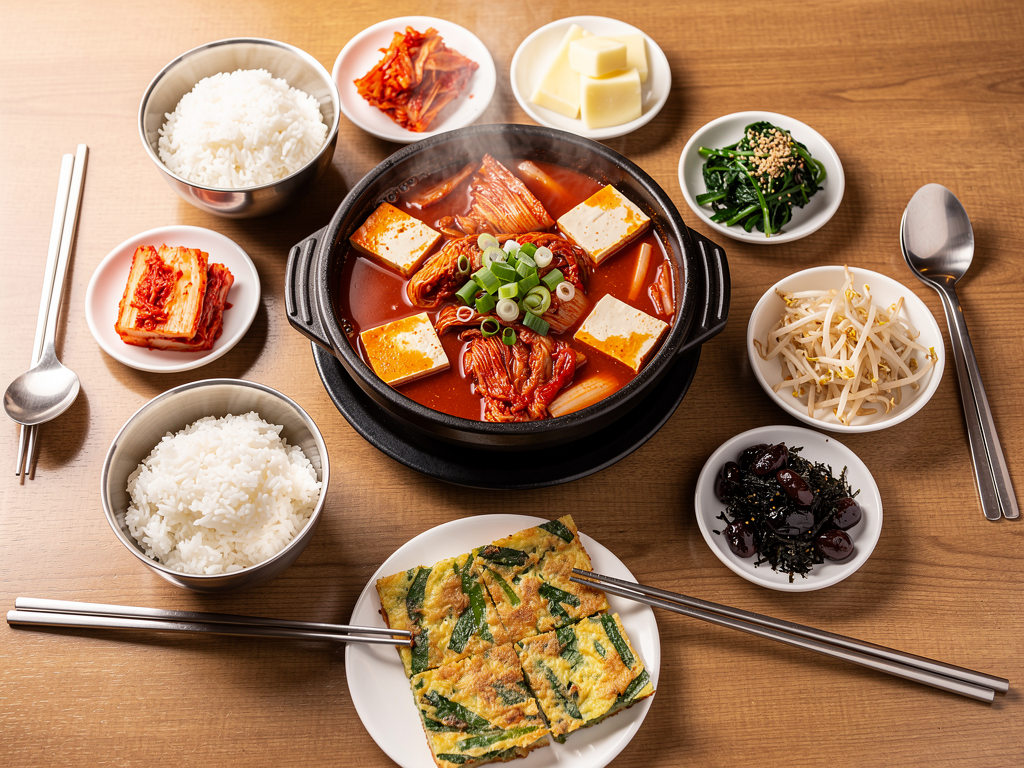
How to eat it
It comes to the table still boiling, in its pot, with rice and banchan. You do not ladle it into a bowl; you eat from the pot with a long spoon, alternating with rice, and let the banchan reset your palate between spoonfuls of the sour-spicy broth. At a Korean BBQ table it is the stew round — ordered once the meat is going, shared by everyone, and the reason the rice is there. A solo bowl is a complete lunch on its own.
If you are new to it, the thing to notice is the difference between the kimchi you get on the side (crisp, fresh, sharp) and the kimchi in the pot (soft, deep, sweet-sour): same jar, different age.
The one-paragraph answer
What is kimchi jjigae? A thick Korean stew of aged, sour cabbage kimchi and its juice, firm tofu, onion and spring onion, seasoned with chilli flakes, cooked and served in one small pot with rice. Its quality is decided by how long the kimchi fermented, not by the recipe. In Korea the default protein is pork belly; in the UAE no menu prices a pork version, Hanok lets you choose, Manna Land and The Skewers do not say, and Mukbang Shows is beef-and-chicken only. It costs AED 43 to 58 as a bowl and AED 80 to 98 as a table pot, and it is the cheapest stew on every menu that sells it.
Time Out Dubai’s Korean restaurant round-up is an independent view of the wider Dubai scene if you want to go beyond the four menus here.
FAQ
What is kimchi jjigae in simple terms?
A Korean stew of well-fermented, sour cabbage kimchi simmered with tofu, onion and spring onion in a small pot, seasoned with chilli flakes and eaten with rice. It is everyday home food in Korea, not a special-occasion dish.
Does kimchi jjigae have pork in it?
In Korea, usually yes — pork belly is the default. In the UAE none of the menus in this guide prices a pork version. Hanok offers vegetable or chicken-beef, Mukbang Shows is beef-and-chicken only, and Manna Land and The Skewers do not state the protein, so ask.
Is kimchi jjigae halal?
It depends on the kitchen. Mukbang Shows’ Kimchi Jeongol is 100% halal with no pork and no alcohol served. Nuri Grill & Bar is licensed and lists pork on its menu. For Hanok, Manna Land and The Skewers, confirm directly.
What is the difference between kimchi jjigae and kimchi jeongol?
Same stew, different vessel. Jjigae is a deep bowl finished in the kitchen for one or two people; jeongol (or hot pot) is a wide pan cooked at the table for a group, and it costs AED 30 to 40 more for the format.
How much does kimchi jjigae cost in the UAE?
AED 43 at The Skewers in Abu Dhabi, AED 48 to 56 at Hanok in Dubai, AED 58 at Manna Land in Abu Dhabi, and AED 50 solo or AED 89 sharing as Kimchi Jeongol at Mukbang Shows in both cities.
Why does old kimchi make a better kimchi jjigae?
Because fermentation is the seasoning. Young kimchi gives a thin, sharp stew; kimchi aged for weeks or months gives the deep, rounded, sweet-sour broth the dish is known for. Korean cooks make the stew to use up kimchi that has become too sour to eat raw.
Is kimchi jjigae very spicy?
It is spicy — the heat comes from the kimchi’s own chilli plus added gochugaru — but it is rarely the hottest dish on a Korean menu.
Related guides
More from our Korean food guides across the UAE: