Updated: September 2026
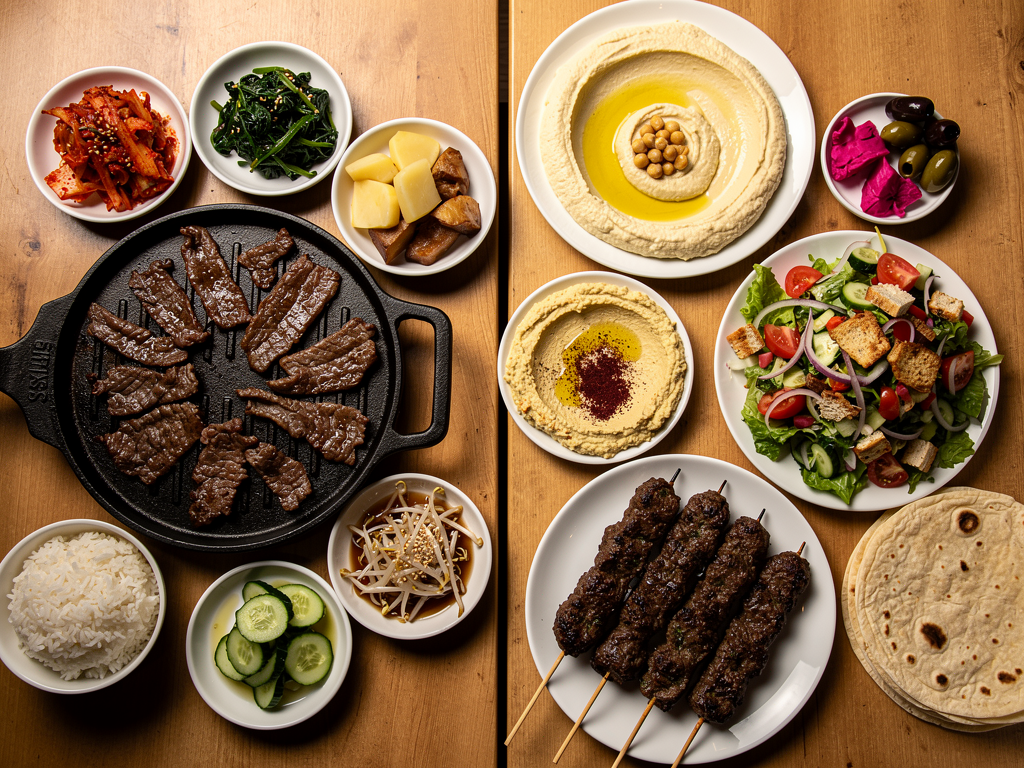
Ask about korean food vs arabic food in the UAE and you will usually get an answer about taste. That is the least useful way to compare them, because both cuisines are built on the same instincts — fermentation, shared plates, a table rather than a plate — and which one you prefer is a matter of what you grew up eating. The difference that actually changes your evening is structural: Arabic restaurants here charge you for every side dish, and Korean restaurants give them away. Everything else follows from that.
The short answer: the sides are the bill, or the sides are free
At an Arabic table in the UAE, the meal is assembled plate by plate and each plate is priced. At Zaroob on Sheikh Zayed Road, a six-plate cold spread of hummus at AED 26, moutabbal at AED 27, muhammara at AED 28, vine leaves at AED 31, fattoush at AED 29 and tabbouleh at AED 29 reaches AED 170 before anyone has ordered a main course. At Arabian Tea House in Al Fahidi, Arabic appetizers run AED 30 to 33 each and Emirati ones AED 25 to 37 — again, before a main.
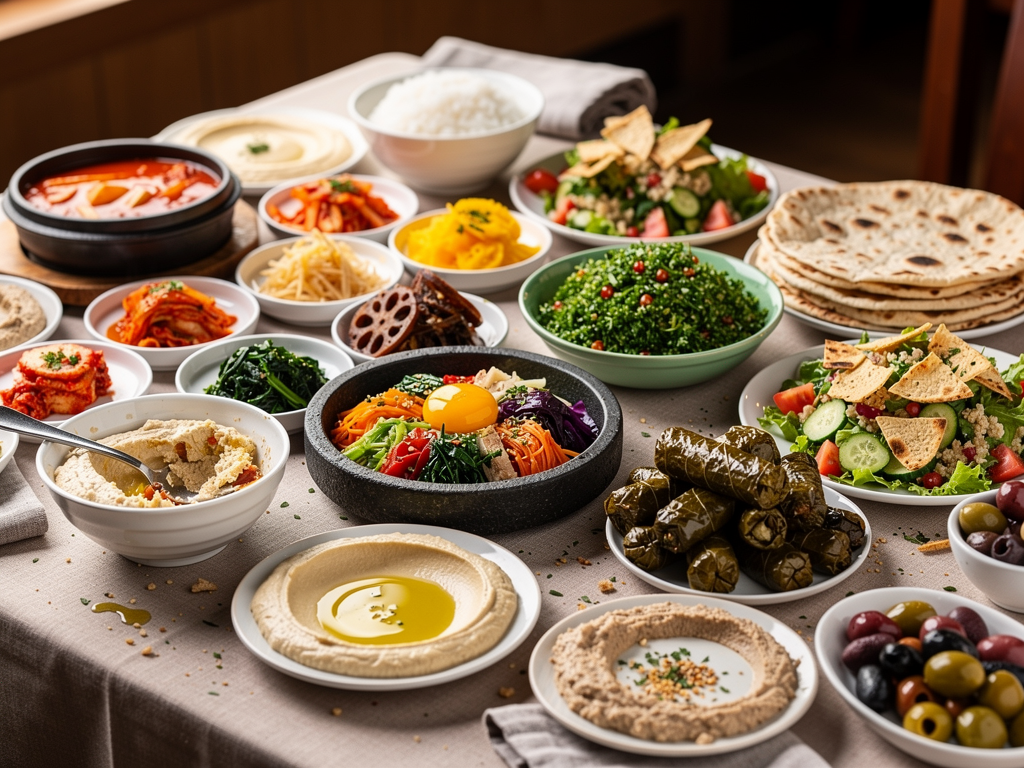
At a Korean table, the equivalent spread arrives without being ordered. Banchan — the small dishes of kimchi, seasoned spinach, pickled radish, bean sprouts — are treated as part of the cover rather than a course. At Mukbang Shows, eight of them are included inside an unlimited BBQ tier that starts at AED 69 per person.
Neither model is cheaper in the abstract. The Arabic model gives you precise control: you order exactly what you want and pay for exactly that. The Korean model gives you predictability: you pay once per head and stop doing arithmetic. Which one wins depends almost entirely on how many people are sitting down, and we can put a number on that below.
What Korean and Arabic food actually cost in the UAE
The price gap in korean food vs arabic food is narrower than most people assume once the unlimited format is set aside. An Arabic main course in the UAE in September 2026 runs roughly AED 42 to 86 for one person, with cold mezze at AED 20 to 40 each on top. A Korean à la carte main runs roughly AED 38 to 99 with the sides already included. Unlimited Korean BBQ runs AED 69 to 129 per person depending on tier and branch.
| Venue | Area | Price (AED) | Halal | Standout order |
|---|---|---|---|---|
| Mukbang Shows | Deira, JBR, DWTC, Muroor Rd, Electra St | 69–129 per person | Yes — beef and chicken only, no alcohol | Gangnam unlimited tier, AED 69 |
| Arabian Tea House | Al Fahidi (Bastakiya) | 25–86 per dish | Confirm directly | Machboos Deyay, AED 62 |
| Reem Al Bawadi | Marina Walk | 18–104 | Confirm directly | Meal For 2 mixed grill, AED 104 |
| Zaroob | DIFC / Sheikh Zayed Road | 21–39 per plate | Confirm directly | Mousakhan rolls, AED 39 |
| Operation Falafel | Downtown Dubai | 18–59 | Confirm directly | Sharing hummus for four, AED 45 |
| The Korean Restaurant (Hanok) | International City | 45–110 | Confirm directly | Bibimbap, AED 53–55 |
| Manna Land | Al Nahyan, Abu Dhabi | 45–158 | Confirm directly | Bulgogi Set, AED 58 |
The crossover sits at about three people. Below that, an Arabic sharing platter usually wins outright: Reem Al Bawadi’s Meal For 2 mixed grill is AED 104 for two, including hummus and salad, while the cheapest Mukbang unlimited tier for two comes to AED 138 because of the two-person minimum. Above three, the unlimited model tends to win per head — but only if the table genuinely eats more than one round. Unlimited pricing is a bet on your own appetite, and the house has run the numbers more often than you have.
Where the two cuisines actually meet
They meet at the grill, and they meet almost exactly. Charcoal-cooked meat, eaten with bread or rice, a sharp salad and a garlic or sesame sauce, is common ground rather than contrast. Arabian Tea House prices its Mixed Barbeque at AED 75, Emirati Kebab Laham at AED 72 and Ryash Barbeque lamb chops at AED 86. Reem Al Bawadi’s Shish Tawook Plate is AED 42 for two skewers. Korean BBQ sits in the same AED 69 to 129 per-person band.
The difference is who does the cooking. Arabic grilling happens in the kitchen and arrives finished. Korean BBQ happens at your table, over a burner set into it, and the cooking is the entertainment — which is why the format supports an unlimited model at all. Nobody can eat quickly when they are also the chef. If the grill is the part of Arabic food you like most, Korean BBQ is the easiest possible entry point, and our bulgogi vs shawarma comparison goes into the marinades in detail.
Where they genuinely diverge: the shared pot
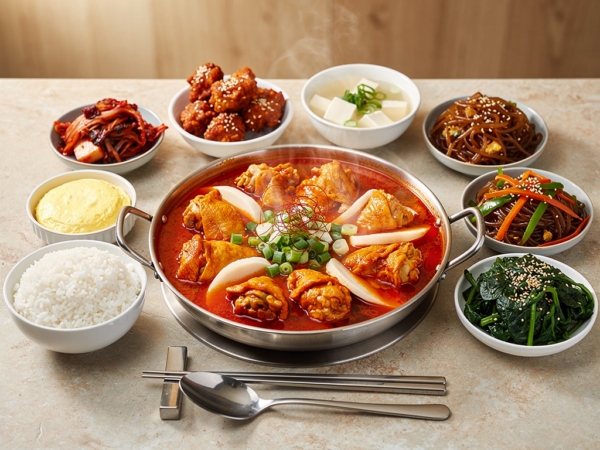
This is the real gap in korean food vs arabic food, and it is the one most people are not expecting. Korean menus build an entire course category around a bubbling communal pot set in the middle of the table — jjigae at AED 48 to 63 at Hanok, jeongol and hot pots from AED 78 to 158 across UAE Korean menus. It is not a starter and it is not a side. It is frequently the centre of the meal, and everyone eats from it directly.
Arabic menus in the UAE largely do not sell anything in that shape. Soup exists — Zaroob prices lentil soup at AED 23 — but it is a first course in an individual bowl, not a centrepiece. There is no Arabic equivalent of six people leaning into the same pan for forty minutes. Our jjigae vs harees comparison works through the closest match either cuisine offers.
The rice column diverges too, though less dramatically. Emirati machboos and kabsa are spiced and steamed together, so the flavour is in the rice — Arabian Tea House prices Machboos Deyay at AED 62 and Laham Machboos at AED 76. Korean bibimbap and dupbap assemble cold and hot components over plain rice at the last moment, so the flavour sits on it and you mix it yourself. Same staple, opposite philosophy, as our dupbap vs kabsa comparison sets out.
Fermentation, heat, and the surprise nobody warns you about
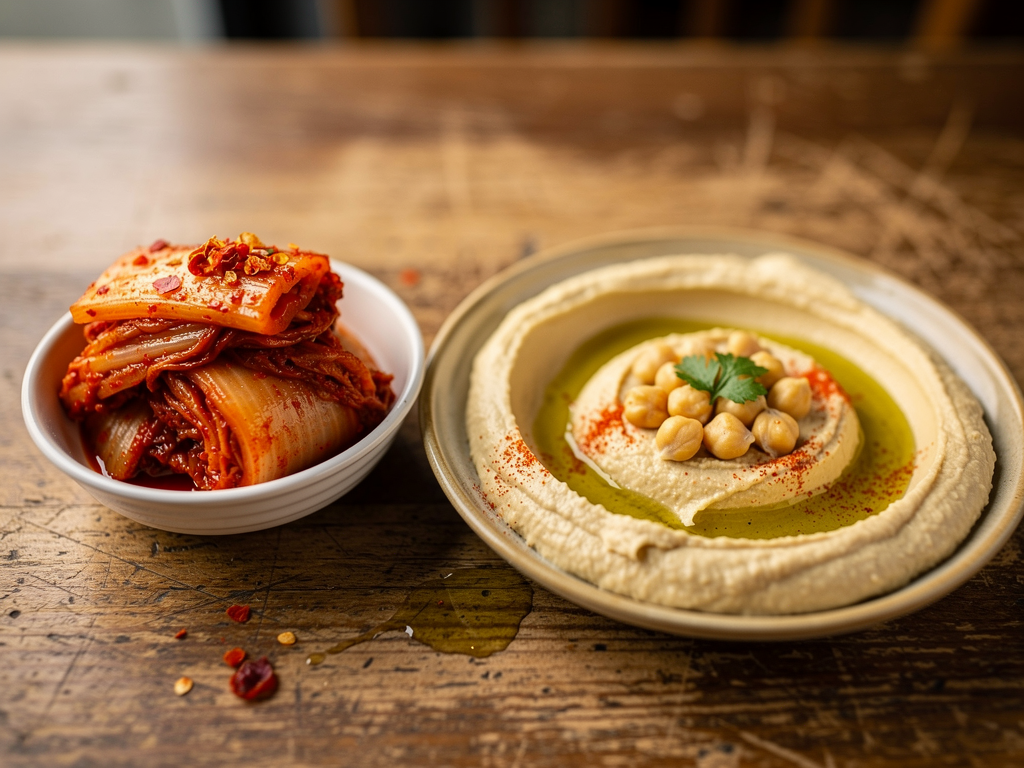
Both cuisines lean hard on fermentation; they just reach for different jars. Korean cooking runs on gochujang and doenjang — fermented chilli and soybean pastes that bring sourness and depth together. Arabic cooking gets to the same place through yoghurt, sumac, dried lime and pickles. The job is identical: cut the richness, keep the palate awake.
Heat is where first-timers get caught. Arabic food in the UAE is heavily spiced — cinnamon, cardamom, baharat, dried lime — but it is rarely chilli-hot. A large part of the Korean menu is built directly on chilli. If your reference point is Arabic food, the gochujang level in a jjigae or a plate of tteokbokki is the single most common surprise, and it is worth asking about before you order rather than after. The mild end of a Korean menu is genuinely mild — bulgogi, japchae, most of the BBQ — but the map is not the one you are used to reading.
The side dishes deserve their own note, because they are the clearest window into both cuisines. Mezze are chosen; banchan are given. That changes the psychology of the table as much as the bill — you curate an Arabic meal and you receive a Korean one. Our banchan vs mezze comparison is the deepest dive the portal has on that single contrast.
Bread against rice is the last structural split. An Arabic meal is anchored by flatbread used as a utensil — you scoop with it, you wrap with it, you use it instead of cutlery. A Korean meal is anchored by a bowl of short-grain rice eaten with a spoon, and bread appears essentially nowhere. Both cuisines then close on something cold and milky or soaked in syrup: luqaimat and kunafa on one side, bingsu on the other.
For wider background, both traditions are well documented — there is a good overview of Korean cuisine, one on Emirati cuisine, and a broader survey of Arab cuisine.
Is Korean food or Arabic food easier to eat halal in the UAE?
This is the one question where korean food vs arabic food is not a close contest, and it is worth being straight about it.
Arabic cuisine as served in the UAE is overwhelmingly halal by default. The question rarely comes up because it rarely needs to.
Korean cuisine is not halal by default in its home country. Pork is mainstream there — samgyeopsal is a national dish, jeyuk bokkeum is an everyday lunch, and the sausage in budae jjigae is the point of budae jjigae. Soju is a staple at the table. None of that transfers automatically, which means the halal question is a real one when you eat Korean in the UAE, and the answer varies venue by venue rather than cuisine-wide.
Mukbang Shows is 100% halal across all five branches: BBQ is beef and chicken only, there is no pork anywhere on the premises, and no alcohol is served. For every other venue named in this guide — Korean or Arabic — confirm directly rather than assuming, including whether a particular branch is licensed.
Where to eat each in the UAE
Mukbang Shows is the clearest place to see the per-person model in action, which is why it leads this list. Four unlimited tiers: Gangnam at AED 69 (value branches — Deira, Muroor Road, Electra Street) or AED 79 (premium — JBR, DWTC); Daegu at AED 89 / 99; Jeju at AED 99 / 109; and Bukchon Hanok at AED 129 flat everywhere. Each tier includes seven kinds of BBQ, eight banchan, two gimbap, soup and rice, with a two-person minimum and an AED 60 leftover charge. If you would rather compare like for like against an Arabic main, the à la carte side runs Bibimbap AED 53–62, Beef Dupbap AED 66, Soondubu Jjigae AED 59, Kimchi Jeongol AED 89 and Haemul Jeongol AED 99. Deira is on +971-4-886-4494.
The honest limitation: it sells no Arabic food at all — no hummus, no mezze, no machboos, no flatbread. If you want both cuisines at one table, this is not the answer. And for two people, Reem Al Bawadi’s AED 104 platter simply costs less than the AED 138 minimum here.
Arabian Tea House (Al Fahidi, plus Mercato Mall, Umm Suqeim, the Jumeirah Archaeological Site and Sharjah) is the best Emirati reference point in the country because it publishes a full price list rather than a sample. Harees AED 37, Machboos Deyay AED 62, Laham Machboos AED 76, Saloona AED 60–72, Mixed Barbeque AED 75. The Al Fahidi site is a heritage courtyard with no parking of its own, and timings are worth confirming during Ramadan.
Reem Al Bawadi (Marina Walk, plus Al Safa, Jumeirah 3, Downtown Dubai and Al Muteena) is the closest structural match to Korean BBQ — charcoal meat sold as a sharing platter. Hummus AED 20, Shish Tawook Plate AED 42, Meal For 2 mixed grill AED 104, steamed rice AED 18. Most of its grill and hot mezze sections carry no printed price on the ordering page, so ask before assuming.
Zaroob (DIFC / Sheikh Zayed Road) is the plate-by-plate model at its most legible, and the source of the AED 170 six-plate figure above. It is a delivery and walk-in operation rather than a long-sitting restaurant, and those are delivery list prices, read in early September 2026.
Operation Falafel (Downtown Dubai, Dubai Hills, Al Barsha 3, Silicon Oasis, Muhaisnah) is useful because it prints single and sharing prices side by side — hummus AED 27 alone or AED 45 for four, fattoush AED 29 or AED 56. That is the Arabic answer to the per-person question, and it shows the sharing discount is real but modest.
On the Korean side, The Korean Restaurant (Hanok) in International City is the à la carte benchmark: hot pots AED 80–110, jjigae AED 48–63, bibimbap AED 53–55, fried chicken AED 48. Its per-dish prices sit close to Arabian Tea House’s, which is the fairest single comparison in this guide — strip out the unlimited format and the two cuisines are not far apart at all. In Abu Dhabi, Manna Land in Al Nahyan carries the widest shared-pot list found anywhere in the UAE, with jeongol from AED 78 to 158 and every jjigae at a flat AED 58, and publishes its menu in English and Arabic.
So which should you pick tonight?
Count the people first. Two of you, and the Arabic grill platter is the better-value evening. Four or more with real appetites, and the unlimited Korean tier is hard to beat per head. If someone at the table dislikes chilli, Arabic food is the safer host. If someone wants to do something rather than be served, Korean BBQ is the one that gives them a job.
And if the question is which cuisine is better, the honest answer in korean food vs arabic food is that they are solving the same problem — how to feed a group of people from a shared table without anyone feeling short-changed — using two different economic models. The UAE is one of the few places on earth where you can test both properly in the same week. If you want the same treatment applied to a different matchup, our Korean food vs Japanese food guide is the sibling to this one.
FAQ
At what group size does Korean food become cheaper than Arabic food?
Around three people. Below that, an Arabic sharing platter usually costs less — Reem Al Bawadi’s Meal For 2 is AED 104 against a AED 138 minimum for two on Mukbang’s cheapest unlimited tier. Above three, the per-person model typically wins.
Are banchan really free?
At Mukbang Shows the eight banchan are included in every unlimited tier at no extra charge. Including the side dishes with the meal is standard practice in Korean sit-down restaurants generally, but confirm at any specific venue rather than assuming.
Do Korean restaurants in the UAE serve pork?
It varies by venue, which is exactly why it is worth asking. Mukbang Shows uses beef and chicken only and serves no pork at any branch. Confirm directly anywhere else.
What is the closest Arabic dish to Korean BBQ?
A charcoal mixed grill. Arabian Tea House’s Mixed Barbeque at AED 75 and Reem Al Bawadi’s Meal For 2 at AED 104 sit in the same format and price band as Korean BBQ tiers — the difference is that the Korean version is cooked at your table.
Which cuisine is spicier?
Korean, by a clear margin, because it uses chilli directly through gochujang and gochugaru. Arabic food is heavily spiced but rarely chilli-hot, so the heat is the most common surprise for diners crossing over.
Can you eat both cuisines at one table?
Not at Mukbang Shows, which sells Korean food only. Separate visits are the practical approach, and doing the Arabic meal first makes the free-banchan contrast obvious without any arithmetic.
Related guides
More from our Korean food guides across the UAE: