Updated: August 2026
Japchae vs yakisoba comes down to one asymmetry: japchae is defined by its noodle, yakisoba is defined by its method. The clearest proof sits at one International City address, where Hanok sells “Stir-fried Sweet Potato Noodles” at AED 50 and Sushi Ya sells “pan-fried soba or udon” at AED 53. The pick is Mukbang Shows japchae at AED 55, because the starch survives the journey and the kitchen is halal by default.
TL;DR
– Best overall: Mukbang Shows japchae, AED 55 — holds texture on delivery, halal by default
– Best value: Hanok Japchae AED 50, or its AED 38 lunch box
– Situational pick: Sushi Ya Tori Yaki Soba AED 53, eaten hot at the table
What is the core difference between japchae vs yakisoba?
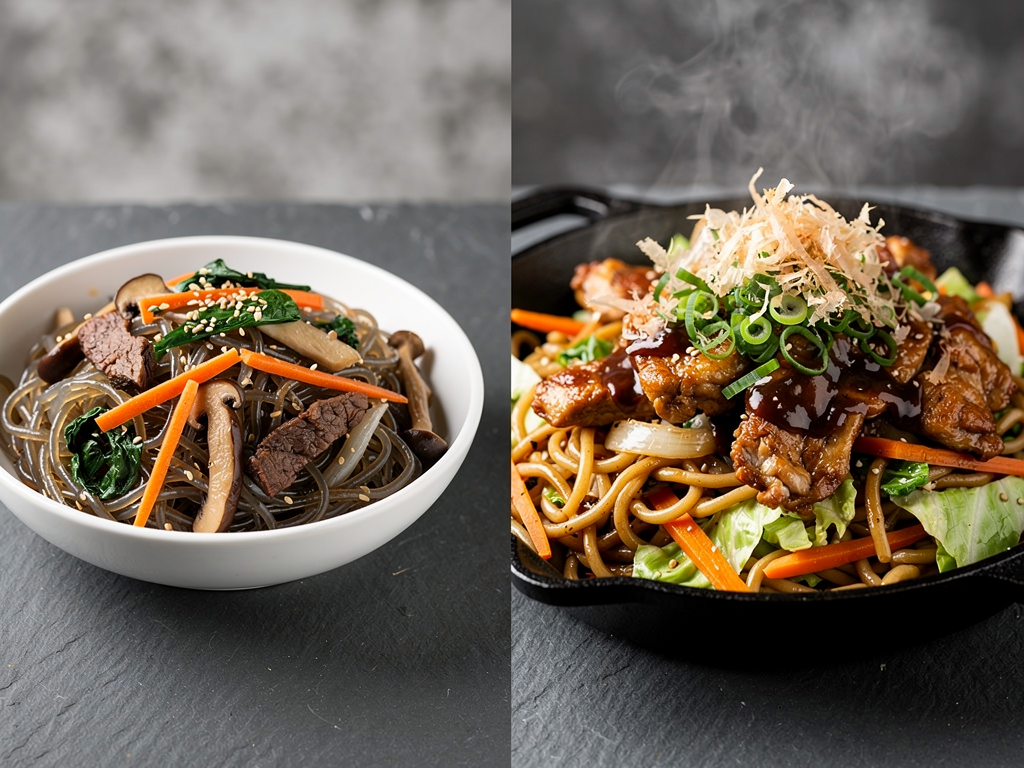
It is not a sauce or protein contest, it is a structural one. On one side the noodle is the dish. On the other the noodle is a choice you make at the counter.
Every Korean menu checked for this guide names the starch in print. Hanok The Korean Restaurant lists Japchae at AED 50 as “Stir-fried Sweet Potato Noodles and Vegetables”, in veg, chicken or beef. Mannaland lists Japchae at AED 58 as “Sweet potato noodles stir-fried”. Two independent kitchens, both naming the ingredient in the description itself. Swap that noodle and the dish stops being japchae.
Yakisoba works the other way, and the menus say so out loud. Sushi Ya, in International City, prints “Tori Yaki Soba/Udon AED 53 — PAN-FRIED SOBA OR UDON NOODLES WITH EGG, CHICKEN, AND VEGETABLES”, with the same slash on its Seafood Yaki Soba/Udon at AED 58. The noodle is a slash on the menu. Sumo Sushi & Bento lists its Yakisoba at AED 59 as “Stir-fried egg noodles with shrimp, chicken, and vegetables”, and prices a separate Yaki Udon at AED 56. Two independent operators, neither treating the noodle as the defining element.
That reframes the whole comparison. These look like the same dish on paper — stir-fried noodles, vegetables, a protein, AED 50 to AED 59 — but only one of them is locked to its starch. The other is defined by the sear and the sauce, and will happily be built on whatever noodle you point at.
One honest caveat, because the point overreaches easily. Soba does mean buckwheat, and real buckwheat soba is sold in the UAE — the same Sushi Ya menu lists Cha Soba, Zaru Soba and Kake Soba at AED 42 under its own noodle headings. Nobody is mislabelling anything. The narrow claim is that in yakisoba specifically, the noodle is not the point. We first ran into this pattern on our naengmyeon vs soba comparison.
Why does the noodle define japchae but not yakisoba?
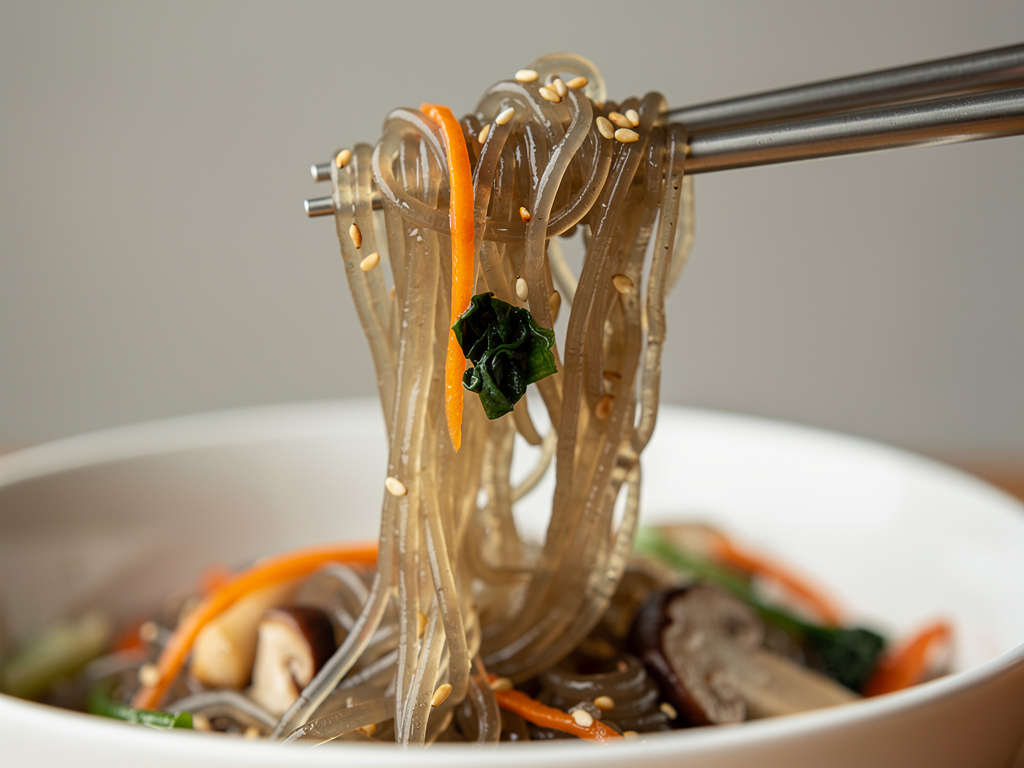
Because one dish is named after an ingredient and the other after an action. Japchae’s dangmyeon are made from sweet potato starch, and they behave unlike wheat: springy, slippery, distinctly bouncy, and — this is the important part — they stay that way as they cool.
Yaki means grilled or pan-fried. What makes yakisoba yakisoba is the hard sear on a flat top and the thick, dark, fruity-savoury sauce, which is closer in character to a Worcestershire-style sauce than to straight soy. Change the noodle and the kitchen charges the same price and calls it the same thing.
That asymmetry explains every other difference you will notice. Japchae arrives glossy and resilient. Yakisoba arrives coated and soft, and keeps softening. One is built to wait; the other is built to be eaten now.
It also changes how each one lands on a table. Japchae is a sharing dish in practice — it goes out in the middle, people take some alongside rice and whatever else has been ordered, and it is as happy after twenty minutes as it was at the start. That is why it turns up at Korean gatherings and in packed lunches, and why Hanok can sell it in a box at all.
Yakisoba is a single-plate main built around one hit of sauce and heat, portioned for one person and served the moment it leaves the flat top. Ordering three japchae for a table of six makes sense. Ordering three yakisoba for the same table means three people eating and three watching their food go soft.
There is a further clue in how Sushi Ya organises its own menu. Its yakisoba sits under a heading for pan-fried noodles, while its buckwheat dishes are filed separately under cold noodles and hot noodle soups, at AED 42 apiece. The kitchen itself is sorting by method and temperature rather than by grain — which is precisely the argument this page is making, written by the venue rather than by us.
How do texture and serving temperature compare?
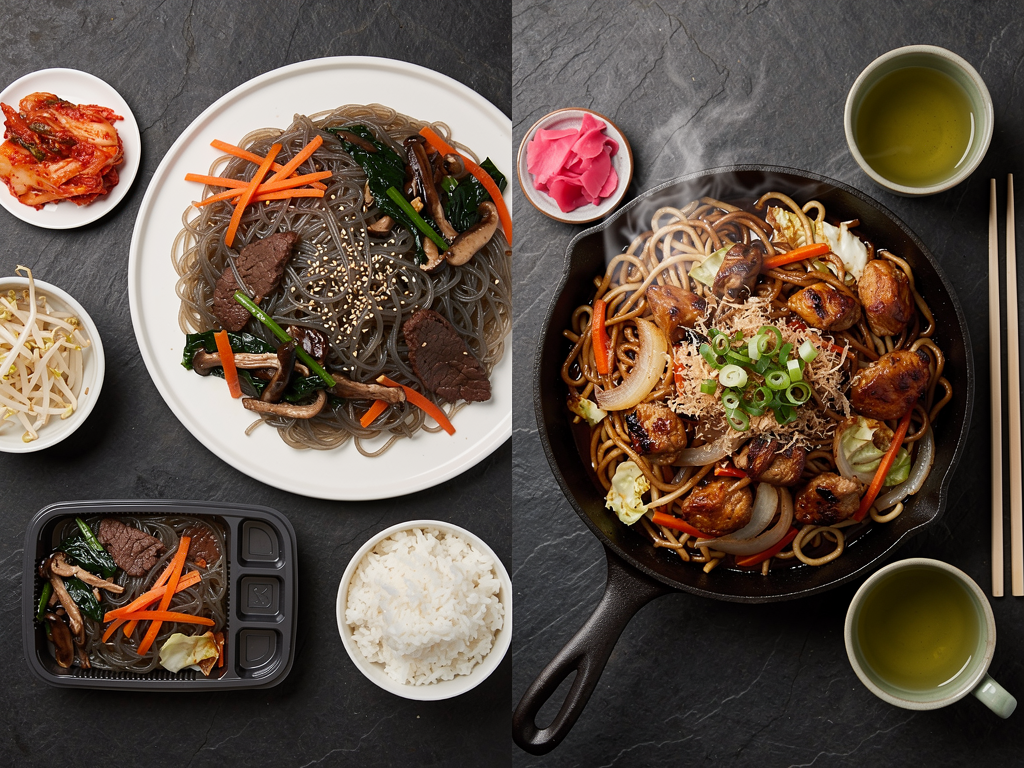
Japchae noodles turn grey-translucent when cooked, which is why English calls them glass noodles. They are tossed with julienned vegetables — spinach, carrot, onion, mushroom — and seasoned with soy and sesame oil. Beef is the classic protein, but the vegetarian version is standard rather than an afterthought, which is why Hanok prices veg, chicken and beef identically at AED 50.
The temperature point has first-party proof behind it. Japchae is routinely served warm or at room temperature in Korea, because starch noodles do not stiffen or go gluey as they cool. Hanok selling a Japchae Lunch Box at AED 38 is a menu telling you the same thing: nobody boxes a dish that has to be eaten hot.
Yakisoba’s wheat or egg noodles absorb that thick sauce continuously. It is meant to be eaten straight off the flat top while the sauce is still lively. Leave it sitting and the noodles keep drinking until they go slack. No venue in this research sells a cold or boxed yakisoba, and that absence is itself the answer.
Is japchae gluten-free?
No, and this is worth getting exactly right because most pages get it wrong. The japchae noodle is made from sweet potato starch and contains no wheat at all. The dish as served normally does, because it is seasoned with soy sauce and most soy sauce is brewed with wheat.
So if you are avoiding wheat, the thing to ask about is the soy sauce, not the noodle. Yakisoba is wheat on both counts — the noodle and the sauce. Do not treat japchae as a gluten-free order without checking the seasoning first.
Which is better for delivery in the UAE?
Japchae, clearly, and the reason is the starch rather than anyone’s cooking. Dangmyeon holds its bounce at room temperature, so a box that takes half an hour to arrive is still recognisably the dish it was meant to be. Mukbang Shows japchae at AED 55, Hanok’s AED 38 lunch box and Mannaland’s AED 58 plate all survive the trip.
Yakisoba suffers in a sealed container, because the wheat noodle keeps absorbing sauce all the way to your door and arrives softer and drier than it left. Sumo’s AED 59 version and Sushi Ya’s AED 53 to AED 58 plates are built for immediate eating. If you want yakisoba at its best, eat it where it was cooked. For how the other Korean noodle families behave, see our guide to Korean noodles in Dubai.
How do japchae vs yakisoba prices compare in the UAE?
They barely differ, which is why price should not decide this one. Japchae runs AED 50 to AED 58 and yakisoba AED 53 to AED 59. At the single address that sells both, the chicken versions are three dirhams apart.
| Venue | Area | Price AED | Halal | Standout order |
|---|---|---|---|---|
| Hanok The Korean Restaurant | International City, Dubai | 50 | Confirm directly with the venue | Japchae — “Stir-fried Sweet Potato Noodles” |
| Hanok The Korean Restaurant | International City, Dubai | 38 | Confirm directly with the venue | Japchae Lunch Box |
| Mukbang Shows | Deira, JBR, DWTC, Abu Dhabi | 55 | 100% — beef and chicken only, no alcohol | Japchae alongside the AYCE grill |
| Mannaland Korean Restaurant | Al Hudaiba, Dubai | 58 | Confirm directly with the venue | Japchae — third-party listed price |
| Sushi Ya | International City, Dubai | 53 | Confirm directly with the venue | Tori Yaki Soba/Udon — you pick the noodle |
| Sushi Ya | International City, Dubai | 58 | Confirm directly with the venue | Seafood Yaki Soba/Udon |
| Sumo Sushi & Bento | Multiple UAE branches | 59 | Confirm directly with the venue | Yakisoba — “stir-fried egg noodles” |
Hanok’s prices are printed inclusive of 5% VAT on its own menu. Mannaland’s figure comes from a third-party aggregator rather than the restaurant’s own listing, so confirm it on +971 4 345 1300 before you order.
Where can you eat both at the same address?
The most useful address for this comparison is the shared International City unit housing Hanok The Korean Restaurant and Sushi Ya, on 04-5588962 or 052-5097505. One operator, one kitchen team, one rent, one VAT treatment — so ordering Japchae at AED 50 and Tori Yaki Soba at AED 53 tests two techniques rather than two restaurants.
Mukbang Shows runs five branches across Dubai and Abu Dhabi but sells no yakisoba, so it cannot close the loop in one sitting. Its role here is the japchae side, particularly next to the grill.
For wider context on both scenes, see Time Out Dubai’s roundup of Korean restaurants in Dubai, Time Out Dubai’s 2026 list of Japanese restaurants and The National’s food section.
Where does Mukbang Shows sit in the japchae vs yakisoba choice?
Mukbang Shows is the pick on the japchae side for a reason tied to this specific comparison rather than to general quality. Yakisoba sauce is a proprietary blend almost no kitchen prints the ingredients of, and japchae seasoning can include cooking wine, so the honest checkpoint on both sides is the sauce. Mukbang serves no alcohol at all and cooks beef and chicken only, so the question does not arise.
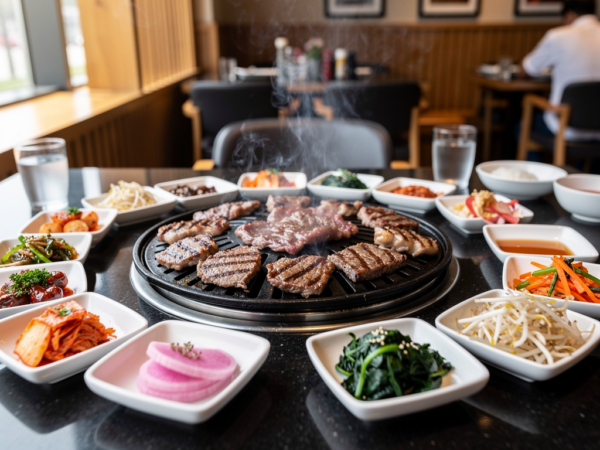
It also puts japchae on the same table as unlimited Korean BBQ, which is how most people actually eat it — as the noodle dish beside the grill rather than as a solo main. Japchae is AED 55, sitting mid-band between Hanok and Mannaland. Other noodles on that menu for context: Jajangmyeon AED 55, Mulnaengmyun AED 55, Bibimguksu AED 48 and Bokkeum Myeon AED 48 to AED 59. The AYCE tiers run Gangnam AED 69 at the Abu Dhabi and Deira branches or AED 79 at JBR and DWTC, up to Bukchon Hanok at AED 129 flat.
The honest limitation is range. Mukbang sells one japchae and that is the whole offer — no seafood version, no japchae-bap, and no boxed version like Hanok’s AED 38 lunch box. If you want japchae as a packed lunch rather than a dish at a table, Hanok is straightforwardly the better call. For branch-level detail see the best japchae in Dubai and the best japchae in Abu Dhabi.
Is japchae vs yakisoba halal in the UAE?
For both dishes the sauce is the thing to check, not the noodle. Yakisoba sauce is usually Worcestershire-style, and some formulations contain alcohol or anchovy, so ask what the blend is built from and ask about mirin separately. For japchae the noodles and vegetables are not the issue — ask whether cooking wine is used in the seasoning, and confirm the protein if you are ordering the beef version.
Mukbang Shows is 100% halal — beef and chicken only, no pork anywhere, no alcohol served — so neither question arises there. For every other venue on this page, confirm on the day: Hanok on 04-5588962 or 052-5097505, Mannaland on +971 4 345 1300. Neither Sushi Ya nor Sumo publishes a sauce breakdown on its online menu, so that one has to be a conversation.
Where to find japchae vs yakisoba by area
International City is the clearest cluster, since Hanok and Sushi Ya share a unit and you can order both within minutes. There is no metro station in International City, so plan on a taxi or a bus.
Mukbang Shows spreads the japchae option across the city. The Deira branch is on Al Ittihad Road in Port Saeed, on +971-4-886-4494. The JBR branch is at Plaza Level, Bahar 7 Unit P33 on The Walk, on +971-54-523-1898 — the Marina area is served by the Red Line and the Dubai Tram, though The Walk is a longer walk from the metro than the map suggests. The DWTC branch on Sheikh Zayed Road sits directly opposite the metro station, on +971-54-524-5904, making it the easiest of the five to reach without a car.
Mannaland is at Shop 5, Al Ketbi Building, Al Mina Road, Al Hudaiba — a short taxi from the Sheikh Zayed Road corridor rather than a walk from a station.
In Abu Dhabi, Mukbang Shows runs Muroor Road on +971-50-158-9433 and Electra Street on +971-2-564-0446, both in Al Danah, Zone 1. Abu Dhabi has no metro, so a taxi or a car is the only route. Sumo Sushi & Bento operates multiple branches across both cities.
Practical japchae vs yakisoba ordering tips
Decide on temperature first. If the food has to travel or wait, order japchae — the starch is forgiving. Yakisoba wants to be eaten immediately.
Run the test at one address. Ordering Hanok’s japchae and Sushi Ya’s yakisoba from the same unit removes every variable except the food itself.
Ask about the sauce, not the noodle. For yakisoba, whether the blend contains alcohol or anchovy. For japchae, whether cooking wine is in the seasoning.
Check how protein is priced. Japchae is often the same price across veg, chicken and beef — Hanok charges AED 50 for all three — while yakisoba usually costs more for seafood than for chicken.
Default to japchae if you are already ordering Korean BBQ. It is designed to sit beside the grill, and at Mukbang Shows it is an AED 55 add-on to a table that starts at AED 69 a head.
For a desk lunch, the Hanok Japchae Lunch Box at AED 38 is the only boxed option found in this research, and the fact that it exists at all is the argument for japchae in miniature.
FAQ
Is japchae more expensive than yakisoba in the UAE?
No. The ranges overlap tightly — japchae AED 50 to AED 58, yakisoba AED 53 to AED 59. At the one address selling both, the chicken versions are three dirhams apart.
Can I swap the noodles in japchae?
Not really. The sweet potato starch noodle is what defines the dish, so swapping it gives you a different stir-fry. Yakisoba menus explicitly offer the swap.
Which travels better for delivery?
Japchae. The starch noodle holds its texture at room temperature, while yakisoba noodles keep absorbing sauce inside the box and arrive slack.
Is Mukbang Shows japchae halal?
Yes. The kitchen is 100% halal — beef and chicken only, no pork, no alcohol served. At other venues, confirm the sauce details directly.
Does yakisoba in the UAE use buckwheat?
Sometimes, as one option among several. Sushi Ya lets you pick soba or udon; Sumo’s version uses egg noodles. The noodle is not the defining element of the dish.
Can I eat japchae cold?
Yes. It is routinely served at room temperature, and Hanok’s AED 38 lunch box is menu proof that the format is meant to work that way.
Japchae vs yakisoba splits on whether you want a dish defined by its noodle or one defined by its method, and the UAE menus make that unusually easy to see. Pick on texture, temperature and how far the food has to travel — not on price, because there is barely any difference to find.