Updated: July 2026
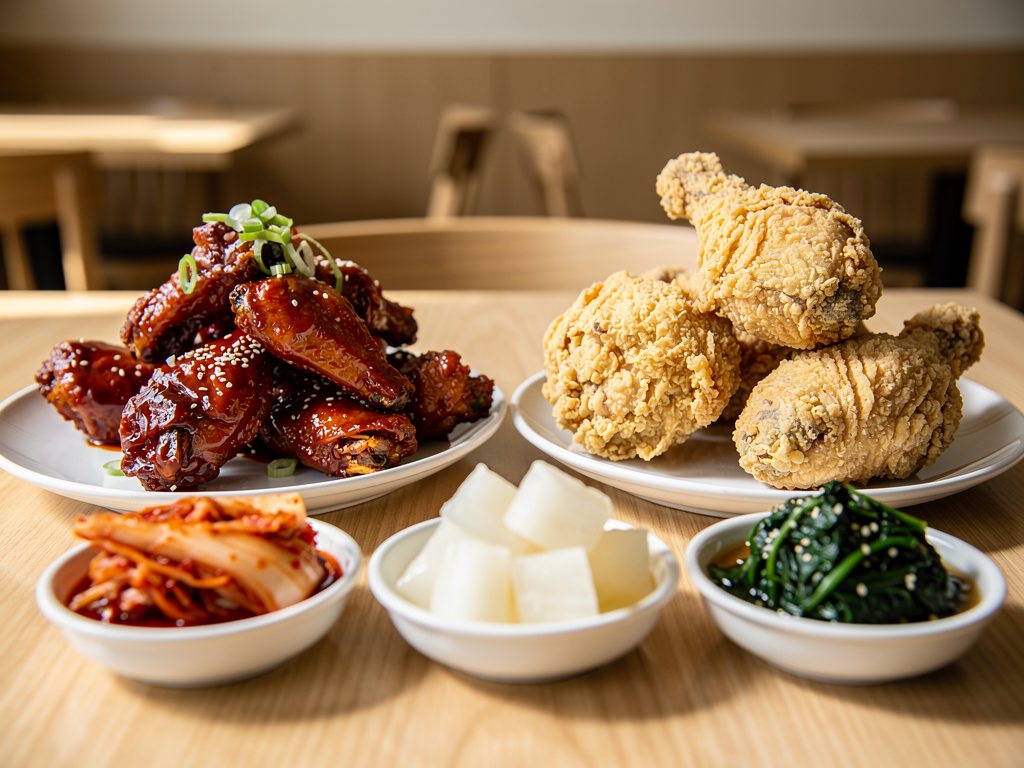
Korean fried chicken vs american fried chicken comes down to when the flavour goes on. American fried chicken is dredged in seasoned flour and fried once, so the taste lives inside a thick, craggy crust and it is eaten dry. Korean fried chicken is thinly coated in starch, fried twice, then glazed after frying — which is why the crunch survives a wet sauce.
The short version
– The double fry is the whole difference: it dries the crust so sauce can sit on it
– American wins on price, portability, leftovers and feeding a family
– Korean wins on texture under sauce, and only if you eat it fresh at the table
Korean fried chicken vs american fried chicken: what is the difference?
Two styles, two problems being solved. American fried chicken was engineered to be delicious dry, portable and cheap — which is exactly why it became the world’s fast food. Korean fried chicken was engineered to carry a sauce without going soft, which makes it a restaurant dish rather than a car dish.
Everything else follows from that. The flour dredge, the single fry and the bone-in pieces all serve the American goal. The starch coating, the double fry and the post-fry glaze all serve the Korean one. Neither is a worse version of the other, and on UAE delivery apps they sit side by side at roughly a 2:1 price gap with nothing explaining why.
What makes Korean fried chicken different: the double fry
The double fry is the entire technique. The first fry, at a lower temperature of around 160°C, cooks the meat through and renders fat and moisture out from under the skin. The chicken then rests for several minutes. The second fry, hotter at roughly 180–190°C, dehydrates the coating and sets it hard.
The coating matters as much as the frying. Korean kitchens use potato or corn starch, sometimes with a little flour, rather than a thick seasoned-flour dredge. That produces a thin, glassy shell instead of a craggy one — less surface area, less to go soggy.
Then the flavour goes on afterwards, as a glaze: yangnyeom built from gochujang, garlic, sugar and ketchup or corn syrup, or soy garlic, honey butter, or a dusting of cheese powder. That order of operations is the point. A double-fried starch crust is dry and hard enough that a wet sauce can sit on it for a surprisingly long time. A Southern buttermilk crust under the same sauce would be soft in minutes.
This is also where the price comes from. Two fries plus a rest takes far longer than one, sauces are made rather than bought in, and the portions are usually boneless. The background on Korean fried chicken covers the method in more detail.
What makes American fried chicken different
American fried chicken descends from West African frying traditions meeting Scottish methods in the American South, developed largely by Black cooks, and standardised into its current form by the twentieth-century chains.
The method: bone-in pieces brined or soaked in buttermilk, dredged in seasoned flour — the seasoning lives in that flour — and fried once until the crust is thick, craggy and golden. It is served dry, with the spice already built in, alongside biscuits, slaw, mash or fries.
Because the crust is thick and flour-based, it holds up. It is genuinely good cold, it reheats acceptably, and it survives a drive across Dubai in a paper bag. That is not a compromise; it is the design brief, and it is why the American style still owns the weeknight.
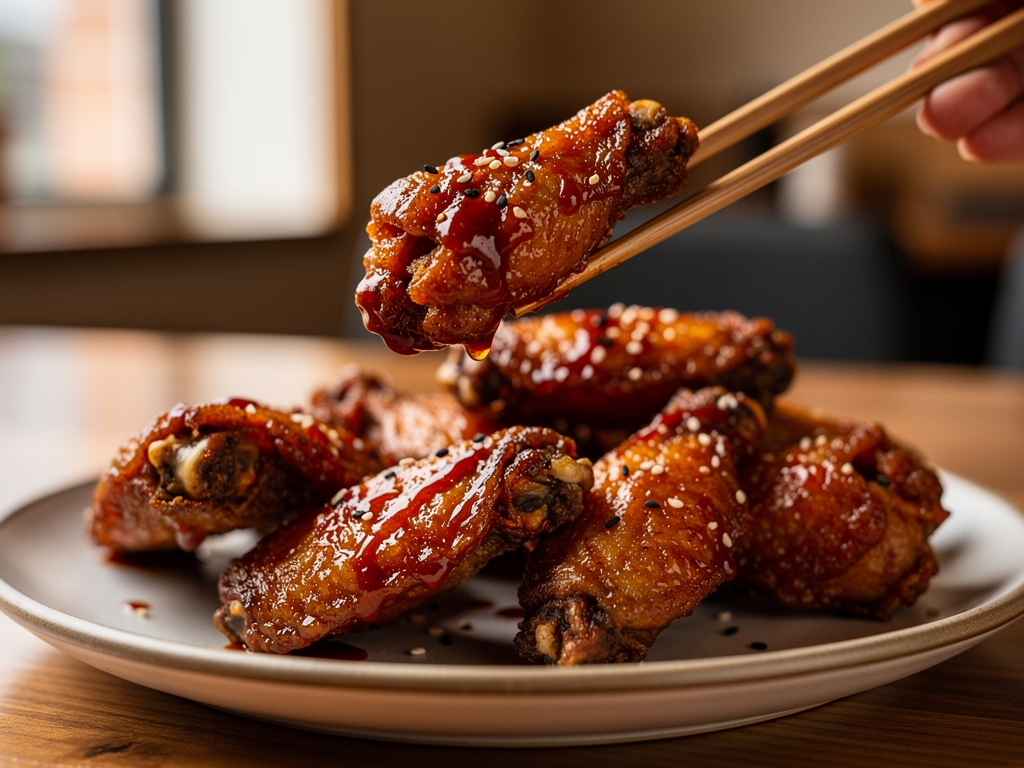
Korean fried chicken vs american fried chicken: the side-by-side comparison
| Aspect | Korean fried chicken | American fried chicken |
|---|---|---|
| Coating | Thin potato or corn starch | Thick seasoned flour dredge |
| Frying | Twice — low, rest, then high | Once |
| Where the flavour lives | In a glaze applied after frying | Inside the crust, before frying |
| Texture | Thin, glassy, brittle crunch | Thick, craggy, substantial crunch |
| Sauce | Essential — the dish is defined by it | None; served dry |
| Typical cut | Boneless pieces, wings, drumettes | Bone-in bird pieces |
| Served with | Pickled radish, chips, corn cheese | Biscuits, slaw, mash, fries |
| Delivery | Poor — best within minutes of the fryer | Excellent — built for it |
| Reheating | Never as good as fresh | Acceptable, especially in an air fryer |
| Typical UAE price | ~AED 45–95 a portion | Fast-food priced |
Which one is crispier?
Korean, under sauce — that is not really debatable, and it is the reason the double fry exists at all. A glazed piece of Korean fried chicken still audibly cracks several minutes after the sauce goes on.
Dry against dry, it is closer and more a matter of preference. American-style has a thicker, craggier, more substantial crunch in the first bite; Korean has a thinner, sharper, more brittle one. Craggy versus glassy. If your idea of great fried chicken is a heavy shattering crust with a lot of coating, the American style is not going to lose that comparison for you.
Which one is spicier?
Neither category is inherently hotter — they are hot in different places.
Korean yangnyeom is sweet-hot: gochujang, sugar and garlic, so the heat arrives late and sits behind the sweetness. It lingers. American hot chicken and the spicy chain variants put cayenne and pepper into the crust and the frying oil, so the heat is immediate, dry and front-loaded, then fades.
The practical difference is what cuts it. Korean fried chicken is traditionally eaten with pickled white radish, whose acidity resets the palate between bites. Coleslaw does a related job on the American side but is creamy rather than sharp, so it dulls rather than resets.
Which is better value in the UAE?
Honestly: the American chains, most of the time. A Korean fried chicken order runs roughly two to three times a fast-food chicken meal, and if the goal is feeding a family on a Tuesday, there is no argument to be made. Pretending otherwise would be nonsense.
What the extra money buys is real, though. The double fry is labour, the sauces are made in-house, and the portions are usually boneless — you are paying for meat rather than bone weight, which closes some of the apparent gap.
Where Korean genuinely wins on maths is inside an all-you-can-eat format. At Mukbang Shows the AYCE tiers start at AED 69, and the higher tiers include Korean fried chicken alongside the grill, which is a completely different calculation from buying a single portion.
Which one should you order?
Order Korean if: it is a shared table; you want sauce; you are eating it in the restaurant rather than at home; or you want something that is an event rather than a dinner. It is also the better order for anyone who finds the American crust too heavy.
Order American if: you want it cheap, fast, bone-in or portable; you want leftovers that are still good tomorrow; or you are feeding children who are not going to touch a gochujang glaze.
The single most useful rule: match the style to the journey. If the chicken has to travel, order American. If it only has to cross a room, order Korean.
Is Korean fried chicken halal in the UAE?
Usually the meat is not the question. Halal chicken is the default across the UAE, in both categories, which is part of why this is an unusually fair place to compare the two styles — the difference comes down to method and price rather than sourcing.
What is worth checking is the sauce and the venue. Glazes are made in-house and recipes vary, and some Korean rooms in the UAE sit inside licensed hotels. In Korea, fried chicken is traditionally eaten with beer — the pairing has its own name, chimaek — and in the alcohol-free halal rooms here that simply becomes chicken with soft drinks, mocktails and Korean tea.
Our guide to whether Korean food is halal covers the cuisine more broadly. Among the venues below, DAK states halal chicken on its delivery listings and Mashisoyo states on its own FAQ that it serves halal food; for the others, confirm at the specific branch.
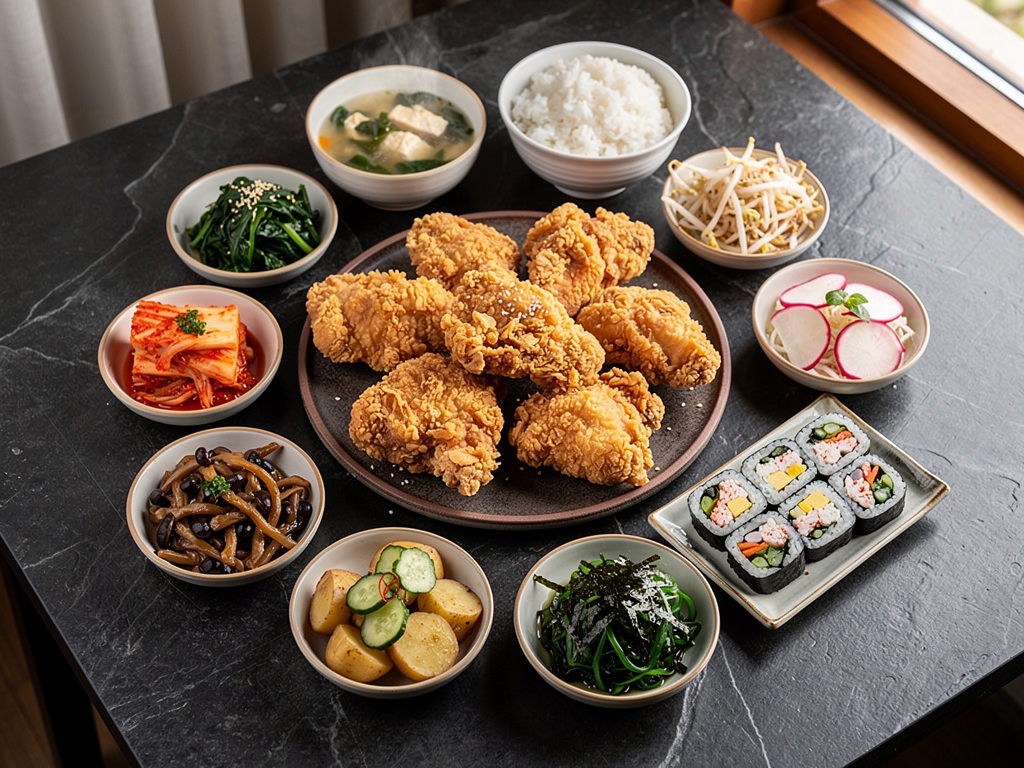
Where to eat Korean fried chicken in the UAE
Mukbang Shows is first here for a specific reason rather than a general one: its fried chicken sits on an all-you-can-eat Korean BBQ menu, so a table that cannot agree does not have to. Five builds, each in two sizes — plain Fried Chicken AED 82 sharing or AED 48 smaller, and Yangnyeom, Honey Soy, Garlic Mayo and Korean Cheese Chicken at AED 90 or AED 51. Chicken Tangsuyuk, the sweet-and-sour Korean-Chinese version, is AED 59.
The sides are Korean rather than American: Korean Corn Cheese AED 39, Tteokbokki AED 55, gimbap from AED 41. All-you-can-eat BBQ runs from AED 69 at Deira, Muroor and Electra (AED 79 at JBR and DWTC), and the higher tiers include the fried chicken. Everything is 100% halal, beef and chicken only, and all drinks are non-alcoholic.
Deira is on Al Ittihad Road in Port Saeed (+971-4-886-4494); the others are JBR on The Walk (+971-54-523-1898), Love Mukbang at DWTC opposite the World Trade Centre metro station (+971-54-524-5904), Muroor Road (+971-50-158-9433) and Electra Street (+971-2-564-0446) in Abu Dhabi. Prices are on the full menu.
The honest limitation: this is a Korean BBQ house that does fried chicken well, not a fried chicken specialist. The dedicated chains fry to order all day and that is the entire operation, so on a quiet weekday a specialist will out-crisp a grill house that is mid-service across forty tables. It is also a restaurant order rather than a fast one — not the place for a bucket in eight minutes. And Korean fried chicken does not survive delivery well anywhere, here included.
Kyochon is Korea’s best-known chicken chain and the benchmark in Dubai for the honey and soy-garlic glazes — the reference point if you want to taste what the method is supposed to deliver. Outlets are in Al Ghurair Centre on Al Rigga Road in Deira and in Mall of the Emirates. Mall-format, chicken only, no grill or stews; confirm halal status at the branch.
Nene Chicken is built around sauce choice, and its freak sauce and snowing cheese styles are the reason people go — the easiest place in Dubai to taste several glazes in one order. It is at Al Raha Building in Al Barsha, opposite CityMax Hotel, and in Food Central on Level 2 of City Centre Deira. Small counter-service outlets, and the sauce-forward styles divide people.
Mashisoyo in JLT is the cheapest sit-down way to eat Korean fried chicken as part of a full Korean meal rather than on its own, with tteokbokki, kimbap and BBQ on the same menu. Basement of JBC 1 Tower, Cluster G, roughly AED 50 per person, open until late.
DAK Korean Chicken on Al Reem Island is Abu Dhabi’s dedicated specialist and the clearest value pick in the capital at roughly AED 41–59 a dish, with halal chicken stated at source on its listings. Al Reem means a drive from most of the city, and it is chicken only.
Madang runs eleven fried chicken variants — the widest range in Abu Dhabi, and the place to go if comparing glazes is the actual point of the trip. Outlets at Holiday Inn Al Sa’adah and in Al Ghazal. It publishes no dish prices, and one outlet is inside a hotel, so confirm both pricing and licensing before booking.
KFC, Popeyes, Texas Chicken and Albaik are the American-style benchmark that almost everyone in the UAE already knows, with hundreds of outlets between them — seasoned-flour crust, single fry, bone-in, served dry, and built to be eaten in a car or reheated tomorrow. Albaik brings the Saudi broast style and its garlic sauce into the same category. They are not attempting what Korean fried chicken does; there is no sauced-and-still-crunchy option on those menus. Treat them as the value and convenience answer.
For rankings rather than a comparison, see our guides to the best Korean fried chicken in Dubai and in Abu Dhabi, or Time Out Dubai’s Korean restaurant list for a wider view.
Where Korean fried chicken came from
Korean fried chicken — called simply chikin (치킨) in Korea — is much younger than its American cousin. Fried chicken arrived with the American military presence after the Korean War, Korean chains developed the style through the 1970s and 1980s, and the sauced yangnyeom version is generally credited to the early 1980s.
It grew up as a social, late-night, delivered-to-the-door food, cut small for sharing with chopsticks, and served with pickled white radish called chicken-mu. That sharing format is why it reads as a restaurant dish here rather than a solo meal, and why it is priced as one. The Korea Tourism Organization’s food guide covers the wider context.
Ordering tips that actually help
Start with a small portion if you have never had it. At Mukbang Shows that is AED 48–51, which is enough to work out whether the style is for you before committing to a sharing platter.
Order the glaze you are curious about, not the safe one. Plain fried chicken is the version closest to what you already know, so ordering it first tends to leave people wondering what the fuss was about.
Eat it immediately. The double-fried crust is at its best in the first few minutes, and the glaze works against it from the moment it goes on. This is the single biggest reason people are disappointed by Korean fried chicken ordered to an office.
Have something sharp alongside it. Pickled radish, kimchi or anything acidic cuts the sugar in the glaze — without it, a full portion of yangnyeom gets cloying by the end.
For a group that cannot agree, order both styles. A Korean sharing platter and an American bucket on the same table settles the argument faster than any guide, this one included.
If you have a wheat allergy, ask about the glaze rather than the coating. Gochujang is commonly made with wheat or barley, even where the crust is pure starch.
FAQ
Why is Korean fried chicken more expensive than American fried chicken?
Two fries with a rest in between takes considerably longer than one, the glazes are made in-house rather than bought in, and the portions are usually boneless, so you are buying meat rather than bone weight. It is a restaurant dish priced like one.
Does Korean fried chicken really stay crispy under sauce?
Yes, for far longer than a flour-crusted piece would. The second high-temperature fry drives moisture out and sets a glassy starch shell that resists the glaze. It is not permanent — it is a matter of minutes, not hours — which is why it is best eaten where it is cooked.
Can I reheat Korean fried chicken the next day?
You can, but it never comes back to what it was. American fried chicken reheats far more successfully, and is genuinely good cold, which Korean is not.
Which is better for families with young children?
Usually the American chains — milder by default, bone-in and familiar, and a fraction of the price. A sweet glaze like honey soy is the gentler introduction if you do want to try the Korean style with kids.
Is Korean fried chicken halal in the UAE?
The chicken generally is, since halal is the default here. The variables are the glaze recipe and whether the venue is licensed, so those are the things to ask about rather than the meat.
What should I drink with it?
In Korea the pairing is beer, in a combination called chimaek. In the UAE’s halal Korean rooms it is soft drinks, mocktails, bubble tea or Korean tea — and something cold matters more than what it is, because the glaze builds heat.
Where can I compare both styles in one meal?
Any Korean restaurant with an American chain nearby will do it, and Deira makes that easy. Order a Korean sharing portion, add a small bucket from a chain, and taste them side by side while both are fresh.
Korean fried chicken vs american fried chicken is not really a contest — they are parallel answers to different evenings. One is sharing theatre that has to be eaten where it is made. The other is reliable, cheap and still good tomorrow. Knowing which evening you are having is the whole skill.
Related guides
More from our Korean food guides across the UAE: