Updated: August 2026
Korean fried chicken vs karaage comes down to when the flavour goes on. Karaage is marinated first and fried dry, so the seasoning sits inside the meat. Korean fried chicken is fried twice and glazed after, so the seasoning sits on the outside and the crust is engineered to survive sauce. In the UAE the real decision is portion size, not flavour.
TL;DR
– The one order that settles it: Kimura-ya, Business Bay — Karaage five pieces AED 40 and Korean Style Karaage five pieces AED 42, same kitchen, same portion
– Cheapest karaage: Yamanote Atelier, Abu Dhabi Mall — AED 28
– Best for a table: Mukbang Shows — half bird AED 48–51, whole AED 82–90, four glazes
– The rule of thumb: karaage is a plate for one, Korean fried chicken is a bird for a group
What is the real difference in Korean fried chicken vs karaage?
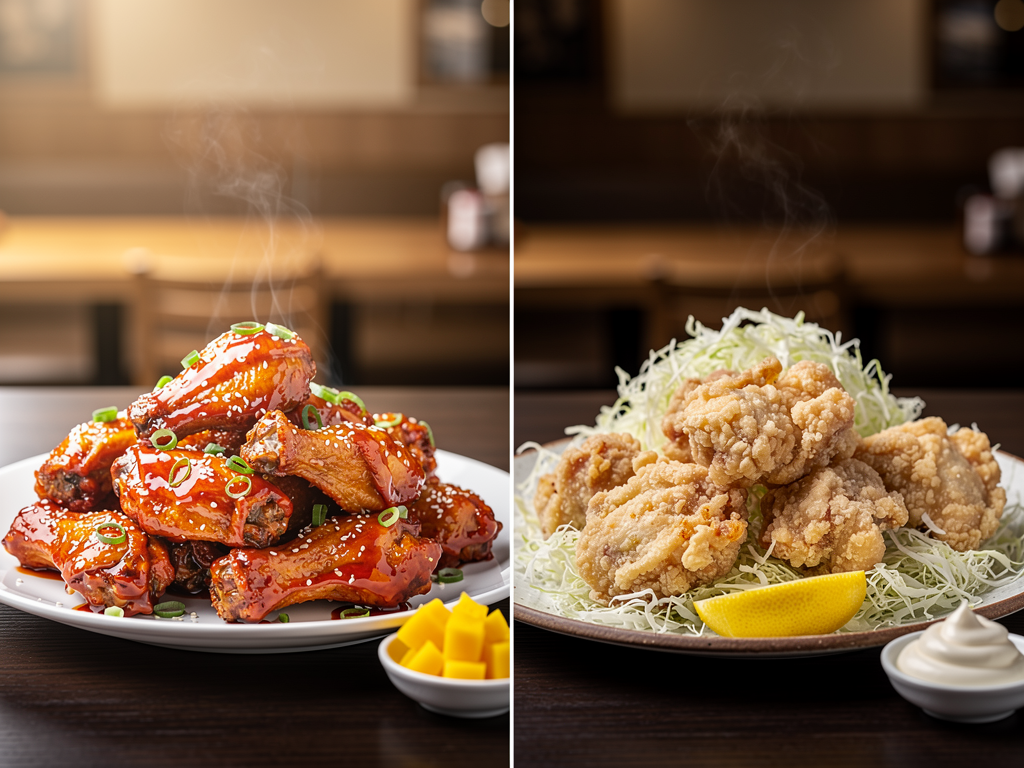
The order of operations. Karaage marinates chicken thigh in soy, ginger, garlic and usually sake or mirin, then dredges it in potato starch and fries it once. The flavour lives inside the meat and the crust is left deliberately dry so it shatters.
Korean fried chicken reverses that. The bird is fried, usually twice, and only then glazed — yangnyeom, honey soy, garlic mayo, cheese. The flavour lives on the outside, and the crust has one job: survive a wet coating without going soft.
That single reversal explains everything else people argue about. Karaage almost never arrives sauced, because a dry starch crust cannot hold a glaze. Korean fried chicken almost always does. Karaage comes with a lemon wedge and Japanese mayonnaise. Korean fried chicken comes with pickled radish to cut the sugar in the sauce.
It also explains the portions, which is the part that actually affects your evening. One dish was built as a snack for one person. The other was built as a bird for a table.
How do the crusts compare?
Potato starch fried once gives karaage a pale, craggy, matte shell. It is genuinely loud straight out of the fryer and then it quiets down over five to ten minutes as it takes on moisture from the meat and the air.
A proper Korean double-fry does something different on purpose. The first fry cooks the chicken through and starts drying the skin; the second, hotter fry drives the remaining moisture out and leaves a thin, almost translucent, glassy shell. That shell is the whole reason the dish can be drowned in sauce and still crunch twenty minutes later.
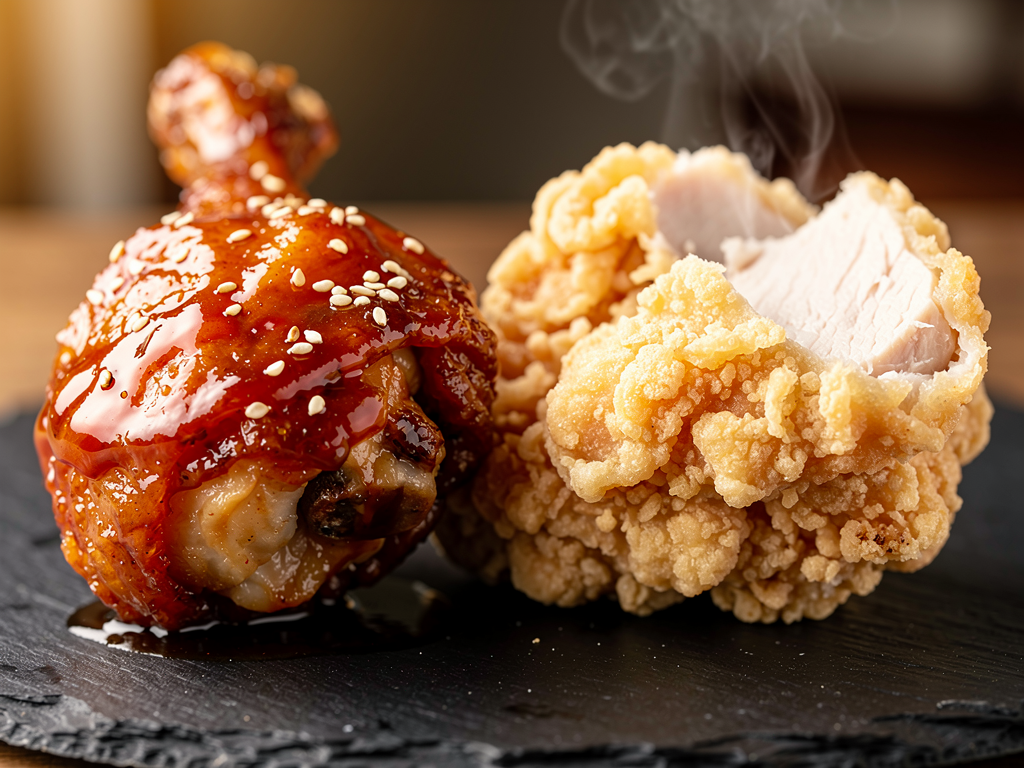
Which gives you a test you can run yourself, anywhere in the UAE. If sauced Korean fried chicken has gone soft five minutes after it lands, it was almost certainly fried once and then glazed — a sauced karaage with a Korean name on the menu.
The trade-off runs both ways, and neither side wins outright. Karaage’s longer marinade tends to produce a juicier interior. An overdone double-fry can leave Korean fried chicken drier inside. Both have serious defenders in Dubai and Abu Dhabi.
Which is better for solo meals and which for sharing?
Karaage for one, Korean fried chicken for a group, and the published UAE prices make the case cleanly.
Karaage is sold as a snack or a single-person meal: AED 28 to AED 43 for a plate of pieces, AED 49 to AED 60 once it becomes a bento or a rice bowl. There is no whole-bird karaage, because that is not what the format is for.
Korean fried chicken has individual boxes too — AED 33 at Kyochon buys five wings or seven boneless bites — but the format keeps scaling upward, to a half bird at AED 48 to AED 51 and a whole one at AED 82 to AED 115.
Priced per gram the two dishes sit closer together than people expect. The gap in the headline numbers exists because one of them keeps going up into table-sharing sizes. So the honest framing of Korean fried chicken vs karaage is not which tastes better — it is whether you are eating alone at lunch or splitting something at dinner.
Where can you taste both in one order?
Kimura-ya in Business Bay, and it is the single most useful address in this comparison. Its menu lists Karaage (Original or Spicy), five pieces, AED 40, described as Japanese-style fried chicken. Directly alongside sits Korean Style Karaage, five pieces, AED 42, described as chicken bites with a Korean twist.
Same kitchen, same portion count, two dirhams apart. Order both, put them on the table together, and check the crust at five minutes and again at twenty. That is a better answer than any argument online.
The same menu runs a Karaage Bento at AED 49 with potato salad and Japanese rice, a tartar-sauce version at AED 49, and a Karaage Mayo rice ball at AED 27.
The honest caveat: this is a Japanese kitchen’s read on the Korean style, not a dedicated double-fry operation, and it is delivery-first rather than a dining room. Prices are Deliveroo listings and generally sit above dine-in.
What does the Korean side look like at Mukbang Shows?
Textbook fry-then-glaze, with a price list that happens to prove the point. Plain Fried Chicken is AED 48 for a half bird and AED 82 for a whole. The four glazed versions — Yangnyeom, Honey Soy, Garlic Mayo and Korean Cheese Chicken — are AED 51 half and AED 90 whole.
That AED 3 difference on a half bird is the clearest published illustration in the UAE of the argument this article is making. The sauce is a separate, later step, and it is priced as one.
It is the widest published Korean fried chicken list in this comparison, across five branches in Dubai and Abu Dhabi, on a menu that also carries unlimited Korean BBQ from AED 69. Everything is 100% halal, beef and chicken only, with no alcohol on the premises. The Deira branch on Al Ittihad Rd is +971-4-886-4494.
The honest limitation is straightforward: Mukbang only plays on one side of this comparison. There is no karaage on the menu and there is not going to be. If the marinated Japanese style is what you want, go to a Japanese kitchen. See also our guides to the best Korean fried chicken in Dubai and the best Korean fried chicken in Abu Dhabi.
How do other UAE kitchens price karaage?
Keisyo in Al Karama prices its Chicken Karaage at AED 43 and describes it on the menu as soy-marinated fried chicken thigh pieces — the marinade-first principle, printed in a UAE restaurant’s own words.
Its range shows how karaage is sold here as a meal rather than a side: Karaage Don AED 55 over rice, Karaage Bento AED 60 with rice, potato salad, kimchi and miso soup, and a sweet-sour tartar version from AED 45 to AED 65 depending on format. Karama parking is tight, and these are delivery prices.
Yamanote Atelier at Abu Dhabi Mall has the cheapest verified karaage in this comparison at AED 28. It is a bakery-café rather than an izakaya, the plate is sized for one person, and at that price it competes with a sandwich rather than with dinner. Read AED 28 as a snack benchmark, not the definitive version. No Korean fried chicken on its menu.
Kyochon runs counters at Deira City Centre, Mall of the Emirates and First Avenue Mall in Motor City. Individual boxes all land at AED 33 — five wings, three drumsticks, four mixed pieces or seven boneless bites, each with one signature flavour of your choosing. Scale up and it is AED 48 for a Mega Box, AED 59 to AED 63 for doubles, AED 115 for a whole chicken meal or twelve drumsticks with three sides. Note the structure: the flavour is a choice applied after frying. It is a food-court counter, not a restaurant.
What do Korean fried chicken and karaage cost in the UAE?
| Venue | Area | Price AED | Halal | Standout order |
|---|---|---|---|---|
| Yamanote Atelier | Abu Dhabi Mall, Al Zahiyah | 28 | Confirm directly | Chicken Karaage plate |
| Kyochon | Deira City Centre & other malls | 33–115 | Confirm directly | AED 33 individual box, one glaze |
| Kimura-ya | Business Bay, Dubai | 27–49 | Confirm directly | Karaage AED 40 vs Korean Style AED 42 |
| Keisyo | Al Karama, Dubai | 43–65 | Confirm directly | Karaage Bento AED 60 |
| Mukbang Shows | 5 branches, Dubai & Abu Dhabi | 48–90 | 100% halal (beef & chicken only) | Half Yangnyeom AED 51 |
All figures checked 9 August 2026 on Deliveroo listings, which generally run above dine-in prices. Halal status at venues other than Mukbang Shows should be confirmed directly, and the marinade and glaze are the components worth asking about.
Is Korean fried chicken halal in the UAE, and is karaage?
Both dishes are chicken, so the meat is rarely the question. The components worth asking about are the marinade and the glaze.
For karaage, canonical recipes call for sake or mirin in the marinade, so that is the specific thing to ask about. For Korean fried chicken, some canonical yangnyeom glazes include rice wine, so ask what the glaze is built on. Neither question is an accusation — plenty of kitchens make both dishes without either ingredient.
Mukbang Shows removes the question entirely: 100% halal, beef and chicken only, no alcohol anywhere on the premises. For every other venue on this page, confirm directly, and be aware that licensed venues serve alcohol.
What is Korean fried chicken (양념치킨)?
A twice-fried style built around a crust that can take a thick glaze. The bird is cut into pieces, seasoned simply, fried at a lower temperature to cook through, then fried again hotter to drive out the remaining moisture. That second fry produces the thin, glassy shell the dish is known for.
The sauce goes on afterwards. Yangnyeom is the gochujang-based sweet-heat classic; honey soy is stickier and more savoury; garlic mayo and cheese versions add richness. Pickled radish cubes are the standard partner, and they are there to cut through the sugar.
The style emerged in South Korea through the 1970s and 1980s as fried chicken shops multiplied and competed on sauces, and the double-fry plus post-fry glaze became the standard method. In the UAE it shows up as half and whole birds and as smaller individual boxes.
Portion scale is the practical thing to know. A half bird at AED 48 to AED 51 feeds one hungry adult or two lighter eaters with sides. A whole bird at AED 82 to AED 90 comfortably covers three or four. That is why it is rarely marketed as a solo lunch. The style also differs from American fried chicken, which usually seasons the coating and serves it dry — covered in our guide to Korean fried chicken vs American.
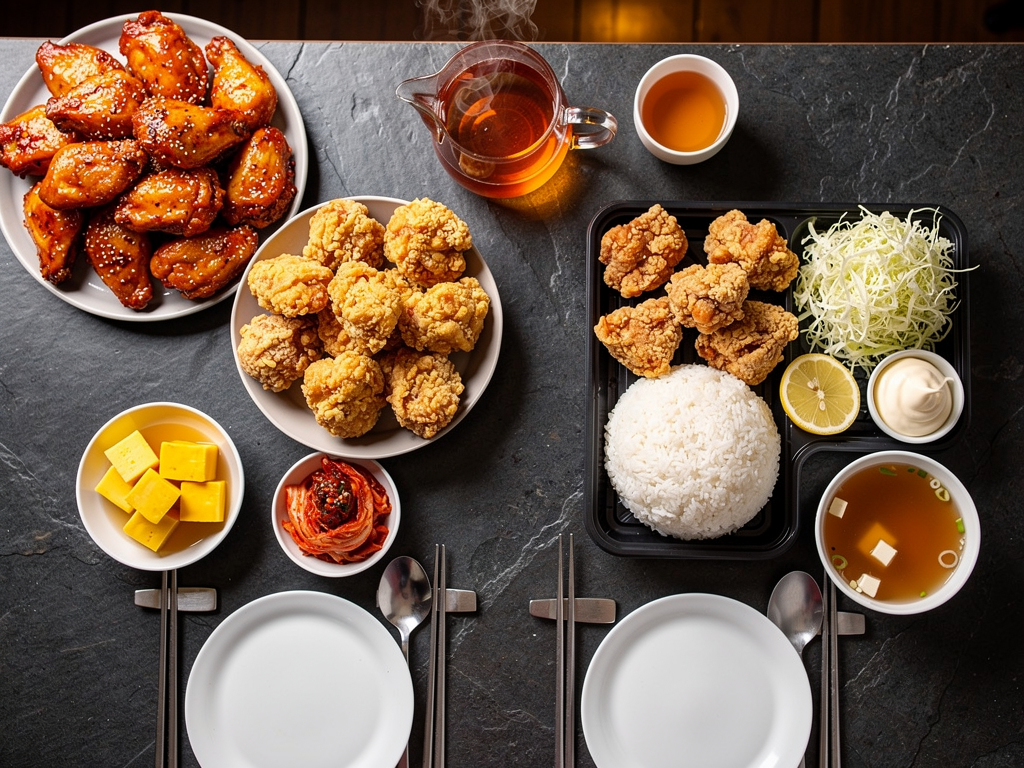
What is karaage (からあげ)?
Japanese fried chicken that begins with a marinade. Thigh meat is cut into bite-size pieces and steeped in soy sauce, ginger, garlic and often sake or mirin, then dredged in potato starch and deep-fried once.
The result is juicy meat carrying flavour all the way through, under a pale, craggy crust. It is served with a lemon wedge and Japanese mayonnaise, and it is almost never glazed — potato starch simply does not hold sauce the way a Korean double-fried shell does, and it does not need to, because the seasoning is already inside.
In the UAE it appears as plates of five pieces from AED 28 to AED 43, or as a complete meal in a bento or rice bowl from AED 49 to AED 60. Keisyo’s “soy-marinated” menu wording is the clearest printed example of the technique in the local market.
That marinade-first logic is also why it works so well as a solo meal. One plate with rice, or one bento, feeds one person without leftovers. The downside against Korean fried chicken is that the crust softens faster once you start eating, so it rewards being eaten promptly.
Where do you find each style by area in the UAE?
The Korean side clusters where groups eat. Mukbang Shows sits on Al Ittihad Rd in Port Saeed, Deira, with further branches at JBR on The Walk and at DWTC on Sheikh Zayed Road, opposite World Trade Centre metro station — the easiest of the three to reach without a car.
In Abu Dhabi, the Muroor Road and Electra Street branches both sit in Al Danah, Zone 1, near the city centre. Kyochon covers the mall trade at Deira City Centre, Mall of the Emirates and Motor City, which suits shoppers who want speed over a table.
Karaage is more scattered and lives in everyday lunch neighbourhoods. Business Bay has Kimura-ya, where the whole comparison can be run inside a single order, and Business Bay metro station is close by. Al Karama has Keisyo and its full range of karaage formats.
Abu Dhabi Mall in Al Zahiyah has Yamanote Atelier and its AED 28 plate, which happens to sit on the same side of the capital as the Electra Street Mukbang branch — so an Abu Dhabi resident can genuinely test both sides of this comparison in one day without a long drive.
The geography reflects the dishes. Japanese kitchens in Business Bay and Karama lean toward compact bento presentation with rice, cabbage and miso. Korean venues in Deira and on Sheikh Zayed Road lean toward loud shared meals with a grill nearby. Solo diners drift to one; groups drift to the other.
How should you order Korean fried chicken vs karaage?
Run the side-by-side test if you want to settle it properly. Order the AED 40 karaage and the AED 42 Korean-style plate at Kimura-ya together, then check the crust at five, ten and twenty minutes. It costs AED 82 and removes the guesswork permanently.
Ask about the marinade for karaage and the glaze base for Korean fried chicken if halal compliance matters to you. Mukbang Shows takes the question off the table entirely.
Pick by group size, not by preference. A AED 28 to AED 43 plate or a AED 55 don feeds one cleanly. A AED 82 to AED 90 whole bird plus sides feeds three or four. Mixing both in one meal works fine when one person wants the Japanese style.
Eat karaage immediately. The potato-starch crust fades fast, so it is the worse candidate for a long delivery. Korean fried chicken holds up better in a bag precisely because of the double-fry.
Keep the sides with their own dish. Lemon and mayonnaise belong with karaage; pickled radish and banchan belong with Korean fried chicken. They are not interchangeable.
Do not judge either style on one bad delivery. Crust quality drops after about half an hour in transit, so dine-in or immediate takeaway is the only fair test. For venue context, see Time Out Dubai on Japanese restaurants in the city and its roundup of Korean restaurants in Dubai.
FAQ
Is karaage just Japanese fried chicken?
Yes, but the marinade-first method and the potato-starch coating set it apart from most other styles. It is not glazed the way Korean fried chicken is.
Which is spicier?
Depends entirely on the glaze. Yangnyeom carries real gochujang heat; a spicy karaage is usually milder because the heat is in the marinade rather than a sauce.
Can I order both in one meal?
Yes. Kimura-ya in Business Bay lists both five-piece plates on the same menu at AED 40 and AED 42.
Which is cheaper?
A karaage plate at AED 28 to AED 43 undercuts most single Korean orders, though Kyochon’s AED 33 boxes are competitive and whole-bird pricing drops the per-piece cost when shared.
Does delivery ruin the crunch?
Karaage suffers more. The glassy Korean double-fried shell survives transit better, even under sauce.
Is one healthier than the other?
Both are deep-fried. The difference in oil absorption is small enough not to base a decision on.
Korean fried chicken vs karaage is really a question about the size of your meal and when you want the flavour delivered. Run the two-plate test at Kimura-ya once, and you will know which side you are on for good.
Related guides
More from our Korean food guides across the UAE: