Updated: July 2026
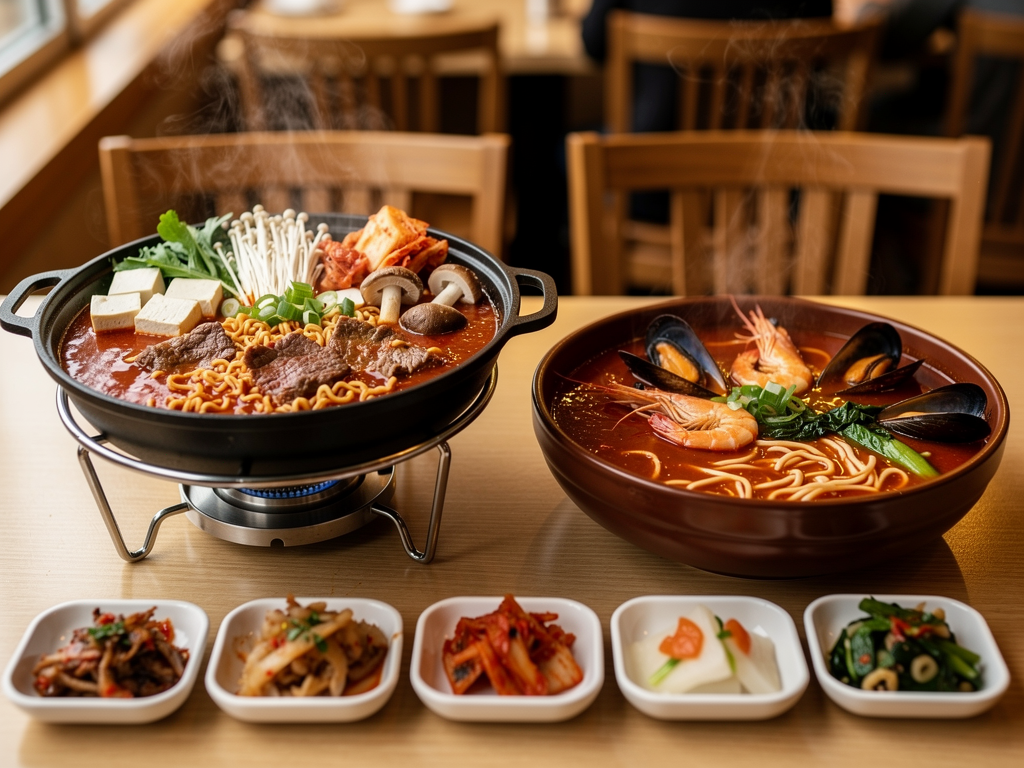
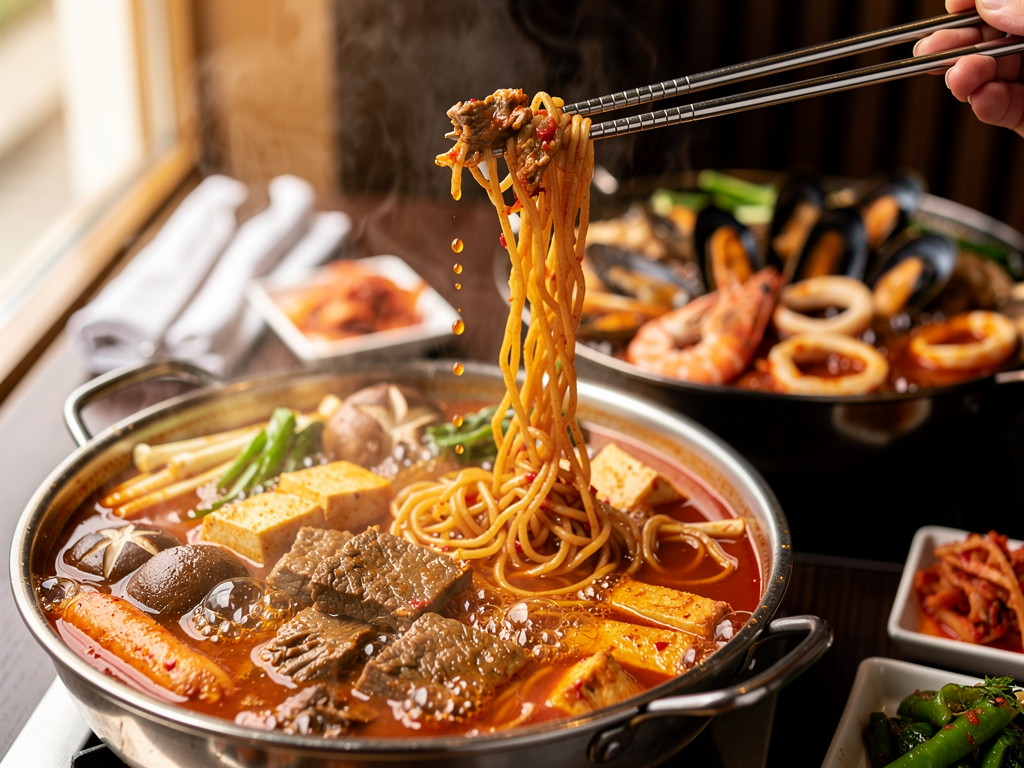
Budae jjigae vs jjampong is meat stew versus seafood noodle soup. Budae jjigae is a communal pot of gochujang broth loaded with meat, tofu, kimchi and ramyeon noodles, cooked in front of you on a burner. Jjampong is a single deep bowl of wheat noodles in a fiery seafood broth, built in a searing wok and served ready to eat.
The short version
– Budae jjigae is a shared project; jjampong is one person’s meal
– Jjampong hits sharper up front; budae jjigae builds heat as the pot reduces
– Both headline at AED 99 at Mukbang Shows, which flips the value maths on group size
Budae jjigae vs jjampong: what is the difference?
Budae jjigae vs jjampong is the difference between a stew and a soup, and between meat and seafood. Budae jjigae arrives raw or half-built on a portable burner and cooks at your table for ten to fifteen minutes while everyone serves themselves. Jjampong arrives finished, in a bowl, and it is yours.
They look similar on a menu — both are red, both are spicy, both cost around AED 99 in the UAE — and that is where most of the confusion comes from. Underneath, they are not even from the same culinary tradition. Budae jjigae is Korean, born in the 1950s. Jjampong is Korean-Chinese, and considerably older.
What is budae jjigae?
Budae jjigae (부대찌개) means “army base stew”. It came out of post-war scarcity: after the Korean War, surplus processed meat from US army bases around Uijeongbu — spam, hot dogs, ham, bacon — was cooked into a Korean gochujang and kimchi broth. What began as making do became a national comfort food, and Uijeongbu still has a street of specialists dedicated to it.
The standard build is kimchi, gochujang and chilli flakes in stock, plus tofu, onion, spring onion and mushrooms, with a slice of processed cheese melted on top and a block of instant ramyeon noodles added near the end. It is served on a burner because it is meant to be cooked communally and eaten slowly, which is why it functions as a group dish rather than a plate of food.
The heat profile is worth understanding before you order. Gochujang is a fermented paste with sugar in it, so the spice arrives deep and slightly sweet rather than sharp. But the pot keeps reducing on the burner while you eat, and the last bowl out of it is meaningfully hotter than the first.
There is fuller background on the Wikipedia page for budae-jjigae, and our guide to where to eat budae jjigae in Dubai covers the venues.
What is jjampong?
Jjampong (짬뽕) is Korean-Chinese rather than Korean-Korean. It descends from the cooking of Chinese migrants in Incheon’s Chinatown from the late nineteenth century, with the Japanese dish champon as a related ancestor, and it became the fiery red bowl Koreans know through twentieth-century adaptation.
The technique is what defines it. Chilli oil and gochugaru are bloomed in a searing wok, then squid, prawns, mussels, cabbage, onion and carrot are flashed in that heat before the stock goes in. That produces the smoky note Koreans call bul-mat — literally “fire taste” — and it is the single thing that separates a good jjampong from a mediocre one. Wheat noodles go in the bowl and the broth goes over.
Its heat is chilli-oil heat: immediate, sharp, at the back of the throat, and it fades as the broth cools. Its permanent menu partner is jjajangmyeon, the black bean noodle dish, and jjamjjamyeon — half and half in one bowl — exists because people cannot choose between them.
See the Wikipedia entry on jjamppong for the history, or our full explainer on what jjampong is.
Budae jjigae vs jjampong: the side-by-side comparison
| Aspect | Budae jjigae | Jjampong |
|---|---|---|
| Category | Jjigae — a stew | Korean-Chinese noodle soup |
| Origin | Uijeongbu, South Korea, 1950s | Incheon Chinatown, late 1800s |
| Main protein | Meat — in the UAE, beef and chicken | Seafood — squid, prawns, mussels |
| Broth base | Fermented gochujang and kimchi | Chilli oil bloomed in a wok, seafood stock |
| Noodles | Instant ramyeon, added near the end | Cooked wheat noodles, in the bowl |
| How it is served | Communal pot on a tabletop burner | One deep bowl per person |
| Time at the table | Cooks for 10–15 minutes in front of you | Arrives ready |
| Spice character | Deep and sweet-hot, builds as it reduces | Sharp and immediate, fades as it cools |
| Feeds | Two to four sharing | One |
| Typical UAE price | AED 75–120 for a sharing pot | AED 45–75 a bowl |
Which one is spicier?
Jjampong is usually the sharper of the two on first contact, because its heat comes from chilli oil bloomed in a hot wok and from raw chilli flakes. It hits the throat immediately.
Budae jjigae is deeper and rounder. Gochujang is fermented and contains sugar, and the tofu, cheese and noodles in the pot blunt the edge further. It reads as less aggressive in the first bowl.
The reversal is the part worth knowing: budae jjigae sits on a live burner throughout the meal, so the broth reduces and concentrates while you eat. By the end of the pot it is often hotter than the jjampong was. Jjampong does the opposite — it is at its fiercest when it lands and mellows as it cools. Neither dish is mild, and neither is a good choice for someone who genuinely dislikes chilli.
Which one is better for a group?
Budae jjigae, without much argument. It is designed as a shared table pot: one burner, one centre of gravity, everyone helping themselves, and it stretches with a bowl of rice. One sharing pot plus rice handles three adults comfortably.
Jjampong is a single bowl by design. Ordering four jjampongs is not a shared meal — it is four people eating separately at the same table, and there is no centrepiece. If your table wants something to gather around, the stew is the order. If everyone wants their own thing and wants it quickly, the bowls are.
Which one is safer if you are avoiding pork?
Budae jjigae is the riskier of the two by default, and it is worth being blunt about why: the canonical recipe is built on spam, ham, hot dogs and bacon. Those are all pork, and they are not garnish — they are the identity of the dish in Korea. Any halal version has to rebuild it.
Jjampong is naturally pork-free in its headline ingredients, because it is a seafood dish. The things to ask about are the broth and the accompaniments, since pork stock and pork-filled dumplings appear routinely in Korean-Chinese kitchens. The squid and the prawns are never the issue.
Our guide to whether Korean food is halal works through the whole cuisine, including which dishes need a question asked and which do not.
Which should you order?
Order budae jjigae if: you are three or more; you want a long, slow, interactive dinner rather than a fast one; you like the comfort-food register of melted cheese, noodles and broth; or you want one dish to be the event rather than one of several.
Order jjampong if: you are eating alone or as a pair; you want seafood; you want food quickly; you want the broth-and-noodle hit without the project; or you are ordering across a mixed table where everyone wants something different.
At Mukbang Shows both headline at AED 99, which makes the maths unusually clean: for a group, the stew is the cheaper meal per head, and for one or two people, jjampong is — especially at the smaller AED 60 size.
Where to eat budae jjigae and jjampong in the UAE
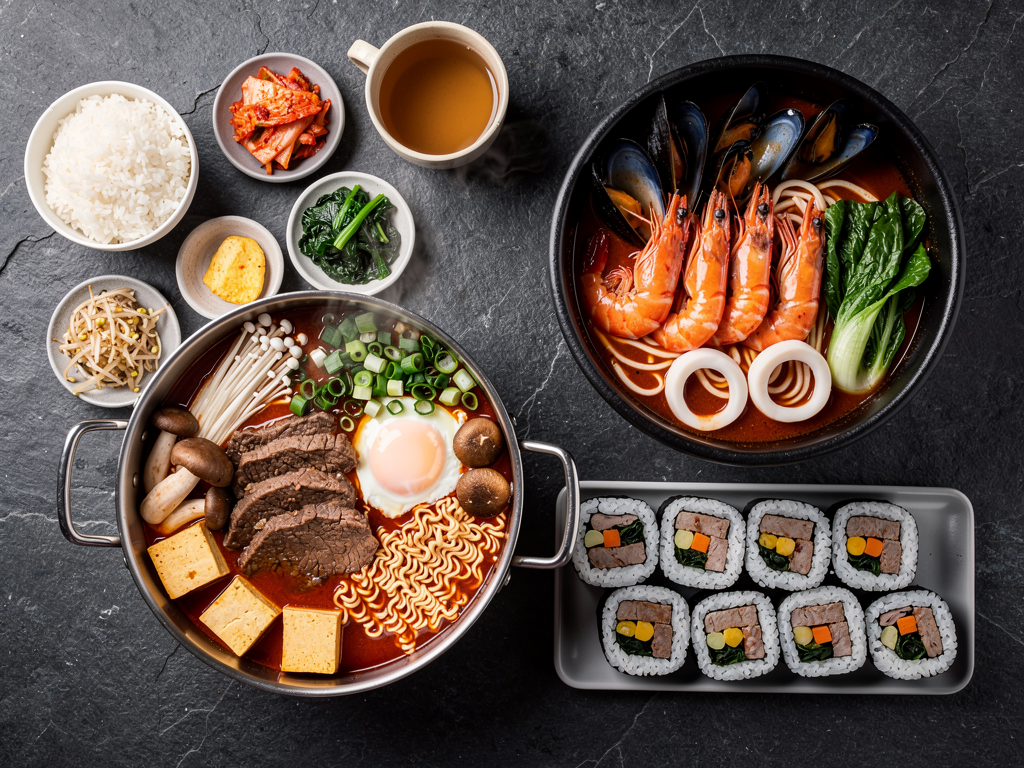
Mukbang Shows is first here because both pots are on the same menu at the same headline price, so you can run the comparison across two visits without changing anything else. Budae Jjigae is AED 99, built halal with no spam, ham or pork of any kind — beef and chicken stand in for the cured meats. Jjampong is AED 99 for the sharing size or AED 60 for the smaller one.
The rest of the stew section sits alongside them: Haemul Jeongol AED 99, Kimchi Jeongol AED 89, Soondubu Jjigae AED 59, Doenjang Jjigae AED 59. Jajangmyeon — jjampong’s black-sauce sibling — is AED 55, which is the cheapest way to understand what jjampong is reacting against. All-you-can-eat Korean BBQ runs from AED 69 at the value branches.
The Deira branch is on Al Ittihad Road in Port Saeed (+971-4-886-4494). The others are JBR, Plaza Level of Bahar 3 on The Walk (+971-54-523-1898); Love Mukbang at DWTC, opposite the World Trade Centre metro station on Sheikh Zayed Road (+971-54-524-5904); Muroor Road, Abu Dhabi (+971-50-158-9433); and Electra Street, Abu Dhabi (+971-2-564-0446).
The honest limitations, and there are two. Because the budae jjigae is halal-built, it does not taste like the Korean original and is not trying to — spam, ham and hot dogs bring a salty, cured, faintly synthetic flavour that beef and chicken do not replicate. The halal version is cleaner, meatier and less salty. Plenty of people prefer it; someone who grew up on the Uijeongbu original will notice immediately. And on the jjampong side, this is a Korean BBQ house rather than a dedicated Korean-Chinese kitchen, so the wok char a jjampong specialist chases is not the headline skill of the room.
Mannaland in Al Hudaiba is one of Dubai’s long-standing Korean kitchens and the most reliable place to eat both categories in the same week — stews and noodle bowls are both core menu, at roughly AED 150–200 for two. It is an old-school room with old-school pacing rather than a group-dinner venue.
HYU in JLT Cluster O is a small alcohol-free family-run room, trusted by Dubai’s Korean community since 2010, and the kind of kitchen where a stew is cooked as a stew rather than as a menu obligation. Around AED 150–200 for two. Small room, queues at peak, no tabletop grill; confirm halal meat sourcing directly.
Seoul Garden in Al Karama does the hot-pot-and-grill combination at around AED 170 for two — a sensible middle option if you want the shared burner without a premium bill. Busy and functional; confirm halal status directly.
The Korean Restaurant (Hanok) in International City is the Korean-Chinese pick. This is where residents go for jjajangmyeon and jjampong specifically, which makes it the stronger choice if jjampong is the actual goal rather than the comparison. Around AED 150 for two. No unlimited BBQ, and International City is a trek from most of Dubai.
Sonamu at the Asiana Hotel in Deira brings hotel polish to the classic stews and is the most comfortable room on this list for a long shared pot. Roughly AED 180–260 for two — well above the casual rooms for the same dishes. It sits inside a hotel, so confirm halal status and whether the venue is licensed before booking.
Korean Bowl in Al Danah is the Abu Dhabi answer for a straightforward bowl or pot with no grill session attached. It is on Al Widih Street behind the Millennium Hotel (02-675-2562) and rates 4.7 with diners. Short menu, so confirm what is running on the day.
Time Out Dubai’s Korean restaurant list is a reasonable wider view, and the full Mukbang menu lists both dishes with current prices.
Price and format comparison
| Venue | Area | Price | Halal status | Best for |
|---|---|---|---|---|
| Mukbang Shows | Deira, JBR, DWTC, Muroor, Electra | AED 99 either; jjampong AED 60 small | 100% halal, beef and chicken only | Comparing both, and groups |
| Mannaland | Al Hudaiba, Dubai | ~AED 150–200 for two | Confirm directly | Eating both across one week |
| HYU | JLT Cluster O, Dubai | ~AED 150–200 for two | Alcohol-free; confirm sourcing | Broth quality over theatre |
| Seoul Garden | Al Karama, Dubai | ~AED 170 for two | Confirm directly | Mid-price shared burner |
| The Korean Restaurant (Hanok) | International City, Dubai | ~AED 150 for two | Confirm directly | Jjampong specifically |
| Sonamu | Deira, Dubai | ~AED 180–260 for two | Confirm directly | A comfortable long dinner |
| Korean Bowl | Al Danah, Abu Dhabi | Casual sit-down | Confirm directly | Abu Dhabi, no grill |
Across the UAE a sharing-size budae jjigae runs roughly AED 75–120 at casual Korean restaurants and more inside hotels, while a bowl of jjampong runs roughly AED 45–75 because it is one person’s meal. That is the whole value story: per head, the stew gets cheaper the more people you bring, and the bowl does not change.
Ordering tips that actually help
Tell the kitchen how many are sharing the budae jjigae. Sharing sizes vary between venues, and a pot built for three is a lot of food for two.
Order rice with the stew. The broth at the bottom of the pot is the best part of it, and it is designed to be eaten over rice rather than drunk.
Eat jjampong straight away. The noodles keep absorbing broth in the bowl and go soft within about ten minutes, which is why it is a dish you order when you are ready to eat rather than as a first course.
Do not order one of each for two people. Between a sharing pot and a full bowl that is far too much food, and the stew is the one that will still be sitting there.
If halal sourcing is your reason for asking, ask about the broth rather than the dish. For budae jjigae, ask what replaces the processed meat; for jjampong, ask what the stock is made from.
FAQ
Are budae jjigae and jjampong the same kind of dish?
No. Budae jjigae is a jjigae — a Korean stew, shared from a communal pot cooked at the table. Jjampong is a Korean-Chinese noodle soup served in one bowl per person. They share a red colour and a chilli hit, and little else.
Which one is cheaper in the UAE?
It depends entirely on how many people are eating. A bowl of jjampong is cheaper than a sharing pot of budae jjigae, but a single stew split three ways works out cheaper per head than three separate bowls.
Which one is spicier?
Jjampong is sharper immediately; budae jjigae gets hotter as the pot reduces on the burner. By the end of a long meal, the stew often overtakes it.
Does jjampong contain pork?
The headline ingredients are seafood, so usually not — but pork stock and pork-filled dumplings do appear in Korean-Chinese kitchens, so the broth is the thing to ask about rather than the seafood.
Is the halal version of budae jjigae any good?
It is a different dish, honestly. Beef and chicken give a cleaner, meatier, less salty result than spam and hot dogs. Some people prefer it; anyone chasing the original cured-meat flavour will notice what is missing.
Can one person eat a budae jjigae?
Physically yes, but it is built for sharing, and the ten-to-fifteen minute table cook makes it an odd solo order. Jjampong is the dish for eating alone.
Can you order both at the same restaurant?
At Mukbang Shows, yes — both are on the menu at AED 99. Most other rooms lean towards one style or the other, so you will usually be picking per visit.
Budae jjigae vs jjampong really is a question about your table, not your palate. Count the heads, decide whether you want dinner to be an event or a meal, and the menu answers itself.
Related guides
More from our Korean food guides across the UAE: