Updated: September 2026
Mandu vs momos compares two dumplings that travelled the same road out of China and landed on very different menus. In the UAE, a momo is sold by its finish: steamed, fried, kothey, jhol, chilli, tandoori. A mandu is sold by its cooking and its pot: fried or steamed, then soup, hot pot or casserole. A plate of ten momos costs AED 20–51; a Korean mandu plate costs AED 35–48.
Quick answer
- Same family: wheat-wrapper dumplings that reached Nepal, Tibet and Korea from China during the Mongol era.
- Different dip: momos come with achar or chutney; mandu with a soy-based dip.
- Different menu grid: momo menus multiply filling by finish (up to ten finishes); mandu menus offer fried or steamed, then a soup or a pot.
- Halal: Mukbang Shows’ menu is 100% halal, with no pork and no alcohol; for every momo counter below, confirm directly.
What is the difference between mandu vs momos?
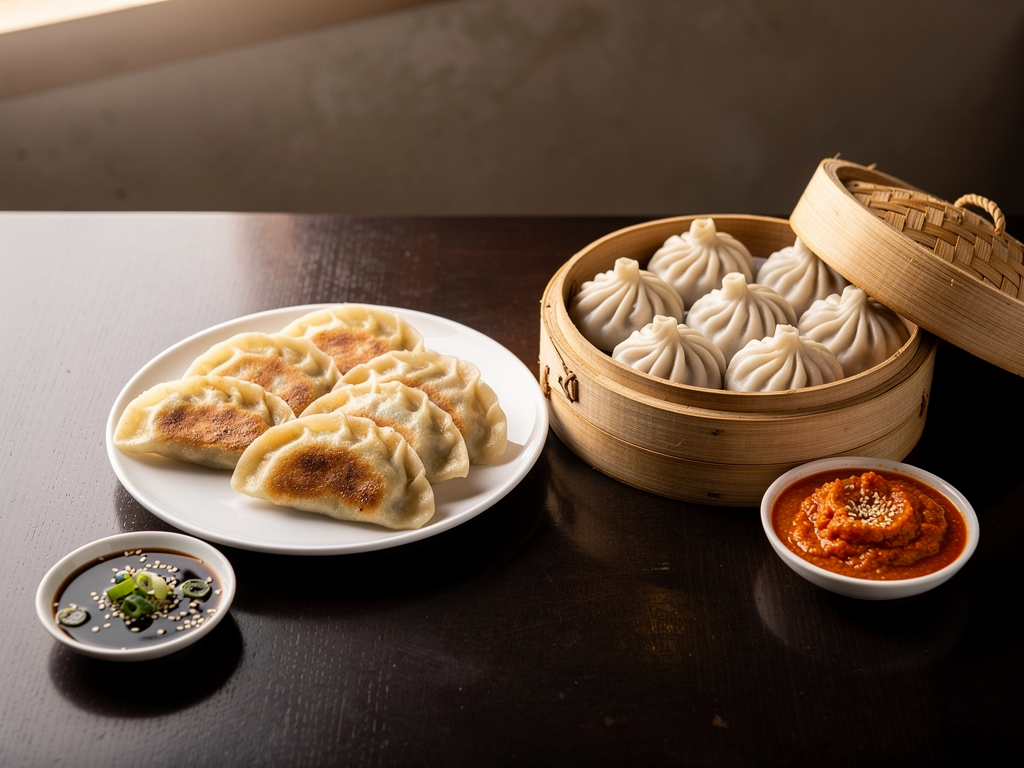
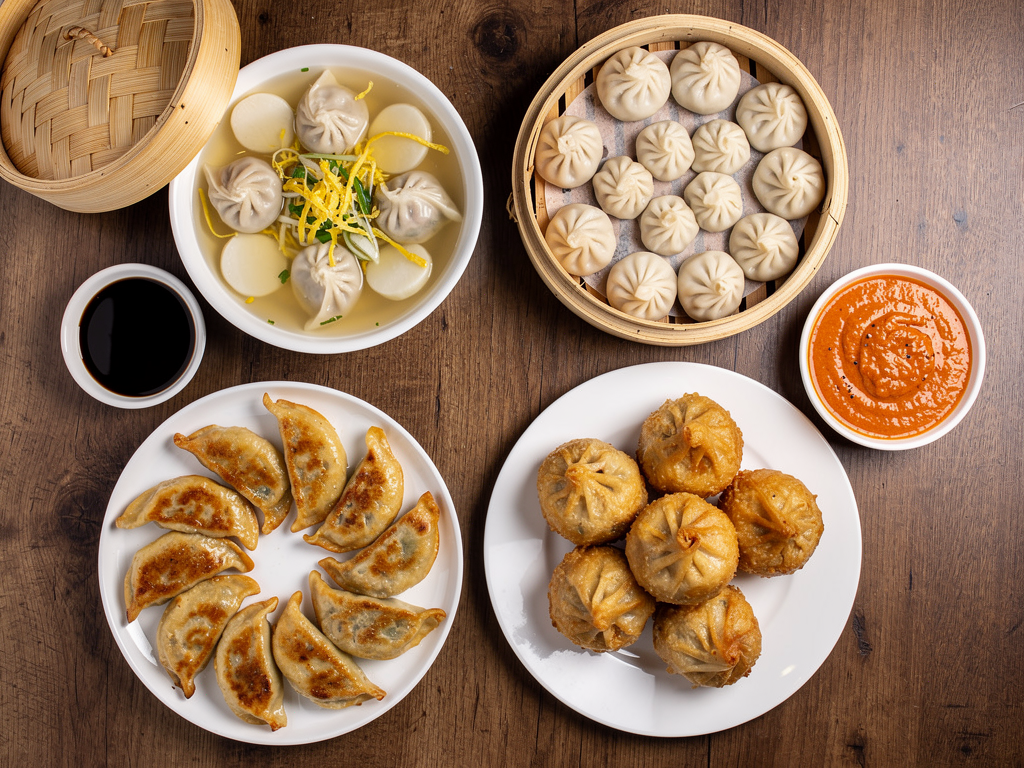
The difference is what happens after the dumpling is made. A momo is a Nepalese and Tibetan steamed dumpling, served with achar or chutney and then “finished” in a dozen ways: pan-fried as kothey, dropped into a spiced soup as jhol, tossed in chilli sauce as C-momo, or given an Indian twist such as tandoori or butter chicken. Mandu is a Korean dumpling that is steamed, boiled, pan-fried or deep-fried, then eaten on its own or cooked into a broth, a hot pot or a casserole.
On a UAE menu this shows up clearly. A momo counter prints a grid, with filling down one side and finish across the top. A Korean menu prints mandu once, then puts the same dumpling into soups and pots further down the page.
Did mandu and momos come from the same place?
Very likely, yes. Wikipedia says dumplings “were brought from China by the Mongols in the 13th century” to the Himalayas, and that mandu was “first brought to Korea from the Yuan dynasty in the 14th century”, the Mongol dynasty in China. Wikipedia’s momo entry lists mandu among its similar dishes.
The clearest proof is in the pan. Kothey momo comes from the Chinese guotie, “first steamed, then fried”. Gun-mandu (군만두) is the Korean pan-fried dumpling, from guun-mandu, “panned” dumplings. They are the same technique written in two alphabets.
The origin of the momo itself is still argued between Tibet and Nepal. Gulf News on the momo’s Himalayan story calls it “debatable”, and one theory credits Newar merchants trading in Lhasa with carrying the recipe home. Mandu, meanwhile, was royal court food in Korea before it became street food at pojangmacha stalls and bunsik snack bars. That is exactly where Mukbang files it on its menu, under Korean Street Food (분식).
How do the dips and sauces differ?
In the mandu vs momos question, the dip is where the two dumplings split most. Wikipedia says momos are “usually served with a dipping sauce known as achar or chutney”, and in Nepal these are tomato-based or made from sesame, peanut or soybean. UAE menus print the same range: Dallo Momo serves “Nepali chutney”, Darjeeling Cafe serves “chilli and peanut sauce”, and Wow Momo serves “schezwan chutney and chilli oil”.
Mandu is usually eaten with a soy-based dip. Kimchi mandu carries its heat inside instead, since the kimchi in the filling “gives it a spicier taste”.
If you want the pickle side of that story, our kimchi vs achar comparison covers why kimchi is a dish and achar a condiment.
What are jhol, kothey and C-momo?
These are the momo finishes you will see on every Dubai menu:
- Steam: the plain dumpling with chutney on the side.
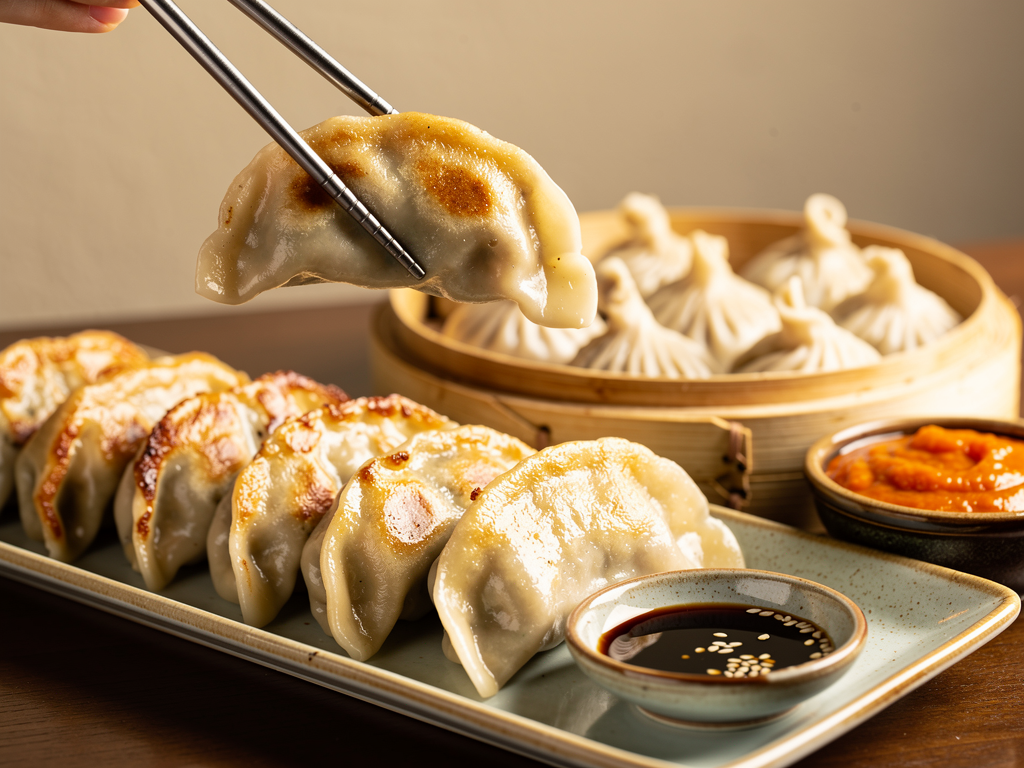
- Kothey (kothy, kothe): steamed, then pan-fried, the momo’s gun-mandu.
- Fried: deep-fried whole.
- Jhol: served in a thin, spiced soup instead of a dip. Wikipedia notes jhol “may be sesame- or tomato-based”.
- Chiso jhol: a cold version. Dallo Momo describes its cold white soup as “made with sesame seeds, peanuts, and soybeans”.
- C-momo / chilli momo: “steamed or fried, then served in chili sauce”.
- Indian finishes: Darjeeling Cafe sells Tandoori, Afghani, Mallai, Manchurian and Kurkure styles, and Wow Momo prints Butter Chicken Momo and Tandoori Chicken Momo.
Darjeeling Cafe prints the finish as a paid add-on, “not extra momo but its an addon to the same momo ordered”: fried +AED 3, kothey +7, chilli, Manchurian or tandoori +10, schezwan +12. No Korean menu read sells a mandu that way.
Where can you order momos in Dubai and Abu Dhabi?
Five momo menus were read in full for this guide on 25 September 2026. Delivery-app prices are labelled as such.
Variety Momo Restaurant & Cafe, Al Fahidi / Meena Bazaar, Bur Dubai. Its Talabat listing prints chicken momos at 10 pieces for AED 20 steamed, 23 kothey or fried, 24 chilli or jhol and 26 schezwan, plus a 20-piece mixed platter at AED 58. Its own site prints lower dine-in prices (steam AED 14–16) without piece counts. Fillings are veg, chicken, buff and paneer.
Dallo Momo Restaurant, International City. On Deliveroo it prints 10 pieces of chicken steam momo at AED 31, kothey 33, hot jhol 35, and the cold chiso jhol at AED 45. A platter of six styles, two pieces each, is AED 51.
Darjeeling Cafe, Karama. On Deliveroo it prints chicken momos at AED 22 for six and AED 40 for ten, veg at 20 and 38, mutton at 26 and 45, and prawn at 27. A jhol momo (six pieces “with veg and noodles”) is AED 34, and finishes are priced as add-ons.
Wow Momo, IMPZ. Its Talabat list prices run from chicken steam at AED 39 to tandoori chicken at 52, with platters at 39 for six and 63 for twelve. A 50% promotion was showing on every line when read, so check the live price.
Momo Station Cafe, Al Danah, Abu Dhabi. Its own site prints chicken momos at AED 14 steamed, 15 kothey, 18 fried and 20 jhol or Manchurian, with veg from AED 12, and says “free soup included”.
Where can you order mandu in Dubai and Abu Dhabi?
Mandu is on most Korean menus in the UAE, usually once as a plate and again inside a soup or pot. Four menus were read.
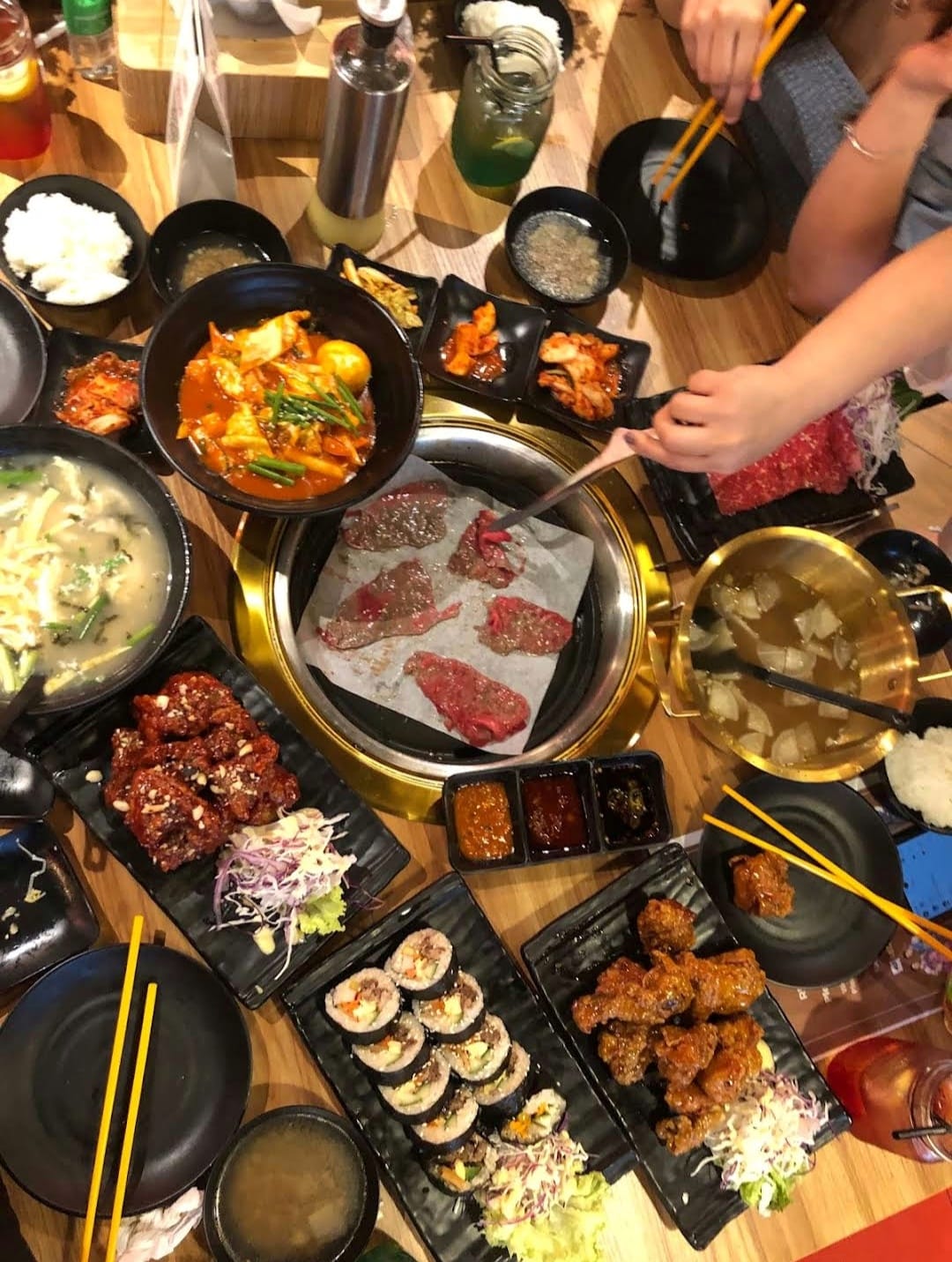
Mukbang Shows prints “Mandu — fried or steamed. Kimchi, vegetable, beef, chicken or seafood” at AED 48, in its Korean Street Food section, at Deira, JBR and DWTC in Dubai and on Muroor Road and Electra Street in Abu Dhabi. The same dumplings go into Tteok Mandu Guk, rice cake and dumpling soup, at AED 59. Plain Tteokguk is AED 51, so the dumplings add AED 8 to the soup. For the full dish breakdown, see our mandu explainer.
The Korean Restaurant (Hanok), International City, prints Kimchi Mandu and Leek Mandu at AED 35 each, pan-fried “with sauce”, and a Mando Hot Pot at AED 90 regular or 110 large.
Mannaland, Al Nahyan, Abu Dhabi, prints Tteok Manduguk at AED 58 and a Mandu Jeongol, dumplings cooked in casserole, at AED 78 regular or 147 large.
Nuri Grill & Bar, Hilton Yas Island, Abu Dhabi, is the only Korean menu read that prints a piece count: fried or steamed dumplings, 5 pieces for AED 70. The line is printed “Beef/Pork”, and Nuri is a licensed venue (alcohol served).
More options by city are in our guide to mandu in Dubai and our guide to mandu in Abu Dhabi.
How do mandu vs momos prices compare in the UAE?
Momos are cheaper on almost every menu read. Momo counters print piece counts and Korean kitchens mostly do not, so you can see exactly what you are paying per dumpling on one side only.
| Venue | Dish | Pieces printed | Price (AED) | Per piece |
|---|---|---|---|---|
| Momo Station Cafe, Abu Dhabi | Chicken steam momo (free soup) | not printed | 14 | — |
| Variety Momo, Bur Dubai | Chicken steam momo | 10 | 20 (Talabat) | 2.00 |
| Darjeeling Cafe, Karama | Chicken momo | 6 · 10 | 22 · 40 (Deliveroo) | 3.67 · 4.00 |
| Dallo Momo, International City | Chicken steam momo | 10 | 31 (Deliveroo) | 3.10 |
| Wow Momo, IMPZ | Chicken platter | 6 · 12 | 39 · 63 (Talabat list) | 6.50 · 5.25 |
| Hanok, International City | Kimchi or Leek Mandu | not printed | 35 | — |
| Mukbang Shows | Mandu, fried or steamed | not printed | 48 | — |
| Nuri, Yas Island | Fried or steamed dumplings | 5 | 70 | 14.00 |
Two quirks stand out. At Darjeeling Cafe the ten-piece plate is dearer per piece than the six. At Wow Momo the twelve-piece platter is cheaper per piece than the six. For context, Gulf News put a six-piece plate at Dh18–20 in December 2021.
The honest maths: Mukbang’s AED 48 mandu costs the same as 2.4 Variety ten-piece plates or about 1.5 Dallo plates.
Mandu vs momos in soup: jhol momo or mandu guk?
They are different kinds of soup. In jhol momo the soup is the sauce: a thin, spiced, often tomato- or sesame-based liquid poured over the dumplings instead of a dip. Variety’s chicken jhol is AED 24 for ten pieces, Dallo’s hot jhol AED 35 and its cold chiso jhol AED 45, and Momo Station’s jhol AED 20.
In mandu guk the soup is a broth. Wikipedia describes manduguk as “made with mandu in beef broth”, and the Korean versions add sliced rice cakes: Mukbang’s Tteok Mandu Guk is AED 59 and Mannaland’s Tteok Manduguk AED 58. From there Korean menus keep climbing in pot size, to Hanok’s Mando Hot Pot (90/110) and Mannaland’s Mandu Jeongol (78/147). No momo menu read sells a momo hot pot. The nearest is momo thukpa, a noodle soup with momos, at Variety for AED 28.
Are mandu vs momos halal in the UAE?
Mukbang’s mandu is halal by menu design. The live menu states “100% Halal”, the kitchen’s meats are beef and chicken, seafood is also served, and there is no pork and no alcohol. Its mandu fillings are kimchi, vegetable, beef, chicken or seafood.
For momos, read the printed filling and then confirm directly. The UAE momo menus read for this guide print chicken, vegetable, paneer, cheese, mutton, prawn, soya, mushroom and buff. Buff is water-buffalo meat, a traditional momo filling in Nepal and Tibet. Wikipedia notes pork is also a common momo filling in Nepal, Tibet, Sikkim and Bhutan, but none of the five UAE momo menus read prints a pork line. On the Korean side, Nuri on Yas Island prints its dumplings as “Beef/Pork”.
None of this is a certification. Ask the kitchen.
Are momos Indian or Nepali?
Both, in practice. Wikipedia describes momos as Nepalese and Tibetan, “also popular in neighbouring Bangladesh, Bhutan, and India”, and notes that on the Indo-Gangetic Plains chicken became the most common meat and vegetable momos appeared “to feed the large population of vegetarian Hindus”. UAE menus reflect that mix. Dallo and Momo Station cook the Nepali and Darjeeling styles, while Darjeeling Cafe’s Tandoori and Mallai finishes and Wow Momo’s Butter Chicken Momo are Indian street-food takes.
That is why this page sits under our Korean food vs Indian food guide, next to the other dumpling pairs.
Which should you order: mandu or momos?
Order momos if you want a cheap, fast plate of ten, a choice of finishes, a spicy chutney, or a jhol soup. Variety’s AED 20 plate on Talabat and Momo Station’s AED 14 plate with free soup are the cheapest. Dallo’s cold chiso jhol is the one to try if you have never had it.
Order mandu if you want a dumpling with a kimchi filling option, a soy dip, a dumpling-and-rice-cake soup, or a dumpling as one dish on a larger Korean table. Mukbang’s AED 48 plate offers five fillings, fried or steamed, and sits beside unlimited beef and chicken Korean BBQ from AED 69 a person.
The honest limitation: Mukbang sells no momos, no jhol, no chilli momo, no tandoori finish and no achar or chutney. Its mandu also costs more per plate, at AED 48 with no piece count, against a ten-piece momo plate at AED 20–31. For a cheap snack of ten dumplings in a spicy sauce, a momo counter is the better choice.
Readers comparing more dumplings can go on to our mandu vs dim sum comparison, our mandu vs gyoza comparison or our mandu vs sambousek comparison. For the history of each dish, start with the encyclopaedia entry on momo and the encyclopaedia entry on mandu.
Mandu vs momos at a glance
| Mandu (만두) | Momos | |
|---|---|---|
| From | Korea, via the Yuan dynasty, 14th century | Nepal and Tibet, via the Mongols, 13th century |
| Cooked | steamed, boiled, pan-fried or deep-fried | steamed first, then finished |
| Pan-fried version | gun-mandu | kothey |
| Dip | soy-based | achar or chutney: tomato, sesame, peanut, soybean |
| In soup | manduguk in beef broth; hot pot; casserole | jhol, hot or cold; momo thukpa |
| UAE fillings read | kimchi, vegetable, beef, chicken, seafood (Mukbang) | chicken, veg, paneer, cheese, mutton, prawn, buff |
| UAE plate price read | AED 35–48; 70 for five at a hotel | AED 12–22 Abu Dhabi café; AED 20–51 for ten in Dubai |
FAQ
Is mandu the same as momo?
No, but they are close relatives. Both are wheat-wrapper dumplings that came from China during the Mongol era. Momos are Nepalese and Tibetan and are served with achar or chutney in many finishes; mandu is Korean and is served with a soy dip, or in soups and hot pots.
What is the Korean version of kothey momo?
Gun-mandu, the pan-fried mandu. Kothey comes from the Chinese guotie and is steamed and then fried, and gun-mandu is the Korean pan-fried dumpling, so the technique is the same.
How much are momos in Dubai?
On menus read in September 2026, ten chicken momos cost AED 20 at Variety Momo on Talabat, AED 31 at Dallo Momo on Deliveroo and AED 40 at Darjeeling Cafe, which also sells six for AED 22. In Abu Dhabi, Momo Station Cafe prints chicken momos from AED 14 with free soup.
How much is mandu in Dubai and Abu Dhabi?
Mandu is AED 48 at Mukbang Shows and AED 35 at The Korean Restaurant (Hanok) in International City. Tteok mandu guk is AED 59 at Mukbang and AED 58 at Mannaland in Abu Dhabi.
What is buff momo?
Buff momo is filled with water-buffalo meat, a traditional filling in Nepal and Tibet. Several UAE momo menus print it alongside chicken, vegetable and paneer.
Is the mandu at Mukbang Shows halal?
Yes. Mukbang Shows’ menu is 100% halal, with beef and chicken as its meats, seafood also served, no pork and no alcohol. Its mandu comes fried or steamed with kimchi, vegetable, beef, chicken or seafood filling.
Does Mukbang Shows serve momos?
No. Mukbang Shows is a Korean restaurant and serves mandu, not momos. For momos, try a Nepali or Indian momo counter such as Variety Momo, Dallo Momo, Darjeeling Cafe or Momo Station Cafe, and confirm the filling directly.