Updated: September 2026
Jjigae (찌개) is the Korean stew: thicker, saltier and more concentrated than a soup, cooked and served bubbling in an earthenware pot, and put in the middle of the table to be shared with rice. If you are asking what is jjigae after reading a UAE menu that files kimchi jjigae under “Soup” and a hot pot for four under “Stew”, the answer is in the weight of the pot — a guk is a personal soup, a jjigae is a shared stew, a jeongol is a pan still cooking on a burner. This page explains the category, the naming rule and the pot, then reads nine UAE menus for what a jjigae costs.
TL;DR
– Jjigae = a thick, strongly seasoned stew, half solids, shared with rice.
– Between guk (thin, personal) and jeongol (a pan simmered at the table).
– Named by main ingredient (kimchi, sundubu, budae) or seasoning (doenjang, gochujang).
– UAE single pot: AED 43 (The Skewers) to AED 87 (HYU beef, delivery); most AED 50–60.
– Mukbang Shows’ four stews are beef and chicken by design — not the cheapest, not the widest.
What is jjigae in Korean food?
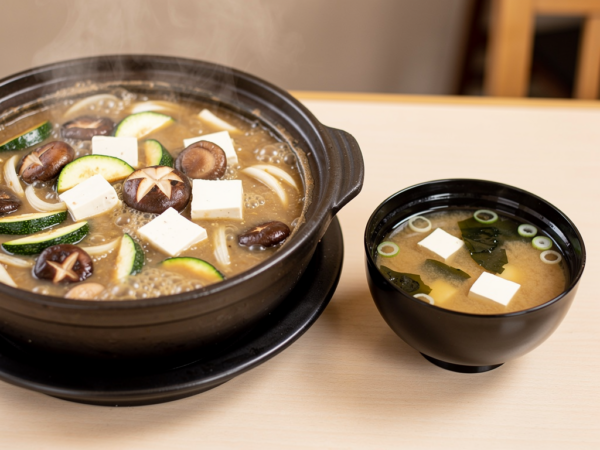
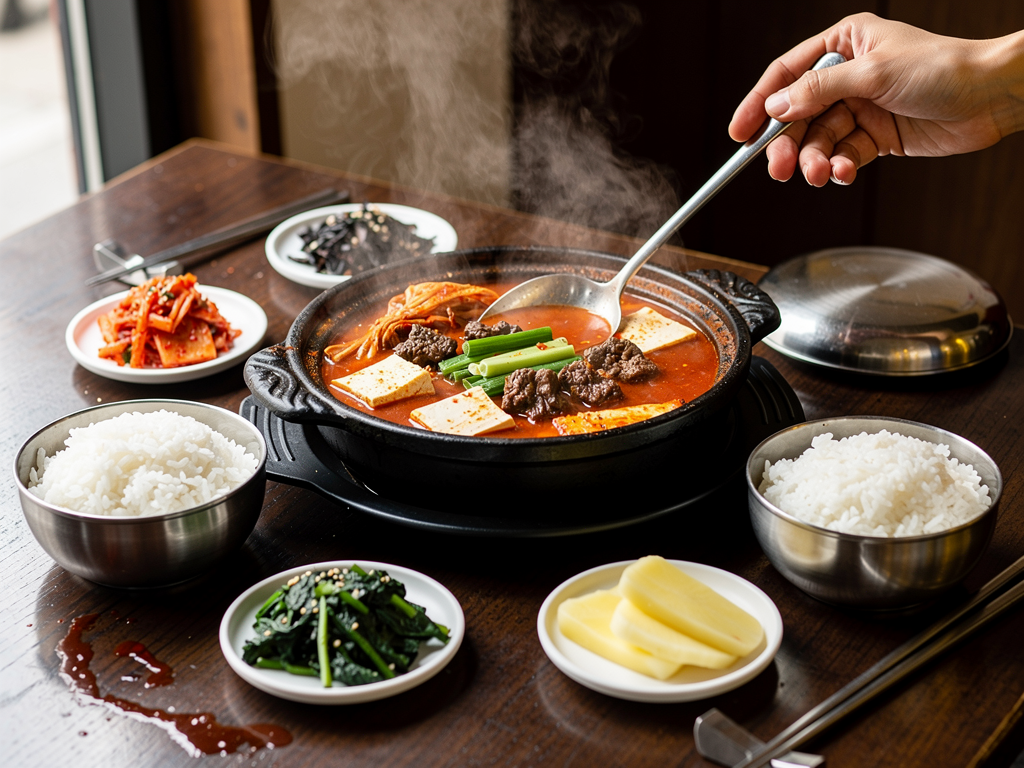
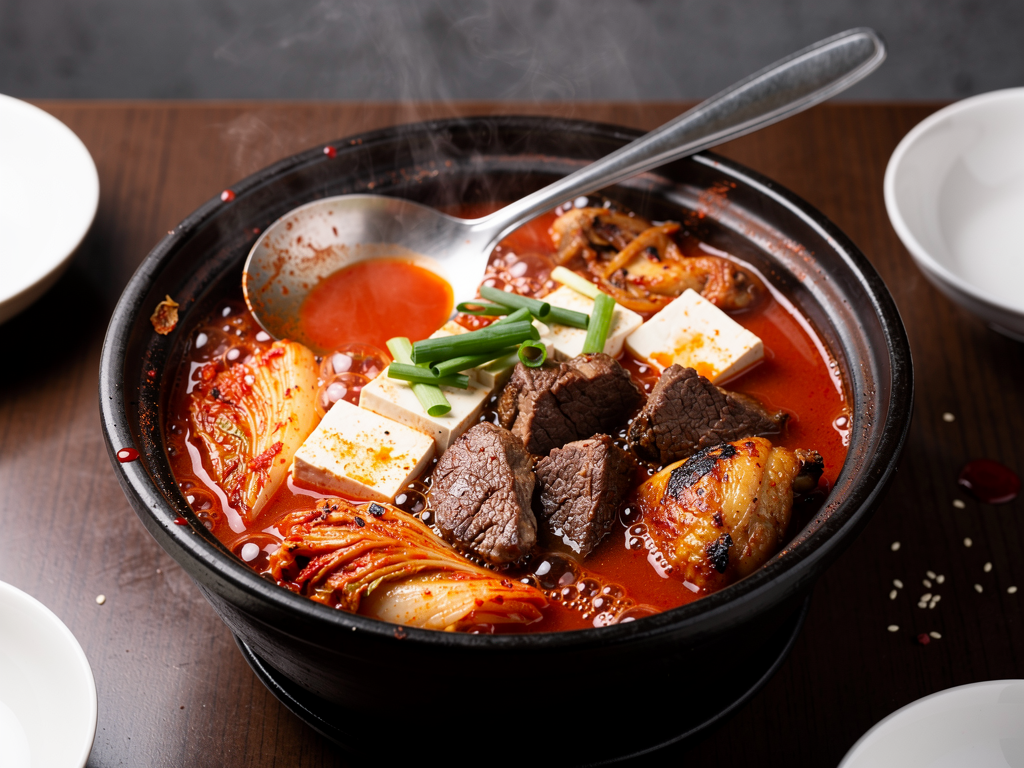
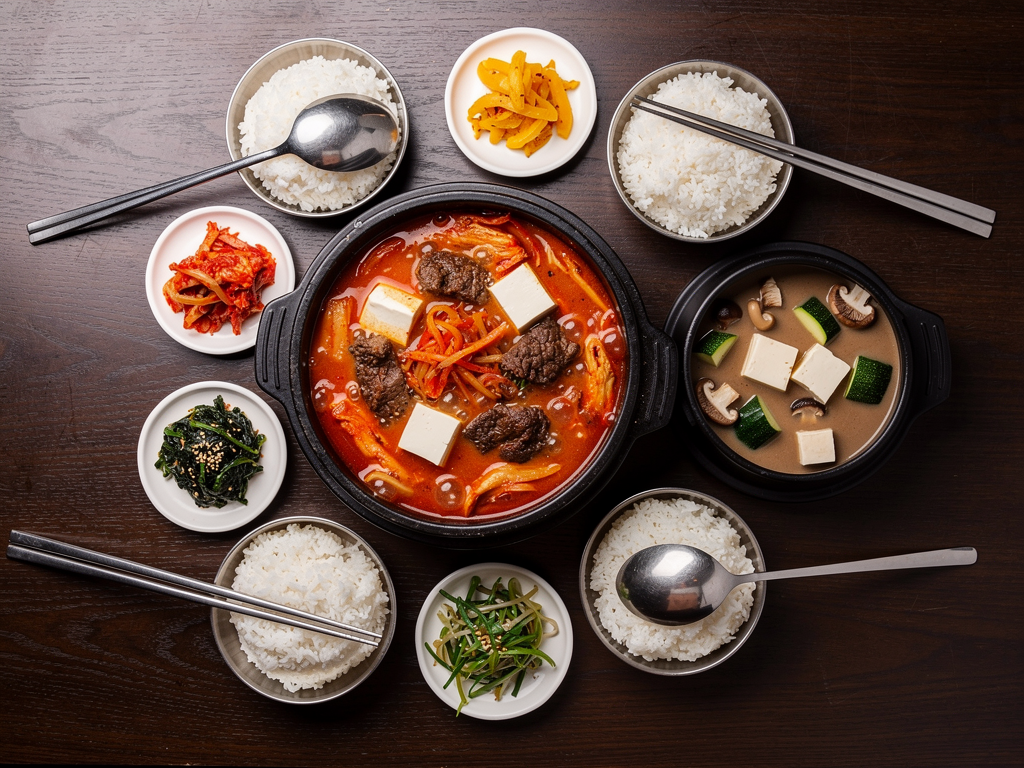
The one-line answer to what is jjigae: the Korean stew. Meat, seafood or vegetables sit in a small amount of strongly seasoned broth — roughly half solids, half liquid — and the whole thing is cooked and served in a ttukbaegi, the black earthenware pot that goes from flame to table and keeps the stew at a boil for minutes after it lands. Everyone spoons from the pot onto their own rice.
The encyclopaedia entry on jjigae puts the two defining facts plainly: jjigae are “often served as a communal dish”, and “compared to jeongol, which primarily consists of broth or stock, jjigae have less liquid (roughly half solid ingredients) and have stronger seasoning”. The seasoning is one of four fermented bases — gochujang (chilli paste), doenjang (soybean paste), ganjang (soy sauce) or saeu-jeot (salted shrimp).
It is old. In the Joseon dynasty the dish “was known as jochi, and two varieties would always be present on the King’s surasang” — the royal table. The everyday version is the same idea at home: one pot, one flame, everyone’s spoon.
How is jjigae different from guk and jeongol?
This is the distinction that matters at the table, and the real reason people search what is jjigae. Korean has three words for a hot pot of things, and the word tells you the bowl, who eats it and roughly what it costs.
Guk (국) and tang (탕) are soups: thin, light, served per person in a small bowl beside rice. Our guk and tang explainer covers them. Jjigae is the middle weight: less water, more solids, saltier, in a ttukbaegi, shared. Jeongol (전골) is the top: a wide, shallow pan of raw ingredients simmered on a burner at the table, seasoned from the start and mostly broth — see our jeongol explainer.
The rule of thumb for any UAE menu: guk or tang is mine, jjigae is ours, jeongol is ours and still cooking.
| Word | What it is | Pot | Who eats it | UAE price band (Sept 2026) |
|---|---|---|---|---|
| Guk / tang 국 · 탕 | thin personal soup | small bowl, beside rice | one person | AED 49–85 |
| Jjigae 찌개 | thick stew, half solids | earthenware ttukbaegi | shared, with rice | AED 43–87 solo |
| Jeongol 전골 | pan simmered at the table | wide shallow pan on a burner | two or more | AED 78–270 |
One UAE menu draws the jjigae-versus-jeongol line inside a single item. Mukbang Shows prints its kimchi stew as Kimchi Jeongol AED 89 / 50 — the same kimchi-and-beef stew as a shared table pot at 89 or a solo ttukbaegi portion at 50. Order the 50 and you have a jjigae; order the 89 and it is a jeongol. No other menu read for this page makes the boundary that visible.
How is a jjigae named?
By one of two things: the main ingredient or the seasoning base. The ttukbaegi is the constant; the name tells you what is in it.
Named by main ingredient: kimchi jjigae (aged kimchi), sundubu jjigae (soft tofu), dubu jjigae (firm tofu), budae jjigae (“army base” stew — sausage, ham, beans, ramyeon in its canonical form), biji jjigae (soy pulp), ge jjigae (crab), altang (pollock roe).
Named by seasoning: doenjang jjigae (soybean paste), gochujang jjigae (chilli paste), cheonggukjang jjigae (fast-fermented, strong-smelling soybean paste), saeujeot jjigae (salted shrimp).
Four of these are the whole UAE market, and the portal explains each on its own page: the kimchi jjigae explainer, the doenjang jjigae explainer, the soondubu jjigae explainer and the budae jjigae explainer. This page does not repeat them. It is the parent: what the word means, how to tell the family apart, and what it costs here.
Why does the UAE menu make what is jjigae so confusing?
Because the word “stew” disappears in translation and every kitchen then files its jjigae wherever it likes. Nine menus were read live on 18 September 2026, and no two file the same way.
Koreana in Al Barsha 1 is the only Dubai listing found with a section literally headed “Korean Stew
HYU in Jumeirah Lake Towers does the opposite: every jjigae sits under one heading called “Soup” and is translated that way — “Kimchi Jjigae (Kimchi Soup with Tofu)” AED 67, “Daenjang Jjigae (Soybean Paste Soup with Veg & Tofu)” AED 67, “Soondooboo Jjigae” AED 72, “Budae-Jjigae” AED 79.99, all delivery-listing prices. Hanok, The Korean Restaurant in International City, files its jjigae under “STEW” and its hot pots under “SOUP”. Manna Land in Abu Dhabi has a four-line “STEW” section with three stews at one flat price. Mukbang Shows puts jjigae, jeongol and jjampong in one stews-and-hot-pots block.
Nine kitchens, nine filing systems. The only rule that survives all of them: read the Korean word beside the English one. If it ends in -jjigae, it is a shared stew in a pot, whatever the heading says.
What is the protein step?
The most useful thing a UAE jjigae menu prints, and only two menus print it. A jjigae is defined by its seasoning base and its pot, not by its meat — so some kitchens sell the same stew at a vegetable price and a meat price, and the gap is the printed cost of the protein.
Hanok does it for every stew: Kimchi Jjigae AED 48 (VEG) / 56 (CHICKEN / BEEF); Tofu Jjigae, Doenjang Stew and Sundubu Stew each AED 48 (VEG) / 53 (CHICKEN / BEEF); Sundubu Stew 63 (SEAFOOD). The meat is AED 5–8 on the page, the seafood AED 15. HYU does it on its delivery listing: Kimchi Jjigae 67 with tofu, 87 with beef or tuna; Daenjang Jjigae 67, or 86.98 with beef.
Why it matters beyond the arithmetic: the protein is also the halal question. The Korean default for kimchi jjigae is pork belly, and the canonical budae jjigae is spam and ham. A menu that prints the protein has answered the question; a menu that prints only “Kimchi Jjigae AED 43” — The Skewers in Abu Dhabi, the cheapest in the country — has not, and you ask.
What is the rice test?
A jjigae is eaten with rice — it is the shared wet centre of a rice meal, not a course on its own — and three UAE menus print that on the stew line. Koreana writes “Served with Rice” or “Served with Steamed White Rice” on all six jjigae. Mashisoyo in JLT West prints “Kimchi-jjigae (Served with Rice)” AED 64 on its delivery listing. Koreana goes one step further with a set it calls “JUNGSIK (MAIN + STEW)” at AED 96, listed against AED 120: one main plus one stew, which is the Korean jeongsik set meal where the stew is the side, priced on paper.
Mukbang Shows’ unlimited BBQ tiers print “Soup & steamed rice” as a line inside every tier — Gangnam AED 69 at Deira, Muroor Road and Electra Street (AED 79 at JBR and DWTC), Daegu 89 / 99, Jeju 99 / 109, Bukchon Hanok 129 everywhere. That is a soup, not a jjigae; the stews are à la carte. If a menu lists a jjigae with no rice anywhere near it, order the rice.
How much does jjigae cost in the UAE?
Between AED 43 and AED 87 for a single pot, and the ladder is orderly once you separate solo pots from sharing pots and menu prices from delivery prices.
| Venue | Where | Jjigae lines (AED) | Filed under | Source |
|---|---|---|---|---|
| The Skewers Korean BBQ | Hamdan St, Abu Dhabi | Kimchi Jjigae 43 | Soup & Stew | own site |
| The Korean Restaurant (Hanok) | International City, Dubai | Kimchi 48 veg / 56 meat · Tofu, Doenjang, Sundubu 48 veg / 53 meat · Sundubu seafood 63 | Stew | own site |
| Koreana Restaurant | Al Barsha 1, Dubai | Sundubu, Kimchi, Doenjang 50 · Biji 60 · Dangmyun 65 · Budae (chicken) 65 · Jungsik main + stew 96 | Korean Stew | Deliveroo listing |
| Mukbang Shows Restaurant | Deira, JBR, DWTC · Muroor Rd, Electra St | Kimchi Jeongol 89 / 50 solo · Soondubu 59 · Doenjang 59 · Budae 99 | Stews & hot pots | own menu |
| Manna Land | Al Nahyan, Abu Dhabi | Kimchi 58 · Deonjang 58 · Soon Tofu 58 | Stew | own site |
| Leseoul | Al Barsha 1, Dubai | Doenjang 60 | Stews | Deliveroo listing |
| Mashisoyo | JLT West, Dubai | Kimchi-jjigae 64 (served with rice) | — | Deliveroo listing |
| HYU Korean Restaurant | JLT, Dubai | Kimchi 67 / 87 beef or tuna · Daenjang 67 / 86.98 beef · Soondooboo 72 · Mandoo Bulgogi 79 · Budae 79.99 | Soup | Deliveroo listing |
| Nuri Grill Bar | Hilton Abu Dhabi Yas Island | Kimchi, Deonjang, Sundubu 80 · Budae 270 (sharing) | — | own site, VAT incl. |
Read down the middle column and the pattern is clear. The value tier is Abu Dhabi and Al Barsha: 43 at The Skewers, 48–56 at Hanok, 50 at Koreana, 58 at Manna Land, 59 at Mukbang. JLT is a delivery-priced tier at 64–87. Yas Island is the hotel tier at 80. Budae jjigae runs its own ladder because of what goes in it: 65 (Koreana, chicken), 79.99 (HYU), 99 (Mukbang), 270 (Nuri, a sharing pot).
For contrast, the shared jeongol and hot-pot tier in the same kitchens runs AED 78–158 — Manna Land’s Mandu Jeongol 78 / 147, Hanok’s hot pots 80–110, Mukbang’s Haemul Jeongol 99 — and up to 270 at Nuri. The weight rule predicts the band: a jjigae for one costs about half a jeongol for two.
Is jjigae halal?
The stew is not inherently halal or haram; it depends on the protein and the stock. The Korean default for kimchi jjigae is pork belly. The canonical budae jjigae is spam, ham and hot dogs. Doenjang and sundubu jjigae are usually built on anchovy stock, and sundubu often carries clams — seafood, not pork, and fine for most diners. The pot and the paste are never the problem; the meat is.
In the UAE none of the nine menus above prints a pork jjigae line. Nuri’s own menu lists pork cuts elsewhere on the same page and links a wine menu, so it is a licensed venue with pork on the menu, per its own site — reported as an observation, not a ruling on its kitchen. Time Out Dubai’s March 2026 Korean list labels HYU “Unlicensed” — a licence fact, not a halal certificate. For every other venue, confirm directly, and where a line does not print the protein, ask.
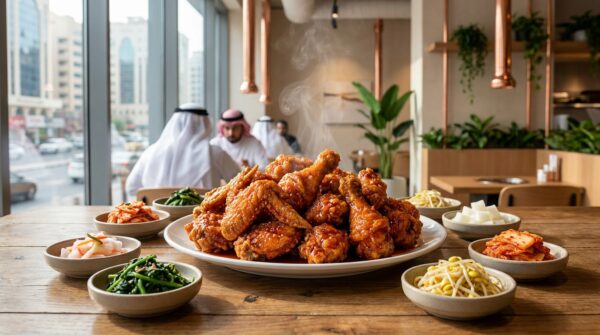
Mukbang Shows is the one kitchen in this article where the whole stew list is beef and chicken by design: Soondubu Jjigae and Doenjang Jjigae at AED 59, the kimchi stew at 50 solo or 89 shared, and a Budae Jjigae at AED 99 rebuilt on beef and chicken with no spam and no pork — the one jjigae whose original recipe is processed pork, made without it. No alcohol is served.
Where should you go for jjigae in the UAE?
This is a definition page, not a ranking — our guides to the best kimchi jjigae in Dubai and the best soondubu jjigae in Abu Dhabi do that city by city. But the nine menus divide cleanly into three jobs.
For halal certainty across the whole list, Mukbang Shows. Four stews, every one beef or chicken, the only halal-built budae jjigae found on a UAE menu, and the same prices at five branches in two cities. Deira (Al Ittihad Rd, Port Saeed, +971-4-886-4494), JBR (Plaza Level, Bahar 7, The Walk, +971-54-523-1898), DWTC (The Apartments Block A, Sheikh Zayed Rd, +971-54-524-5904), Muroor Road (547 Sultan Bin Zayed The First St, Al Danah, +971-50-158-9433) and Electra Street (Zayed The First St, behind Sun and Sand Sports, +971-2-564-0446). Minimum two people on the unlimited BBQ tiers; the AED 60 leftover charge applies to those tiers only.
The honest limitation: Mukbang is neither the cheapest nor the widest. The Skewers prints a kimchi jjigae at AED 43 and Koreana prints three at AED 50 with rice, against Mukbang’s 50 solo kimchi and 59 paste stews. Koreana’s list is six deep and Hanok prints a vegetable price for every stew; Mukbang has four stews, no vegetarian-priced version, and no tofu, biji or glass-noodle jjigae.
For the widest list or a printed vegetable price, Koreana or Hanok. Koreana in Al Barsha 1 has the only “Korean Stew
For the cheapest pot, The Skewers. Kimchi Jjigae AED 43 on Hamdan Street, Abu Dhabi, with the site printing hours of 11 AM to 3 AM every day. One stew, no printed protein — ask. Manna Land in Al Nahyan is the tidy middle at a flat AED 58 for kimchi, doenjang or soon tofu, and its menu prints the protein (“Kimchi and beef stew”).
HYU, Mashisoyo and Leseoul in JLT and Al Barsha are the delivery-listing options at 60–87; Nuri on Yas Island is the hotel tier at 80, with its sharing budae jjigae at 270 for a table.
How to read a Korean stew menu in three steps
Read the suffix. It answers what is jjigae on any menu. -guk or -tang: a personal bowl, order rice with it. -jjigae: a shared pot for the table, thick and hot. Jeongol or “hot pot”: a pan for two or more — check whether the price is per pot or per person (Mukbang prints Kimchi Jeongol at 89 big / 50 solo; Hanok prints its hot pots as R and L; Manna Land as R and L).
Ignore the English heading. “Soup” at HYU means every jjigae; “Soup” at Hanok means hot pots; “Stew” at Manna Land includes a braised short rib. The Korean word beside the English one is the reliable label.
Find the protein and the rice. If the line prints VEG / CHICKEN-BEEF, or “Kimchi and beef stew”, the halal question is answered. If it prints “Served with Rice”, the meal is complete. If it prints neither, ask both questions before the pot arrives — it will arrive boiling, and the first spoonful is always too hot.
FAQ
What does jjigae mean in Korean?
Jjigae (찌개) means stew — a thick, strongly seasoned pot with roughly half solid ingredients, cooked and served in an earthenware ttukbaegi and shared from the centre of the table with rice. In the Joseon court it was called jochi.
Is jjigae a soup?
No. A soup is guk or tang — thin, light, one bowl per person. Jjigae has less liquid, more solids and stronger seasoning, and it is shared. Many UAE menus file jjigae under “Soup” anyway, so read the Korean suffix, not the heading.
What is the difference between jjigae and jeongol?
Jeongol is a wide, shallow pan of raw ingredients simmered on a burner at the table and is mostly broth; jjigae is thicker, cooked in a pot and served already bubbling. Mukbang Shows prints the line inside one item: Kimchi Jeongol AED 89 as a shared pot, AED 50 as a solo stew.
What are the main types of jjigae?
Kimchi jjigae, doenjang jjigae, sundubu (soft tofu) jjigae and budae jjigae are the four every UAE Korean kitchen sells. Dubu (firm tofu), biji (soy pulp), dangmyun (glass noodle), gochujang and cheonggukjang jjigae exist but are rare here — Koreana in Al Barsha prints biji and dangmyun.
How much does jjigae cost in the UAE?
AED 43 (The Skewers, Abu Dhabi) to AED 87 (HYU beef or tuna kimchi jjigae, Dubai, delivery listing) for a single pot. Most kitchens sit at AED 50–60: Koreana 50, Hanok 48–56, Manna Land 58, Mukbang Shows 59. Budae jjigae runs 65–99, and 270 for a sharing pot at Nuri.
Is jjigae halal?
It depends on the protein and the stock, not the paste. The Korean default for kimchi jjigae is pork belly and the canonical budae jjigae is spam, so ask where the menu does not print the meat. Mukbang Shows’ four stews are beef and chicken only, including a budae jjigae rebuilt without spam or pork, with no alcohol served.
Does jjigae come with rice?
It is meant to be eaten with rice, and Koreana and Mashisoyo print “Served with Rice” on the stew line. Elsewhere rice is a separate order — check before the pot arrives.
Every price on this page was read from the venue’s own menu or its delivery listing on 18 September 2026 and is labelled as one or the other. Menus change; what is jjigae — the shared stew in the middle of the table — does not.